
Excerpts From Bhagavadgita Complete Translation
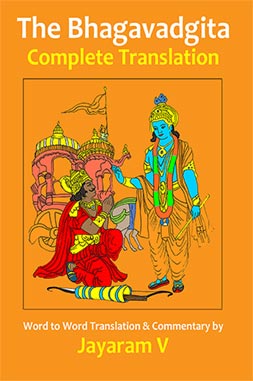
Book Details
Paperback: 874 pages
Publisher: Pure Life Vision
Edition: First
Date of Pub: 11/10/2011
Language: English
ISBN-10: 1935760041
ISBN-13: 978-1-935760-04-7
Product Dimensions: 6.14 x 9.21 in
Spine Width: 1.7292000000
Max Retail Price: $35.25
US Sale Price:
Click Here to Know
Ch.10.34, Manifestation of God as Beauty, etc.
Translation
I am the all ending death; and I am the origin of what happens in future. In women, I am fame, beauty, speech, memory intelligence, fortitude and patience.
Commentary
As far as the earthly life is concerned, death is the end of everything that a being acquires from Nature, which includes both the mind and the body. Therefore, death is rightly described here as all devouring and all ending (sarva hara). Death shares the functions of destruction and renewal with Brahman. As the Destroyer, Brahman is the ultimate cause of death and destruction in the mortal worlds. His destruction has the twin purpose of ending and beginning the cyclical nature of existence to continue the course of creation as ordained. He destroys what is undesirable and renews what is obligatory to uphold the order and regularity of the universe. In our case, He ends what we desperately try to hold on to as ours. He does it by opening our eyes to the inherent nature of our existence and the possibilities that exist beyond it. When we continue to cling to things and wallow in darkness and desires, death comes as an interruption to end our striving and craving. Imagine how oppressive life would be if there is no death for us. The life of Bhishma is a great example to know how prolonging life beyond ordinary limits can really become a source of mental torture. We are in a way blessed because our lives are limited and we do not have to suffer upon earth for too long. In death, we find a temporary respite and a great opportunity to start all over again and do things differently so that we may have a better future. In this regard also, Brahman has a role to play. He not only puts an end to things and beings, He also sows the seeds of things that are yet to come. Thus, through the process of destruction, renewal and regeneration, He makes sure that existence in various dimensions of His creation continues in an orderly manner. In His unmanifested aspect, Brahman is devoid of qualities (nirguna); but in His manifested aspect as Isvara, He reflects many divine qualities in His sattvic nature, some of which are reflected in us also. They manifest in us to the extent we purify ourselves.
We cannot realize the Self that resides within us, unless we develop some divine qualities and practice them. Lord Krishna here mentions some of the most sublime and divine qualities found in women, which are inherited by them from the Universal Mother. They are the footprints of Brahman in the Nature of things. They manifest in women to the extent they advance spiritually and fill their hearts and minds with divine thoughts. Kirti means both name and fame. Not all famous people earn a name for themselves because they sacrifice their virtue and morality to climb the ladder of success. Srih means beauty, auspiciousness, wealth and prosperity. These are the qualities of Goddess Lakshmi. The ability to speak well (vak) comes with knowledge, virtue, education, upbringing and refinement. The other qualities mentioned here are directly related to the quality of sattva. They manifest when sattva is predominant in a person.
Suggestions for Further Reading
- The Awakened Life - A Book on Spirituality
- The Bhagavadgita - A Complete Translation
- Essays on The Bhagavadgita - A Book
- Excerpts From The Bhagavadgita Complete Translation
- Brahman - A Book by Jayaram V
- Introduction to Hinduism - A Book
- Think Success: A Book on Self-help
- Being the Best by Jayaram V
- Selected Upanishads
- Brihadaranyaka Upanishad
- Chandogya Upanishad
- Thoughts and Quotations
- Essays On Dharma
- Esoteric Mystic Hinduism
- Introduction to Hinduism
- Hindu Way of Life
- Essays On Karma
- Hindu Rites and Rituals
- The Origin of The Sanskrit Language
- Symbolism in Hinduism
- Essays on The Upanishads
- Concepts of Hinduism
- Essays on Atman
- Hindu Festivals
- Spiritual Practice
- Right Living
- Yoga of Sorrow
- Happiness
- Mental Health
- Concepts of Buddhism
- General Essays