
The Birth Of The Buddha in The Canonical Accounts
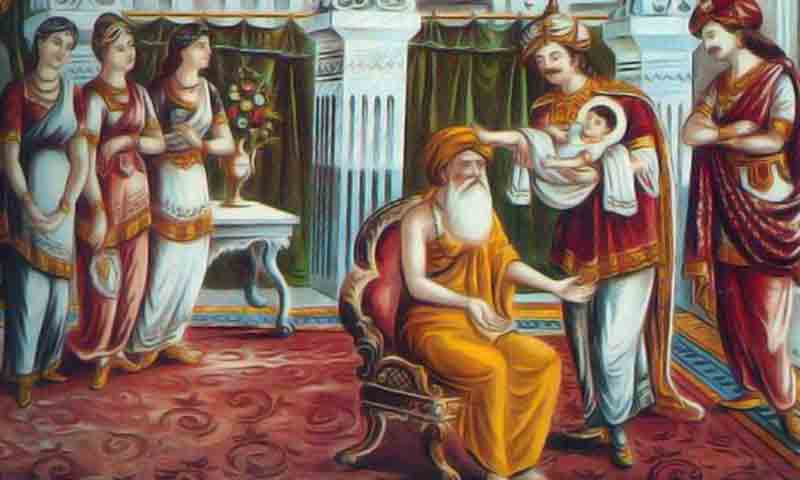
The miraculous birth of the Buddha
(Majjhima Nikâya, Sutta 123.)
THERE are two canonical accounts of the wonderful circumstances attending the birth of Gotama, viz., the Nâlaka Sutta in the Sutta Nipâta, which was translated by Dr. Fausböll in 1881 (Sacred Books of the East, Vol. X., part 2, p. 124) and the Dialogue in the Middling Collection, now translated for the first time. This was first pointed out by Oldenberg in 1881, in his Life of Buddha, where he gave us one or two details concerning it (Oldenberg's Buddha, English translation, 1882, p. 417).
In 1894, Chalmers gave an account of it in the Journal of the Royal Asiatic Society, and the Pâli text was printed by him in the same learned Journal for October, 1895. It is from this text that our translation is made, except that in some doubtful readings I have compared the version of the King of Siam, which has lately been distributed throughout the United States.
An uncanonical account of Gotama's birth (apart from the inevitable commentary on our present text) is to be found in the Commentary on the Birth Stories. This account has been twice translated: by Rhys Davids in 1880 (Buddhist Birth Stories), and by Henry C. Warren in 1896 (Buddhism in Translations, p. 38). It is based upon our present Sutta and the one in the Sutta Nipâta. The portion based upon the latter is given by Warren at p. 48. As in the case of the Haggadah of the Hebrews, it was reckoned quite fair among the ancient Hindus, to add embellishments to a narrative in the form of commentary. It will be seen, however, that not even in the commentary do the Buddhists p. 486 claim for their master a virginal nativity, but only a birth attended with marvels. The idea that Gotama remembered being born and remembered also a pre-existent state is derived from the familiar doctrine of transmigration.
All other accounts of the Buddha's nativity, such as those translated from the Sanskrit or Chinese, of which we have a specimen in Sacred Books of the East, Vols. XIX. and XLIX.,1 are late patristic poems, on an entirely different footing from the canonical Pâli texts. There is no doubt that these last have come down to us from the men who knew Gotama. Our present Sutta is quoted in a work as old as the Christian era (the Questions of King Milinda); and the chain of transmission is strong.
DIALOGUE ON WONDERS AND MARVELS.
(Majjhima Nikâya, Sutta 123.)
THUS HAVE I HEARD. On one occasion the Blessed One was staying at Sâvatthi in the Jetavana cloister-garden of Anâthap.n.dika. Now a number of monks, after returning from the quest of alms, and having eaten their meal, were sitting assembled in the room of state, when the following conversation arose:
"Wonderful, O brother! marvellous, O brother! is the occult power and magical might of the2 Tathâgata: when, for instance, upon the decease of the former Buddha, who has broken down obstacles and avenues, exhausted his transmigrations and passed beyond all pain, the Tathâgata perceives: 'Such were the families of the Blessed Ones, such were the names of the Blessed Ones; their clans were so-and-so; such were their moral codes, such their doctrines, their knowledges, their dwellings, and those whom they delivered.'"
After such talk as this, the venerable Ânanda addressed the monks and said: "Wonderful, brethren, are the Tathâgatas, and endowed with wonderful qualities; marvellous, brethren! are the Tathâgatas, and endowed with marvellous qualities."
Such was the course of conversation among the monks when it was broken off. Now, the Blessed One, having arisen from retirement at eventide, came into the room of state and sat down upon the seat prepared for him. While sitting there the Blessed One addressed the monks and said: "Monks! What now is the subject of your conversation while sitting together? And what, p. 487 moreover, was the course of your conversation which you just broke off?
[They answered]: "Here, Lord, having returned from the quest of alms and having eaten our meal, we have been sitting assembled in the room of state, when the following conversation arose: 'Wonderful, O brother! marvellous, O brother! is the occult power and magical might of the Tathâgata,' (etc., repeated from above, down to the end of Ânanda's speech). "This, Lord, was the course of conversation which was broken off. Just then the Blessed One arrived."
Hereupon the Blessed One said to the venerable Ânanda: "And so, Ânanda, the wonderful and marvellous qualities of the Tathâgata become more and more apparent."
[Ananda replied]: "In my presence, Lord, was it heard [from the lips] of the Blessed One, and in my presence received: 'Ânanda, the Bodhisat is mindful and conscious of being born when he is born with the Tusita body.' This fact, Lord, that the Bodhisat was mindful and conscious when he was born with the Tusita body, I hold to be a wonderful and marvellous quality of the Blessed One."
2. "'Ânanda, the Bodhisat abode for a lifetime in the Tusita body.1
3. "'Ânanda, the Bodhisat is mindful and conscious when he leaves the Tusita body and descends into his mother's womb. [These words occur identically in the Pâli, in slightly different order, in the Book of the Great Decease III. 15. Sacred Books of the East, Vol. XI., p. 46.]
4. "'Ânanda, when the Bodhisat leaves the Tusita body and descends into his mother's womb, then in the world of the devas, together with those of Mâra and Brahma, and unto the race of sama.nas and brahmans, devas, and mortals, there appears a splendor limitless and eminent, surpassing the might of the devas. And even in the boundless realms of space, with their darkness upon darkness, where yonder sun and moon, so magical, so mighty, are felt not in the sky, there too appears the splendor limitless and eminent, surpassing the very might of the devas, so that beings who are born there observe among themselves by reason of that splendor: "Friend, indeed there are other beings born here, and this ten-thousand world-system rocks and quakes and tremendously trembles: a splendor limitless and eminent appears in the universe surpassing even the might of the devas."
5. "'Ânanda, when the Bodhisat descends into his mothers womb, the four sons of the devas who keep watch over the four quarters approach him and say: "Let neither mortals nor demons do harm unto the Bodhisat or the Bodhisat's mother!"
6. "'Ânanda, when the Bodhisat is descending into his mother's womb, she is pure from sexuality,1 has abstained from taking life, from theft, from lusts, from evil conduct, from lying, and from all kinds of wine and strong drink, which are a cause of irreligion.
7. "'Ânanda, when the Bodhisat is descending into his mother's womb, among the attendants around her no lustful thought arises, and she is unsurpassed by any shining attendant of the night.
8. "'Ânanda, when the Bodhisat is descending into his mother's womb, she is possessed of the five qualities of pleasure; she is surrounded by, established in, and endowed with the five qualities of pleasure.
9. "'Ânanda, . . . the Bodhisat's mother has no sickness at all, but is happy in a body free from pain, and sees the Bodhisat transparently in the womb (literally, gone across the womb) in full possession of all his limbs and faculties. Even as a gem or precious stone, Ânanda, being radiant, fine, octagonal, and well wrought, is therefore strung upon a dark-blue string or upon a tawny or a red or a white or a yellow string, so that any man with eyes, upon taking it in his hand, may reflect: "This gem or precious stone, being radiant (etc. . . . . .) is therefore strung upon this dark-blue string, or . . . yellow string,"--even so, Ânanda, when the Bodhisat descends into his mother's womb, his mother has no sickness at all, but is happy in a body free from pain, and sees the Bodhisat transparently in the womb in full possession of all his limbs and faculties.
10. "'Ânanda, seven days after the birth of the Bodhisat, his mother departed this life, and was born with the Tusita body.
11. "'Moreover, Ânanda, while other women bring forth after a gestation of nine or ten months, the Bodhisat's mother does not p.489 act in the usual way with the Bodhisat: just ten months does she carry the Bodhisat before she brings him forth.
12. "'Moreover, Ânanda, while other women bring forth when sitting or lying down, the Bodhisat's mother does not bring forth the Bodhisat in the usual way: she actually brings him forth standing.
13. "'Ânanda, when the Bodhisat leaves his mother's womb, devas are the first to receive him, and mortals afterwards.
14. "'Ânanda, when the Bodhisat leaves his mother's womb, he does not touch the ground: four sons of the devas stand before his mother and receive him. "Be thou a blessed goddess," they say: "unto thee is born an eminent son."1
15. "'Ânanda, when the Bodhisat leaves his mother's womb, he leaves it quite clean, undefiled with matter or blood, but pure, clean, and undefiled by any impurity. As in the case of a gem or a jewel, Ânanda, laid in Benâres cloth, the gem or jewel does not defile the shining2 cloth at all, nor the Benâres cloth the jewel or the gem (and why?--because they both are pure): even so, Ânanda, when the Bodhisat leaves his mother's womb, he leaves it quite clean, undefiled with matter or blood, but pure, clean, and undefiled by any impurity.
16. "'Ânanda, . . . there come two showers of water from the sky, one of cool water and the other of warm, to supply the needed water for the Bodhisat and his mother.
17. "'Ânanda, the new-born Bodhisat stands sheer upright on his feet, walks northwards with a seven-paced stride, holding3 over himself a white canopy, and looking forth in all directions utters the bull-like speech: "I am the chief of the universe, I am the best in the universe, I am the eldest in the universe. This is my last existence: I shall now be born no more!"
18. "'Ânanda, when the Bodhisat leaves his mother's womb, then in the world of devas, together with those of Mâra and Brahma, and unto the race of sama.nas and brahmans, devas, and mortals, there appears a splendor limitless and eminent, surpassing the might of the devas; and even in the boundless realms of space, with their darkness upon darkness, where yonder sun and moon, so magical, so mighty, are felt not in the sky, there too appears p. 490 the splendor limitless and eminent, surpassing the very might of the devas, so that beings who are born there consider1 among themselves by reason of that splendor: "Friend, indeed there are other beings born here, and this ten-thousand world-system rocks and quakes and tremendously trembles: a splendor limitless and eminent appears in the universe surpassing even the might of the devas."
"'Therefore, Ânanda, do thou hold this also to be a wonderful and marvellous quality of the Tathâgata. In this world, Ânanda, the sensations of the Tathâgata are known when they arise, are known when they continue, are known when they decline. Known are the phases of his consciousness when they arise; his reflections are known when they arise and known when they decline. Therefore, Ânanda, do thou hold this also to be a wonderful and marvellous quality of the Tathâgata.'
"This fact also, Lord, that the sensations of the Blessed One are known when they arise, are known when they continue, are known when they decline; that his phases of consciousness are known when they arise; that his reflections are known when they arise, known when they continue, and known when they decline,--this also, Lord, I hold to be a wonderful and marvellous quality of the Blessed One."
Thus spoke the venerable Ânanda. The Master assented, and the monks were rapt and rejoiced at the discourse of the venerable Ânanda.
[Here ends] the Dialogue on Wonders and Marvels, third [in a particular subdivision of the Middling Collection].
{the following note appears in the November, 1898 issue, Vol. XII., No. 11}
THE ANTIQUITY OF THE BUDDHIST NATIVITY SUTTA.
An eminent New Testament scholar has asked me to give proof of the antiquity of this document, which I translated in The Open Court for August last. Pending a longer article, I will briefly say that the title of Sutta 611 of the Majjhima Nikâya is graven on the Bairât Rock in India, among other canonical titles. This inscription, by the Emperor Asoka, dates from the third century before Christ. Other inscriptions of the same date speak of reciters of the Pitakas, reciters of the Suttas, and reciters of the Five Nikâyas, whereof the Majjhima is one. Moreover, on Asoka's stûpa at Bharhut there is a picture of Gotama's mother's dream of his descent into her womb. This dream is not in the canonical text, but in the commentaries. Now if the commentary was used in the third century before Christ, à fortiori the text was.
In the preface to my translation, I said that "our present Sutta" was quoted in Milinda. This was a mistake, into which I was led by want of access to the Pâli of Milinda. I should have said "our present Nikâya," whereof the Nativity Sutta is an integral part.
ALBERT J. EDMUNDS.
{the following note appears in the June, 1899 issue, Vol. XIII., No. 6}
A FURTHER NOTE ON THE BUDDHIST NATIVITY SUTTA.
Since writing my note in the November number, I have made further researches into the sources of this document. I have found large portions of it in other parts of the Pâli canon, and am convinced that it is one of the most fundamental narratives, on a footing with the Book of the Great Decease. Thus, the statement that the mothers of Bodhisats always die a week after the Nativity is in the Udâna (V. 2). The splendors and earthquakes at Buddha's descent from heaven and birth in the world, are in the A.nguttara-Nikâya (IV. 127) and partly also in the Sanskrit Divyâvadâna, p. 204. But, above all, nearly the entire Nativity Sutta (Majjhima 123) translated by me last August, is embedded in the Dîgha-Nikâya (Mahâpadhâna-Sutta, No. 14), where it is told of a former Buddha, Vipassî. I made my translation in March, 1897, and my increasing knowledge of Pâli leads me to correct the second paragraph, which should run thus:
"Wonderful, O brother! marvellous, O brother! is the occult power and magical might of the Tathâgata: when, for example, he has knowledge of bygone Buddhas who have gone into Nirvâna, have broken down obstacles and avenues, exhausted their transmigrations and passed beyond all pain; and the Tathâgata perceives: 'Such were the families of the Blessed Ones, such were the names of the Blessed Ones; their clans were so-and-so; such were their moral codes, such their doctrines, their wisdom, their dwellings, and their manner of release.'"
The Nativity Suttas (including the one in the Sutta-Nipâta) lie behind the Lalita Vistara and other early poems and commentaries. They probably constituted one of the ancient Nine Divisions of the canon, called Marvels. Together with the First Sermon, the Chain of Causation, the Confessional, the Antinomies of the p. 380 Schools and the Book of the Great Decease, they rank among those prime documents of the religion around which all recensions rally.
Suggestions for Further Reading
- Buddhism - The Concept of Anatta or No Self
- Anatta or Anatma in Buddhism
- Anicca or Anitya in Buddhism
- The Buddha on God
- The Buddha on Avijja or Ignorance and on the Origin of Life
- The Eightfold Path Of Buddhism
- The Four Noble Truths of Buddhism
- Buddhism - Right Living On The Eightfold Path
- Handbook for the Relief of Suffering by Ajaan Lee
- Meat Eating or Vegetarianism in Buddhism
- The Agendas of Mindfulness
- Meditation on Anicca or Impermanence in Buddhism
- A Sketch of the Buddha's Life
- What is Ignorance And Cessation Of Ignorance
- The Meaning of the Buddha's Awakening
- Basic Breath Meditation Practice
- Buddha's Teachings on Kamma or Karma
- Affinities Of Buddhism And Christianity
- Death and Dying in Buddhism
- Buddhism In A Nutshell
- The Buddha on Ignorance or Avijja
- Dhamma for Everyone by Ajaan Lee Dhammadharo
- Advaita Vedanta and Buddhism
- Four Discourses of the Buddha on Everyman's Ethics
- The Five Aggregates A Study Guide
- The Healing Power of the Five Buddhist Percepts
- The Working of Maya or Illusion - A Buddhist Perspective
- Buddhism - Kamma (Karma) and its Fruit
- Buddhism - Kamma (Karma) A Study Guide
- Buddhism - Living the Dhamma A Practice Guide
- What Anatta or No-Self is All About
- Buddhism - The Middle Way
- The Buddhist Monastic Code, Dhamma-Vinaya
- Nibbana, or Nivranva in Buddhsim
- Why The Buddha Taught the Anatta or Not-Self Doctrine
- The Status of Women in Buddhist Societies
- Buddhism - The Practice of Loving-Kindness (Metta)
- Buddhism - Does Rebirth Make Sense
- Buddhism - Right Concentration
- Buddhism - Intentions and Nirvana
- The Round of Rebirth - Samsara
- The Role of Samavega in Buddhism
- The Chaos Theory and Nirvana in Buddhism
- A Christian's Journey Into Buddhism
- A Simple Guide to Buddhism
- Buddhist Cosmology - The Thirty one Realms of Existence
- Buddhism and the concept of renunciation
- Sankharas (Samskaras) in Buddhism
- Vedanta and Buddhism A Comparative Study
- Buddhism - Vipansana or Insight Meditation
- The Right Approach To End Suffering in Buddhismm
- Essays On Dharma
- Esoteric Mystic Hinduism
- Introduction to Hinduism
- Hindu Way of Life
- Essays On Karma
- Hindu Rites and Rituals
- The Origin of The Sanskrit Language
- Symbolism in Hinduism
- Essays on The Upanishads
- Concepts of Hinduism
- Essays on Atman
- Hindu Festivals
- Spiritual Practice
- Right Living
- Yoga of Sorrow
- Happiness
- Mental Health
- Concepts of Buddhism
- General Essays
Footnotes
1. Translated from the Pâli text of the Middling Collection of the Dialogues of Gotama.
1. These two volumes represent the same work, Vol. XIX. being translated from a Chinese version, Vol. XLIX. from the Sanskrit original.
2. The indefinite article may be read here with equal propriety.
1. Repetitions similar to those italicised in the above paragraph occur at the beginning and end of the eighteen statements which follow. They are here numbered for convenience.
1. Cf. Diogenes Laërtius on the birth of Plato: "Then he kept her pure of marriage until the birth." (Lives of the Philosophers, Bk. 3.)
This abstinence, ascribed to the mother of Plato, we know from the context to imply a divine paternity, such as that which is the subject of the Ion of Euripides. The abstinence of Gotama's mother, on the other hand, implies no such thing, but refers merely to the period of gestation. Such abstinence is enjoined in the Institutes of Vishnu, LXIX. 17, and was also observed by Essenes. (Josephus, Wars, II. viii. 13.) It is a familiar practice of Oriental hygiene. Moreover Gotama is credited with parents. (Milinda, IV. 4. 11, quoted from some Sutta not known Rhys Davids in 1890.)
1. Cf. Luke i. 28.
2.The King of Siam repeats "Benâres cloth" here: Kâsikavattha.m, instead of Kâsita.m vattha.m.
3. A participle in the Middle Voice. The commentary on the Birth Stories says that the god Brahma held it! Canopy appears to me a more dignified translation than "parasol" or "umbrella." It is an emblem of royalty.
1. This is practically the only verbal difference in this stereotyped repetition.
1. Misprinted 71 in Rhys Davids' Manual, 1894.
Source: Source: A MONTHLY MAGAZINE Devoted to the Science of Religion, the Religion of Science, and the Extension of the Religious Parliament Idea. Volume XII CHICAGO THE OPEN COURT PUBLISHING COMPANY1898 {Scanned and edited by Christopher M. Weimer, April 2002}