
Mahayana Buddhism
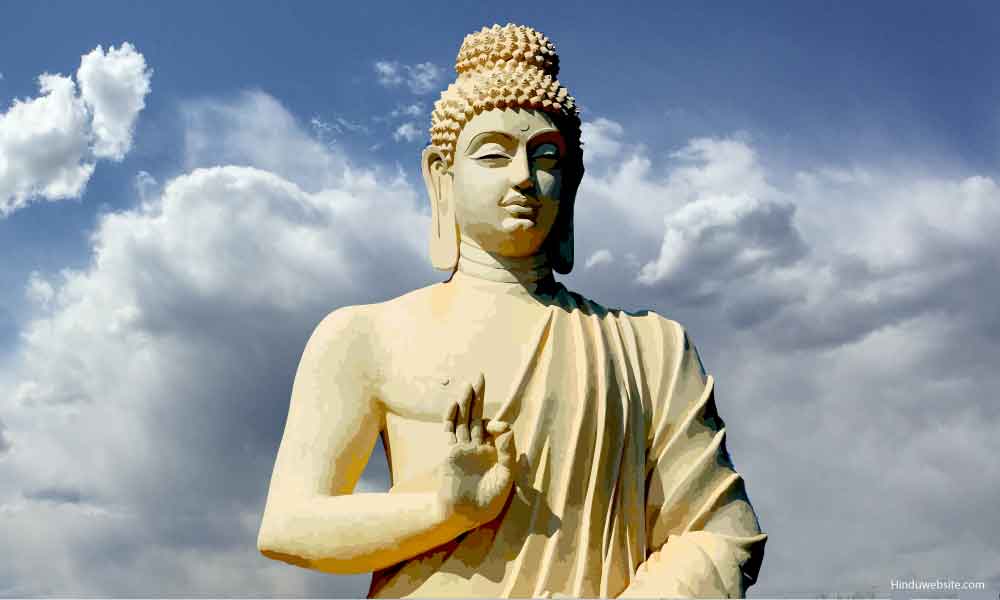
THE MAHAYANA
| CHAPTER |
PAGE |
|
| XVI | MAIN FEATURES OF THE MAHAYANA | 3 |
| XVII | BODHISATTVAS | 7 |
| XVIII | THE BUDDHAS of MAHAYANISM | 26 |
| XIX | MAHAYANIST METAPHYSICS | 36 |
| XX | MAHAYANIST SCRIPTURES | 47 |
| XXI | CHRONOLOGY OF THE MAHAYANA | 63 |
| XXII | FROM KANISHKA TO VASUBANDHU | 76 |
| XXIII | INDIAN BUDDHISM AS SEEN BY THE CHINESE PILGRIMS | 90 |
| XXIV | DECADENCE OF BUDDHISM IN INDIA | 107 |
CHAPTER XVI
![[go to top]](../../images/scrollup.gif)
MAIN FEATURES OF THE MAHAYANA
The obscurest period in the history of Buddhism is that which follows the reign of Asoka, but the enquirer cannot grope for long in these dark ages without stumbling upon the word Mahayana. This is the name given to a movement which in its various phases may be regarded as a philosophical school, a sect and a church, and though it is not always easy to define its relationship to other schools and sects it certainly became a prominent aspe [4] ct of Buddhism in India about the beginning of our era besides achieving enduring triumphs in the Far East. The word[1] signifies Great Vehicle or Carriage, that is a means of conveyance to salvation, and is contrasted with Hinayana, the Little Vehicle, a name bestowed on the more conservative party though not willingly accepted by them. The simplest description of the two Vehicles is that given by the Chinese traveller I-Ching (635-713 A.D.) who saw them both as living realities in India.
He says[2] "Those who worship Bodhisattvas and read Mahayana Sutras are called Mahayanists, while those who do not do this are called Hinayanists." In other words, the Mahayanists have scriptures of their own, not included in the Hinayanist Canon and adore superhuman beings in the stage of existence immediately below Buddhahood and practically differing little from Indian deities. Many characteristics could be added to I-Ching's description but they might not prove universally true of the Mahayana nor entirely absent from the Hinayana, for however divergent the two Vehicles may have become when separated geographically, for instance in Ceylon and Japan, it is clear that when they were in contact, as in India and China, the distinction was not always sharp. But in general the Mahayana was more popular, not in the sense of being simpler, for parts of its teaching were exceedingly abstruse, but in the sense of striving to invent or include doctrines agreeable to the masses. It was less monastic than the older Buddhism, and more emotional; warmer in charity, more personal in devotion, more ornate in art, literature and ritual, more disposed to evolution and development, whereas the Hinayana was conservative and rigid, secluded in its cloisters and open to the plausible if unjust accusation of selfishness. The two sections are sometimes described as northern and southern Buddhism, but except as a rough description of their distribution at the present day, this distinction is not accurate, for the Mahayana penetrated to Java, while the Hinayana reached Central Asia and China. But it is true that the development of the Mahayana was due to influences prevalent in northern India and not equally prevalent in the South. The terms Pali and Sanskrit Buddhism are convenient and as accurate as can be expected of any nomenclature covering so large a field.
Though European writers usually talk of two Yânas or Vehicles—the great and the little—and though this is clearly the important distinction for historical purposes, yet Indian and Chinese Buddhists frequently enumerate three. These are the Śrâvakayâna, the vehicle of the ordinary Bhikshu who hopes to become an Arhat, the Pratyekabuddhayâna for the rare beings who are able to become Buddhas but do not preach the law to others, and in contrast to both of these the Mahayana or vehicle of Buddhas and Bodhisattvas. As a rule these three Vehicles are not regarded as hostile or even incompatible. Thus the Lotus sutra,[3] maintains that there is really but one vehicle though by a wise concession to human weakness the Buddha lets it appear that there are three to suit divers tastes. And the Mahayana is not a single vehicle but rather a train comprising many carriages of different classes. It has an unfortunate but distinct later phase known in Sanskrit as Mantrayâna and Vajrayâna but generally described by Europeans as Tantrism. This phase took some of the worst features in Hinduism, [5]such as spells, charms, and the worship of goddesses, and with misplaced ingenuity fitted them into Buddhism. I shall treat of it in a subsequent chapter, for it is chronologically late. The silence of Hsüan Chuang and I-Ching implies that in the seventh century it was not a noticeable aspect of Indian Buddhism.
Although the record of the Mahayana in literature and art is clear and even brilliant, it is not easy either to trace its rise or connect its development with other events in India. Its annals are an interminable list of names and doctrines, but bring before us few living personalities and hence are dull. They are like a record of the Christian Church's fight against Arians, Monophysites and Nestorians with all the great figures of Byzantine history omitted or called in question. Hence I fear that my readers (if I have any) may find these chapters repellent, a mist of hypotheses and a catalogue of ancient paradoxes. I can only urge that if the history of the Mahayana is uncertain, its teaching fanciful and its scriptures tedious, yet it has been a force of the first magnitude in the secular history and art of China, Japan and Tibet and even to-day the most metaphysical of its sacred books, the Diamond Cutter, has probably more readers than Kant and Hegel.
Since the early history of the Mahayana is a matter for argument rather than precise statement, it will perhaps be best to begin with some account of its doctrines and literature and proceed afterwards to chronology. I may, however, mention that general tradition connects it with King Kanishka and asserts that the great doctors Aśvaghosha and Nâgârjuna lived in and immediately after his reign. The attitude of Kanishka and of the Council which he summoned towards the Mahayana is far from clear and I shall say something about this difficult subject below. Unfortunately his date is not beyond dispute for while a considerable consensus of opinion fixes his accession at about 78 A.D., some scholars place it earlier and others in the second century A.D.[4] Apart from this, it appears established that the Sukhâvatî-vyûha which is definitely Mahayanist was translated into Chinese between 147 and 186 A.D. We may assume that it was then already well known and had been composed some time before, so that, whatever Kanishka's date may [6]have been, Mahayanist doctrines must have been in existence about the time of the Christian era, and perhaps considerably earlier. Naturally no one date like a reign or a council can be selected to mark the beginning of a great school. Such a body of doctrine must have existed piecemeal and unauthorized before it was collected and recognized and some tenets are older than others. Enlarging I-Ching's definition we may find in the Mahayana seven lines of thought or practice. All are not found in all sects and some are shared with the Hinayana but probably none are found fully developed outside the Mahayana. Many of them have parallels in the contemporary phases of Hinduism.
1. A belief in Bodhisattvas and in the power of human beings to become Bodhisattvas.
2. A code of altruistic ethics which teaches that everyone must do good in the interest of the whole world and make over to others any merit he may acquire by his virtues. The aim of the religious life is to become a Bodhisattva, not to become an Arhat.
3. A doctrine that Buddhas are supernatural beings, distributed through infinite space and time, and innumerable. In the language of later theology a Buddha has three bodies and still later there is a group of five Buddhas.
4. Various systems of idealist metaphysics, which tend to regard the Buddha essence or Nirvana much as Brahman is regarded in the Vedanta.
5. A canon composed in Sanskrit and apparently later than the Pali Canon.
6. Habitual worship of images and elaboration of ritual. There is a dangerous tendency to rely on formulæ and charms.
7. A special doctrine of salvation by faith in a Buddha, usually Amitâbha, and invocation of his name. Mahayanism can exist without this doctrine but it is tolerated by most sects and considered essential by some.
FOOTNOTES:
[1] Sanskrit, Mahâyâna; Chinese, Ta Ch'êng (pronounced Tai Shêng in many southern provinces); Japanese, Dai-jō Tibetan, Theg-pa-chen-po; Mongolian, Yäkä-külgän; Sanskrit, Hînayâna; Chinese, Hsiao-Ch'êng; Japanese, Shō-jō Tibetan, Theg-dman; Mongolian Ütśükän-külgän. In Sanskrit the synonyms agrayâna and uttama-yâna are also found.
[2] Record of Buddhist practices. Transl. Takakusu, 1896, p. 14. Hsüan Chuang seems to have thought that acceptance of the Yogâcâryabhûmi (Nanjio, 1170) was essential for a Mahayanist. See his life, transl. by Beal, p. 39, transl. by Julien, p. 50.
[3] Saddharma-Puṇḍarîka, chap. III. For brevity, I usually cite this work by the title of The Lotus.
[4] The date 58 B.C. has probably few supporters among scholars now, especially after Marshall's discoveries.
CHAPTER XVII
BODHISATTVAS
Let us now consider these doctrines and take first the worship of Bodhisattvas. This word means one whose essence is knowledge but is used in the technical sense of a being who is in process of obtaining but has not yet obtained Buddhahood. The Pali Canon shows little interest in the personality of Bodhisattvas and regards them simply as the preliminary or larval form of a Buddha, either Śâkyamuni[5] or some of his predecessors. It was incredible that a being so superior to ordinary humanity as a Buddha should be suddenly produced in a human family nor could he be regarded as an incarnation in the strict sense.
But it was both logical and edifying to suppose that he was the product of a long evolution of virtue, of good deeds and noble resolutions extending through countless ages and culminating in a being superior to the Devas. Such a being awaited in the Tushita heaven the time fixed for his appearance on earth as a Buddha and his birth was accompanied by marvels. But though the Pali Canon thus recognizes the Bodhisattva as a type which, if rare, yet makes its appearance at certain intervals, it leaves the matter there. It is not suggested that saints should try to become Bodhisattvas and Buddhas, or that Bodhisattvas can be helpers of mankind.[6] But both these trains of thought are natural developments of the older ideas and soon made themselves prominent. It is a characteristic doctrine of Mahayanism that men can try and should try to become Bodhisattvas.
In the Pali Canon we hear of Arhats, Pacceka Buddhas, and perfect Buddhas. For all three the ultimate goal is the same, namely Nirvana, but a Pacceka Buddha is greater than an Arhat, because he has greater intellectual powers though he is not omniscient, and a perfect Buddha is greater still, partly because he is omniscient and partly because he saves others. But if we admit that the career of the Buddha is better and nobler, and also that it is, as the Introduction to the Jâtaka recounts, simply the result of an earnest resolution to school himself and help others, kept firmly through the long chain of existences, there is nothing illogical or presumptuous in making our goal not the quest of personal salvation, but the attainment of Bodhisattvaship, that is the state of those who may aspire to become Buddhas. In fact the Arhat, engrossed in his own salvation, is excused only by his humility and is open to the charge of selfish desire, since the passion for Nirvana is an ambition like any other and the quest for salvation can be best followed by devoting oneself entirely to others. But though my object here is to render intelligible the Mahayanist point of view including its objections to Hinayanism, I must defend the latter from the accusation of selfishness. The vigorous and authoritative character of Gotama led him to regard all mankind as patients requiring treatment and to emphasize the truth that they could cure themselves if they would try. But the Buddhism of the Pali Canon does not ignore the duties of loving and instructing others;[7] it merely insists on man's power to save himself if properly instructed and bids him do it at once: "sell all that thou hast and follow me." And the Mahayana, if less self-centred, has also less self-reliance, and self-discipline. It is more human and charitable, but also more easygoing: it teaches the believer to lean on external supports which if well chosen may be a help, but if trusted without discrimination become paralyzing abuses. And if we look at the abuses of both systems the fossilized monk of the Hinayana will compare favourably [9] with the tantric adept. It was to the corruptions of the Mahayana rather than of the Hinayana that the decay of Buddhism in India was due.
The career of the Bodhisattva was early divided into stages (bhûmi) each marked by the acquisition of some virtue in his triumphant course. The stages are variously reckoned as five, seven and ten. The Mahâvastu,[8] which is the earliest work where the progress is described, enumerates ten without distinguishing them very clearly. Later writers commonly look at the Bodhisattva's task from the humbler point of view of the beginner who wishes to learn the initiatory stages. For them the Bodhisattva is primarily not a supernatural being or even a saint but simply a religious person who wishes to perform the duties and enjoy the privileges of the Church to the full, much like a communicant in the language of contemporary Christianity. We have a manual for those who would follow this path, in the Bodhicaryâvatâra of Śântideva, which in its humility, sweetness and fervent piety has been rightly compared with the De Imitatione Christi. In many respects the virtues of the Bodhisattva are those of the Arhat. His will must be strenuous and concentrated; he must cultivate the strictest morality, patience, energy, meditation and knowledge. But he is also a devotee, a bhakta: he adores all the Buddhas of the past, present and future as well as sundry superhuman Bodhisattvas, and he confesses his sins, not after the fashion of the Pâtimokkha, but by accusing himself before these heavenly Protectors and vowing to sin no more.
Śântideva lived in the seventh century[9] but tells us that he follows the scriptures and has nothing new to say. This seems to be true for, though his book being a manual of devotion presents its subject-matter in a dogmatic form, its main ideas are stated and even elaborated in the Lotus. Not only are eminent figures in the Church, such as Sâriputra and Ânanda, there designated as future Buddhas, but the same dignity is predicted wholesale for five hundred and again for two thousand [10]monks while in Chapter x is sketched the course to be followed by "young men or young ladies of good family" who wish to become Bodhisattvas.[10] The chief difference is that the Bodhicaryâvatâra portrays a more spiritual life, it speaks more of devotion, less of the million shapes that compose the heavenly host: more of love and wisdom, less of the merits of reading particular sûtras. While rendering to it and the faith that produced it all honour, we must remember that it is typical of the Mahayana only in the sense that the De Imitatione Christi is typical of Roman Catholicism, for both faiths have other sides.
Śântideva's Bodhisattva, when conceiving the thought of Bodhi or eventual supreme enlightenment to be obtained, it may be, only after numberless births, feels first a sympathetic joy in the good actions of all living beings. He addresses to the Buddhas a prayer which is not a mere act of commemoration, but a request to preach the law and to defer their entrance into Nirvana. He then makes over to others whatever merit he may possess or acquire and offers himself and all his possessions, moral and material, as a sacrifice for the salvation of all beings. This on the one hand does not much exceed the limits of dânam or the virtue of giving as practised by Śâkyamuni in previous births according to the Pali scriptures, but on the other it contains in embryo the doctrine of vicarious merit and salvation through a saviour. The older tradition admits that the future Buddha (e.g. in the Vessantara birth-story) gives all that is asked from him including life, wife and children. To consider the surrender and transfer of merit (pattidâna in Pali) as parallel is a natural though perhaps false analogy. But the transfer of Karma is not altogether foreign to Brahmanic thought, for it is held that a wife may share in her husband's Karma nor is it wholly unknown to Sinhalese Buddhism.[11] After thus deliberately rejecting all personal success and selfish aims, the neophyte makes a vow (praṇidhâna) to acquire enlightenment for the good of all beings and not to swerve from the rules of life and faith requisite for this end. He is then a "son [11]of Buddha," a phrase which is merely a natural metaphor for saying that he is one of the household of faith[12] but still paves the way to later ideas which make the celestial Bodhisattva an emanation or spiritual son of a celestial Buddha.
Asanga gives[13] a more technical and scholastic description of the ten bhûmis or stages which mark the Bodhisattva's progress towards complete enlightenment and culminate in a phase bearing the remarkable but ancient name of Dharmamegha known also to the Yoga philosophy. The other stages are called: muditâ (joyful): vimalâ (immaculate): prabhâkarî (light giving): arcismatî (radiant): durjaya (hard to gain): abhimukhî (facing, because it faces both transmigration and Nirvana): dûramgamâ (far-going): acalâ (immovable): sâdhumatî (good minded).
The incarnate Buddhas and Bodhisattvas of Tibet are a travesty of the Mahayana which on Indian soil adhered to the sound doctrine that saints are known by their achievements as men and cannot be selected among infant prodigies.[14] It was the general though not universal opinion that one who had entered on the career of a Bodhisattva could not fall so low as to be reborn in any state of punishment, but the spirit of humility and self-effacement which has always marked the Buddhist ideal tended to represent his triumph as incalculably distant. Meanwhile, although in the whirl of births he was on the upward grade, he yet had his ups and downs and there is no evidence that Indian or Far Eastern Buddhists arrogated to themselves special claims and powers on the ground that they were well advanced in the career of Buddhahood. The vow to suppress self and follow the light not only in this life but in all future births contains an element of faith or fantasy, but has any religion formed a nobler or even equivalent picture of the soul's destiny or built a better staircase from the world of men to the immeasurable spheres of the superhuman?
One aspect of the story of Sâkyamuni and his antecedent births thus led to the idea that all may become Buddhas. An [12] equally natural development in another direction created celestial and superhuman Bodhisattvas. The Hinayana held that Gotama, before his last birth, dwelt in the Tushita heaven enjoying the power and splendour of an Indian god and it looked forward to the advent of Maitreya. But it admitted no other Bodhisattvas, a consequence apparently of the doctrine that there can only be one Buddha at a time. But the luxuriant fancy of India, which loves to multiply divinities, soon broke through this restriction and fashioned for itself beautiful images of benevolent beings who refuse the bliss of Nirvana that they may alleviate the sufferings of others.[15] So far as we can judge, the figures of these Bodhisattvas took shape just about the same time that the personalities of Vishnu and Śiva were acquiring consistency. The impulse in both cases is the same, namely the desire to express in a form accessible to human prayer and sympathetic to human emotion the forces which rule the universe. But in this work of portraiture the Buddhists laid more emphasis on moral and spiritual law than did the Brahmans: they isolated in personification qualities not found isolated in nature. Śiva is the law of change, of death and rebirth, with all the riot of slaughter and priapism which it entails: Vishnu is the protector and preserver, the type of good energy warring against evil, but the unity of the figure is smothered by mythology and broken up into various incarnations. But Avalokita and Mañjuśrî, though they had not such strong roots in Indian humanity as Śiva and Vishnu, are genii of purer and brighter presence. They are the personifications of kindness and knowledge. Though manifold in shape, they have little to do with mythology, and are analogous to the archangels of Christian and Jewish tradition and to the Amesha Spentas of Zoroastrianism. With these latter they may have some historical connection, for Persian ideas may well have influenced Buddhism about the time of the Christian era. However difficult it may be to prove the foreign origin of Bodhisattvas, few of them have a clear origin in India and all of them [13] are much better known in Central Asia and China. But they are represented with the appearance and attributes of Indian Devas, as is natural, since even in the Pali Canon Devas form the Buddha's retinue. The early Buddhists considered that these spirits, whether called Bodhisattvas or Devas, had attained their high position in the same way as Śâkyamuni himself, that is by the practice of moral and intellectual virtues through countless existences, but subsequently they came to be regarded as emanations or sons of superhuman Buddhas. Thus the Kâraṇḍa-vyûha relates how the original Âdi-Buddha produced Avalokita by meditation and how he in his turn produced the universe with its gods.
Millions of unnamed Bodhisattvas are freely mentioned and even in the older books copious lists of names are found,[16] but two, Avalokita and Mañjuśrî, tower above the rest, among whom only few have a definite personality. The tantric school counts eight of the first rank. Maitreya (who does not stand on the same footing as the others), Samantabhadra, Mahâsthâna-prâpta and above all Kshitigarbha, have some importance, especially in China and Japan.
Avalokita[17] in many forms and in many ages has been one of the principal deities of Asia but his origin is obscure. His main attributes are plain. He is the personification of divine mercy and pity but even the meaning of his name is doubtful. In its full form it is Avalokiteśvara, often rendered the Lord who looks down (from heaven). This is an appropriate title for the God of Mercy, but the obvious meaning of the participle avalokita in Sanskrit is passive, the Lord who is looked at. Kern[18] thinks it may mean the Lord who is everywhere visible as a very present help in trouble, or else the Lord of View, like the epithet Dṛishtiguru applied to Śiva. Another form of the name is Lokeśvara or Lord of the world and this suggests that avalokita may be a synonym of loka, meaning the visible universe. It has also been suggested that the name may refer to the small image of Amitâbha which is set in his diadem and thus looks down on him. But such small images set in the head of a larger figure are not distinctive of Avalokita: they are found [14] in other Buddhist statues and paintings and also outside India, for instance at Palmyra. The Tibetan translation of the name[19] means he who sees with bright eyes. Hsüan Chuang's rendering Kwan-tzǔ-tsai[20] expresses the same idea, but the more usual Chinese translation Kuan-yin or Kuan-shih-yin, the deity who looks upon voices or the region of voices, seems to imply a verbal misunderstanding. For the use of Yin or voice makes us suspect that the translator identified the last part of Avalokiteśvara not with Îśvara lord but with svara sound.[21]
Avalokiteśvara is unknown to the Pali Canon and the Milinda Pañha. So far as I can discover he is not mentioned in the Divyâvadâna, Jâtakamâlâ or any work attributed to Aśvaghosha. His name does not occur in the Lalita-vistara but a list of Bodhisattvas in its introductory chapter includes Mahâkaruṇâcandin, suggesting Mahâkaruna, the Great Compassionate, which is one of his epithets. In the Lotus[22] he is placed second in the introductory list of Bodhisattvas after Mañjuśrî. But Chapter XXIV, which is probably a later addition, is dedicated to his praises as Samantamukha, he who looks every way or the omnipresent. In this section his character as the all-merciful saviour is fully developed. He saves those who call on him from shipwreck, and execution, from robbers and all violence and distress. He saves too from moral evils, such as passion, hatred and folly. He grants children to women who worship him. This power, which is commonly exercised by female deities, is worth remarking as a hint of his subsequent transformation into a goddess. For the better achievement of his merciful deeds, he assumes all manner of forms, and appears in the guise of a Buddha, a Bodhisattva, a Hindu deity, a goblin, or a Brahman and in fact in any shape. This chapter was translated into Chinese before 417 A.D. and therefore can hardly be later than 350. He is also mentioned in the Sukhâvatî-vyûha. [15] The records of the Chinese pilgrims Fa-Hsien and Hsüan Chuang[23] indicate that his worship prevailed in India from the fourth till the seventh century and we are perhaps justified in dating its beginnings at least two centuries earlier. But the absence of any mention of it in the writings of Aśvaghosha is remarkable.[24]
Avalokita is connected with a mountain called Potala or Potalaka. The name is borne by the palace of the Grand Lama at Lhassa and by another Lamaistic establishment at Jehol in north China. It reappears in the sacred island of P´u-t´o near Ningpo. In all these cases the name of Avalokita's Indian residence has been transferred to foreign shrines. In India there were at least two places called Potala or Potalaka—one at the mouth of the Indus and one in the south. No certain connection has been traced between the former and the Bodhisattva but in the seventh century the latter was regarded as his abode. Our information about it comes mainly from Hsüan Chuang[25] who describes it when speaking of the Malakuta country and as near the Mo-lo-ya (Malaya) mountain. But apparently he did not visit it and this makes it probable that it was not a religious centre but a mountain in the south of which Buddhists in the north wrote with little precision.[26] There is no evidence that Avalokita was first worshipped on this Potalaka, though he is often associated with mountains such as Kapota in Magadha and Valavatî in Katâha.[27] In fact the connection of Potala with Avalokita remains a mystery.
Avalokita has, like most Bodhisattvas, many names. Among the principal are Mahâkaruna, the Great Compassionate one, Lokanâtha or Lokeśvara, the Lord of the world, and Padmapâni, or lotus-handed. This last refers to his appearance as portrayed in statues and miniatures. In the older works of art his figure [16] is human, without redundant limbs, and represents a youth in the costume of an Indian prince with a high jewelled chignon, or sometimes a crown. The head-dress is usually surmounted by a small figure of Amitâbha. His right hand is extended in the position known as the gesture of charity.[28] In his left he carries a red lotus and he often stands on a larger blossom. His complexion is white or red. Sometimes he has four arms and in later images a great number. He then carries besides the lotus such objects as a book, a rosary and a jug of nectar.[29]
The images with many eyes and arms seem an attempt to represent him as looking after the unhappy in all quarters and stretching out his hands in help.[30] It is doubtful if the Bodhisattvas of the Gandhara sculptures, though approaching the type of Avalokita, represent him rather than any other, but nearly all the Buddhist sites of India contain representations of him which date from the early centuries of our era[31] and others are preserved in the miniatures of manuscripts.[32]
He is not a mere adaptation of any one Hindu god. Some of his attributes are also those of Brahmâ. Though in some late texts he is said to have evolved the world from himself, his characteristic function is not to create but, like Vishnu, to save and like Vishnu he holds a lotus. But also he has the title of Îśvara, which is specially applied to Śiva. Thus he does not issue from any local cult and has no single mythological pedigree but is the idea of divine compassion represented with such materials as the art and mythology of the day offered.
He is often accompanied by a female figure Târâ.[33] In the tantric period she is recognized as his spouse and her images, common in northern India from the seventh century onwards, [17] show that she was adored as a female Bodhisattva. In Tibet Târâ is an important deity who assumes many forms and even before the tantric influence had become prominent she seems to have been associated with Avalokita. In the Dharmasangraha she is named as one of the four Devîs, and she is mentioned twice under the name of To-lo Pu-sa by Hsüan Chuang, who saw a statue of her in Vaisali and another at Tiladhaka in Magadha. This last stood on the right of a gigantic figure of Buddha, Avalokita being on his left.[34]
Hsüan Chuang distinguishes To-lo (Târâ) and Kuan-tzǔ-tsai. The latter under the name of Kuan-yin or Kwannon has become the most popular goddess of China and Japan, but is apparently a form of Avalokita. The god in his desire to help mankind assumes many shapes and, among these, divine womanhood has by the suffrage of millions been judged the most appropriate. But Târâ was not originally the same as Kuan-yin, though the fact that she accompanies Avalokita and shares his attributes may have made it easier to think of him in female form.[35]
The circumstances in which Avalokita became a goddess are obscure. The Indian images of him are not feminine, although his sex is hardly noticed before the tantric period. He is not a male deity like Krishna, but a strong, bright spirit and like the Christian archangels above sexual distinctions. No female form of him is reported from Tibet and this confirms the idea that none was known in India,[36] and that the change was made in China. It was probably facilitated by the worship of Târâ and of Hâritî, an ogress who was converted by the Buddha and is frequently represented in her regenerate state caressing a child. [18] She is mentioned by Hsüan Chuang and by I-Ching who adds that her image was already known in China. The Chinese also worshipped a native goddess called T'ien-hou or T'ou-mu. Kuan-yin was also identified with an ancient Chinese heroine called Miao-shên.[37] This is parallel to the legend of Ti-tsang (Kshitigarbha) who, though a male Bodhisattva, was a virtuous maiden in two of his previous existences. Evidently Chinese religious sentiment required a Madonna and it is not unnatural if the god of mercy, who was reputed to assume many shapes and to give sons to the childless, came to be thought of chiefly in a feminine form. The artists of the T'ang dynasty usually represented Avalokita as a youth with a slight moustache and the evidence as to early female figures does not seem to me strong,[38] though a priori I see no reason for doubting their existence. In 1102 a Chinese monk named P'u-ming published a romantic legend of Kuan-yin's earthly life which helped to popularize her worship. In this and many other cases the later developments of Buddhism are due to Chinese fancy and have no connection with Indian tradition.
Târâ is a goddess of north India, Nepal and the Lamaist Church and almost unknown in China and Japan. Her name means she who causes to cross, that is who saves, life and its troubles being by a common metaphor described as a sea. Târâ also means a star and in Puranic mythology is the name given to the mother of Buddha, the planet Mercury. Whether the name was first used by Buddhists or Brahmans is unknown, but after the seventh century there was a decided tendency to give Târâ the epithets bestowed on the Śaktis of Śiva and assimilate her to those goddesses. Thus in the list of her 108 names[39] she is described among other more amiable attributes as [19] terrible, furious, the slayer of evil beings, the destroyer, and Kâlî: also as carrying skulls and being the mother of the Vedas. Here we have if not the borrowing by Buddhists of a Śaiva deity, at least the grafting of Śaiva conceptions on a Bodhisattva.
The second great Bodhisattva Mañjuśrî[40] has other similar names, such as Mañjunâtha and Mañjughosha, the word Mañju meaning sweet or pleasant. He is also Vagîśvara, the Lord of Speech, and Kumârabhûta, the Prince, which possibly implies that he is the Buddha's eldest son, charged with the government under his direction. He has much the same literary history as Avalokita, not being mentioned in the Pali Canon nor in the earlier Sanskrit works such as the Lalita-vistara and Divyâvadâna. But his name occurs in the Sukhâvatî-vyûha: he is the principal interlocutor in the Lankâvatâra sûtra and is extolled in the Ratna-karaṇḍaka-vyûha-sûtra.[41] In the greater part of the Lotus he is the principal Bodhisattva and instructs Maitreya, because, though his youth is eternal, he has known many Buddhas through innumerable ages. The Lotus[42] also recounts how he visited the depths of the sea and converted the inhabitants thereof and how the Lord taught him what are the duties of a Bodhisattva after the Buddha has entered finally into Nirvana. As a rule he has no consort and appears as a male Athene, all intellect and chastity, but sometimes Lakshmî or Sarasvatî or both are described as his consorts.[43]
His worship prevailed not only in India but in Nepal, Tibet, China, Japan and Java. Fa-Hsien states that he was honoured in Central India, and Hsüan Chuang that there were stupas dedicated to him at Muttra.[44] He is also said to have been incarnate in Atîsa, the Tibetan reformer, and in Vairocana who introduced Buddhism to Khotan, but, great as is his benevolence, he is not so much the helper of human beings, which is Avalokita's special function, as the personification of thought,[20] knowledge, and meditation. It is for this that he has in his hands the sword of knowledge and a book. A beautiful figure from Java bearing these emblems is in the Berlin Museum.[45] Miniatures represent him as of a yellow colour with the hands (when they do not carry emblems) set in the position known as teaching the law.[46] Other signs which distinguish his images are the blue lotus and the lion on which he sits.
An interesting fact about Mañjuśrî is his association with China,[47] not only in Chinese but in late Indian legends. The mountain Wu-t'ai-shan in the province of Shan-si is sacred to him and is covered with temples erected in his honour.[48] The name (mountain of five terraces) is rendered in Sanskrit as Pancaśîrsha, or Pancaśikha, and occurs both in the Svayambhû Purâṇa and in the text appended to miniatures representing Mañjuśrî. The principal temple is said to have been erected between 471 and 500 A.D. I have not seen any statement that the locality was sacred in pre-Buddhist times, but it was probably regarded as the haunt of deities, one of whom—perhaps some spirit of divination—was identified with the wise Mañjuśrî. It is possible that during the various inroads of Græco-Bactrians, Yüeh-Chih, and other Central Asian tribes into India, Mañjuśrî was somehow imported into the pantheon of the Mahayana from China or Central Asia, and he has, especially in the earlier descriptions, a certain pure and abstract quality which recalls the Amesha-Spentas of [21] Persia. But still his attributes are Indian, and there is little positive evidence of a foreign origin. I-Ching is the first to tell us that the Hindus believed he came from China.[49] Hsüan Chuang does not mention this belief, and probably did not hear of it, for it is an interesting detail which no one writing for a Chinese audience would have omitted. We may therefore suppose that the idea arose in India about 650 A.D. By that date the temples of Wu-t'ai-Shan would have had time to become celebrated, and the visits paid to India by distinguished Chinese Buddhists would be likely to create the impression that China was a centre of the faith and frequented by Bodhisattvas.[50] We hear that Vajrabodhi (about 700) and Prajña (782) both went to China to adore Mañjuśrî. In 824 a Tibetan envoy arrived at the Chinese Court to ask for an image of Mañjuśrî, and later the Grand Lamas officially recognized that he was incarnate in the Emperor.[51] Another legend relates that Mañjuśrî came from Wu-t'ai-Shan to adore a miraculous lotus[52] that appeared on the lake which then filled Nepal. With a blow of his sword he cleft the mountain barrier and thus drained the valley and introduced civilization. There may be hidden in this some tradition of the introduction of culture into Nepal but the Nepalese legends are late and in their collected form do not go back beyond the sixteenth century.
After Avalokita and Mañjuśrî the most important Bodhisattva is Maitreya,[53] also called Ajita or unconquered, who is the only one recognized by the Pali Canon.[54] This is because he does not stand on the same footing as the others. They are superhuman in their origin as well as in their career, whereas Maitreya is simply a being who like Gotama has lived innumerable lives and ultimately made himself worthy of Buddhahood which he awaits in heaven. There is no reason to doubt that Gotama regarded himself as one in [22] a series of Buddhas: the Pali scriptures relate that he mentioned his predecessors by name, and also spoke of unnumbered Buddhas to come.[55] Nevertheless Maitreya or Metteyya is rarely mentioned in the Pali Canon.[56] He is, however, frequently alluded to in the exegetical Pali literature, in the Anâgata-vaṃsa and in the earlier Sanskrit works such as the Lalita-vistara, the Divyâvadâna and Mahâvastu. In the Lotus he plays a prominent part, but still is subordinate to Mañjuśrî. Ultimately he was eclipsed by the two great Bodhisattvas but in the early centuries of our era he received much respect. His images are frequent in all parts of the Buddhist world: he was believed to watch over the propagation of the Faith,[57] and to have made special revelations to Asaṅga.[58] In paintings he is usually of a golden colour: his statues, which are often gigantic, show him standing or sitting in the European fashion and not cross-legged. He appears to be represented in the earliest Gandharan sculptures and there was a famous image of him in Udyâna of which Fa-Hsien (399-414 A.D.) speaks as if it were already ancient.[59] Hsüan Chuang describes it as well as a stupa erected[60] to commemorate Sâkyamuni's prediction that Maitreya would be his successor. On attaining Buddhahood he will become lord of a terrestrial paradise and hold three assemblies under a dragon flower tree,[61] at which all who have been good Buddhists in previous births will become Arhats. I-Ching speaks of meditating on the advent of Maitreya in language like that which Christian piety uses of the second coming of Christ and concludes a poem which is incorporated in his work with the aspiration "Deep as the depth of a lake be my pure and calm meditation. Let me look for the first meeting [23] under the Tree of the Dragon Flower when I hear the deep rippling voice of the Buddha Maitreya."[62] But messianic ideas were not much developed in either Buddhism or Hinduism and perhaps the figures of both Maitreya and Kalkî owe something to Persian legends about Saoshyant the Saviour.
The other Bodhisattvas, though lauded in special treatises, have left little impression on Indian Buddhism and have obtained in the Far East most of whatever importance they possess. The makers of images and miniatures assign to each his proper shape and colour, but when we read about them we feel that we are dealing not with the objects of real worship or even the products of a lively imagination, but with names and figures which have a value for picturesque but conventional art.
Among the best known is Samantabhadra, the all gracious,[63] who is still a popular deity in Tibet and the patron saint of the sacred mountain Omei in China, with which he is associated as Mañjuśrî with Wu-t́ai-shan. He is represented as green and riding on an elephant. In Indian Buddhism he has a moderately prominent position. He is mentioned in the Dharmasangraha and in one chapter of the Lotus he is charged with the special duty of protecting those who follow the law. But the Chinese pilgrims do not mention his worship.
Mahâsthâmaprâpta[64] is a somewhat similar figure. A chapter of the Lotus (XIX) is dedicated to him without however giving any clear idea of his personality and he is extolled in several descriptions of Sukhâvatî or Paradise, especially in the Amitâyurdhyâna-sûtra. Together with Amitâbha and Avalokita he forms a triad who rule this Happy Land and are often represented by three images in Chinese temples.
Vajrapâṇi is mentioned in many lists of Bodhisattvas (e.g. in the Dharmasangraha) but is of somewhat doubtful position as Hsüan Chuang calls him a deva.[65] Historically his recognition as a Bodhisattva is interesting for he is merely Indra transformed into a Buddhist. The mysterious personages called Vajradhara and Vajrasattva, who in later times are even [24] identified with the original Buddha spirit, are further developments of Vajrapâṇi. He owes his elevation to the fact that Vajra, originally meaning simply thunderbolt, came to be used as a mystical expression for the highest truth.
More important than these is Kshitigarbha, Ti-tsang or Jizō[66] who in China and Japan ranks second only to Kuan-yin. Visser has consecrated to him an interesting monograph[67] which shows what strange changes and chances may attend spirits and how ideal figures may alter as century after century they travel from land to land. We know little about the origin of Kshitigarbha. The name seems to mean Earth-womb and he has a shadowy counterpart in Akâśagarbha, a similar deity of the air, who it seems never had a hold on human hearts. The Earth is generally personified as a goddess[68] and Kshitigarbha has some slight feminine traits, though on the whole decidedly masculine. The stories of his previous births relate how he was twice a woman: in Japan he was identified with the mountain goddess of Kamado, and he helps women in labour, a boon generally accorded by goddesses. In the pantheon of India he played an inconspicuous part,[69] though reckoned one of the eight great Bodhisattvas, but met with more general esteem in Turkestan, where he began to collect the attributes afterwards defined in the Far East. It is there that his history and transformations become clear.
He is primarily a deity of the nether world, but like Amitâbha and Avalokita he made a vow to help all living creatures and specially to deliver them from hell. The Taoists pictured hell as divided into ten departments ruled over by as many kings, and Chinese fancy made Ti-tsang the superintendent of these functionaries. He thus becomes not so much a Saviour as the kindly superintendent of a prison who preaches to the inmates and willingly procures their release. Then we hear of six Ti-tsangs, corresponding to the six worlds of sentient beings, the gracious spirit being supposed to multiply his personality in [25] order to minister to the wants of all. He is often represented as a monk, staff in hand and with shaven head. The origin of this guise is not clear and it perhaps refers to his previous births. But in the eighth century a monk of Chiu Hua[70] was regarded as an incarnation of Ti-tsang and after death his body was gilded and enshrined as an object of worship. In later times the Bodhisattva was confused with the incarnation, in the same way as the portly figure of Pu-tai, commonly known as the laughing Buddha, has been substituted for Maitreya in Chinese iconography.
In Japan the cult of the six Jizōs became very popular. They were regarded as the deities of roads[71] and their effigies ultimately superseded the ancient phallic gods of the crossways. In this martial country the Bodhisattva assumed yet another character as Shōgun Jizō, a militant priest riding on horseback[72] and wearing a helmet who became the patron saint of warriors and was even identified with the Japanese war god, Hachiman. Until the seventeenth century Jizō was worshipped principally by soldiers and priests, but subsequently his cult spread among all classes and in all districts. His benevolent activities as a guide and saviour were more and more emphasized: he heals sickness, he leng thens life, he leads to heaven, he saves from hell: he even suffers as a substitute in hell and is the special protector of the souls of children amid the perils of the underworld. Though this modern figure of Jizō is wrought with ancient materials, it is in the main a work of Japanese sentiment.
FOOTNOTES:
[5] In dealing with the Mahayanists, I use the expression Śâkyamuni in preference to Gotama. It is their own title for the teacher and it seems incongruous to use the purely human name of Gotama in describing doctrines which represent him as superhuman.
[6] But Kings Hsin-byu-shin of Burma and Śrî Sûryavaṃsa Râma of Siam have left inscriptions recording their desire to become Buddhas. See my chapters on Burma and Siam below. Mahayanist ideas may easily have entered these countries from China, but even in Ceylon the idea of becoming a Buddha or Bodhisattva is not unknown. See Manual of a Mystic (P.T.S. 1916), pp. xviii and 140.
[7] E.g. in Itivuttakam 75, there is a description of the man who is like a drought and gives nothing, the man who is like rain in a certain district and the man who is Sabbabhûtânukampako, compassionate to all creatures, and like rain falling everywhere. Similarly Ib. 84, and elsewhere, we have descriptions of persons (ordinary disciples as well as Buddhas) who are born for the welfare of gods and men bahujanahitâya, bahujanasukhâya, lokânukampâya, atthâya, hitâya, sukhâya devamanussânam.
[8] Ed. Senart, vol. I. p. 142.
[9] The Bodhicaryâvatâra was edited by Minayeff, 1889 and also in the Journal of the Buddhist Text Society and the Bibliotheca Indica. De la Vallée Poussin published parts of the text and commentary in his Bouddhisme and also a translation in 1907.
[10] The career of the Bodhisattva is also discussed in detail in the Avatamsaka sûtra and in works attributed to Nâgârjuna and Sthiramati, the Lakshaṇa-vimukta-hṛidaya-śâstra and the Mahâyâna-dharma-dhâtvaviśeshata-śâstra. I only know of these works as quoted by Teitaro Suzuki.
[11] See Childers, Pali Dict. s.v. Patti, Pattianuppadânam and Puñño.
[12] It occurs in the Pali Canon, e.g. Itivuttakam 100. Tassa me tumhe puttâ orasâ, mukhato jâtâ, dhammajâ.
[13] See Sylvain Lévi, Mahâyâna-sûtrâlankâra: introduction and passim. For much additional information about the Bhûmis see De la Vallée Poussin's article "Bodhisattva" in E.R.E.
[14] Eminent doctors such as Nâgârjuna and Asanga are often described as Bodhisattvas just as eminent Hindu teachers, e.g. Caitanya, are described as Avatâras.
[15] The idea that Arhats may postpone their entry into Nirvana for the good of the world is not unknown to the Pali Canon. According to the Maha Parin-Sutta the Buddha himself might have done so. Legends which cannot be called definitely Mahayanist relate how Piṇḍola and others are to tarry until Maitreya come and how Kâśyapa in a less active role awaits him in a cave or tomb, ready to revive at his advent. See J.A. 1916, II. pp. 196, 270.
[16] E.g. Lotus, chap. I.
[17] De la Vallée Poussin's article "Avalokita" in E.R.E. may be consulted.
[18] Lotus, S.B.E. XXI. p. 407.
[19] sPyan-ras-gzigs rendered in Mongol by Nidübär-üdzäkci. The other common Mongol name Ariobalo appears to be a corruption of Âryâvalokita.
[20] Meaning apparently the seeing and self-existent one. Cf. Ta-tzǔ-tsai as a name of Śiva.
[21] A maidservant in the drama Mâlatîmâdhava is called Avalokita. It is not clear whether it is a feminine form of the divine name or an adjective meaning looked-at, or admirable.
[22] S.B.E. XXI. pp. 4 and 406 ff. It was translated in Chinese between A.D. 265 and 316 and chap. XXIV was separately translated between A.D. 384 and 417. See Nanjio, Catalogue Nos. 136, 137, 138.
[23] Hsüan Chuang (Watters, II. 215, 224) relates how an Indian sage recited the Sui-hsin dhârani before Kuan-tzǔ-tsai's image for three years.
[24] As will be noticed from time to time in these pages, the sudden appearance of new deities in Indian literature often seems strange. The fact is that until deities are generally recognized, standard works pay no attention to them.
[25] Watters, vol. II. pp. 228 ff. It is said that Potalaka is also mentioned in the Hwa-yen-ching or Avatamsaka sûtra. Tibetan tradition connects it with the Śâkya family. See Csoma de Körös, Tibetan studies reprinted 1912, pp. 32-34.
[26] Just as the Lankâvatâra sûtra purports to have been delivered at Lankapura-samudra-malaya-śikhara rendered in the Chinese translation as "in the city of Lanka on the summit of the Malaya mountain on the border of the sea."
[27] See Foucher, Iconographie bouddhique, 1900, pp. 100, 102.
[28] Varamudra.
[29] These as well as the red colour are attributes of the Hindu deity Brahmâ.
[30] A temple on the north side of the lake in the Imperial City at Peking contains a gigantic image of him which has literally a thousand heads and a thousand hands. This monstrous figure is a warning against an attempt to represent metaphors literally.
[31] Waddell on the Cult of Avalokita, J.R.A.S. 1894, pp. 51 ff. thinks they are not earlier than the fifth century.
[32] See especially Foucher, Iconographie Bouddhique, Paris, 1900.
[33] See especially de Blonay, Études pour servir à l'histoire de la déesse bouddhique Târâ, Paris, 1895. Târâ continued to be worshipped as a Hindu goddess after Buddhism had disappeared and several works were written in her honour. See Raj. Mitra, Search for Sk. MSS. IV. 168, 171, X. 67.
[34] About the time of Hsüan Chuang's travels Sarvajñâmitra wrote a hymn to Târâ which has been preserved and published by de Blonay, 1894.
[35] Chinese Buddhists say Târâ and Kuan-Yin are the same but the difference between them is this. Târâ is an Indian and Lamaist goddess associated with Avalokita and in origin analogous to the Saktis of Tantrism. Kuan-yin is a female form of Avalokita who can assume all shapes. The original Kuan-yin was a male deity: male Kuan-yins are not unknown in China and are said to be the rule in Korea. But Târâ and Kuan-yin may justly be described as the same in so far as they are attempts to embody the idea of divine pity in a Madonna.
[36] But many scholars think that the formula Om manipadme hum, which is supposed to be addressed to Avalokita, is really an invocation to a form of Śakti called Maṇipadmâ. A Nepalese inscription says that "The Śâktas call him Śakti" (E.R.E. vol. II. p. 260 and J.A. IX. 192), but this may be merely a way of saying that he is identical with the great gods of all sects.
[37] Harlez, Livre des esprits et des immortels, p. 195, and Doré, Recherches sur les superstitions en Chine, pp. 94-138.
[38] See Fenollosa, Epochs of Chinese and Japanese Art I. pp. 105 and 124; Johnston, Buddhist China, 275 ff. Several Chinese deities appear to be of uncertain or varying sex. Thus Chun-ti is sometimes described as a deified Chinese General and sometimes identified with the Indian goddess Marîcî. Yü-ti, generally masculine, is sometimes feminine. See Doré, l.c. 212. Still more strangely the Patriarch Aśvaghosha (Ma Ming) is represented by a female figure. On the other hand the monk Ta Shêng (c. 705 A.D.) is said to have been an incarnation of the female Kuan Yin. Mañjuśrî is said to be worshipped in Nepal sometimes as a male, sometimes as a female. See Bendall and Haraprasad, Nepalese MSS. p. lxvii.
[39] de Blonay, l.c. pp. 48-57.
[40] Chinese, Man-chu-shih-li, or Wên-shu; Japanese, Monju; Tibetan, hJam-pahi-dbyans (pronounced Jam-yang). Mañju is good Sanskrit, but it must be confessed that the name has a Central-Asian ring.
[41] Translated into Chinese 270 A.D.
[42] Chaps. XI. and XIII.
[43] A special work Mañjuśrîvikrîḍita (Nanjio, 184, 185) translated into Chinese 313 A.D. is quoted as describing Mañjuśrî's transformations and exploits.
[44] Hsüan Chuang also relates how he assisted a philosopher called Ch'en-na (=Diṅnâga) and bade him study Mahayanist books.
[45] It is reproduced in Grünwedel's Buddhist Art in India. Translated by Gibson, 1901, p. 200.
[46] Dharmacakramudra.
[47] For the Nepalese legends see S. Levi, Le Nepal, 1905-9.
[48] For an account of this sacred mountain see Edkins, Religion in China, chaps. XVII to XIX.
[49] See I-tsing, trans. Takakusu, 1896, p. 136. For some further remarks on the possible foreign origin of Mañjuśrî see below, chapter on Central Asia. The verses attributed to King Harsha (Nanjio, 1071) praise the reliquaries of China but without details.
[50] Some of the Tantras, e.g. the Mahâcînakramâcâra, though they do not connect Mañjuśrî with China, represent some of their most surprising novelties as having been brought thence by ancient sages like Vasishṭha.
[51] J.R.A.S. new series, XII. 522 and J.A.S.B. 1882, p. 41. The name Manchu perhaps contributed to this belief.
[52] It is described as a Svayambhû or spontaneous manifestation of the Âdi-Buddha.
[53] Sanskrit, Maitreya; Pali, Metteyya; Chinese, Mi-li; Japanese, Miroku; Mongol, Maidari; Tibetan, Byams-pa (pronounced Jampa). For the history of the Maitreya idea see especially Péri, B.E.F.E.O. 1911, pp. 439-457.
[54] But a Siamese inscription of about 1361, possibly influenced by Chinese Mahayanism, speaks of the ten Bodhisattvas headed by Metteyya. See B.E.F.E.O. 1917, No. 2, pp. 30, 31.
[55] E.g. in the Mahâparinibbâna Sûtra.
[56] Dig. Nik. XXVI. 25 and Buddhavamsa, XXVII. 19, and even this last verse is said to be an addition.
[57] See e.g. Watters, Yüan Chwang, I. 239.
[58] See Watters and Péri in B.E.F.E.O. 1911, 439. A temple of Maitreya has been found at Turfan in Central Asia with a Chinese inscription which speaks of him as an active and benevolent deity manifesting himself in many forms.
[59] He has not fared well in Chinese iconography which represents him as an enormously fat smiling monk. In the Liang dynasty there was a monk called Pu-tai (Jap. Hotei) who was regarded as an incarnation of Maitreya and became a popular subject for caricature. It would appear that the Bodhisattva himself has become superseded by this cheerful but undignified incarnation.
[60] The stupa was apparently at Benares but Hsüan Chuang's narrative is not clear and other versions make Râjagṛiha or Srâvasti the scene of the prediction.
[61] Campa. This is his bodhi tree under which he will obtain enlightenment as Sâkyamuni under the Ficus religiosa. Each Buddha has his own special kind of bodhi tree.
[62] Record of the Buddhist religion, Trans. Takakusu, p. 213. See too Watters, Yüan Chwang, II. 57, 144, 210, 215.
[63] Chinese P'u-hsien. See Johnston, From Peking to Mandalay, for an interesting account of Mt. Omei.
[64] Or Mahâsthâna. Chinese, Tai-shih-chih. He appears to be the Arhat Maudgalyâyana deified. In China and Japan there is a marked tendency to regard all Bodhisattvas as ancient worthies who by their vows and virtues have risen to their present high position. But these euhemeristic explanations are common in the Far East and the real origin of the Bodhisattvas may be quite different.
[65] E.g. Watters, I. p. 229, II. 215.
[66] Kshitigarbha is translated into Chinese as Ti-tsang and Jizō is the Japanese pronunciation of the same two characters.
[67] In Ostasiat. Ztsft. 1913-15. See too Johnston, Buddhist China, chap. VIII.
[68] The Earth goddess is known to the earliest Buddhist legends. The Buddha called her to witness when sitting under the Bo tree.
[69] Three Sûtras, analysed by Visser, treat of Kshitigarbha. They are Nanjio, Nos. 64, 65, 67.
[70] A celebrated monastery in the portion of An-hui which lies to the south of the Yang-tse. See Johnston, Buddhist China, chaps, VIII, IX and X.
[71] There is some reason to think that even in Turkestan Kshitigarbha was a god of roads.
[72] In Annam too Jizō is represented on horseback.
CHAPTER XVIII
THE BUDDHAS OF MAHAYANISM
This mythology did not grow up around the Buddha without affecting the central figure. To understand the extraordinary changes of meaning both mythological and metaphysical which the word Buddha undergoes in Mahayanist theology we must keep in mind not the personality of Gotama but the idea that he is one of several successive Buddhas who for convenience may be counted as four, seven or twenty-four but who really form an infinite series extending without limit backwards into the past and forwards into the future.[73] This belief in a series of Buddhas produced a plentiful crop of imaginary personalities and also of speculations as to their connection with one another, with the phenomena of the world and with the human soul.
In the Pali Canon the Buddhas antecedent to Gotama are introduced much like ancient kings as part of the legendary history of this world. But in the Lalita-vistara (Chap. XX) and the Lotus (Chap. VII) we hear of Buddhas, usually described as Tathâgatas, who apparently do not belong to this world at all, but rule various points of the compass, or regions described as Buddha-fields (Buddha-kshetra). Their names are not the same in the different accounts and we remain dazzled by an endless panorama of an infinity of universes with an infinity of shining Buddhas, illuminating infinite space.
Somewhat later five of these unearthly Buddhas were formed into a pentad and described as Jinas[74] or Dhyâni Buddhas (Buddhas of contemplation), namely, Vairocana, Akshobhya, Ratnasambhava, Amitâbha and Amoghasiddhi. In the fully developed form of this doctrine these five personages [27]are produced by contemplation from the Âdi-Buddha or original Buddha spirit and themselves produce various reflexes, including Bodhisattvas, human Buddhas and goddesses like Târâ. The date when these beliefs first became part of the accepted Mahayana creed cannot be fixed but probably the symmetrical arrangement of five Buddhas is not anterior to the tantric period[75] of Buddhism.
The most important of the five are Vairocana and Amitâbha. Akshobhya is mentioned in both the Lotus and Smaller Sukhâvatî-vyûha as the chief Buddha of the eastern quarter, and a work purporting to be a description of his paradise still extant in Chinese[76] is said to have been translated in the time of the Eastern Han dynasty. But even in the Far East he did not find many worshippers. More enduring has been the glory of Vairocana who is the chief deity of the Shingon sect in Japan and is represented by the gigantic image in the temple at Nara. In Java he seems to have been regarded as the principal and supreme Buddha. The name occurs in the Mahâvastu as the designation of an otherwise unknown Buddha of luminous attributes and in the Lotus we hear of a distant Buddha-world called Vairocana-rasmi-pratimandita, embellished by the rays of the sun.[77] Vairocana is clearly a derivative of Virocana, a recognized title of the sun in Sanskrit, and is rendered in Chinese by Ta-jih meaning great Sun. How this solar deity first came to be regarded as a Buddha is not known but the connection between a Buddha and light has always been recognized. Even the Pali texts represent Gotama as being luminous on some occasions and in the Mahayanist scriptures Buddhas are radiant and light-giving beings, surrounded by halos of prodigious extent and emitting flashes which illuminate the depths of space. The visions of innumerable paradises in all quarters containing jewelled stupas and lighted by refulgent Buddhas which are frequent in these works seem founded on astronomy vaporized under the influence of the idea that there are millions of universes all equally transitory and unsubstantial. There is no reason, so [28]far as I see, to regard Gotama as a mythical solar hero, but the celestial Buddhas[78] clearly have many solar attributes. This is natural. Solar deities are so abundant in Vedic mythology that it is hardly possible to be a benevolent god without having something of the character of the sun. The stream of foreign religions which flowed into India from Bactria and Persia about the time of the Christian era brought new aspects of sun worship such as Mithra, Helios and Apollo and strengthened the tendency to connect divinity and light. And this connection was peculiarly appropriate and obvious in the case of a Buddha, for Buddhas are clearly revealers and light-givers, conquerors of darkness and dispellers of ignorance.
Amitâbha (or the Buddha of measureless light), rising suddenly from an obscure origin, has like Avalokita and Vishnu become one of the great gods of Asia. He is also known as Amitâyus or measureless life, and is therefore a god of light and immortality. According to both the Lotus and the Smaller Sukhâvatî-vyûha he is the lord of the western quarter but he is unknown to the Lalita-vistara. It gives the ruler of the west a lengthy title,[79] which suggests a land of gardens. Now Paradise, which has biblical authority as a name for the place of departed spirits, appears to mean in Persian a park or enclosed garden and the Avesta speaks of four heavens, the good thought Paradise, the good word Paradise, the good deed Paradise and the Endless Lights.[80] This last expression bears a remarkable resemblance to the name of Amitâbha and we can understand that he should rule the west, because it is the home to which the sun and departed spirits go. Amitâbha's Paradise is called Sukhâvatî or Happy Land. In the Puranas the city of Varuṇa (who is suspected of having a non-Indian origin) is said to be situated in the west and is called Sukha (Linga P. and Vayu P.) or Mukhya (so Vishnu P. and others). The name Amitâbha also occurs in the Vishnu Purana as the name of a class of gods and it is curious that they are in one place[81] associated with [29]other deities called the Mukhyas. The worship of Amitâbha, so far as its history can be traced, goes back to Saraha, the teacher of Nâgârjuna. He is said to have been a Sudra and his name seems un-Indian. This supports the theory that this worship was foreign and imported into India.[82]
This worship and the doctrine on which it is based are an almost complete contradiction of Gotama's teaching, for they amount to this, that religion consists in faith in Amitâbha and prayer to him, in return for which he will receive his followers after death in his paradise. Yet this is not a late travesty of Buddhism but a relatively early development which must have begun about the Christian era. The principal works in which it is preached are the Greater Sukhâvatî-vyûha or Description of the Happy Land, translated into Chinese between 147 and 186 A.D., the lesser work of the same name translated in 402 A.D. and the Sûtra of meditation on Amitâyus[83] translated in 424. The first of these works purports to be a discourse of Śâkyamuni himself, delivered on the Vulture's Peak in answer to the questions of Ânanda. He relates how innumerable ages ago there was a monk called Dharmâkara who, with the help of the Buddha of that period, made a vow or vows[84] to become a Buddha but on conditions. That is to say he rejected the Buddhahood to which he might become entitled unless his merits obtained certain advantages for others, and having obtained Buddhahood on these conditions he can now cause them to be fulfilled. In other words he can apportion his vast store of accumulated merit to such persons and in such manner as he chooses. The gist of the conditions is that he should when he obtained Buddhahood be lord of a paradise whose inhabitants live in unbroken happiness until they obtain Nirvana. All who have thought of this paradise ten times are to be admitted therein, unless they have committed grievous sin, and Amitâbha will appear to them at the moment of death so that their thoughts may not be troubled. The Buddha shows Ânanda a [30] miraculous vision of this paradise and its joys are described in language recalling the account of the New Jerusalem in the book of Revelation and, though coarser pleasures are excluded, all the delights of the eye and ear, such as jewels, gardens, flowers, rivers and the songs of birds await the faithful.
The smaller Sukhâvatî-vyûha, represented as preached by Śâkyamuni at Śrâvasti, is occupied almost entirely with a description of the paradise. It marks a new departure in definitely preaching salvation by faith only, not by works, whereas the previous treatise, though dwelling on the efficacy of faith, also makes merit a requisite for life in heaven. But the shorter discourse says dogmatically "Beings are not born in that Buddha country as a reward and result of good works performed in this present life. No, all men or women who hear and bear in mind for one, two, three, four, five, six or seven nights the name of Amitâyus, when they come to die, Amitâyus will stand before them in the hour of death, they will depart this life with quiet minds and after death they will be born in Paradise."
The Amitâyur-dhyâna-sûtra also purports to be the teaching of Śâkyamuni and has an historical introduction connecting it with Queen Vaidehî and King Bimbisâra. In theology it is more advanced than the other treatises: it is familiar with the doctrine of Dharma-kâya (which will be discussed below) and it represents the rulers of paradise as a triad, Amitâyus being assisted by Avalokita and Mahasthâmaprâpta.[85] Admission to the paradise can be obtained in various ways, but the method recommended is the practice of a series of meditations which are described in detail. The system is comprehensive, for salvation can be obtained by mere virtue with little or no prayer but also by a single invocation of Amitâyus, which suffices to free from deadly sins.
Strange as such doctrines appear when set beside the Pali texts, it is clear that in their origin and even in the form which they assume in the larger Sukhâvatî-vyûha they are simply an exaggeration of ordinary Mahayanist teaching.[86] Amitâbha is [31] merely a monk who devotes himself to the religious life, namely seeking bodhi for the good of others. He differs from every day devotees only in the degree of sanctity and success obtained by his exertions. The operations which he performs are nothing but examples on a stupendous scale of pariṇâmanâ or the assignment of one's own merits to others. His paradise, though in popular esteem equivalent to the Persian or Christian heaven, is not really so: strictly speaking it is not an ultimate ideal but a blessed region in which Nirvana may be obtained without toil or care.
Though this teaching had brilliant success in China and Japan, where it still flourishes, the worship of Amitâbha was never predominant in India. In Nepal and Tibet he is one among many deities: the Chinese pilgrims hardly mention him: his figure is not particularly frequent in Indian iconography[87] and, except in the works composed specially in his honour, he appears as an incidental rather than as a necessary figure. The whole doctrine is hardly strenuous enough for Indians. To pray to the Buddha at the end of a sinful life, enter his paradise and obtain ultimate Nirvana in comfort is not only open to the same charge of egoism as the Hinayana scheme of salvation but is much easier and may lead to the abandonment of religious effort. And the Hindu, who above all things likes to busy himself with his own salvation, does not take kindly to these expedients. Numerous deities promise a long spell of heaven as a reward for the mere utterance of their names,[88] yet the believer continues to labour earnestly in ceremonies or meditation. It would be interesting to know whether this doctrine of salvation by the utterance of a single name or prayer originated among Buddhists or Brahmans. In any case it is closely related to old ideas about the magic power of Vedic verses.
The five Jinas and other supernatural personages are often regarded as manifestations of a single Buddha-force and at last this force is personified as Âdi-Buddha.[89] This admittedly [32] theistic form of Buddhism is late and is recorded from Nepal, Tibet (in the Kâlacakra system) and Java, a distribution which implies that it was exported from Bengal.[90] But another form in which the Buddha-force is impersonal and analogous to the Parabrahma of the Vedânta is much older. Yet when this philosophic idea is expressed in popular language it comes very near to Theism. As Kern has pointed out, Buddha is not called Deva or Îśvara in the Lotus simply because he is above such beings. He declares that he has existed and will exist for incalculable ages and has preached and will preach in innumerable millions of worlds. His birth here and his nirvana are illusory, kindly devices which may help weak disciples but do not mark the real beginning and end of his activity. This implies a view of Buddha's personality which is more precisely defined in the doctrine known as Ṭrikâya or the three bodies[91] and expounded in the Mahâyâna-sûtrâlankâra, the Awakening of Faith, the Suvarṇa-prabhâsa sûtra[92] and many other works. It may be stated dogmatically as follows, but it assumes somewhat divergent forms according as it is treated theologically or metaphysically.
A Buddha has three bodies or forms of existence. The first is the Dharma-kâya, which is the essence of all Buddhas. It is true knowledge or Bodhi. It may also be described as Nirvana and also as the one permanent reality underlying all phenomena and all individuals. The second is the Sambhoga-kâya, or body of enjoyment, that is to say the radiant and superhuman form in which Buddhas appear in their paradises or when otherwise manifesting themselves in celestial splendour. The third is the Nirmâna-kâya, or the body [33] of transformation, that is to say the human form worn by Śâkyamuni or any other Buddha and regarded as a transformation of his true nature and almost a distortion, because it is so partial and inadequate an expression of it. Later theology regards Amitâbha, Amitâyus and Śâkyamuni as a series corresponding to the three bodies. Amitâbha does not really express the whole Dharma-kâya, which is incapable of personification, but when he is accurately distinguished from Amitâyus (and frequently they are regarded as synonyms) he is made the more remote and ethereal of the two. Amitâyus with his rich ornaments and his flask containing the water of eternal life is the ideal of a splendidly beneficent saviour and represents the Sambhoga-kâya.[93] Śâkyamuni is the same beneficent being shrunk into human form. But this is only one aspect, and not the most important, of the doctrine of the three bodies. We can easily understand the Sambhoga-kâya and Nirmâna-kâya: they correspond to a deity such as Vishnu and his incarnation Krishna, and they are puzzling in Buddhism simply because we think naturally of the older view (not entirely discarded by the Mahayana) which makes the human Buddha the crown and apex of a series of lives that find in him their fulfilment. But it is less easy to understand the Dharma-kâya.
The word should perhaps be translated as body of the law and the thought originally underlying it may have been that the essential nature of a Buddha, that which makes him a Buddha, is the law which he preaches. As we might say, the teacher lives in his teaching: while it survives, he is active and not dead.
The change from metaphor to theology is illustrated by Hsüan Chuang when he states[94] (no doubt quoting from his edition of the Pitakas) that Gotama when dying said to those around him "Say not that the Tathâgata is undergoing final [34] extinction: his spiritual presence abides for ever unchangeable." This apparently corresponds to the passage in the Pali Canon,[95] which runs "It may be that in some of you the thought may arise, the word of the Master is ended: we have no more a teacher. But it is not thus that you should regard it. The truths and the rules which I have set forth, let them, after I am gone, be the Teacher to you." But in Buddhist writings, including the oldest Pali texts, Dharma or Dhamma has another important meaning. It signifies phenomenon or mental state (the two being identical for an idealistic philosophy) and comprises both the external and the internal world. Now the Dharma-kâya is emphatically not a phenomenon but it may be regarded as the substratum or totality of phenomena or as that which gives phenomena whatever reality they possess and the double use of the word dharma rendered such divagations of meaning easier.[96] Hindus have a tendency to identify being and knowledge. According to the Vedânta philosophy he who knows Brahman, knows that he himself is Brahman and therefore he actually is Brahman. In the same way the true body of the Buddha is prajñâ or knowledge.[97] By this is meant a knowledge which transcends the distinction between subject and object and which sees that neither animate beings nor inanimate things have individuality or separate existence. Thus the Dharma-kâya being an intelligence which sees the illusory quality of the world and also how the illusion originates[98] may be regarded as the origin and ground of all phenomena. As such it is also called Tathâgatagarbha and Dharma-dhâtu, the matrix or store-house of all phenomena. On the other hand, inasmuch as it is beyond them and implies their unreality, it may also be regarded as the annihilation of all phenomena, in other words as Nirvana. In fact the Dharma-kâya (or Bhûta-tathatâ) is sometimes[99] defined in words similar to those which the Pali Canon makes the Buddha use when asked if the Perfect Saint exists after death—"it is neither that which is existence nor that which is non-existence, nor that which is at once existence and non-existence nor that which is neither existence nor [35] non-existence." In more theological language it may be said that according to the general opinion of the Mahayanists a Buddha attains to Nirvana by the very act of becoming a Buddha and is therefore beyond everything which we call existence. Yet the compassion which he feels for mankind and the good Karma which he has accumulated cause a human image of him (Nirmâna-kâya) to appear among men for their instruction and a superhuman image, perceptible yet not material, to appear in Paradise.
FOOTNOTES:
[73] In Mahâparinib. Sut. I. 16 the Buddha is made to speak of all the other Buddhas who have been in the long ages of the past and will be in the long ages of the future.
[74] Though Dhyâni Buddha is the title most frequently used in European works it would appear that Jina is more usual in Sanskrit works, and in fact Dhyâni Buddha is hardly known outside Nepalese literature. Ratnasambhava and Amoghasiddhi are rarely mentioned apart from the others. According to Getty (Gods of Northern Buddhism, pp. 26, 27) a group of six, including the Âdi-Buddha himself under the name of Vajrasattva, is sometimes worshipped.
[75] About the same period Śiva and Vishnu were worshipped in five forms. See below, Book V. chap. III. sec. 3 ad fin.
[76] Nanjio, Cat. No. 28.
[77] Virocana also occurs in the Chândogya Up. VIII. 7 and 8 as the name of an Asura who misunderstood the teaching of Prajâpati. Verocana is the name of an Asura in Sam. Nik. I. xi. 1. 8.
[78] The names of many of these Buddhas, perhaps the majority, contain some word expressive of light such as Âditya, prabhâ or tejas.
[79] Chap. XX. Pushpavalivanârajikusumitâbhijña.
[80] E.g. Yashts. XXII. and XXIV. S.B.E. vol. XXIII. pp. 317 and 344. The title Pure Land (Chinese Ch'ing-t'u, Japanese Jo-do) has also a Persian ring about it. See further in the chapter on Central Asia.
[81] Vishnu P., Book III. chap. II.
[82] See below: Section on Central Asia, and Grünwedel, Mythologie, 31, 36 and notes: Taranatha (Shiefner), p. 93 and notes.
[83] Amitâyur-dhyâna-sûtra. All three works are translated in S.B.E. vol. XLIX.
[84] Praṇidhâna. Not only Amitâbha but all Bodhisattvas (especially Avalokita and Kshitigarbha) are supposed to have made such vows. This idea is very common in China and Japan but goes back to Indian sources. See e.g. Lotus, XXIV. verse 3.
[85] These Bodhisattvas are also mentioned but without much emphasis in the Greater Sukhâvatî-vyûha.
[86] Even in Hinayanist works such as the Nidânakathâ Sumedha's resolution to become a Buddha, formed as he lies on the ground before Dipankara, has a resemblance to Amîda's vow. He resolves to attain the truth, to enable mankind to cross the sea of the world and only then to attain Nirvana.
[87] See Foucher, Iconographie Bouddhique dans l'Inde.
[88] The Bhagavad-gîtâ states quite clearly the doctrine of the deathbed prayer (VIII. ad init.). "He who leaves this body and departs remembering me in his last moments comes to my essence. Whatever form (of deity) he remembers when he finally leaves this body, to that he goes having been used to ponder on it."
[89] See art. Âdi-Buddha in E.R.E. Asanga in the Sûtrâlankâra (IX. 77) condemns the doctrine of Âdi-Buddha, showing that the term was known then, even if it had not the precise dogmatic sense which it acquired later. His argument is that no one can become a Buddha without an equipment (Sambhâra) of merit and knowledge. Such an equipment can only be obtained from a previous Buddha and therefore the series of Buddhas must extend infinitely backwards.
[90] For the prevalence of the doctrine in mediæval Bengal see B.K. Sarkar, Folklore Element in Hindu Culture, which is however sparing of precise references. The Dharma or Nirañjana of the Śûnya Purâna seems to be equivalent to Âdi-Buddha.
Sometimes the Âdi-Buddha is identified with Vajrasattva or Samantabhadra, although these beings are otherwise classified as Bodhisattvas. This appears analogous to the procedure common in Hinduism by which a devotee declares that his special deity is all the gods and the supreme spirit.
[91] It would appear that some of the Tantras treat of five bodies, adding to the three here given others such as the Ânandakâya, Vajrakâya and Svabhâvakâya. For this doctrine see especially De la Vallée Poussin, J.R.A.S. 1906, pp. 943-997 and Muséon, 1913, pp. 257 ff. Jigs-med nam-mká, the historian of Tibetan Buddhism, describes four. See Huth, Ges. d. Bud. in d. Mongolei, vol. II. pp. 83-89. Hinduism also assigns to living beings three bodies, the Kâraṇa-śarîra, lingaś. and sthûlaś.
[92] Translated into Chinese by Dharmaraksha between 397 and 439 A.D.
[93] The prototype of the Sambhoga-kâya is found in the Pali Canon, for the Buddha says (Mahâparinib. Sut. III. 22) that when he appears among the different classes of gods his form and voice are similar to theirs.
[94] Watters, vol. II. p. 38. "Spiritual essence" is Fa-shên in Chinese, i.e. Dharma-kâya. Another pass age is quoted to the effect that "henceforth the observances of all my disciples constitute the Tathâgata's Fa-shên, eternal and imperishable."
[95] Mahâparinib. Sut. VI. i.
[96] Something similar might happen in English if think and thing were pronounced in the same way and a thing were believed to be that which we can think.
[97] See Ashtasâhasrikâ Prajñâ-pâramitâ, chap. IV, near beginning.
[98] It is in this last point that no inferior intelligence can follow the thought of a Buddha.
[99] The Awakening of Faith, Teitaro Suzuki, p. 59.
CHAPTER XIX
MAHAYANIST METAPHYSICS
Thus the theory of the three bodies, especially of the Dharma-kâya, is bound up with a theory of ontology. Metaphysics became a passion among the travellers of the Great Vehicle as psychology had been in earlier times. They may indeed be reproached with being bad Buddhists since they insisted on speculating on those questions which Gotama had declared to be unprofitable and incapable of an answer in human language. He refused to pronounce on the whence, the whither and the nature of things, but bade his disciples walk in the eightfold path and analyse the human mind, because such analysis conduces to spiritual progress. India was the last country in the world where such restrictions were likely to be observed. Much Mahayanist literature is not religious at all but simply metaphysics treated in an authoritative and ecclesiastical manner. The nature and origin of the world are discussed as freely as in the Vedânta and with similar results: the old ethics and psychology receive scant attention. Yet the difference is less than might be supposed. Anyone who reads these treatises and notices the number of apparently eternal beings and the talk about the universal mind is likely to think the old doctrine that nothing has an âtman or soul, has been forgotten. But this impression is not correct; the doctrine of Nairâtmyam is asserted so uncompromisingly that from one point of view it may be said that even Buddhas do not exist. The meaning of this doctrine is that no being or object contains an unchangeable permanent self, which lives unaltered in the same or in different bodies. On the contrary individual existences consist of nothing but a collection of skandhas or a santâna, a succession or series of mental phenomena. In the Pali books this doctrine is applied chiefly to the soul and psychological enquiries. The Mahayana applied it to the external world and proved by ingenious arguments that nothing at all exists. Similarly the doctrine of Karma is maintained, though it is seriously modified by the [37] admission that merit can be transferred from one personality to another. The Mahayana continued to teach that an act once performed affects a particular series of mental states until its effect is exhausted, or in popular language that an individual enjoys or suffers through a series of births the consequences of previous acts. Even the instance of Amitâbha's paradise, though it strains the doctrine of Karma to the utmost, does not repudiate it. For the believer performs an act—to wit, the invocation of Amitâbha—to which has been attached the wonderful result that the performer is reborn in a blessed state. This is not essentially different from the idea found in the Pali Canon that attentions paid to a Buddha may be rewarded by a happy rebirth in heaven.[100]
Mahayanist metaphysics, like all other departments of this theology, are beset by the difficulty that the authorities who treat of them are not always in accord and do not pretend to be in accord. The idea that variety is permissible in belief and conduct is deeply rooted in later Buddhism: there are many vehicles, some better than others no doubt and some very ramshackle, but all are capable of conveying their passengers to salvation. Nominally the Mahayana was divided into only two schools of philosophy: practically every important treatise propounds a system with features of its own. The two schools are the Yogâcâras and Mâdhyamikas.[101] Both are idealists and deny the reality of the external world, but whereas the Yogâcâras (also called Vijñânavâdins) admit that Vijñâna or consciousness and the series of states of which it consists are real, the Mâdhyamikas refuse the title of reality to both the subjective and the objective world and hence gained a reputation of being complete nihilists. Probably the Mâdhyamikas are the older school.
Both schools attach importance to the distinction between relative and absolute knowledge. Relative knowledge is true for human beings living in the world: that is to say it is not more false than the world of appearance in which they live. The Hinayanist doctrines are true in this sense. Absolute knowledge [38] rises above the world of appearance and is altogether true but difficult to express in words. The Yogâcâra makes three divisions, dividing the inferior knowledge into two. It distinguishes first illusory knowledge (parikalpita) such as mistaking a piece of rope for a snake or belief in the existence of individual souls. Secondly knowledge which depends on the relations of things (paratantra) and which though not absolutely wrong is necessarily limited, such as belief in the real existence of ropes and snakes. And thirdly absolute knowledge (parinishpanna), which understands all things as the manifestation of an underlying principle. The Mâdhyamikas more simply divide knowledge into samvṛiti-satya and paramârtha-satya, that is the truth of every-day life and transcendental truth. The world and ordinary religion with its doctrines and injunctions about good works are real and true as samvṛiti but in absolute truth (paramârtham) we attain Nirvana and then the world with its human Buddhas and its gods exists no more. The word śûnyam or śûnyatâ, that is void, is often used as the equivalent of paramârtham. Void must be understood as meaning not an abyss of nothingness but that which is found to be devoid of all the attributes which we try to ascribe to it. The world of ordinary experience is not void, for a great number of statements can be made about it, but absolute truth is void, because nothing whatever can be predicated of it. Yet even this colourless designation is not perfectly accurate,[102] because neither being nor not-being can be predicated of absolute truth. It is for this reason, namely that they admit neither being nor not-being but something between the two, that the followers of Nâgârjuna are known as the Mâdhyamikas or school of the middle doctrine, though the European reader is tempted to say that their theories are extreme to the point of being a reductio ad absurdum of the whole system. Yet though much of their logic seems late and useless sophistry, its affinity to early Buddhism cannot be denied. The fourfold proposition that the answer to certain questions cannot be any of the statements "is," "is not," "both is and is not," "neither is nor is not," is part of the earliest known stratum of Buddhism. The Buddha himself is represented [39] as saying[103] that most people hold either to a belief in being or to a belief in not being. But neither belief is possible for one who considers the question with full knowledge. "That things have being is one extreme: that things have no being is the other extreme. These extremes have been avoided by the Tathâgata and it is a middle doctrine that he teaches," namely, dependent origination as explained in the chain of twelve links. The Mâdhyamika theory that objects have no absolute and independent existence but appear to exist in virtue of their relations is a restatement of this ancient dictum.
The Mahayanist doctors find an ethical meaning in their negations. If things possessed svabhâva, real, absolute, self-determined existence, then the four truths and especially the cessation of suffering and attainment of sanctity would be impossible. For if things were due not to causation but to their own self-determining nature (and the Hindus always seem to understand real existence in this sense) cessation of evil and attainment of the good would be alike impossible: the four Noble Truths imply a world which is in a state of constant becoming, that is a world which is not really existent.
But for all that the doctrine of śûnyatâ as stated in the Mâdhyamika aphorisms ascribed to Nâgârjuna leaves an impression of audacious and ingenious sophistry. After laying down that every object in the world exists only in relation to every other object and has no self-existence, the treatise proceeds to prove that rest and motion are alike impossible. We speak about the path along which we are passing but there is really no such thing, for if we divide the path accurately, it always proves separable into the part which has been passed over and the part which will be passed over. There is no part which is being passed over. This of course amounts to a denial of the existence of present time. Time consists of past and future separated by an indivisible and immeasurable instant. The minimum of time which has any meaning for us implies a change, and two elements, a former and a subsequent. The present minute or the present hour are fallacious expressions.[104] [40] Therefore no one ever is passing along a path. Again you cannot logically say that the passer is passing, for the sentence is redundant: the verb adds nothing to the noun and vice versa: but on the other hand you clearly cannot say that the non-passer is passing. Again if you say that the passer and the passing are identical, you overlook the distinction between the agent and the act and both become unreal. But you cannot maintain that the passer is different from the passing, for a passer as distinct from passing and passing as distinct from a passer have no meaning. "But how can two entities exist at all, if they exist neither as identical with one another nor as different from one another?"
The above, though much abridged, gives an idea of the logic of these sûtras. They proceed to show that all manner of things, such as the five skandhas, the elements, contact, attachment, fire and fuel, origination, continuation and extinction have no real existence. Similar reasoning is then applied to religious topics: the world of transmigration as well as bondage and liberation are declared non-existent. In reality no soul is in bondage and none is released.[105] Similarly Karma, the Buddha himself, the four truths, Nirvana and the twelve links in the chain of causation are all unreal. This is not a declaration of scepticism. It means that the Buddha as a human or celestial being and Nirvana as a state attainable in this world are conceivable only in connection with this world and therefore, like the world, unreal. No religious idea can enter into the unreal (that is the practical) life of the world unless it is itself unreal. This sounds a topsy turvy argument but it is really the same as the Advaita doctrine. The Vedânta is on the one hand a scheme of salvation for liberating souls which transmigrate unceasingly in a world ruled by a personal God. But when true knowledge is attained, the soul sees that it is identical with the Highest Brahman and that souls which are in bondage and God who rules the world are illusions like the world itself. But the Advaita has at least a verbal superiority over the Mâdhyamika philosophy, for in its terminology Brahman is the real and the existent contrasted with the world of illusion. The result of giving to what the Advaita calls the real and existent the name of śûnyatâ or [41] void is disconcerting. To say that everything without distinction is non-existent is much the same as saying that everything is existent. It only means that a wrong sense is habitually given to the word exist, as if it meant to be self-contained and without relation to other objects. Unless we can make a verbal contrast and assert that there is something which does exist, it seems futile to insist on the unreality of the world. Yet this mode of thought is not confined to text-books on logic. It invades the scriptures, and appears (for instance) in the Diamond Cutter[106] which is still one of the most venerated books of devotion in China and Japan. In this work the Buddha explains that a Bodhisattva must resolve to deliver all living beings and yet must understand that after he has thus delivered innumerable beings, no one has been delivered. And why? Because no one is to be called a Bodhisattva for whom there exists the idea of a being, or person. Similarly a saint does not think that he is a saint, for if he did so think, he would believe in a self, and a person. There occur continually in this work phrases cast in the following form: "what was preached as a store of merit, that was preached as no store of merit[107] by the Tathâgata and therefore it is called a store of merit. If there existed a store of merit, the Tathâgata would not have preached a store of merit." That is to say, if I understand this dark language rightly, accumulated merit is part of the world of illusion which we live in and by speaking of it as he did the Buddha implied that it, like everything else in the world, is really non-existent. Did it belong to the sphere of absolute truth, he would not have spoken of it as if it were one of the things commonly but erroneously supposed to exist. Finally we are told of the highest knowledge "Even the smallest thing is not known or perceived there; therefore it is called the highest perfect knowledge." That is to say perfect knowledge transcends all distinctions; it recognises the illusory nature of all individuality and the truth of sameness, the never-changing one behind the ever-changing many. In this sense it is said to perceive nothing and know nothing.
One might expect that a philosophy thus prone to use [42] the language of extreme nihilism would slip into a destructive, or at least negative system. But Mahayanism was pulled equally strongly in the opposite direction by the popular and mythological elements which it contained and was on the whole inclined to theism and even polytheism quite as much as to atheism and acosmism. A modern Japanese writer[108] says that Dharma-kâya "may be considered to be equivalent to the Christian conception of the Godhead." This is excessive as a historical statement of the view current in India during the early centuries of our era, but it does seem true that Dharma-kâya was made the equivalent of the Hindu conception of Param Brahma and also that it is very nearly equivalent to the Chinese Tao.[109]
The work called Awakening of Faith[110] and ascribed to Aśvaghosha is not extant in Sanskrit but was translated into Chinese in 553 A.D. Its doctrine is practically that of the Yogâcâra school and this makes the ascription doubtful, but it is a most important treatise. It is regarded as authoritative in China and Japan at the present day and it illustrates the triple tendency of the Mahayana towards metaphysics, mythology, and devotional piety. It declares that faith has four aspects. Three of these are the three Jewels, or Buddha, the Law and the Church, and cover between them the whole field of religion and morality as generally understood. The exposition is tinged with a fine unselfish emotion and tells the believer that though he should strive not for his own emancipation but for the salvation of others yet he himself receives unselfish and supernatural assistance. He is remembered and guarded by Buddhas and Bodhisattvas in all quarters of the Universe who are eternally trying to liberate mankind by various expedients (upâya). By expedient is meant a modified presentment of the truth, which is easier of comprehension and, if not the goal, at least on the road to it, such as the Paradise of Amitâbha.[111]
But the remaining aspect of faith, which is the one that the author puts first in his enumeration, and treats at great length, is "to believe in the fundamental truth, that is to think joyfully of suchness." By suchness (in Sanskrit bhûta-tathatâ, in Chinese Chên ju) is meant absolute truth as contrasted with the relative truth of ordinary experience.[112] The word is not illuminating nor likely to excite religious emotion and the most that can be said for it is that it is less dreary than the void of Nâgârjuna. Another and more positive synonym is dharma-dhâtu, the all-embracing totality of things. It is only through our ignorance and subjectivity that things appear distinct and individuate. Could we transcend this subjectivity, isolated objects would cease to exist. Things in their fundamental nature cannot be named or explained: they are beyond the range of language and perception: they have no signs of distinction but possess absolute sameness (samatâ). From this totality of things nothing can be excluded and to it nothing can be added. Yet it is also śûnyatâ, negation or the void, because it cannot be said to possess any of the attributes of the world we live in: neither existence nor non-existence, nor unity nor plurality can be predicted of it. According to the celebrated formula of Nâgârjuna known as the eight Nos there is in it "neither production (utpâda) nor destruction (uccheda) nor annihilation (nirodha) nor persistence (sasvatâ) nor unity (ekârtha) nor plurality (nânârtha) nor coming in (âgamana) nor going out (nirgama)." But when we perceive that both subject and object are unreal we also see that suchness is the one reality and from that point of view it may be regarded as the Dharma-kâya of all Buddhas. It is also called Tathâgatagarbha, the womb or store-house of the Buddha, from which all individual existences are evolved under the law of causation, but this aspect of it is already affected by ignorance, for in Bhûta-tathatâ as known in the light of the highest truth there is neither causation nor production. The Yogâcâra employs the word śûnyatâ (void), though not so much as its sister school, but it makes special use of the term âlaya-vijñâna, the receptacle or store of consciousness. This in so far as it is superindividual is an aspect of suchness, but when it affirms and particularises itself it becomes citta, that is the human mind, or to be more [44] accurate the substratum of the human mind from which is developed manas, or the principle of will, self-consciousness and self-affirmation. Similarly the Vedânta philosophy, though it has no term corresponding to âlaya-vijñâna, is familiar with the idea that Brahman is in one aspect immeasurable and all-embracing but in another is infinitesimal and dwells in the human heart: or that Brahman after creating the world entered into it. Again another aspect of suchness is enlightenment (bodhi), that is absolute knowledge free from the limitations of subject and object. This "is the universal Dharma-kâya of the Tathâgatas" and on account of this all Tathâgatas are spoken of as abiding in enlightenment a priori. This enlightenment may be negative (as śûnyata) in the sense that it transcends all relations but it may also be affirmative and then "it transforms and unfolds itself, whenever conditions are favourable, in the form of a Tathâgata or some other form in order that all beings may be induced to bring their store of merit to maturity."[113]
It will be seen from the above that the absolute truth of the Mahayanists varies from a severely metaphysical conception, the indescribable thing in itself, to something very like an all-pervading benevolent essence which from time to time takes shape in a Buddha. And here we see how easy is the transition from the old Buddhism to a form of pantheism. For if we admit that the Buddha is a superhuman intelligence appearing from time to time according to a certain law, we add little to this statement by saying that the essence or spirit of the cosmos manifests itself from time to time as a Buddha. Only, such words as essence or spirit are not really correct. The world of individuals is the same as the highest truth, the same as the Dharma-kâya, the same as Nirvana. It is only through ignorance that it appears to be different and particularized. Ignorance, the essence of which consists in believing in the distinction between subject and object, is also called defilement and the highest truth passes through various stages of defilement ending with that where under the influence of egoism and passion the external world of particulars is believed to be everything. But the various stages may influence one another[114] so that under a higher influence the mind which is involved in subjectivity [45] begins to long for Nirvana. Yet Nirvana is not something different from or beyond the world of experience; it does not really involve annihilation of the skandhas. Just as in the Advaita he who has the true knowledge sees that he himself and everything else is Brahman, so for the Mahayanist all things are seen to be Nirvana, to be the Dharma-kâya. It is sometimes[115] said that there are four kinds of Nirvana (a) absolute Nirvana, which is a synonym of the Dharma-kâya and in that sense universally present in all beings, (b) upadhiśesha-nirvâṇa, the state of enlightenment which can be attained during life, while the body with its limitations still remains, (c) anupadhiśesha-nirvâṇa, a higher degree of the same state attained after death when the hindrances of the body are removed, (d) Nirvana without abode or apratishṭhita-nirvâṇa. Those who attain to this understand that there is no real antithesis between Samsâra and Nirvana:[116] they do not seek for rest or emancipation but devote themselves to beneficent activity and to leading their fellows to salvation. Although these statements that Nirvana and Samsâra are the same are not at all in the manner of the older Buddhism, yet this ideal of disinterested activity combined with Nirvana is not inconsistent with the portrait of Gotama preserved in the Pali Canon.
The Mahayanist Buddhism of the Far East makes free use of such phrases as the Buddha in the heart, the Buddha mind and the Buddha nature. These seem to represent such Sanskrit terms as Buddhatva and Bodhicitta which can receive either an ethical or a metaphysical emphasis. The former line of thought is well shown in Śântideva[117] who treats Bodhicitta as the initial impulse and motive power of the religious life, combining intellectual illumination and unselfish devotion to the good of others. Thus regarded it is a guiding and stimulating principle somewhat analogous to the Holy Spirit in Christianity. But the Bodhicitta is also the essential quality of a Buddha (and the Holy Spirit too is a member of the Trinity) and in so far as a man has the Bodhicitta he is one with all Buddhas. [46] This conception is perhaps secondary in Buddhism but it is also as old as the Upanishads and only another form of the doctrine that the spirit in every man (antaryâmin) is identical with the Supreme Spirit. It is developed in many works still popular in the Far East[118] and was the fundamental thesis of Bodhidharma, the founder of the Zen school. But the practical character of the Chinese and Japanese has led them to attach more importance to the moral and intellectual side of this doctrine than to the metaphysical and pantheistic side.
FOOTNOTES:
[100] E.g. in Mahâparinib. Sut. IV. 57, the Buddha says "There has been laid up by Cunda the smith (who had given him his last meal) a karma, redounding to length of life, to good fortune, to good fame, to the inheritance of heaven, and of sovereign power."
[101] Strictly speaking Madhyamaka is the name of the school Mâdhyamika of its adherents. Both forms are used, e.g. Madhyamakakârikâs and Mâdhyamikasûtra.
[102] Nâgârjuna says Śûnyam iti na vaktavyam aśûnyam iti va bhavet Ubhayam nobhayam ceti prâjñâptyartham tu kathyate, "It cannot be called void or not void or both or neither but in order to somehow indicate it, it is called Śûnyatâ."
[103] Sam. Nik. XXII. 90. 16.
[104] Gotama, the founder of the Nyâya philosophy, also admitted the force of the arguments against the existence of present time but regarded them as a reductio ad absurdum. Shadworth Hodgson in his Philosophy of Reflection, vol. I. p. 253 also treats of the question.
[105] The Sânkhya philosophy makes a similar statement, though for different reasons.
[106] Vajracchedikâ. See S.B.E. vol. XLIX. It was translated into Chinese by Kumârajîva (384-417 A.D.).
[107] Or in other repetitions of the same formula, beings, ideas, good things, signs, etc., etc.
[108] Soyen Shaku, Sermons of a Buddhist Abbot, p. 47.
[109] See for a simple and persuasive statement of these abstruse doctrines a charming little book called Wu-Wei by H. Borel.
[110] Translated from the Chinese by Teitaro Suzuki, 1900. The translation must be used with care, as its frequent use of the word soul may lead to misunderstanding.
[111] Asaṅga's work Mahâyâna-sûtrâlankâra (edited and translated by S. Lévi) which covers much of the same ground is extant in Sanskrit as well as in Chinese and Tibetan translations. It is a lucid and authoritative treatise but does not appear to have ever been popular, or to be read now in the Far East. For Yogâcâra see also Muséon, 1904, p. 370.
[112] The discussion of tathatâ in Kathâvatthu, XIX. 5 seems to record an early phase of these speculations.
[113] Awakening of Faith, Teitaro Suzuki, pp. 62 and 70.
[114] The process is generally called Vâsana or perfuming.
[115] Vijñânamâtra Śâstra. Chinese version quoted by Teitaro Suzuki, Outlines of Mahâyâna Buddhism, p. 343. Apparently both upâdhi and upadhi are used in Buddhist Sanskrit. Upâdi is the Pali form.
[116] So the Mâdhyamika Śâstra (XXV. 19) states that there is no difference between Samsâra and Nirvâna. Cf. Rabindranath Tagore, Sadhana, pp. 160-164.
[117] E.g. Bodhicaryâvatâra, chap. I, called praise of the Bodhicitta.
[118] E.g. the Ṕu-t́i-hsin-li-hsiang-lun (Nanjio, 1304), translated from Nâgârjuna, and the Ta-Ch'êng-fa-chieh-wu-ch́a-pieh-lun, translated from Sthiramati (Nanjio, 1258).
CHAPTER XX
MAHAYANIST SCRIPTURES
In a previous chapter I have discussed the Pali Canon and I shall subsequently have something to say about the Chinese and Tibetan Canons, which are libraries of religious and edifying works rather than sacred books similar to the Vedas or the Bible. My present object is to speak of the Sanskrit literature, chiefly sutras, which appeared contemporaneously with the rise of Mahayanism in India.
The Mahayanist scriptures are the largest body of sacred writings extant in the world, but it is not easy either to define the limits of the Canon or to say when it was put together. According to a common tradition Kanishka played for the Church of the Great Vehicle much the same part as Asoka for the Theravâdins and summoned a Council which wrote commentaries on the Tripitaka. This may be reasonably held to include a recension of the text commented on but we do not know what that text was, and the brief and perplexing accounts of the Council which we possess indicate not that it gave its imprimatur to Mahayanist sutras but that it was specially concerned with the Abhidharma works of the Sarvâstivâdin school.
In any case no Canon formed in the time of Kanishka can have been equivalent to the collections of writings accepted to-day in China and Tibet, for they contain works later than any date which can be assigned to his reign, as do also the nine sacred books revered in Nepal. It was agreed among Indian Buddhists that the scriptures were divided among the three Pitakas or baskets, but we may surmise that there was no unanimity as to the precise contents of each basket. In India the need for unanimity in such matters is not felt. The Brahmans always recognized that the most holy and most jealously preserved scriptures could exist in various recensions and the Mahabharata shows how generations of respectful and uncritical hearers may allow adventitious matter of all sorts [48] to be incorporated in a work. Something of the same kind happened with the Pitakas. We know that the Pali recension which we possess was not the only one, for fragments of a Sanskrit version have been discovered.
There was probably a large floating literature of sutras, often presenting several recensions of the same document worked up in different ways. Just as additions were made to the list of Upanishads up to the middle ages, although the character of the later works was different from that of the earlier, so new sutras, modern in date and in tone, were received in the capacious basket. And just as the Puranas were accepted as sacred books without undermining the authority of the Vedas, so new Buddhist scriptures superseded without condemning the old ones. Various Mahayanist schools had their own versions of the Vinaya which apparently contain the same rules as the Pali text but also much additional narrative, and Asanga quotes from works corresponding to the Pali Nikâyas, though his doctrine belongs to another age.[119] The Abhidharma section of the Pali Canon seems however to have been peculiar to the Theravâda school. The Sarvâstivâdin Pitaka of the same name was entirely different and, judging from the Chinese Canon, the Mahayanists gave the title to philosophic works by such authors as Asanga and Vasubandhu, some of which were described as revelations from Maitreya.
Specially characteristic of Mahayanist Buddhism are the Vaipulya[120] sutras, that is sutras of great extension or development. These works, of which the Lotus is an example, follow the same scheme as the older sutras but are of wider scope and on a much larger scale, for they often consist of twenty or more chapters. They usually attempt to give a general exposition of the whole Dharma, or at least of some aspect of it which is [49] extolled as sufficient for the right conduct of life. The chief speaker is usually the Buddha, who is introduced as teaching on the Vulture Peak, or some other well-known locality, and surrounded by a great assemblage many of whom are superhuman beings. The occasion of the discourse is commonly signalized by his sending forth rays of light which illuminate the universe until the scene includes other worlds. As early as the Anguttara Nikâya[121] we find references to the danger of a taste for ornate and poetic sutras and these compositions seem to be the outcome of that taste. The literary ideas and methods which produced them are illustrated by the Sûtrâlankâra of Aśvaghosha, a collection of edifying tales, many of which use the materials supplied by the Pali Nikâyas and Vinaya but present them in a more effective and artistic form. It was thought a pious task to amplify and embellish the simple narratives handed down by tradition.
The Mahayanist scriptures are composed in Sanskrit not in Pali, but it is only rarely—for instance in the works of Aśvaghosha—that Buddhist Sanskrit conforms to the rules of the classical language. Usually the words deviate from this standard both in form and meaning and often suggest that the text as we have it is a Sanskritized version of an older work in some popular dialect, brought into partial conformity with literary usage. In the poetical portions, this process of sanskritization encountered greater difficulties than in prose, because metre and prosody often refused to admit the changes required by grammar, so that this poetical dialect cannot be called either Sanskrit, Pali or Magadhi but remains a mixture of learned and popular speech. But Sanskrit did not become a sacred language for the Mahayanists like Latin for Roman Catholics. It is rather Pali which has assumed this position among the Hinayanists, for Burmese and Sinhalese translations of the Pitakas acquired no authority. But in the north the principle[122] that every man might read the Buddha's word in his own vernacular was usually respected: and the populations of Central Asia, the Chinese, the Tibetans, and the Mongols translated the scriptures into their [50] own languages without attaching any superstitious importance to the original words, unless they were Dhâraṇîs or spells.
About the time of the Christian era or perhaps rather earlier, greater use began to be made of writing for religious purposes. The old practice of reciting the scriptures was not discontinued but no objection was made to preserving and reading them in written copies. According to tradition, the Pali scriptures were committed to writing in Ceylon during the reign of Vaṭṭagâmaṇi, that is according to the most recent chronology about 20 B.C., and Kanishka caused to be engraved on copper plates the commentaries composed by the council which he summoned. In Aśvaghosha[123] we find the story of a Brahman who casually taking up a book to pass the time lights on a copy of the Sutra of the Twelve Causes and is converted. But though the Buddhists remained on the whole true to the old view that the important thing was to understand and disseminate the substance of the Master's teaching and not merely to preserve the text as if it were a sacred formula, still we see growing up in Mahayanist works ideas about the sanctity and efficacy of scripture which are foreign to the Pali Canon. Many sutras (for instance the Diamond Cutter) extol themselves as all-sufficient for salvation: the Prajñâ-pâramitâ commences with a salutation addressed not as usual to the Buddha but to the work itself, as if it were a deity, and Hodgson states that the Buddhists of Nepal worship their nine sacred books. Nor was the idea excluded that certain words, especially formulæ or spells called Dhâraṇî, have in themselves a mysterious efficacy and potency.[124] Some of these are cited and recommended in the Lotus.[125] In so far as the repetition of sacred words or spells is regarded as an integral part of the religious life, the doctrine has no warrant in the earlier teaching. It obviously becomes more and more prominent in later works. But the idea itself is old, for it is clearly the same that produced a belief in the Brahmanic mantras, particularly the mantras of the Atharva Veda, and early Buddhism did not reject mantras in their proper place. Thus[126] the deities present themselves to the Buddha and offer to teach him a formula which will protect his disciples from the attacks of evil spirits. Hsüan Chuang even states that the council [51] which sat at Râjagṛiha after the Buddha's death compiled five Pitakas, one of which consisted of Dhâraṇîs,[127] and it may be that the collection of such texts was begun as early as the collection of discourses and rules. But for many centuries there is no evidence that they were in any way confounded with the Dharma.
The Mahayanist scriptures are so voluminous that not even the clergy were expected to master any considerable part of them.[128] Indeed they make no claim to be a connected whole. The theory was rather that there were many vehicles plying on the road to salvation and many guide books. No traveller thought of taking the whole library but only a few volumes which suited him. Most of the Chinese and Japanese sects avowedly base themselves upon three sutras, selected according to the taste of each school from the hundreds quoted in catalogues. Thus the T'ien-t'ai sect has for its scriptures the Lotus, the Nirvâṇa-sûtra and the Prajñâ-pâramitâ, while the Shin-shu sect admits only the three Amidist sutras.
The following are the names of some of the principal Mahayanist scriptures. Comparatively few of them have been published in Europe and some exist only in Chinese or Japanese translations.
1. Prajñâ-pâramitâ or transcendental knowledge[129] is a generic name given to a whole literature consisting of treatises on the doctrine of śûnyatâ, which vary greatly in length. They are classed as sutras, being described as discourses delivered by the Buddha on the Vulture Peak. At least ten are known, besides excerpts which are sometimes described as substantive works. The great collection translated into Chinese by Hsüan Chuang is said to consist of 200,000 verses and to comprise sixteen different sutras.[130] The earliest translation of one of these treatises into Chinese (Nanjio, 5) was made about 170 A.D. and [52] everything indicates that portions of the Prajñâ-pâramitâ are among the earliest Mahayanist works and date from about the first century of our era. Prajñâ not only means knowledge of the absolute truth, that is to say of śûnyatâ or the void, but is regarded as an ontological principle synonymous with Bodhi and Dharma-kâya. Thus Buddhas not only possess this knowledge in the ordinary sense but they are the knowledge manifest in human form, and Prajñâ is often personified as a goddess. All these works lay great stress on the doctrine of śûnyatâ, and the non-existence of the world of experience. The longest recension is said to contain a polemic against the Hinayana.
The Diamond Cutter is one of the best known of these transcendental treatises and the two short works called Heart of the Prajñâ-pâramitâ, which are widely read in Japan, appear to be brief abstracts of the essence of this teaching.
2. The Saddharma-Puṇḍarîka, or Lotus of the Good Law,[131] is one of the best known Mahayanist sutras and is highly esteemed in China and Japan. It purports to be a discourse delivered by Śâkyamuni on the Vulture Peak to an assemblage of Bodhisattvas. The Lotus clearly affirms the multiplicity of vehicles, or various ways of teaching the law, and also the eternity of the Buddha, but it does not emphasize, although it mentions, the doctrine of śûnyatâ. The work consists of two parts of which the second (chaps. XXI-XXVI) is a later addition. This second part contains spells and many mythological narratives, including one of an ancient Bodhisattva who burnt himself alive in honour of a former Buddha. Portions of the Lotus were translated into Chinese under the Western Tsin Dynasty 265-316 A.D. and it is quoted in the Mahâ-prajñâ-pâramitâ-śâstra ascribed to Nâgârjuna.[132] The first part [53] is probably not later than the first century A.D. The Lotus is unfortunately accessible to English readers only in a most unpoetic translation by the late Professor Kern, but it is a great religious poem which starting from humanity regards religion as cosmic and universal, rather than something mainly concerned with our earth. The discourses of Śâkyamuni are accompanied in it by stupendous miracles culminating in a grand cosmic phantasmagoria in which is evoked the stupa containing the body of a departed Buddha, that is a shrine containing the eternal truth.
3. The Lalita-vistara[133] is a life of Śâkyamuni up to the commencement of his mission. Though the setting of the story is miraculous and Buddhas and Bodhisattvas innumerable are freely spoken of, yet the work does not enunciate the characteristic Mahayanist doctrines so definitely as the other treatises here enumerated. It is said to have originally belonged to the school of the Sarvâstivâdins and to have been subsequently accepted by the Mahayanists, and though it is not an epic but a collection of ballads and legends, yet it often reads as if it were a preliminary study for Aśvaghosha's Buddhacarita. It contains Sanskrit versions of old legends, which are almost verbal renderings of the Pali text, but also new material and seems to be conscious of relating novelties which may arouse scepticism for it interrupts the narrative to anathematize those who do not believe in the miracles of the Nativity and to extol the merits of faith (śraddhâ not bhakti). It is probably coeval with the earlier Gandharan art but there are no facts to fix its date.[134]
4. The Lankâvatâra[135] gives an account of the revelation of the good Law by Śâkyamuni when visiting Lanka. It is presumably subsequent to the period when Ceylon had become [54] a centre of Buddhism, but the story is pure fancy and unconnected with history or with older legends. It relates how the Buddha alighted on Mt. Malaya in Lanka. Ravana came to pay his respects and asked for definitions of virtue and vice which were given. The Bodhisattva Mahâmati (apparently Mañjuśrî) proceeded to propound a series of more abstruse questions which are answered at considerable length. The Lankâvatâra represents a mature phase of speculation and not only criticizes the Sânkhya, Pâsupata and other Hindu schools, but is conscious of the growing resemblance of Mahayanism to Brahmanic philosophy and tries to explain it. It contains a prophecy about Nâgârjuna and another which mentions the Guptas, and it appears to allude to the domination of the Huns. This allusion would make its date as late as the sixth century but a translation into Chinese which is said to correspond with the Sanskrit text was made in 513. If so the barbarians referred to cannot be the Huns. An earlier translation made in 443 does not agree with our Sanskrit text and perhaps the work existed in several recensions.
5. The Suvarṇa-prabhâsa or Glitter of Gold[136] is a Vaipulya sûtra in many ways resembling the Lotus. It insists on the supernatural character of the Buddha. He was never really born nor entered into Nirvana but is the Dharma-kâya. The scene is laid at Râjagṛiha and many Brahmanic deities are among the interlocutors. It was translated into Chinese about 420 A.D. and fragments of a translation into Uigur have been discovered in Turkestan.[137] The contents comprise philosophy, legends and spells.
6. Gaṇḍa-vyûha[138] or the Structure of the World, which is compared to a bubble. The name is not found in the catalogue of the Chinese Tripitaka but the work is said to be the same as the Avataṃsaka sûtra which is popular in the Far East under the name of Hua-yên in China or Ke-gon in Japan. The identity of the two books could not have been guessed from the extracts and analyses which have been published but is guaranteed by [55] high authorities.[139] It is possible however that the Gaṇḍa-vyûha is only a portion of the larger work called Avataṃsaka. So far as can be judged from the extracts, this text preaches in a fully developed form, the doctrines of Śûnyatâ, Dharma-kâya, the omnipresence of the Buddha and the redemption of the world by the exertions of Bodhisattvas. Yet it seems to be early, for a portion of it was translated into Chinese about 170 A.D. (Nanjio, 102) and about 405 Kumârajîva translated a commentary on it ascribed to Nâgârjuna (Nanjio, 1180).
7. Tathâgata-guhyaka. This work is known by the analysis of Rajendralala Mitra from which it appears to be a Tantra of the worst class and probably late. Its proper title is said to be Śrîguhyasamaja. Watanabe states that the work catalogued by Nanjio under No. 1027 and translated into Chinese about 1000 A.D. is an expurgated version of it. The Śikshâsamuccaya cites the Tathâgata-guhya-sûtra several times. The relations of these works to one another are not quite clear.
8. Samâdhirâja[140] is a Vyâkaraṇa or narrative describing different forms of meditation of which the Samâdhirâja is the greatest and best. The scene is laid on the Vulture's Peak and the principal interlocutors are Śâkyamuni and Candraprabha, a rich man of Râjagṛiha. It appears to be the same as the Candrapradîpa-sûtra and is a complete and copious treatise, which not only expounds the topic from which it takes its name but incidentally enumerates the chief principles of Mahayanism. Watanabe[141] states that it is the Yüeh-têng-san-mei-ching (Nanjio, 191) translated about 450 and again in 557 A.D.
9. Daśabhûmîśvara.[142] An account of the ten stages in the career of a Bodhisattva before he can attain to Buddhahood. The scene is laid in the paradise of Indra where Śâkyamuni was temporarily sojourning and the principal interlocutor is a Bodhisattva named Vajragarbha. It is said to be the same as the Daśabhûmika-sûtra first translated into Chinese about 300 A.D. [56] (Nanjio, 105 and 110) but this work appears to be merely a portion of the Gaṇḍa-vyûha or Avataṃsaka mentioned above.
These nine works are all extant in Sanskrit and are known in Nepal as the nine Dharmas, the word Dharma being an abbreviation for Dharmaparyâya, revolution or exposition of the law, a term frequently used in the works themselves to describe a comprehensive discourse delivered by the Buddha. They are all quoted in the Śikshâsamuccaya, supposed to have been written about 650 A.D. No similar collection of nine seems to be known in Tibet or the Far East and the origin of the selection is obscure. As however the list does not include the Svayambhû Purâṇa, the principal indigenous scripture of Nepal, it may go back to an Indian source and represent an old tradition.
Besides the nine Dharmas, numerous other sûtras exist in Sanskrit, Chinese, Tibetan and the languages of Central Asia. Few have been edited or translated and even when something is known of their character detailed information as to their contents is usually wanting. Among the better known are the following.
10. One of the sûtras most read in China and admired because its style has a literary quality unusual in Buddhist works is commonly known as the Lêng-yen-ching. The full title is Shou-lêng-yen-san-mei-ching which is the Chinese transliteration of Śûrangama Samâdhi.[143] This sutra is quoted by name in the Śikshâsamuccaya and fragments of the Sanskrit text have been found in Turkestan.[144] The Śûrangama-Samâdhi Sûtra has been conjectured to be the same as the Samâdhirâja, but the accounts of Rajendralala Mitra and Beal do not support this theory. Beal's translation leaves the impression that it resembles a Pali sutta. The scene is laid in the Jetavana with few miraculous accessories. The Buddha discusses with Ânanda the location of the soul and after confuting his theories expounds the doctrine of the Dharma-kâya. The fragments found in Turkestan recommend a particular form of meditation.
11. Târanâtha informs us that among the many Mahayanist works which appeared in the reign of Kanishka's son was the [57] Ratnakûṭa-dharma-paryâya in 1000 sections and the Ratnakûṭa is cited not only by the Śikshâsamuccaya but by Asanga.[145] The Tibetan and Chinese canons contain sections with this name comprising forty-eight or forty-nine items among which are the three important treatises about Amitâbha's paradise and many dialogues called Paripṛicchâ, that is, questions put by some personage, human or superhuman, and furnished with appropriate replies.[146] The Chinese Ratnakûṭa is said to have been compiled by Bodhiruchi (693-713 A.D.) but of course he is responsible only for the selection not for the composition of the works included. Section 14 of this Ratnakûṭa is said to be identical with chapters 11 and 12 of the Mûlasarvâstivâdin Vinaya.[147]
12. The Guṇa-kâraṇḍa-vyûha and Kâraṇḍa-vyûha are said to be two recensions of the same work, the first in verse the second in prose. Both are devoted to the praise of Avalokita who is represented as the presiding deity of the universe. He has refused to enter Buddhahood himself until all living creatures attain to true knowledge and is specially occupied in procuring the release of those who suffer in hell. The Guṇa-kâraṇḍa-vyûha contains a remarkable account of the origin of the world which is said to be absent from the prose version. The primeval Buddha spirit, Âdi-Buddha or Svayambhû, produces Avalokita by meditation, and Avalokita produces the material world and the gods of Hinduism from his body, Śiva from his forehead, Nârâyaṇa from his heart and so on. As such doctrines are not known to have appeared in Indian Buddhism before the tenth century it seems probable that the versified edition is late. But a work with the title Ratna-kâraṇḍaka-vyûha-sûtra was translated into Chinese in 270 and the Kâraṇḍa-vyûha is said to have been the first work translated into Tibetan.[148]
13. The Karuṇâa-puṇḍarîka[149] or Lotus of Compassion is mainly occupied with the description of an imaginary continent called Padmadhâtu, its Buddha and its many splendours. It exists in Sanskrit and was translated into Chinese about 400 A.D. (Nanjio, No. 142).
14. The Mahâvairocanâbhisambhodhi called in Chinese Ta-jih-ching or Great Sun sutra should perhaps be mentioned as it is the principal scripture of the Chên-yen (Japanese Shingon) school. It is a late work of unknown origin. It was translated into Chinese in 724 A.D. but the Sanskrit text has not been found.
There are a great number of other sutras which are important for the history of literature, although little attention is paid to them by Buddhists at the present day. Such are the Mahayanist version of the Mahâparinirvâṇa recounting the death and burial of the Buddha and the Mahâsannipâta-sûtra, which apparently includes the Sûryagarbha and Candragarbha sutras. All these works were translated into Chinese about 420 A.D. and must therefore be of respectable antiquity.
Besides the sutras, there are many compositions styled Avadânas or pious legends.[150] These, though recognized by Mahayanists, do not as a rule contain expositions of the Sûnyatâ and Dharma-kâya and are not sharply distinguished from the more imaginative of the Hinayanist scriptures.[151] But they introduce a multiplicity of Buddhas and Bodhisattvas and represent Sâkyamuni as a superhuman worker of miracles.
They correspond in many respects to the Pali Vinaya but teach right conduct not so much by precept as by edifying stories and, like most Mahayanist works they lay less stress upon monastic discipline than on unselfish virtue exercised throughout successive existences. There are a dozen or more collections of Avadânas of which the most important are the Mahâvastu and the Divyâvadâna. The former[152] is an encyclopædic work which contains inter alia a life of Sâkyamuni. It describes itself as [59] belonging to the Lokottaravâdins, a section of the Âryamahâ-sanghikas. The Lokottaravâdins were an ancient sect, precursors of the Mahayana rather than a branch of it, and much of the Mahâvastu is parallel to the Pali Canon and may have been composed a century or two before our era. But other parts seem to belong to the Gandharan period and the mention of Chinese and Hunnish writing points to a much later date.[153] If it was originally a Vinaya treatise, it has been distended out of all recognition by the addition of legends and anecdotes but it still retains a certain amount of matter found also in the Pali and Tibetan Vinayas. There were probably several recensions in which successive additions were made to the original nucleus. One interpolation is the lengthy and important section called Daśabhûmika, describing the career of a Bodhisattva. It is the only part of the Mahâvastu which can be called definitely Mahayanist. The rest of the work marks a transitional stage in doctrine, just as its language is neither Prakrit or Sanskrit but some ancient vernacular brought into partial conformity with Sanskrit grammar. No Chinese translation is known.
The Divyâvadâna[154] is a collection of legends, part of which is known as the Asokâvadâna and gives an edifying life of that pious monarch. This portion was translated into Chinese A.D. 317-420 and the work probably dates from the third century of our era. It is loosely constructed: considerable portions of it seem to be identical with the Vinaya of the Sarvâstivâdins and others with passages in the works of Aśvaghosha.
The Avadânas lie on the borderland between scripture and pious literature which uses human argument and refers to scripture for its authority. Of this literature the Mahayanist church has a goodly collection and the works ascribed to such doctors as Aśvaghosha, Nâgârjuna, Asanga and Vasubandhu hold a high place in general esteem. The Chinese Canon places many of them in the Pitakas (especially in the Abhidharma Pitaka) and not among the works of miscellaneous writers.
The Mahayanist scriptures are still a living force. In Nepal the nine Dharmas receive superstitious homage rather than [60] intelligent study, but in Tibet and the Far East the Prajñâ-pâramitâ, the Lotus and the sutras about Amitâbha are in daily use for public worship and private reading. I have heard the first-named work as well as the Lêng-yen-ching expounded, that is, read aloud with an extempore paraphrase, to lay congregations in China, and the section of it called the Diamond Cutter is the book which is most commonly in the hands of religious Tibetans. The Lotus is the special scripture of the Nichiren sect in Japan but is universally respected. The twenty-fourth chapter which contains the praises of Avalokita is often printed separately. The Amitâbha sûtras take the place of the New Testament for the Jōdō and Shin sects and copies of them may also be found in almost every monastery throughout China and Annam. The Suvarṇa-prabhâsa is said to be specially popular among the Mongols. I know Chinese Buddhists who read the Hua-yen (Avataṃsaka) every day. Modern Japanese writers quote frequently from the Lankâvatâra and Kâśyapa-parivarta but I have not met with any instance of these works being in popular use.
I have mentioned already the obscurity surrounding the history of the Mahayanist Canon in India and it may seem to throw doubt on the authenticity of these scriptures. Unauthentic they certainly are in the sense that European criticism is not likely to accept as historical the discourses which they attribute to the Buddha and others, but there is no reason to doubt that they are treatises composed in India early in our era and representing the doctrines then prevalent. The religious public of India has never felt any difficulty in accepting works of merit—and often only very moderate merit—as revelations, whether called Upanishads, Puranas, Sutras or what not. Only rarely have such works received any formal approbation, such as recognition by a council. Indeed it is rather in Ceylon, Burma, Tibet and China than in India itself that authoritative lists of scriptures have been compiled. The natural instinct of the Hindus was not to close the Canon but to leave it open for any additions which might be vouchsafed.
Two sketches of an elastic Mahayanist Canon of this kind are preserved, one in the Śikshâsamuccaya[155] attributed to Śântideva, who probably flourished in the seventh century, and [61] the other in a little work called the Duration of the Law, reporting a discourse by an otherwise unknown Nandimitra, said to have lived in Ceylon 800 years after the Buddha's death.[156] The former is a compendium of doctrine illustrated by quotations from what the author regarded as scripture. He cites about a hundred Mahayanist sutras, refers to the Vinaya and Divyâvadâna but not apparently to the Abhidharma. He mentions no Tantras[157] and not many Dhâraṇîs.
The second work was translated by Hsüan Chuang and was therefore probably written before 600 A.D.[158] Otherwise there is no external evidence for fixing its date. It represents Nandimitra as explaining on his deathbed the steps taken by the Buddha to protect the True Law and in what works that Law is to be found. Like the Chinese Tripitaka it recognizes both Mahayanist and Hinayanist works, but evidently prefers the former and styles them collectively Bodhisattva-Piṭaka. It enumerates about fifty sutras by name, beginning with the Prajñâ-pâramitâ, the Lotus and other well-known texts. Then comes a list of works with titles ending in Samâdhi, followed by others called Paripṛicchâ[159] or questions. A new category seems to be formed by the Buddhâvataṃsaka-sûtra with which the sutras about Amitâbha's Paradise are associated. Then comes the Mahâsannipâta-sûtra associated with works which may correspond to the Ratnakûṭa division of the Chinese Canon.[160] The writer adds that there are "hundreds of myriads of similar sutras classified in groups and categories." He mentions the Vinaya and Abhidharma without further particulars, whereas in describing the Hinayanist versions of these two Pitakas he gives many details.
The importance of this list lies in the fact that it is Indian rather than in its date, for the earliest catalogue of the Chinese Tripitaka compiled about[161] 510 is perhaps older and certainly [62] ampler. But if the catalogue stood alone, it might be hard to say how far the selection of works in it was due to Chinese taste. But taking the Indian and Chinese evidence together, it is clear that in the sixth century Indian Mahayanists (a) tolerated Hinayanist scriptures while preferring their own, (b) made little use of the Vinaya or Abhidharma for argument or edification, though the former was very important as a code, (c) recognized extremely numerous sutras, grouped in various classes such as Mahâsannipâta and Buddhâvataṃsaka, (d) and did not use works called Tantras. Probably much the same is true of the fourth century and even earlier, for Asanga in one work[162] quotes both Maha-and Hinayanist scriptures and among the former cites by name seventeen sutras, including one called Paripṛicchâ or questions.
FOOTNOTES:
[119] In the Mahâyâna-sûtrâlankâra he quotes frequently from the Samyukta and Ekottara Âgamas, corresponding to the Samyutta and Anguttara Nikâyas of the Pali.
[120] A reading Vaitulya has also been found in some manuscripts of the Lotus discovered at Kashgar and it is suggested that the word may refer to the sect of Vetullas or Vetulyakas mentioned in the Commentary on the Kathâvatthu as holding that the Buddha really remained in the Tushita heaven and sent a phantom to represent him in the world and that it was Ânanda, not the Buddha, who preached the law. See Kern, Vers. en Med. der K. Ak. v. Wetenschappen, Letterk., R. 4 D. VIII. pp. 312-9, Amsterdam, 1907, and De la Vallée Poussin's notice of this article in J.R.A.S. 1907, pp. 434-6. But this interpretation does not seem very probable.
[121] IV. 160. 5.
[122] See Cullavagga, V. 33. The meaning evidently is that the Buddha's words are not to be enshrined in an artificial literary form which will prevent them from being popular.
[123] Sûtrâlankâra, I. 2.
[124] See Waddell, "The Dhâraṇî cult" in Ostasiat. Ztsft. 1912, pp. 155 ff.
[125] Chap. XXI, which is however a later addition.
[126] Dig. Nik. 32.
[127] Watters, Yüan Chwang, II. p. 160.
[128] The Mahâvyutpatti (65) gives a list of 105 sûtras.
[129] The word pâram-itâ means as an adjective gone to the further shore or transcendent. As a feminine substantive it means a transcendent virtue or perfection.
[130] See Walleser, Prajñâ-pâramitâ in Quellen der Religionsgeschichte, pp. 15 ff. S.B.E. XLIX. Nanjio, Catalogue Nos. 1-20 and Rajendralala Mitra's Nepalese Buddhist Literature, pp. 177 ff. Versions are mentioned consisting of 125,000 verses, 100,000 verses, 25,000 verses, 10,000 verses and 8,000 verses respectively. (Similarly at the beginning of the Mahâbhârata we are told that the Epic consists of 8,800 verses, of 24,000 and of 100,000.) Of these the last or Ashṭasâhasrikâ has been published in the Bibliotheca Indica and the second or Śatasâhasrikâ is in process of publication. It is in prose, so that the expression "verses" appears not to mean that the works are Gâthâs. A Khotanese version of the Vajracchedikâ is edited in Hoernle's Manuscript Remains by Sten Konow. The Sanskrit text was edited by Max Müller in Anecdota Oxoniensia.
[131] The Sanskrit text has been edited by Kern and Nanjio in Bibliotheca Buddhica; translated by Burnouf (Le Lotus de la bonne Loi), 1852 and by Kern (Saddharma-Puṇḍarîka) in S.B.E. vol. XXI.
[132] There appears to have been an earlier Chinese version of 255 A.D. but it has been lost. See Nanjio, p. 390. One of the later Chinese versions alludes to the existence of two recensions (Nanjio, No. 139). See B.E.F.E.O. 1911, p. 453. Fragments of a shorter and apparently earlier recension of the Lotus have been discovered in E. Turkestan. See J.R.A.S. 1916, pp. 269-277.
[133] Edited by Rajendralala Mitra in the Bibliotheca Indica and partially translated in the same series. A later critical edition by Lefmann, 1902-8.
[134] The early Chinese translations seem doubtful. One said to have been made under the later Han has been lost. See Nanjio, No. 159.
[135] See Burnouf, Introduction, pp. 458 ff. and J.R.A.S. 1905, pp. 831 ff. Rajendralala Mitra, Nepalese Buddhist Literature, p. 113. A brief analysis is given in J.A.S.B. June, 1905 according to which the sûtra professes to be the work of a human author, Jina of the clan of Kâtyâyana born at Campâ. An edition of the Sanskrit text published by the Buddhist Text Society is cited but I have not seen it. Chinese translations were made in 443 and 515 but the first is incomplete and does not correspond with our Sanskrit text.
[136] Abstract by Rajendralala Mitra, Nepalese Buddhist Lit. p. 241.
[137] See Nanjio, No. 127 and F.W.K. Muller in Abhandl. der K. Preuss. Akad. der Wissenschaften, 1908. The Uigur text is published in Bibliotheca Buddhica, 1914. Fragments of the Sanskrit text have also been found in Turkestan.
[138] Abstract by Raj. Mitra, Nepalese Buddhist Lit. pp. 90 ff. The Śikshâsamuccaya cites the Gaṇḍa-vyûha several times and does not mention the Avataṃsaka.
[139] The statement was first made on the authority of Takakusu quoted by Winternitz in Ges. Ind. Lit. II. i. p. 242. Watanabe in J.R.A.S. 1911, 663 makes an equally definite statement as to the identity of the two works. The identity is confirmed by Pelliot in J.A. 1914, II. pp. 118-121.
[140] Abstract by Raj. Mitra, Nepalese Buddhist Lit. pp. 81 ff. Quoted in Śântideva's Bodhicaryâvatâra, VIII. 106.
[141] See J.R.A.S. 1911, 663.
[142] Abstract by Raj. Mitra, Nepalese Buddhist Lit. pp. 81 ff.
[143] Translated in part by Beal, Catena of Buddhist Scriptures, pp. 286-369. See also Teitaro Suzuki, Outlines of Mahâyâna, p. 157. For notices of the text see Nanjio, Nos. 399, 446, 1588. Fa-Hsien, chap. XXIX. For the equivalence of Shou-lêng-yen and Śûrangama see Nanjio's note to No. 399 and Julien, Méthode, 1007 and Vasilief, p. 175.
[144] See Śikshâs, ed. Bendall, pp. 8,91 and Hoernle, Manuscript remains, I. pp. 125 ff.
[145] Mahâyâna-sûtrâlankâra, XIX. 29.
[146] E.g. the Râshtra-pâla-paripṛicchâ edited in Sanskrit by Finot, Biblioth. Buddhica, 1901. The Sanskrit text seems to agree with the Chinese version. The real number of sûtras in the Ratnakûṭa seems to be 48, two being practically the same but represented as uttered on different occasions.
[147] There is another somewhat similar collection of sûtras in the Chinese Canon called Ta Tsi or Mahâsannipâta but unlike the Ratnakûṭa it seems to contain few well-known or popular works.
[148] I know of these works only by Raj. Mitra's abstracts, Nepal. Bud. Lit. pp. 95 and 101. The prose text is said to have been published in Sanskrit at Calcutta, 1873.
[149] Raj. Mitra, Nepalese Buddhist Lit. pp. 285 ff. The Sanskrit text was published for the Buddhist Text Society, Calcutta, 1898.
[150] Avadâna is primarily a great and glorious act: hence an account of such an act.
[151] The Avadâna-śataka (Feer, Annales du Musée Guimet, XVIII) seems to be entirely Hinayanist.
[152] Edited by Senart, 3 vols. 1882-1897. Windisch, Die Komposition des Mahâvastu, 1909. Article "Mahavâstu" in E.R.E.
[153] So too do the words Horâpâthaka (astrologer), Ujjhebhaka (? Uzbek), Peliyaksha (? Felix). The word Yogâcâra (I. 120) may refer simply to the practice of Yoga and not to the school which bore this name.
[154] Edited by Cowell and Neil, 1886. See Nanjio, 1344.
[155] Edited by Bendall in Bibl. Buddhica.
[156] Nanjio, No. 1466. For a learned discussion of this work see Lévi and Chavannes in J.A. 1916, Nos. I and II.
[157] It is not likely that the Tathâgata-guhya-sûtra which it quotes is the same as the Tantra with a similar name analysed by Rajendralal Mitra.
[158] Watters, J.R.A.S. 1898, p. 331 says there seems to have been an earlier translation.
[159] Many works with this title will be found in Nanjio.
[160] But the Chinese title seems rather to represent Ratnarâsi.
[161] See Nanjio, pp. xiii-xvii.
[162] Mahâyâna-sûtrâlankâra. See Lévi's introduction, p. 14. The "Questions" sutra is Brahma-paripṛicchâ.
CHAPTER XXI
CHRONOLOGY OF THE MAHAYANA
In the previous chapters I have enumerated some features of Mahayanism, such as the worship of Bodhisattvas leading to mythology, the deification of Buddhas, entailing a theology as complicated as the Christian creeds, the combination of metaphysics with religion, and the rise of new scriptures consecrating all these innovations. I will now essay the more difficult task of arranging these phenomena in some sort of chronological setting.
The voluminous Chinese literature concerning Buddhism offers valuable assistance, for the Chinese, unlike the Hindus, have a natural disposition to write simple narratives recording facts and dates. But they are diarists and chroniclers rather than historians. The Chinese pilgrims to India give a good account of their itinerary and experiences, but they have little idea of investigating and arranging past events and merely recount traditions connected with the places which they visited. In spite of this their statements have considerable historical value and on the whole harmonize with the literary and archæological data furnished by India.
The Tibetan Lama Târanâtha who completed his History of Indian Buddhism[163] in 1608 is a less satisfactory authority. He merits attention but also scepticism and caution. His work is a compilation but is not to be despised on that ground, for the Tibetan translations of Sanskrit works offer a rich mine of information about the history of the Mahayana. Unfortunately few of these works take the historical point of view and Târanâtha's own method is as uncritical as his materials. Dire confusion prevails as to chronology and even as to names,[164] so [64] that the work is almost useless as a connected account, though it contains many interesting details.
Two epochs are of special importance for the development of later Indian Buddhism, that of Kanishka and that of Vasubandhu and his brother Asanga. The reader may expect me to discuss at length the date of Kanishka's accession, but I do not propose to do so for it may be hoped that in the next few years archaeological research in India or Central Asia will fix the chronology of the Kushans and meanwhile it is waste of time to argue about probabilities or at any rate it can be done profitably only in special articles. At present the majority of scholars place his accession at about 78 A.D., others put it back to 58 B.C. and arrange the Kushan kings in a different order,[165] while still others[166] think that he did not come to the throne until the second century was well advanced. The evidence of art, particularly of numismatics, indicates that Kanishka reigned towards the end of his dynasty rather than at the beginning, but the use of Greek on his coins and his traditional connection with the beginnings of the Mahayana are arguments against a very late date. If the date 78 A.D. is accepted, the conversion of the Yüeh-chih to Buddhism and its diffusion in Central Asia cannot have been the work of Kanishka, for Buddhism began to reach China by land about the time of the Christian era.[167] There is however no reason to assume that they were his work. Kanishka, like Constantine, probably favoured a winning cause, and Buddhism may have been gradually making its way among the Kushans and their neighbours for a couple of centuries before his time. In any case, however important his reign may [65] have been for the Buddhist Church, I do not think that the history of the Mahayana should be made to depend on his date. Chinese translations, supported by other evidence, indicate that the Mahayanist movement had begun about the time of our era. If it is proved that Kanishka lived considerably later, we should not argue that Mahayanism is later than was supposed but rather that his relation towards it has been misunderstood.[168]
The date of Vasubandhu has also been much discussed and scholars have generally placed him in the fourth or fifth century but Péri[169] appears to have proved that he lived from about 280 to 360 A.D. and I shall adopt this view. This chronology makes a reasonable setting for the development of Buddhism. If Kanishka reigned from about 78 to 123 A.D. or even later, there is no difficulty in supposing that Aśvaghosha flourished in his reign and was followed by Nâgârjuna. The collapse of the Kushan Empire was probably accompanied by raids from Iranian tribes, for Persian influence appears to have been strong in India during the confused interval between the Kushans and Guptas (225-320). The latter inaugurated the revival of Hinduism but still showed favour to individual Buddhists, and we know from Fa-Hsien that Buddhism was fairly flourishing during his visit to India (399-415). There is nothing improbable in supposing that Vasubandhu, who is stated to have lived at Court, was patronized by the early Guptas. The blank in Buddhist history which follows his career can be explained first by the progress of Hinduism at the expense of Buddhism and secondly by the invasions of the Huns. The Chinese pilgrim Sung-Yün has left us an account of India in this distressful period and for the seventh century the works of Hsüan Chuang and I-Ching give copious information.
In investigating the beginnings of the Mahayana we may start from the epoch of Asoka, who is regarded by tradition as the patron and consolidator of the Hinayanist Church. And the tradition seems on the whole correct: the united evidence of [66] texts and inscriptions goes to show that the Buddhists of Asoka's time held the chief doctrines subsequently professed by the Sinhalese Church and did not hold the other set of doctrines known as Mahayanist. That these latter are posterior in time is practically admitted by the books that teach them, for they are constantly described as the crown and completion of a progressive revelation. Thus the Lotus[170] illustrates the evolution of doctrine by a story which curiously resembles the parable of the prodigal son except that the returned penitent does not recognize his father, who proceeds to reveal gradually his name and position, keeping back the full truth to the last. Similarly it is held in the Far East that there were five periods in Śâkyamuni's teaching which after passing through the stage of the Hinayana culminated in the Prajñâ-pâramitâ and Amitâbha sutras shortly before his death. Such statements admit the historical priority of the Hinayana: it is rudimentary (that is early) truth which needs completion and expansion. Many critics demur to the assumption that primitive Buddhism was a system of ethics purged of superstition and mythology. And in a way they are right. Could we get hold of a primitive Buddhist, we should probably find that miracles, magic, and superhuman beings played a large part in his mind and that the Buddha did not appear to him as what we call a human teacher. In that sense the germs of the Mahayana existed in the life-time of Gotama. But the difference between early and later Buddhism lies in this, that the deities who surround the Buddha in the Pali Pitakas are mere accessories: his teaching would not be affected if they were all removed. But the Bodhisattvas in the Lotus or the Sutra of the Happy Land have a doctrinal significance.
Though in India old ideas persist with unusual vitality, still even there they can live only if they either develop or gather round them new accretions. As one of the religions of India, Buddhism was sensitive to the general movement of Indian thought, or rather it was a part of that movement. We see as clearly in Buddhist as in non-Buddhist India that there was a tendency to construct philosophic systems and another tendency to create deities satisfying to the emotions as well as to the intellect and yet another tendency to compose new scriptures. But apart [67] from this parallel development, it becomes clear after the Christian era that Buddhism is becoming surrounded by Hinduism. The influence is not indeed one-sided: there is interdependence and interpenetration but the net result is that the general Indian features of each religious period overpower the specially Buddhist features and in the end we find that while Hinduism has only been profoundly modified Buddhism has vanished.
If we examine the Pali Pitakas, including the heresies mentioned in the Kathâvatthu, we find that they contain the germs of many Mahayanist ideas. Thus side by side with the human portrait of the Buddha there is the doctrine that he is one in a series of supernatural teachers, each with the same life-history, and this life is connected with the whole course of nature, as is shown by the sympathetic earthquakes which mark its crises. His birth is supernatural and had he willed it he could have lived until the end of the present Kalpa.[171] So, too, the nature of a Buddha when he is released from form, that is after death, is deep and unfathomable as the ocean.[172] The Kathâvatthu condemns the ideas (thus showing that they existed) that Buddhas are born in all quarters of the universe, that the Buddha was superhuman in the ordinary affairs of life, that he was not really born in the world of men and that he did not preach the Law himself. These last two heresies are attributed by the commentary to the Vetulyakas who are said to have believed that he remained in the Tushita heaven and sent a phantom to preach on earth. Here we have the rudiments of the doctrine afterwards systematized under the name of the three bodies of Buddha. Similarly though Nirvana is regarded as primarily an ethical state, the Pali Canon contains the expression Nirvâṇadhâtu and the idea[173] that Nirvana is a sphere or realm (âyatanam) which transcends the transitory world and in which such antitheses are coming and going, birth and death, cease to exist. This foreshadows the doctrine of Bhûta-tathatâ and we seem to hear a prelude to the dialectic of Nâgârjuna when the Kathâvatthu discusses whether Suññatâ or the void is predicable of the Skandhas and when it condemns the views that anything now existing existed in the past: and that knowledge of the present is possible (whereas the moment anything is known it is [68] really past). The Kathâvatthu also condemns the proposition that a Bodhisattva can be reborn in realms of woe or fall into error, and this proposition hints that the career of a Bodhisattva was considered of general interest.
The Mahayana grows out of the Hinayana and in many respects the Hinayana passes into it and is preserved unchanged. It is true that in reading the Lotus we wonder how this marvellous cosmic vision can represent itself as the teaching of Gotama, but the Buddhacarita of Aśvaghosha, though embellished with literary mythology, hardly advances in doctrine beyond the Pali sutras describing the marvels of the Buddha's nativity[174] and the greater part of Nâgârjuna's Friendly Epistle, which purports to contain an epitome of the faith, is in phraseology as well as thought perfectly in harmony with the Pali Canon. Whence comes this difference of tone in works accepted by the same school? One difficulty of the historian who essays to account for the later phases of Buddhism is to apportion duly the influence of Indian and foreign elements. On the one hand, the Mahayana, whether we call it a development or perversion, is a product of Indian thought. To explain its trinities, its saviours, its doctrine of self sacrifice it is not necessary to seek abroad. New schools, anxious to claim continuity and antiquity, gladly retained as much of the old doctrine as they could. But on the other hand, Indian Buddhism came into contact with foreign, especially Iranian, ideas and undoubtedly assimilated some of them. From time to time I have drawn attention to such cases in this work, but as a rule the foreign ideas are so thoroughly mastered and indianized that they cease to be obvious. They merely open up to Indian thought a new path wherein it can move in its own way.
In the period following Asoka's death Buddhism suffered a temporary eclipse. Pushyamitra who in 184 B.C. overthrew the Mauryas and established the Sunga dynasty was a patron of the Brahmans. Târanâtha describes him[175] as a ferocious persecutor, and the Divyâvadâna supports the story. But the persecution, if it really occurred, was probably local and did not seriously check the spread of Buddhism, which before the time of Kanishka had extended northwards to Bactria and Kashmir. The latter territory became the special home of the Sarvâstivâdins. It was [69] in the reign of Pushyamitra that the Græco-Bactrian king Menander or Milinda invaded India (155-3 B.C.) and there were many other invasions and settlements of tribes coming from the north-west and variously described as Sakas, Pahlavas, Parthians and Yavanas, culminating in the conquests of the Kushans. The whole period was disturbed and confused but some general statements can be made with considerable confidence.
From about 300 B.C. to 100 A.D. we find inscriptions, buildings and statues testifying to the piety of Buddhist and Jain donors but hardly any indications of a similar liberality to Brahmans. In the second and third centuries A.D. grants of land to Brahmans and their temples begin to be recorded and in the fourth century (that is with the rise of the Gupta Dynasty) such grants become frequent. These facts can hardly be interpreted otherwise than as meaning that from 300 B.C. to 100 A.D. the upper classes of India favoured Buddhism and Jainism and did not favour the Brahmans in the same way or to the same extent. But it must be remembered that the religion of the Brahmans continued throughout this period and produced a copious literature, and also that the absence of works of art may be due to the fact that their worship was performed in sacrificial enclosures and that they had not yet begun to use temples and statues. After the first century A.D. we have first a gradual and then a rapid rise in Brahmanic influence. Inscriptions as well as books indicate that a linguistic change occurred in the same period. At first popular dialects were regarded as sufficiently dignified and current to be the medium for both scripture and official records. Sanskrit remained a thing apart—the peculiar possession of the Brahman literati. Then the popular language was Sanskritized, the rules of Sanskrit grammar being accepted as the standard to which it ought to conform, though perfect conformity was impracticable. In much the same way the modern Greeks try to bring Romaic into line with classical Greek. Finally Sanskrit was recognized as the proper language for literature, government and religion. The earliest inscriptions[176] in correct Sanskrit seem to date from the second century A.D. Further, the invaders who entered India from the [70] north-west favoured Buddhism on the whole. Coins indicate that some of them worshipped Śiva[177] but the number and beauty of Buddhist monuments erected under their rule can hardly be interpreted except as a sign of their patronage. And their conversion was natural for they had no strong religious convictions of their own and the Brahmans with their pride of caste shrank from foreigners. But Buddhism had no prejudice of race or class: it was animated by a missionary spirit and it was probably the stronger creed at this period. It not only met the invaders on their entry into India but it sent missionaries to them in Bactria and Afghanistan, so that to some extent they brought Buddhism with them. But it was a Buddhism combined with the most varied elements. Hellenic art and religion had made the figures of Apollo, Herakles and Helios familiar in Bactria, and both Bactria and northern India were in touch with Zoroastrians. The mixed cults of these borderlands readily professed allegiance to the Buddha but, not understanding Indian ideas, simply made him into a deity and having done this were not likely to repudiate other Indian deities. Thus in its outward form the Buddhism of the invaders tended to be a compound of Indian, Greek and Persian ideas in which Sun worship played a large part, for not only Indian myths, but Apollo and Helios and the Persian Mithra all entered into it. Persian influence in art is discernible as early as the architecture of Asoka: in doctrine it has something to do with such figures as Vairocana and Amitâbha. Græco-Roman influence also was powerful in art and through art affected religion. In Asoka's time likenesses of the Buddha were unknown and the adoration of images, if not entirely due to the art of Gandhara, was at least encouraged by it.
But though coins and sculpture bring clearly before us a medley of deities corresponding to a medley of human races, they do not help us much in tracing the growth of thought, phases of which are preserved in a literature sufficiently copious though the record sometimes fails at the points of transition where it would be of most interest. It is natural that sacred books should record accepted results rather than tentative innovations and even disguise the latter. But we can fix a few dates which enable us to judge what shape Buddhism was taking [71] about the time of the Christian era. The Tibetan historian Târanâtha is not of much help, for his chronology is most confused, but still he definitely connects the appearance of Mahayanist texts with the reign of Kanishka and the period immediately following it[178] and regards them as a new phenomenon. Greater assistance is furnished by the Chinese translators, whose dates are known with some exactitude. Thus the earliest Buddhist work rendered into Chinese is said to be the sutra of forty-two sections, translated by Kâśyapa Mâtanga in 67 A.D. It consists of extracts or resumés of the Buddha's teaching mostly prefaced by the words "The Buddha said," doubtless in imitation of the Confucian Analects where the introductory formula "The master said" plays a similar part. Its ideas and precepts are Hinayanist:[179] the Arhat is held up as the ideal and in a remarkable passage[180] where the degrees of sanctity are graded and compared no mention is made of Bodhisattvas. This first translation was followed by a long series of others, principally from the Sûtra-Piṭaka, for very little of the Vinaya was translated before the fifth century. A great number of Hinayanist sutras were translated before 300 A.D. but very few after 450. On the other hand portions of the sutra about Amîda's Paradise, of the Prajñâ-pâramitâ, and of the Avataṃsaka were translated about 150 A.D. and translations of the Lotus and Lalita-vistara appeared about 300.
Great caution is necessary in using these data and the circumstances of China as well as of India must be taken into account. If translations of the Vinaya and complete collections of sutras are late in appearing, it does not follow that the corresponding Indian texts are late, for the need of the Vinaya was not felt until monasteries began to spring up. Most of the translations made before the fifth century are extracts and of indifferent workmanship. Some are retained in the Chinese Tripitaka but are superseded by later versions. But however inaccurate and incomplete these older translations may be, if any of them can be identified with a part of an extant Sanskrit [72] work it follows that at least that part of the work and the doctrines contained in it were current in India or Central Asia some time before the translation was made. Applying this principle we may conclude that the Hinayana and Mahayana were flourishing side by side in India and Central Asia in the first century A.D. and that the Happy Land sutras and portions of the Prajñâ-pâramitâ already existed. From that time onwards Mahayanist literature as represented by Chinese translations steadily increases, and after 400 A.D. Hinayanist literature declines, with two exceptions, the Vinaya and the Abhidharma books of the Sarvâstivâdins. The Vinaya was evidently regarded as a rule of life independent of theology, but it is remarkable that Hsüan Chuang after his return from India in 645 should have thought it worth while to translate the philosophy of the Sarvâstivâdins.
Other considerations render this chronology probable. Two conspicuous features of the Mahayana are the worship of Bodhisattvas and idealist philosophy. These are obviously parallel to the worship of Śiva and Vishnu, and to the rise of the Vedanta. Now the worship of these deities was probably not prevalent before 300 B.C., for they are almost unknown to the Pali Pitakas, and it was fully developed about the time of the Bhagavad-gîtâ which perhaps assumed its present form a little before the Christian era. Not only is the combination of devotion and metaphysics found in this work similar to the tone of many Mahayanist sutras but the manifestation of Krishna in his divine form is like the transformation scenes of the Lotus.[181] The chief moral principle of the Bhagavad-gîtâ is substantially the same as that prescribed for Bodhisattvas. It teaches that action is superior to inaction, but that action should be wholly disinterested and not directed to any selfish object. This is precisely the attitude of the Bodhisattva who avoids the inaction of those who are engrossed in self-culture as much as the pursuit of wealth or pleasure. Both the Gîtâ and Mahayanist treatises lay stress on faith. He who thinks on Krishna when dying goes to Krishna[182] just as he who thinks on Amitâbha goes [73] to the Happy Land and the idea is not unknown to the Pali texts, for it finds complete expression in the story of Maṭṭhakuṇḍali.[183]
The idea of a benevolent deity to be worshipped with devotion and faith and not with ceremonies is strange to old Buddhism and old Brahmanism alike. It was a popular idea which became so strong that neither priests nor Bhikshus could ignore it and in its ultimate result it is hard to say whether Buddhist or Brahmanic elements are more prominent. Both Avalokita and Krishna are Devas. The former has the beauty of holiness and the strength which it gives, but also the weakness of a somewhat abstract figure: the latter is very personal and springs from the heart of India but to those who are not Hindus seems wanting in purity and simplicity. The divine character of both figures is due to Brahmanism rather than Buddhism, but the new form of worship which laid stress on a frame of mind rather than on ceremonial and the idea of Avatâras or the periodic appearance of superhuman saviours and teachers indicate the influence of Buddhism on Brahmanism.
There is a similar parallel between the newer Buddhist philosophy and the Vedantist school represented by Śankara, and Indian critics detected it. Śankara was called a Pracchanna-bauddha or crypto-buddhist by his theological opponents[184] and the resemblance between the two systems in thought, if not in word, is striking. Both distinguish relative and absolute truth: for both the relative truth is practically theism, for both absolute truth is beyond description and whether it is called Brahman, Dharma-kâya or Śûnyatâ is not equivalent to God in the Christian or Mohammedan sense. Just as for the Vedantist there exist in the light of the highest knowledge neither a personal God nor an individual soul, so the Mâdhyamika Sûtra can declare that the Buddha does not really exist. The Mahayanist philosophers do not use the word Mâyâ but they state the same theory in a more subjective form by ascribing the appearance of the phenomenal world to ignorance, a nomenclature [74] which is derived from the Buddha's phrase, "From ignorance come the Sankhâras."
Here, as elsewhere, Buddhist and Brahmanic ideas acted and reacted in such complex interrelations that it is hard to say which has borrowed from the other. As to dates, the older Upanishads which contain the foundations but not the complete edifice of Vedantism, seem a little earlier than the Buddha. Now we know that within the Vedantist school there were divergences of opinion which later received classic expression in the hands of Śankara and Râmânuja. The latter rejected the doctrines of Mâyâ and of the difference between relative and absolute truth. The germs of both schools are to be found in the Upanishads but it seems probable that the ideas of Śankara were originally worked out among Buddhists rather than among Brahmans and were rightly described by their opponents as disguised Buddhism. As early as 520 A.D. Bodhidharma preached in China a doctrine which is practically the same as the Advaita.
The earliest known work in which the theory of Mâyâ and the Advaita philosophy are clearly formulated is the metrical treatise known as the Kârikâ of Gauḍapâda. This name was borne by the teacher of Śankara's teacher, who must have lived about 700 A.D., but the high position accorded to the work, which is usually printed with the Mâṇḍûkya Upanishad and is practically regarded as[185] a part of it, make an earlier date probable. Both in language and thought it bears a striking resemblance to Buddhist writings of the Mâdhyamika school and also contains many ideas and similes which reappear in the works of Śankara.[186] On the other hand the Lankâvatâra Sûtra which was translated into Chinese in 513 and therefore can hardly have been composed later than 450, is conscious that its doctrines resemble Brahmanic philosophy, for an interlocutor [75] objects that the language used in it by the Buddha about the Tathâgatagarbha is very like the Brahmanic doctrine of the Âtman. To which the Buddha replies that his language is a concession to those who cannot stomach the doctrine of the negation of reality in all its austerity. Some of the best known verses of Gauḍapâda compare the world of appearance to the apparent circle of fire produced by whirling a lighted torch. This striking image occurs first in the Maitrâyana Upanishad (VI. 24), which shows other indications of an acquaintance with Buddhism, and also in the Lankâvatâra Sûtra.
A real affinity unites the doctrine of Śankara to the teaching of Gotama himself. That teaching as presented in the Pali Pitakas is marked by its negative and deliberately circumscribed character. Its rule is silence when strict accuracy of expression is impossible, whereas later philosophy does not shrink from phrases which are suggestive, if not exact. Gotama refuses to admit that the human soul is a fixed entity or Âtman, but he does not condemn (though he also does not discuss) the idea that the whole world of change and becoming, including human souls, is the expression or disguise of some one ineffable principle. He teaches too that the human mind can grow until it develops new faculties and powers and becomes the Buddha mind, which sees the whole chain of births, the order of the world, and the reality of emancipation. As the object of the whole system is practical, Nirvana is always regarded as a terminus ad quem or an escape (nissaranam) from this transitory world, and this view is more accurate as well as more edifying than the view which treats Brahman or Śûnyatâ as the origin of the universe. When the Vedanta teaches that this changing troubled world is merely the disguise of that unchanging and untroubled state into which saints can pass, it is, I believe, following Gotama's thought, but giving it an expression which he would have considered imperfect.
FOOTNOTES:
[163] Translated by Schiefner, 1869. Târanâtha informs us (p. 281) that his chief authorities were the history of Kshemendrabhadra, the Buddhapurâna of Indradatta and Bhaṭaghaṭî's history of the succession of the Âcâryas.
[164] The Tibetans generally translate instead of transliterating Indian names. It is as if an English history of Greece were to speak of Leader of the People instead of Agesilaus.
[165] They place Kanishka, Vâsishka, Huvishka and Vasudeva before Kadphises I and Kadphises II.
[166] E.g. Staël Holstein who also thinks that Kanishka's tribe should be called Kusha not Kushan. Vincent Smith in his latest work (Oxford History of India, p. 130) gives 120 A.D. as the most probable date.
[167] My chief difficulty in accepting 78-123 A.D. as the reign of Kanishka is that the Chinese Annals record the doings of Pan Ch'ao between 73 and 102 in Central Asia, with which region Kanishka is believed to have had relations, and yet do not mention his name. This silence makes it primâ facie probable that he lived either before or after Pan Ch'ao's career.
The catalogues of the Chinese Tripitaka state that An-Shih-Kao (148-170 A.D.) translated the Mârgabhûmi-sûtra of Sangharaksha, who was the chaplain of Kanishka. But this unfortunately proves nothing except that Kanishka cannot have been very late. The work is not a scripture for whose recognition some lapse of time must be postulated. An-Shih-Kao, who came from the west, may very well have translated a recent and popular treatise.
[168] In this connection we may remember Târanâtha's statement that Kanishka's Council put an end to dissentions which had lasted about a century. But he also states that it was after the Council that Mahayanist texts began to appear. If Kanishka flourished about 50 A.D. this would fit in with Târanâtha's statements and what we know of the history of Buddhism.
[169] B.E.F.E.O. 1911, 339-390. Satiśchandra Vidyâbhûshana arrived at the same conclusion in J.A.S.B. 1905, p. 227.
[170] Chap. IV.
[171] Mahâparinib. Sut. III.
[172] Majj. Nik. 72.
[173] Udâna. VIII. 1-4.
[174] Accariyabbhutasuttam. Majj. Nik. 123.
[175] Chap. XVI.
[176] That of Rudradaman at Girnar, dated 72 in the Saka Era, has hitherto been considered the oldest, but it is now said that one discovered at Isapur near Muttra is older. See J.R.A.S 1912, p. 114.
[177] E.g. Kadphises II and Vasudeva.
[178] Chaps. XII, XIII.
[179] The last section (42) as translated by Teitaro Suzuki in the Sermons of a Buddhist Abbot may seem an exception, for it contains such statements as "I consider the doctrine of sameness as the absolute ground of reality." But the translation seems to me doubtful.
[180] Sec. 11.
[181] Just as all gods and worlds are seen within Krishna's body, so we are told in the Kâraṇḍa-vyûha (which is however a later work) that in the pores of Avalokita's skin are woods and mountains where dwell saints and gods.
[182] Bhag. G. VIII. 5.
[183] Commentary on Dhammapada, P.T.S. edition, pp. 25 ff. especially p. 33.
[184] See Râmânuja, Śrîbhâshya, II. 2, 27 and Padma-Purâṇa uttarakanda 43 (quoted by Suhtankar in Vienna Oriental Journ. vol. XXII. 1908). Mâyâvâdam asacchâstrâm pracchannam bauddham ucyate. The Mâdhvas were specially bitter in their denunciation of Śankara.
[185] Or as itself forming four separate Upanishads. For other arguments in favour of an early date see Walleser, Älterer Vedânta, pp. 14 ff. He states that the Kârikâ is quoted in the Tibetan translations of Bhavaviveka's Tārkajvālā. Bhavaviveka was certainly anterior to the travels of Hsüan Chuang and perhaps was much earlier. But if he died about 600 A.D. a work quoted by him can hardly have been later than 550 and may be much earlier. But see also Jacobi in J.A.O.S. April, 1913, p. 51.
[186] For the resemblances to Nâgârjuna see J.R.A.S. 1910, pp. 136 ff. Especially remarkable are II. 32 na nirodho na cotpattir, etc., and IV. 59 and the whole argument that causation is impossible. Noticeable too is the use of Buddhist terms like upâya, nirvâṇa, buddha and âdibuddha, though not always in the Buddhist sense.
CHAPTER XXII
FROM KANISHKA TO VASUBANDHU
Tradition, as mentioned above, connects the rise of the Mahayana with the reign of Kanishka. Materials for forming a picture of Indian life under his rule are not plentiful but it was clearly an age of fusion. His hereditary dominions were ample and he had no need to spend his reign in conquests, but he probably subdued Kashmir as well as Khotan, Yarkand and Kashgar.[187] Hostages from one of these states were sent to reside in India and all accounts agree that they were treated with generosity and that their sojourn improved the relations of Kanishka with the northern tribes. His capital was Purushapura or Peshawar, and the locality, like many other features of his reign, indicates a tendency to amalgamate India with Persia and Central Asia. It was embellished with masterpieces of Gandharan sculpture and its chief ornament was a great stûpa built by the king for the reception of the relics of the Buddha which he collected. This building is described by several Chinese pilgrims[188] and its proportions, though variously stated, were sufficient to render it celebrated in all the Buddhist world. It is said to have been several times burnt, and rebuilt, but so solid a structure can hardly have been totally destroyed by fire and the greater part of the monument discovered in 1908 probably dates from the time of Kanishka. The base is a square measuring 285 feet on each side, with massive towers at the corners, and on each of the four faces projections bearing staircases. [77] The sides were ornamented with stucco figures of the Buddha and according to the Chinese pilgrims the super-structure was crowned with an iron pillar on which were set twenty-five gilded disks. Inside was found a metal casket, still containing the sacred bones, and bearing an inscription which presents two points of great interest. Firstly it mentions "Agiśala the overseer of works at Kanishka's vihâra," that is, probably Agesilaus, a foreigner in the king's service. Secondly it states that the casket was made "for the acceptance of the teachers of the Sarvâstivâdin sect,"[189] and the idea that Kanishka was the special patron of the Mahayana must be reconsidered in the light of this statement.
Legends ascribe Kanishka's fervour for the Buddhist faith not to education but to conversion. His coinage, of which abundant specimens have been preserved, confirms this for it presents images of Greek, Persian, Indian and perhaps Babylonian deities showing how varied was the mythology which may have mingled with Gandharan Buddhism. The coins bearing figures of the Buddha are not numerous and, as he undoubtedly left behind him the reputation of a pious Buddhist, it is probable that they were struck late in his reign and represent his last religious phase.[190] Hsüan Chuang[191] repeats some legends which relate that he was originally anti-Buddhist, and that after his conversion he summoned a council and built a stupa.
The substance of these legends is probable. Kanishka as a barbarian but docile conqueror was likely to adopt Buddhism if he wished to keep abreast of the thought and civilisation of his subjects, for at that time it undoubtedly inspired the intellect and art of north-western India. Both as a statesman and as an enquirer after truth he would wish to promote harmony and stop sectarian squabbles. His action resembles that of Constantine who after his conversion to Christianity proceeded to summon the Council of Nicæa in order to stop the dissensions of the Church and settle what were the tenets of the religion which he had embraced, a point about which both he and [78] Kanishka seem to have felt some uncertainty. Our knowledge of Kanishka's Council depends chiefly on the traditions reported by Hsüan Chuang[192] which present many difficulties. He tells us that the king, acting in consultation with Parśva, issued summonses to all the learned doctors of his realm. They came in such crowds that a severe test was imposed and only 499 Arhats were selected. There was some discussion as to the place of meeting but finally Kashmir[193] was selected and the king built a monastery for the Brethren. When the Council met, there arose a question as to whether Vasumitra (who is not further described) should be admitted seeing that he was not an Arhat but aspired to the career of a Bodhisattva. But owing to the interposition of spirits he was not only admitted but made president.
The texts of the Tripitaka were collected and the Council "composed 100,000 stanzas of Upadeśa Śâstras explanatory of the canonical sûtras, 100,000 stanzas of Vinaya-vibhâshâ Śâstras explanatory of the Vinaya and 100,000 of Abhidharma-vibhâshâ Śâstras explanatory of the Abhidharma. For this exposition of the Tripitaka all learning from remote antiquity was thoroughly examined; the general sense and the terse language (of the Buddhist scriptures) was again and again made clear and distinct, and learning was widely diffused for the safe-guiding of disciples. King Kanishka caused the treatises when finished to be written out on copper plates and enclosed these in stone boxes which he deposited in a tope made for the purpose. He then ordered spirits to keep and guard the texts and not to allow any to be taken out of the country by heretics; those who wished to study them could do so in the country. When leaving to return to his own country, Kanishka renewed Asoka's gift of all Kashmir to the Buddhist Church."[194]
Paramârtha (499-569 A.D.) in his Life of Vasubandhu[195] gives an account of a council generally considered to be the same [79] as that described by Hsüan Chuang, though the differences in the two versions are considerable. He says that about five hundred years[196] after the Buddha's death (i.e. between 87 B.C. and 13 A.D. if the Buddha died 487 B.C.) an Indian Arhat called Katyâyanî-putra, who was a monk of the Sarvâstivâdin school, went to Kipin or Kashmir. There with 500 other Arhats and 500 Bodhisattvas he collected the Abhidharma of the Sarvâstivâdins and arranged it in eight books called Ka-lan-ta (Sanskrit Grantha) or Kan-tu (Pali Gantho). This compilation was also called Jñâna-prasthâna. He then made a proclamation inviting all who had heard the Buddha preach to communicate what they remembered. Many spirits responded and contributed their reminiscences which were examined by the Council and, when they did not contradict the sûtras and the Vinaya, were accepted, but otherwise were rejected. The selected pieces were grouped according to their subject-matter. Those about wisdom formed the Prajñâ Grantha, and those about meditation the Dhyâna Grantha and so on. After finishing the eight books they proceeded to the composition of a commentary or Vibhâshâ and invited the assistance of Aśvaghosha. When he came to Kashmir, Katyâyanî-putra expounded the eight books to him and Aśvaghosha put them into literary form. At the end of twelve years the composition of the commentary was finished. It consisted of 1,000,000 verses.... Katyâyanî-putra set up a stone inscribed with this proclamation. "Those who hereafter learn this law must not go out of Kashmir. No sentence of the eight books, or of the Vibhâshâ must pass out of the land, lest other schools or the Mahayana should corrupt the true law." This proclamation was reported to the king who approved it. The sages of Kashmir had power over demons and set them to guard the entrance to the country, but we are told that anyone desirous of learning the law could come to Kashmir and was in no way interrupted.
There follows a story telling how, despite this prohibition, a native of Ayodhya succeeded in learning the law in Kashmir [80] and subsequently teaching it in his native land. Paramârtha's account seems exaggerated, whereas the prohibition described by Hsüan Chuang is intelligible. It was forbidden to take the official copies of the law out of Kashmir, lest heretics should tamper with them.
Târanâtha[197] gives a singularly confused account of the meeting, which he expressly calls the third council, but makes some important statements about it. He says that it put an end to the dissensions which had been distracting the Buddhist Church for nearly a century and that it recognized all the eighteen sects as holding the true doctrine: that it put the Vinaya in writing as well as such parts of the Sûtra-piṭaka and Abhidharma as were still unwritten and corrected those which already existed as written texts: that all kinds of Mahayanist writings appeared at this time but that the Śrâvakas raised no opposition.
It is hard to say how much history can be extracted from these vague and discrepant stories. They seem to refer to one assembly regarded (at least in Tibet) as the third council of the Church and held under Kanishka four or five hundred years[198] after the Buddha's death. As to what happened at the council tradition seems to justify the following deductions, though as the tradition is certainly jumbled it may also be incorrect in details.
(a) The council is recognized only by the northern Church and is unknown to the Churches of Ceylon, Burma and Siam. It seems to have regarded Kashmir as sacred land outside which the true doctrine was exposed to danger. (b) But it was not a specially Mahayanist meeting but rather a conference of peace and compromise. Târanâtha says this clearly: in Hsüan Chuang's account an assembly of Arhats (which at this time must have meant Hinayanists) elect a president who was not an Arhat and according to Paramârtha the assembly consisted of 500 Arhats and 500 Bodhisattvas who were convened by a leader of the Sarvâstivâdin school and ended by requesting Aśvaghosha to revise their work. (c) The literary result of the council [81] was the composition of commentaries on the three Pitakas. One of these, the Abhidharma-mahâvibhâshâ-śâstra, translated into Chinese in 437-9 and still extant, is said to be a work of encyclopædic character, hardly a commentary in the strict sense. Paramârtha perhaps made a confusion in saying that the Jñâna-prasthâna itself was composed at the council. The traditions indicate that the council to some extent sifted and revised the Tripitaka and perhaps it accepted the seven Abhidharma books of the Sarvâstivâdins.[199] But it is not stated or implied that it composed or sanctioned Mahayanist books. Târanâtha merely says that such books appeared at this time and that the Hinayanists raised no active objection.
But if the above is the gist of the traditions, the position described is not clear. The council is recognized by Mahayanists yet it appears to have resulted in the composition of a Sarvâstivâdin treatise, and the tradition connecting the Sarvâstivâdins with the council is not likely to be wrong, for they are recognized in the inscription on Kanishka's casket, and Gandhara and Kashmir were their headquarters. The decisions of councils are often politic rather than logical and it may be that the doctors summoned by Kanishka, while compiling Sarvâstivâdin treatises, admitted the principle that there is more than one vehicle which can take mankind to salvation. Perhaps some compromise based on geography was arranged, such as that Kashmir should be left to the Sarvâstivâdin school which had long flourished there, but that no opposition should be offered to the Mahayanists elsewhere.
The relations of the Sarvâstivâdins to Mahayanism are exceedingly difficult to define and there are hardly sufficient materials for a connected account of this once important sect, but I will state some facts about it which seem certain.
It is ancient, for the Kathâvatthu alludes to its doctrines.[200] It flourished in Gandhara, Kashmir and Central Asia, and Kanishka's casket shows that he patronized it.[201] But it appears [82] to have been hardly known in Ceylon or Southern India. It was the principal northern form of Hinayanism, just as the Theravâda was the southern form. I-Ching however says that it prevailed in the Malay Archipelago.
Its doctrines, so far as known, were Hinayanist but it was distinguished from cognate schools by holding that the external world can be said to exist and is not merely a continual process of becoming. It had its own version of the Abhidharma and of the Vinaya. In the time of Fa-Hsien the latter was still preserved orally and was not written. The adherents of this school were also called Vaibhâshikas, and Vibhâshâ was a name given to their exegetical literature.
But the association of the Sarvâstivâdins with Mahayanists is clear from the council of Kanishka onwards. Many eminent Buddhists began by being Sarvâstivâdins and became Mahayanists, their earlier belief being regarded as preliminary rather than erroneous. Hsüan Chuang translated the Sarvâstivâdin scriptures in his old age and I-Ching belonged to the Mûlasarvâstivâdin school;[202] yet both authors write as if they were devout Mahayanists. The Tibetan Church is generally regarded as an extreme form of Mahayanism but its Vinaya is that of the Sarvâstivâdins.
Though the Sarvâstivâdins can hardly have accepted idealist metaphysics, yet the evidence of art and their own version of the Vinaya make it probable that they tolerated a moderate amount of mythology, and the Mahayanists, who like all philosophers were obliged to admit the provisional validity of the external world, may also have admitted their analysis of the same as provisionally valid. The strength of the Hinayanist schools lay in the Vinaya. The Mahayanists showed a tendency to replace it by legends and vague if noble aspirations. But a code of discipline was necessary for large monasteries and the code of the Sarvâstivâdins enjoyed general esteem in Central Asia and China.
Three stages in the history of Indian Buddhism are marked by the names of Aśvaghosha, Nâgârjuna and the two brothers [83] Asanga and Vasubandhu. It would be easier to give a precise description of its development if we were sure which of the works ascribed to these worthies are authentic, but it seems that Aśvaghosha represents an ornate and transitional phase of the older schools leading to Mahayanism, whereas Nâgârjuna is connected with the Prajñâ-pâramitâ and the nihilistic philosophy described in the preceding chapter. Asanga was the founder of the later and more scholastic system called Yogâcâra and is also associated with a series of revelations said to have been made by Maitreya.
As mentioned above, tradition makes Aśvaghosha,[203] one of the most brilliant among Sanskrit writers, live at the court of Kanishka[204] and according to some accounts he was given to the Kushans as part of a war indemnity. The tradition[205] is confirmed by the style and contents of his poems and it has been noted by Foucher that his treatment of legends is in remarkable accord with their artistic presentment in the Gandharan sculptures. Also fragmentary manuscripts of his dramas discovered in Central Asia appear to date from the Kushan epoch. Aśvaghosha's rank as a poet depends chiefly on his Buddhacarita, or life of the Buddha up to the time of his enlightenment. It is the earliest example of a Kâvya, usually translated as artificial epic, but here literary skill is subservient to the theme and does not, as too often in later works, overwhelm it. The Buddha is its hero, as Râma of the Râmâyana, and it sings the events of his earlier life in a fine flow of elaborate but impassioned language. Another of his poems,[206] discovered only a few years ago, treats of the conversion of Nanda, the Buddha's half-brother.
Various other works are ascribed to Aśvaghosha and for the history of Buddhism it is of great interest to decide whether he was really the author of The Awakening of Faith. This skilful exposition of a difficult theme is worthy of the writer of the Buddhacarita but other reasons make his authorship doubtful, for the theology of the work may be described as the full-blown flower of Mahayanism untainted by Tantrism. It includes the doctrines of Bhûta-tathatâ, Âlaya-vijñâna, Tathâgatagarbha and the three bodies of Buddha. It would be dangerous to say that these ideas did not exist in the time of Kanishka, but what is known of the development of doctrine leads us to expect their full expression not then but a century or two later and other circumstances raise suspicions as to Aśvaghosha's authorship. His undoubted works were translated into Chinese about 400 A.D. but The Awakening of Faith a century and a half later.[207] Yet if this concise and authoritative compendium had existed in 400, it is strange that the earlier translators neglected it. It is also stated that an old Chinese catalogue of the Tripitaka does not name Aśvaghosha as the author.[208]
The undoubted works of Aśvaghosha treat the Buddha with ornate but grave rhetoric as the hero of an epic. His progress is attended by miracles such as Indian taste demands, but they hardly exceed the marvels recounted in the Pali scriptures and there is no sign that the hero is identified, as in the Ramayana of Tulsi Das or the Gospel according to St. John, with the divine spirit. The poet clearly feels personal devotion to a Saviour. He dwells on the duty of teaching others and not selfishly seeking one's own salvation, but he does not formulate dogmas.
The name most definitely connected with the early promulgation of Mahayanism is Nâgârjuna.[209] A preponderance of [85] Chinese tradition makes him the second patriarch after Aśvaghosha[210] and this agrees with the Kashmir chronicle which implies that he lived soon after Kanishka.[211] He probably flourished in the latter half of the second century. But his biographies extant in Chinese and Tibetan are almost wholly mythical, even crediting him with a life of several centuries, and the most that can be hoped is to extract a few grains of history from them. He is said to have been by birth a Brahman of Vidarbha (Berar) and to have had as teacher a Sudra named Saraha or Râhulabhadra. When the legend states that he visited the Nâgas in the depths of the sea and obtained books from them, it seems to admit that he preached new doctrines. It is noticeable that he is represented not only as a philosopher but as a great magician, builder, physician, and maker of images.
Many works are attributed to him but they have not the same authenticity as the poems of Aśvaghosha. Some schools make him the author of the Prajñâ-pâramitâ but it is more usually regarded as a revelation. The commentary on it known as Mahâ-prajñâ-pâramitâ-śâstra is generally accepted as his work. A consensus of tradition makes him the author of the Mâdhyamika[212] aphorisms of which some account has been given above. It is the principal authority of its school and is provided with a commentary attributed to the author himself and with a later one by Candrakîrti.[213] There is also ascribed to him a work called the Suhrillekha or friendly letter, a compendium of Buddhist doctrines, addressed to an Indian king.[214] This work [86] is old for it was translated into Chinese in 434 A.D. and is a homily for laymen. It says nothing of the Mâdhyamika philosophy and most of it deals with the need of good conduct and the terrors of future punishment, quite in the manner of the Hinayana. But it also commends the use of images and incense in worship, it mentions Avalokita and Amitâbha and it holds up the ideal of attaining Buddhahood. Nâgârjuna's authorship is not beyond dispute but these ideas may well represent a type of popular Buddhism slightly posterior to Aśvaghosha.[215]
In most lists of patriarchs Nâgârjuna is followed by Deva, also called Âryadeva, Kâṇadeva or Nîlanetra. I-Ching mentions him among the older teachers and a commentary on his principal work, the Śataśâstra, is attributed to Vasubandhu.[216] Little is known of his special teaching but he is regarded as an important doctor and his pupil Dharmatrâta is also important if not as an author at least as a compiler, for Sanskrit collections of verses corresponding to the Pali Dhammapada are ascribed to him. Âryadeva was a native of southern India.[217]
The next epoch in the history of Buddhism is marked by the names of Asanga and Vasubandhu. The interval between them and Deva produced no teacher of importance, but Kumâralabdha, the founder of the Sautrântika school and perhaps identical with Kumârata the eighteenth Patriarch of the Chinese lists, may be mentioned. Hsüan Chuang says[218] that he was carried off in captivity by a king who reigned somewhere in the east of the Pamirs and that he, Aśvaghosha, Nâgârjuna and Deva were styled the four shining suns.
Asanga and Vasubandhu were brothers, sons of a Brahman who lived at Peshawar. They were both converted from the Sarvâstivâdin school to Mahayanism, but the third brother [87]Virincivatsa never changed his convictions. Tradition connects their career with Ayodhya as well as with Peshawar and Vasubandhu enjoyed the confidence of the reigning monarch, who was probably Candragupta I. This identification depends on the hypothesis that Vasubandhu lived from about 280 to 360 A.D. which, as already mentioned, seems to me to have been proved by M. Péri.[219] The earlier Gupta kings though not Buddhists were tolerant, as is shown by the fact that the king of Ceylon[220] was allowed to erect a magnificent monastery at Nâlanda in the reign of Samudragupta (c. 330-375 A.D.).
Asanga founded the school known as Yogâcâra and many authorities ascribe to him the introduction of magical practices and Tantrism. But though he is a considerable figure in the history of Buddhism, I doubt if his importance or culpability is so great as this. For if tradition can be trusted, earlier teachers especially Nâgârjuna dealt in spells and invocations and the works of Asanga[221] known to us are characterized by a somewhat scholastic piety and are chiefly occupied in defining and describing the various stages in the spiritual development of a Bodhisattva. It is true that he admits the use of magical formulæ[222] as an aid in this evolution but they form only a slight part of his system and it does not appear that the Chên-yen or Shingon sect of the Far East (the Sanskrit Mantrayâna) traced its lineage back to him.
Our estimate of his position in the history of Buddhism must depend on our opinion as to the authorship of The Awakening of Faith. If this treatise was composed by Aśvaghosha then doctrines respecting the three bodies of Buddha, the Tathâgatagarbha and the Âlaya-vijñâna were not only known but scientifically formulated considerably before Asanga. The conclusion cannot be rejected as absurd—for Aśvaghosha might speak differently in poems and in philosophical treatises—but [88] it is surprising, and it is probable that the treatise is not his. If so, Asanga may have been the first to elaborate systematically (though not to originate) the idea that thought is the one and only reality. Nâgârjuna's nihilism was probably the older theory. It sounds late and elaborate but still it follows easily if the dialectic of Gotama is applied uncompromisingly not only to our mental processes but to the external world. Yet even in India the result was felt to be fantastic and sophistical and it is not surprising if after the lapse of a few generations a new system of idealism became fashionable which, although none too intelligible, was abstruse rather than paradoxical.
Asanga was alleged to have received revelations from Maitreya and five of his works are attributed to this Bodhisattva who enjoyed considerable honour at this period. It may be that the veneration for the Buddha of the future, the Messiah who would reign over his saints in a pure land, owed something to Persian influence which was strong in India during the decadence of the Kushans.[223] Both Mithraism and Manichæism classified their adepts in various ranks, and the Yogâcâra doctors who delight in grading the progress of the Bodhisattva may have borrowed something from them.[224] Asanga's doctrine of defilement (kleśa) and purification may also owe something to Mani, as suggested by S. Lévi.
In spite of his literary merits Asanga remains a doctor rather than a saint or poet.[225] His speculations have little to do with either Gotama or Amitâbha and he was thus not in living touch with either the old or new schools. His brother Vasubandhu had perhaps a greater position. He is reckoned as the twentieth Patriarch and Tibetan tradition connects him with the worship of Amitâbha.[226]
Paramârtha's life of Vasubandhu represents him as having frequented the court of Vikramâditya (to be identified with Candragupta I), who at first favoured the Sânkhya philosophy [89] but accorded some patronage to Buddhism. During this period Vasubandhu was a Sarvâstivâdin but of liberal views[227] and while in this phase wrote the Abhidharma-kośa, a general exposition of the Abhidharma, mainly according to the views of the Vaibhâshikas but not without criticism. This celebrated work is not well known in Europe[228] but is still a text-book amongst Japanese Buddhist students. It gained the esteem of all schools and we are given to understand that it presupposed the philosophy of the Vibhâshâ and of the Jñâna-prasthâna. According to Paramârtha the original work consisted of 600 aphorisms in verse which were sent by the author to the monks of Kashmir. They approved of the composition but, as the aphorisms were concise, asked for fuller explanations. Vasubandhu then expanded his verses into a prose commentary, but meanwhile his views had undergone a change and when he disapproved of any Vaibhâshika doctrine, he criticized it. This enlarged edition by no means pleased the brethren of Kashmir and called forth polemics. He also wrote a controversial work against the Sânkhya philosophy.
Late in life Vasubandhu, moved by the entreaties of his brother Asanga, became a devout Mahayanist and wrote in his old age Mahayanist treatises and commentaries.[229]
FOOTNOTES:
[187] The uncertainty as to the date of Kanishka naturally makes it uncertain whether he was the hero of these conquests. Kashmir was certainly included in the dominions of the Kushans and was a favourite residence of Kanishka. About 90 A.D. a Kushan king attacked Central Asia but was repulsed by the Chinese general Pan-Ch'ao. Later, after the death of Pan-Ch'ao (perhaps about 103 A.D.), he renewed the attempt and conquered Kashgar, Yarkand and Khotan. See Vincent Smith, Early History of India, 3rd ed. pp. 253 ff.
[188] See Fa-Hsien, ed. Legge, p. 33, B.E.F.E.O. 1903 (Sung Yün), pp. 420 ff. Watters, Yüan Chwang, I. pp. 204 ff. J.R.A.S. 1909, p. 1056, 1912, p. 114. For the general structure of these stûpas see Foucher, L'art Gréco-Bouddhique du Gandhara, pp. 45 ff.
[189] J.R.A.S. 1909, p. 1058. "Acaryanam Sarvastivadinam pratigrahẽ."
[190] Similarly Harsha became a Buddhist late in life.
[191] Watters, vol. I. p. 203. He places Kanishka's accession 400 years after the death of the Buddha, which is one of the arguments for supposing Kanishka to have reigned about 50 B.C., but in another passage (Watters, I. 222, 224) he appears to place it 500 years after the death.
[192] Watters, vol. I. 270-1.
[193] But Târanâtha says some authorities held that it met at Jalandhara. Some Chinese works say it was held at Kandahar.
[194] Walters, l.c.
[195] Translated by Takakusu in T'oung Pao, 1904, pp. 269 ff. Paramârtha was a native of Ujjain who arrived at Nanking in 548 and made many translations, but it is quite possible that this life of Vasubandhu is not a translation but original notes of his own.
[196] Chinese expressions like "in the five hundred years after the Buddha's death" probably mean the period 400-500 of the era commencing with the Buddha's death and not the period 500-600. The period 1-100 is "the one hundred years," 101-200 "the two hundred years" and so on. See B.E.F.E.O. 1911, 356. But it must be remembered that the date of the Buddha's death is not yet certain. The latest theory (Vincent Smith, 1919) places it in 554 B.C.
[197] Chap. XII.
[198] See Watters, I. pp. 222, 224 and 270. It is worth noting that Hsüan Chuang says Asoka lived one hundred years after the Buddha's death. See Watters, I. p. 267. See also the note of S. Lévi in J.R.A.S. 1914, pp. 1016-1019, citing traditions to the effect that there were 300 years between Upagupta, the teacher of Asoka, and Kanishka, who is thus made to reign about 31 A.D. On the other hand Kanishka's chaplain Sangharaksha is said to have lived 700 years after the Buddha.
[199] See Takakusu in J.P.T.S. 1905, pp. 67 ff. For the Sarvâstivâdin Canon, see my chapter on the Chinese Tripitaka.
[200] See above, vol. I. p. 262. For an account of the doctrines see also Vasilief, 245 ff. Rockhill, Life of the Buddha, pp. 190 ff.
[201] Its connection with Gandhara and Kashmir is plainly indicated in its own scriptures. See Przyluski's article on "Le Nord-Ouest de l'Inde dans le Vinaya des Mûla-sarvâstivâdins," J.A. 1914, II. pp. 493 ft. This Vinaya must have received considerable additions as time went on and in its present form is posterior to Kanishka.
[202] The distinction between Sarvâstivâdin and Mûlasarvâstivâdin is not clear to me. I can only suggest that when a section of the school accepted the Mahâvibhâshâ and were known as Vaibhâshikas others who approved of the school chiefly on account of its excellent Vinaya called themselves Primitive Sarvâstivâdins.
[203] See Sylvain Lévi, J.A. 1908, XII. 57 ff., and Winternitz, Ges. Ind. Lit. II. i. pp. 201 ff.
[204] The only reason for doubting it is that two stories (Nos. 14 and 31) in the Sûtrâlankâra (which appears to be a genuine work) refer to Kanishka as if he had reigned in the past. This may be a poetic artifice or it may be that the stories are interpolations. See for the traditions Watters on Yüan Chwang, II. 102-4 and Takakusu in J.R.A.S. 1905, p. 53 who quotes the Chinese Samyukta-ratna-piṭaka-sûtra and the Record of Indian Patriarchs. The Chinese list of Patriarchs is compatible with the view that Aśvaghosha was alive about 125 A.D. for he was the twelfth Patriarch and Bodhidharma the twenty-eighth visited China in 520. This gives about 400 years for sixteen Patriarchs, which is possible, for these worthies were long-lived. But the list has little authority.
[205] The traditions are conveniently collected in the introduction to Teitaro Suzuki's translation of The Awakening of Faith.
[206] The Saundarânandakâvya.
[207] See Nanjio, Nos. 1182, 1351, 1250, 1299. It is noticeable that the translator Paramârtha shows a special interest in the life and works of Asanga and Vasubandhu.
[208] See Winternitz, Ges. Ind. Lit. II. i. p. 211. It is also noticeable that The Awakening of Faith appears to quote the Lankâvatâra sûtra which is not generally regarded as an early Mahayanist work.
[209] Nâgârjuna cannot have been the founder of the Mahayana for in his Mahâ-prajñâ-pâramitâ-śâstra (Nanjio, 1169, translation by Kumârajiva) he cites inter alia the Lotus, the Vimalakirti-sûtra, and a work called Mahâyâna-śâstra. See B.E.F.E.O. 1911, p. 453. For Nâgârjuna see especially Grünwedel, Mythologie, pp. 29 ff. and the bibliography given in the notes. Jour. Budd. Text. Soc. V. part iv. pp. 7 ff. Watters, Yüan Chwang, pp. 200 ff. Târanâtha, chap. XV and Winternitz, Ges. Ind. Lit. II. i. pp. 250 ff.
[210] He is omitted from the list of Buddhabhadra, giving the succession according to the Sarvâstivâdins, to which school he did not belong. I-Ching classes him with Aśvaghosha and Aryadeva as belonging to the early period.
[211] Râjataranginî, i. 173, 177.
[212] Edited in the Bibliotheca Buddhica by De la Vallée Poussin and (in part) in the Journal of the Buddhist Text Soc. See too Walleser, Die Mittlere Lehre des Nâgârjuna nach der Tibetischen Version übertragen, 1911: nach der Chinesischen Version übertragen, 1912.
[213] The ascription of these works to Nâgârjuna is probably correct for they were translated by Kumârajîva who was sufficiently near him in date to be in touch with good tradition.
[214] The name of this king, variously given as Udayana, Jetaka and Śâtavâhana, has not been identified with certainty from the various transcriptions and translations in the Chinese and Tibetan versions. See J. Pali Text Soc. for 1886 and I-Ching Records of the Buddhist Religion (trans. Takakusu), pp. 158 ff. The Andhra kings who reigned from about 240 B.C. to 225 A.D. all claimed to belong to the Śâtavâhana dynasty. The stupa of Amarâvati in the Andhra territory is surrounded by a stone railing ascribed to the period 160-200 A.D. and Nâgârjuna may have addressed a pious king living about that time.
[215] For other works attributed to Nâgârjuna see Nanjio, Nos. 1169, 1179, 1180, 1186 and Walleser's introduction to Mittlere Lehre nach der Chinesischen Version The Dharmasangraha, a Sanskrit theological glossary, is also attributed to Nâgârjuna as well as the tantric work Pancakrama. But it is not likely that the latter dates from his epoch.
[216] Nanjio, No. 1188.
[217] The very confused legends about him suggest a comparison with the Dravidian legend of a devotee who tore out one of his eyes and offered it to Śiva. See Grünwedel, Mythologie, p. 34 and notes. Polemics against various Hinayanist sects are ascribed to him. See Nanjio, Nos. 1259, 1260.
[218] Watters, Yüan Chwang, II. p. 286. Hsüan Chuang does not say that the four were contemporary but that in the time of Kumâralabdha they were called the four Suns.
[219] For Asanga and Vasubandhu see Péri in B.E.F.E.O. 1911, pp. 339-390. Vincent Smith in Early History of India, third edition, pp. 328-334. Winternitz, Ges. Ind. Lit. II. i. p. 256. Watters, Yüan Chwang, I. pp. 210, 355-359. Taranâtha, chap. XXII. Grünwedel, Mythologie, p. 35.
[220] Meghavarman. See V. Smith, l.c. 287.
[221] Two have been preserved in Sanskrit: the Mahâyâna-sûtrâlankâra (Ed. V. Transl., S. Lévi, 1907-1911) and the Bodhisattva-bhûmi (English summary in Muséon, 1905-6). A brief analysis of the literature of the Yogâcâra school according to Tibetan authorities is given by Stcherbatskoi in Muséon, 1905, pp. 144-155.
[222] Mahâyâna-sûtrâl. XVIII. 71-73. The ominous word maithuna also occurs in this work, XVIII. 46.
[223] Vincent Smith, l.c. p. 275.
[224] But there are of course abundant Indian precedents, Brahmanical as well as Buddhist, for describing various degrees of sanctity or knowledge.
[225] The wooden statues of Asanga and Vasubandhu preserved in the Kōfukaji at Nara are masterpieces of art but can hardly claim to be other than works of imagination. They date from about 800 A.D. See for an excellent reproduction Tajima's Select Relics, II. x.
[226] See Eitel and Grünwedel, but I do not know in what texts this tradition is found. It is remarkable that Paramârtha's life (T'oung Pao, 1904, pp. 269-296) does not say either that he was twentieth patriarch or that he worshipped Amida.
[227] On receiving a large donation he built three monasteries, one for Hinayanists, one for Mahayanists and one for nuns.
[228] The work consists of 600 verses (Kârikâ) with a lengthy prose commentary (Bhâshya) by the author. The Sanskrit original is lost but translations have been preserved in Chinese (Nanjio, Nos. 1267, 1269, 1270) and Tibetan (see Cordier, Cat. du Fonds tibétain de la Bib. Nat. 1914, pp. 394, 499). But the commentary on the Bhâshya called Abhidharma-kośa-vyâkhyâ, or Sphuṭârtha, by Yásomitra has been preserved in Sanskrit in Nepal and frequently cites the verses as well as the Bhâshya in the original Sanskrit. A number of European savants are at present occupied with this literature and Sir Denison Ross (to whom I am indebted for much information) contemplates the publication of an Uigur text of Book I found in Central Asia. At present (1920), so far as I know, the only portion of the Abhidharma-kośa in print is De la Vallée Poussin's edition and translation of Book III, containing the Tibetan and Sanskrit texts but not the Chinese (De la Vallée Poussin—Vasubandhu et Yaśomitra, London, 1914-18). This chapter deals with such topics as the structure of the universe, the manner and place of rebirth, the chain of causation, the geography of the world, the duration and characteristics of Kalpas, and the appearance of Buddhas and Cakravartins.
[229] See Nanjio, pp. 371-2, for a list of his works translated into Chinese. Hsüan Chuang's account differs from the above (which is taken from Paramârtha) in details. He also tells a curious story that Vasubandhu promised to appear to his friends after death and ultimately did so, though he forgot his promise until people began to say he had gone to hell.
CHAPTER XXIII
INDIAN BUDDHISM AS SEEN BY THE CHINESE PILGRIMS
About the time of Vasubandhu there existed four schools of Indian Buddhism called Vaibhâshika, Sautrântika, Mâdhyamika and Yoga or Yogâcâra.[230] They were specially concerned with philosophy and apparently cut across the older division into eighteen sects, which at this period seem to have differed mainly on points of discipline. Though not of great practical importance, they long continued to play a certain part in controversial works both Buddhist and Brahmanic. The first two which were the older seem to have belonged to the Hinayana and the other two even more definitely to the Mahayana. I-Ching[231] is quite clear as to this. "There are but two kinds of the so-called Mahayana" he says, "first the Mâdhyamika, second the Yoga.... These two systems are perfectly in accordance with the noble doctrine. Can we say which of the two is right? Both equally conform to truth and lead us to Nirvana" and so on. But he does not say that the other two systems are also aspects of the truth. This is the more remarkable because he himself followed the Mûla-sarvâstivâdins. Apparently Sarvâstivâdin and Vaibhâshika were different names for the same school, the latter being applied to them because they identified themselves with the commentary (Vibhâshâ) already mentioned whereas the former and older designation came to be used chiefly with reference to their disciplinary rules. Also there were two groups of Sarvâstivâdins, those of Gandhara and those of Kashmir. The name of Vaibhâshika was applied chiefly to the latter who, if we may find a kernel of truth in legends which are certainly exaggerated, endeavoured to make Kashmir a holy land with a monopoly of the pure doctrine. Vasubandhu and Asanga appear to have broken up this isolation for they first preached [91] the Vaibhâshika doctrines in a liberal and eclectic form outside Kashmir and then by a natural transition and development went over to the Mahayana. But the Vaibhâshikas did not disappear and were in existence even in the fourteenth century.[232] Their chief tenet was the real existence of external objects. In matters of doctrine they regarded their own Abhidharma as the highest authority.[233] They also held that Gotama had an ordinary human body and passed first into a preliminary form of Nirvana when he attained Buddhahood and secondly into complete Nirvana at his death. He was superhuman only in the sense that he had intuitive knowledge and no need to learn. Their contempt for sutras may have been due to the fact that many of them discountenance the Vaibhâshika views and also to a knowledge that new ones were continually being composed.
I-Ching, who ends his work by asserting that all his statements are according to the Ârya-mûla-sarvâstivâda-nikâya and no other, gives an interesting summary of doctrine.
"Again I say: the most important are only one or two out of eighty thousand doctrines of the Buddha: one should conform to the worldly path but inwardly strive to secure true wisdom. Now what is the worldly path? It is obeying prohibitive laws and avoiding any crime. What is the true wisdom? It is to obliterate the distinction between subject and object, to follow the excellent truth and to free oneself from worldly attachments: to do away with the trammels of the chain of causality: further to obtain merit by accumulating good works and finally to realize the excellent meaning of perfect reality."
Such a statement enables us to understand the remark which he makes elsewhere that the same school may belong to the Hinayana and Mahayana in different places, for, whatever may be meant by wisdom which aims at obliterating the difference between subject and object, it is clearly not out of sympathy with Yogâcâra doctrines. In another place where he describes the curriculum followed by monks he says that they learn the Yogâcârya-śâstra first and then eight compositions of Asanga and Vasubandhu. Among the works prescribed for logic is the Nyâyadvâra-śâstra attributed to Nâgârjuna. The monk [92] should learn not only the Abhidharma of the Sarvâstivâdins but also the Âgamas, equivalent to the Sûtra-piṭaka. So the study of the sûtras and the works of Asanga and Vasubandhu is approved by a Sarvâstivâdin.
The Sautrântikas,[234] though accounted Hinayanists, mark a step in the direction of the Mahayana. The founder of the school was Kumarâlabdha, mentioned above. In their estimation of scripture they reversed the views of the Vaibhâshikas, for they rejected the Abhidharma and accepted only the sûtras, arguing that the Abhidharma was practically an extract from them. As literary criticism this is correct, if it means that the more ancient sûtras are older than the oldest Abhidharma books. But the indiscriminate acceptance of sûtras led to a creed in which the supernatural played a larger part. The Sautrântikas not only ascribed superhuman powers to the Buddha, but believed in the doctrine of three bodies. In philosophy, though they were realists, they held that external objects are not perceived directly but that their existence is inferred.[235]
Something has already been said of the two other schools, both of which denied the reality of the external world. The differences between them were concerned with metaphysics rather than theology and led to no popular controversies.
Up to this point the history of Indian Buddhism has proved singularly nebulous. The most important dates are a matter of argument, the chief personages half mythical. But when the records of the Chinese pilgrims commence we are in touch with something more solid. They record dates and facts, though we must regret that they only repeat what they heard and make no attempt to criticize Indian traditions or even to weave them into a connected chronicle.
Fa-Hsien, the first of these interesting men, left China in 399 and resided in India from 405 to 411, spending three years at Pataliputra and two at Tamralipti. He visited the Panjab, Hindustan and Bengal and his narrative leaves the impression that all these were in the main Buddhist countries: of the Deccan which he did not visit he heard that its inhabitants were barbarous and not Buddhists, though it contained some [93] Buddhist shrines. Of the Middle Kingdom (which according to his reckoning begins with Muttra) he says that the people are free and happy and neither kill any living creature nor drink intoxicating liquor.[236] He does not hint at persecution though he once or twice mentions that the Brahmans were jealous of the Buddhists. Neither does he indicate that any strong animosity prevailed between Maha and Hinayanists. But the two parties were distinct and he notes which prevailed in each locality. He left China by land and found the Hinayana prevalent at Shen-shen and Wu-i (apparently localities not far from Lob-Nor) but the Mahayana at Khotan. Nearer India, in countries apparently corresponding to parts of Kashmir and Gilgit, the monks were numerous and all Hinayanist. The same was the case in Udyana, and in Gandhara the Hinayanists were still in the majority. In the Panjab both schools were prevalent but the Hinayana evidently strong. In the district of Muttra the Law was still more flourishing, monasteries and topes were numerous and ample alms were given to the monks. He states that the professors of the Abhidharma and Vinaya made offerings to those works, and the Mahayanists to the book Prajñâ-pâramitâ, as well as to Mañjuśrî and Kwan-shih-yin. He found the country in which are the sacred sites of Śrâvasti, Kapilavastu and Kusinârâ sparsely inhabited and desolate, but this seems to have been due to general causes, not specially to the decay of religion. He mentions that ninety-six[237] varieties of erroneous views are found among the Buddhists, which points to the existence of numerous but not acutely hostile sects and says that there still existed, apparently in Kośala, followers of Devadatta who recognized three previous Buddhas but not Śâkyamuni. He visited the birth-places of these three Buddhas which contained topes erected in their honour.
He found Magadha prosperous and pious. Of its capital, Patna, he says "by the side of the topes of Asoka has been made a Mahayana monastery very grand and beautiful, there is also a Hinayana one, the two together containing 600 or 700 monks." It is probable that this was typical of the religious condition of Magadha and Bengal. Both schools existed but [94] the Mahayana was the more flourishing. Many of the old sites, such as Râjagṛiha and Gaya, were deserted but there were new towns near them and Bodh Gaya was a place of pilgrimage with three monasteries. In the district of Tamralipti (Tamluk) on the coast of Bengal were 22 monasteries. As his principal object was to obtain copies of the Vinaya, he stayed three years in Patna seeking and copying manuscripts. In this he found some difficulty, for the various schools of the Vinaya, which he says were divided by trivial differences only, handed down their respective versions orally. He found in the Mahayanist monastery one manuscript of the Mahâsânghika rules and considered it the most complete, but also took down the Sarvâstivâdin rules.
After the death of Vasubandhu few names of even moderate magnitude stand out in the history of Indian Buddhism. The changes which occurred were great but gradual and due not to the initiative of innovators but to the assimilative power of Hinduism and to the attractions of magical and emotional rites. But this tendency, though it doubtless existed, did not become conspicuous until about 700 A.D. The accounts of the Chinese pilgrims and the literature which has been preserved suggest that in the intervening centuries the monks were chiefly occupied with scholastic and exegetical work. The most distinguished successors of Asanga were logicians, among whom Diṅnâga was pre-eminent. Sthiramati[238] and Guṇamati appear to have belonged to the same school and perhaps Bhavaviveka[239] too. The statements as to his date are inconsistent but the interesting fact is recorded that he utilized the terminology of the Sânkhya for the purposes of the Mahayana.
Throughout the middle ages the study of logic was pursued but Buddhists and Jains rather than by Brahmans.[240] Vasubandhu composed some treatises dealing exclusively with logic but it was his disciple Diṅnâga who separated it definitely from philosophy and theology. As in idealist philosophy, so in pure logic there was a parallel movement in the Buddhist and Brahmanic schools, but if we may trust the statements [95] of Vâcaspatimiśra (about 1100 A.D.) Diṅnâga interpreted the aphorisms of the Nyâya philosophy in a heterodox or Buddhist sense. This traces the beginnings of Indian logic to a Brahmanic source but subsequently it flourished greatly in the hands of Buddhists, especially Diṅnâga and Dharmakîrti. The former appears to have been a native of Conjevaram and a contemporary of Kâlidâsa. Both the logician and the poet were probably alive in the reign of Kumâragupta (413-455). Diṅnâga spent much time in Nâlanda, and though the Sanskrit originals of his works are lost the Tibetan translations[241] are preserved.
The Buddhist schools of logic continued for many centuries. One flourished in Kashmir and another, founded by Candragomin, in Bengal. Both lasted almost until the Mohammedan conquest of the two countries.
From about 470 to 530 A.D. northern India groaned under the tyranny of the Huns. Their King Mihiragula is represented as a determined enemy of Buddhism and a systematic destroyer of monasteries. He is said to have been a worshipper of Śiva but his fury was probably inspired less by religious animosity than by love of pillage and slaughter.
About 530 A.D. he was defeated by a coalition of Indian princes and died ten years later amid storms and portents which were believed to signify the descent of his wicked soul into hell. It must have been about this time that Bodhidharma left India for he arrived in Canton about 520. According to the Chinese he was the son of a king of a country called Hsiang-Chih in southern India[242] and the twenty-eighth patriarch and he became an important figure in the religion and art of the Far East. But no allusion to him or to any of the Patriarchs after Vasubandhu has been found in Indian literature nor in the works of Hsüan Chuang and I-Ching. The inference is that he was of no importance in India and that his reputation in China was not great before the eighth century: also that the Chinese lists of patriarchs do not represent the traditions of northern India.
Religious feeling often ran high in southern India. Buddhists, Jains and Hindus engaged in violent disputes, and persecution was more frequent than in the north. It is easy to suppose that Bodhidharma being the head of some heretical sect had to fly and followed the example of many monks in going to China. But if so, no record of his school is forthcoming from his native land, though the possibility that he was more than an individual thinker and represented some movement unknown to us cannot be denied. We might suppose too that since Nâgârjuna and Âryadeva were southerners, their peculiar doctrines were coloured by Dravidian ideas. But our available documents indicate that the Buddhism of southern India was almost entirely Hinayanist, analogous to that of Ceylon and not very sympathetic to the Tamils.
The pilgrims Sung-Yün and Hui-Shêng[243] visited Udyana and Gandhara during the time of the Hun domination (518-521). They found the king of the former a pious Buddhist but the latter was governed by an Ephthalite chieftain, perhaps Mihiragula himself, who was a worshipper of demons. Of the Yetha or Ephthalites they make the general observation that "their rules of politeness are very defective." But they also say that the population of Gandhara had a great respect for Buddhism and as they took back to China 170 volumes, "all standard works belonging to the Great Vehicle," the Ephthalite persecution cannot have destroyed the faith in north-western India. But the evil days of decay were beginning. Henceforward we have no more pictures of untroubled piety and prosperity. At best Buddhism receives royal patronage in company with other religions; sectarian conflicts increase and sometimes we hear of persecution. About 600 A.D. a king of Central Bengal named Saśâṅka who worshipped Śiva attempted to extirpate Buddhism in his dominions and destroyed the Bo tree at Bodh Gaya.[244] On the other hand we hear of the pious Pûrṇavarman, king of Magadha, who made amends for these sacrileges, and of Śîlâditya, king of the country called Mo-lo-po by the Chinese, who was so careful of animal life, that he even strained the water drunk by his horses and elephants, lest they should consume minute insects.
We know more of Indian Buddhism in the seventh century than in the periods which precede or follow it. The epoch was marked by the reign of the great king, or rather emperor, Harsha-Vardhana (606-648 A.D.), and the works written by Bâṇa, Bhartrihari and others who frequented his court have come down to us. Also we are fortunate in possessing the copious narrative of Hsüan Chuang, the greatest of the Chinese pilgrims, who spent sixteen years (629-645) in India as well as the work known as the "Record of the Buddhist religion as practised in India and the Malay Archipelago," composed by I-Ching who travelled in those countries from 671 to 695. I-Ching also wrote the lives of sixty Chinese pilgrims who visited India during the seventh century and probably there were many others of whom we have no record.
The reign of Harsha is thus illustrated by a number of contemporary dateable works unusual in India. The king himself wrote some Buddhist hymns,[245] and three dramas are ascribed to him but were probably composed by some of the literary men whom he patronized. For all that, the religious ideas which they contain must have had his approval. The Ratnâvalî and Priyadarśikâ are secular pieces and so far as they have any religious atmosphere it is Brahmanic, but the Nàgânanda is a Buddhist religious drama which opens with an invocation of the Buddha and has a Jâtaka story for its plot.[246] Bâṇa was himself a devout Brahman but his historical romance Harshacarita and his novel called Kâdambarî both describe a mixture of religions founded on observation of contemporary life. In an interesting passage[247] he recounts the king's visit to a Buddhist ascetic. The influence of the holy man causes the more intelligent animals in his neighbourhood, such as parrots, to devote themselves to Buddhist lore, but he is surrounded by devotees of the most diverse sects, Jains, Bhâgavatas, Pâncarâtras, Lokâyatikas with followers of Kapila, Kaṇâda and many [98] other teachers. Mayûra, another literary protégé of Harsha's, was like Bâna a Brahman, and Subandhu, who flourished a little before them, ignores Buddhism in his romance called Vâsavadattâ. But Bhartrihari, the still popular gnomic poet, was a Buddhist. It is true that he oscillated between the court and the cloister no less than seven times, but this vacillation seems to have been due to the weakness of the flesh, not to any change of convictions. For our purpose the gist of this literature is that Hinduism in many forms, some of them very unorthodox, was becoming the normal religion of India but that there were still many eminent Buddhists and that Buddhism had sufficient prestige to attract Harsha and sufficient life to respond to his patronage.
About 600 A.D. India was exhausted by her struggle with the Huns. After it there remained only a multitude of small states and obscure dynasties, but there was evidently a readiness to accept any form of unifying and tranquillizing rule and for nearly half a century this was provided by Harsha. He conquered northern India from the Panjab to Bengal but failed to subdue the Deccan. Though a great part of his reign was spent in war, learning and education flourished. Hsüan Chuang, who was his honoured guest, gives a good account of his administration but also makes it plain that brigandage prevailed and that travelling was dangerous.
After 643 Harsha, who was growing elderly, devoted much attention to religion and may be said to have become a Buddhist, while allowing himself a certain eclectic freedom. Several creeds were represented among his immediate relatives. Devotion to Śiva was traditional in the family: his father had been a zealous worshipper of the Sun and his brother and sister were Buddhists of the Sammitîya sect. Harsha by no means disowned Brahmanic worship, but in his latter years his proclivity to Buddhism became more marked and he endeavoured to emulate the piety of Asoka. He founded rest houses and hospitals, as well as monasteries and thousands of stupas. He prohibited the taking of life and the use of animal food, and of the three periods into which his day was divided two were devoted to religion and one to business. He also exercised a surveillance over the whole Buddhist order and advanced meritorious members.
Hsüan Chuang has left an interesting account of the religious [99] fêtes and spectacles organized by Harsha. At Kanauj he attended a great assembly during which a solemn procession took place every day. A golden image of Buddha was borne on an elephant and Harsha, dressed as Indra, held a canopy over it, while his ally Raja Kumara,[248] dressed as Brahmâ, waved a fly-whisk. It was subsequently washed by the king's own hands and in the evening his Majesty, who like Akbar had a taste for religious discussion, listened to the arguments of his Chinese guest. But the royal instructions that no one was to speak against the Master of the Law were so peremptory that even his biographer admits there was no real discussion. These edifying pageants were interrupted by disagreeable incidents which show that Harsha's tolerance had not produced complete harmony. A temporary monastery erected for the fêtes caught fire and a fanatic attempted to stab the king. He confessed under examination that he had been instigated to the crime by Brahmans who were jealous of the favours which the Buddhists received. It was also established that the incendiaries were Brahmans and, after the ringleaders had been punished, five hundred were exiled. Harsha then proceeded to Allahabad to superintend a quinquennial distribution of alms. It was his custom to let treasure accumulate for five years and then to divide it among holy men and the poor. The proceedings lasted seventy-five days and the concourse which collected to gaze and receive must have resembled the fair still held on the same spot. Buddhists, Brahmans and Jains all partook of the royal bounty and the images of Buddha, Sûrya and Śiva were worshipped on successive days, though greater honour was shown to the Buddha. The king gave away everything that he had, even his robes and jewels, and finally, arrayed in clothes borrowed from his sister, rejoiced saying "all I have has entered into incorruptible and imperishable treasuries." After this, adds Hsüan Chuang, the king's vassals offered him jewels and robes so that the treasury was replenished. This was the sixth quinquennial distribution which Harsha had held and the last, for he died in 648. He at first favoured the Hinayana but subsequently went over to the Mahayana, being moved in part by the exhortations of Hsüan Chuang.
Yet the substance of Hsüan Chuang's account is that though Buddhism was prospering in the Far East it was decaying in India. Against this can be set instances of royal piety like those described, the fame enjoyed by the shrines and schools of Magadha and the conversion of the king of Tibet in 638 A.D. This event was due to Chinese as well as Indian influence, but would hardly have occurred unless in north-eastern India Buddhism had been esteemed the religion of civilization. Still Hsüan Chuang's long catalogue of deserted monasteries[249] has an unmistakable significance. The decay was most pronounced in the north-west and south. In Gandhara there were only a few Buddhists: more than a thousand monasteries stood untenanted and the Buddha's sacred bowl had vanished. In Takshaśîla the monasteries were numerous but desolate: in Kashmir the people followed a mixed faith. Only in Udyâna was Buddhism held in high esteem. In Sind the monks were numerous but indolent.
No doubt this desolation was largely due to the depredations of Mihiragula. In the Deccan and the extreme south there was also a special cause, namely the prevalence of Jainism, which somewhat later became the state religion in several kingdoms. In Kalinga, Andhra and the kingdom of the Colas the pilgrim reports that Jains were very numerous but counts Buddhist monasteries only by tens and twenties. In Dravida there were also 10,000 monks of the Sthavira school but in Malakuta among many ruined monasteries only a few were still inhabited and here again Jains were numerous.
For all Central India and Bengal the pilgrim's statistics tell the same tale, namely that though Buddhism was represented both by monasteries and monks, the Deva-temples and unbelievers were also numerous. The most favourable accounts are those given of Kanauj, Ayodhya and Magadha where the sacred sites naturally caused the devout to congregate.
The statistics which he gives as to sects are interesting.[250] The total number of monks amounted to about 183,000. Of these only 32,000 belonged definitely to the Mahayana: more [101] than 96,000 to the Hinayana, and 54,500 studied both systems or at any rate resided in monasteries which tolerated either course of study. Some writers speak as if after our era Mahayanism was predominant in India and the Hinayana banished to its extreme confines such as Ceylon and Kashmir. Yet about A.D. 640 this zealous Mahayanist[251] states that half the monks of India were definitely Hinayanist while less than a fifth had equally definite Mahayanist convictions. The Mahayana laid less stress on monasticism than the Hinayana and therefore its strength may have lain among the laity, but even so the admitted strength of the Hinayana is remarkable. Three Hinayanist schools are frequently mentioned, the Sthaviras, Sarvâstivâdins and Sammitîyas. The first are the well-known Sinhalese sect and were found chiefly in the south (Conjeevaram) and in East Bengal, besides the monks of the Sinhalese monastery at Gaya. The Sarvâstivâdins were found, as their history would lead us to expect, chiefly in the north and beyond the frontiers of India proper. But both were outnumbered by the Sammitîyas, who amounted to nearly 44,000 monks. The chief doctrine[252] of this sect is said to have been that individuals (puggalo) exist as such in the truest sense. This doctrine was supported by reference to the sutra known as the Burden and the Burden bearer.[253] It does not assert that there is a permanent and unchangeable soul (attâ) but it emphasizes the reality and importance of that personality which all accept as true for practical purposes. It is probable that in practice this belief differed little from the ordinary Brahmanic doctrine of metempsychosis and this may be one reason for the prevalence of the sect.
I-Ching, though he does not furnish statistics, gives a clear conspectus of Buddhist sects as they existed in his time. He starts from the ancient eighteen sects but divides them into four groups or Nikayas. (a) The Ârya-Mahâsanghika-nikâya. This comprised seven subdivisions but was apparently the least influential school as it was not predominant anywhere, though [102] it coexisted with other schools in most parts. The Lokottaravâdins mentioned by Hsüan Chuang as existing at Bamiyan belonged to it. They held that the Buddha was not subject to the laws of nature. (b) Ârya-Sthavira-nikâya. This is the school to which our Pali Canon belongs. It was predominant in southern India and Ceylon and was also found in eastern Bengal. (c) The Ârya-Mûla-sarvâstivâda-nikâya with four subdivisions. Almost all belonged to this school in northern India and it was nourishing in Magadha. (d) The Ârya-Sammitîya-nikâya with four subdivisions flourished in Lâṭa and Sindhu. Thus the last three schools were preponderant in southern, northern and western India respectively. All were followed in Magadha, no doubt because the holy places and the University of Nâlandâ attracted all shades of opinion, and Bengal seems to have been similarly catholic. This is substantially the same as Hsüan Chuang's statement except that I-Ching takes a more favourable view of the position of the Sarvâstivâda, either because it was his own school or because its position had really improved.
It would seem that in the estimation of both pilgrims the Maha-and Hinayana are not schools but modes in which any school can be studied. The Nikâya[254] or school appears to have been chiefly, though not exclusively, concerned with the rule of discipline which naturally had more importance for Buddhist monks than it has for European scholars. The observances of each Nikâya were laid down in its own recension of the scriptures which was sometimes oral and sometimes in writing. Probably all the eighteen schools had separate Vinayas, and to some extent they had different editions of the other Pitakas, for the Sarvâstivâdins had an Abhidharma of their own. But there was no objection to combining the study of Sarvâstivâdin literature with the reading of treatises by Asanga [103] and Vasubandhu[255] or sutras such as the Lotus, which I-Ching's master read once a day for sixty years. I-Ching himself seems to regard the two Vehicles as alternative forms of religion, both excellent in their way, much as a Catholic theologian might impartially explain the respective advantages of the active and contemplative lives. "With resolutions rightly formed" he says "we should look forward to meeting the coming Buddha Maitreya. If we wish to gain the lesser fruition (of the Hinayana) we may pursue it through the eight grades of sanctification. But if we learn to follow the course of the greater fruition (of the Mahayana) we must try to accomplish our work through long ages."[256]
I-Ching observes that both Vehicles agree in prescribing the same discipline, in prohibiting the same offences and enjoining the practice of the noble truths. His views, which are substantially those of Hsüan Chuang,[257] must be those current in the seventh century when the Hinayana was allowing the Mahayana to overgrow it without resistance, but the relations of the two creeds are sometimes stated differently. For instance the Angulimâliya sutra,[258] known only in a Tibetan translation, states that whereas for the Hinayana such formulæ as the four truths and the eightfold path are of cardinal importance, the Mahayana does not recognize them, and it is undoubtedly true that the Vaipulya sutras frequently ignore the familiar doctrines of early Buddhism and hint that they belong to a rudimentary stage of instruction.
I-Ching makes no mention of persecution but he deplores the decay of the faith. "The teaching of the Buddha is becoming less prevalent in the world from day to day" he says. "When I compare what I have witnessed in my younger days and what I see to-day in my old age, the state is altogether different and we are bearing witness to this and it is hoped we shall be more [104]attentive in future." Though he speaks regretfully of lax or incorrect discipline, he does not complain of the corruption of the faith by Tantrism and magical practices. He does however deprecate in an exceedingly curious passage the prevalence of religious suicide.[259]
Except for progressive decay, the condition of Indian Buddhism as described by the two pilgrims is much the same. Meals were supplied to monks in the monasteries and it was no longer usual to beg for food in the streets, since the practice is mentioned by I-Ching as exceptional. On Upavasatha days it was the custom for the pious laity to entertain the monks and the meal was sometimes preceded by a religious service performed before an image and accompanied by music. I-Ching describes the musical services with devout enthusiasm. "The priests perform the ordinary service late in the afternoon or in the evening twilight. They come out of the monastery and walk three times round a stupa, offering incense and flowers. Then they all kneel down and one of them who sings well begins to chant hymns describing the virtues of the great Teacher and continues to sing ten or twenty ślokas. They then return to the place in the monastery where they usually assemble and, when all have sat down, a reciter mounting the lion-seat (which is near the head priest) reads a short sutra. Among the scriptures for such an occasion the 'Service in three parts' is often used. This is a selection of Aśvaghosha. The first part contains ten ślokas of a hymn. The second part is a selection from some scripture consisting of the Buddha's words. Then there is an additional hymn as the third part of the service, of more than ten ślokas, being prayers that express the wish to bring one's merits to maturity. After the singing the assembled Bhikshus exclaim Subhâshita or Sâdhu, that is well-said or bravo. The reader descends and the Bhikshus in order salute the lion-seat, the seats of Bodhisattvas and Arhats, and the superior of the monastery."[260]
I-Ching also tells us of the ceremonial bathing of images and prefaces his description by the remark that "the meaning of the Truths is so profound that it is a matter beyond the comprehension of vulgar minds while the ablution of the holy images is practicable for all. Though the Great Teacher has entered Nirvana yet his image exists and we should worship it with zeal as though in his presence. Those who constantly offer incense and flowers to it are enabled to purify their thoughts and those who perpetually bathe his image are enabled to overcome the sins that involve them in darkness."[261] He appears to contemplate chiefly the veneration of images of Sâkyamuni but figures of Bodhisattvas were also conspicuous features in temples, as we know not only from archæology but from the biography of Hsüan Chuang, where it is said that worshippers used to throw flowers and silk scarves at the image of Avalokita and draw auguries from the way they fell.
Monasteries were liberally decorated with statues, carvings and pictures.[262] They often comprised several courts and temples. Hsüan Chuang says that a monastery in Magadha which he calls Ti-lo-shi-ka had "four courts with three storeyed halls, lofty terraces and a succession of open passages.... At the head of the road through the middle gate were three temples with disks on the roof and hung with small bells; the bases were surrounded by balustrades, and doors, windows, beams, walls, and stairs were ornamented with gilt work in relief." In the three temples were large images representing the Buddha, Târâ and Avalokita.
The great centres of Buddhist learning and monastic life, mentioned by both pilgrims, were Valabhî or Balabhi in Gujarat and Nalanda. The former was a district rather than a single locality and contained 100 monasteries with 6000 monks of the Sammitîya school. Nalanda was in Magadha not far from Gaya. The date of its foundation is unknown but a great temple (though apparently not the first) was built about [106] 485 A.D.[263] Fa-Hsien mentions a village called Nala but without indicating that it was a seat of learning. Hence it is probable that the University was not then in existence or at least not celebrated. Hsüan Chuang describes it as containing six monasteries built by various kings and surrounded by an enclosing wall in which there was only one gate. I-Ching writing later says that the establishment owned 200 villages and contained eight halls with more than 3000 monks. In the neighbourhood of the monastery were a hundred sacred spots, several marked by temples and topes. It was a resort for Buddhists from all countries and an educational as well as a religious centre. I-Ching says that students spent two or three years there in learning and disputing after which they went to the king's court in search of a government appointment. Successful merit was rewarded not only by rank but by grants of land. Both pilgrims mention the names of several celebrities connected with Nalanda. But the worthies of the seventh century did not attain to more than scholastic eminence. The most important literary figure of the age is Śântideva of whose life nothing is known. His writings however prove that the Buddhism of this period was not a corrupt superstition, but could inspire and nourish some of the most beautiful thoughts which the creed has produced.
FOOTNOTES:
[230] See Vasilief, Le Bouddhisme, Troisième supplément, pp. 262 ff. Köppen, Rel. des Buddha, I. 151. Takakusu in J. Pali Text Society, 1905, pp. 67-146.
[231] Records, translated by Takakusu, p. 15.
[232] They are mentioned in the Sarva-darśana-saṅgraha.
[233] Kern (Indian Buddhism, p. 126) says they rejected the authority of the Sûtras altogether but gives no reference.
[234] See Vasilief, pp. 301 ff. and various notices in Hsüan Chuang and Watters. Also de la Vallée Poussin's article in E.R.E.
[235] Hsüan Chuang informs us that when he was in Śrughna he studied the Vibhâshâ of the Sautrântikas, but the precise significance of this term is not plain.
[236] Fa-Hsien's Travels, chap. XVI.
[237] This figure is probably deduced from some artificial calculation of possible heresies like the 62 wrong views enumerated in the Brahma-Jala sûtra.
[238] He must have lived in the fourth century as one of his works (Nanjio, 1243) was translated between 397 and 439.
[239] Watters, Yüan Chwang, II. 221-224. Nanjio, 1237. The works of Guṇamati also are said to show a deep knowledge of the Sânkhya philosophy.
[240] For the history of logic in India, see Vidyâbhusana's interesting work Mediæval School of Indian Logic, 1909. But I cannot accept all his dates.
[241] Diṅnâga's principal works are the Pramâṇa-samuccaya and the Nyâya-praveśa. Hsüan Chuang calls him Ch'en-na. See Watters, II. 209. See Stcherbatskoi in Muséon, 1904, pp. 129-171 for Diṅnâga's influence on the development of the Naiyâyika and Vaiśeshika schools.
[242] His personal name is said to have been P'u-ti-to-lo and his surname Ch'a-ti-li. The latter is probably a corruption of Kshatriya. Hsiang-Chih possibly represents a name beginning with Gandha, but I can neither find nor suggest any identification.
[243] See B.E.F.E.O. 1903, pp. 379 ff.
[244] His evil deeds are several times mentioned by Hsüan Chuang. It required a miracle to restore the Bo tree.
[245] See Ettinghausen, Harshavardhana, Appendix III.
[246] The appearance of Gaurî as a dea ex machina at the end hardly shows that Harsha's Buddhism had a Śâktist tinge but it does show that Buddhists of that period turned naturally to Śivaite mythology.
[247] Harshacarita, chap. VII. The parrots were expounding Vasubandhu's Abhidharma-kośa. Bâṇa frequently describes troops of holy men apparently living in harmony but including followers of most diverse sects. See Kâdambari, 193 and 394: Harshacar. 67.
[248] It is curious that Bâṇa (Harshacarita, VII.) says of this prince that from childhood he resolved never to worship anyone but Śiva.
[249] The Râshṭra-pâla-paripṛicchâ (Ed. Finot, pp. ix-xi, 28-33) inveighs against the moral degeneration of the Buddhist clergy. This work was translated into Chinese between 589 and 618, so that demoralisation must have begun in the sixth century.
[250] See Rhys Davids in J.R.A.S. 1891, pp. 418 ff.
[251] Hsüan Chuang was not disposed to underrate the numbers of the Mahayana for he says that the monks of Ceylon were Mahayanists.
[252] See the beginning of the Kathâvatthu. The doctrine is formulated in the words Puggalo upalabbhati saccikaṭṭhaparamaṭṭhenâti, and there follows a discussion between a member of the orthodox school and a Puggalavâdin, that is one who believes in the existence of a person, soul or entity which transmigrates from this world to another.
[253] Sam. Nik. XXII. 221.
[254] This use of Nikâya must not be confused with its other use to denote a division of the Sûtra-Pitaka. It means a group or collection and hence can be used to denote either a body of men or a collection of treatises. These Nikâyas are also not the same as the four schools (Vaibhâshikas, etc.), mentioned above, which were speculative. Similarly in Europe a Presbyterian may be a Calvinist, but Presbyterianism has reference to Church government and Calvinism to doctrine.
There were in India at this time (1) two vehicles, Maha-and Hinayana, (2) four speculative schools, Vaibhâshikas, etc., (3) four disciplinary schools, Mûla-sarvâstivâdins, etc. These three classes are obviously not mutually exclusive. Thus I-Ching approved of (a) the Mahayana, (b) the Mâdhyamika and Yogâcâra, which he did not consider inconsistent and (c) the Mûla-sarvâstivâda.
[255] I-Ching, transl. Takakusu, p. 186.
[256] Three Asankhya Kalpas. I-Ching, Takakusu's transl. pp. 196-7. He seems to regard the Mahayana as the better way. He quotes Nâgârjuna's allusions to Avalokita and Amitâyus with apparent approval; he tells us how one of his teachers worshipped Amitâyus and strove to prepare himself for Sukhâvatî and how the Lotus was the favourite scripture of another. He further tells us that the Mâdhyamika and the Yoga systems are both perfectly correct.
[257] Hsüan Chuang speaks of Mahayanists belonging to the Sthavira school.
[258] Quoted by Rockhill, Life of the Buddha, pp. 196 ff.
[259] Chaps. XXXVIII and XXXIX. He seems to say that it is right for the laity to make an offering of their bodies by burning but not for Bhikshus. The practice is recognized and commended in the Lotus, chap. XXII, which however is a later addition to the original work.
[260] I-Ching, transl. Takakusu, pp. 153-4 somewhat abridged. I-Ching (pp. 156-7) speaks of Mâtricheta as the principal hymn writer and does not identify him with Aśvaghosha.
[261] I believe the golden image in the Arakan Pagoda at Mandalay is still washed with a ceremonial resembling that described by I-Ching.
[262] I-Ching says that monasteries commonly had a statue of Mahâkâla as a guardian deity.
[263] By the Gupta king, Narasinha Gupta Bâlâditya. Much information about Nâlandâ will be found in Satis Chandra Vidyabhusana's Mediæval School of Indian Logic, pp. 145-147. Hsüan Chuang (Life, transl. Beal, p. 111) says that it was built 700 years before his time, that is, in the first century B.C. He dwells on the beauty of the buildings, ponds and flowers.
CHAPTER XXIV
DECADENCE OF BUDDHISM IN INDIA
The theme of this chapter is sad for it is the decadence, degradation and ultimate disappearance of Buddhism in India. The other great religions offer no precise parallel to this phenomenon but they also do not offer a parallel to the circumstances of Buddhism at the time when it flourished in its native land. Mohammedanism has been able to maintain itself in comparative isolation: up to the present day Moslims and Christians share the same cities rather than the same thoughts, especially when (as often) they belong to different races. European Christianity after a few centuries of existence had to contend with no rival of approximately equal strength, for the struggle with Mohammedanism was chiefly military and hardly concerned the merits of the faiths. But Buddhism never had a similarly paramount and unchallenged position. It never attempted to extirpate its rivals. It coexisted with a mass of popular superstition which it only gently reprobated and with a powerful hereditary priesthood, both intellectual and pliant, tenacious of their own ideas and yet ready to countenance almost any other ideas as the price of ruling. Neither Islam nor Christianity had such an adversary, and both of them and even Judaism resemble Buddhism in having won greater success outside their native lands than in them. Jerusalem is not an altogether satisfactory spectacle to either Christians or Jews.[264]
Still all this does not completely explain the disappearance of Buddhism from India. Before attempting to assign reasons, we shall do well to review some facts and dates relating to the period of decadence. If we take all India into consideration the period is long, but in many, indeed in most, districts the process of decay was rapid.
In the preceding chapter I have mentioned the accounts of Indian Buddhism which we owe to the Chinese travellers, Hsüan Chuang and I-Ching. The latter frankly deplores the decay of [108] the faith which he had witnessed in his own life (i.e. about 650-700 A.D.) but his travels in India were of relatively small extent and he gives less local information than previous pilgrims. Hsüan Chuang describing India in 629-645 A.D. is unwilling to admit the decay but his truthful narrative lets it be seen. It is only of Bengal and the present United Provinces that he can be said to give a favourable account, and the prosperity of Buddhism there was largely due to the personal influence of Harsha.[265] In central and southern India, he tells us of little but deserted monasteries. It is clear that Buddhism was dying out but it is not so clear that it had ever been the real religion of this region. In many parts it did not conquer the population but so to speak built fortresses and left garrisons. It is probable that the Buddhism of Andhra, Kalinga and the south was represented by little more than such outposts. They included Amarâvati, where portions of the ruins seem assignable to about 150 A.D., and Ajantâ, where some of the cave paintings are thought to be as late as the sixth century. But of neither site can we give any continuous history. In southern India the introduction of Buddhism took place under the auspices of Asoka himself, though his inscriptions have as yet been found only in northern Mysore and not in the Tamil country. The Tamil poems Manimêgalei and Silappadigaram, especially the former, represent it as prevalent and still preserving much of its ancient simplicity. Even in later times when it had almost completely disappeared from southern India, occasional Buddhist temples were founded. Rajaraja endowed one at Negapatam about 1000 A.D. In 1055 a monastery was erected at Belgami in Mysore and a Buddhist town named Kalavati is mentioned as existing in that state in 1533.[266] But in spite of such survivals, even in the sixth century Buddhism could not compete in southern India with either Jainism or Hinduism and there are no traces of its existence in the Deccan after 1150.
For the Konkan, Maharashtra and Gujarat, Hsüan Chuang's statistics are fairly satisfactory. But in all this region the Sammitîya sect which apparently was nearer to Hinduism than the others was the most important. In Ujjain Buddhism [109]was almost extinct but in many of the western states it lingered on, perhaps only in isolated monasteries, until the twelfth century. Inscriptions found at Kanheri (843 and 851 A.D.), Dambal (1095 A.D.) and in Miraj (1110 A.D.) testify that grants were made to monasteries at these late dates.[267] But further north the faith had to endure the violence of strangers. Sind was conquered by the Arabs in 712; Gujarat and the surrounding country were invaded by northern tribes and such invasions were always inimical to the prosperity of monasteries.
This is even more true of the Panjab, the frontier provinces and Kashmir. The older invaders such as the Yüeh-chih had been favourably disposed to Buddhism, but those who came later, such as the Huns, were predaceous barbarians with little religion of any sort. In Hsüan Chuang's time it was only in Udyana that Buddhism could be said to be the religion of the people and the torrent of Mohammedan invasion which swept continuously through these countries during the middle ages overwhelmed all earlier religions, and even Hinduism had to yield. In Kashmir Buddhism soon became corrupt and according to the Râjataranginî[268] the monks began to marry as early as the sixth century. King Lâlitâditya (733-769) is credited with having built monasteries as well as temples to the Sun, but his successors were Sivaites.
Bengal, especially western Bengal and Bihar, was the stronghold of decadent Buddhism, though even here hostile influences were not absent. But about 730 A.D. a pious Buddhist named Gopâla founded the Pâla dynasty and extended his power over Magadha. The Pâlas ruled for about 450 years and supplied a long and devout line of defenders of the faith. But to the east of their dominions lay the principality of Kanauj, a state of varying size and fortunes and from the eighth century onwards a stronghold of Brahmanic learning.
The revolution in Hinduism which definitely defeated, though it did not annihilate Buddhism, is generally connected with the names of Kumâriḷa Bhatta (c. 750) and Śaṅkara (c. 800). We know the doctrines of these teachers, for many of their works have come down to us, but when we enquire what was their political importance, or the scope and extent of the [110] movement which they championed we are conscious (as so often) of the extraordinary vagueness of Indian records even when the subject might appeal to religious and philosophic minds.[269] Kumâriḷa is said to have been a Brahman of Bihar who abjured Buddhism for Hinduism and raged with the ardour of a proselyte against his ancient faith. Tradition[270] represents him as instigating King Sudhanvan to exterminate the Buddhists. But nothing is known of this king and he cannot have had the extensive empire with which he is credited.
Śaṅkara was a Brahman of the south who in a short life found time to write numerous works, to wander over India, to found a monastic order and build four monasteries. In doctrine and discipline he was more pliant than Kumâriḷa and he assimilated many strong points of Buddhism. Both these teachers are depicted as the successful heroes of public disputations in which the interest at stake was considerable. The vanquished had to become a disciple of the vanquisher or to forfeit his life and, if he was the head of an institution, to surrender its property. These accounts, though exaggerated, are probably a florid version of what occurred and we may surmise that the popular faith of the day was generally victorious. What violence the rising tide of Hinduism may have wrought, it is hard to say. There is no evidence of any general persecution of Buddhism in the sense in which one Christian sect persecuted another in Europe. But at a rather later date we hear that Jains were persecuted and tortured by Śaiva princes both in southern India and Gujarat, and if there were any detailed account, epigraphic or literary, of such persecutions in the eighth and ninth centuries, there would be no reason for doubting it. But no details are forthcoming. Without resorting to massacre, an anti-Buddhist king had in his power many effective methods of hostility. He might confiscate or transfer monastic property, or forbid his subjects to support monks. Considering the state of Buddhism as represented by Hsüan Chuang and I-Ching it is probable that such measures would suffice to ensure the triumph of the Brahmans in most parts of India.
After the epoch of Śaṅkara, the history of Indian Buddhism is confined to the Pâla kingdom. Elsewhere we hear only of isolated grants to monasteries and similar acts of piety, often striking but hardly worthy of mention in comparison with the enormous number of Brahmanic inscriptions. But in the Pâla kingdom[271] Buddhism, though corrupt, was flourishing so far as the number of its adherents and royal favour were concerned. Gopâla founded the monastery of Odontapuri or Udandapura, which according to some authorities was in the town of Bihar. Dharmapâla the second king of the dynasty (c. 800 A.D.) built on the north bank of the Ganges the even more celebrated University of Vikramaśila,[272] where many commentaries were composed. It was a centre not only of tantric learning but of logic and grammar, and is interesting as showing the connection between Bengal and Tibet. Tibetans studied there and Sanskrit books were translated into Tibetan within its cloisters. Dharmapâla is said to have reigned sixty-four years and to have held his court at Patna, which had fallen into decay but now began to revive. According to Târanâtha his successor Devapâla built Somapuri, conquered Orissa and waged war with the unbelievers who had become numerous, no doubt as a result of the preaching of Śaṅkara. But as a rule the Pâlas, though they favoured Buddhism, did not actively discourage Hinduism. They even gave grants to Hindu temples and their prime ministers were generally Brahmans who[273] used to erect non-Buddhist images in Buddhist shrines. The dynasty continued through the eleventh century and in this period some information as to the condition of Indian Buddhism is afforded by the relations between Bengal and Tibet. After the persecution of the tenth century Tibetan Buddhism was revived by the preaching of monks from Bengal. Mahîpâla then occupied the throne (c. 978-1030) and during his reign various learned men accepted invitations [112] to Tibet. More celebrated is the mission of Atîsa, a monk of the Vikramaśila monastery, which took place about 1038. That these two missions should have been invited and despatched shows that in the eleventh century Bengal was a centre of Buddhist learning. Probably the numerous Sanskrit works preserved in Tibetan translations then existed in its monasteries. But about the same time the power of the Pâla dynasty, and with it the influence of Buddhism, were curtailed by the establishment of the rival Sena dynasty in the eastern provinces. Still, under Râmapâla, who reigned about 1100, the great teacher Abhayakara was an ornament of the Mahayana. Târanâtha[274] says that he corrected the text of the scriptures and that in his time there were many Pandits and resident Bhikshus in the monasteries of Vikramasîla, Bodh-Gaya and Odontapuri.
There is thus every reason to suppose that in the twelfth century Buddhism still nourished in Bihar, that its clergy numbered several thousands and its learning was held in esteem. The blow which destroyed its power was struck by a Mohammedan invasion in 1193. In that year Ikhtiyar-ud-Din Muhammad,[275] a general of Kutb-ud-Din, invaded Bihar with a band of only two hundred men and with amazing audacity seized the capital, which, consisting chiefly of palaces and monasteries, collapsed without a blow. The monks were massacred to a man, and when the victors, who appear not to have understood what manner of place they had captured, asked the meaning of the libraries which they saw, no one was found capable of reading the books.[276] It was in 1193 also that Benares was conquered by the Mohammedans. I have found no record of the sack of the monastery at Sarnath but the ruins are said to show traces of fire and other indications that it was overwhelmed by some sudden disaster.
The Mohammedans had no special animus against Buddhism. They were iconoclasts who saw merit in the destruction of images and the slaughter of idolaters. But whereas Hinduism was spread over the country, Buddhism was concentrated in [113] the great monasteries and when these were destroyed there remained nothing outside them capable of withstanding either the violence of the Moslims or the assimilative influence of the Brahmans. Hence Buddhism suffered far more from these invasions than Hinduism but still vestiges of it lingered long[277] and exist even now in Orissa. Târanâtha says that the immediate result of the Moslim conquest was the dispersal of the surviving teachers and this may explain the sporadic occurrence of late Buddhist inscriptions in other parts of India. He also tells us that a king named Cangalarâja restored the ruined Buddhist temples of Bengal about 1450. Elsewhere[278] he gives a not discouraging picture of Buddhism in the Deccan, Gujarat and Rajputana after the Moslim conquest of Magadha but adds that the study of magic became more and more prevalent. In the life of Caitanya it is stated that when travelling in southern India (about 1510 A.D.) he argued with Buddhists and confuted them, apparently somewhere in Arcot.[279] Manuscripts preserved in Nepal indicate that as late as the fifteenth or sixteenth century Bengali copyists wrote out Buddhist works, and there is evidence that Bodh-Gaya continued to be a place of pilgrimage. In 1585 it was visited by a Nepalese named Abhaya Râjâ who on his return erected in Patan a monastery imitated from what he had seen in Bengal, and in 1777 the Tashi Lama sent an embassy. But such instances prove little as to the religion of the surrounding Hindu population, for at the present day numerous Buddhist pilgrims, especially Burmese, frequent the shrine. The control of the temple passed into the hands of the Brahmans and for the ordinary Bengali Buddha became a member of India's numerous pantheon. Pandit Harapraśad Sastri mentions a singular poem called Buddhacaritra, completed in 1711 and celebrating an incarnation of Buddha which apparently commenced in 1699 and was to end in the reappearance of the golden age. But the being called Buddha is a form of Vishṇu and the work is as strange a jumble of religion as it is [114] of languages, being written in "a curious medley of bad Sanskrit, bad Hindi and bad Bihari."
It is chiefly in Orissa that traces of Buddhism can still be found within the limits of India proper. The Saraks of Baramba, Tigaria and the adjoining parts of Cuttack describe themselves as Buddhists.[280] Their name is the modern equivalent of Śrâvaka and they apparently represent an ancient Buddhist community which has become a sectarian caste. They have little knowledge of their religion but meet once a year in the cave temples of Khandagiri, to worship a deity called Buddhadeva or Caturbhuja. All their ceremonies commence with the formula Ahiṃsâ parama dharma and they respect the temple of Puri, which is suspected of having a Buddhist origin.
Nagendranâth Vasu has published some interesting details as to the survival of Buddhist ideas in Orissa.[281] He traces the origin of this hardy though degraded form of Mahayanism to Râmâi Pandit,[282] a tantric Âcârya of Magadha who wrote a work called Śûnya Purâṇa which became popular. Orissa was one of the regions which offered the longest resistance to Islam, for it did not succumb until 1568. A period of Śivaism in the tenth and eleventh centuries is indicated by the temples of Bhuvaneshwar and other monuments. But in the twelfth and thirteenth centuries the reigning dynasty were worshippers of Vishnu and built the great temples at Puri and Konârak, dedicated to Jagannâtha and Sûrya-nârâyaṇa respectively. We do not however hear that they persecuted Buddhism and there are reasons for thinking that Jagannâtha is a form of the Buddha[283] and that the temple at Puri was originally a Buddhist site. [115] It is said that it contains a gigantic statue of the Buddha before which a wall has been built and also that the image of Jagannâtha, which is little more than a log of wood, is really a case enclosing a Buddhist relic. King Pratâparudra († 1529) persecuted Buddhism, which implies that at this late date its adherents were sufficiently numerous to attract attention. Either at the beginning of his reign or before it there flourished a group of six poets of whom the principal were Acyutânanda Dâsa and Caitanya Dâsa.[284] Their works are nominally devoted to the celebration of Kṛishṇa's praises and form the chief vernacular scripture of the Vaishṇavas in Orissa but in them Kṛishṇa, or the highest form of the deity by whatever name he is called, is constantly identified with Śûnya or the Void, that favourite term of Mahayanist philosophy. Passages from them are also quoted stating that in the Kali age the followers of the Buddha must disguise themselves; that there are 3000 crypto-Buddhists hidden in various parts of Orissa, that Hari has been incarnate in many Buddhas and that the Buddha will appear again on earth. The phrase "I take refuge in the Buddha, in Mâtâ Âdiśakti (= Dharma) and in the Sangha" is also quoted from these works and Caitanya Dâsa describes five Vishnus, who are apparently identical with the five Dhyâni Buddhas.[285]
Târanâtha states that the last king of Orissa, Mukunda Deva, who was overthrown by the Mohammedans in 1568, was a Buddhist and founded some temples and monasteries. In the seventeenth century, there flourished a Buddhist poet named Mahâdevadâsa,[286] and the Tibetan pilgrim Buddhagupta visited among other sites the old capital of Mayurabhanja and saw a stupa there. It is claimed that the tribe known as Bâthuris or Bâuris have always been crypto-Buddhists and have preserved their ancient customs. They are however no credit to their religion, for one of their principal ceremonies is hook-swinging.[287]
The doctrine of the Bâthuris is called Mahimâ Dharma and experienced an interesting revival in 1875.[288] A blind man named Bhîma Bhoi had a vision of the Buddha who restored his sight [116] and bade him preach the law. He attracted some thousands of adherents and led a band to Puri proclaiming that his mission was to bring to light the statue of Buddha concealed in the temple. The Raja resisted the attempt and the followers of Bhîma Bhoi were worsted in a sanguinary encounter. Since that time they have retired to the more remote districts of Orissa and are said to hold that the Buddha will appear again in a new incarnation. They are also called Kumbhipatias and according to the last census of India (1911) are hostile to Brahmans and probably number about 25,000.
Traces of Buddhism also survive in the worship of a deity called Dharma-Râjâ or Dharma-Thakur which still prevails in western and southern Bengal.[289] Priests of this worship are usually not Brahmans but of low caste, and Haraprasad thinks that the laity who follow it may number "several millions." Though Dharma has come to be associated with the goddess of smallpox and is believed even by his adorers to be a form of Vishnu or of Śiva, yet Dhyâna, or meditation, forms a part of his worship and the prayers and literature of the sect retain some traces of his origin. Thus he is said to be highly honoured in Ceylon and receives the epithet Śûnyamûrti.
A corrupt form of Buddhism still exists in Nepal.[290] This country when first heard of was in the hands of the Nevars who have preserved some traditions of a migration from the north and are akin to the Tibetans in race and language, though like many non-Aryan tribes they have endeavoured to invent for themselves a Hindu pedigree. Buddhism was introduced under Asoka. As Indian influence was strong and communication with Tirhut and Bengal easy, it is probable that Buddhism in Nepal reflected the phases which it underwent in Bengal. A Nepalese inscription of the seventh century gives a list of shrines of which seven are Śivaite, six Buddhist and four Vishnuite.[291] After that date it was more successful [117] in maintaining itself, for it did not suffer from Mohammedan attacks and was less exposed to the assimilative influence of Brahmanism. That influence however, though operating in a foreign country and on people not bred among Brahmanic traditions, was nevertheless strong. In 1324 the king of Tirhut, being expelled thence by Mohammedans, seized the throne of Nepal and brought with him many learned Brahmans. His dynasty was not permanent but later in the fourteenth century a subsequent ruler, Jayasthiti, organized society and religion in consultation with the Brahman immigrants. The followers of the two religions were arranged in parallel divisions, a group of Buddhists classified according to occupation corresponding to each Hindu caste, and appropriate rules and ceremonies were prescribed for the different sections. The code then established is still in force in essentials and Nepal, being intellectually the pupil of India, has continued to receive such new ideas as appeared in the plains of Bengal. When these ascended to the mountain valleys they were adopted, with free modification of old and new material alike, by both Buddhists and Hindus, but as both sects were geographically isolated, each tended to resemble the other more than either resembled normal Buddhism or Hinduism. Naturally the new ideas were mainly Brahmanic and Buddhism had no chance of being fortified by an importation of even moderately orthodox doctrine. In the fourteenth century arose the community of wandering ascetics called Nâthas who were reverenced by Hindus and Buddhists alike. They rejected the observances of both creeds but often combined their doctrines and, though disavowed by the Brahmans, exercised a considerable influence among the lower castes. Some of the peculiar deities of Nepal, such as Matsyendranâth, have attributes traceable to these wanderers. In 1769 Nepal was conquered by the Gurkhas. This tribe seems related to the Tibetan stock, as are the Nevars, but it had long been Hinduized and claimed a Rajput ancestry. Thus Gurkha rule has favoured and accelerated the hinduizing of Nepalese Buddhism.
Since the time of Hodgson the worship of the Âdi-Buddha, or an original divine Buddha practically equivalent to God, has been often described as characteristic of Nepalese religion and such a worship undoubtedly exists. But recent accounts indicate that it is not prominent and also that it can hardly be [118] considered a distinct type of monotheistic Buddhism. The idea that the five Dhyâni-Buddhas are emanations or manifestations of a single primordial Buddha-spirit is a natural development of Mahayanist ideas, but no definite statement of it earlier than the Kâlacakra literature is forthcoming, though many earlier works point towards it.[292] In modern Nepal the chief temple of the Âdi-Buddha is on the hill of Svayambhû (the self-existent) near Katmandu. According to a legend preserved in the Svayambhû Purâṇa, a special divine manifestation occurred in ancient times on an adjoining lake; a miraculous lotus arose on its surface, bearing an image, over which a Caitya was subsequently erected. The shrine is greatly venerated but this Âdi-Buddha, or Svayambhû, does not differ essentially from other miraculous images in India which are said not to consist of ordinary matter but to embody in some special way the nature of a deity. The religion of Nepal is less remarkable for new developments of Buddhism than for the singular fusion of Buddhism with Hinduism which it presents and which helps us to understand what must have been the last phase in Bengal.
The Nepalese Brahmans tolerate Buddhism. The Nepâla-mâhâtmya says that to worship Buddha is to worship Śiva, and the Svayambhû Purâna returns the compliment by recommending the worship of Paśupati.[293] The official itinerary of the Hindu pilgrim includes Svayambhû, where he adores Buddha under that name. More often the two religions adore the same image under different names: what is Avalokita to the one is Mahâkâla to the other. Durgâ is explained as being the incarnation of the Prajñâ-pâramitâ and she is even identified with the Âdi-Buddha. The Nepalese pantheon like the Tibetan contains three elements, often united in modern legends: firstly aboriginal deities, such as Nagas and other nature spirits: secondly definitely Buddhist deities or Bodhisattvas of whom Mañjuśrî receives the most honour: thirdly Hindu deities such as Gaṇeśa and Kṛishṇa. The popular deity Matsyendranath appears to combine all three elements in his own person.
Modern accounts of Nepal leave the impression that even [119] corrupt Buddhism is in a bad way, yet the number of religious establishments is considerable. Celibacy is not observed by their inmates, who are called banras (bandyas). On entering the order the novice takes the ancient vows but after four days he returns to his tutor, confesses that they are too hard for him and is absolved from his obligations. The classes known as Bhikshus and Gubhârjus officiate as priests, the latter being the higher order. The principal ceremony is the offering of melted butter. The more learned Gubhârjus receive the title of Vajrâcârya[294] and have the sole right of officiating at marriages and funerals.
There is little learning. The oldest scriptures in use are the so-called nine Dharmas.[295] Hodgson describes these works as much venerated and Rajendralal Mitra has analysed them, but Sylvain Lévi heard little of them in 1898, though he mentions the recitation of the Prajñâ-pâramitâ. The Svayambhû Purâṇa is an account of the manifestation of the Âdi-Buddha written in the style of those portions of the Brahmanic Purâṇas which treat of the glories of some sacred place. In its present form it can hardly be earlier than the sixteenth century A.D. The Nepâla-mâhâtmya is a similar work which, though of Brahmanic origin, puts Buddha, Vishnu and Śiva on the same footing and identifies the first with Krishna. The Vâgvatî-mâhâtmya[296] on the other hand is strictly Śivaite and ignores Buddha's claims to worship. The Vâmśâvali, or Chronicle of Nepal, written in the Gurkha language (Parbatiya) is also largely occupied with an account of sacred sites and buildings and exists in two versions, one Buddhist, the other Brahmanical.
But let us return to the decadence of Buddhism in India. It is plain that persecution was not its main cause nor even very important among the accessory causes. The available records contain clearer statements about the persecution of Jainism than of Buddhism but no doubt the latter came in for some rough handling, though not enough to annihilate a vigorous sect. Great numbers of monasteries in the north were demolished by the Huns and a similar catastrophe [120] brought about the collapse of the Church in Bihar. But this last incident cannot be called religious persecution, for Muhammad did not even know what he was destroying. Buddhism did not arouse more animosity than other Indian religions: the significant feature is that when its temples and monasteries were demolished it did not live on in the hearts of the people, as did Hinduism with all its faults.
The relation between the laity and the Church in Buddhism is curious and has had serious consequences for both good and evil. The layman "takes refuge" in the Buddha, his law and his church but does not swear exclusive allegiance: to follow supplementary observances is not treasonable, provided they are not in themselves objectionable. The Buddha prescribed no ceremonies for births, deaths and marriages and apparently expected the laity to continue in the observance of such rites as were in use. To-day in China and Japan the good layman is little more than one who pays more attention to Buddhism than to other faiths. This charitable pliancy had much to do with the victories of Buddhism in the Far East, where it had to struggle against strong prejudices and could hardly have made its way if it had been intolerant of local deities. But in India we see the disadvantages of the omission to make the laity members of a special corporation and the survival of the Jains, who do form such a corporation, is a clear object lesson. Social life in India tends to combine men in castes or in communities which if not castes in the technical sense have much the same character. Such communities have great vitality so long as they maintain their peculiar usages, but when they cease to do so they soon disintegrate and are reabsorbed. Buddhism from the first never took the form of a corporation. The special community which it instituted was the saṅgha or body of monks. Otherwise, it aimed not at founding a sect but at including all the world as lay believers on easy terms. This principle worked well so long as the faith was in the ascendent but its effect was disastrous when decline began. The line dividing Buddhist laymen from ordinary Hindus became less and less marked: distinctive teaching was found only in the monasteries: these became poorly recruited and as they were gradually deserted or destroyed by Mohammedans the religion of the Buddha disappeared from his native land.
Even in the monasteries the doctrine taught bore a closer resemblance to Hinduism than to the preaching of Gotama and it is this absence of the protestant spirit, this pliant adaptability to the ideas of each age, which caused Indian Buddhism to lose its individuality and separate existence. In some localities its disappearance and absorption were preceded by a monstrous phase, known as Tantrism or Śâktism, in which the worst elements of Hinduism, those which would have been most repulsive to Gotama, made an unnatural alliance with his church.
I treat of Tantrism and Śâktism in another chapter. The original meaning of Tantra as applied to literary compositions is a simplified manual.[297] Thus we hear of Vishnuite Tantras and in this sense there is a real similarity between Buddhist and tantric teaching, for both set aside Brahmanic tradition as needlessly complicated and both profess to preach a simple and practical road to salvation. But in Hinduism and Buddhism alike such words as Tantra and tantric acquire a special sense and imply the worship of the divine energy in a female form called by many names such as Kâlî in the former, Târâ in the latter. This worship which in my opinion should be called Śâktism rather than Tantrism combines many elements: ancient, savage superstitions as well as ingenious but fanciful speculation, but its essence is always magic. It attempts to attain by magical or sacramental formulæ and acts not only prosperity and power but salvation, nirvana and union with the supreme spirit. Some of its sects practise secret immoral rites. It is sad to confess that degenerate Buddhism did not remain uncorrupted by such abuses.
It is always a difficult and speculative task to trace the early stages of new movements in Indian religion, but it is clear that by the eighth century and perhaps earlier the Buddhism of Bihar and Bengal had fallen a prey to this influence. Apparently the public ritual in the Vihâras remained unchanged and the usual language about nirvâna and śûnyatâ was not discarded, but it was [122] taught that those who followed a certain curriculum could obtain salvation by magical methods. To enter this curriculum it was necessary to have a qualified teacher and to receive from him initiation or baptism (abhisheka). Of the subsequent rites the most important is to evoke one of the many Buddhas or Bodhisattvas recognized by the Mahayana and identify oneself with him.[298] He who wishes to do this is often called a sâdhaka or magician but his achievements, like many Indian miracles, are due to self-hypnotization. He is directed to repair to a lonely place and offer worship there with flowers and prayers. To this office succeed prolonged exercises in meditation which do not depart much from the ancient canon since they include the four Brahmâ-vihâras. Their object is to suppress thought and leave the mind empty. Then the sâdhaka fills this void with the image of some Bodhisattva, for instance Avalokita. This he does by uttering mystic syllables called bîja or seed, because they are supposed to germinate and grow into the figures which he wishes to produce. In this way he imagines that he sees the emblems of the Bodhisattva spring up round him one by one and finally he himself assumes the shape of Avalokita and becomes one with him. Something similar still exists in Tibet where every Lama chooses a tutelary deity or Yi-dam whom he summons in visible form after meditation and fasting.[299] Though this procedure when set forth methodically in a mediæval manual seems an absurd travesty of Buddhism, yet it has links with the early faith. It is admitted in the Pitakas that certain forms of meditation[300] lead to union with Brahmâ and it is no great change to make them lead to union with other supernatural beings. Still we are not here breathing the atmosphere of the Pitakas. The object is not to share Brahmâ's heaven but to become temporarily identified with a deity, and this is not a byway of religion but the high road.
But there is a further stage of degradation. I have already mentioned that various Bodhisattvas are represented as accompanied by a female deity, particularly Avalokita by Târâ. The [123] mythological and metaphysical ideas which have grown up round Śiva and Durgâ also attached themselves to these couples. The Buddha or Bodhisattva is represented as enjoying nirvana because he is united to his spouse, and to the three bodies already enumerated is added a fourth, the body of perfect bliss.[301] Sometimes this idea merely leads to further developments of the practices described above. Thus the devotee may imagine that he enters into Târâ as an embryo and is born of her as a Buddha.[302] More often the argument is that since the bliss of the Buddha consists in union with Târâ, nirvana can be obtained by sexual union here, and we find many of the tantric wizards represented as accompanied by female companions. The adept should avoid all action but he is beyond good and evil and the dangerous doctrine that he can do evil with impunity, which the more respectable sects repudiate, is expressly taught. The sage is not defiled by passion but conquers passion by passion: he should commit every infamy: he should rob, lie and kill Buddhas.[303] These crazy precepts are probably little more than a speculative application to the moral sphere of the doctrine that all things are non-existent and hence equivalent. But though tantrists did not go about robbing and murdering so freely as their principles allowed, there is some evidence that in the period of decadence the morality of the Bhikshus had fallen into great discredit. Thus in the allegorical Vishnuite drama called Prabodhacandrodaya and written at Kalanjar near the end of the eleventh century Buddhists and Jains are represented as succumbing to the temptations of inebriety and voluptuousness.
It is necessary to mention this phase of decadence but no good purpose would be served by dwelling further on the absurd and often disgusting prescriptions of such works as the Tathâgata-guhyaka. If the European reader is inclined to condemn unreservedly a religion which even in decrepitude could find place for such monstrosities, he should remember that the aberrations of Indian religion are due not to its [124] inherent depravity, but to its universality. In Europe those who follow disreputable occupations rarely suppose that they have anything to do with the Church. In India, robbers, murderers, gamblers, prostitutes, and maniacs all have their appropriate gods, and had the Marquis de Sade been a Hindu he would probably have founded a new tantric sect. But though the details of Śâktism are an unprofitable study, it is of some importance to ascertain when it first invaded Buddhism and to what extent it superseded older ideas.
Some critics[304] seem to imply—for their statements are not very explicit—that Śâktism formed part if not of the teaching of the Buddha, at least of the medley of beliefs held by his disciples. But I see no proof that Śâktist beliefs—that is to say erotic mysticism founded on the worship of goddesses—were prevalent in Magadha or Kosala before the Christian era. Although Siri, the goddess of luck, is mentioned in the Pitakas, the popular deities whom they bring on the scene are almost exclusively masculine.[305] And though in the older Brahmanic books there are passages which might easily become tantric, yet the transition is not made and the important truths of religion are kept distinct from unclean rites and thoughts. The Bṛihad-âraṇyaka contains a chapter which hardly admits of translation but the object of the practices inculcated is simply to ensure the birth of a son. The same work (not without analogies in the ecstatic utterances of Christian saints) boldly compares union with the Âtman to the bliss of one who is embraced by a beloved wife, but this is a mere illustration and there is no hint of the doctrine that the goal of the religious life is obtainable by maithuna. Still such passages, though innocent in themselves, make it easy to see how degrading superstitions found an easy entrance into the noblest edifices of Indian thought and possibly some heresies condemned in the Kathâvatthu[306] indicate that even at this early date the Buddhist Church was contaminated by erotic fancies. But, if so, there is no evidence that such malpractices were widespread. [125] The appendices to the Lotus[307] show that the worship of a many-named goddess, invoked as a defender of the faith, was beginning to be a recognized feature of Buddhism. But they contain no indications of left-handed Tantrism and the best proof that it did not become prevalent until much later is afforded by the narratives of the three Chinese pilgrims who all describe the condition of religion in India and notice anything which they thought singular or reprehensible. Fa-Hsien does not mention the worship of any female deity,[308] nor does the Life of Vasubandhu, but Asanga appears to allude to Śâktism in one passage.[309] Hsüan Chuang mentions images of Târâ but without hinting at tantric ritual, nor does I-Ching allude to it, nor does the evidence of art and inscriptions attest its existence. It may have been known as a form of popular superstition and even have been practised by individual Bhikshus, but the silence of I-Ching makes it improbable that it was then countenanced in the schools of Magadha. He complains[310] of those who neglect the Vinaya and "devote their whole attention to the doctrine of nothingness," but he says not a word about tantric abuses.[311]
The change probably occurred in the next half century[312] for Padma-Sambhava, the founder of Lamaism who is said to have resided in Gaya and Nalanda and to have arrived in Tibet in 747 A.D., is represented by tradition as a tantric wizard, and about the same time translations of Tantras begin to appear in Chinese. The translations of the sixth and seventh centuries, including those of I-Ching, comprise a considerable though not preponderant number of Dhâraṇîs. After the seventh century [126] these became very numerous and several Tantras were also translated.[313] The inference seems to be that early in the eighth century Indian Buddhists officially recognized Tantrism.
Tantric Buddhism was due to the mixture of Mahayanist teaching with aboriginal superstitions absorbed through the medium of Hinduism, though in some cases there may have been direct contact and mutual influence between Mahayanism and aboriginal beliefs. But as a rule what happened was that aboriginal deities were identified with Hindu deities and Buddhism had not sufficient independence to keep its own pantheon distinct, so that Vairocana and Târâ received most of the attributes, brahmanic or barbarous, given to Śiva or Kâli. The worship of the goddesses, described in their Hinduized form as Durgâ, Kâlî, etc., though found in most parts of India was specially prevalent in the sub-himalayan districts both east and west. Now Padma-Sambhava was a native of Udyâna or Swat and Târanâtha represents the chief Tantrists[314] as coming from there or visiting it. Hsüan Chuang[315] tells us that the inhabitants were devout Mahayanists but specially expert in magic and exorcism. He also describes no less than four sacred places in it where the Buddha in previous births gave his flesh, blood or bones for the good of others. Have we here in a Buddhist form some ancient legend of dismemberment like that told of Satî in Assam? Of Kashmir he says that its religion was a mixture of Buddhism with other beliefs.[316] These are precisely the conditions most favourable to the growth of Tantrism and though [127] the bulk of the population are now Mohammedans, witchcraft and sorcery are still rampant. Among the Hindu Kashmîris[317] the most prevalent religion has always been the worship of Śiva, especially in the form representing him as half male, half female. This cult is not far from Śâktism and many allusions[318] in the Râjataranginî indicate that left-hand worship was known, though the author satirizes it as a corruption. He also several times mentions[319] Mâtri-cakras, that is circles sacred to the Mothers or tantric goddesses. In Nepal and Tibet tantric Buddhism is fully developed but these countries have received so much from India that they exhibit not a parallel growth, but late Indian Tantrism as imported ready-made from Bengal. It is here that we come nearest to the origins of Tantrism, for though the same beliefs may have flourished in Udyâna and Kashmir they did not spread much in the Panjab or Hindustan, where their progress was hindered at first by a healthy and vigorous Hinduism and subsequently by Mohammedan invasions. But from 700 to 1197 A.D. Bengal was remote alike from the main currents of Indian religion and from foreign raids: little Aryan thought or learning leavened the local superstitions which were infecting and stifling decadent Buddhism. Hsüan Chuang informs us that Bhaskaravarma king of Kâmarûpa[320] attended the fêtes celebrated by Harsha in 644 A.D. and inscriptions found at Tezpur indicate that kings with Hindu names reigned in Assam about 800 A.D. This is agreeable to the supposition that an amalgamation of Śivaism and aboriginal religion may have been in formation about 700 A.D. and have influenced Buddhism.
In Bihar from the eighth century onwards the influence of Tantrism was powerful and disastrous. The best information about this epoch is still to be found in Târanâtha, in spite of his defects.
He makes the interesting statement that in the reign of Gopâla who was a Buddhist, although his ministers were not (730-740 A.D.), the Buddhists wished their religious buildings [128] to be kept separate from Hindu temples but that, in spite of protests, life-sized images of Hindu deities were erected in them.[321] The ritual too was affected, for we hear several times of burnt offerings[322] and how Bodhibhadra, one of the later professors of Vikramaśila, was learned in the mystic lore of both Buddhists and Brahmans. Nalanda and the other viharas continued to be seats of learning and not merely monasteries, and for some time there was a regular succession of teachers. Târanâtha gives us to understand that there were many students and authors but that sorcery occupied an increasingly important position. Of most teachers we are told that they saw some deity, such as Avalokita or Târâ. The deity was summoned by the rites already described[323] and the object of the performer was to obtain magical powers or siddhi. The successful sorcerer was known as siddha, and we hear of 84 mahâsiddhas, still celebrated in Tibet, who extend from Rahulabhadra Nâgârjuna to the thirteenth century. Many of them bear names which appear not to be Indian.
The topics treated of in the Tantras are divided into Kriyâ (ritual), Caryâ (apparently corresponding to Vinaya), Yoga, and Anuttara-yoga. Sometimes the first three are contrasted with the fourth and sometimes the first two are described as lower, the third and fourth as higher. But the Anuttara-yoga is always considered the highest and most mysterious.[324] Târanâtha says[325] that the Tantras began to appear simultaneously with the Mahayana sûtras but adds that the Anuttara-yoga tantras appeared gradually.[326] He also observes that the Âcârya Ânanda-garbha[327] did much to spread them in Magadha. It is not until [129] a late period of the Pâla dynasty that he mentions the Kâlacakra which is the most extravagant form of Buddhist Tantrism.
This accords with other statements to the effect that the Kâlacakra tantra was introduced in 965 A.D. from Śambhala, a mysterious country in Central Asia. This system is said to be Vishnuite rather than Śivaite. It specially patronizes the cult of the mystic Buddhas such as Kâlacakra and Heruka, all of whom appear to be regarded as forms of Âdi-Buddha or the primordial Buddha essence. The Siddha named Pito is also described as the author of this doctrine,[328] which had less importance in India than in Tibet.
On the other hand Târanâtha gives us the names of several doctors of the Vinaya who flourished under the Pâla dynasty. Even as late as the reign of Râmapâla (? 1080-1120) we hear that the Hinayanists were numerous. In the reign of Dharmapâla (c. 800 A.D.) some of them broke up the great silver image of Heruka at Bodh-Gaya and burnt the books of Mantras.[329] These instances show that the older Buddhism was not entirely overwhelmed by Tantrism[330] though perhaps it was kept alive more by pilgrims than by local sentiment. Thus the Chinese inscriptions of Bodh-Gaya though they speak at length of the three bodies of Buddha show no signs of Tantrism. It would appear that the worship celebrated in the holy places of Magadha preserved a respectable side until the end. In the same way although Tantrism is strong in the literature of the Lamas, none of the many descriptions of Tibet indicate that there is anything scandalous in the externals of religion. Probably in Tibet, Nepal and mediæval Magadha alike the existence of disgraceful tantric literature does not indicate such widespread depravity as might be supposed. But of its putrefying influence in corrupting the minds of those who ought to have preserved [130] the pure faith there can be no doubt. More than any other form of mixed belief it obliterated essential differences, for Buddhist Tantrism and Śivaite Tantrism are merely two varieties of Tantrism.
What is happening at Bodh-Gaya at present[331] illustrates how Buddhism disappeared from India. The abbot of a neighbouring Śivaite monastery who claims the temple and grounds does not wish, as a Mohammedan might, to destroy the building or even to efface Buddhist emblems. He wishes to supervise the whole establishment and the visits of pilgrims, as well as to place on the images of Buddha Hindu sectarian marks and other ornaments. Hindu pilgrims are still taken by their guides to venerate the Bodhi tree and, but for the presence of foreign pilgrims, no casual observer would suppose the spot to be anything but a Hindu temple of unusual construction. The same process went a step further in many shrines which had not the same celebrity and effaced all traces and memory of Buddhism.
At the present day the Buddha is recognized by the Brahmans as an incarnation of Vishnu,[332] though the recognition is often qualified by the statement that Vishnu assumed this form in order to mislead the wicked who threatened to become too powerful if they knew the true method of attaining superhuman powers. But he is rarely worshipped in propriâ personâ.[333] As a rule Buddhist images and emblems are ascribed to Vishnu or Śiva, according to sectarian preferences, but in spite of fusion some lingering sense of original animosity prevents Gotama from receiving even such respect as is accorded to incarnations like Paraśu-râma. At Bodh-Gaya I have been told that Hindu pilgrims are taken by their guides to venerate the Bodhi-tree but not the images of Buddha.
Yet in reviewing the disappearance of Buddhism from India we must remember that it was absorbed not expelled. The result of the mixture is justly called Hinduism, yet both [131] in usages and beliefs it has taken over much that is Buddhist and without Buddhism it would never have assumed its present shape. To Buddhist influence are due for instance the rejection by most sects of animal sacrifices: the doctrine of the sanctity of animal life: monastic institutions and the ecclesiastical discipline found in the Dravidian regions. We may trace the same influence with more or less certainty in the philosophy of Śaṅkara and outside the purely religious sphere in the development of Indian logic. These and similar points are dealt with in more detail in other parts of this work and I need not dwell on them here.
FOOTNOTES:
[264] Written before the war.
[265] Even at Kanauj, the scene of Harsha's pious festivities, there were 100 Buddhist monasteries but 200 Deva temples.
[266] Rice, Mysore and Coorg from the Inscriptions, p. 203.
[267] See the note by Bühler in Journ. Pali Text Soc. 1896, p. 108.
[268] Râjataranginî, III. 12.
[269] See for the supposed persecution of Buddhism in India, J.P.T.S. 1896, pp. 87-92 and 107-111 and J.R.A.S. 1898, pp. 208-9.
[270] As contained in the Śaṅkara-dig-vijaya ascribed to Mâdhava and the Śaṅkara-vijaya ascribed to Ânandagiri.
[271] Târanâtha in his twenty-eighth and following chapters gives an account, unfortunately very confused, of the condition of Buddhism under the Pâla dynasty. See also B.K. Sarkar, Folklore Element in Hindu Culture, chap. XII, in which there are many interesting statements but not sufficient references.
[272] See Vidyabhusana's Mediæval School of Indian Logic, p. 150, for an account of this monastery which was perhaps at the modern Pârthaghâta. I have found no account of what happened to Nalanda in this period but it seems to have disappeared as a seat of learning.
[273] See Târanâtha, chap. XXVIII.
[274] Chap. XXXVI. It is interesting to notice that even at this late period he speaks of Hinayanists in Bengal.
[275] Often called Muhammad Bakhtyar but Bakhtyar seems to have been really his father's name.
[276] Raverty, Tabat-i-Nasiri, p. 552. "It was discovered that the whole of that fortress and city was a college and in the Hindi tongue they call a college Bihar."
[277] Many of them have been collected by Pandit Haraprasad Sastri in Jour. As. Soc. Bengal, 1895, pp. 55 ff. and in his Discovery of living Buddhism in Bengal, Calcutta, 1897.
[278] Chap. XL ad fin. Is the Râmacandra whom he mentions the last Yadava King (about 1314)? Târanâtha speaks of his son.
[279] Caitanya-caritamrita, chap. VII, transl. by Jadunath Sarkar, p. 85. This biography was written in 1582 by Kṛishṇadas. Caitanya died in 1533.
[280] Census of India, 1901: vol. VI. Bengal, pp. 427-430.
[281] The Archæological Survey of Mayurabhanj (no date? 1911), vol. I. pp. cv-cclxiii. The part containing an account of Buddhism in Orissa is also printed separately with the title Modern Buddhism, 1911.
[282] For Râmâi Pandit see Dinesh Chandra Sen, Hist. Bengali Language and Lit. pp. 30-37, and also B.K. Sarkar, Folklore Element in Hindu Culture, p. 192, and elsewhere. He appears to have been born at the end of the tenth century and though the Śûnya Purâṇa has been re-edited and interpolated parts of it are said to be in very old Bengali.
[283] Nagendranâth Vasu quotes a couplet from the Mahâbhârata of the poet Saraladasa: "I pay my humble respects to the incarnation of Buddha who in the form of Buddha dwells in the Nîlâcala, i.e. Puri." The Imperial Gazetteer of India (s.v. Puri Town) states that in modern representations of Vishṇu's ten avatâras, the ninth, or Buddhâvatâra, is sometimes represented by Jagannâtha.
[284] I give the dates or the authority of Narandra Nâth while thinking that they may be somewhat too early. The two authors named wrote the Śûnya Samhitâ and Nirguṇa Mâhâtmya respectively.
[285] l.c. clxxvi ff., ccxix-ccxxiii, ccxxxi.
[286] Author of a poem called Dharmagîtâ.
[287] l.c. cxvi ff. and ccxxxii.
[288] l.c. ccxxxiv ff.
[289] See Haraprasad Sastri, l.c. He gives a curious account of one of his temples in Calcutta. See also B.K. Sarkar, Folklore Element in Hindu Culture for the decadence of Buddhism in Bengal and its survival in degenerate forms.
[290] See B.H. Hodgson, Essays on the languages, literature and religion of Nepal and Tibet, 1874. For the religion of Nepal see also Wright, History of Nepal, 1877; C. Bendall, Journal of Literary and Archæological Research in Nepal, 1886; Rajendralal Mitra, Sanskrit Buddhist literature of Nepal; and especially S. Lévi, Le Nepal, 3 vols. 1905-8.
[291] S. Lévi in J.A. II. 1904, p. 225. He gives the date as 627.
[292] The doctrine of the Âdi-Buddha is fully stated in the metrical version of the Kâraṇḍa-vyûha which appears to be a later paraphrase of the prose edition. See Winternitz, Gesch. Ind. Lit. II. i. 238.
[293] Compare the fusion of Śivaism and Buddhism in Java.
[294] Or Vajrâcârya-arhat-bhikshu-buddha, which in itself shows what a medley Nepalese Buddhism has become.
[295] See above chap. XX. for some account of these works.
[296] Dedicated to the sacred river Vâgvatî or Bagmati.
[297] Hardly any Buddhist Tantras have been edited in Europe. See Bendall, Subhâshita-sangraha for a collection of extracts (also published in Muséon, 1905), and De la Vallée Poussin, Bouddhisme, Études el Matériaux. Id. Pancakrama, 1896.
While this book was going through the press I received the Tibetan Tantra called Shrichakrasambhara (Avalon's Tantric Texts, vol. VII) with introduction by A. Avalon, but have not been able to make use of it.
[298] See Foucher, Iconographie bouddhique, pp. 8 ff. De la Vallée Poussin, Bouddhisme, Études et Matériaux, pp. 213 ff. For Japanese tantric ceremonies see the Si-Do-In-Dzon in the Annales du Musée Guimet, vol. VIII.
[299] In ancient Egypt also the Kher ḥeb or magician-priest claimed the power of becoming various gods. See Budge, Osiris, II. 170 and Wiedemann, Magic im alten Aegypten, 13 ff.
[300] The Brahmâ-vihâras. E.g. Dig. Nik. XIII.
[301] Mahâsukhakâya or vajrakâya.
[302] De la Vallée Poussin, Bouddhisme, Études et Matériaux, p. 153.
[303] See Subhâshita-saṅgraha edited by Bendall. Part II. pp. 29 ff. especially p. 41. Parasvaharaṇam kâryam paradârânishevaṇam Vaktavyam cânṛitam nityam sarvabuddhâṃśca ghâtayet. See also Tathâgata-guhyaka in Rajendralal Mitra's Sanskrit Literature in Nepal, pp. 261-264.
[304] For instance De la Vallée Poussin in his Bouddhisme, Études et Matériaux, 1896. In his later work, Bouddhisme, Opinions sur l'histoire de la dogmatique, he modifies his earlier views.
[305] See Dig. Nik. XX. and XXXII.
[306] KathâV. XXIII. 1 and 2.
[307] These appendices are later additions to the original text but they were translated into Chinese in the third century. Among the oldest Sanskrit MSS. from Japan is the Ushṇisha-vijaya-dhâraṇî and there is a goddess with a similar name. But the Dhâraṇî is not Śâktist. See text in Anec. Oxon. Aryan series.
[308] He speaks of Kwan-shih-yin but this is probably the male Avalokita.
[309] Mahâyâna-sûtrâlankâra, IX. 46. Of course there may be many other allusions in yet unedited works of Asanga but it is noticeable that this allusion to maithuna is only made in passing and is not connected with the essence of his teaching.
[310] Transl. Takakusu, p. 51.
[311] Târanâtha, chap. XXII seems also to assign a late origin to the Tantras though his remarks are neither clear nor consistent with what he says in other passages. He is doubtless right in suggesting that tantric rites were practised surreptitiously before they were recognized openly.
[312] It is about this time too that we hear of Tantrism in Hinduism. In the drama Mâlatî and Mâdhava (c. 730 A.D.) the heroine is kidnapped and is about to be sacrificed to the goddess Candâ when she is rescued.
[313] See the latter part of Appendix II in Nanjio's Catalogue.
[314] E.g. Lalitavajra, Lîlâvajra, Buddhaśânti, Ratnavajra. Târanâtha also (tr. Schiefner, p. 264) speaks of Tantras "Welche aus Udyana gebracht und nie in Indien gewesen sind." It is also noticeable, as Grünwedel has pointed out, that many of the siddhas or sorcerers bear names which have no meaning in Aryan languages: Bir-va-pa, Na-ro-pa, Lui-pa, etc. A curious late tradition represents Śâktism as coming from China. See a quotation from the Mahâcînatantra in the Archæological Survey of Mayurabhanj, p. xiv. Either China is here used loosely for some country north of the Himalayas or the story is pure fancy, for with rare exceptions (for instance the Lamaism of the Yüan dynasty) the Chinese seem to have rejected Śâktist works or even to have expurgated them, e.g. the Tathâgata-guhyaka.
[315] His account of Udyâna and Kashmir will be found in Watters, chapters VII and VIII.
[316] Traces of Buddhism still exist, for according to Bühler the Nilamata Purâṇa orders the image of Buddha to be worshipped on Vaisakha 15 to the accompaniment of recitations by Buddhist ascetics.
[317] For notices of Kashmirian religion see Stein's translation of the Râjataranginî and Bühler, Tour in Search of Sanskrit manuscripts. J. Bomb. A.S. 1877.
[318] VI. 11-13, VII. 278-280, 295, 523.
[319] I. 122, 335, 348: III. 99, V. 55.
[320] Also called Kumâra.
[321] Similarly statues of Mahâdevî are found in Jain temples now, i.e. in Gujarat.
[322] This very unbuddhist practice seems to have penetrated even to Japan. Burnt offerings form part of the ritual in the temple of Narita.
[323] See for instance the account of how Kamalarakshita summoned Yamâri.
[324] So too the Saṃhitâs of the Vaishṇavas and the Âgamas of the Śaivas are said to consist of four quarters teaching Jñâna, Yoga, Kriyâ and Caryâ respectively. See Schrader, Introd. to Pâncarâtra, p. 22. Sometimes five classes of Tantras are enumerated which are perhaps all subdivisions of the Anuttara-yoga, namely Guhyasamâja, Mâyâjâla, Buddhasammâyoga, Candraguhyatilaka, Manjuśrîkrodha. See Târanâtha (Schiefner), p. 221.
[325] Chap. XLIII. But this seems hardly consistent with his other statements.
[326] The Lamas in Tibet have a similar theory of progressive tantric revelation. See Waddell, Buddhism of Tibet, pp. 56, 57.
[327] In the reign of Mahîpâla, 978-1030 A.D.
[328] Târanâtha, p. 275. For the whole subject see Grünwedel, Mythologie des Buddhismus, pp. 41-2 and my chapters on Tibet below.
[329] Schiefner (transl. Târanâtha, p. 221) describes these Śrâvakas or Hinayanists as "Saindhavas welche Çrâvakas aus Simhala u.s.w. waren." They are apparently the same as the Saindhava-çrâvakas often mentioned by Târanâtha. Are they Hinayanists from Sindh where the Sammitiya school was prevalent? See also Pag Sam Jon Zang, pp. cxix, 114 and 134 where Sarat Chandra Das explains Sendha-pa as a brahmanical sect.
[330] The curious story (Târanâtha, p. 206) in which a Buddhist at first refuses on religious grounds to take part in the evocation of a demon seems also to hint at a disapproval of magic.
[331] This passage was written about 1910. In the curious temple at Gaya called Bishnupad the chief object of veneration is a foot-like mark. Such impressions are venerated in many parts of the world as Buddha's feet and it seems probable, considering the locality, that this footprint was attributed to Buddha before it was transferred to Vishnu.
[332] There are no very early references to this Avatâra. It is mentioned in some of the Puranas (e.g. Bhâgavata and Agni) and by Kshemendra.
[333] But see the instances quoted above from Kashmir and Nepal.
Suggestions for Further Reading
- Discourses of the Ancient Nuns, Bhikkhuni-Samyutta
- The Staus of Buddhist Women in Buddha's Time
- A History of Chinese Buddhism
- The Rock Edicts of King Asoka
- A Record of Fa-hien's Travels to India and Ceylon - Part 1
- A Record of Fa-hien's Travels to India and Ceylon - Part 2
- Chinese Buddhism
- The Jataka Tales
- Maha kassapa, Father of the Buddhist Sangha
- Life and History of Maha Moggallana
- The Mahayana Buddhism - History and Metaphysics
- Readings from the edicts of king Asoka
- Theravada Buddhism Chronology
- The Early Life Of The Buddha
- History Of The Four Buddhist Councils
- History Of Buddhism, Early Period
- History of Buddhism: The Mauryan Period
- History Of Buddhism, The Post Mauryan Period, Reasons For Decline
- Chinese Buddhism
- Mahayana Buddhism
- Schools of Buddhism
- Theravada Buddhism
- Hinduwebsite - the History Section
- The History of Jainism
- Maha-satipatthana Sutta - A Sutra on Buddhist Mindfulness Meditation
- A Short History of Buddhism In Myanmar or Burma
- Life of Sariputta, A Disciple of The Buddha
- The Gospel of the Buddha
- Buddha, Truth and Brotherhood; An Epitome of Many Buddhist Scriptures
- Essays On Dharma
- Esoteric Mystic Hinduism
- Introduction to Hinduism
- Hindu Way of Life
- Essays On Karma
- Hindu Rites and Rituals
- The Origin of The Sanskrit Language
- Symbolism in Hinduism
- Essays on The Upanishads
- Concepts of Hinduism
- Essays on Atman
- Hindu Festivals
- Spiritual Practice
- Right Living
- Yoga of Sorrow
- Happiness
- Mental Health
- Concepts of Buddhism
- General Essays
Source: Hinduism And Buddhism, Volume II. (of 3) An Historical Sketch Author: Charles Eliot. ROUTLEDGE & KEGAN PAUL LTD Broadway House, 68-74 Carter Lane, London, E.C.4. First published 1921 Reprinted 1954 Reprinted 1957 Reprinted 1962 PRINTED IN GREAT BRITAIN BY LUND HUMPHRIES LONDON - BRADFORD