
The Second Sermon Of The Buddha
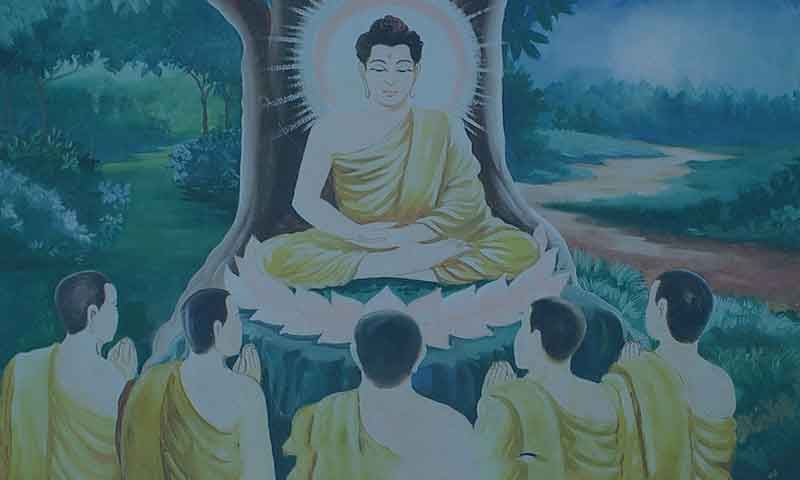
Dhammacakkappavattana Sutta - Setting the Wheel of Truth Rolling
On the fifth day after he arrived at the Deer Park at Isipitana near Benares where he delivered his first sermon to the five wandering monks and converted them to his path, the Buddha delivered them his second sermon on Not Self.
It is known in Buddhist literature as " The Sermon on the Non Existence of Soul." The sermon is presented below in complete detail, for the readers' benefit.
"O monks, the body cannot be considered as soul because it is liable to destruction sensation, perception, predisposition, and consciousness also cannot be considered as soul, because even the consciousness is subject to destruction. Is not the form transitory? Is it permanent? Are not the sensation, perception, inclination, and consciousness transitory? Are they permanent? And that which is transitory, is it evil or good? And that which is transitory, evil, and liable to change, can it be ever considered as ' this is mine' or as "this is I am " " or as " this is my eternal soul "?
"Then o monks, all physical form whether past, present, or future, whether subjective or objective, far or near, high or low, should be rightfully regarded as " this is not I ", "this is not mine" and "this is not my eternal soul." In the like manner all sensation, perception, inclinations and consciousness must be considered as "these are not mine", "these are not I" and "these are not my eternal soul."
"Knowing thus, O monks, a true disciple will develop an aversion to the physical form, to the sensation, perception, inclination and consciousness. There by he overcomes his desire, becomes freed and having become freed realizes that becoming is exhausted, that he has lived a pure life, that he had done what was expected of him and that he has done away with mortality for ever. "
Thus ended the second sermon of the Buddha. The monks who listened to this discourse got enlightenment immediately thereafter and became Arhats, or the perfect ones.
The following text is reproduced from Anatta-lakkhana Sutta The Discourse on the Not-self Characteristic, Translated from Pali by Thanissaro Bhikkhu
The Not Self Characteristic from the Anatta Lakkhana Sutta
I have heard that on one occasion the Blessed One was staying at Varanasi in the Game Refuge at Isipatana. There he addressed the group of five monks:
"Form, monks, is not self. If form were the self, this form would not lend itself to disease. It would be possible [to say] with regard to form, 'Let this form be thus. Let this form not be thus.' But precisely because form is not self, form lends itself to dis-ease. And it is not possible [to say] with regard to form, 'Let this form be thus. Let this form not be thus.'
"Feeling is not self...
"Perception is not self...
"[Mental] fabrications are not self...
"Consciousness is not self. If consciousness were the self, this consciousness would not lend itself to dis-ease. It would be possible [to say] with regard to consciousness, 'Let my consciousness be thus. Let my consciousness not be thus.' But precisely because consciousness is not self, consciousness lends itself to dis-ease. And it is not possible [to say] with regard to consciousness, 'Let my consciousness be thus. Let my consciousness not be thus.'
"What do you think, monks — Is form constant or inconstant?"
"Inconstant, lord."
"And is that which is inconstant easeful or stressful?"
"Stressful, lord."
"And is it fitting to regard what is inconstant, stressful, subject to change as: 'This is mine. This is my self. This is what I am'?"
"No, lord."
"...Is feeling constant or inconstant?"
"Inconstant, lord."...
"...Is perception constant or inconstant?"
"Inconstant, lord."...
"...Are fabrications constant or inconstant?"
"Inconstant, lord."...
"What do you think, monks — Is consciousness constant or inconstant?"
"Inconstant, lord."
"And is that which is inconstant easeful or stressful?"
"Stressful, lord."
"And is it fitting to regard what is inconstant, stressful, subject to change as: 'This is mine. This is my self. This is what I am'?"
"No, lord."
"Thus, monks, any body whatsoever that is past, future, or present; internal or external; blatant or subtle; common or sublime; far or near: every body is to be seen as it actually is with right discernment as: 'This is not mine. This is not my self. This is not what I am.'
"Any feeling whatsoever...
"Any perception whatsoever...
"Any fabrications whatsoever...
"Any consciousness whatsoever that is past, future, or present; internal or external; blatant or subtle; common or sublime; far or near: every consciousness is to be seen as it actually is with right discernment as: 'This is not mine. This is not my self. This is not what I am.'
"Seeing thus, the well-instructed disciple of the noble ones grows disenchanted with the body, disenchanted with feeling, disenchanted with perception, disenchanted with fabrications, disenchanted with consciousness. Disenchanted, he becomes dispassionate. Through dispassion, he is fully released. With full release, there is the knowledge, 'Fully released.' He discerns that 'Birth is ended, the holy life fulfilled, the task done. There is nothing further for this world.'"
That is what the Blessed One said. Gratified, the group of five monks delighted at his words. And while this explanation was being given, the hearts of the group of five monks, through not clinging (not being sustained), were fully released from fermentation/effluents.
Suggestions for Further Reading
- Buddhism - The Concept of Anatta or No Self
- Anatta or Anatma in Buddhism
- Anicca or Anitya in Buddhism
- The Buddha on God
- The Buddha on Avijja or Ignorance and on the Origin of Life
- The Buddha On the Self And Anatta, the Not-Self
- History Of The Four Buddhist Councils
- Chinese Buddhism
- The Eightfold Path Of Buddhism
- The Four Noble Truths of Buddhism
- Four Stages of Progress on the Middle Way in Buddhism
- The Practice of Friendliness, Kalyanamittata, in Buddhism
- Karma or Kamma In Buddhism
- Mahayana Buddhism
- Buddha's Last Days and Final Words
- Buddhism - The Middle Way
- The Buddha's Teaching on Right Mindfulness
- The Meaning and Practice of Mindfulness
- Buddhism - Vinaya or Monastic Discipline
- Right Conduct For Lay Buddhists
- Nirvana or Nibbana in Buddhism
- Buddhism - Objects of Meditation and Subjects for Meditation
- Buddhism - Right Speech and Mind Training
- Buddhism - Right Living On The Eightfold Path
- Handbook for the Relief of Suffering by Ajaan Lee
- Theravada Buddhism
- Meat Eating or Vegetarianism in Buddhism
- Essays On Dharma
- Esoteric Mystic Hinduism
- Introduction to Hinduism
- Hindu Way of Life
- Essays On Karma
- Hindu Rites and Rituals
- The Origin of The Sanskrit Language
- Symbolism in Hinduism
- Essays on The Upanishads
- Concepts of Hinduism
- Essays on Atman
- Hindu Festivals
- Spiritual Practice
- Right Living
- Yoga of Sorrow
- Happiness
- Mental Health
- Concepts of Buddhism
- General Essays