
Symbolism of Ksheera Sagara Manthan
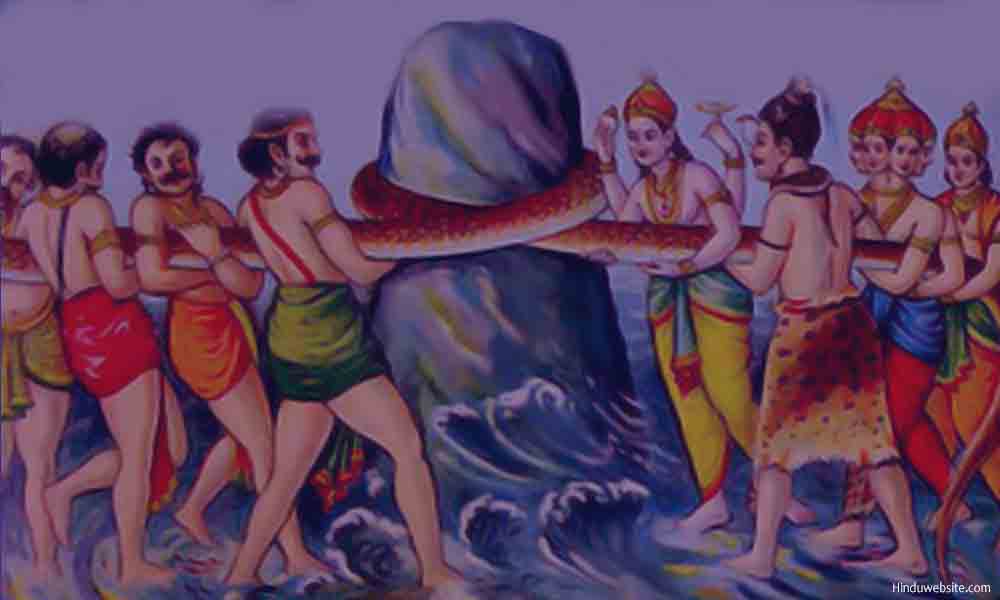
Author's Note: This essay was originally written by me and posted at Hinduwebsite in 2001. While writing on the symbolism of Ksheera Sagara Manthan, I did not rely upon any text or third party source. It was solely based upon my intuitive knowledge. Afterwards many interpretations have surfaced. I have revised this article now, after nearly 15 years, to remove some verbiage and add a few more hidden symbolisms. 04/16/2016
Many Hindus are familiar with the story of Sagara Manthan (also known as Samudra Manthan or Ksheera Sagara Manthan) or the Churning of the Ocean of Milk. It is mentioned in the Bhagavata Purana, the Vishnu Purana, and in the epic Mahabharata. The story goes like this.
The Story of Sagara Manthan
Once Indra lost his kingdom due to the disrespect he showed to sage Durvasa who cursed him out of anger. He approached Lord Vishnu, who advised him to seek the help of the demons to churn the ocean of milk (ksheer sagar) so that he and the devas could partake the Amrit (ambrosia), which would make them immortal and help them regain their lost kingdom.
According to his advice, the devas under the leadership of Indra approached the demons (Asuras) for help. After deliberations, they all finally agreed to churn the ocean together and share the proceeds.
To churn the ocean, first they sought the help of Mount Mandhara, and the great snake Vasuki. The obliged. Using Vasuki, the snake god as the rope and Mandhara, the mountain, as the churning stick they began to churn the ocean. While they were churning it, Lord Vishnu assumed the form of a tortoise and held Mandhara from sinking.
During the churning, several wonderful objects sprung out of the ocean. However, the first to manifest from the ocean was a deadly poison, known as halahal, which seemed to threaten the very existence of all by engulfing the worlds and poison everything. No one was willing to deal with the poison that appeared in the ocean or remove it.
They prayed to Lord Shiva, the healer of sickness and remover of all poisons. He came and saw the poison spreading in the ocean. He gathered the whole poison with his hands into a large cup, and while the gods and demons were watching in amazement, he swallowed it in one gulp. Parvathi, his consort, who was standing by his side, pressed his neck as he swallowed to make sure that the poison would not flow into his stomach. Fortunately, due to the act of Parvathi the poison remained stuck forever in his throat, neither going up into his mind nor going down into his stomach.
Once the danger passed, the gods and demons began churning the ocean again. As they churned, several objects came out, Kamadhenu (the wish fulfilling cow), Ucchaisrava (the white horse), Airavata (the white elephant), Kaustubhamani (a rare diamond), Kalpavriksha (the wish fulfilling tree), Lakshmi (the goddess of wealth), and Sura or Varuni (the goddess of wine). The devas and Asuras divided the objects among themselves. Lakshmi was gifted to Vishnu who was supporting them all along as the tortoise. Finally, Dhanvantari (the divine physician) appeared with the vessel of Amrita in his skillful hands.
The Devas had a plan from the beginning to deny the Asuras their share of Amrita because they did not want the evil ones become immortal and become an eternal pain to all. With the help of Lord Vishnu, they tricked the demons and secured the entire Amrita for themselves. Lord Vishnu assumed the form of a vivacious woman, Mohini, to delude the demons and make them forget temporarily all about the Amrit.
While they were lusting for Mohini, he quietly distributed the ambrosia among the gods, which made them immortal. By the time the Asuras realized what happened, it was already late. Because of Amrit the gods not only became immortal but also defeated the demons in the war that followed and regained their world. This, in brief, is the story of churning of the ocean by gods and demons (deva danava ksheera sagara manthan).
The underlying symbolism of Sagara Manthan
Now, this episode from the Puranas is not just a mythical story. To the ignorant people, the stories from the Puranas look like fictional stories, and some may even laugh at them. However, the wise ones perceive in them hidden symbolism and great spiritual lessons. In fact, many scriptures of Hinduism, including the Vedas are couched in deep symbolism. You will gain an insight into them only if you have the knowledge of the scriptures or have the gift of gods. Like many other Puranic stories, Ksheera Sagara Manthan has a deep symbolism, which becomes evident as you go through the following. Symbolically, it represents the spiritual endeavor of human beings to gain immortality or liberation (Moksha) through yogic practices such as concentration, withdrawal of the senses, self-control, detachment, austerities and renunciation.
Gods and demons
The body is the microcosm, in which both god and demons reside, just as they reside in their respective spheres in the macrocosm. The gods represent the sense organs, virtue, and pleasure principle, while the demons represent delusion, evil tendencies, and the pain principle. The gods also represent the sattva, purity and intelligence, whereas the demons tamas, darkness and grossness of the body.
Spirituality or self-transformation is a churning process which requires the integration of both positive and negative aspects of the human personality. The participation of both the gods and the demons signify that when human seek immortality or liberation through spiritual practice they have to integrate and harmonize both subtle and gross bodies in them and harness both positive and negative energies for the common goal.
Secondly, in spiritual practice, impurities and evil nature also play an important role. By creating barriers and difficulties, they challenge the practitioners to improve their methods or strengthen their resolve and character. As long as a yogi is vulnerable to them he cannot progress on the path. Every failure and set back is an opportunity to him to improve and perfect his methods and approach. Thus, darkness has its own place in the liberation of beings or in gaining immortality (Amrit).
The ocean of milk
The ocean of milk (ksheer sagar), which was churned by the gods and demons, represents the mind or the consciousness, which contains many hidden secrets and treasures. Immortality is also hidden in it. In Hindu literature, the mind is always compared to an ocean (mano sagaram) while thoughts, emotions, modifications and projections of the mind to the waves that rise and fall. The symbolism of the mind as an ocean is universal, known in other cultures also.
The ocean also symbolizes Samsara, or the phenomenal world (samsara sagaram). Just as the human body, the world is also a mixture of both good and evil. They both participate in the continuation of the world and play an important role in the liberation of beings. Death is the poison that is hidden in it. When you churn the world, seeking things because of desires and attachments, you incur sinful karma, another poison, which keeps you bound to the lord of Death. You cannot resolve both, without divine help, or the help of Shiva.
Mount Mandhara and tortoise
Mandhara, the mountain, which was used for the churning stands for concentration. “Mandhara" is a combination of two words "man" (mind) and "dhara" (a point or line) which means a pointed mind in a state of concentration. As you know, you cannot practice spirituality or experience self-absorption without reigning your mind and holding it steady.
During the churning of the ocean, Mount Mandhara was supported by Lord Vishnu in his incarnation as a Tortoise. The tortoise here stands for pratyahara, the withdrawal of the mind and senses into oneself, which is essential to practice concentration (dharana) and meditation or contemplation (dhyana).
The symbolism also suggests that God, Self or Vishnu, is the support for the mind when one is engaged in concentration and meditation or in any spiritual churning of the mind and body. You know that the tortoise has a very hard outer shell, while its inner parts are very tender. Therefore, it also symbolizes a yogi’s state of mind which is impenetrable from outside, but very tender and compassionate from inside filled with devotion to God. The tortoise also symbolizes the human head. The outer shell represents the skull and the inner parts the brain. The head is the support of all spiritual activities just as Vishnu was in the churning of the ocean.
The serpent Vasuki
The great serpent Vasuki, who was used by gods and demons to churn the ocean, represents desire or intention. In Hindu symbolism, desire has traditionally been compared to a thousand hooded serpent. As a divine serpent, Vasuki represents the resolve, desire or the good intention of the gods and demons to obtain Amrit and attain immortality. Without right intention, there can be no initiation into spirituality and without intention and initiation there is no possibility of achieving liberation.
Desires are also the driving forces in our actions or sacrifices. Desire-ridden actions are responsible for karma, while desireless actions, which are performed for the welfare of the world, such as the daily sacrifices, or as a service or as sacrificial offerings to God lead to liberation. Both gods and demons used desire as the rope (means). However, gods churned the ocean according to the instructions of Vishnu for the welfare of the worlds and to protect them from evil, while the demons churned it solely with selfish intentions to use the Amrit for their own ends. Hence, eventually the demons failed to achieve liberation.
To churn the oceans, both gods and demons held the serpent steadily. It is not possible to practice yoga or austerities, unless you keep your desires under control and practice moderation. Gods and demons were able to churn the oceans because they firmly held the serpent with their hands. Thus, the act of holding the serpent in their hands and controlling its movements denotes self-control or the act of holding desires under control in spiritual practice.
Manthan, churning
Churning symbolizes the spiritual transformation or purification of the mind and body on the path of liberation when one is engaged in austerities, celibacy, restraints and self-discipline. It leads to purification of the mind and body and eventual liberation or immortality (Amrit). When milk is churned, butter becomes separated from the milk. In spiritual churning, what become separated from the impurities of the mind like the butter are sattva and mental brilliance (medhas) or pure intelligence. They also lead to increased discernment or the ability to see things clearly without distortions.
Like butter both sattva and intelligence are white in color. They help the mind stabilize in the contemplation of the Self. Just as butter serves as an offering in a fire sacrifice (yajna), sattva and intelligence serve as offerings in the internal sacrifice (antar yajna) of the mind and body. When butter is heated on fire, it becomes ghee, which is also used in sacrifices as an offering. Immortality or liberation is the ghee or the final product in the practice of yoga, just as Amrit is in the churning of the oceans. When a yogi subjects his mind and body (butter) to intense spiritual heat (tapah) through austerities (tapas), they become further purified. His latent impressions become burnt as a result and he attains final liberation (Amrit).
Halahal, the great poison
During the churning of the ocean, halahal, a great poison emerged out of the oceans. The halahal represents all the negativity that surfaces in your consciousness when you begin spiritual practice. It represents pain and suffering, evil thoughts, negative feelings and emotions such as anger, pride, doubt, delusion or despair which initiates experience at the beginning of their spiritual practice.
When the mind is subjected to intense training and discipline during self-purification, it throws up a lot of demons and negativity, which act very much like a poison and destabilize the internal world of a yogi. Hence, it is common for many initiates in the initial stages of their practice to experience intense fear and doubt or feel mentally disturbed. Some may even become mentally unstable or fall seriously ill.
Such problems intensify if a seeker has weaknesses or unresolved problems, or if he does not have proper guidance or resolve. Collectively, all the suffering that arises in the initial stages of spiritual practice can be considered halahal, the great poison of suffering. It can potentially destabilize a person and wean him away from the path of liberation.
Lord Shiva
The intervention of Lord Shiva to resolve the problem of halahal symbolizes the importance of yoga or asceticism, virtue and purity in spiritual life. It also symbolizes the importance of divine grace (anugraha) and the mediation of a spiritual master (guru) in liberation. Lord Shiva symbolizes a yogi or a renunciant (Sanyasi). He represents the ascetic values of renunciation, equanimity, discipline, virtue, knowledge, and self-control. He is pure, truthful, intelligent, auspicious, and inwardly detached.
He was able to consume the poison that arose from the churning of the ocean because he was pure, strong and divine. Therefore, seekers who want to deal with the early problems of spiritual life, such as the instability of the mind, negativity or suffering, should cultivate the austere and divine qualities of Lord Shiva. Only then, they can withstand the rigors of spiritual life and protect themselves. At the same time, to remain protected and progress on the path, they should seek the grace of Shiva (God) or the help of a spiritual master (who is also a personification of Shiva, the universal teacher), or both.
Lord Shiva is also the lord of breath, prananath, or praneshwar. In the body, breath is the purifier and stabilizer. He is also the lord of the organs, who keeps the mind and body pure by removing their impurities and evil influences. In spiritual practice he removes the poisons of the mind and body such as negativity, restlessness, stress, fear and laziness. Advanced yogis gain great control over their breath, which many can even withhold for long duration. During meditation they also learn to keep their minds steady and free from impurities by holding their breath in their throat, near the palate.
The objects
The various objects that came out of the ocean during the churning of the ocean symbolize the psychic, spiritual or supernatural powers or perfections (siddhis), which manifest when a yogi progresses on the path of yoga or liberation. According Hindu tradition, one has to be careful about such powers since they can seriously interfere with one’s spiritual progress. They should be used with great caution and discretion for the welfare of the world or others, rather than for selfish gains. Probably it was why gods and demons readily distributed those powers without any quarrel, since they did not want to become distracted from their final goal of achieving liberation.
Goddess Lakshmi
Among the objects that emerged during the churning, the most prominent one was goddess Lakshmi. She was gifted to Lord Vishnu. The gifting of Lakshmi has an important symbolic significance in spiritual life. Lakshmi symbolizes material wealth or abundance. The underlying symbolism of the act of gifting her to Vishnu is that since all the wealth in the universe belongs to God or Brahman (Vishnu), it is necessary to return to him whatever wealth which a devotee finds or earns in his life. His sacrifice will keep him free from karmic debt and facilitate his progress on the path.
As the Isa Upanishad declares, Brahman is the true inhabitant of the universe and everything in the universe belongs to him. One should therefore live selflessly, performing all actions as an offering to God. The scriptures such as the Bhagavadgita also suggest that on the spiritual path when wealth manifests as the fruit of one's actions, one should renounce the ownership of it and offer it to God as a sacrifice to avoid the consequences of owning wealth or spending it.
Dhanvantari, the divine physician
Dhanvantari is the divine physician. He represents health or physical Wellbeing. During the churning of the ocean he manifested in the end with the vessel, which contained the Amrit. Dhanvantari symbolizes the physical vigor, energy and mental brilliance which arise from the long and arduous practice of yoga and austerities. Prolonged spiritual practice also lead to liberation and immortality. Thus, the body of a liberated being (jivanmukta) is not only healthy but also divine as a vessel of immortality.
Mohini
At the time of the distribution of the elixir, Lord Vishnu manifested as Mohini, a beautiful, celestial maiden and ensured that it was distributed to gods rather than the demons. One may criticize him for his partiality. However, there is an underlying symbolism in this also. Lord Vishnu is beyond the dualities of likes and dislikes. He treats everyone alike. In distributing the Amrit to gods he did not show any partiality. He simply performed his duty as an upholder of Rta (order and regularity), Karma and Dharma.
The Asuras were evil people, each with a long history of evil actions. No one denied them immortality. They denied it to themselves by their cruel and evil actions and intentions. Vishnu’s actions symbolize the role of God in creation as the upholder of Dharma. It suggests that no matter how good you are, or how good your current action may be, you cannot escape from the sins of your past or the karma which you incurred as a consequence of your actions. By denying the distribution of Amrit to the demons, he saved the world from their oppression and protected Dharma.
Mohini also symbolizes the power of Maya, who deludes the worlds and beings from pursuing liberation by subjecting them to delusion, desire, duality, and ignorance. Because of their evil nature and demonic qualities, the asuras easily fell under the spell of Maya and lost their chance to become immortal. The gods were intent upon securing immortality. Hence, they remained focused on it and kept themselves free from the spell.
There is also an important message in this. Human life is precious because only humans can practice spirituality and attain liberation by using their intelligence. Therefore, people should not throw away the precious opportunity by pursuing evil desires or engaging in selfish actions under the spell of Maya. They should practice yoga, cultivate divine qualities and work for liberation to become immortal, without becoming deluded or distracted and without losing their focus on liberation. This is in brief the symbolism hidden in the story of Sagar manthan.
Suggestions for Further Reading
- Symbols of Hinduism
- Beware the Gods are Here
- The Story of Brahma, Gods, Demons and the Humans
- The Story of Gods, Demons and the Soul
- Goddesses, Energies and Divinities of Hinduism in our Inner Universe
- The Wheel As A Symbol Of Creation With God As Its Hub
- The Concept of Brahman As Priest and As Supreme Self
- An Important Lesson From the Mahabharat
- The Samkhya Philosophy and 24 Principles of Creation
- The Bhagavadgita On The Problem Of Sorrow
- The Concept of Atman or Eternal Soul in Hinduism
- The Practice of Atma Yoga Or The Yoga Of Self
- The Problem of Maya Or Illusion and How To Deal With It
- Belief In Atman, The Eternal Soul Or The Inner Self
- Brahman, The Highest God Of Hinduism
- The Bhagavad Gita Original Translations
- The Bhagavadgita, Philosophy and Concepts
- Bhakti yoga or the Yoga of Devotion
- Hinduism And The Evolution of Life And Consciousness
- Why to Study the Bhagavadgita Parts 1 to 4
- The Triple Gunas, Sattva, Rajas and Tamas
- The Practice of Tantra and Tantric Ritual in Hinduism and Buddhism
- The Tradition Of Gurus and Gurukulas in Hinduism
- Origin, Definition and Introduction to Hinduism
- Hinduism, Way of Life, Beliefs and Practices
- A Summary of the Bhagavadgita
- Avatar, the Reincarnation of God Upon Earth
- The Bhagavadgita on Karma, the Law of Actions
- The Mandukya Upanishad
- The Bhagavadgita On The Mind And Its Control
- Symbolic Significance of Numbers in Hinduism
- The Belief of Reincarnation of Soul in Hinduism
- The True Meaning Of Renunciation According To Hinduism
- The Symbolic Significance of Puja Or Worship In Hinduism
- Introduction to the Upanishads of Hinduism
- Origin, Principles, Practice and Types of Yoga
- Hinduism and the Belief in one God
- Essays On Dharma
- Esoteric Mystic Hinduism
- Introduction to Hinduism
- Hindu Way of Life
- Essays On Karma
- Hindu Rites and Rituals
- The Origin of The Sanskrit Language
- Symbolism in Hinduism
- Essays on The Upanishads
- Concepts of Hinduism
- Essays on Atman
- Hindu Festivals
- Spiritual Practice
- Right Living
- Yoga of Sorrow
- Happiness
- Mental Health
- Concepts of Buddhism
- General Essays