
The Truth About You and Your Self-image
Before you proceed further let us ponder over these, which I have formulated for the purpose of this discussion. If you understand them, you will understand what this discussion is going to be.
To know oneself by oneself is to dream a dream within a dream and remember simultaneously all the details of that dream without being part of that dream.
Truly each river is an illusion, just as everything else in the objective universe is. Countless drops of water, grains of sand, dirt and gravel, give you the illusion of a flowing river that really does not exist as a river except in your mind. That river which you see from the banks is never the same and never exists in the same state. You cannot say you see the same river each time you look at it or drink the same water from the same river, although you tend to do. That river which you see from the banks is an impression of the river you have seen before. You hold it in your mind as if it has never changed. You may not agree, but the river does not exist as a phenomenon, except in your imagination. Each moment it is created and destroyed by a combination of factors. Indeed, the river that you see is not the same that I see, although we may stand side by side and watch the same flow. Indeed everything in life is such, an illusion that we create and hold in our minds to make sense of an ever-changing world that is difficult to contain in a crucible of experience.
We cope with life by ignoring its impermanence and creating our own sense of permanence and continuity.
Each day when I wake up, I am a new person I rarely meet and hardly know.
It is difficult to know oneself. To the extent you are self-aware, you control your life and destiny. Not many people succeed in this quest, because it is the most difficult thing to do. It is not that we are completely ignorant of ourselves. We know who are, what we stand for and represent, but the self-images that we build overtime and hold in our minds are shaped mostly by unverified beliefs and conditioned thinking and may not actually represent our true identities. Your senses stand between you and the world and the awareness they create stand between you and your true identity. As a result, you hardly know the truth. To the extent you can clear the fog they create, you will see the truth clearly; but most of the time we choose to live with it rather than deal with it. That fog is identified in the yoga and the Hindu tradition as the impurity (dosa or mala) that needs to be removed before you can see the Self hidden within you in its own light.
In worldly life, our attention remains focused on the things and problems we have to deal with. We rarely take time to look within ourselves and know who we are behind the masks we wear and the dramas we create. We choose to live with the illusions we hatch rather than the reality that confronts us because illusions shield us temporarily from the problems we face. To know yourself you have to deal with many barriers that prevent you from thinking truthfully and objectively. You have to be transparent and absolutely honest with yourself, setting aside all pretentions and self-deceptions. You have to free yourself from the conditioning that shape your thinking and behavior.
Are you what you are?
Therefore, we seldom get to know ourselves truthfully. If I ask you who you are, you may tell me your name, your family background, your profession or your accomplishments. These are aspects of your personality; but do they truly represent you? Most importantly, whether these aspects of your personality or individuality exist because of you or you exist because of them? This is an interesting question. Let us attempt to answer this question in a very practical and direct way and see where we end up.
At the most basic and tangible level, a person is made up of two parts, the mind and the body. We are not going to include the intangible or the eternal Self here, because we are not usually aware of it and in our waking consciousness we do not know anything about it. However, what pervades the mind and body or what arises from their association, is the sense of self, the identity, or the notion of "I am." For the purpose of this discussion, we will consider this as the third part. Our attempt here is to know this third part by understanding the other two and analyzing them. The third part is fundamentally different from the other two. We will realize the reason for this as we gradually expand our discussion and understand its essential nature. Here is a graphic representation of the components that make up a person.
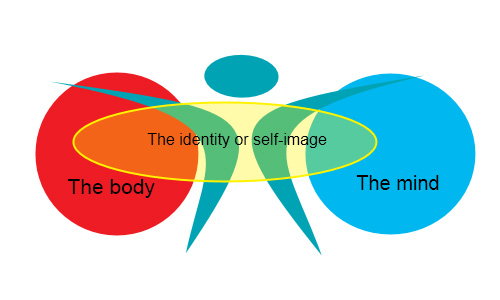 Components of human personality
Now the mind and body, both have numerous parts and sub-parts. If you keep on dividing both of them into their most basic and fundamental parts beyond which further divisions cannot be made, the total number of parts you arrive at in the process would add up to an incredible number that would be difficult to express mathematically.
The illusion of the Self
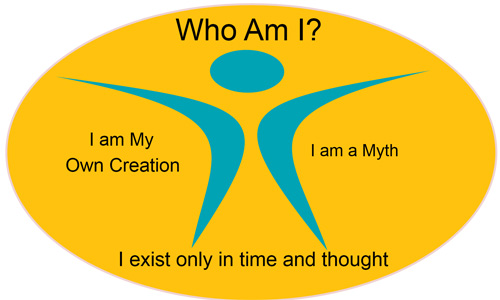 The notion of Self from different perspectives
The third part, the individuality or the personality is not a real part. It is a notion formed by numerous thoughts, ideas, concepts, desires, feelings, memories, emotions, experiences, attachments, beliefs, perceptions, sensations, associations, relationships, and even dreams. These are even more difficult to count, since a vast number of them remain hidden deeply in the consciousness. They are also difficult to distinguish because they may become disguised into numerous forms. This is the component which one assumes as one's true identity. While it does represent a person partially and superficially, it is not one's true identity, since it exists only conceptually to the extent it extends itself into the components of one's mind and body and assumes them as its own parts. This self exists in relation to things, and has states which are numerous, ephemeral and amorphous. It manages to perpetuate its identity as an individual entity with the help of dominant desires, attachments and habitual thought patterns. When these are dissolved, it becomes dissolved.
You begin to realize this, when you sit in meditation and take a deep look at yourself and try to locate your existential self. As you begin to explore your self-identity, one thing becomes clear. You cannot locate it exactly in any part of your body or your mind. You cannot find it hidden in one place. You will realize, much to your surprise, if you are sensitive enough, that your identity, or your individuality exists in the sum total of your parts, but not in the individual parts. That is you exist as a person in the aggregation or coming together of your various parts. Take away a few aspects of you and you are no more the same person you believe yourself to be. The parts are found in everyone. What distinguishes one from another is how these parts are held together as an entity in relation to oneself. You do not exist in your parts that are universal. Individual parts do not distinguish you. You come into existence when these come together and create the illusion of an individuality.
Thus, your beingness is a temporary construct held together by memory and experience. Your identity does not exist in the parts of your body or your mind, but only when you view them in relation to yourself as your parts, your belongings or possessions. You will experience pain when you are separated from them. You will experience joy when you are brought into contact with them. You will grow in strength as you expand yourself by adding more to yourself by way of knowledge, experience, physical power and awareness. In other words, your individuality, your very identity, is a mere notion, or a concept just like the illusion of a drama that appears on a screen for the time images are projected upon it. Your beingness is a creation that comes into existence through your thoughts, desires and actions and remains so in a state of flux by association and aggregation. Truly, it is an illusion, which you perpetuate with the help of a few dominant desires, memories, feelings, emotions and attachments.
Physically speaking, your body and brain are real; but your mind is not so real. It is a repository of all that happens to you externally and internally, really or imaginarily, whereas your individually is just a formation created in it by their association and interaction in response to the world outside. Yet we cling to it, because without it our lives are empty and meaningless. Of what use the experience, when the one who experiences is hardly aware of it? Life is so overwhelming that we cope with it by transforming our perceptions and experiences into a few generalities, routines and habits by which we can safely navigate ourselves through an unsafe and complex world.
You are your own creator, preserver and destroyer
I think, therefore I am (cogito ergo sum), said Rene Descartes. Now, many thinkers approached this statement differently. Whatever may be their interpretation, one fact stands out: our individuality, the fact that we exist as individual entities, arises from our thinking, our desires and attachments. We comes into existence basically by attribution. In this sense, we are our own creators, our own preservers and our own destroyers. Hence, in both Hinduism and Buddhism, we recognize karma as central to our existence. We think, therefore we exist; and since we exist we keep thinking and desiring, which ensures our continuity in the form of becoming and being, the two states from which we are rarely free.
Our experiences shape our personalities. We are products of our interaction with the world in which we live. The world lives in us in fragments, while we live in the world as its temporary dependents. We carry within us the burden of life crushed into memories. Depending upon how interpret them and what relations we establish with the things of the world, we formulate a notion of who we are. The process is similar to that of seeing shapes in clouds. The shapes are not real but they are formed by our imagination. We create our individualities in a similar manner. Filtering our thoughts and experiences according to our desires, knowledge, beliefs attitudes, hopes and fears, we create ourselves to experience life and fulfillment.
The individuality that arises from our numerous experiences as a formation is never static. Like the river, we described before it is in a constant state of flux. It evolves and transforms constantly, while we grow, age and wither away eventually. In truth we die and are reborn each moment. Yet most of us continue to believe that as individuals we are static and that the personality that exists in each of us remains more or less the same throughout.
That the personality or beingness is a formation is an indisputable fact. It is a like a cloud, a wisp of smoke, a flowing river, or a swirl in the waters of life. It is a mythical formation. It is a illusion that forms in our consciousness by the association of our own thoughts and experiences to which we attribute ownership and doership.
Whether this construction, which one creates out of one's own thoughts and experiences as one's identity, outlasts one life and reincarnates repeatedly until is dispersed fully is difficult to answer either intellectually or scientifically. Ancient Indian scholars probed into this aspect repeatedly from numerous perspectives. They tried to understand how the beingness came into existence and whether existence had anything to do with non-existence. They also wondered whether this notion of Self was just a notion or whether there was a greater reality behind it. They also wondered whether there was anything permanent and eternal behind the impermanence that was so strikingly apparent in the phenomenal world. From observation and with insight they surmised that since the moving parts required an unmoving support, like the axis in a moving wheel, the impermanent world must be dependent upon an eternal and indestructible power or source. Such philosophical attempts resulted in the emergence of a great body of Hindu literature which we now know as the Darshanas or visions.
The theistic schools (astikas) believed that behind the apparent illusion of self, which was also called the lower self or the physical self, was an eternal Self that existed not notionally, relatively or by association of parts but in an absolute and real sense. The atheistic schools, the foremost of which was classical Buddhism, argued that there was nothing else beyond the notional Self, which was just a formation created by the aggregation of things. It was a not-self (anatta), in the sense that it was not an eternal and permanent self (atma), but an individuality in a state of flux, held together by desires and delusion. When its parts were dispersed the notional self disappeared into a non-existent state or into a vast emptiness, known as Nirvana. The theistic schools argued that when this notional or false self was dissolved, the real Self hidden within the body would emerge from hiding and escape into an eternal and indescribable reality to remain forever free.
Now, which of these two arguments are correct? That you have to find by yourself.
Suggestions for Further Reading
- Understanding Your Attachments
- Awakening Your Mind and Body To Higher Consciousness
- How to Cultivate Mindful Awareness
- The Basis For Spiritual Life
- Christian Inspiration
- Opening Your Heart to Compassion
- For the Ego Religion is a Tool
- Conquering Fear
- Gandhi, Jesus, Hitler, What is Common to Them?
- Healing Your Consciousness - Advanced Self-healing Techniques
- How to Solve Problems With Spiritual Help?
- Self Discovery - Opening the Door to Self-realization
- How Karma Applies to Animals?
- The Truth About You and Your Self-image
- Relevance of Scriptures in Modern Life
- Making Peace With The Imperfections of Your Existence
- Materialism and Spirituality, The Two Paths of Life
- The Soul and the Mind
- Morality and Nature in Good Vs. Evil
- What is Your Natural State of Mind?
- Why Gandhi's Non-violence Was not True Non-violence
- Objective Concentration Techniques
- If Peace Is All You Want
- Please Come Back to Earth and Be Here
- The Importance of Right Knowledge
- Right Thinking, Right Speech and Right Action
- How to Practice Silence
- The Soul, The Ego and The Process of Liberation
- Spirituality - The Power of True Surrender
- Tapping Into The Hidden Intelligence
- Ten Reflections For a Spiritual Person
- The Mind and The Illusion of Reality
- What is True Surrender
- What is True Surrender
- Your True Guru
- The Significance of Vegetarian Food In Spiritual Life
- Books on Vegetarian Cooking
- Is Enlightenment the Right Word for Spiritual Liberation?
- Who Am I?
- Why do we want our World to End?
- Why is Life Such a Struggle?
- What is Intelligence? A Definition of Intelligence.
- The Witness Self or the Observing Self
- The Zen Art of Seeing Things As They Are - A Story
- Essays On Dharma
- Esoteric Mystic Hinduism
- Introduction to Hinduism
- Hindu Way of Life
- Essays On Karma
- Hindu Rites and Rituals
- The Origin of The Sanskrit Language
- Symbolism in Hinduism
- Essays on The Upanishads
- Concepts of Hinduism
- Essays on Atman
- Hindu Festivals
- Spiritual Practice
- Right Living
- Yoga of Sorrow
- Happiness
- Mental Health
- Concepts of Buddhism
- General Essays