
Jiddu Krishnamurti - A Biography
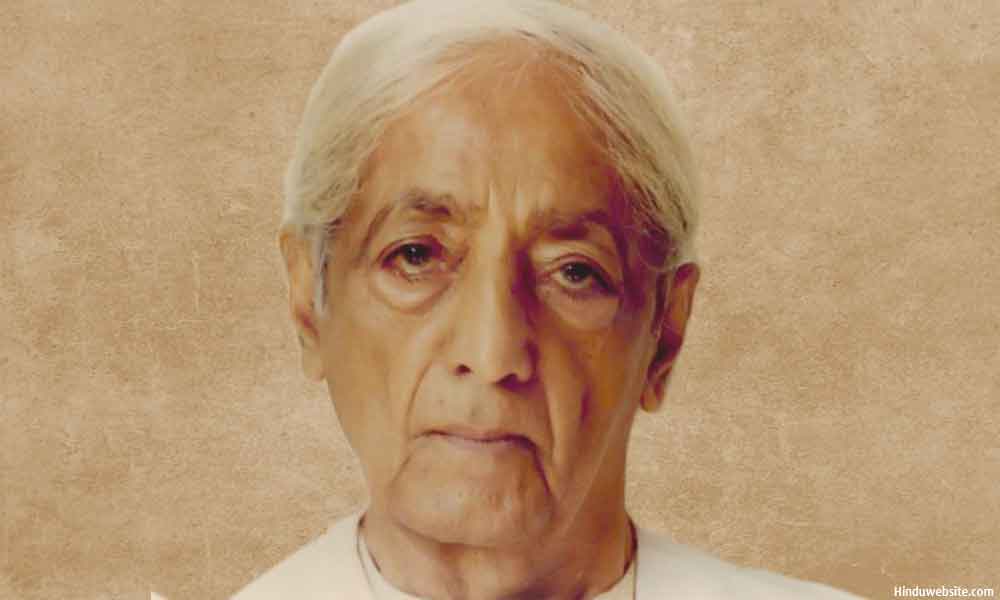
Notes by Jayram V
Jiddu Krishnamurti or J. Krishnamurti (May 11, 1895–February 17, 1986), was born in Madanapalle, India and discovered, in 1909, as a teenager by C.W. Leadbeater on the private beach at the Theosophical headquarters at Adyar in Chennai, India. He was subsequently raised under the tutelage of Annie Besant and C.W. Leadbeater within the world-wide organization of the Theosophical Society, who believed him to be a vehicle for a prophesied World Teacher.
As a young man, he disavowed this destiny and also dissolved the Order established to support it, and eventually spent the rest of his life travelling the world as an individual speaker and educator with essentially the following message:"Truth is a pathless land", humans cannot come to it through any organization, through any creed, through any dogma, priest or ritual, not through any philosophic knowledge or psychological technique. At age 90 he addressed the United Nations on the subject of peace and awareness, and was awarded the 1984 UN Peace Medal. He gave his last talk in India a month before his death, in 1986, in Ojai, California.
His supporters, working through charitable trusts, founded several independent schools across the world—in India, England and the United States—and transcribed many of his thousands of talks, publishing them as educational philosophical books.
His official biographer, Mary Lutyens wrote a book about Krishnamurti's early life in India, England, and finally in Ojai, California, entitled Krishnamurti: The Years of Awakening. She was a close associate of his from the Order of the Star, and knew him from the early days until the end of his life. This book contains many insights into this period of his life, about which he rarely spoke. Lutyens wrote three additional volumes of biography: The Years of Fulfillment (1983), The Open Door (1988), and Krishnamurti and the Rajagopals (1996). Additionally, she published an abridgement of the first three volumes, The Life and Death of Krishnamurti (1991). Other published biographies of Krishnamurti include: Krishnamurti, A Biography (1986), by associate Pupul Jayakar and Star In the East: Krishnamurti, The Invention of a Messiah (2002), by Roland Vernon.
Birth
Jiddu Krishnamurti came from a family of Telugu-speaking Brahmins. His father, Jiddu Narianiah, graduated from Madras University and then became an official in the Revenue Department of the British administration, rising by the end of his career to the position of rent collector and District Magistrate. His parents were second cousins, having a total of eleven children, only six of whom survived childhood. They were strict vegetarians, even shunning eggs, and throwing away any food that the "shadow of an Englishman crossed". (Lutyens, Awakening, p 1)
He was born in a small town about 150 miles (250 km) north of Madras, India. His birthdate has been also stated as May 12, however Mary Lutyens, points out, that the Brahmin day is calculated from dawn and he was born at 12:30 AM, so therefore on May 11. It's only the Western world who would state this was May 12. "As an eighth child, who happened to be a boy, he was, in accordance with Hindu orthodoxy, named after Sri Krishna who had himself been an eighth child."[1]
Youth
In 1903, the family moved to Cudappah and Krishna contracted malaria, a disease with which he would suffer recurrent bouts over many years. In 1904, his eldest sister died, aged twenty. In his memoirs, he describes his mother as "to a certain extent psychic" and how she would frequently see and converse with her dead daughter. Krishna also states that he saw his dead sister on some occasions. In Dec 1905, his mother, Jiddu Sanjeevamma, died at Cudappah, when Krishnamurti was ten years old. Krishna says: "I may mention that I saw her [my mother] after she died" (Lutyens, p 5)
"Narianiah, though an orthodox Brahmin, had been a member of the Theosophical Society since 1881 (Theosophy embraces all religions)." (Lutyens, p 7). This was while Helena Blavatsky was still its head in India. Narianiah had retired at the end of 1907 and wrote to Annie Besant to recommend himself as a caretaker for the 260-acre Theosophical estate at Adyar. He had four boys and Annie thought they would be a disturbing influence and so turned him down. He continued his requests and finally was accepted as an assistant to the Recording Secretary of the Esoteric Section. His family which included, himself, his four sons, and a nephew moved there on Jan 23, 1909.[2] It was a few months after this last move that Krishna was discovered by C.W. Leadbeater. One evening, C.W.Leadbeater went with his young assistants to the beach to bathe. On returning he told his assistant Ernest Wood that one of the boys on the beach had the most wonderful aura he had ever seen, without a particle of selfishness in it. It could not be Krishna’s outward appearance that struck Leadbeater for apart from his wonderful aura, he was not at all impressive at that time. This is how Krishnamurti was discovered by the Theosophists in 1909.
Leadbeater's Influence
This discovery created a bit of a problem, as there was already a conflicting claim made for Hubert van Hook (b 1896), son of Dr Weller van Hook, a surgeon in Chicago, and the General Secretary of the Theosophical Society in the United States. Hubert was also chosen by Leadbeater and after she left her husband, his mother brought him to India for special training. After Krishna was found, Hubert was soon dropped. (Lutyens, p 12)
Leadbeater had a history of being in the company of young boys, and gossip about that was vehemently denied by Annie Besant. The gossip erupted into a scandal in 1906 and led to Leadbeater's resignation from the Theosophical Society, however at the end of 1908 he was re-instated on a vote. (Lutyens, p 15)
Hubert and Mrs Van Hook, his mother, also arrived at Adyar and stayed there for some time.
Separation from father
Krishna (or Krishnaji as he was often called) and his younger brother Nitya were educated at the Theosophical compound and later taken to England to finish their education. His father, pushed into the background by the swirl of interest around Krishna, ended up in a lawsuit against the Society to try to protect his parental interests. As a result of this separation from his family and home, Krishnamurti and his brother Nitya became extremely close and in the following years they often travelled together.
A philosophical awakening
Mary Lutyens states that there came a time when Krishnamurti fully believed that he was to become the World Teacher that he had been told, after correct guidance and education, he would become. However, the unnexpected death of his brother Nitya on November 11, 1925 at age 27 from tuberculosis, fundamentally shook his belief and faith in the divine 'Masters', and the leaders of the Theosophical Society. (Crucially, though he later abandoned the society, he was never to explicitly deny his role of 'the World Teacher' which had been foreseen. Typically he would prefer to discuss directly the fundamental problems effecting mankind rather than such grand and imposed notions - no matter how essentially true they may have been.) He had prayed directly to the Masters for his brother's life to be spared but it was not. The experience of his brother's death shattered his remaining illusions.
From The Song of Life (1931)
My brother died; We were as two stars in a naked sky. He was like me, Burnt by the warm sun...
He died; I wept in loneliness. Where'er I went, I heard his voice and his happy laughter. I looked for his face in every passer by and asked each if he had not met with my brother; But none could give me comfort. I worshipped, I prayed, But the gods were silent. I could weep no more; I could dream no more. I sought him in all things, in every clime. I heard the whispering of many trees Calling me to his abode. And then, in my search, I beheld Thee, O Lord of my heart; In Thee alone I saw the face of my brother. In Thee alone, O my eternal Love, Do I behold the faces Of all the living and all the dead.
From 1925 onward things were to never be the same again.
...An old dream is dead and a new one is being born, as a flower that pushes through the solid earth. A new vision is coming into being and a greater consciousness is being unfolded. ...A new strength, born of suffering, is pulsating in the veins and a new sympathy and understanding is being born of past suffering---a greater desire to see others suffer less, and, if they must suffer, to see that they bear it nobly and come out of it without too many scars. I have wept, but I do not want others to weep; but if they do, I know what it means. (from The Herald of the Star, January 1926)
In 1925, he was expected by Theosophists to enter Sydney, Australia walking on water, but this did not eventuate and he visited Australia the following year by ship.[1]
Krishnamurti's new vision and consciousness continued to develop and reached a climax in 1929, when he rebuffed attempts by Leadbeater and Besant to continue with The Order of the Star - the section of the Theosophical Society devoted to the coming of the World Teacher. Krishnamurti dramatically dissolved the Order on the opening day of the annual Star Camp at Ommen, Holland, August 2, 1929, where, in front of several thousand members, he gave a speech saying:
You may remember the story of how the devil and a friend of his were walking down the street, when they saw ahead of them a man stoop down and pick up something from the ground, look at it, and put it away in his pocket. The friend said to the devil, "What did that man pick up?" "He picked up a piece of the truth," said the devil. "That is a very bad business for you, then," said his friend. "Oh, not at all," the devil replied, "I am going to help him organize it."
I maintain that truth is a pathless land, and you cannot approach it by any path whatsoever, by any religion, by any sect. That is my point of view, and I adhere to that absolutely and unconditionally. Truth, being limitless, unconditioned, unapproachable by any path whatsoever, cannot be organized; nor should any organization be formed to lead or coerce people along a particular path.
After disbanding the Order of the Star and drifting away from the Theosophical Society, its belief system and practices, Krishnamurti spent the rest of his life holding dialogues and giving public talks across the world on the nature of belief, truth, sorrow, freedom, death and the apparently eternal quest for a spiritually-fulfilled life et cetera. Following on from the 'pathless land' notion, Krishnamurti accepted neither followers nor worshippers, seeing the relationship between disciple and guru as encouraging the antithesis of spiritual emancipation - dependency and exploitation. He constantly urged people to think independently and clearly and to explore and discuss specific topics together with him, to "walk as two friends". He accepted gifts and financial support freely offered to him by people inspired by his work (his main residence being on donated land in Ojai, California) and relentlessly continued with lecture tours and the publication of books and talk transcripts for more than half a century.
Later years and "farewell talks"
In his later years, J. Krishnamurti spoke at the United Nations in New York, on the 11th April 1985, where he was awarded the United Nations 1984 Peace medal. (Talk and Q+A session transcript)
In November of 1985, he revisited the places in which he had grown up in India, holding a last set of "farewell talks" between then and January 1986. These last talks were on fundamental principles of belief and lessons. Krishnamurti commented that he did not wish to invite Death, but was not sure how long his body would last, he had already lost some 6 kg (13 lb) and once he could no longer talk or teach, he would have no further purpose. He said a formal farewell to all four points of the compass, the so-called 'elephant's turn', on the Adayar shore where he had long ago come to the attention of others. His final talk, on January 4, 1986, invited his co-participants to examine with him the nature of inquiry, the nature of life, and the nature of creation. It ended:
"So we are inquiring what makes a bird. What is creation behind all this? Are you waiting for me to describe it, to go into it? ... Why? Why do you ask [what creation is]? Because I asked? No description can ever describe the origin. The origin is nameless; the origin is absolutely quiet, it's not whirring about making noise. Creation is something that is most holy, that's the most sacred thing in life, and if you have made a mess of your life, change it. Change it today, not tomorrow. If you are uncertain, find out why and be certain. If your thinking is not straight, think straight, logically. Unless all that is prepared, all that is settled, you can't enter into this world, into the world of creation."
"It ends." (these two words are hardly audible, breathed rather than spoken)
"This is the last talk. Do you want to sit together quietly for a while? All right, sirs, let us sit quietly for a while."
(quotes in this section from "The Future Is Now: Last Talks in India")
J. Krishnamurti passed away one and a half months later at the age of 90 from pancreatic cancer. His remains were cremated and scattered by friends and former associates in the three countries where he had spent most of his life, India, England and United States of America.
Teachings
"The Core of the Teachings" contains the essence of Krishnamurti's work. It was written in London on October 21, 1980, and states in its entirety:
The core of Krishnamurti's teaching is contained in the statement he made in 1929 when he said: 'Truth is a pathless land'. Man cannot come to it through any organization, through any creed, through any dogma, priest or ritual, not through any philosophic knowledge or psychological technique. He has to find it through the mirror of relationship, through the understanding of the contents of his own mind, through observation and not through intellectual analysis or introspective dissection. Man has built in himself images as a fence of security — religious, political, personal. These manifest as symbols, ideas, beliefs. The burden of these images dominates man's thinking, his relationships and his daily life. These images are the causes of our problems for they divide man from man. His perception of life is shaped by the concepts already established in his mind. The content of his consciousness is his entire existence. This content is common to all humanity. The individuality is the name, the form and superficial culture he acquires from tradition and environment. The uniqueness of man does not lie in the superficial but in complete freedom from the content of his consciousness, which is common to all mankind. So he is not an individual.
Freedom is not a reaction; freedom is not a choice. It is man's pretence that because he has choice he is free. Freedom is pure observation without direction, without fear of punishment and reward. Freedom is without motive; freedom is not at the end of the evolution of man but lies in the first step of his existence. In observation one begins to discover the lack of freedom. Freedom is found in the choiceless awareness of our daily existence and activity. Thought is time. Thought is born of experience and knowledge which are inseparable from time and the past. Time is the psychological enemy of man. Our action is based on knowledge and therefore time, so man is always a slave to the past. Thought is ever-limited and so we live in constant conflict and struggle. There is no psychological evolution.
When man becomes aware of the movement of his own thoughts he will see the division between the thinker and thought, the observer and the observed, the experience and the experiencer. He will discover that this division is an illusion. Then only is there pure observation which is insight without any shadow of the past or of time. This timeless insight brings about a deep radical mutation in the mind.
Total negation is the essence of the positive. When there is negation of all those things that thought has brought about psychologically, only then is there love, which is compassion and intelligence.
In "The Last Talks", Radhika Herzberger comments,
"He had set his face against the whole paraphernalia of organized religion - its dogma, churches, rituals, sacred books and gurus - since 1929 when he had written: 'When Krishnamurti dies, which is inevitable, you will set about forming rules in your minds, because the individual, Krishnamurti, had represented to you the Truth. So you will build a temple, you will then begin to have ceremonies, to invent phrases, dogmas, systems of belief, creeds, and to create philosophies. If you build great foundations upon me, the individual, you will be caught in that house, in that temple, and so you will have to have another Teacher come and extricate you from that temple. But the human mind is such that you will build another temple around Him, and so it will go on and on.'
A tremendous volume of material exists documenting the philosophical investigations of Krishnamurti (or simply "K" as he is sometimes referred to) mostly in the form of recorded conversations and talks, although K also wrote several series of short essays and kept a personal journal at least twice in his life. He had dialogues and personal meetings with a wide variety of people from all kinds of backgrounds. An example of the far-ranging and probing dialogues he had is a series of conversations recorded in 1980 with theoretical physicist David Bohm that resulted in the publication of The Ending of Time and The Future of Humanity. These conversations are also available on audio tape and a subset of them on video and DVD as well. Two conversations with Swami Venkatesananda in Saanen explore the role of the guru and the fundamental paths of Hinduism. These conversations are also available on audio tape.
Observation without reward
Questioner: "I have listened to you for many years and I have become quite good at watching my thoughts and being aware of every thing I do, but I have never touched the deep waters or experienced the transformation of which you speak. Why?"
Krishnamurti: "I think it is fairly clear why none of us do experience something beyond the mere watching. There may be rare moments of an emotional state in which we see, as it were, the clarity of the sky between clouds, but I do not mean anything of that kind. All such experiences are temporary and have very little significance. The questioner wants to know why, after these many years of watching, he hasn't found the deep waters. Why should he find them? Do you understand? You think that by watching your own thoughts you are going to get a reward: if you do this, you will get that. You are really not watching at all, because your mind is concerned with gaining a reward. You think that by watching, by being aware, you will be more loving, you will suffer less, be less irritable, get something beyond; so your watching is a process of buying. With this coin you are buying that, which means that your watching is a process of choice; therefore it isn't watching, it isn't attention. To watch is to observe without choice, to see yourself as you are without any movement of desire to change, which is an extremely arduous thing to do; but that doesn't mean that you are going to remain in your present state. You do not know what will happen if you see yourself as you are without wishing to bring about a change in that which you see. Do you understand?
I am going to take an example and work it out, and you will see. Let us say I am violent, as most people are. Our whole culture is violent; but I won't enter into the anatomy of violence now, because that is not the problem we are considering. I am violent, and I realize that I am violent. What happens? My immediate response is that I must do something about it, is it not? I say I must become non-violent. That is what every religious teacher has told us for centuries: that if one is violent one must become non-violent. So I practise, I do all the ideological things. But now I see how absurd that is, because the entity who observes violence and wishes to change it into non-violence, is still violent. So I am concerned, not with the expression of that entity, but with the entity himself. You are following all this, I hope?
Now, what is that entity who says, `I must not be violent'? Is that entity different from the violence he has observed? Are they two different states? Do you understand, sirs, or is this too abstract? It is near the end of the talk and probably you are a bit tired. Surely, the violence and the entity who says, `I must change violence into non-violence', are both the same. To recognize that fact is to put an end to all conflict, is it not? There is no longer the conflict of trying to change, because I see that the very movement of the mind not to be violent is itself the outcome of violence.
So, the questioner wants to know why it is that he cannot go beyond all these superficial wrangles of the mind. For the simple reason that, consciously or unconsciously, the mind is always seeking something, and that very search brings violence, competition, the sense of utter dissatisfaction. It is only when the mind is completely still that there is a possibility of touching the deep waters."
6th public talk Ojai, 21st July 1955 from the booklet "Surely, Freedom From the Self is the True Function of Man".
Other Themes
Choiceless Awareness
The liberating process must begin with the choiceless awareness of what you will and of your reactions to the symbol-system which tells you that you ought, or ought not, to will it. (Foreword to The First and Last Freedom)
The Problem
If, living in the world, you refuse to be a part of it, you will help others out of this chaos--not in the future, not tomorrow, but now. (The First and Last Freedom, p25)
Revolution
Real revolution is not according to any particular pattern, either of the left or of the right, but it is a revolution of values, a revolution from sensate values to the values that are not sensate or created by environmental influences. (The First and Last Freedom, p43) To bring about a fundamental revolution in oneself, one must understand the whole process of one's thought and feeling in relationship. (p49, The First and Last Freedom.)
Meditation
"So, to meditate is to purge the mind of its self-centered activity. And if you have come this far in meditation, you will find there is silence, a total emptiness. The mind is uncontaminated by society; it is no longer subject to any influence, to the pressure of any desire. It is completely alone, and being alone, untouched it is innocent. Therefore there is a possibility for that which is timeless, eternal, to come into being. This whole process is meditation."
Creativeness
The state of creativeness comes only when the self, which is the process of recognition and accumulation, ceases to be because, after all, consciousness as the 'me' is the centre of recognition, and the centre of recognition, and recognition is merely the process of the accumulation of experience. (p40, The First and last Freedom.) The creative release comes only when the thinker is the thought -- but the gap cannot be bridged by any effort. (p140, The First and Last Freedom.)
Thought
Anything that springs from thought is conditioned, is of time, of memory; therefore it is not real. (p139, The First and Last Freedom.)
Belief
If we had no belief but goodwill, love and consideration between us, there would be no wars. (p183, The First and Last Freedom.)
Peace
To live peacefully means not to create antagonism. (p184, The First and Last Freedom.)
Love
Love is not different from truth. Love is that state in which the thought process, as time, has completely ceased. Where love is, there is transformation. Without love, revolution has no meaning, for the revolution is merely destruction, decay, a greater and greater ever-mounting mystery. Where there is love, there is revolution, because love is transformation from moment to moment. (p288, The First and Last Freedom.)
A good "first book" to gain an understanding of his teachings is Freedom From the Known, San Francisco: Harper & Row, 1969, ISBN 0-06-064808-2.
Suggestions for Further Reading
- Jiddu Krishnamurthy
- Becoming Aware of Jiddu Krishnamurthy
- Jiddu Krishnamurthy on Love
- Good Conduct by Jiddu Krishnamurthy
- Biographies of Hindu saints of India and the world
- The Sevenfold Nature of Human Body
- The Historical Christ, The Story of Jesus From Occult Sources
- Thought Forms By Dr.Annie Besant
- Thoughts and Aphorisms of Sri Aurobindo
- Fate and freewill by Sri Aurobindo
- Sri Aurobindo on Yoga
- The Superman by Sri Aurobindo
- The Days and Nights of Brahma
- Life After Death
- The Seven Creations
- The Formation of Solar System
- The Zodiac and Its Antiquity
- Supreme Personality by Dr. Delmer Eugene Croft
- Gnani Yoga, The Law of Karma by Yogi Ramacharaka
- The Hindu-Yogi Science Of Breath, by Yogi Ramacharaka
- Redirect to Rajayoga index page
- Essays On Dharma
- Esoteric Mystic Hinduism
- Introduction to Hinduism
- Hindu Way of Life
- Essays On Karma
- Hindu Rites and Rituals
- The Origin of The Sanskrit Language
- Symbolism in Hinduism
- Essays on The Upanishads
- Concepts of Hinduism
- Essays on Atman
- Hindu Festivals
- Spiritual Practice
- Right Living
- Yoga of Sorrow
- Happiness
- Mental Health
- Concepts of Buddhism
- General Essays
Source: Content for the biography of J.Krishnamurthy has been adapted from the Wikipedia article "Jiddu Krishnamurthy" under the TGNU Free Documentation License