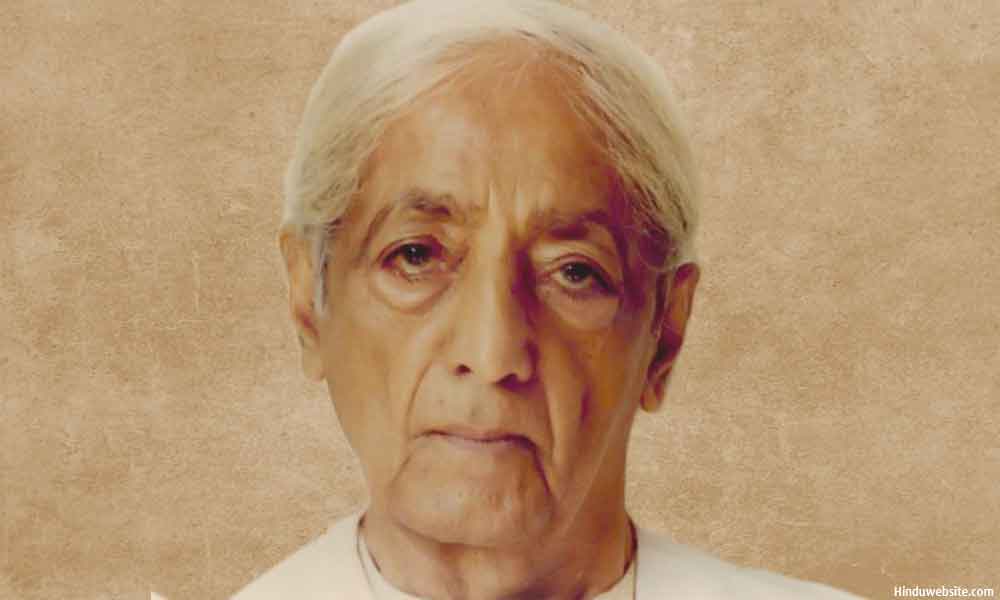
Excerpts From the Teachings & Speeches of J.Krishnamurthy
Experience
One cannot describe or give to another the fullness of an
experience. Each one must live it for himself. (ALPINO, ITALY
1ST PUBLIC TALK 1ST JULY, 1933)
Do you have an experience which is not recognized? Do you
understand what it means? Because that is after all God, that
is the Truth, that is the Eternal or what you will. The moment
you have a measure with which to measure, that is not Truth.
Our Gods are measurable; we know them previously. Our scriptures,
our friends and our religious teachers have so conditioned us
that we know what every thing is. All that we are doing is merely
this process of recognition. MADRAS 1ST PUBLIC TALK 5TH JANUARY
1952
Awareness
How can you find out what you really feel and think? From
my point of view, you can do that only by being aware of your
whole life. (ALPINO, ITALY 1ST PUBLIC TALK 1ST JULY, 1933)
Authority
As long as you do not understand the cause of authority,
you are but an imitative machine, and where there is imitation
there cannot be the rich fulfillment of life. (ALPINO, ITALY
1ST PUBLIC TALK 1ST JULY, 1933)
You are responsible for such external authorities as religion,
politics, morality, for such authorities as economic and social
standards. Out of your emptiness, out of your incompleteness,
you have created these external standards from which you now
try to free yourself. (ALPINO, ITALY 1ST PUBLIC TALK 1ST JULY,
1933)
Problems
Now it is my intention to show that so long as we deal with
these problems apart, separately, we but increase the misunderstanding,
and therefore the conflict, and thereby the suffering and the
pain; whereas, until we deal with the social problem and the
religious and economic problems as a comprehensive whole, not
as divided, but rather see the delicate and the subtle connection
between what we call religious, social or economic problems
- until you see this real connection, this intimate and subtle
connection between these three, whatever problem you may have,
you are not going to solve it. AUCKLAND NEW ZEALAND 1ST PUBLIC
TALK 28TH MARCH, 1934
System
I have no system. I think systems are pernicious things,
because they may for the moment alleviate the problems, but
if you merely follow a system you are a slave to it. AUCKLAND
NEW ZEALAND 1ST PUBLIC TALK 28TH MARCH, 1934
What brings about comprehension is not to search for a new
system, but to discover for yourselves, as individuals, not
as a collective machine but as individuals, what is false and
what is true in the existing system, not to substitute a new
system for the old. AUCKLAND NEW ZEALAND 1ST PUBLIC TALK 28TH
MARCH, 1934
God
Sir, why do you want to know whether God is masculine or
feminine? Why do we question? Why do we try to find out if there
is a God, if it is personal, if it is masculine? Is it not because
we feel the insufficiency of living? AUCKLAND, NEW ZEALAND TALK
TO BUSINESSMEN 6TH APRIL, 1934
Our God is merely a means of escape from these things; whereas,
to me, there is something much more fundamental, real. I say
there is something like God; let us not inquire into what it
is. You will find out if you begin to really understand the
very conflict which is crippling the mind and heart: this continual
struggle for self-security, this horror of exploitation, wars
and nationalities, and the absurdities of organized religion.
If we can face these and understand them, then we shall find
out the real meaning instead of speculating; the real meaning
of life, the real meaning of God. AUCKLAND, NEW ZEALAND TALK
TO BUSINESSMEN 6TH APRIL, 1934
Do you have an experience which is not recognized? Do you
understand what it means? Because that is after all God, that
is the Truth, that is the Eternal or what you will. The moment
you have a measure with which to measure, that is not Truth.
MADRAS 1ST PUBLIC TALK 5TH JANUARY 1952
Completeness of Action
Only when mind is free of the division of time can true action
result. STRESA, ITALY 1ST PUBLIC TALK 2ND JULY, 1933
When action is born of completeness, not in the division
of time, then that action is harmonious and is freed from the
trammels of society, classes, races, religions and acquisitiveness.
To put it differently, action must become truly individual.
STRESA, ITALY 1ST PUBLIC TALK 2ND JULY, 1933
By individual action I mean action that is born of complete
comprehension, complete understanding by the individual, understanding
not imposed by others. Where that understanding exists, there
is true individuality, true aloneness - not the aloneness of
escape into solitude, but the aloneness that is born of the
full comprehension of the experiences of life. STRESA, ITALY
1ST PUBLIC TALK 2ND JULY, 1933
For the completeness of action, mind must be free of this
idea of time as yesterday, today, and tomorrow. If mind is not
liberated from that division, then conflict arises and leads
to suffering and to the search for escapes from that suffering.
STRESA, ITALY 1ST PUBLIC TALK 2ND JULY, 1933
Security
Physical security is a crude form of security, but since
it has been impossible for the majority of mankind to attain
that security, man has turned to the subtle form of security
which he calls spiritual or religious. STRESA, ITALY 1ST PUBLIC
TALK 2ND JULY, 1933
When you are satiated with physical security or when you
cannot attain it, you turn to what you call spiritual security.
And when you turn to that, you establish and vitalize those
things which you call religion and organized spiritual beliefs.
STRESA, ITALY 1ST PUBLIC TALK 2ND JULY, 1933
Because you seek security you establish a form of religion,
a system of philosophical thought in which you are caught, to
which you become a slave. Therefore, from my point of view,
religions with all their intermediaries, their ceremonies, their
priests, destroy creative understanding and pervert judgment.
STRESA, ITALY 1ST PUBLIC TALK 2ND JULY, 1933
So security is but escape. And since most people are trying
to escape, they have made themselves into machines of habit
in order to avoid conflict. They create religious beliefs, ideas;
they worship the image of an imitation which they call God;
they try to forget their inability to face the struggle by losing
themselves in work. All these are ways of escape.
Belief in God
Most of our conceptions of God, of reality, of truth, are
merely speculative imitations. Therefore they are utterly false,
and all our religions are based on such falsities.
A man who has lived all his life in a prison can only speculate
about freedom; a man who has never experienced the ecstasy of
freedom cannot know freedom. So it is of little avail to discuss
God, truth; but if you have the intelligence, the intensity
to destroy the barriers around you, then you will know for yourself
the fulfillment of life. You will then no longer be a slave
in a social or religious system. STRESA, ITALY 1ST PUBLIC TALK
2ND JULY, 1933
Authority
Now in order to safeguard security, you create authority.
Isn't that so? To receive comfort, you must have someone or
some system to give you comfort. STRESA, ITALY 1ST PUBLIC TALK
2ND JULY, 1933
To have security, there must be a person, an idea, a belief,
a tradition, that gives you the assurance of security. So in
our attempt to find security, we set up an authority and become
slaves to that authority. STRESA, ITALY 1ST PUBLIC TALK 2ND
JULY, 1933
In our search for security we set up religious ideals that
we, in our fear, have created; we seek security through priests
or spiritual guides whom we call teachers or masters. Or, again,
we seek our authority in the power of tradition - social, economic,
or political. STRESA, ITALY 1ST PUBLIC TALK 2ND JULY, 1933
Method
So I say, do not seek a way, a method. There is no method,
no way to truth.STRESA, ITALY 1ST PUBLIC TALK 2ND JULY, 1933
Immortality
You have many ideas concerning completeness of life and immortality.
But, to me, this immortality, this richness, this completeness
of life can only be understood and lived when the mind is wholly
free from the limitations, the stupidities, that environment,
past and present, inherited or acquired, is continually placing
about us. NEW YORK CITY 1ST PUBLIC TALK 11TH MARCH, 1935
Conditioning
Now, you are conditioned by environment. You are the result
of your past and present environment, and what you express,
calling it individuality or self-expression, is nothing but
the expression of that conditioning environment. NEW YORK CITY
1ST PUBLIC TALK 11TH MARCH, 1935
To me, the true expression of individuality is that intelligence
which is awakened through freeing the mind from the conditioning
environment of the past and the present. NEW YORK CITY 1ST PUBLIC
TALK 11TH MARCH, 1935
Freedom from Inner Limitations
Until we discover, through experiment, our subtle and deep
limitations, with their reactions, and so free ourselves from
them, we shall lead a life of confusion and strife. For these
limitations prevent the pliability of mind-emotion, making it
incapable of true adjustment to the movement of life. This lack
of pliability is the source of our egotistic competition, fear
and the pursuit of security, leading to many comforting illusions.
OJAI 1ST TALK IN THE OAK GROVE 5TH APRIL, 1936
Clarity of Thought
To understand the confusion and misery that exist in ourselves,
and so in the world, we must first find clarity within ourselves
and this clarity comes about through right thinking.
This clarity is not to be organized for it cannot be exchanged
with another.
Clarity is not the result of verbal assertion but of intense
self-awareness and right thinking
Group Thinking
Organized group thought becomes dangerous however good it
may appear; organized group thought can be used, exploited;
group thought ceases to be right thinking, it is merely repetitive.
Clarity is essential for without it change and reform merely
lead to further confusion. OJAI 1ST PUBLIC TALK 1945
Self Knowledge
Right thinking comes with self-knowledge. Without understanding
yourself, you have no basis for thought; without self-knowledge
what you think is not true. OJAI 1ST PUBLIC TALK 1945
Without self-knowledge understanding is not possible. OJAI
1ST PUBLIC TALK 1945
You must approach the understanding of the self simply, without
any pretensions, without any theories. OJAI 1ST PUBLIC TALK
1945
If I would understand you I must have no preconceived formulations
about you, there must be no prejudice; I must be open, without
judgment, without comparison. OJAI 1ST PUBLIC TALK 1945
Through approximation we think we are understanding, but
is understanding born of comparison, judgment? Or is it the
outcome of non-comparative thought? If you would understand
something do you compare it with something else or do you study
it for itself? OJAI 1ST PUBLIC TALK 1945
The understanding of oneself is from moment to moment; if
we merely accumulate knowledge of the self, that very knowledge
prevents further understanding, because accumulated knowledge
and experience becomes the center through which thought focuses
and has its being. THE FIRST AND LAST FREEDOM CHAPTER 4 'SELF-KNOWLEDGE'
To know yourself, there must be the awareness, the alertness
of mind in which there is freedom from all beliefs, from all
idealization because beliefs and ideals only give you a color,
perverting true perception. THE FIRST AND LAST FREEDOM CHAPTER
4 'SELF-KNOWLEDGE'
If we have no beliefs with which the mind has identified
itself, then the mind, without identification, is capable of
looking at itself as it is - and then, surely, there is the
beginning of the understanding of oneself. THE FIRST AND LAST
FREEDOM CHAPTER 6 'BELIEF'
The Problem of Duality
Change or reform merely within the pattern of duality produces
only further confusion and pain and hence is retrogression.
OJAI 1ST PUBLIC TALK 1945
Listening
Though we appear to be incapable of listening, it seems to
me that it is one of the most necessary and essential things
that we have to do, you and I have to do. MADRAS 1ST PUBLIC
TALK 5TH JANUARY 1952
You should not translate what I am saying, or interpret what
I am saying, or understand it according to your background;
because when you do that, you stop all thinking. MADRAS 1ST
PUBLIC TALK 5TH JANUARY 1952
To listen without interpretation requires extraordinary alertness
of mind. Please try during these discussions and at home to
really listen to each other without interpretation, just to
listen without translating according to your prejudices. MADRAS
1ST PUBLIC TALK 5TH JANUARY 1952
After all, translations mean that you have previous knowledge
which confines thought, prevents it from penetrating further
and deeper. So it is essential that you and I should establish
the right kind of relationship. MADRAS 1ST PUBLIC TALK 5TH JANUARY
1952
I do not believe in authority of any kind; and if you treat
what I am saying as authoritarian, then you stop listening.
MADRAS 1ST PUBLIC TALK 5TH JANUARY 1952
Recognition
By recognition, I mean something that happens when you meet
or see somebody. You then have a subjective reaction, emotion,
and you recognize; you give it a name; and that recognition
only strengthens each experience; and each experience limits,
conditions, and narrows down the self. MADRAS 1ST PUBLIC TALK
5TH JANUARY 1952
So, if you would understand what is reality, what is God,
that centre of recognition must completely end. Otherwise, what
have you? The projection of your mind and memory, what you have
learnt from the past, with which you recognize what is happening.
And what is happening is your own experience projected. MADRAS
1ST PUBLIC TALK 5TH JANUARY 1952
If I want to know what truth is, my mind must be in a state
in which no recognition can ever take place. Is that possible?
MADRAS 1ST PUBLIC TALK 5TH JANUARY 1952
Do you have an experience which is not recognized? Do you
understand what it means? Because that is after all God, that
is the Truth, that is the Eternal or what you will. The moment
you have a measure with which to measure, that is not Truth.
Our Gods are measurable; we know them previously. Our scriptures,
our friends and our religious teachers have so conditioned us
that we know what every thing is. All that we are doing is merely
this process of recognition. MADRAS 1ST PUBLIC TALK 5TH JANUARY
1952
Retreating From Conditioning
And I think it is essential sometimes to go to retreat, to
stop everything that you have been doing, to stop your beliefs
and experiences completely, and look at them anew, not keep
on repeating like machines whether you believe or do not believe.
You would then let in fresh air into your minds. MADRAS 1ST
PUBLIC TALK 5TH JANUARY 1952
Stop being a member of some society. Stop being a Brahmin,
a Hindu, a Christian, a Mussulman. Stop your worship, rituals,
take a complete retreat from all those and see what happens.
MADRAS 1ST PUBLIC TALK 5TH JANUARY 1952
In a retreat, do not plunge into something else, do not take
some book and be absorbed in new knowledge and new acquisition.
Have a complete break with the past and see what happens. Sirs,
do it, and you will see delight. You will see vast expanses
of love, understanding and freedom. When your heart is open,
then reality can come. Then the whisperings of your own prejudices,
your own noises, are not heard. That is why it is good to take
a retreat, to go away and to stop the routine - not only the
routine of out ward existence but the routine which the mind
establishes for its own safety and convenience. MADRAS 1ST PUBLIC
TALK 5TH JANUARY 1952
The Unconscious
The conscious mind can absorb very little. You can only absorb
what has been taught in the school; that is not very much. But
the unconscious is also being treated in the school, the interactions
between you and the teacher, between you and your friends; all
that is going on underground. That matters much more than the
mere absorption of facts on the surface. RAJGHAT 3RD TALK TO
BOYS AND GIRLS 12TH DECEMBER 1952
Comparison
One of the things that prevents the sense of being secure
is comparison. When you are compared with somebody else, in
your studies or in your games or in your looks, you have a sense
of anxiety, a sense of fear, a sense of uncertainty. So, as
we were discussing yesterday with some of the teachers, it is
very important to eliminate, in our school here at Rajghat,
this sense of comparison, this sense of giving you grades or
marks, and ultimately the fear of examination. BANARAS, INDIA
7TH JANUARY 1954 4TH TALK TO STUDENTS AT RAJGHAT SCHOOL
Being
To be is to be related, and there is no such thing as living
in isolation. THE FIRST AND LAST FREEDOM CHAPTER 4 'SELF-KNOWLEDGE'
When one is interested in understanding what is, the actual
state of the mind, one does not need to force, discipline, or
control it; on the contrary, there is passive alertness, watchfulness.
This state of awareness comes when there is interest, the intention
to understand. THE FIRST AND LAST FREEDOM CHAPTER 4 'SELF-KNOWLEDGE'
Memory and Experience
The fundamental understanding of oneself does not come through
knowledge or through the accumulation of experiences, which
is merely the cultivation of memory. THE FIRST AND LAST FREEDOM
CHAPTER 4 'SELF-KNOWLEDGE'
Fear
If you consider, you will see that one of the reasons for
the desire to accept a belief is fear. THE FIRST AND LAST FREEDOM
CHAPTER 6 'BELIEF'
Belief
If we have no beliefs with which the mind has identified
itself, then the mind, without identification, is capable of
looking at itself as it is - and then, surely, there is the
beginning of the understanding of oneself. THE FIRST AND LAST
FREEDOM CHAPTER 6 'BELIEF'
Belief destroys; and this is seen in our everyday lifeTHE
FIRST AND LAST FREEDOM CHAPTER 6 'BELIEF'
Effort and Control
I think we shall understand the significance of life if we
understand what it means to make an effort. Does happiness come
through effort? Have you ever tried to be happy? It is impossible,
is it not? You struggle to be happy and there is no happiness,
is there? THE FIRST AND LAST FREEDOM CHAPTER 7 'EFFORT'
Joy does not come through suppression, through control or
indulgence. You may indulge but there is bitterness at the end.
THE FIRST AND LAST FREEDOM CHAPTER 7 'EFFORT'
You may suppress or control, but there is always strife in
the hidden. Therefore happiness does not come through effort,
nor joy through control and suppression; and still all our life
is a series of suppressions, a series of controls, a series
of regretful indulgences. THE FIRST AND LAST FREEDOM CHAPTER
7 'EFFORT'
Does love or understanding come by strife? I think it is
very important to understand what we mean by struggle, strife
or effort. THE FIRST AND LAST FREEDOM CHAPTER 7 'EFFORT'
Struggle
Being aware that we are empty, inwardly poor, we struggle
either to collect things outwardly, or to cultivate inward riches.
There is effort only when there is an escape from that inward
void through action, through contemplation, through acquisition,
through achievement, through power, and so on. That is our daily
existence. I am aware of my insufficiency, my inward poverty,
and I struggle to run away from it or to fill it. This running
away, avoiding, or trying to cover up the void, entails struggle,
strife, effort. THE FIRST AND LAST FREEDOM CHAPTER 7 'EFFORT'
Simplicity
Simplicity is not merely adjustment to a pattern. It requires
a great deal of intelligence to be simple and not merely conform
to a particular pattern, however worthy outwardly. THE FIRST
AND LAST FREEDOM CHAPTER 11 'SIMPLICITY'
A great many saints, a great many teachers, have renounced
the world; and it seems to me that such a renunciation on the
part of any of us does not solve the problem. Simplicity which
is fundamental, real, can only come into being inwardly; and
from that there is an outward expression. THE FIRST AND LAST
FREEDOM CHAPTER 11 'SIMPLICITY'
A simple person sees much more directly, has a more direct
experience, than the complex person. THE FIRST AND LAST FREEDOM
CHAPTER 11 'SIMPLICITY'
That simplicity comes only through self-knowledge, through
understanding ourselves; the ways of our thinking and feeling;
the movements of our thoughts; our responses; how we conform
...to be safe, to be secure. THE FIRST AND LAST FREEDOM CHAPTER
11 'SIMPLICITY'
When one is seeking security, one is obviously in a state
of fear and therefore there is no simplicity.
Without being simple, one cannot be sensitive - to the trees,
to the birds, to the mountains, to the wind, to all the things
which are going on about us in the world; if one is not simple
one cannot be sensitive to the inward intimation of things.
Most of us live so superficially, on the upper level of our
consciousness; there we try to be thoughtful or intelligent,
which is synonymous with being religious; there we try to make
our minds simple, through compulsion, through discipline. But
that is not simplicity.
To be simple in the whole, total process of our consciousness
is extremely arduous; because there must be no inward reservation,
there must be an eagerness to find out, to inquire into the
process of our being, which means to be awake to every intimation,
to every hint; to be aware of our fears, of our hopes, and to
investigate and to be free of them more and more and more. Only
then, when the mind and the heart are really simple, not encrusted,
are we able to solve the many problems that confront us. THE
FIRST AND LAST FREEDOM CHAPTER 11 'SIMPLICITY'
Awareness
When you are aware, you see the whole process of your thinking
and action; but it can happen only when there is no condemnation.
When I condemn something, I do not understand it, and it
is one way of avoiding any kind of understanding. I think most
of us do that purposely; we condemn immediately and we think
we have understood. If we do not condemn but regard it, are
aware of it, then the content, the significance of that action
begins to open up. Just be aware - without any sense of justification
- which may appear rather negative but is not negative. THE
FIRST AND LAST FREEDOM CHAPTER 12 'AWARENESS'
If I want to understand you, I have to be passively aware;
then you begin to tell me all your story. Surely that is not
a question of capacity or specialization. THE FIRST AND LAST
FREEDOM CHAPTER 12 'AWARENESS'
To Be Aware Without Choice
What is important, surely, is to be aware without choice,
because choice brings about conflict. The chooser is in confusion,
therefore he chooses; if he is not in confusion, there is no
choice. Only the person who is confused chooses what he shall
do or shall not do. The man who is clear and simple does not
choose; what is, is. Action based on an idea is obviously the
action of choice and such action is not liberating; on the contrary,
it only creates further resistance, further conflict, according
to that conditioned thinking. THE FIRST AND LAST FREEDOM CHAPTER
12 'AWARENESS'
To Be Aware Without Memory
The important thing, therefore, is to be aware from moment
to moment without accumulating the experience which awareness
brings; because, the moment you accumulate, you are aware only
according to that accumulation, according to that pattern, according
to that experience. That is your awareness is conditioned by
your accumulation and therefore there is no longer observation
but merely translation. THE FIRST AND LAST FREEDOM CHAPTER 12
'AWARENESS'
Where there is translation, there is choice, and choice creates
conflict; in conflict there can be no understanding. THE FIRST
AND LAST FREEDOM CHAPTER 12 'AWARENESS'
Self Centered Love
Love is the only thing that is eternally new. Since most
of us have cultivated the mind, which is the result of time,
we do not know what love is. THE FIRST AND LAST FREEDOM CHAPTER
19 'SELF-CENTRED ACTIVITY'
We talk about love; we say we love people, that we love our
children, our wife, our neighbor, that we love nature; but the
moment we are conscious that we love, self-activity has come
into being; therefore it ceases to be love. THE FIRST AND LAST
FREEDOM CHAPTER 19 'SELF-CENTRED ACTIVITY'
Organized Religion
First of all, one cannot belong to any organized religion.
I think that is one of the most difficult things for most human
beings; they want to cling to some kind of hope, belief, some
kind of theory or conclusion, or an experience of their own,
giving it a religious significance. Any kind of attachment and
therefore dependence on one’s particular, secret experience
or the accumulated experience of the so-called saints, the mystics,
or your own particular guru or teacher, all that must be completely
and wholly set aside. I hope you are doing it, because a religious
mind is not burdened with fear, or seeking out any form of security
and pleasure. A mind that is not burdened with experience is
absolutely necessary to find out what meditation is. In seeking
experience lies the way to illusion. Beyond Violence Chapter
10 The Religious Mind
Meditation
Meditation is the emptying of the mind, totally. The content
of the mind is the result of time, of what is called evolution;
it is the result of a thousand experiences, a vast accumulation
of knowledge, of memories. - Beyond Violence Chapter 10 The
Religious Mind
The mind is so burdened with the past because all knowledge
is the past, all experience is the past, and all memory is the
accumulated result of a thousand experiences—that is the known.
Beyond Violence Chapter 10 The Religious Mind
Authority
I am saying this most undogmatically: do not listen to anybody—including
the speaker, especially the speaker—because you are very easily
influenced, because you are all wanting something, craving for
something, craving for enlightenment, for joy, for ecstasy,
for heaven; you are caught very easily. So you have to find
it out completely by yourself. Therefore there is no need to
go to India, or to any Zen Buddhist monastery, to meditate,
or to look to any teacher; because if you know how to look,
everything is in you. Therefore you put aside completely all
authority, all looking to anybody, because truth does not belong
to anybody, it is not a personal matter. Meditation is not a
private, personal pleasure or experience. Beyond Violence Chapter
10 The Religious Mind