
Bhagavadgita: 1. The Yoga of Arjuna's Sorrow
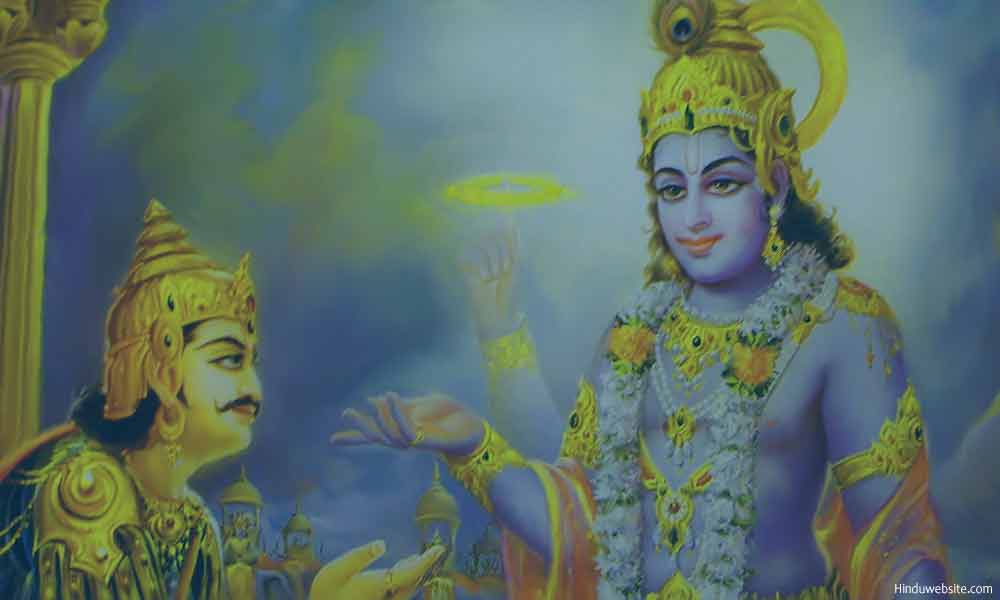
Summary: This is the opening chapter of the Bhagavadgita. It sets the stage for the rest of the discourse. Aruna enters the battlefield, sees all the people who are present there and suffer from a severe sorrow as he thinks of the consequences of the war and their lasting repercussions.
Arjuna Vishada Yoga
1. Asked Dhritarashtra, In the field of righteousness called Kurukshetra, O Sanjaya, doing what are my sons and Pandavas, assembled and excited to fight?
2. Spoke thus Sanjaya, Having seen the numerous battle formations of the Pandava's army, king Duryodhana approached his teacher and uttered the following words.
3. O great teacher, look at the military might of the army of Pandu's sons, strategically arranged by your intelligent disciple and son of Drupada.
4. Here in this army are great heroes and archers, equal to Arjuna and Bhima in fighting, like Yuyudhna, Virata and also the great charioteer, Drupada.
5. And there are great fighters like Dhristaketu, Chekitanu, king of Kasi, the powerful Purujit, Kuntibhoja and Saibya, the notable among men.
6. There are also the mighty Yudhamanyu, powerful Uttamauja, the son of Subhadra and the sons of Draupadi who are all great charioteers.
7. O Superior among the twice born, let me tell you about the most distinguished leaders of my own army, so that you will be able to locate them and remember them during the war.
8. You, Bhishma, Karna, Kripa, Aswaththama, Vikarna and Somadatta's son, who are the best combination for victory in any war, are there
9. And innumerable other heroes too, ready to sacrifice their lives for my sake, equipped with various weapons and well informed in the art of warfare.
10. Unlimited is our strength, well protected by our grandfather Bhishma, while limited is the strength of the Pandavas' army, although it is well protected by Bhima.
11. Therefore all of you should now give full protection to Bhishma, in all the strategic places, as arranged.
12. Then valiant Bhishma, the oldest among the Kurus and the great grandfather, blew his conch making the sound of the roar of a lion, increasing the joy ( of Duryodhana).
13. Then many conches, large drums, small drums, kettle drums, and horns were all at once blown suddenly resulting in a tumultuous noise.
14. Then seated in a great chariot, drawn by white horses, Krishna and Arjuna, also blew their divine conches
15. Panchajanyam, by Hrisikesa, Devadatta by Arjuna, Paundram by Bhima, the voracious eater and performer of mighty deeds.
16. Anantavijayam by king and Kunti's son, Yudhishtira, Sughosha and Manipushpaka by Nakula and Sahadeva .
17. King of Kasi, the supreme archer, Sikhandi, the great charioteer, Dhristadyumna, Virata and the invincible Satyaki, blew their respective conches.
18. O Lord of the earth, Drupada, the sons of Draupadi, Subhadra's son and the mighty armed Abhimanyu also blew their conches.
19. That noise shattered the hearts of the Dhritarashtra's sons and the sky and the earth reverberated with the tumultuous sound
20. There upon, watching the sons of Dhritarashtra thus arrayed, preparing himself for the battle, becoming ready to take the bow into his hands, Arjuna.
21. O Lord of the world, (Arjuna) said these words to Hrisikesa. Said Arjuna, O untainted One, into the middle of both the armies please take my chariot and station me.
22. I want to see them all who are now standing here with the desire to fight and with whom I have to fight in this battle that is about to begin.
23. Let me also see all those who have assembled here to fight, wishing the welfare of the evil minded son of Dhritarashtra (Duryodhana).
24. Sanjaya said, O, Bharata, Addressed thus by Arjuna, Krishna stationed their excellent chariot between the two armies.
25. In front of Bhishma, Drona and all the chieftains of the world, said Krishna, Partha, see all the Kurus.
26. There, standing between the two armies Arjuna saw, his elders, grandfathers, teachers, maternal uncles, brothers, sons, grandsons, friends and also,
27. Fathers-in-law, well wishers in both the armies. After seeing all the relations stationed there, Arjuna,
28. (Arjuna) was overwhelmed with compassion and said these words with great sorrow. Said Arjuna, Seeing all these kinsfolk, O Krishna, assembled here in such a fighting spirit,
29. All the limbs of my body are quivering and my mouth is becoming parched. My whole body is trembling. My hair is standing on end.
30. Gandivam, my bow, is slipping from my hand, and my skin is burning all over, nor I am able to stand properly as my mind is reeling.
31. I am seeing extreme consequences, O Kesava. I am unable to see any positive good by killing my kinsfolk in this fight.
32. I do not desire victory O Krishna, nor kingdom, nor enjoyment, of what use to us, O Govinda, the kingdom or the enjoyments or even the life?
33. For whose sake we desire kingdom, enjoyment and all the comforts, they are all here standing in the battle field, having decided to give up their lives and riches.
34. Teachers, elders, sons, and also grandfathers, maternal uncles, fathers-in-law, grandsons, brothers-in-law and kinsmen,
35. O Madhusudhana, I do not like to kill them , even though they may wish to kill me, not even for the sake of the three worlds. Then what to speak of the earth?
36. By killing the sons of Dhritarashtra, what pleasure we will get O Janardhana ? Sin alone will befall us if we kill these aggressors.
37. Therefore it does not befit us to kill the sons of Dhritarashtra and all our relations. Certainly O Madhava, how can we be happy by killing our own people?
38. Even though they do not perceive, with minds lost to greed, the fallibility of destroying their own family and the disloyalty to their own friends.
39. But why should we, who know the sin of destroying the family, for the sake of avoiding the sin, O Janardhana, turn away from this sin?
40. With the destruction of the family, family order (dharma) and eternal order (dharma) are lost. The whole family transforms itself into adharma (disorder or irreligiousness).
40. With the emergence of adharma, O Krishna, women become impure. And when women fall into bad ways, O descendent of Vrisni, admixture of castes takes place.
41. The intermixture of castes lead the destroyers of the family and also the family to hell. The ancestors (in heaven) also fall, as they do not receive the ritualistic offerings of food and water due to them.
43. Because of the misdeeds of these destroyers of family and order of the castes, the order (dharma) of the community and of the family are permanently destroyed.
44. O Janardhana, I have heard from others that those men whose destroy their family order (dharma) would always dwell in hell.
45. Oh, how strange it is that we have got into this act of committing such a great sin, out of greed for enjoying royal pleasures, by trying to kill our own people!
46. It is much better if the sons of Dhritarashtra, armed with weapons, kill me when I am unarmed and not in a mood to fight and take revenge.
47. Said Sanjaya, Saying thus amidst the battle field, Arjuna sat down in his chariot, distressed mentally by sorrow and dropping aside his bow and arrows.
Thus ends the first chapter named the Yoga of Arjuna's Sorrow in the Upanishad of the divine Bhagavad-Gita , the knowledge of the Absolute, the yogic scripture, and the debate between Arjuna and Lord Krishna.
Suggestions for Further Reading
- The Samkhya Philosophy and 24 Principles of Creation
- The Bhagavadgita On The Problem Of Sorrow
- The Concept of Atman or Eternal Soul in Hinduism
- The Practice of Atma Yoga Or The Yoga Of Self
- The Problem of Maya Or Illusion and How To Deal With It
- Belief In Atman, The Eternal Soul Or The Inner Self
- Brahman, The Highest God Of Hinduism
- The Bhagavad Gita Original Translations
- The Bhagavadgita, Philosophy and Concepts
- Bhakti yoga or the Yoga of Devotion
- Hinduism And The Evolution of Life And Consciousness
- Why to Study the Bhagavadgita Parts 1 to 4
- The Triple Gunas, Sattva, Rajas and Tamas
- The Practice of Tantra and Tantric Ritual in Hinduism and Buddhism
- The Tradition Of Gurus and Gurukulas in Hinduism
- Origin, Definition and Introduction to Hinduism
- Hinduism, Way of Life, Beliefs and Practices
- A Summary of the Bhagavadgita
- Avatar, the Reincarnation of God Upon Earth
- The Bhagavadgita on Karma, the Law of Actions
- The Mandukya Upanishad
- The Bhagavadgita On The Mind And Its Control
- Symbolic Significance of Numbers in Hinduism
- The Belief of Reincarnation of Soul in Hinduism
- The True Meaning Of Renunciation According To Hinduism
- The Symbolic Significance of Puja Or Worship In Hinduism
- Introduction to the Upanishads of Hinduism
- Origin, Principles, Practice and Types of Yoga
- Hinduism and the Belief in one God
- Essays On Dharma
- Esoteric Mystic Hinduism
- Introduction to Hinduism
- Hindu Way of Life
- Essays On Karma
- Hindu Rites and Rituals
- The Origin of The Sanskrit Language
- Symbolism in Hinduism
- Essays on The Upanishads
- Concepts of Hinduism
- Essays on Atman
- Hindu Festivals
- Spiritual Practice
- Right Living
- Yoga of Sorrow
- Happiness
- Mental Health
- Concepts of Buddhism
- General Essays
Copyright: All rights are reserved. No part of this publication may be reproduced stored in a retrieval system, or transmitted in any form or by any means, electronic, mechanical, photocopying, recording, scanning or otherwise, except for your personal use, without the prior written permission of Hinduwebsite.com or the author Jayaram V. If you want to publish the FREE Translation of the Bhagavad gita on your website please contact us and take our prior and written approval.