
Justification of Caste System in The Bhagavadgita
Summary: The triple gunas of Nature are responsible for the diversity of forms in creation. They are also responsible for desire-ridden actions. In this essay we discuss the role of gunas in the fourfold division of human and their predominant behavior.
Gunas and the fourfold division of human beings
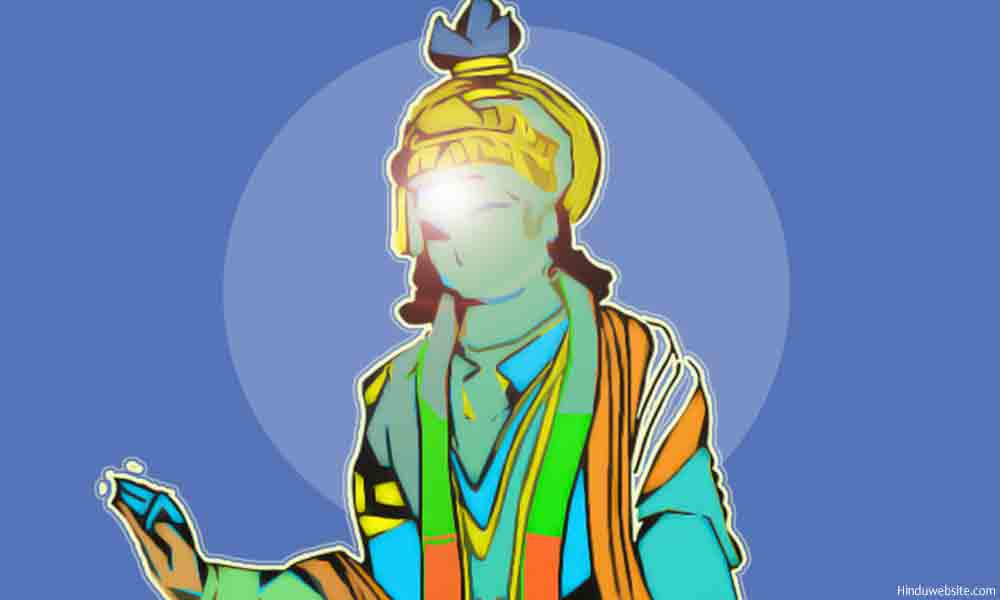
In Chapter 4 Verse 13 Lord Krishna proclaims Himself as the Creator, having brought into existence four kinds of people, categorized according to their qualities and duties based on the qualities. Instead of attributing partiality to the Lord based on this statement, it is worthwhile to look into the subject with an open mind and in a wider context.
The whole creation is made up of only of three gunas (qualities of nature) in different combinations and permutations. They are Sattva, Rajas and Tamas. 'Sattva' represents righteousness, contemplation, purity, moderation, equanimity, and such other noble qualities and is the highest among the three. Rajas represents valor, achievement, ambition, desire for success, worldly desires, and such other active qualities and comes next in terms of divinity or spirituality. Tamas represents dullness, inactivity, laziness, depression and such other insipid qualities and occupies the lowest position among the three gunas. Here, the importance of the three gunas (attributes) are determined according to their capacity to bring Peace, harmony and happiness.
The whole creation is a mixture of the three gunas, each guna presenting itself in varying its quantities and concentrations. That explains the variety and diversity in the creation. These qualities are present in all beings in different concentrations and quantities. Human beings are no exception.
If a person has more of Sattva than the other two qualities, he will have a purer disposition. If a person has the highest concentration of Rajas followed by Sattva, he will have a worldly but noble disposition. If he has the highest concentration of Rajas followed by Tamas, instead of sattva, he will have a worldly but cruder disposition. Finally if the quality of Tamas is in greater concentration compared to the other two qualities, such a person will have a completely gross and cruel disposition.
How does a particular combination of gunas arise in a human being? It is not because he is born in a particular group or community but because he is a product of his previous actions performed in his previous lives. Given the faculty of Freewill, each human being performs different actions. These actions produce results, some of which are immediate and visible while some are invisible and carried forward as a residue. That which is immediate is enjoyed while the residual results come to fruition in some future life. When actions or causes are different, effects will have to be different.
Therefore, the existence of these four types of human beings in the creation is a natural process of the orderly existence of which God is the Supreme Lord. This is from the standpoint of the qualities inherent in the creation of human beings. There will also be variations in the humanity form the standpoint of duties performed by people.
The fourfold caste system
We have seen how human beings differ based upon their inherent qualities of nature. Driven by their predominant guna-combinations, the humanity can also be seen divided into four natural groups, based upon the actions performed by them. Those people with the predominance of Sattva followed by Rajas and Tamas will be in knowledge related professions; like philosophers, preachers and teachers etc.
Those people with the predominance of Rajas followed by Sattva and Tamas in that order will be in achievement related professions like conquerors, leaders, administrators etc. Those people with the predominance of Rajas followed by Tamas and Sattva in that order will be in trade related professions like manufacturers, businessmen, financiers etc.
Those people with the predominance of Tamas followed by Rajas and Sattva will be in service related professions like clerks, cooks, coolies etc. Rajas being the intermediary attitude (guna), when either Sattva or Tamas is predominant in a particular combination, only Rajas follows it. Therefore, occurrence of four groups as above is a certainty; where as any other combination is impossibility.
The four-fold division among human beings, by virtue of their attitudes and by virtue of the actions performed by them, is natural in the creation. As long as there is humanity in the world so long the four-fold division will also remain. Nothing except acceptance of such fact can be done about that because creation means, it is by the combination of different shades of the three gunas only. As the Creator, Lord Krishna owns up His responsibility for the natural division, but nowhere in Gita He distinguishes human beings on the basis of their birth, caste, creed, gender or any other man made division. Before God all are equal, and are eligible to receive the highest Knowledge taught by Him to free them form the clutches of sorrow; it is every one's birthright. The Free Will given to each one, irrespective of their guna-combinations ensures this birthright. Those who use their free will to reach the Lord reach Him without doubt; so also those who use their free will to solely chase materialistic and sensuous pleasures vainly go after them and are ever immersed in sorrow ingrained in such a pursuit.
While owning up responsibility for the natural four fold division in the creation, in the same Verse, Lord Krishna also declares that He is not responsible for that. It is from the perspective of He being the non-doer witness, which concept will be dealt with in the appropriate place later.
Therefore, there is no grain of truth in the observation, that Lord being impartial having owned up responsibility for the four-fold division in the humanity, is proved as above.
Some people observe that the teaching of Bhagavad-Gita is not for youngsters as they might turn recluse upon being taught the Knowledge propounded by Bhagavad- Gita.
We shall analyze the truth in the above observation
Suggestions for Further Reading
- The Samkhya Philosophy and 24 Principles of Creation
- The Bhagavadgita On The Problem Of Sorrow
- The Concept of Atman or Eternal Soul in Hinduism
- The Practice of Atma Yoga Or The Yoga Of Self
- The Problem of Maya Or Illusion and How To Deal With It
- Belief In Atman, The Eternal Soul Or The Inner Self
- Brahman, The Highest God Of Hinduism
- The Bhagavad Gita Original Translations
- The Bhagavadgita, Philosophy and Concepts
- Bhakti yoga or the Yoga of Devotion
- Hinduism And The Evolution of Life And Consciousness
- Why to Study the Bhagavadgita Parts 1 to 4
- The Triple Gunas, Sattva, Rajas and Tamas
- The Practice of Tantra and Tantric Ritual in Hinduism and Buddhism
- The Tradition Of Gurus and Gurukulas in Hinduism
- Origin, Definition and Introduction to Hinduism
- Hinduism, Way of Life, Beliefs and Practices
- A Summary of the Bhagavadgita
- Avatar, the Reincarnation of God Upon Earth
- The Bhagavadgita on Karma, the Law of Actions
- The Mandukya Upanishad
- The Bhagavadgita On The Mind And Its Control
- Symbolic Significance of Numbers in Hinduism
- The Belief of Reincarnation of Soul in Hinduism
- The True Meaning Of Renunciation According To Hinduism
- The Symbolic Significance of Puja Or Worship In Hinduism
- Introduction to the Upanishads of Hinduism
- Origin, Principles, Practice and Types of Yoga
- Hinduism and the Belief in one God
- Essays On Dharma
- Esoteric Mystic Hinduism
- Introduction to Hinduism
- Hindu Way of Life
- Essays On Karma
- Hindu Rites and Rituals
- The Origin of The Sanskrit Language
- Symbolism in Hinduism
- Essays on The Upanishads
- Concepts of Hinduism
- Essays on Atman
- Hindu Festivals
- Spiritual Practice
- Right Living
- Yoga of Sorrow
- Happiness
- Mental Health
- Concepts of Buddhism
- General Essays