
What is Advaita or Advaita Vedanta?
There is only one reality and it is God. (Sounds familiar?)
Dvaita means duality, sense of separation, the notion that there is one and there is another, the conscious experience of an object by a subject or the known by a knower. It is to be aware that you and I exist as two entities and perceive the world in which we exist to be different and separate. Its opposite is Advaita, which means non-duality or the absence of duality, objectivity or otherness. It is a state of oneness with the rest of creation, of the subject with the object, of the knower with the known, of the lower self with the highest self and of the ordinary consciousness with the higher consciousness. It comes with a heightened sense of awareness in which one sees everything in oneself and as oneself. It is the state described in the Upanishads in which one experiences the self as everything and everything in oneself.
Many religions, including the atheistic ones such as Jainism and Buddhism are dualistic in the sense that they do not acknowledge unitary experience of being everything and in everything. So are Judaism, Zoroastrianism, Christianity and Islam. For them, the veil of separation between the person and his or her experience or perception of the world are always present. Some of them believe that God may not exist but souls do exist eternally, without ever having been created by any primacy cause such as God. Others believe that both God and souls exist and though they are made in the image of God they are different in some respects and remain so throughout the period of creation. They may continue to exist till such time the creation continues or eternally for ever. A soul may have the essence of God, but it is not God. A soul may become liberated from earth and go to heaven, but would not become the absolute. A soul may become liberated and remain free from any obligation, but it would not (for heaven sake!) merge into him. Even after dissolution the souls may be withdrawn into a latent state but continue to exist eternally independent of what happens to the material manifestation. Ignoring the subtle details and differences, this in brief is what dualism or dvaita is all about.
The non-dualistic (advaita) schools (for there are many) believe that god and souls are not different. According to them there is only one reality and it is God. The souls come into existence because the One becomes many for his own joy or ananda. Through his dynamic power (or shakti) he brings forth many worlds and many jivas or individual souls and subjects them, through the action of maya or illusion, to the limitations of self (egoism), time (mortality), awareness (ignorance), concealment (illusion), completeness (desires) and action (karma). Deluded, the souls continue their individual existence till they realize their true nature either by the grace of God or through their own previous effort. This realization is called liberation or moksha (cessation of moha or delusion). Once liberated, the individual soul realizes what it has always been and becomes one with itself.
Thus in its dualistic state, under the influence of maya or illusion, an individual soul alternates between two realities, one true and permanent and the other untrue and impermanent. One never changing, eternal and absolute and the other ever changing, transient and relative. To realize the truth hidden behind the veil, to see the radiant being hidden behind the golden lid, to experience the absolute in a relative state and to emerge from a world of dark desires into a world of absolute freedom, this is what a jiva has to aim for and live for in its mortal state.
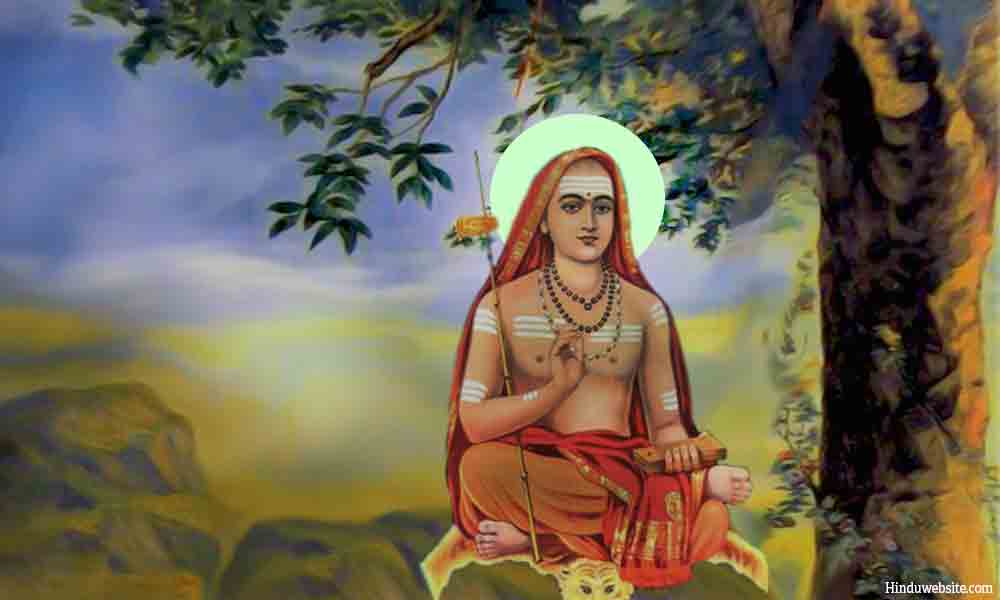
There is a misconception that Sankaracharya propounded the theory of Advaita. It is not true. Centuries before him the Advaita school existed both as a philosophy and a dogma. We can trace it in the Upanishads, the Brahmasutras, the Bhagavadgita and many schools of Saivism. Long before him, Yagnavalkya, Uddalaka Aruni, Ashtavakra and Gaudapada expounded the same philosophy. Sankaracharya added logical or scriptural base and made it more prominent. Through his commentaries and writings he gave a new direction to the school of thought and made it more contemporary. His action was timely and god sent, because it saved generations of Hindus from confusion and conversion in the face of Islam knocking at their doors with a sword and whip as well as gifts and the promise of a better life. His followers continued his work and the momentum generated by him in his short life of 32 years or so. His disciples and their disciples like Suresvara, Padmapada, Prakasatma, Vidyaranya, Vachaspati and many more who followed him and in his footsteps added a rich body of religious literature in support of this school and preserved the tradition and its philosophy for the modern world.
Theory of Knowledge and Means of Interpretation
The advaita school accepts the six pramanas or tests of the Hindu theory of interpreting or arriving at empirical knowledge. They are: perception (pratyaksa), inference (anumana), comparison (upamana), testimony (sabda), presumption (arthapatti) and negation (anupalabdhi). Of these Sankara refers to three pramanas: perception, inference and scriptural testimony. Of these again, the scriptural testimony or the testimony of the Vedas is considered the most important. In the Vedas again it is the knowledge of the absolute Brahman (jnana kanda in contrast to the karma kanda) which is more important in preparing the jiva for the experience of oneness. Advaita vedanta does not advocate dogmatic blind belief based on scriptural evidence. Reason is important. Accepting any dogma without subjecting it to reason would lead to evil consequences. But more important than reason is experience (anubhava). It is the ultimate test of truth and the scriptures are valid only because they reveal the nature of such experience.
The inner self is self-aware and self-luminous. Its very nature is knowledge and consciousness. But it becomes veiled by the actions of the physical self which depends upon the mind to know. The knowledge it gains through the mind is not valid because it does not stand the test of the three times (past, present and future) and of the different states of mind (waking, dreaming, deep sleep etc).
The phenomenal world we experience is also a projection of the mind. It is also self contradictory because of its diversity, impermanence and inconsistency. For the individual, it exists through his mind, which has its own modes and defective methods of perception. So from an absolute perspective, the phenomenal world in which we live and experience cannot be relied upon as a true source of knowledge.
Knowledge of the objective world is but a kind of ignorance or illusion because it prevents us from perceiving things as they are and also the truth hidden in them. Much of what we see is a mere projection. We mistake one for the other, couple the truth with untruth and relate ourselves with the world in terms mine and not mine. The objective of self enquiry is to free ourselves from this confusion and see the truth as it is, to become aware within our own pure consciousness and know simply without any dependence on the external means of knowing. This will come through direct experience.
According to the Advaita Vedanta, reality cannot be two because anything that implies division, contradiction, negation, or conditionality fails the test of supreme consciousness whose nature is eternal and unconditional oneness and indivisibility. If Brahman and Atman are separate, it means one of them is not real, or dependent or imperfect or incomplete or mutable or divided while none of these can truly describe Brahman who is a negation of all these. Therefore Atman and Brahman represent one and the same consciousness. For our understanding we may name them differently as Atman and Brahman but in reality they are but one absolute indistinguishable consciousness which we can experience only by removing our ignorance.
Similarly what we term as saguna and nirguna Brahman are in reality one and the same consciousness. Their apparent division in our minds is an illusion (maya) or a phenomenal appearance caused by maya, just as we tend to mistake the rope for a snake in certain states of mind.
The concept of maya is another important aspect of Advaita Vedanta. Maya is responsible for our phenomenal experience of duality. This maya is neither real nor unreal. It is unreal when viewed from an absolute state of consciousness and real when we view it from relative state. Because it is neither real nor unreal, it is difficult to determine what it actually is (anirvachaniya).
Maya creates ignorance and through ignorance we fail to discriminate between truth and untruth and become attached to the phenomenal world or the world of illusory appearances (samsara). Because of ignorance we also develop false notions of self and identify ourselves with our physical minds and bodies. This results in our bondage and cycle of births and deaths. This mistaken identify leaves impressions or imprints on the imperishable soul and results in its continuation in the phenomenal worlds through many births and deaths. Actually the soul has neither death nor birth, but what appears to be its birth and death is also an illusion.
One can become free from this illusion through jnana or wisdom or through devotion and practice or a combination of all these. Self realization or liberation does not mean that the self needs to know something new or that it has to attain a state of freedom some time in future. Atman is eternally free and self-luminous. It is already aware and already free. What is required is to overcome our ignorance about its state, or the veil of illusion that hides its luminosity from our egoistic selves. Knowledge here does not mean intellectual knowledge, but awareness that comes out of insight and personal experience, through a process of inner purification and self-discipline. The senses have to be withdrawn from the phenomenal world into the mind and the mind into the self. When the senses are quiet and the mind is withdrawn, the veil of ignorance drops and the self shines forth in its full radiance.
It is possible for human beings to realize this state while in their physical bodies. Those who realize it are freed forever. It does not make a difference if they are jivanmuktas (freed from mortal life) or videhamuktas (freed from bodies). There is nothing else to be realized or achieved because the soul has realized its non-difference from the Absolute self which is it true nature.
Suggestions for Further Reading
- Advaita Vedanta, Concepts and Conclusion
- Advaita Vedanta As It Exists
- The Vedanta Philosophy According to Shankara and Ramanuja
- Brahman the highest God of Hinduism
- The Concept of Atman or Eternal Soul in Hinduism
- The Five Bodies of Jiva, the Limited Being
- Brahman according to Advaita and Dvaita schools of thought
- The Concept of Atman or Eternal Soul in Hinduism
- The Problem of Maya Or Illusion and How To Deal With It
- Belief In Atman, The Eternal Soul Or The Inner Self
- Brahman, The Highest God Of Hinduism
- The Bhagavad Gita Original Translations
- The Bhagavadgita, Philosophy and Concepts
- Bhakti yoga or the Yoga of Devotion
- Hinduism And The Evolution of Life And Consciousness
- Why to Study the Bhagavadgita Parts 1 to 4
- Origin, Definition and Introduction to Hinduism
- Symbolic Significance of Numbers in Hinduism
- The Belief of Reincarnation of Soul in Hinduism
- The True Meaning Of Renunciation According To Hinduism
- The Symbolic Significance of Puja Or Worship In Hinduism
- Introduction to the Upanishads of Hinduism
- Origin, Principles, Practice and Types of Yoga
- Essays On Dharma
- Esoteric Mystic Hinduism
- Introduction to Hinduism
- Hindu Way of Life
- Essays On Karma
- Hindu Rites and Rituals
- The Origin of The Sanskrit Language
- Symbolism in Hinduism
- Essays on The Upanishads
- Concepts of Hinduism
- Essays on Atman
- Hindu Festivals
- Spiritual Practice
- Right Living
- Yoga of Sorrow
- Happiness
- Mental Health
- Concepts of Buddhism
- General Essays