
Ashtavakra, Vedic Seer and Teacher
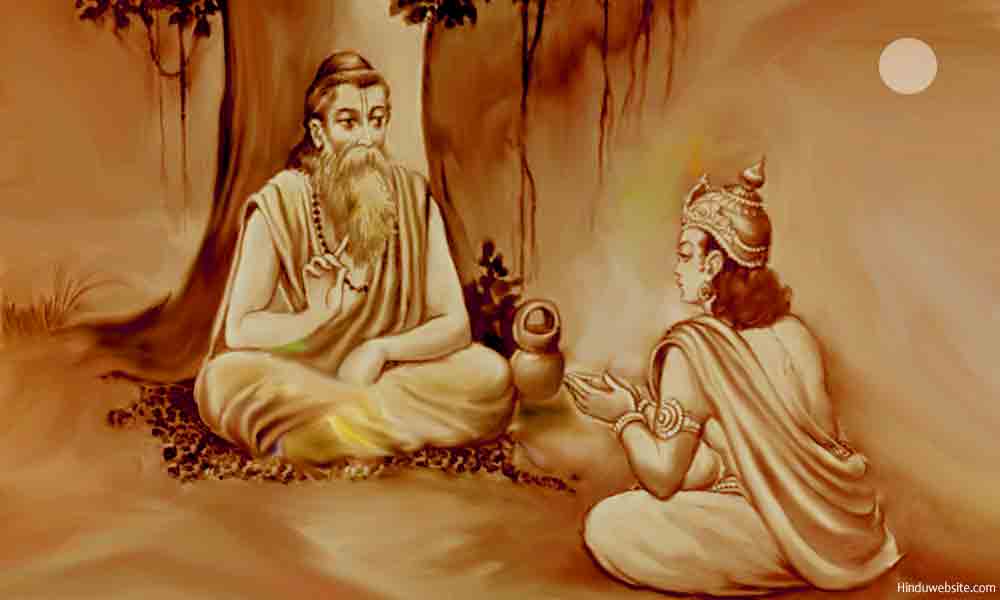
Ashtavakra was a famous seer and teacher of the early Vedic period. His teachings and philosophy is avaialable to us in the Ashtavakra Gita which is considered an authoritative work on advaita vedanta or theory of monism. According to tradition, Ashtavakra was born to Kahoda and Sujata, both of whom were students of Uddalaka and also related to him. Sujata was Uddalaka's daugher, while Kahoda was originally his student, whom he made his son-in-law, impressed by his excellent qualities.
Nothing much is known about the life of Ashtavakra except that he was born in a family of eminent teachers and that he himself was the teacher of Patanjali, the author of Yogasutras. According to tradition he was a precocious child who was born with eight deformities, which earned him the name Ashtavakra. Probably, he might have received his initiation into advaita vedanta from his grandfather Uddalaka, who is mentioned frequently in the Upanishads as a teacher as well as student.
Uddalaka Aruni belonged to a special group of priests known as Charakas. The Charakas were wandering teachers who traveled from one part of the country to another spreading the knowledge of the Vedas and very popular for their knowledge and teaching ability. The young Ashtavakra must have spent considerable time traveling with his parents and grandparents and learning the secrets of the Vedanta from them.
The Ashtavakra Gita was composed in the form of a dialogue between Ashtavakra and King Janaka on the nature of soul, the nature of reality, the cause of the bondage and the means of liberation. It contains 20 chapters and 298 verses of which some are spoken by Ashtavakra and some by Janaka in response to his teachings. From the scripture we learn that king Janaka became enlightened with just one hearing.
It is incorrect to say that the composition is a mere summary of the already existing texts such as the Upanishads or the Bhagavadgita. The information contained in the text contais a coherent philosophy and unfolds gradually, unlike the Upanishads which are more or less lose losely organized and lack coherenece and continuity.
Whatever may be the truth, the Ashtavakra Gita seems to be the work of a self realized seer who had experienced oneness with the supreme self. Advaita Vedanta was subsequently made more popular by the effort and writings of Adi Shankaracharya. T
here is also another argument that Ashtavakra was a mythical person and that the work was probably composed by a disciple of Sankaracharya at a much later date presenting the best principles of advaita vedanta in summary form.
Summary of Teachings
There are two ways to live in this world. Either to watch and be happy or get involved. The deeper the involvement, the greater the stress and the pain.
Many religions teach us not to get involved, but just be a pure witness to what goes on inside and outside. The Buddhist practice of mindfulness is a step in this direction.
Not to get involved with samsara or remain passive is difficult for ordinary human beings, because we have the tendency to feel important, to be part of something, to identify ourselves with some event or movement or other people.
The ego is so deceptive in its mechanism that it will somehow drag us into the middle of the worldly activities through some dubious means. We see this happening in many areas of our lives especially in the religious world.
If you see some religious people fighting for a religious cause or fighting for God physically or emotionally as if God is a helpless being or a political leader, who needs these people to protect his teachings, you can be sure of the play of the ego there.
The snobbery of a religious man is a direct display of ego. The attempts of a few followers of a guru or spiritual person to prevent others from reaching him without the latter's instructions is an example of a puffed up ego. Possessive as ordinarily we are, these people want to own their religion or God or their spiritual masters!
Ashtavakra advises us not to get involved, but simply watch. This noninvolvement should be practiced not in the physical sense but from a spiritual point of view.
You can still get involved, settle disputes, help some body, resolve some one else's problem, teach the religious scriptures or write about them or be an arbitrator or even fight for a righteous cause, but all this has to be done unemotionally, without any particular aim or desire, with detachment, without feeling important and egoistic or as a sacrificial offering to God. We know that without adequate preparation, without inner spiritual advancement and without proper training under an adept or enlightened person this is not simply possible.
We have made available the entire translation of the the Ashtavakra Gita which you may go through or the brief summary presented below.
Know that you are neither the body nor the mind nor the senses, but pure witnessing consciousness
The world appears because of your ignorance and it will disappear when you truly know who you are.
The whole reality is one. The duality between the subject and the object, the knower and the known arises because of ignorance.
When you achieve the supreme state of non duality by realizing that your are in everything and everything is in you and know who you truly are there is nothing that can bind you to this world.
Abandon desire and gain and look on everything like a dream with dispassion, equanimity and detachment
Live with a sense of abandon, with an empty mind, freed from deliberate action, setting aside all preferences and pairs of opposites, without interest in action or inaction, renunciation or acquisition, gain or loss and the very need to become liberated. This is the mark of a truly liberated person who is at peace wherever he is.
Know that you are God himself and that everything is in yourself. Live with this faith.
Suggestions for Further Reading
- Ashtavakra Gita or the Ashtavakra Samhita
- The Bhagavad-gita in a nutshell
- The Bhagavadgita a modern prose translation
- Agasthya the Pitcher Born Hindu Sage Who Went to South
- The Concept of Avatar or Incarnation in Hinduism
- Ananda, the State of Bliss or Happiness
- Akasa, Ether or The Sky and The Fifth Element
- What is Ahimsa, Non-violence or Non-injury?
- The Concept of Atman or Eternal Soul in Hinduism
- The Problem of Maya Or Illusion and How To Deal With It
- Belief In Atman, The Eternal Soul Or The Inner Self
- Brahman, The Highest God Of Hinduism
- The Bhagavad Gita Original Translations
- The Bhagavadgita, Philosophy and Concepts
- Bhakti yoga or the Yoga of Devotion
- Hinduism And The Evolution of Life And Consciousness
- Why to Study the Bhagavadgita Parts 1 to 4
- Origin, Definition and Introduction to Hinduism
- Symbolic Significance of Numbers in Hinduism
- The Belief of Reincarnation of Soul in Hinduism
- The True Meaning Of Renunciation According To Hinduism
- The Symbolic Significance of Puja Or Worship In Hinduism
- Introduction to the Upanishads of Hinduism
- Origin, Principles, Practice and Types of Yoga
- Essays On Dharma
- Esoteric Mystic Hinduism
- Introduction to Hinduism
- Hindu Way of Life
- Essays On Karma
- Hindu Rites and Rituals
- The Origin of The Sanskrit Language
- Symbolism in Hinduism
- Essays on The Upanishads
- Concepts of Hinduism
- Essays on Atman
- Hindu Festivals
- Spiritual Practice
- Right Living
- Yoga of Sorrow
- Happiness
- Mental Health
- Concepts of Buddhism
- General Essays