
The Vedic Symbolism of Gods and Demons
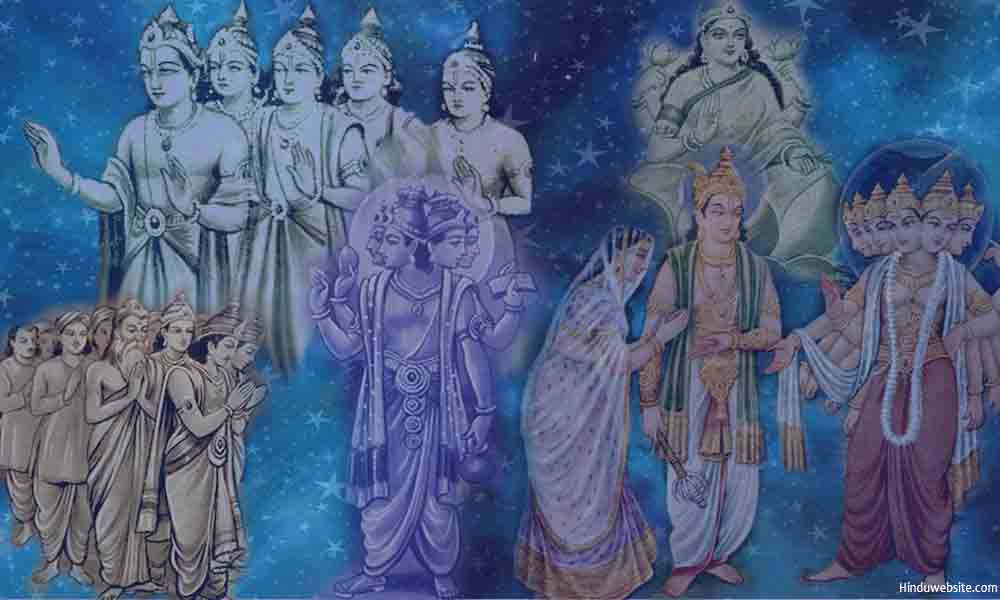
Summary: This essay is about the distinction between gods, humans and demons, the children of Brahma, and their relative significance in God's creation
It is only at the end of many births, the man of wisdom surrenders to Me, realizing that Vasudeva is all. But it is very rare to come across such great souls. Bhagavadgita, Chapter 7
Early Vedic cosmology identified five worlds only, the mortal world of humans, the world of ancestors, the heaven of gods, the underworld of demons and the immortal world of Brahman. Of them, only the last one was eternal and indestructible. The others existed for the duration of the cycle of creation. The embodied souls (jivas), could ascend or descend to any of these worlds during their transmigration, according to their deeds and purity.
According to the Vedic theories of creation, Brahma, the supreme lord of heaven, created gods (devas), humans (manavas) and demons (rakshasas, asuras, danavas, or daityas). Gods live in the upper regions of the manifested worlds, humans live upon earth, and demons live in the lower regions (patala) or the nether worlds. The worlds of gods are filled with light, of demons with darkness, while the human world is subject to the duality of both light and darkness.
Humans are the intermediaries
Humans are the intermediaries, who partake the qualities of both gods and demons. Therefore, we have both good and evil tendencies. According to their actions, past karma and the predominance of desires, we may either cultivate divine qualities and ascend to the immortal world of Brahman or develop demonic nature and fall down into the darkest hell.
Of the three classes of beings, humans have the unique opportunity to become one with Brahman and attain liberation. Neither gods nor demons have the opportunity, unless they descend into the mortal world as humans and work for their liberation. It means that in the mortal world there may be some humans who may be gods in disguise. Due to the influence of Maya, they themselves may not know that they are gods. Since one cannot rule out the possibility, human beings have to be careful in their dealings and relationship with others, so that they may not unintentionally incur sinful karma by disrespecting any divinity in a human body.
The celestial wars between gods and demons
According to the Puranic lore, in the beginning all the children of Brahma Prajapati were mortals. Then, at the suggestion of Brahma, gods managed to secure elixir(amrit) by churning the oceans. The demons helped them to churn the oceans with the promise that they would be entitled for their share. However, in the end, gods managed to secure the whole elixir for themselves by deceiving them, whereby they became immortal, while humans and demons remained mortals. However, they may work for their salvation by spiritual means.
Ever since the earliest days of creation, especially after the churning of oceans in which the demons were deceived by the trickery of Vishnu, gods and demons have been waging a bitter and continuous war for the domination of the worlds. The demons occasionally gain overwhelming strength and threaten the power of Indra and peace in the world. Whenever, they manage to gain ascendance, gods seek the help of the Trinity to defeat them and protect the heaven and their power.
Gods and demons in the microcosm
Symbolically, gods represent the pleasure principle and the demons the pain principle. Since they exist in us as organs and tendencies, we are subject to both pain and pleasure. Since gods and demons reside in the human body, it is considered the field of Nature (kshetra). Depending upon who has the superior strength in our bodies, we may experience pain or pleasure, knowledge and ignorance, discernment or delusion.
The food we eat becomes an offering to the deities who reside in us. Although the organs in the body are considered divinities, they are vulnerable to evil desires and intentions. Only breath is impervious to it. Hence, it is important that we practice self-restraint, cultivate purity, offer food to gods before we eat so that only gods in the body are nourished by it, instead of the demons.
Gods gain strength when the body is filled with the predominance of sattva and the mind is filled with divine thoughts. The scriptures suggest that to abide in good conduct, human beings should eat sattvic food, offer the food to gods before eating it, perform daily and periodic sacrifices, abide in dharma and virtuous conduct and practice devotion to God.
If the demons gain strength, the body becomes a virtual hell, with the darkness and grossness of rajas and tamas, pride, egoism, envy, delusion and other impurities. Hence, to protect themselves from the demonic influence, it is necessary for humans to cultivate virtue, practice dharma, acquire the right knowledge and work for liberation.
Brahma
Brahma is not only the progenitor of all the three classes of beings, he is also their guardian and spiritual teacher. According to the Vedas, he revealed to humans the knowledge of the scriptures and the means to liberation. To the gods he taught the knowledge of the Self through Indra, their leader. He tried to teach the same to Vairochana, the leader of the Demons. However, he misunderstood the teaching and returned to his world with the belief that body was the Self to teach the same doctrine to his fellow demons. Ever since, the demons believe in the doctrine of not-Self (the body) rather than the Self.
The Trinity
Both gods and demons worship the Trinity. However, gods do it as part of their essential nature and duty. They carry out their eternal duties with diligence to ensure the order and regularity of the world. They have their own weaknesses, but they help humans in procreation and continuation of the world. The demons are excessively selfish. They worship the triple gods (Brahma, Vishnu and Shiva) to gain personal boons and powers. Once they secure those powers, they tend to misuse them, often challenging the very deities who grant their wishes and empower them with supernatural powers. Thus, the demons are unpredictable and unreliable, and their methods of worship are extreme and delusional.
The mortal world is vulnerable to both good and evil
The mortal world of humans is vulnerable to the influence of both gods and demons. So is the case with the human body. A constant battle goes on in our minds and bodies between good and evil powers, and depending upon our own nature and inclination, we let one or the other prevail, or both. Human beings have a great responsibility to protect their world and their bodies from the influence of evil and darkness, for which they have to seek the help of gods and practice Dharma. It is said that God is the upholder of Dharma and the balancing power. Therefore, one should seek refuge in him to stay free from evil influence. The Bhagavadgita declares that whenever evil gains ascendance in our world, God incarnates upon earth to destroy evil, protect the virtuous and restore balance.
Although gods are superior to humans, the Creator has created them in such a way that they have to invariably depend upon humans for their survival. While the gods enrich the earth with fertility and ensure timely rains, good harvest and the proper onset of seasons and favorable conditions, they cannot make their own food. For that, they have to depend upon the sacrificial food which the humans offer them through sacrifices and Vedic ceremonies.
Significance of Vedic sacrifices
Thus, in Hinduism sacrifices have a special significance. They are meant to nourish the gods. Since, human beings are by nature selfish, their duties require them to transcend their selfish nature through the practice of Dharma and help others through sacrifices and charity in their survival and Wellbeing. In return for the food they offer and the gifts they give, gods oblige them by ensuring the order and regularity of the world. They grant them their wishes, protect them from natural calamities and fulfill their desire for peace and happiness. Thus, a reciprocally beneficial relationship exists between gods and humans.
Need to nurture gods
The world is protected by gods as long as humans make their offerings and abide in Dharma. If they fail to do so, gods will fade from our world and our consciousness and the world will be engulfed in darkness. As Sri Aurobindo said, gods withdraw from earth consciousness if they are not properly worshipped or remembered. Hence, it is essential that humans do not abandon their duties or their obligation to nourish gods. If gods are undernourished or neglected, the world will fall into evil ways and our minds and bodies succumb to evil temptations. The world will become increasingly evil, resulting in chaos and suffering.
Suggestions for Further Reading
- Hinduism - Gods and Goddess in the Vedas
- The Vedas, Meaning and Significance
- Symbolism of the Vedas
- The Symbolism of Mahishasura Mardini
- The Many Gods and Goddesses of Hinduism
- The Secrets of Devas, The Vedic Gods of Hinduism
- Ritual and Spiritual Aspects of the Vedic Tradition
- Demonic Qualities and Evil Nature
- Yajna - Vedic Sacrifices in Hinduism
- Visadevas, Gods Hinduism
- Aspects, Emanations, Incarnations and Forms of God Vishnu
- Creation in Hinduism As a Transformative Evolutionary process
- The Body as an Abode of Gods
- The Symbolism of Time or Kala and Death in Hinduism
- The Ashtadikpalas, Rulers of Eight Directions
- Death and Afterlife in Hinduism
- God and You in Hinduism
- Brahma, Vishnu, Shiva, the Highest Gods of Hinduism
- Gods and Goddesses of Hinduism
- Symbolism of Vedic Rituals or Sacrifices
- Indriyas, the Sense Organs
- Symbolic Significance of Trimurthis or The Hindu Trinity
- Essays On Dharma
- Esoteric Mystic Hinduism
- Introduction to Hinduism
- Hindu Way of Life
- Essays On Karma
- Hindu Rites and Rituals
- The Origin of The Sanskrit Language
- Symbolism in Hinduism
- Essays on The Upanishads
- Concepts of Hinduism
- Essays on Atman
- Hindu Festivals
- Spiritual Practice
- Right Living
- Yoga of Sorrow
- Happiness
- Mental Health
- Concepts of Buddhism
- General Essays