
Who am I? Aham Brahmasmi
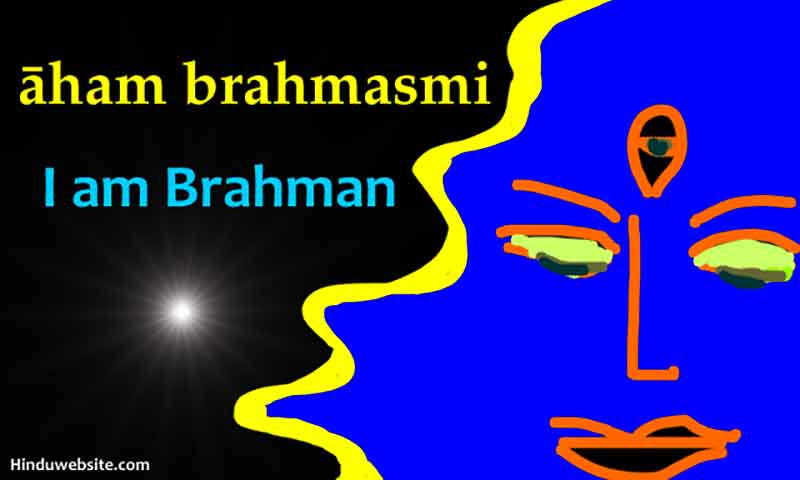
Mahavakya: aham brahmasmi
Translation: aham = I, Brahmasmi = am Brahman
Meaning: I am Brahman
The statement "I am Brahman" is both a postulation on the state of Brahman at an intellectual level and an expression of an enlightened yogi (Brahmajnani) in a state of self-realization. The first one comes out of an insight through the study that "I am" is the state of "Brahman". The second one comes out of an inner experience that "I am indeed none other than Brahman". One is a philosophical insight gained through vichara (thinking), and the other is an awareness which is experienced in a transcendental state of samadhi or union.
The statement "aham brahmasmi" does not vouch that "Atman (self) is Brahman", but "I am Brahman". It is an expression of "I am ness", not Atman, in relationship with Brahman. This distinction is important because different schools of Hinduism interpret the relationship between Atman and Brahman differently, which we will discuss in the last part of this essay. The state of "I am ness" exists in creation in different degrees, ranging from a self aware state of "I am only" to a nescient state of "I am not".
The Five States of "I am ness"
We can discern at least five different states of "I am ness" in beings (jivas). These states are neither sequential nor consequential. A being may experience one or more of these at different times in its existence or at the same time in different dimensions of consciousness. There may be even divisions and subdivision with in each state. We are confining here our discussion to a general description of the five states, which are explained below.
- The first state is the state of "I am not aware that I exist". This is the unconscious state which we experience in our sleeping state and which a recently born baby experiences in its waking state. In the macrocosm, it is also the state of the inanimate objects and many lower organisms.
- The second one is the state of "I am aware that I exist but I cannot conceptualize it". This is the semi conscious state which we experience in our dreaming state and the state of a few weeks' old baby. In the macrocosm it is the state of most animals and birds.
- The third one is the state of "I am aware that I exist in relationship with things, beings and objects." This is the waking state of our ordinary consciousness. In this state, I have some awareness of myself, which is sufficient enough for me to conduct myself in the world and deal with it intelligently. I can identify myself with my unique features, my individuality, my physical personality, my distinct qualities, my actions, my thoughts, my desires and my emotions. It is also the state of duality and the state of a bonded soul.
- The fourth one is the state of "I am aware that I exist. I am also aware that I am existence itself." In this state, I can experience my omnipresence. I can shift my center of awareness at will. I am detached, not bound by the limitations of ego. I am a liberated soul in its subjective state of complete awareness, fulfilled and detached. I exist not in relationship with others but by myself. This is the state of the pure consciousness and of the unlimited self, having the awareness of "I am Brahman" and "Thou art That", not as a mental notion but in a state of self-realization. This is the state of Atman.
- The fifth one is the state of "I am I am." I do not know anyone or anything other than myself. I am absorbed in myself and exist by myself. I am limitless and absolute except when I am associated with my nature (prakriti). I have no duality. There is no instrument by which I know my existence or my otherness, except in a jiva or in a state of incarnation. I am in all and all are in me. This is the state of the supreme eternal Brahman, the state of oneness, the state of non duality, the indivisible, infinite, immeasurable, unknowable state of Being. This is a pure state of "I am only". This is the indescribable state of Brahman in its absolute aspect.
The Four States of Consciousness
Corresponding with these are the four states of self awareness in human beings. The Mandukya Upanishad speaks of them in some detail. In each state, an individual experiences his self differently. These are described below.
- The jagrat or vaishvanara or the waking state. In this state the real self is hidden and the false self is active and in control. This is a state where the lower self is active and the higher self is veiled or hidden. This is a state where I am the body, the mind, the senses and the elements. I am subject to the play of the elements and the laws of karma. I go by a name and form that separates me from rest of the world. This is what the wise say night and the ignorant call day.
- The taijasa or svapna or dreaming state. This is a state where I am semi conscious and identify myself with my inner consciousness, my subtle bodies and senses. I am not even sure which of my selves is active in my dreams, whether my false self or real self or an imaginary self.
- The prajna or sushupti or deep sleep state. This is a state where I am unconscious and do not know who I am. I am asleep. So are my mind, body and the senses.
- The Turiya or the pure state of being. This is a state where I know who I am really. I am wide awake, not in a state of duality but unity and bliss. In this state, I have transcended my elemental self. I Know that I am Atman and also Brahman. I know that I am neither outer consciousness nor inner consciousness, neither semi-consciousness nor sleeping consciousness, neither consciousness nor unconsciousness. This is the state in which the ignorant are asleep and the wise ones are wide awake.
Elemental Self vs Real Self
In the Maitri Upanishad, Prajapati explains to his student Vlakhilyas two types of souls, the bhutatman or the elemental soul and the Atman or the real soul. The bhutatman is the lower self made of the body, the mind, the senses and the elements. It is bound by the qualities of nature and laws of karma. Because it is limited in knowledge it falls into confusion and fails to be conscious of the God, who dwells within. Whenever the elemental soul has thoughts of "I" and "mine", it binds itself with its lower nature and experiences separation and duality. The real self stays in the background, without participating in the events happening around. It awakes only when the elemental soul is at rest or inactive.
In Atman every experience is subjective. Atman does not interact with any object or use any external means to know or experience. It exists by itself and knows by itself. In contrast the experience of elemental self is objective. It uses the mind and the senses to interact with the objects of the phenomenal world. As a seeker begins to withdraw his senses into his mind and his mind into himself, in his elemental self he is confronted with several objects that present themselves to his elemental consciousness. These are the things, desires, thoughts, feelings, knowledge, visions, emotions, temptations, energies, gods and dreams that prevent a smooth self enquiry, like waves of an ocean that rise and fall trying to push away any one who wants to go deeper. If the seeker is not careful he or she would be caught in the whirlpool of these objective phenomena and never reach the inmost self hidden within.
The Gurus as Guide in a World of Objects
This is where the guidance of a guru becomes important. A guru teaches his students how to develop detachment and discernment using the very objective experience that acts as an impediment in case of the uninitiated. He teaches them how to ride the waves of the elemental consciousness like experienced divers, using certain techniques to develop discernment (buddhi) and stay focused. One of the techniques is to develop discrimination and right knowledge by using such expressions as "I am not this" (idam na aham) or "I am not that" (tan na aham), or not this, not this (neti neti). A seeker uses these expressions when various phenomena present themselves in his consciousness, till he transcends the objective reality and reaches the supreme subjective state of "I am Brahman"
The Relationship Between Atman and Brahman
The relationship between Atman and Brahman, or the questions of whether Atman is Brahman, has been approached differently by different schools of religious thought in ancient India. Following is a summary of how this relationship has been interpreted in the past by various schools of Hinduism, Jainism and Buddhism.
- All is Brahman. There is nothing else other than Brahman. He is the cause of all causes. He is also called Atman. In reality there is no distinction between the two. Atman is another name of Brahman or a mental construct we use to make sense of Brahman as the self of individual beings. There may be many beings in the creation, but there in only one Brahman in all of them. During creation Brahman projects himself out as everything and at the end of creation withdraws everything into himself. The phenomenal world is unreal. It an illusion or an apparition, which disappears when we overcome our ignorance and realize the true state of Brahman.
- All is Brahman. Brahman is everything. He is the cause of all causes. However Brahman and Atman cannot be construed as the same. There is a subtle difference. Their relationship is one of bheda-abheda (different but also the same). The individual selves exist in Brahman sharing the same consciousness but appearing as separate entities like the reflection of objects in a mirror in relationship with the mirror. The individual beings become deluded by the power of maya after coming into contact with the elements and qualities of nature. When they overcome maya, they regain their true consciousness. They rejoin Brahman and exist no more as individual entities.
- Brahman and the individual selves exist as separate entities sharing the same consciousness. Brahman is not the cause of their creation. The individual beings co exist eternally with Brahman and come under the cloud of maya or delusion caused by Prakriti which also coexist with them eternally. When they are freed from it they continue to exist as individual beings in their fully realized state even after liberation. They never become one with Brahman. You will find this argument in the Samkhya Darshana.
- Brahman does not exist. But the individual selves exist. They join with Prakriti and experience the illusion of limitations in the phenomenal world. When they overcome the illusion they regain their pure state and continue their existence as liberated beings.
- An absolute being or cause of causes does not exist or may not exist. Beings are anatman that is they do not have souls that are eternal and absolute in nature. Beings come into existence through the aggregation of elements and qualities which result in the formation of bodies and consciousness and the illusion of individuality (ego or self) that is subject to becoming and changing and the laws of karma. It is like the way water vapor or clouds appear in an empty space and assume many forms and states owing to a variety of circumstances and the action of elements. When beings transcend the process of becoming and changing through detachment and mindfulness they enter a state of freedom from becoming and changing which is called nirvana or kaivalya. This view is held in atheistic or materialistic (nastika vada or lokayata) schools.
Suggestions for Further Reading
- Om, Aum, Pranava or Nada in Mantra and Yoga Traditions
- Brahmacharya or Celibacy in Hinduism
- Atheism and Materialism in Ancient India
- Solving the Hindu Caste System
- How To Choose Your Spiritual Guru?
- Creation in Hinduism As a Transformative Evolutionary Process
- Wealth and Duty in Hinduism
- Do You Have Any Plans For Your Rebirth or Reincarnation?
- Understanding Death and Impermanence
- Lessons from the Dance of Kali, the Mother Nature
- Letting your God live in You - The True Essence of the Hindu Way of Life
- prajnanam brahma - Brahman is Intelligence
- Maslow's Hierarchy Of Needs From The Perspective Of Hinduism
- The Defintion and Concept of Maya in Hinduism
- The Meaning of Nirvana
- Self-knowledge, Difficulties in Knowing Yourself
- Hinduism - Sex and Gurus
- The Construction of Hinduism
- The Meaning and Significance of Heart in Hinduism
- The Origin and Significance of the Epic Mahabharata
- The True Meaning of Prakriti in Hinduism
- Three Myths about Hinduism
- What is Your Notion of God?
- Why Hinduism is a Preferred Choice for Educated Hindus
- Essays On Dharma
- Esoteric Mystic Hinduism
- Introduction to Hinduism
- Hindu Way of Life
- Essays On Karma
- Hindu Rites and Rituals
- The Origin of The Sanskrit Language
- Symbolism in Hinduism
- Essays on The Upanishads
- Concepts of Hinduism
- Essays on Atman
- Hindu Festivals
- Spiritual Practice
- Right Living
- Yoga of Sorrow
- Happiness
- Mental Health
- Concepts of Buddhism
- General Essays