
Purusharthas in Hinduism
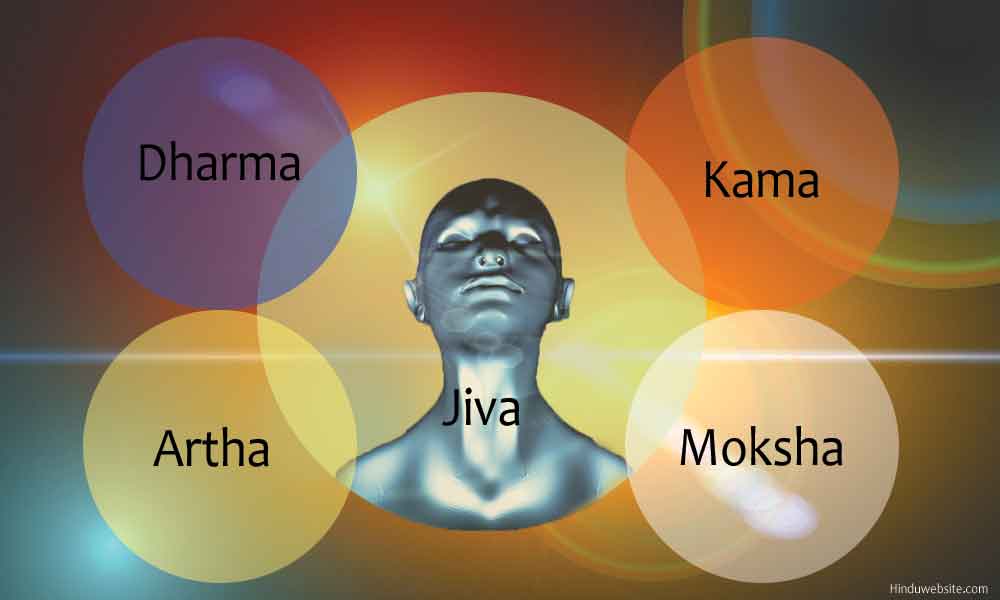
Purusha means either God or a human being. Artha means, purpose, an object or objective. "Purusharthas" means objectives of a person or a human being. Purusha does not mean male in the physical sense, but any individual soul or Self in its purest, undifferentiated aspect. So the Purusharthas are applicable to both men and women equally.
However, the Hindu law books place greater emphasis upon men in performing their obligatory duties and associative roles for women. Sons in a family may have emotional attachment with their mother but have an obligatory duty towards their father, who is responsible for their birth since, as per Hindu beliefs, he carries them in his semen before he transfer them to his wife. A father also lives through his sons. He transmits his powers, name and fame, to his eldest son before he departs from this world. Thus, the Vedic tradition, as is the case with many ancient religious traditions, is predominantly men oriented.
The Purusharthas serve as pointers in the life of a human being. They are based on the vision of God which is evident in the creation He manifested and which can be followed by man to be part of that vision and in harmony with His aims. His worlds are established on the principles of dharma. They are filled with the abundance of material and spiritual beings and energies, who seek fulfillment by achieving their desires and liberation. Since man is God in his microcosmic aspect, he too should emulate God and manifest the same reality in his own little world. He should pursue the same aims, experience life in its fullness and be an instrument of God by serving the purpose for which he has been created. The four chief aims or Purusharthas are:
- Dharma (righteousness)
- Artha (wealth)
- Kama (desire)
- Moksha (salvation or liberation)
The rationale behind these Purusharthas becomes clear when we consider the basic tenets of Hinduism. Man is an aspect of God. He is God's objective reality in creation. He exists in relationship with God like a reflection in the mirror that is somewhat different yet inseparable and somewhat similar. Veiled in him is the true self by the influence and involvement of Prakriti or primordial nature. The purpose of his life upon earth is to follow the law (dharma) of God and achieve salvation (moksha) or freedom from his false self (ahamkara) by leading a balanced life in which both material comforts and human passions have their own place and legitimacy. The four aims are essential for the continuity of life upon earth and for the order and regularity of the world. They provide structure and meaning to human life and give us a reason to live with a sense of duty, moral obligation and responsibility.
Man cannot simply take birth on earth and start working for his salvation right away by means of just dharma alone. If that is so man would never realize why he would have to seek liberation in the first place. As he passes through the rigors of life and experiences the problem of human suffering, he learns to appreciate the value of liberation. He becomes sincere in his quest for salvation. So we have the four goals, instead of just one, whose pursuit provides us with an opportunity to learn important lessons and move forward on the spiritual path. What the Purusharthas characterize is not a life of self-negation, but of balance, complexity, richness, opportunities and moderation in a cosmic drama of immense proportions in which man ultimately envisions and experiences his true grandeur and fulfills the very purpose of his creation.
Every individual in Hindu society is expected to achieve these four objectives with detachment, without any expectation and as a sacrificial offering to God in the ritual of human life. They have to be pursued selflessly for a higher and greater cause. Depending upon the attitude and the manner in which we pursue them, they either set us free or entangle us deeper with the allurements of human life.
Dharma
The first of the goals is dharma, a word which is difficult to translate in English. Since the same word is used in many eastern religions, it means many things to many people and eludes a true definition. It has been variously translated as duty, faith, religion, righteousness, sacred law, justice, ethics, morality and so on. According to one school of Hinduism, dharma is an obligatory duty as prescribed by the Vedas to be performed by an individual in accordance with the rules prescribed for the caste to which he or she belongs. God is an upholder of dharma because he performs His duties even though they are not obligatory and He is without desire or preference.
There is no word in Latin or English that can truly explain the complex meaning of dharma. Its first letter "dha" is also the first letter of dharitri, the earth, which is suggestive of its connection with the earth or earthly life. In a wider sense, dharma is the secret glue, the binding force, which upholds and regulates this entire creation just as the gravitational force controls and holds the entire material universe as one piece. It is the divine constitution that defines our roles and responsibilities, our social and moral order, our purpose and goals and the rewards and punishments that are appropriate for our actions. It is the law of God that is sacred, inviolable and pervasive. It is responsible for order, regularity, harmony, control, predictability and accountability. According to Manusmriti, dharma is four footed in the Krita age and loses one leg in each successive age. Thus in the fourth and last age of Kali, it becomes crippled and rests upon just one leg.
Dharma exists in all planes, in all aspects and at all levels of creation. In the context of human life, dharma consists of all that an individual undertakes in harmony with divine injunctions and his own sense of morality and justice. However to comprehend the true nature of dharma is not an easy task. The world is enveloped in illusion as our human minds are. What we see in the world and learn from it may not be true and reliable. What we consider as right and wrong or dharma and adharma may not stand the test of truth. Hence to practice dharma we are advised to rely upon the scriptures and follow the injunctions contained there in.
The sources of dharma are the Vedas, the Vedangas, the Sutra literature of which the most important are the Dharmashastras, and scriptures such as the Bhagavadgita. In ancient India Dharmashastras (law books) played an important role in guiding people on the path of dharma. It is however difficult to say how far they are relevant in the present age. One should also remember that dharma should not be viewed as end in itself but the means to a still higher end, liberation.
Artha
Artha means wealth. Hinduism recognizes the importance of material wealth for the overall happiness and well being of an individual. A house holder requires wealth, because he has to perform many duties to uphold dharma and take care of the needs of his family and society. A person should not seek wealth for wealth sake but to uphold dharma and help the members of his family and society achieve their goals. Hinduism therefore rightly places material wealth as the second most important objective in human life. While dharma and moksha are meant for oneself, wealth and sex are to be pursued for the sake of others. Lord Vishnu is the best role model for any householder. He leads a luxurious life, served by the goddess of wealth herself, but is very dutiful, helpful, responsive and righteous. So was Lord Krishna while he was in human form. He lived a very luxurious life, but was righteous, detached and balanced.
Hinduism advocates austerity, simplicity and detachment, but does not glorify poverty. Wealth is not an impediment to self-realization, but attachment to wealth is. Desire for wealth is different from greed for wealth. Selfless desire for wealth is preferable to selfish desire for wealth. Money and wealth are a form of divine energy. God is abundance. He is endowed with eight kinds of wealth. But as Sri Aurobindo pointed out we have negative attitude mostly about wealth because hostile and negative forces want us believe so and thereby prevent its use for righteous reasons.
Seeking wealth through human actions is not discouraged in Hinduism. The Vedic hymns are mostly invocations addressed to gods and goddesses by men desiring wealth and prosperity. However they also emphasize the need for right intention, right means and moderation in the pursuit of wealth. Aiming for wealth is a virtue, but greed is not. Amassing wealth for the family and for the welfare of oneself is not sinful, but taking what does not belong to one is. Hinduism, Jainism and Buddhism benefited greatly in the past by the individual contribution of rich merchants, their wives and children.
Poverty has become a grotesque reality in present day Hindu society and erroneously considered by many as a virtue. This is a Christian influence. Hindus have become so poverty conscious that if a saint or a sage leads a comfortable life, they scoff at him, saying that he is not a true yogi. They have to remind themselves of the simple fact that none of the Hindu gods and goddesses are really poor. While they always help the poor and the needy, none of them glorify poverty as a virtue. According to Hinduism all experiences are self created and provide an opportunity to learn. So is poverty and so is wealth. Renunciation does not mean to leave aside wealth or denounce the wealthy. It means detachment from wealth. To become indifferent to the comforts and discomforts of life caused by wealth.
Hinduism advocates moderation and balance in the pursuit of material and spiritual goals. Some Hindus think otherwise, ignoring the fact that what is applicable to an ascetic does not apply to a householder. Swami Vivekananda rightly said that religion was not for the empty stomachs. When a person is beset with survival problems, he would hardly find any solace in religion. Soothing words would not comfort a hungry soul as much as a morsel of food.
Kama
Kama in a broader sense means desire and in a narrow sense sexual desire. Both Hinduism and Buddhism consider desire as the root cause of human suffering. According to the Bhagavadgita, desire leads delusion and bondage to the cycle of births and deaths. The way out of suffering is to become detached from the sense objects through such practices as yoga and meditation and perform desireless actions as a sacrificial offerings to God with a sense of duty, accepting God as the doer and without hankering after the fruit of one's actions. According to Manusmriti man performs sacrifices because of the desire for rewards, with the expectation that his actions will bear fruit. Not a single act of him here on earth appears ever to be done by a man free from desire. So he who performs his prescribed duties out of desire in the right manner will obtain the fulfillment of all the desires and reach the deathless state or even beyhond1. As we can see the right way to fulfill one's desire is by performing one's obligatory duties in the right manner but not by neglecting them so that the way of the dharma also becomes the way of fulfillment of desires.
Hinduism differs from other religions in its interpretation and approach to the subject of sex. Sex can be either a means to liberation and happiness in life or a great hindrance and cause of suffering depending upon how we approach it. In any case ultimately one has to overcome it to achieve salvation. It can be done either by abstaining from it or by indulging in it. The former is the way of the Vedanta and the latter the way of the Tantras. One is the way of suppression and the other the way of expression through detachment and understanding in which sexual energy is sublimated and transformed into a higher form of energy. It is just the way you learn to handle fire. In both cases the difficulties are way too many and so are the risks. Sexual desire is the ultimate of all desires and unless it is overcome one is not free from the taints of Maya.
In Hinduism there is permission for sexual activity up to a limit, so long as it is not in conflict with the principles of dharma and used for the purposes of procreation, perpetuation of family and social order, within the boundaries established by tradition, social norms and scriptures. Sexual activity is part of obligatory duty and not to be misused for enjoyment as it would lead to attachment, delusion and one's downfall. Sexual relationship outside marriage is not permitted except in special circumstances as laid down in the Dharmashastras. Marriage is a sacred institution in which both the husband and wife join their energies and destinies to promote each other's liberation by performing their respective obligatory duties, which only married couple can perform. Through the bonds of marriage they also bind their respective karmas.
While the law books draw a clear demarcation between legitimate and illegitimate sex, sex by itself is not considered unclean or sinful. Sexual desire is an important and legitimate aspect of manava dharma (human obligations) and is created by nature to perpetuate life in the material plane. Creation itself is a continuation of the union between Purusha and Prakriti, the male and female aspects of the manifest universe, which is symbolically represented in the form of Sivalinga. Creation ends when this union ends. Sexual desire is also the last stronghold of Prakriti and the final refuge of our attachment with samsara. It is the most difficult spiritual obstacle to be overcome. In most people it perpetuates the delusion of the mind and serves as an important force of Prakriti by which she maintains her stranglehold upon them and keeps them bound to the cycle of births and deaths.
The ambivalent attitude of Hinduism on the subject of sex is rooted in its historical growth during which it assimilated divergent traditions and practices of which some were derived from ancient fertility cults. It becomes evident as we go through the scriptures and find in them various stories related to the libidinous activities of various gods and goddesses. While on the one hand we have an established school of opinion that considers celibacy as a great virtue and a necessary condition for liberation, on the other we have stories from the Hindu Puranas which depict the sexual exploits of gods and goddesses and the odd situations that develop out of them.
Some of the stories give us an impression that the gods are oversexed beings who cannot control themselves from temptation in the company of beautiful women. Besides sensuous gods, there are celestial nymphs of indescribable beauty who add passion and drama to Hindu mythology through their activities. At times they descend to earth to disturb and distract the minds of ascetic people who are absorbed in deep meditation. Even Siva, Vishnu and Krishna are not above reproach. Many divinities and legendary heroes, including Bharata the founder of the Indian race are born out of illegitimate sexual conduct. Scholars however tend to consider these stories of sexual union to be symbolic in nature and not to be taken literally.
Whatever may be the truth, sex constituted an important aspect of Hindu society from ancient times. The Dharmashastras prescribed a definite code of conduct to safeguard the social and moral order. Married women were not allowed to meet men in private when they were not accompanied by their husbands or, in their absence, any other male member of their families. Women whose husbands died were allowed to beget children through their brother-in-laws (Gautama 18.4). A marriageable maiden who was not given in marriage had the freedom to choose her sexual partners after giving up the ornaments she received from her family and parents (Gautama 18.20). To avoid misuse of this provision, the scriptures recommended that girls should be married before they reached puberty. Adultery was a punishable offence while killing an unchaste woman or a prostitute was not (Gautama 22.26&27). Mental attitude, the state of mind and the dominant quality of Prakriti at the time of sexual union were considered important because they impacted the children who were born out of such unions. Polygamy was an accepted social norm. It bred intrigue and jealousy among women who shared a common husband. Women were sold and brought in the market place. While sex with unmarried maidens was a lesser taboo, adultery was a punishable offence. More so if it happened between a lower caste male and higher caste female.
According to Hinduism, sex in an important aspect of human life, but lust is not. Lust is one of the chief enemies of man. It is a demonic quality, just as greed and pride are, and one of the biggest hurdles on the spiritual path. All lustful activity would result in sin with unhappy consequences for all those involved in it directly or indirectly. Even gods are not spared from the consequences of lustful sex. However, prostitutes and pleasure girls added color and zest to ancient Hindu society. Some of them were highly skilled in the art and science of sex. They were patronized and frequented by men of repute. They employed various tricks to attract men and keep them under their charm. Prostitution is still a rampant problem in India and one of the chief concerns of women activists and welfare organizations
One of the notable developments within Hinduism during the post Mauryan period was the rise of Tantrism which upheld sexual activity and considered it to be an expression of the divine. The Tantrics indulged in various kinds of esoteric sexual rites to experience the blissful nature of God. They believed in the possibility of sublimating sexual energy through austerities and penances to transcend one's lower nature and achieve higher states of consciousness. They practiced various breathing and yoga techniques to prolong their sexual prowess so that they could experiences higher states of blissful consciousness during sexual union practiced with detachment. These sects continue to remain on the fringes of society attracting ridicule and criticism and largely unknown and misunderstood by the general public. For the vast majority of Hindus, sex is a taboo unless it is in tune with the social, moral and religious laws.
Moksha
The pursuit of dharma regulates the life of a human being and keeps him on the righteous path. The pursuit of artha and kama enrich his experience and impart to him valuable lesson. The pursuit of moksha or salvation liberates him and lead him to the world Brahman. The pursuit of dharma usually begins in the early age when one is initiated into religious studies. The pursuit of artha and kama begins in most cases after one becomes a householder. The pursuit of moksha however is the most important of all aims and can begin at any time. The other aims are preparatory for this final aim. However, in most cases, though not correctly, moksha becomes an important pursuit in the old age during vanaprastha or the age of retirement. Moksha is both a purushartha and a paramartha (transcendental aim), which is important not only for men but also for the divine beings.
Moksha actually means absence of moha or delusion. Delusion is caused by the inter play of the triple gunas, the activity of the senses, attachment with and desire for sense objects. A person achieves liberation when he increases the quality of sattva, suppressing rajas and tamas and overcomes his desire for sense objects by detachment, self control, surrender to god and offering of one's actions to God. There are many paths to salvation and all of them lead to God. The main paths are the path of knowledge, of action, of devotion and of renunciation. Each path has its own advantages and disadvantages. whatever may be the path, the help and guidance of a guru is indispensable to one's spiritual journey. A guru is God in human form whose his chief purpose is to remove the darkness hidden in the hearts and minds of his disciples and help them find their true selves.
The purpose of Purusharthas is to ensure that people would not neglect their obligatory duties in their deluded state by becoming obsessed with particular desires that may lead to moral and social decadence and destruction of family values. The four Purusharthas are responsible for balance in human life. They make life a rewarding and enriching experience. They cater to the spiritual and material aspirations of human beings and lead them in the right direction on the path of liberation. The exemplify the very functioning of God who, without any particular aim or desire, detached, seeks to establish these four aims in the entire manifest creation through his trinity of Brahma, Vishnu and Mahesha and Himself as the highest and supreme aim of all. Thus by worshipping Brahma we can gain the knowledge of dharma and perform our obligatory duties with precision and perfection. By worshipping Vishnu we can gain material and spiritual wealth and work for the welfare of our families and society. By worshipping Siva we can seek the fulfillment of our desires and overcome our delusion and finally by pursuing Brahman, or any of these gods as Brahman, we can achieve liberation by becoming Brahman Himself.
Suggestions for Further Reading
- Advaita For Practical People
- Treatment of Animals in Hinduism
- Ascetic Traditions and Practices in Hinduism
- Aspects, Emanations, Incarnations and Forms of God Vishnu
- Caste System and the Varnasrama Dharma in Hinduism
- Shedding Light on Atman, the True Self
- Om, Aum, Pranava or Nada in Mantra and Yoga Traditions
- Atheism and Materialism in Ancient India
- Solving the Hindu Caste System
- Creation in Hinduism As a Transformative Evolutionary process
- Creation in Hinduism As a Transformative Evolutionary Process
- Devotion and Meditation in Hinduism
- Do You Have Any Plans For Your Rebirth or Reincarnation?
- Fate And Free Will In Hinduism
- Four Types of Intelligence
- Science and the Future of Hinduism
- Understanding Death and Impermanence
- The Symbolism of Time or Kala and Death in Hinduism
- Lessons from the Dance of Kali, the Mother Nature
- Letting your God live in You - The True Essence of the Hindu Way of Life
- Hinduism - Upanishads - Mahavakyas
- The Defintion and Concept of Maya in Hinduism
- Dhyana or Meditation In Hindu Tradition
- The Meaning of Nirvana
- The Eternal and Temporal Aspects of Hinduism
- The Construction of Hinduism
- The Meaning and Significance of Heart in Hinduism
- The Origin and Significance of the Epic Mahabharata
- The True Meaning of Prakriti in Hinduism
- Three Myths about Hinduism
- What is Your Notion of God?
- Why Hinduism is a Preferred Choice for Educated Hindus
- Essays On Dharma
- Esoteric Mystic Hinduism
- Introduction to Hinduism
- Hindu Way of Life
- Essays On Karma
- Hindu Rites and Rituals
- The Origin of The Sanskrit Language
- Symbolism in Hinduism
- Essays on The Upanishads
- Concepts of Hinduism
- Essays on Atman
- Hindu Festivals
- Spiritual Practice
- Right Living
- Yoga of Sorrow
- Happiness
- Mental Health
- Concepts of Buddhism
- General Essays