
Hinduism Beliefs About War
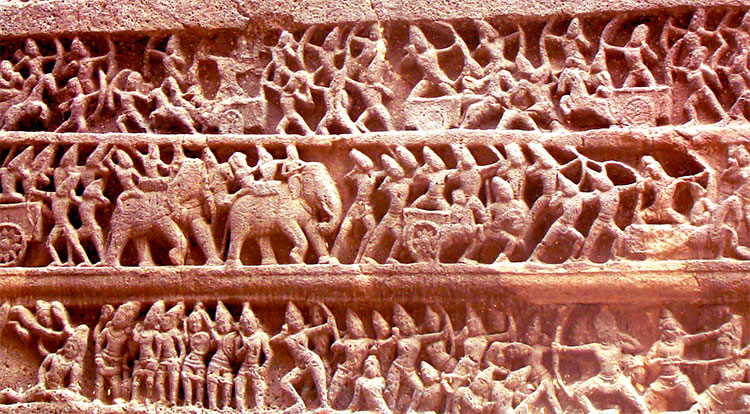
"O Kaunteya, if you are killed ( in the battle) you will ascend to heaven. On the contrary if you win the war you will enjoy the comforts of earthly kingdom. Therefore get up and fight with determination. (Bhagavad gita 2.37)
"With equanimity towards happiness and sorrow, gain and loss, victory and defeat, fight. This way you will not incur any sin. (Bhagavad gita 2.38)
Hinduism is a peaceful religion. Hindu spiritual practices aim to inculcate the ideal of nonviolence among its practitioners. However, Hinduism recognizes the need for war for righteous causes.
Hindu warriors of ancient India were one of the most feared valiant fighters of their times. They preferred to die in the battlefield rather than submit to their enemies. Some of the toughest and bloodiest battles of the ancient and medieval periods were fought in India. If Indian kings lost their wars against foreign aggressors it was not because they lacked courage or fighting spirit, but because they were often betrayed by their own trusted followers and counselors.
In Hinduism, a war is justified when it is fought to uphold Dharma or protect the weak and the innocent. All the Hindu deities have a warrior aspect about them and carry weapons of various kinds. When challenged by the Asuras (demons) they participate in wars on their own or seek the help of other gods to join them in the fight.
The epics and the Puranas are filled with the instances of wars fought between gods and demons and sometimes between gods and gods. When challenged, tradition dictated that a warrior should not withdraw from fighting or show any hesitancy.
Indian warriors exemplified the virtues of the great warriors portrayed in the scriptures. In fighting their battles, they followed the examples of gods and legendary heroes. They would not turn away from the battlefield except under extraordinary circumstances. Since they believed in rebirth, they considered it an opportunity to die in the battlefield and go the warriors heaven where enjoyments of various kinds awaited them.
Numerous battles were fought on the Indian soil from the earliest times. The Vedas refer to the battle of ten kings. Both the epics narrate the great battles fought in remote antiquity. The kings employed spies and kept a close watch on neighboring kingdoms. Often they entered into matrimonial alliances to strengthen their position and relationships. As part of their ambitious plans to expand their rule, they often went on long and grueling campaigns travelling hundreds of miles to engage their enemies in wars, which often lasted for months and resulted in huge bloodshed.
Indian armies were large and consisted of several divisions. They were well maintained, and the soldiers were well paid. Megasthanese wrote that Indian soldiers enjoyed a special status in society. They were honored and respected for their valor during peace times. And when there was a war they fought valiantly with great spirit. The archers used large bows with which they could penetrate any armor and strike fear.
Indian kings employed elephants to create diversion among enemy ranks and create confusion. The elephants were captured systematically and trained until they were battle ready. They were served with an intoxicating drink before they were marched into the battlefield by trained elephant riders. Mechanized contraptions were used by the armies during the time of Mauryas to throw large stones at the enemies. The battles were bloody and the Indian soldiers showed no remorse when it came to physical fighting. Indian swords were made of special alloys and prized very much for their toughness.
Alexander personally witnessed the valor of Indian soldiers and changed his campaign plans. Apart from elephants, Indians used chariots and horses. Army commanders used numerous tactics to defeat their enemies. They used several vyuhas or strategic positioning of the soldiers in the battlefield to prevent the enemy from breaking in.
Certain ground rules were observed by both sides during a war, until foreigners invaded the country and changed the rules and war tactics. Night fighting was not allowed. A warrior would not fight with an opponent if he was already engaged in a fight with another. Stabbing from behind or hitting below the navel was considered a dastardly act. After the fighting was concluded for the day, both sides were allowed to look for dying and dead and clear the battlefield for the next day fight. A war continued until one of the warring kings was killed, captured or surrendered.
In ancient India wars were fought mainly by men. Women rarely participated in them. However, warrior women were not uncommon in ancient India. They were trained warriors and participated in wars without fear. Some of them were employed for spying and killing the enemies deceptively. Chandragupta Maurya employed many women in his administration as soldiers and bodyguards. He lived in a large palace guarded by women warriors. When he went into public he was surrounded by them. The trend was continued by many kings. Indian history is replete with the names of many brave warrior women who fought for their land. Even Akbar had a hard time fighting against Rani Durgavathi (1524 - 1564) of the Chandela Dynasty. Sri Krishnadeva Raya, one of the most notable kings of the south had many warrior women serving in his army. They also participated in contests and the public display of their fighting skills.
Hinduism regards life not much different from a war. The body is the battlefield, in which good and evil wage a relentless war. The Bhagavad-Gita illustrates the point clearly. Waging a war in life or on the battlefield is an obligatory duty, which cannot be avoided. You must bring out your best to fight against evil and subdue the enemy. Not fighting a war either mentally or physically, when it is needed most, is bad karma. Similarly, engaging in it with desires and expectations, especially evil intentions, is also not good, since it leads to karma and bondage. The best way to fight a war is with detachment, indifference and as a service to God.
The Buddha preached the philosophy of nonviolence and integrated it into the Eightfold Path. The concept of not hurting or harming others formed the core practice of many ascetic traditions of ancient India. Those who renounced worldly lives, eschewed all forms of violence aimed to live in peace and harmony. Many spiritual traditions of ancient India, including Buddhism and Jainism made it an integral part of their essential teachings.
The spiritual masters of ancient India advocated nonviolence when violence was a way of life in many parts of the sub-continent. The kings fought among themselves regularly, which reflected the harsh realities of the time in which they lived.
Asoka was the only ruler in the ancient world who tried to introduce the concept of nonviolence as a state policy. His law of piety exhorted people to practice nonviolence. Unfortunately, his legacy was never carried forward by his successors.
In Hinduism, nonviolence was practiced mostly in the spiritual field. It is difficult to say that the people of ancient India were nonviolent. Fighting was an art and warriors took great pride in their fighting abilities. Defending one's honor, women and family interests against evil was upheld as an obligatory duty. Non violence as a creed became famous during the British rule when Mahatma Gandhi took it as the means to shake the British Raj. However, Gandhi's nonviolence, as he himself said, was not of the weak and timid. It was the weapon of the courageous to face evil with equanimity of mind. Gandhi was successful because he was both feared and respected by the British. Both had a love for the law of the land. It is difficult to imagine the fate of Gandhi and the Indian independence movement, had India been colonized by the Germans, Spanish. We know from history what these nations did to the people and their cultures when they occupied their lands.
According to Hinduism, God is pleasant and indifferent under normal circumstances. He would not interfere in the lives of beings or their actions. However, when evil rises its head and begins to oppress people, He incarnates upon earth to fight with it and restore balance. Thus, God Himself sets an example to humans what to do when they are oppressed by evil beings. Defending yourself against evil doers is your duty and honor.
Suggestions for Further Reading
- Hindu Gods - Lord Ganesha
- God and Self in Hinduism
- Goddesses of Hinduism, Their Symbolism and Significance
- Purusharthas in Hinduism
- The History, Antiquity and Chronology of Hinduism
- Ashrama Dharma in Hinduism
- Hinduism and Buddhism
- Death and Afterlife in Hinduism
- Hinduism and Divorce
- Hinduism and Adultery
- Hinduism, Food and Fasting
- The Future of Hinduism
- Good and Evil in Hinduism
- The Hindu Marriage, Past and Present
- What is Maya in Hinduism?
- The Origin and Definition of Hindu
- Hinduism and Polygamy
- Hinduism and polytheism
- Hinduism and Premarital Relationships
- God and Soul, Atma and Paramatma, in Hinduism
- About Suicides in Hinduism
- Religious Tolerance in Hinduism
- Violence and Abuse in Hinduism
- Traditional Status of Women in Hinduism
- Ashtanga Yoga of Patanjali
- About Hanuman or Anjaneya
- Hinduism and Same-sex Marriage
- Perspectives on What Karma Means
- Hinduism - The Role of Shakti in Creation
- Significance of Happiness in Hinduism
- Hindu God Lord Shiva (Siva) - the Destroyer
- The Role of Archakas, Temple Priests, in Hinduism
- Hinduism - Gods and Goddess in the Vedas
- Essays On Dharma
- Esoteric Mystic Hinduism
- Introduction to Hinduism
- Hindu Way of Life
- Essays On Karma
- Hindu Rites and Rituals
- The Origin of The Sanskrit Language
- Symbolism in Hinduism
- Essays on The Upanishads
- Concepts of Hinduism
- Essays on Atman
- Hindu Festivals
- Spiritual Practice
- Right Living
- Yoga of Sorrow
- Happiness
- Mental Health
- Concepts of Buddhism
- General Essays
* The image used for this article is shared under Creative Commons Attribution-Share Alike 3.0 Unported license.