
Chapter 8, The Mysteries of Ancient Cave Temples
Introduction | Chapter I. Shiva | Chapter II. Baal | Chapter III. Buddha | Chapter IV. “The Wisdom of the Other Bank” | Chapter V. King Asoka | Chapter VI. The Mahâyâna | Chapter VII. Avalokitishwara | Chapter VIII. The Cave Temple and its Mysteries | Chapter IX. Architecture | Chapter X. The Essenes | Chapter XI. The Essene Jesus | Chapter XII. More Coincidences | Chapter XIII. Rites | Chapter XIV. Paulinism | Chapter XV. Transubstantiation | Chapter XVI. Ceylon | Chapter XVII. Alexandria | Chapter XVIII. Ophis and the Serpents | Chapter XIX. Descent Into Hell |
Maurice on Temple Worship—Description of Cave Temples—Worship the same in Egypt and Persia—Immense labour employed in constructing them. Cave Mysteries everywhere an object of dread—Cicero on them—Elusis—Lucian on Tree Festival at Hieropolis—Bacchantic Festivals derived from Shiva as Somnâth (Lord of Soma, the first intoxicant)—These Festivals still secretly celebrated in India.
A book was published in 1806 entitled "Indian Antiquities." Its author was named Maurice. On some points no doubt its knowledge is behind our present knowledge, but we get a learned and intelligent writer dealing freely with the matter that was available. The question of the Cave temple and its mysteries specially attracted him.
Mr. Maurice holds that the old Cave temple was an apparatus so accurately fitted in all its parts to certain special requirements, that the Cave temples of India, Egypt, and Eleusis, exhibiting as they do the same means to the same end, must have had the same origin. In the case of Eleusis we know that the idea was brought from Egypt by Melampus.
From Mr. Maurice we can get a fairly good idea of one of these Indian Cave temples. They are said by the natives to be "the work of giants and genii in the earliest ages of the world." They are "admitted to be of the most profound antiquity, of such profound antiquity, indeed, that we are unable to obtain any light concerning the particular era of their fabrication." Of the excavations in the Island of Salsette he writes that Grose in his "Voyage to the East Indies" declares that "their formation would have required a labour equal to that of erecting the pyramids of Egypt." In the same caves are "above six hundred idols, ninety of them in and about the great pagoda." An artist who made sketches there for Governor Boon was so struck with the magnitude of the colossal work that he declared the labour must have occupied forty thousand men for forty years together.
Maurice tells us that the mighty stone giants in these caves were carefully painted, a fact which made them more awful and imposing in the dim light. Two figures at Salsette were twenty-seven feet in height. The great triple bust at Elephanta is "fifteen feet from the base to the top of the cap," whilst the face of another statue, measured by Mr. Grose, is five feet in length.
We must now turn to Maurice's description of an Indian Cave temple. He starts with Elephanta:—
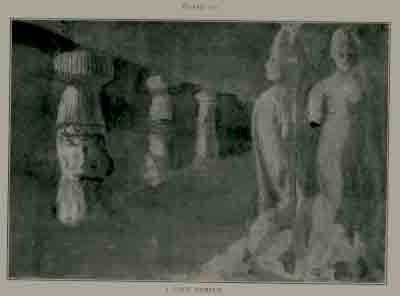
"This astonishing Pantheon of the gods presents itself about half-way up the steep ascent of the mountain, from whose strong bosom it is excavated. Ovington states the dimensions of this temple at about one hundred and twenty feet, and the height at eighteen feet. The enormous mass of solid rock above is supported by four rows of pillars of beautiful proportion, but of an order of architecture totally different from that of Greece. The Capital is also fluted, and is described by Mr. Hunter as having the appearance of a cushion pressed fiat by the superincumbent mountain. Along the sides of the cavern are ranged those mighty colossal statues before alluded to, to the number of forty or fifty, each of them twelve or fifteen feet in height. Some of them have aspects that inspire the beholder with terror, and in the words of Linschoten are distorted into 'such horrible and fearfull formes that they make a man's hayre stand upright.'"
The temple was an observatory, a model of the Kosmos, the figures sculptured on the walls were in their ultimate the heavenly bodies.
"At the west end of the grand pagoda is a dark recess, or Sacellum, twenty feet square, totally destitute of any external ornament except the altar in the centre, and the gigantic figures which guard the four several doors that lead into it. These figures, according to Niebuhr, are naked; are eight in number, two to each door. They are of the enormous height of thirteen feet and a half, and appear starting from the wall to which they are attached. These formidable guardians of this sacred recess point out the use to which it was applied. It was devoted to the most sacred mysteries of their religion."*
This, by the worshippers of Shiva, is deemed the Holy of Holies in their temples. It is called the "Sanctuary of the Shiva Lingam," the Lingam that is specially holy. "The Catechism of the Shaiva Religion," by a Hindu writer, Sabhapati Maudalyar, may be here consulted. He announces that none but Ati Shaiva Brahmins may enter this recess. Additional details are furnished by a German Orientalist.
Lassen, in his "Indische Alterthumskunde," has furnished us with an account of the Greater Mysteries in an Indian Cave temple. Mr. Mackenzie, an English Freemason, gives a capital digest of this, he considering that these rites are very like the secret rites of Masonry. At eight years of age the child girded on the sacred Cord. For the "Fellow Craft degree of the Mason," as Mr. Mackenzie, calls it, the disciple was "led into a gloomy cavern in which the apporheta were to be displayed to him. Here a striking similarity to the Masonic system may be found." Three chief officers or hierophants are seated in the east, west, and south, attended by their subordinates. After an invocation to the sun, an oath was demanded of the aspirant of implicit obedience to his superiors, purity of body, and inviolable secrecy. Water was then sprinkled over him. He was deprived of his sandals and shoes, and was made to circumambulate the cavern (query the Mahâdeo in the middle of it) thrice. Suitable addresses were then made to him, after which he was conducted through seven ranges of caverns in utter darkness. The piercing shrieks of Mahâdevî rent the air, she like Mylitta and Isis bewailing the fact that Shiva, or Time, had grown impotent in the winter, and that earth without him would lack food and perish.
The ancient mysteries depicted the passage of a soul through hell to heaven, and in the scenes described by Lassen, the initiate in the midst of his trepidations was suddenly confronted with the φωτισμος. A brilliant light flashed into the darkness and disclosed Kailas, the heaven of Shiva, "redolent with perfume and radiant with all the gorgeous beauty of an Indian clime, the Gandharves sounded their vînas and sang their sublime songs. Beautiful Apsaras danced around to give a representation of Heaven. This they certainly got in the Cave temple of Elora. The patient Indians, provided only with a small steel chisel and an iron mallet, had converted a mountain into a paradise, into one of the wonders of the world."
Cicero declared that the word "mysteries" was in his day almost synonymous with "abominations," because it was generally believed that human flesh was eaten in them. Human sacrifices were offered at Saturn's festivals. Plutarch, in Themistocles, mentions three beautiful women who were at the same time offered to Bacchus. Clement, of Alexandria, states that Erectheus, King of Athens, and Marius, a Roman general, both sacrificed their daughters. Livy describes the bloody rites of the worship of Bacchus.
These mysterious rites at first were imparted only to few, but afterwards communicated to a great number of both men and women. To the religious ceremonies of these were added the pleasures of wine and feasting in order to allure a greater number of proselytes. Livy goes on to declare that horrible scenes of debauchery were witnessed, as well as secret murders. There was loud shouting, and the noise of drums and cymbals so that none of the cries of persons suffering violation or murder could be heard abroad. One, Rutilus, had a step-son named Aebutius whom he wanted to get rid of. He persuaded the young man's mother to get him initiated into the mysteries of Bacchus. Aebutius had a female friend named Hispalia. He told her of his resolve.
"May the gods forbid, "she cried. "Better for both of us to die." Asked for the meaning of these words she confessed that she had accompanied her mistress once to Bacchanalian celebrations, and that the orgies she witnessed there were too awful for words. To think nothing unlawful was the grand maxim of this religion, and that all who showed any disinclination in submitting to dishonour, or the commission of vice, were sacrificed at once as sacred victims.
It is to be observed that the food offered to the gods was considered the food, of the gods, and as such immortal food. What wonder that in the Greek rites of Bacchus folk battled for the wine and the warm blood.
But in dealing with ancient mysteries if we treat the question from the point of view of naturalism, we are liable to go wrong. The excitement produced by the new intoxicants was viewed at first like the frenzy of the prophet, an influence beyond the earth, and supremely holy. This mistake could by-and-bye give birth to many excesses, but there is no doubt that an intoxicant soon became the chief ingredient in all temple worship. Even in our own days the "Cup" is forbidden to the laity in the Roman Church because originally the laity represented the non-initiates.
Turning to Eleusis, a suburb of Athens, we find a Cave temple, and similar ceremonies. All the city in solemn procession marches to the "Holy Fig Tree" along the "Sacred Way," the Mustai proud of their garlands, the Epoptai or complete initiates in their white garments bear proud myrtle on their brows. A monotonous low chant such as we hear at Indian festivals goes up into the balmy air, recounting the woes of the mighty mother, the wife of Kronos.
That lady, who gave Agriculture to Greece, comes flaunting along in her car drawn by dragons.
The procession now reaches the great Temple, and all who are not initiates are warned away, for the penalty is death to all who reveal the mysteries and all who discover them. There are seven dark caverns and seven light ones. Ceres, and Bacchus, with his torch, are supposed to be seeking Proserpine in hell. Earth abandoned by the goddess no longer bears fruits, like the Indian soil deprived of Shiva's creative force. Hence the wailings and lamentations that occur. The initiate goes through the dark caverns, and the light ones. Thrice blessed is the postulant who is able at last to repeat the culminating formula:—
"I have fasted. I have drunk the Cyceon. I have taken out of the Cista and placed that which I took into the Kalatheon. I have taken out of the Kalatheon and placed that which I took into the Cista."*
Lucian gives an account of the Tree festival at Hieropolis which reads very like the Durgâ-Pûjah in India. The sacrifices and processions are described as being of the splendid and extravagant description. Multitudes flocked there from all countries, including Brahmins from India. And it is said that the visitors brought their gods with them, a detail that throws light on the similarities that we find everywhere. The two mighty Mahâdeo Columns in front had an inscription that unblushingly stated what these columns symbolised. Maurice draws a parallel between the Kusbis of the Indian temples and the Syrian matrons, who as Bunsen puts it "could only escape being sacrificed to the gods by prostitution." The main thesis of Lucian is that the Dea Syria was taken from the Greek Rhea, the wife of Kronos; and that the noise of the drums and the clashing of cymbals denoted the warring winds and boiling waters, and the roar and crackle of the subterranean fires, to show the grief of earth that her womb was still uncultivated. Especially noisy were the rattling sistra and the clashing of the various implements of husbandry, which in the first instance were of brass. The priests were said to be eunuchs, and many young men dismembered themselves during the frenzies of the rites.
Of the actual tree worship, Lucian gives an interesting picture. "They cut down," he says, "a number of large trees and set them upright in the fore court of the temple. Then bringing together goats, sheep, and other victims proper for their purpose, they hang them up alive on these trees. To these are added birds, articles of apparel, and various sorts of furniture, jewels, in short, whatever the devout in their benevolence pleased to contribute to so solemn a sacrifice." Then the trees are set on fire, and the poor animals burnt alive.
But Mylitta had rites more sinister still. Near the temple was a mighty chasm made by the gods in order to drain off the water of Deucalion's Deluge, so ran the legends. Into this chasm animals are flung, and babies in sacks. The tree goddess, Mylitta, was fond of babies. Had this rift and its sinister rites any connection with Shiva and his subterranean home? The two great columns were said to be very much older than the rest of the temple, and to represent some earlier worship. The place was then called "Mahog," which name Colonel Wilford connects with the Mahâbhâga of the Purânas?
Love, lust, wine, gluttony, cruelty, mixed with religious fervour, have they not had their orgies in all lands? The carnival was always the carnival, and the Feast of Fools in the Middle Ages with its "Boy Bishop," and his rollicking companions burlesquing for three days all the holy rites in the cathedral,—that, with much else, was Bacchantic enough.
Mr. Mackenzie, a Freemason, in the passage he cites from Lassen, says that the initiation of the Freemasons is very like the initiation in the Indian temple. One or two of these details can easily be learned by a non-initiate, from Masonic tractates. Over the "Grand-master's" head is a canopy marked with the equilateral triangle which is the special emblem of Shiva. It symbolises also the God worshipped by the Masons, and is called "Le Delta sacré," in France. The triangle is somewhat lamely repeated in the Masonic trowel. Then when the frightened postulant with a "cable tow" (Durgâ's pasha) round his neck is introduced to the conclave, he finds each initiate clutching his neck in a throttling manner to emphasise the absolute necessity of secrecy. The crowning ceremony of all the circling round the "Copestone" need not be dwelt on in these pages. Plainly the "Copestone" is the Mahâdeo. One thing is certain. The terrible secret society of the Thugs or Bhurtotes in India is very ancient. Colonel Meadows Taylor found evidence of these stranglers in the bas reliefs of Elora. They most probably date from a day when the religion of Shiva was furiously persecuted by the Brahmans, and terrorism had to oppose terrorism.
An article in the Asiatic Researches, Vol. VIII., seems to furnish the backbone of the Mystery of Shiva. It gives from the Mahâkâla Sanhita, the death of the Year-god. Shiva dies at Easter and rises up almost immediately as Bâlishwara the Baby-Shiva, the New year. This death in all the old religions took place March 24th, and the resurrection on March 25th. A human victim personified the god.
The "abominations" that shocked Cicero have been going on in India from the earliest days. The Bacchantic festivals seem, even in name, to have been derived from India, for the word Bacchus with some Orientalists is a form of the Sanscrit word Bhâga, the special emblem of maternity. Shiva as Somnâth, is Lord of the Soma, the earliest intoxicant; and he figures as in Greece as a drunken Silenus at the festivals.* Intoxicating liquors, blood (sometimes human), flesh, and fish, are ingredients of the banquet. A woman, stark naked, personifies the Goddess. "These votaries of Sakti assemble at midnight in retired places," says the Reverend W. Simpson, the editor of "Moor's Pantheon," every stage of the proceedings is invested with a mystical meaning, and the whole terminates in licentious sensual indulgence." This author declares that he had good authority for the statement that they still existed in Madras in his day.† It must, however, be mentioned that the rites of the followers of Shiva are divided into two sections, the Right-handed Tantrik rites, the Dakshinas, and the Left-handed Tantrik rites, the Vâmâcharîs. This means practically Black and White magic. The early gods were ranged at different sides of the Zodiac, and the Tantrikas were the worship of the wicked gods, the worship of Shiva as Bhairava and Durgâ as Kâlî. At the beginning, all were no doubt wicked, and much like the gods of Dahomey. And perhaps the rudest excesses of the festivals were deemed logical in some rude days of polyandry. The Sakti sect represents only a small portion of Shiva's followers.
Introduction | Chapter I. Shiva | Chapter II. Baal | Chapter III. Buddha | Chapter IV. “The Wisdom of the Other Bank” | Chapter V. King Asoka | Chapter VI. The Mahâyâna | Chapter VII. Avalokitishwara | Chapter VIII. The Cave Temple and its Mysteries | Chapter IX. Architecture | Chapter X. The Essenes | Chapter XI. The Essene Jesus | Chapter XII. More Coincidences | Chapter XIII. Rites | Chapter XIV. Paulinism | Chapter XV. Transubstantiation | Chapter XVI. Ceylon | Chapter XVII. Alexandria | Chapter XVIII. Ophis and the Serpents | Chapter XIX. Descent Into Hell |
Suggestions for Further Reading
- Hinduism and Christianity, Jesus in India
- The Advaita Vedanta - Non Duality
- Introduction to Hinduism - Prakriti
- The Kapila And The Pâtañjala Samkhya Yoga
- Brahman According to Advaita and Dvaita in Hinduism
- Atheism and Materialism in Ancient India
- Solving the Hindu Caste System
- Emptiness or Sunyavada in Buddhism
- Buddhism - A Discourse on Ignorance
- The Working of Maya or Illusion - A Buddhist Perspective
- Buddhism - The Middle Way or the Middle Path
- What Samsara Means in Buddhism
- The Chaos Theory and Nirvana in Buddhism
- Hinduism and Caste System
- Dealing with Chance, Fate and Acts of God
- Death and Afterlife in Hinduism
- What is Hinduism?
- Hinduism and Diversity
- Hinduism and Judaism
- Hinduism and Same-sex Marriage
- Significance of Happiness in Hinduism
- Redirect - Symbolism Hinduism
- The Meaning and Purpose of Yoga
- Essays On Dharma
- Esoteric Mystic Hinduism
- Introduction to Hinduism
- Hindu Way of Life
- Essays On Karma
- Hindu Rites and Rituals
- The Origin of The Sanskrit Language
- Symbolism in Hinduism
- Essays on The Upanishads
- Concepts of Hinduism
- Essays on Atman
- Hindu Festivals
- Spiritual Practice
- Right Living
- Yoga of Sorrow
- Happiness
- Mental Health
- Concepts of Buddhism
- General Essays