
Chapter 10, Buddhist Influences and The Essenes
Introduction | Chapter I. Shiva | Chapter II. Baal | Chapter III. Buddha | Chapter IV. “The Wisdom of the Other Bank” | Chapter V. King Asoka | Chapter VI. The Mahâyâna | Chapter VII. Avalokitishwara | Chapter VIII. The Cave Temple and its Mysteries | Chapter IX. Architecture | Chapter X. The Essenes | Chapter XI. The Essene Jesus | Chapter XII. More Coincidences | Chapter XIII. Rites | Chapter XIV. Paulinism | Chapter XV. Transubstantiation | Chapter XVI. Ceylon | Chapter XVII. Alexandria | Chapter XVIII. Ophis and the Serpents | Chapter XIX. Descent Into Hell |
Was Essenism due to Buddhist missionaries?—Testimony of Asoka—The μοναστήριον compared with the Sangharâma"—Apostles of the Bloodless Oblation"—Tertullian on the similarity between the rites of the Christians and the Mithraists—Testimony of Philo—Thirty thousand monks go from Alexandria to Ruanwelli in Ceylon, and are hospitably received on the occasion of the consecration of the great temple there, B.C. 170.
We have now reached the critical chapters of the work. Its main contention is that it was through the Jewish sect of the Essenes that Buddhist influences reached Palestine, and were passed on to Christianity. We have therefore to consider:
(1) Was Essenism due to Buddhism?
(2) Did Christianity emerge from Essenism.
The first question will form the subject of this chapter, and the second will be treated afterwards. In my first edition of this work I attached great importance to the evidence of King Asoka. That monarch, as we have seen in Chapter V., has given to Buddhism a record which no other religion can boast of, simply because in lieu of a reed and leaves of plantain trees or other ephemeral methods he has used a chisel and hard stone. By this means he has baffled the pious improver of sacred records, but the King's system was necessarily a little crude. On one pillar he tells us about his "double system of medical aid," on another of the "villages set apart for the monks," on a third, the accommodation of men and animals, on others we read of "the planting of trees and digging of wells," and then of monks "exercising solitary austerities."
Thus when I read in the inscription of the Girnar Rock in Guzerat the king's statement that he had sent into the domains of King Antiochus his "medicaments," and his "double system of medical aid," I thought that the king's statement about his medicaments was important as proving an early connection between India and Egypt, but I did not see how far reaching and overwhelming that evidence was.
A recent and more careful study of the king's inscriptions has proved to me that his Sangharâmas, the establishments that he set up upon roads and in jungles, were all of a pattern and all complete. They were for utilitarian as well as religious purposes. The problem before the king was to send abroad his laws, his religion, his commerce, his officials wherever he could, and especially to reclaim and pierce the vast jungles of his dominions. These had potent sentries, the tiger and the fever. The Indian epics tell us how these were dreaded. Thus roads, wells, herbs for medicines, grain for food, and trees for shade, would be required everywhere, for each Sangharâma was a rude caravanserai, hospital, college, monastery, church, burying-ground, as well as a collection of little leafy pansils where the ascetic could dream his dreams of God.
This gives the Girnar rock-inscription an importance that it is impossible to estimate. If Asoka spread through the dominions of Antiochus his "root drugs and herbs," and his "medical aid for men and animals," the remainder of the Sangharâma, the religion and the fasting monks, must have been present likewise, a pregnant fact.
Let us read the passage carefully. "And moreover within the dominions of Antiochus, the Greek king, of which the generals of Antiochus are the rulers, everywhere the double system of medical aid of the Beloved of the Angels (Asoka) is established, both medical aid for men and medical aid for animals."*
Indeed, these conclusions are completely confirmed by a second passage on the Girnar Rock.
"And the Greek king besides, by whom the four Greek kings (Chapta Yona rajah) Ptolemaios, and Gengakenos and Magas . . . have been induced to permit . . . both here and in foreign countries everywhere (the people) follow the doctrine of the religion of Devanampiya (the friend of the Angels) wherever it reacheth."†
The king's name is never actually mentioned on the inscriptions. He is called the "Friend of the Angels" or Devas. According to Polybius, Antiochus the Great led his army into India and renewed his alliance with Sophagasenes, king of that country. As the Asoka edicts were incised on rocks some six years after Antiochus came to the throne, Prinsep and Wilford believe that this was King Asoka. Meanwhile the building of Alexandria had given a powerful fillip to the intercourse with India by sea. Alexander had designed it to be the capital of his vast empire, and the bridge between India and the West. This project was ably carried out after his death by his lieutenant, the first Ptolemy. Under his wise government and that of his successors, Alexandria soon became the first commercial city in the world. Of more importance was his large tolerance of creeds, whether Egyptian, Grecian, or Jewish. In the year tog B.C. Ptolemy Evergetes was on the throne. He conquered Abyssinia and the greater part of Asia, including Syria, Phœnicia, Babylonia, Persia, Media. His conquests extended to Bactria, and he had a large fleet on the Red Sea. This placed him in contact with India from two different directions. He married the daughter of the "Magas" of the inscriptions, the king of Cyrene.
We have now to consider whether there is any evidence corroborating the testimony of Asoka. Jumping over some two hundred years we reach Philo (25 B.C. to 45 A.D.), Josephus (born 37 A.D.) and Pliny (23 to 79 A.D.). These witnesses describe an institution pin for pin like the Sangharâma, namely the μοναστήριον, and we get from them a knowledge of two remarkable sects of the Jews, the Essenes and the Therapeuts.
When did these sects arise? On that point evidence is scanty. Eusebius declared that they were Christian monks brought there by St. Mark, but Philo, Josephus, and Pliny, if they know nothing very definite, disprove this. Philo declares that their laws, which. differ radically from the Jewish laws, date from Moses. "Our law giver trained into fellowship great numbers of pupils whom he calls Essenes."* He repeats this statement in the same work. He says likewise that they possess commentaries of ancient men who were founders of the school. This throws the Therapeuts back a long way. Josephus also gives to the Essenes Moses as a law giver, and states that anyone who blasphemed him was to be punished with death. He says, too, that the Essenes are as old as the Pharisees and Sadducees.† And Pliny the elder, who witnessed the Essene gatherings on the shores of the Dead Sea, their central haunt, affirms that they had existed there "through thousands of ages."
It is to be observed too, that these Therapeuts were spread widely about, especially in Egypt, to which as we have seen, Asoka sent his Sangharâmas. Says Philo: "There are many parts of the world in which these folks are found, for both Greece and the Barbarian lands must needs have their share in what is good and perfect. They are, however, in greatest abundance in Egypt, in every one of the so-called departments, and especially round about Alexandria. The principal persons draw up their colony from all quarters as to a fatherland of Therapeuts, unto a well-regarded spot which lies on Lake Marea, on a somewhat low hill, very well situated both with regard to security and the mildness of the air."* In fact Egypt swarmed with monks, for many centuries after Christ as well as before, and it was difficult to distinguish the sect of Christians from the worshippers of Serapis, whom we shall by-and-by show to have been Shiva a little disguised. From Rufinus and St. Gerome, three centuries after Christ's death, we get pictures of them.
The theatre of the Eremites was chiefly the valley of the Nile. The huge deserts on each side of the river were peopled with Eremites and monasteries, that of Oxyrinque harboured ten thousand monks and two thousand nuns. Another near Nechia, forty miles from Alexandria, had five thousand monks. To get the dates of the rise of these is now impossible.
Philo, as we have seen, announced that in his day the forty-two districts of Egypt were full of them.
But a question arises: Were the Essenes and the Therapeuts the same, or closely like each other? Some Christian apologists deny this, and they cite Josephus to show that the Essenes dwelt in cities and "employed themselves solely to the labour of agriculture."†
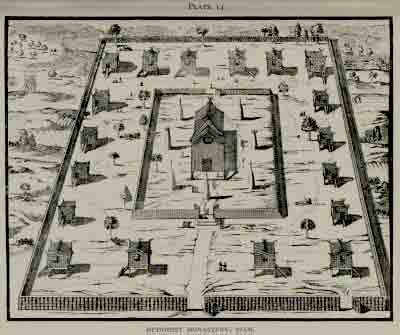
I think a description of a Buddhist monastery may throw a light on these and similar contradictions. A modern Buddhist monastery consists of a quadrangle with a line of separate huts along each side just like the "huts lightly built" of Philo. Each hut is tenanted by a monk and his two servant pupils. Each hut has guest chambers, for two or more guests. The huts in Asoka's time, and also in modern times when the community migrates to the jungle for the Varsha or Lent, were called pansils, and have simply a covering of boughs and leaves, and perhaps mud walls, that as in the days of Job, thieves can "dig into." In the centre of the quadrangle is the sanctuary, a larger building whither the monks resort for worship. Nocturnal worship was a prominent feature with Asoka's monks, and with the Therapeuts and Christians.
A Buddhist Sangharâma consists of:—
(1) Contemplative ascetics trying to develop "visions," and what St. Paul calls "spiritual gifts." Josephus tells us that the Essenes had "knowledge of divine things." Philo calls the Therapeuts "Citizens of Heaven," and says they seek a "divine illumination," an "alliance with the upper world."
(2) Their pupil servants—who in return for spiritual initiation attend to their material wants, like Josephus with Banus.
(3) Inferior monks who have small vocation for the spiritual life. These till the ground in countries like Tibet, and work the convent farms.
(4) Brothers who have found that they have no vocation at all. These may return to civil life, and marry and trade. But the Essenes in cities were bound by "oaths that make one shudder," as Josephus puts it, "never to betray the brethren, and to such of their persuasion as are come from any other place, whatever they have is thrown open as freely as if it were their own, and they go to visit those they have never seen before, as if they were most intimate." This reminds us of the disciples of Christ. and explains the anathemas they were called upon to pronounce "if any receive you not."
(5) Prophets dreaming in solitude and prophets who had failed in life were both part of the same mechanism; for the prophet when he had obtained the inner light was turned into an itinerant missionary. In a work recently recovered, the "Teaching of the Apostles," the Christian missionaries are called "Prophets," and they were only allowed to remain three nights in one place. The Parivrâjikas, or wandering missionaries of Buddhism, could only sleep one night in the same place, and that not in a house. These wandering missionaries, although their work is finished, still exist in Tibet. In that cold climate they say their home is "the starry tent of Buddha," and as often as not sleep in the open on the snow.
It is evident that in countries like Palestine where any doctrines that in the least swerved from Mosaism were promptly punished, the city monks would be a necessary complement to the missionaries.
The analogies between the Essenes and Therapeuts are close enough. Both believed in the immortality of the soul. Both explained the sacred scriptures allegorically. Both lived in monasteries and had goods in common, despised wealth, and before entering the community they parted with all their property. Both considered marriage and sexual intercourse inimical to the higher life. Both abstained from flesh meat and wine, and refused to take part in the animal sacrifices in the Temple. For each was an active cohort in the Great Army which, led as it were by Buddha, assailed sacrificial religion everywhere, and sought to substitute the religion of conscience for religion by body-corporate.
In point of fact, Buddha's missionaries were preaching in Persia long before the days of King Asoka. The Mithraists, the Neo Pythagoreans, the Hermitists were similar secret societies, grouped together as the "Apostles of the Bloodless Altar."
There are two Zoroasters. One of these Zoroasters lived 6,000 years B.C. according to Darmesteter, and the other about 500 years B.C.
The earlier Zoroaster swathed Persia in a network of silly rites and regulations. A culprit who "threw away a dead dog" was to receive a thousand blows with the horse-goad, and one thousand with the Craosha charana. A culprit who slew a dog with a "prickly back" and a "woolly muzzle" was to receive a similar punishment.* This Zoroaster was particular about the number of gnats, ants, lizards that the devout were enjoined to kill.† This Zoroaster proclaimed a god who loved to see on his altar a "hundred horses, a thousand cows, ten thousand small cattle," and so on.‡ But the second Zoroaster proclaimed a bloodless altar, and sought to tear the network of the first Zoroaster to shreds. What was the meaning of this? Simply that the Buddhist Wanderers had by this time invaded Persia, and had fastened their doctrines upon the chief local prophet. This was their habit. A study of this second religion, the religion of Mithras, will help us to some of the secrets of Buddhist propagandism.
Mr. Felix Oswald cites Wassiljew as announcing that the Buddhist missionaries had reached Western Persia B.C. 450. This date would, of course, depend on the date of Buddha's life and Buddha's death. The latter is now definitely fixed by Buhler's translation of Asoka Rupnath rock-inscription, B.C. 470. Wassiljew, citing Daranatha, announces that Madeantica, a convert of Ananda, Buddha's leading disciple, reached Ouchira in Kashmir. From Kashmir Buddhism passed promptly to Kandahar and Kabul (p. 40) . Thence it penetrated quickly to Bactria, and soon invaded "all the country embraced by the word Turkistan, where it flourished until disturbed by Mahomet."
Tertullian has two passages which describe the religion of Mithras.
He says that the devil, to "pervert the truth," by "the mystic rites of his idols, vies even with the essential portions of the sacraments of God. He, too, baptises some—that is, his own believers and faithful followers. He promises the putting away of sins by a laver (of his own), and, if my memory still serves me, Mithras there (in the kingdom of Satan) sets his mark on the foreheads of his soldiers, celebrates also the oblation of bread, and introduces an image of the resurrection, and before a sword wreathes a crown."*
Here is another passage:—
"Some soldier of Mithras, who at his initiation in the gloomy cavern,—in the camp, it may well be said, of darkness,—when at the sword's point a sword is presented to him as though in mimicry of martyrdom, and thereupon a crown is put upon his head, is admonished to resist and cast it off, and, if he likes, transfer it to his shoulders, saying that Mithras is his crown. He even has his virgins and his ascetics (continentes). Let us take note of the devices of the devil, who is wont to ape some of God's things."†
From this it is plain that the worshippers of Mithras had the simple rites of Buddhist and Christian, baptism and the bloodless altar; also an early Freemasonry, which some detect veiled in the Indian life of Buddha. Thus the incident of the sword and crown in the Mithraic initiation is plainly based on the menacing sword of Mara in the "Lalita Vistara," and the crown that he offered Buddha. In modern Masonry it is feigned that Hiram Abiff, the architect of Solomon's temple, made three efforts to escape from three assassins. These are plainly Old Age, Disease and Death. He sought to evade the first at the east of the temple, in the same way that Buddha tried to escape by the eastern gate. The second and third flights of Hiram and Buddha were to the same points of the compass. Then Buddha escaped the lower life through the Gate of Benediction, and Hiram was killed. The disciples of Mithras had, in the comedy of their initiation, "seven tortures,"—heat, cold, hunger, thirst, fire, water, etc.—experiences by no means confined to histrionics in the experience of Buddha's Wanderers. A modern mason goes through the comedy of giving up his gold and silver, and baring his breast and feet, a form that once had a meaning. Mithras was born in a cave; and at Easter there was the ceremony called by Tertullian the "image of the resurrection." The worshippers, Fermicus tells us,* placed by night a stone image on a bier in a cave and went through the forms of mourning. The dead god was then placed in a tomb, and after a time withdrawn from it. Then lights were lit, and poems of rejoicing sounded out: and the priest comforted the devotees. "You shall have salvation from your sorrows!" Dupuis naturally compares all this to the cierge pascal and Catholic rites. In Jerusalem the Greek pontiff goes into the cave called Christ's sepulchre and brings out miraculous fire to the worshippers, who are fighting and biting each other outside, imaging unconsciously Buddha's great battle with Mara and the legions of hell, its thunder and lightning and turmoil, followed by a bright coruscation, and by the angels who greeted his victory. This sudden illumination, which is the chief rite of Freemasonry, of Mithraism, and of Christianity, has oddly enough been thrown overboard by the English Church.
That Mithraism was at once Freemasonry and Buddhism is proved by its great spread. Judaism and the other old priestcrafts were for a "chosen people." At the epoch of Christ, Mithraism had already honeycombed the Roman paganism. Experts have discovered its records in Arthur's Oon and other British caves.
A similar Freemasonry was Pythagoreanism in Greece. Colebrooke, the prince of Orientalists, saw at once that its philosophy was purely Buddhist. Its rites were identical with those of the Mithraists and Essenes. Alexandria was built by the great invader of India, to bridge the East and the West. And an exceptional toleration of creeds was the result.
On the subject of the Essenes Philo wrote a most interesting letter to a man named Hephæstion, of which the following is a portion:—
"I am sorry to find you saying that you are not likely to visit Alexandria again. This restless, wicked city can present but few attractions, I grant, to a lover of philosophic quiet. But I cannot commend the extreme to which I see so many hastening. A passion for ascetic seclusion is becoming daily more prevalent among the devout and the thoughtful, whether Jew or Gentile. Yet surely the attempt to combine contemplation and action should not be so soon abandoned. A man ought at least to have evinced some competency for the discharge of the social duties before he abandons them for the divine. First the less, then the greater.
"I have tried the life of the recluse. Solitude brings no escape from spiritual danger. If it closes some avenues of temptation, there are few in whose case it does not open more. Yet the Therapeutæ, a sect similar to the Essenes, with whom you are acquainted, number many among them whose lives are truly exemplary. Their cells are scattered about the region bordering on the farther shore of the Lake Mareotis. The members of either sex live a single and ascetic life, spending their time in fasting and contemplation, in prayer or reading. They believe themselves favoured with divine illumination—an inner light. They assemble on the Sabbath for worship. and listen to mystical discourses on the traditionary lore which they say has been handed down in secret among themselves. They also celebrate solemn dances and processions of a mystic significance by moonlight on the shore of the great mere. Sometimes, on an occasion of public rejoicing, the margin of the lake on our side will be lit with a fiery chain of illuminations, and galleys, hung with lights, row to and fro with strains of music sounding over the broad water. Then the Therapeutæ are all hidden in their little hermitages, and these sights and sounds of the world they have abandoned make them withdraw into themselves and pray.
"Their principle at least is true. The soul which is occupied with things above, and is initiated into the mysteries of the Lord, cannot but account the body evil, and even hostile. The soul of man is divine, and his highest wisdom is to become as much as possible a stranger to the body with its embarrassing appetites. God has breathed into man from heaven a portion of His own divinity. That which is divine is indivisible. It may be extended, but it is incapable of separation. Consider how vast is the range of our thought over the past and the future, the heavens and the earth. This alliance with an upper world, of which we are conscious, would be impossible were not the soul of man an indivisible portion of that divine and blessed spirit. Contemplation of the divine essence is the noblest exercise of man; it is the only means of attaining to the highest truth and virtue, and therein to behold God is the consummation of our happiness here."
Here we have the higher Buddhism, which seeks to reach the plane of spirit, an "alliance with the upper world," by the aid of solitary reverie. That Philo knew where this religion had come from is, I think, proved by another passage.
"Among the Persians there is the order of Magi who deeply investigate the works of nature for the discovery of truth, and in leisure's quiet are initiated into, and expound in clearest significance, the divine virtues.
"In India, too, there is the sect of the Gymnosophists, who, in addition to speculative philosophy, diligently cultivate the ethical also, and have made their life an absolute ensample of virtue.
"Palestine, moreover, and Syria are not without their harvest of virtuous excellence, which region is inhabited by no small portion of the very populous nation of the Jews. There are counted amongst them certain ones, by name Essenes, in number about four thousand, who derive their name in my opinion by an inaccurate trace from the term in the Greek language for holiness (Essen or Essaios—Hosios, holy), inasmuch as they have shown themselves pre-eminent by devotion to the service of God; not in the sacrifice of living animals, but rather in the determination to make their own minds fit for a holy offering."*
Plainly here the Essenes are pronounced of the same faith as the Gymnosophists of India, who abstain from the bloody sacrifice, that is the Buddhists.
I think I have now proved that Essenism was due to a Buddhism influence. Few deny this now, and fewer would support that energetic but rather wild apologist, Dr. Lightfoot, in his assertion that "there is no notice in either heathen or Christian writers, which points to the presence of a Buddhist within the limits of the Roman Empire till long after the Essenes ceased to exist."
But supposing this to be true, we have at any rate an historical statement that 30,000 Buddhist monks went back to India if they did not come from it. In the Mahâwanso, or ancient Buddhist history of Ceylon, it is announced that on the occasion of the consecration of the famous Buddhist tope at Ruanwelli (160 to 137 B.C.), Buddhist monks came from all parts, including "30,000 from the vicinity of A’lasadda, the capital of the Yona country." (Alexandria, the capital of Greece).*
Dr. Lightfoot, the champion controversialist of his day, springs up at this and maintains that the Yona country is Bactria alone, and that the Alexandria here mentioned is a small town fifteen miles from Caubul. The first assertion disappears in the presence of Asoka's Girnar inscription. The "dominions of Ptolemaios" must certainly have included Egypt; and no town in Afghanistan could possibly be called "The capital of the Greek dominions."
The second suggestion of this distinguished controversialist, brings with it developments that its author could never have anticipated, for the Cingalese historian announces that the invited monks arrived at Ruanwelli and were properly fêted.
Let us suppose for a moment that Dr. Lightfoot's ipse dixit is correct, and that 30,000 monks were at Alexandria in Afghanistan. This Alexandria must have been a small village. It is not now discoverable on any map. Imagine 30,000 monks living by daily begging in such a thrifty place. It took the English government three and a half months to prepare supplies for the Tirah campaign. Imagine 30,000 monks marching from Caubul to Peshawur. Did they lay in a vast store of food with camels, mules, etc., for carriage? If so, had they armed men with them to protect this food from the starving robbers of the passes? And how did they traverse the fifteen or sixteen hundred miles that separate Peshawur from Adam's bridge? How were they fed in the numerous dense jungles and wastes that crossed their path? Also, could 30,000 Buddhists march safely across the kingdoms in India that had never been converted to Buddhism, and who viewed the followers of Buddha as graceless heretics, and burnt them on red hot iron beds?
Introduction | Chapter I. Shiva | Chapter II. Baal | Chapter III. Buddha | Chapter IV. “The Wisdom of the Other Bank” | Chapter V. King Asoka | Chapter VI. The Mahâyâna | Chapter VII. Avalokitishwara | Chapter VIII. The Cave Temple and its Mysteries | Chapter IX. Architecture | Chapter X. The Essenes | Chapter XI. The Essene Jesus | Chapter XII. More Coincidences | Chapter XIII. Rites | Chapter XIV. Paulinism | Chapter XV. Transubstantiation | Chapter XVI. Ceylon | Chapter XVII. Alexandria | Chapter XVIII. Ophis and the Serpents | Chapter XIX. Descent Into Hell |
Suggestions for Further Reading
- Hinduism and Christianity, Jesus in India
- The Advaita Vedanta - Non Duality
- Introduction to Hinduism - Prakriti
- The Kapila And The Pâtañjala Samkhya Yoga
- Brahman According to Advaita and Dvaita in Hinduism
- Atheism and Materialism in Ancient India
- Solving the Hindu Caste System
- Emptiness or Sunyavada in Buddhism
- Buddhism - A Discourse on Ignorance
- The Working of Maya or Illusion - A Buddhist Perspective
- Buddhism - The Middle Way or the Middle Path
- What Samsara Means in Buddhism
- The Chaos Theory and Nirvana in Buddhism
- Hinduism and Caste System
- Dealing with Chance, Fate and Acts of God
- Death and Afterlife in Hinduism
- What is Hinduism?
- Hinduism and Diversity
- Hinduism and Judaism
- Hinduism and Same-sex Marriage
- Significance of Happiness in Hinduism
- Redirect - Symbolism Hinduism
- The Meaning and Purpose of Yoga
- Essays On Dharma
- Esoteric Mystic Hinduism
- Introduction to Hinduism
- Hindu Way of Life
- Essays On Karma
- Hindu Rites and Rituals
- The Origin of The Sanskrit Language
- Symbolism in Hinduism
- Essays on The Upanishads
- Concepts of Hinduism
- Essays on Atman
- Hindu Festivals
- Spiritual Practice
- Right Living
- Yoga of Sorrow
- Happiness
- Mental Health
- Concepts of Buddhism
- General Essays
Footnotes
163:* Translation by Prinsep, "Journ. Bung. As. Soc., "Vol. VII., p. 159.
163:† Ibid, p. 261.
164:* Fragment of "Apology for the Jews."
164:† "Antiquities," Book XVIII., C.1.
165:* Vita Contemp.
165:† "Antiq.," XVIII., 1, par. 5.
168:* "Zendavesta," Fargard, XXX.
168:† Ibid, XIV.
168:‡ "Khordah Avesta," XII.
169:* Pres., V., Hoer, Chap. XI.
169:† "De Corona," XV.
170:* "De Errore," XXIII.
173:* Philo, "Every virtuous man is free."
174:* "Mahâwanso" (Turnour's translation), p. 171.