
India In Primitive Christianity
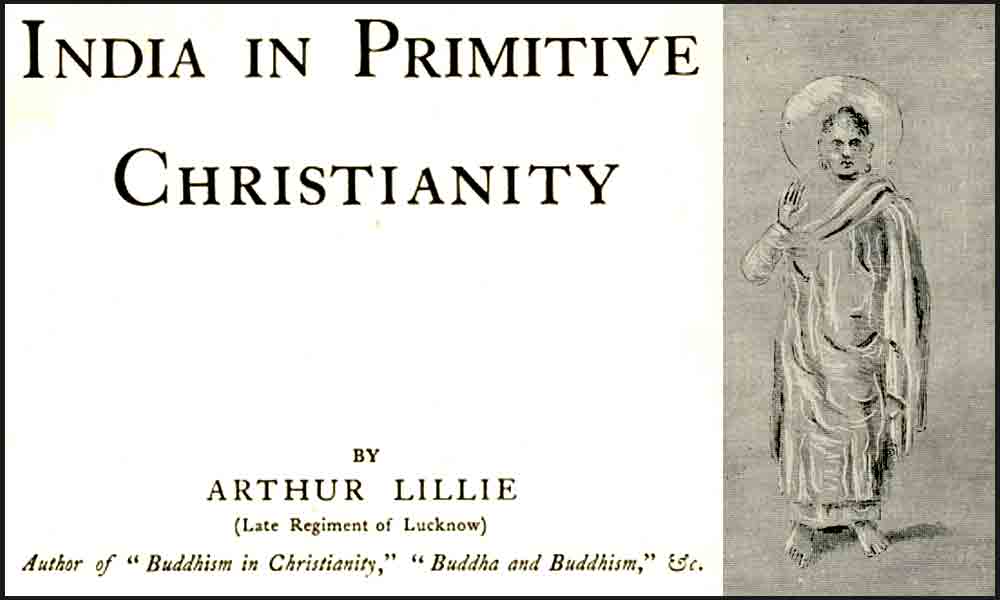
The book Indian in Primitive Christianity presents an interesting angle to the subject of comparative religions, with the underlying implication that there might have been a historic connection between the religions of India and primitive Christianity and the latter had many parallels with Buddhism. The author also suggests that the Biblical God of Judaism and Christianity might be a variation of Shiva. While scholars may agree or disagree with his arguments and evidence, the book is a valuable source of information for anyone interested in the competitive studies of Christianity with the religions of India, especially with Hinduism and Buddhism. Jayaram V
The astonishing points of contact (ressemblances étonnantes) between the popular legend of Buddha and that of Christ, the almost absolute similarity of the moral lessons given to the world, at five centuries’ interval, between these two peerless teachers of the human race, the striking affinities between the customs of the Buddhists and of the Essenes, of whom Christ must have been a disciple, suggest at once an Indian origin to Primitive Christianity. M. Léon de Rosny
His legends being older and not in Sanskrit he has been neglected—Found in India by the Aryans when they crossed the mountains—Shiva as the Cobra, and Durgâ the Tree (pestilential Indian jungle) probably the oldest gods in the world.—Shiva as the Phœnician Baal.—Esoterically a noble Pantheism fighting with the Polytheisms around.—The Shiva-Durga cultus rises everywhere far above other religions and also sinks lower—Invents the Yogi and the Yoga philosophy—Invents the Hypostases—Great importance of Gaṇes’a in the history of civilisation
Tree and Serpent Worship carried by the Phœnicians everywhere—The religion of the Indian jungle—Baal in Palestine—The "Star of Chiun" (Shiva)—The Mahâdeos and Masseboth—Special blood-thirstiness of the Phœnician divinity—Holy of Holies of Jewish Temple, and "Sanctuary of the Shiva-linga" in India
Born of a Virgin—Genealogies—The "Flower star" in the East—Asita and Simeon—The Four Presaging tokens—The Prince leaves the palace—The Bo Tree—Buddha preaches—Early biography altered—Mâyâ Devi is Durgâ—Dasasatanayana, Shiva the "thousand eyed," blesses him when he leaves the palace—Other changes
Chapter 4. “The Wisdom of the Other Bank”
Fine mysticism of Buddhism—The man who was born blind—The Tevigga Sutta—The Sinner—The Penitent Thief—"God revealed in the form of Mercy"—The Death of Buddha
King Asoka—Rock inscriptions—Only reliable records of early Buddhism—Not an atheism—Immortality—Dharma Râj—Kingdom of Justice—Helps to expose a portentous fraud—Buddhaghosa and the Ceylon records—King Wijayo—Date altered by Buddhaghosa one hundred years—Fictitious "Second Convocation"—Mahindo, Asoka's son, visits Ceylon—Vast literature of Shiva-Buddhism palmed upon him—Brief of modern English missionaries in their attack on Buddha
New gods—All of them Shiva—A mask of Buddhism on some of them—Dhyâni or Heavenly Buddhas—Dhyâni Bodhisatwas—Conversion of the relic cairn of early Buddhism into Shiva's Lingam disguised as a Chaitya—Chaitya worship at Mathurâ—Shiva-Buddhism a worship of Shiva with "Left-handed" Tântrika rites—It is to be found in all Buddhist kingdoms—Rapid survey
The great Monastery of Nalanda—The "High Priest of all the World"—Is he the modern Pontiff of Tibet?—Shiva supposed to be incarnate in each successor—Shiva and Durgâ worshipped in all Buddhist rituals—Great revolution effected by King Kanis’ka—Strong remonstrance on the part of the "High Priest of all the World"—He declares that the encroaching cultus is pure S’ivism and Nihilism
Chapter 8. The Cave Temple and its Mysteries
Maurice on Temple Worship—Description of Cave temples—Worship the same in Egypt and Persia—Immense labour employed in constructing them—Cave mysteries everywhere an object of dread—Cicero on them—Eleusis—Lucian on the Tree Festival at Hieropolis—Bacchantic Festivals derived from Shiva as Somnâth (lord of Soma the first intoxicant)—These festivals still secretly celebrated in India
Mr. James Fergusson—The "Sangharâma of Kasyapa"—Was it Elora?—Points of contact—Kailâs—Importance of the head of Avalokitishwara—Found on all Shivan buildings ancient and modern—Buddhist arch the head of the Cobra—Serpent not worshipped in Buddhism until union with S’ivism—Fergusson on the Lingam—Calls it a "Dagoba"—Believes the Kailâs temples at Elora and the Mahabalipur Rathas to have been intended for dormitories of Buddhist monks—Proposition contested—Strange discovery that Avalokitishwara's head is very plentiful on both these old groups of rock-detached temples
Was Essenism due to Buddhist Missionaries?—Testimony of Asoka—The μοναστήριον, compared with the Sangharâma—"Apostles of the Bloodless Oblation"—Tertullian on the similarity between the rites of the Christians and the Mithraists—Testimony of Philo—Thirty thousand monks go from Alexandria to Ruanwelli in Ceylon and are hospitably received on the occasion of the consecration of the great temple there. B.C. 170
Was Jesus an Essene?—Nazarites or Nazareens—Baptised by the Nazarite John—A secret society—"Inquire who is worthy!"—Essene Bread Oblation—Miracle of the Loaves—Probably an Essene Passover gathering—The Codex Nazaræus—The earliest gathering of Christians at Rome, Essene water-drinkers and vegetarians—The Gospel according to the Hebrews—Gospel of the Infancy
Twelve Disciples—Love one another—Buddhist Beatitudes—The Sower—Blind Guides—Early Buddhism, a religion of joy—Buddhist baptismal rites—Other coincidences
The Abbé Huc on the close similarity of Christian and Buddhist rites—Confirmed by Fathers Disderi and Grueber—Reverend S. Beal on a Buddhist liturgy—Mr. Fergusson holds that the various details of the Christian basilica have been taken from the temples of the Buddhists—On which side was the borrowing?—Arguments pro and con.
St. Paul a puzzle—Was he an ascetic mystic, or the author of the theory of the "Atonement," "Original Sin," etc., in fact of priestly Christianity?—Up to the date of Irenæus there is no trace of his writings, nor even of his teachings—Did he convert Peter and James as described in "The Acts?" James, Peter, John the Evangelist and Matthew all Nazarites—also Paul—Were they all instrumental in making the water-drinking Essenes drink wine?—Valentinus—"Left-handed gods"—Early Zodiac of Shiva
Chapter 15. Transubstantiation
Gibbon on the rites of the Agapae at Alexandria—Professor Horace Hayman Wilson discovers similar rites in the Indian books—The S’rî Ka Chakra in the Devî Rashya—The Sacrifice of the Year-god in the Kalî Ka Purâna—Its analogy with the Roman Catholic Eucharist—Both sacrifices make-believe—Startling points of contact with the great Mystery-play in Tibet—Description of the "Sacrificial Body of the Dead Year"—Stabbed and cut to pieces—Great scramble for the fragments—New Year as in Alexandria represented by a baby covered with flour
Hiouen Tsiang, the Chinese traveller, on the religion of the Island in his day—"Followers of the Great Vehicle"—Bishop Copleston combats this—Three hundred "Great Vehicle" monks at Kânchapura—Wytulian heresy—Kappooism—Shiva as Saman Deva Râja supreme in the Island—Dewales and Buddhist Viharas in the same enclosures—Cure of the sick officially handed over to the Kappooists—Sekkraia (Sîva as Indra) a man, half man, half stone—Shivan "Mystery"—The "Inebriating Festival of the Buddha"—Legend—Temple women—Kattragam or Karttikeya—His power and popularity
Adi-Buddha described by Hodgson—Abrasax described by Matter—Close points of contact—Mithras—His death and burial at Easter—Abrasax,—an individual, and also the whole body of the faithful, like Sangha, and also St. Paul's "Christ"—Points of contact between Kattragam and the Logos of Philo—Abrasax has two serpent legs—So has Padmapâni in the sculptures of Jemalgiri—Close analogies between Sekkraia and Serapis—Each is half man, half stone—Description of the advent of the Son of Man in the Gospels quite different from what was expected, but quite in harmony with Shiva's Pralaya
Chapter 18. Ophis and the Serpents
Serpent symbol everywhere in Shiva-Buddhism—Unknown in early Buddhism—Legend of Buddha burning the palace of the Nâga King—On a bas relief of the Sanchi Tope—The Serpent and the Lotus leaf—Valentinus—Dhyâni Buddhas—Saktis or Wives of the Dhyâni Buddhas—Gnostic Aeons—They also have their Saktis—Violent attack of Tertullian on these Saktis—Valentinus and Fourth Gospel—Valentinus and Serpent worship—The Gnostic Christos a Serpent—Cainites and Naasseni—The "Thousand-eyed (Dasasatanayana)" in Alexandria
New evidence—Five bas reliefs of the Amarâvatî Tope—They illustrate
Buddha's Descent into Hell—Details of Amarâvatî Tope imitate details
of an early tope—Tree Worship—Tree stem a lingam—Cairn Worship—Cairn
a lingam—Roman Catholics maintain that their rites give the life
of Jesus in epitome—Question examined—Not the life of the Jesus
of the first three gospels—A "willing victim"—Suffers at night—Herod
Antipas, the "King of the Jews"—An originality of Luke—Why brought
in—His dress the same as that of a Catholic Bishop—The "Amice,"
the Hoodwinking rag of the Freemasons—The spear thrust—Blood and
water—Baby New Year, in Alexandria and Tibet—Covered with flour—Tertullian
on "Eleusinian dissipations"
Suggestions for Further Reading
- Hinduism and Christianity, Jesus in India
- Traditional Status of Women in Hinduism
- Violence and Abuse in Hinduism
- Hinduism - Gods and Goddess in the Vedas
- Hinduism - The Role of Shakti in Creation
- Shedding Light on Atman, the True Self
- The Advaita Vedanta - Non Duality
- Introduction to Hinduism - Prakriti
- The Kapila And The Pâtañjala Samkhya Yoga
- Brahman According to Advaita and Dvaita in Hinduism
- Atheism and Materialism in Ancient India
- Solving the Hindu Caste System
- Emptiness or Sunyavada in Buddhism
- Buddhism - A Discourse on Ignorance
- Buddhism - Talks on the Training of the Mind
- An Anthology of The Teachings of Ajaan Lee Dhammadharo
- The Working of Maya or Illusion - A Buddhist Perspective
- Buddhism - The Middle Way or the Middle Path
- What Samsara Means in Buddhism
- The Chaos Theory and Nirvana in Buddhism
- Hinduism and Caste System
- Dealing with Chance, Fate and Acts of God
- Death and Afterlife in Hinduism
- What is Hinduism?
- Hinduism and Diversity
- Hinduism and Judaism
- Hinduism and Same-sex Marriage
- Significance of Happiness in Hinduism
- Redirect - Symbolism Hinduism
- The Meaning and Purpose of Yoga
- Ashtanga Yoga of Patanjali
- Essays On Dharma
- Esoteric Mystic Hinduism
- Introduction to Hinduism
- Hindu Way of Life
- Essays On Karma
- Hindu Rites and Rituals
- The Origin of The Sanskrit Language
- Symbolism in Hinduism
- Essays on The Upanishads
- Concepts of Hinduism
- Essays on Atman
- Hindu Festivals
- Spiritual Practice
- Right Living
- Yoga of Sorrow
- Happiness
- Mental Health
- Concepts of Buddhism
- General Essays