
Jainism and Belief in God
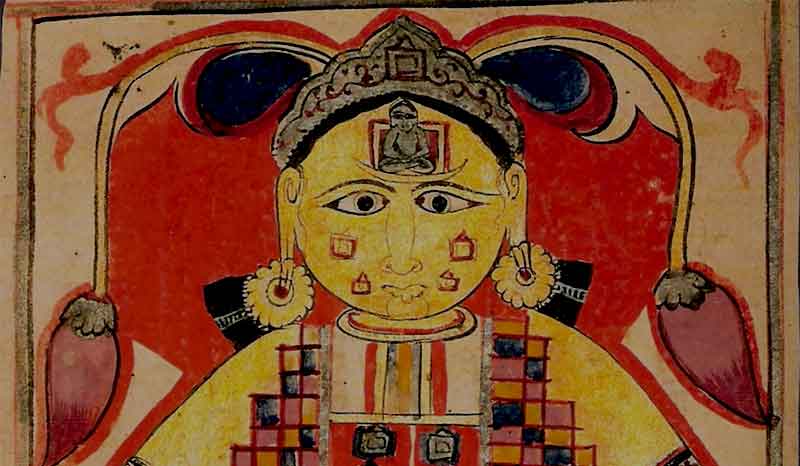
Jainism, Loka Purusha, the Universal Being
Either you are with God or against God, this is one approach. I do not believe in God, but I believe in my Self, this is the second approach. I do not believe in God, but I believe that my Self is God and divine, this is the third approach. I do not believe that God exists, but I believe that some souls can attain godhead through perfection, this is the fourth approach.
Except for the first, the creed of Jainism meanders through the rest of the approaches without compromising its essential doctrine. An outsider may find it difficult to categorize Jainism purely as either theistic or atheistic. However, a Jain would consider his faith as theistic rather than atheistic because he or she believes in the essential divinity of the individual Soul and its eternal existence in an eternal reality personifying the highest perfection. In the following discussion we understand why it is so.
One of the interesting features of a few religious traditions that originated in India is their disbelief in the existence of the Creator God. Samkhya, Buddhism and Jainism believe in the predictable and routine functions of Nature and its divisibility. However, they do not acknowledge the transcendental existence of the eternal principle we identify in the field of philosophy as tie singular cause of causes and in religious practice as God. The idea that one can be atheistic and yet religious, is a paradox for many, especially those who are brought up on the notion that the belief in God and religious practice go together and cannot be separated.
In Christianity and Islam, without pledging faith in God and without submitting to His supremacy and His inviolable law, one cannot be part of the congregation or the community of the followers and find a safe passage through the gates of heaven. In Hinduism, Jainism and Buddhism the belief in God is not a prerequisite to practice religion or achieve liberation.
They place more emphasis upon individual responsibility and personal salvation through righteous conduct and assiduous practice of the teachings left behind by enlightened masters. In this journey what helps them are detachment, renunciation, the absence of desires and inner purity. When the individuality of a being disappears, the individual becomes free from the things that define him and limit him. When the boundaries of separation are obliterated in the inner world that exists in each of us, one becomes part of the ocean existence and cease being an individual subject to duality and ignorance. In this process whether one may resort to God, or a deity is a personal choice, depending upon the path one chooses and the choice one makes.
Hinduism is not an atheistic religion. However, it offers a wide range of choices to its followers to test their beliefs in the waters of life and make their own decision. Also, in Hinduism, belief in God is not an essential prerequisite for achieving salvation, although it is desirable, since it increases the chances of attaining the final goal. Hinduism is very flexible in letting people make their choices and finding truth through trial and error, by reposing faith in the doctrine of karma, according to which every individual is subject to the consequences of his or her actions. Hinduism, Buddhism and Jainism believe in the law of karma. However, they differ with regard to its cause and continuation.
God is a great enigma which none can truly fathom. Students of modern science know how difficult it is to understand the origin and nature of the material universe. If we have such difficulty with the reality with which we interact continuously, imagine the extent of problem we may have in knowing the invisible and transcendental reality called God whom we cannot reach under normal circumstances. None can mentally and definitively construct the vision of the material universe, even though it is partially in the field of our observation and it is even more difficult to envisage the spiritual realm that defies all known laws of existence and is clearly beyond our perception.
These three traditions suggest that religious aspiration begins with a person's inborn inclination, according to his or her previous karma, leading ultimately through self effort to an inner opening in which Truth is perceived or experienced beyond the barriers of conditioned mind and limitations of scriptural or temporal authority.
Therefore, according to them religion is a means to self exploration and spiritual effort to arrive at Truth and should not be construed as an authoritarian and coercive dogma that suspends free inquiry and demands unconditional surrender to scriptural injunctions or a messianic teaching under the weight of authority or fear of blasphemy and persecution.
In all the Indian religions, knowledge gained through personal experience is more valid than knowledge gained through scriptures or teaching. The latter becomes credible and important without valid personal experience and or direct cognizance. One may resort to blind faith and scriptural authority in the initial stages of spiritual effort, but in the end one must reach the object of such a faith, in a state of non-duality, to experience oneness with it and become absorbed in it.
In this approach one can discern an underlying truth that if nonviolence is the suggested method to achieve perfection, the tradition that upholds it cannot violate the same principle to accomplish its aims. Like the many dualities of life, faith, which is a facilitator in the beginning becomes an obstacle at some stage on the spiritual path and ha to be renounced to transcend the mental constructs and intellectual notions and experience the truth directly.
In Buddhism and Jainism faith in the teachings of those who have reached perfection and experienced the truth directly takes precedence over blind faith in the existence an eternal Being. Both deny the very existence of God as an absolute and eternal entity and do not acknowledge His role as the creator of the world and the reality in which we live.
In Buddhism, any discussion about God is regarded as futile because it is of little value in the liberation of an individual. Speculation is considered the function of an idle mind, which is prone to distractions. It would not lead to mitigation of human suffering or the liberation of an individual. What matters most is the personal effort and the sincerity with which the Eightfold path is practiced. The Buddha advised his disciples to remain in the present, mindful of their immediate perceptible world, to know the true nature of their existence and find suitable remedies to the problem of their suffering.
If Buddhism does not clearly confirm or deny the existence of God, leaving the matter rather inconclusive and unanswered, Jainism makes its stand very emphatic by denying the existence of God as a universal and absolute Self responsible for creation, and leaves no scope for ambiguity and uncertainty on the subject.
However, paradoxically, although Jainism does not believe in the existence of the universal Supreme Self, we cannot categorize it as an atheistic tradition because it has clearly elements of theism. Jainism does not acknowledge God, but it does hold the faith that there are innumerable individual souls in varying states of bondage and perfection, which are both divine and eternal. It believes in the eternal nature of individual souls inhabiting the different regions of the universe, having the potential to reach their highest state of perfection, through their individual effort. Jainism also reposes faith in the teachings of Perfected Beings, or Arhats, and the existence's of higher words populated by gods. Both are considered venerable and worthy of emulation.
For a Jain, God is not the center of the world. Yet, a world devoid of God can still be divine and eternal. He perceives divinity or God's essential quality of perfection in the higher realm of the universe and in the eternal, individual souls who are intrinsically pure, having the ability to be omniscient, omnipotent and omnipresent according to their choices and individual actions. The world and the soul are permanent realities which cannot be denied. Even the materiality of our existence is not an illusion but a reality having variable components called tattvas. Matter and substance are real, just as the individual souls are. According to the Akaranga Sutra, "He who denies the world (of fire-bodies), denies the self; and he who denies the self, denies the world (of fire-bodies)."
Thus, in Jainism God is replaced by a permanent reality as individual souls, who are eternal, uncreated and indestructible, who inhabit the universe which is also uncreated and indestructible, subject to the movement of repetitive time cycles stretching over millions of years in which the souls pass through alternating phases of moral decline followed by spiritual recovery, just as mechanically and repetitively the day is followed by night and the night by day.
The God of Jainism or its highest operating principle is not a giver of boons or a liberator of beings, but an ideal state of eternal purity and blissful consciousness, to which humanity can aspire through renunciation, intense self effort and purification. A Jain, who has committed himself to the path of the Perfected Beings, known as the Tirthankaras or Arhats or Jinas, aims to achieve such a state of divinity not for the love of God or to be with God or become like God because He is higher and superior, but to escape from the existential suffering to regain the soul's lost freedom. In short in Jainism, there is no place for bhakti.
Since Hinduism and Jainism, and Jainism and Buddhism coexisted for long in the same region and their proponents interacted frequently, Jainism has traces of both these traditions, just as the other two imbibed some aspects of it. Thus, it appears that at some period in the history of the religious development in India, the worship of Lord Krishna found its way into Jainism. Arishtanemi, the 22nd thirthankara, is linked to him. The result was the origin of the community of Vaishnava Jains, an independent sub-sect of Jainism, who worship Lord Krishna devotionally just as the Hindus do. However, this development was an exception and should not be construed as the standard Jain practice.
Jain scriptures question the existence of God both logically and theistically. The Mahapurana declares that one should reject all notions of some God creating this world. It asks, " f God created this world, where was He before creation and where is He now and how can an immaterial God create a material world?" It goes on to conclude, "Know that the world is uncreated, as time itself is, without a beginning and without an end... Uncreated and indestructible, it endures under the compulsions of its own nature, divided into three sections- the hell, the earth and the heaven."
It is not that a Hindu cannot answer such a critical question However his answers would not fit into the Jain's view of the world and its eternal nature. For a Hindu the material world is unreal and it comes into existence as God's projection or manifestations. For a Jain the world is real because matter is real and uncreated. While it may go through various states or conditions, it has always been there and shall also remain forever, without a beginning and without an end, just like the individual souls.
Although Jains do not acknowledge the presence of God, they acknowledge the existence of higher beings called Arhats in heaven and some gods. The gods are embodied souls who enjoy greater freedom and a higher degree of purity, knowledge and intelligence. The Arhats do not take any interest in the affairs of the world. They are completely indifferent to what goes on here. However, they are interested in the welfare of the world and in helping the imperfect souls to climb the ladder of purity and righteousness through austere self-effort to reach the world of perfect beings.
A Jain worship the Arhats not to gain favors from them, but to cleanse their karma. The very act of worshipping the perfected beings is construed beneficial since it has the purifying effect of reducing the inflow of karmic material into their bodies and thereby hasten their progress on the spiritual path. Thus, primarily the worship of Arhats is not a devotional effort but a spiritual one. (A section of Jains, however, do believe that the Arhats may remove bad karma if you worship them).
The gods, on their part, keep a watch on the activities of the world. They respond to our requests and sincere prayers and help us in our good deeds. Many of them have similar names as the gods of Hinduism but differ in respect of their status and potency. They are not aspects of Supreme Self but individual souls who have reached a higher state of existence through their good deeds. They are worshipped for the good they do not because they are aspects of one Supreme Self.
Suggestions for Further Reading
- The Atomic Theory of Jainism
- History of Jainism
- Jainism - Philosophy and Doctrine
- Major Beliefs of Jainism
- Jain Literature and Canonical Texts
- Jainism Cosmology
- The Jains And Their Creed
- Jainism - Doctrine and History
- An Introduction to Jainism or Jain Dharma
- The Philosophy and Practice of Jainism
- Information Websites on Jainism
- Jainism and the Belief in God
- Jainism - Jivas, the Embodied Souls
- Jainism - Belief in Karma
- The Theory of Knowledge in Jainism
- History of Jainism after Mahavira
- Vardhamana Mahavira
- Jainism - Anekantavada or Nayavada
- An Outsider Perspective on Jainism
- Jainism - Sects and Subsects
- Syadavada or Saptabhangi
- The Tattvas of Jainism
- Jain Thirthankaras
- Ethics of Jainism - The Three Jewels
- Tirthahkaras Before Mahavira
- Essays On Dharma
- Esoteric Mystic Hinduism
- Introduction to Hinduism
- Hindu Way of Life
- Essays On Karma
- Hindu Rites and Rituals
- The Origin of The Sanskrit Language
- Symbolism in Hinduism
- Essays on The Upanishads
- Concepts of Hinduism
- Essays on Atman
- Hindu Festivals
- Spiritual Practice
- Right Living
- Yoga of Sorrow
- Happiness
- Mental Health
- Concepts of Buddhism
- General Essays