
Anekantavada or Nayavada
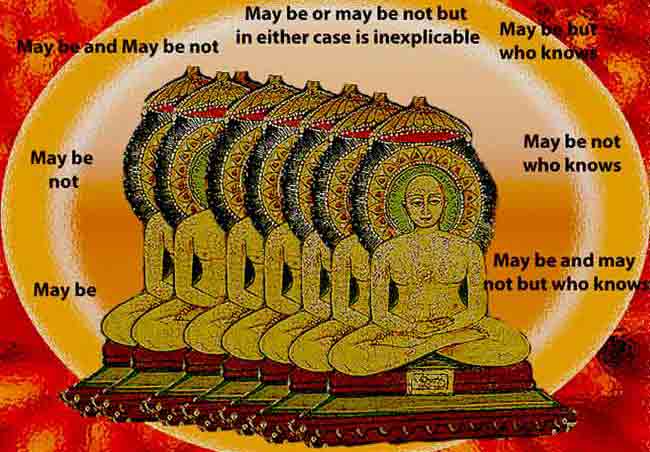
An object can be viewed or studied from various perspectives. You may look at it as a whole, study its parts, consider its functions, relationships, its past, future or its essential nature without any reference to its qualities and peculiarities. In understanding something, in resolving problems, we do in fact follow some of these processes, although we may not conduct our observation or inquiry so systematically.
Jaina philosophers grasped this fundamental process of studying any object or phenomena from various standpoints or points of views, called Nayas, and formulated the theory of relative pluralism or Anekantavada, also called Nayavada, and the doctrine of "May be" or Syadavada, also known as Saptabhangi. With both these approaches they tried to comprehend the truth in its totality, minimizing possible errors arising from the limitation of the human mind and its faculties.
Closely related to this doctrine is the premise that all human knowledge and the various judgments and decisions we make about things are relative and true in the context of certain conditions and factors only. You remove them or the context and your view point may become false or partially true. Since truth is multidimensional, one should not jump to conclusions or argue in defense of their opinions and beliefs without studying the subject from all possible viewpoints and minimizing the possibilities of errors and misunderstandings. Truth can be known only when you synthesize various opposing viewpoints.
The importance of Anekantavada arises from the basic Jain belief that souls (Jivas) that are caught in the phenomenal world (samsara) of births and deaths cannot grasp truth entirely because their omniscience or all knowing awareness is covered by the impurity of karma. Only the liberated souls and the perfect beings possess such knowledge whereby they can grasp truth entirely without the aid of any intermediary such as the mind or the senses. The knowledge gained through the mind and senses and the study of the scriptures is prone to errors. Hence, with regard to their knowledge the Jivas are vulnerable to erroneous conclusions, misunderstanding, misinterpretation, distortion, misapplication and logical fallacies. Such imperfect knowledge, if left unchecked, may lead them astray or delay their liberation. They can overcome this limitation, to some extent, through relative pluralism by studying an object from various perspectives, in its totality, in parts, in relationships and in relation to time and space.
Each religion follows certain principles and basic concepts to arrive at truth. In the Upanishads we come across two fundamental approaches. One is to discern the truth in an illusory world, you have to follow the principle of negation using the "Not this Not this" method. The second one is as stated by the Uddalaka Aruni in a conversation with his son. According to it, you know the essential truth of anything by knowing its basic, unchanging, and all pervading substratum or essence, such as the clay in a pot. Buddhism adapts an entirely opposite approach, holding that nothing is true and permanent and everything is either a process or a becoming. There is no essence so to speak which is immutable and holds good in all conditions and states of existence. Jainism takes a broader approach holding that truth cannot be comprehended easily until we reach the all knowing awareness through liberation or cultivate a multidimensional view with an open mind and a "May be" approach, taking into consideration all the viewpoints associated with it.
There are many viewpoints from which you can observe a thing. Accordingly, there are different schemes of Nayas in Jainism. However, the following division of seven relational ways, or Nayas, to comprehend reality is widely accepted. Of them the first four views are related to objects and meanings and the last three to names and words that define objects give them identity. When considered alone they may create errors.
Naigamanaya: It refers to the viewpoint that regards an object without drawing any distinction between its general and specific qualities. For example when you view a human being as a living being without paying attention to his human qualities, you are using Naigamanaya. It is the highest viewpoint that does not really help you to comprehend the essential nature of an object except in a very generic way. According to another interpretation, Naigamanaya relates to the general purpose rather than the specific purpose. For example, it is like referring to a mango as a fruit rather than by its specific name.
Samgrahanaya: It refers to the viewpoint that considers only the common or general features of an object, but not to its specific qualities. It is a class view, which may help you to draw some immediate conclusions and generalizations about the object, which may not really represent the object since you will not pay attention to its specific qualities that distinguish it from other objects in the same class. For example not all apples may not be sweet, or healthy or ripe or of the same color.
Vyavaharanaya: It is the view, which considers the specific or striking features or characteristics of a thing ignoring the general characteristics it shares with the other things of its class. For example when we preoccupy ourselves with certain striking features in a person ignoring the fact that he is a human being or the features he shapes with other human beings we resort to this viewpoint. Hence it is a conventional or habitual viewpoint in which we preoccupy ourselves with certain details and ignore the larger picture and its place in the totality of things and the rest of the class to which it belongs.
Rjusutranaya: It is the linear and amnesiac view which considers the current state, status or condition of an object, ignoring its past and future. It is like watching the flow of a river in the narrow visual field of your eyes, without bothering yourself from where it is flowing or to where it is going. Such a view has its own advantages and disadvantages, but since it is a very narrow view, it is not very reliable.
Sabdanaya: It is the literal view which considers just the meaning of the words related to an object, ignoring every other detail. A word, such as a name, does not convey much about anything except its literary meaning. Even that may not throw much light about the nature of the object since the same name may refer to many objects or and different names may refer to the same object. Sometimes one may also misuse words or confuse one meaning of the word with another. Hence, we may not comprehend much about an object by relying upon words or know any truth adequately.
Samabhirudhanaya: It is the etymological view in which we focus entirely upon the etymological meaning of the words related to an object, rather than their literal meaning, whereby we consider each synonym related to the object as distinct..
Evambhutanaya: It is the attributive view in which we consider the specific qualities of an object. For example, a fruit is a fruit only when it is eaten. A servant is a servant only when he serves. Sakra is Sakra only when he wields power.
Nayas are the various ways people approach reality or understand it. A narrow view point, which looks at only certain facts and uses them to justify a theory or a standpoint is inherently defective and unacceptable. However, in real life since we do not pay much attention how people think and argue, at times we accept them and suffer from the consequences. Our study and understanding of anything must be complete, for which we must examine it from every possible angle without ignoring the truths that are particular to each standpoint and the views that make up the whole. From the perspective of Anekantavada, there are no absolute or wholesome truths in the world, when we solely rely upon our senses, minds and intelligence to study them superficially. To arrive at an absolute truth or final conclusion (nyaya-niscaya) we must either pay attention to all viewpoints or attain the all-knowing omniscience, which happens only when we remove the layers of karma and become absolutely pure and free.
Suggestions for Further Reading
- The Atomic Theory of Jainism
- History of Jainism
- Jainism - Philosophy and Doctrine
- Major Beliefs of Jainism
- Jain Literature and Canonical Texts
- Jainism Cosmology
- The Jains And Their Creed
- Jainism - Doctrine and History
- An Introduction to Jainism or Jain Dharma
- The Philosophy and Practice of Jainism
- Information Websites on Jainism
- Jainism and the Belief in God
- Jainism - Jivas, the Embodied Souls
- Jainism - Belief in Karma
- The Theory of Knowledge in Jainism
- History of Jainism after Mahavira
- Vardhamana Mahavira
- Jainism - Anekantavada or Nayavada
- An Outsider Perspective on Jainism
- Jainism - Sects and Subsects
- Syadavada or Saptabhangi
- The Tattvas of Jainism
- Jain Thirthankaras
- Ethics of Jainism - The Three Jewels
- Tirthahkaras Before Mahavira
- Essays On Dharma
- Esoteric Mystic Hinduism
- Introduction to Hinduism
- Hindu Way of Life
- Essays On Karma
- Hindu Rites and Rituals
- The Origin of The Sanskrit Language
- Symbolism in Hinduism
- Essays on The Upanishads
- Concepts of Hinduism
- Essays on Atman
- Hindu Festivals
- Spiritual Practice
- Right Living
- Yoga of Sorrow
- Happiness
- Mental Health
- Concepts of Buddhism
- General Essays