
Introduction to the Baudhayana Dharma Sutra
THE case of the Baudhâyana Dharma-sûtra is in many respects analogous to that of the Institutes of the Sacred Law, current in the schools of Âpastamba and Hiranyakesin. Like the latter, it is the work of a teacher of the Black Yagur-veda, who composed manuals on all the various subdivisions of the Kalpa, and founded a Sûtra-karana, which is said to exist to the present day 1 . The Brâhmanical tradition, too, acknowledges these facts, and, instead of surrounding Baudhâyana's work with a halo of myths, simply states that it was originally studied by and authoritative for the followers of the Taittirîya-veda alone, and later only became one of the sources of the Sacred Law for all Brâhmans 2 .
Moreover, the position of Baudhâyana among the teachers of the Yagur-veda is well defined, and his home, or at least the home of his school, is known. But here the resemblance stops. For while the Sûtras of Âpastamba-and Hiranyakesin have been preserved in care-fully and methodically arranged collections, where a certain place is assigned to each section of the Kalpa, no complete set of the Sutras of Baudhâyana's school has, as yet; been found, and the original position of the detached portions which are obtainable is not quite certain. Again, while the works of Âpastamba and Hiranyakesin seem to have been kept free from extensive interpolations, several parts of Baudhâyana's Sûtras have clearly received considerable additions from later hands.
According to the researches of Dr. A. Burnell 1 , whose long residence in Southern India and intimate acquaintance with its Brâhmanical libraries have made him the first authority on the literature of the schools of the Taittirîya-veda, the Sûtras of Baudhâyana consist of six sections, viz. 1. the Srauta-sûtras, probably in nineteen Prasnas; 2. The Karmânta-sûtra in twenty Adhyâyas; 3. The Dvaidha-sûtra in four Prasnas; 4. The Grihya-sûtra in four Prasnas; 5. The Dharma-sûtra in four Prasnas; 6. The Sulva-sûtra in three Adhyâyas. The results of the search for Sanskrit MSS. in other parts of India, and especially in Western India, do not differ materially from those obtained by Dr. Burnell. The Grihya-sûtra, which in Western India occasionally bears the title Smârta-sûtra 2 , contains, however, nine instead of four Prasnas.
The MSS. of the Baudhâyana-sûtras, which contain the text alone, are all incomplete, mostly very corrupt and in bad order, and rarely give more than a small number of Prasnas on detached subjects. The copies in which the text is accompanied by a commentary are in a better condition. Thus the Kalpavivarana of Bhavasvâmin 3 extends over the whole of the Srauta-sûtra, and over the Karmânta and the Dvaidha-sûtras. It shows the proper sequence of the Prasnas on Srauta sacrifices, and that probably the Karmânta and the Dvaidha immediately followed the Srauta-sûtra. But there is no hint in the MSS. or in the commentaries how the Grihya, Dharma, and Sulva-sûtras were originally placed. With respect to these sections, it is only possible to judge from the analogy of the other extant sets of Kalpa-sûtras and from internal evidence. On these grounds it may be shown that the order, adopted by Dr. Burnell, is probably the correct one.
For the beginning of the Grihya-sûtra 1 shows by its wording that it was not a separate treatise, but was immediately connected with some preceding Prasna. The analogy of the collections of the Âpastambîyas, the Hairanyakesas, the Kathas, and other schools permits us to infer that it stood after the Srauta-sûtra. It is further clear that, in its turn, it was succeeded by the Dharma-sûtra. For two passages of the latter work, 1, 2, 3, 15, and II, 8, 15, 9, clearly contain references to the Grihya-sûtra. In the former, the author gives the rule regarding the length of the staff to be carried by a student, as well as the general principle that the staff must be cut from a tree fit for sacrificial purposes. With respect to the latter clause he adds that the details have been given above.' As the Dharma-sûtra contains nothing more on this subject, it follows that the expression 'above' must refer to Grihya-sûtra II, 7, where the usual detailed rules regarding the employment of particular woods for the several varnas are given. In the second passage Baudhâyana says that the rules for the performance of funeral sacrifices have been fully explained in the section on the Ashtakâhoma, which occurs Grihya-sûtra II, 17-18. It is, therefore, perfectly certain that Baudhâyana, just like Âpastamba, placed the Prasnas on the Sacred Law after those on the domestic ceremonies, and that the Dharma-sûtra was not a separate work. Under these circumstances it becomes highly probable that the Sulva-sûtra formed, as is the case in other sets of Kalpa-sûtras, the conclusion of the whole. Thus the only treatise, whose position remains doubtful, is the Pravarakhanda, the list of the Brâhmanical gotras and of their deified ancestors 2 . Possibly it may have stood at the end of the Srauta-sûtra.
The destruction of the continuity of Baudhâyana's Kalpa-sûtra has had the consequence which is commonly observable in other dismembered works, that several of its detached portions have received considerable additions from later and, as it would seem, from several hands. There can be no doubt that a small portion only of the nine Prasnas, found in the Western copies of the Grihya-sûtra, really belongs to Baudhâyana. For the description of the Grihya rites, which strictly follows the general plan laid down in the first Sûtra, is completed in two or three Prasnas
1 . Next follows a Prasna on the anukritis, rites resembling those comprised in the subdivisions treated before, and then a Prasna on prâyaskittas, or expiations of mistakes committed during, and of the neglect of, the performance of the Grihya-karmâni. The remaining Prasnas are filled with a medley of paribhâshâs, general rules, and of full descriptions of ceremonies, some of which have been given before, while others are added afresh. Many of the newly-added rites do not belong to the ancient Brâhmanical worship, but to the Paurânic religions, the service of Siva, Skanda, Nârâyana, and other deities, and some show an admixture of Tântric elements. In some of the later Prasnas, especially IV and V, the language closely resembles that of the first three, and shows the same stereotyped phrases and the same Vedic anomalous forms. But in other sections, particularly VI-IX, we find, instead of Sûtras, the common Anushtubh Sloka throughout, and expressions peculiar to the metrical Smritis and the Purânas. At the end of most Adhyâyas we read the phrase, ity âha Baudhâyanah, or bhagavân Baudhâyanah, 'thus speaks Baudhâyana, or the divine Baudhâyana.' Finally, while the first three Prasnas are divided into Kandikâs or Khandas, the following ones consist of Adhyâyas or chapters. These differences, as well as the fact that the most important Grihya rites, arranged according to a special plan, are done with in the first three Prasnas, necessarily lead to the conclusion that the whole remainder does not belong to Baudhâyana, but consists of so-called Parisishtas, which were composed by the adherents of his school. Further, the fact that the last six Prasnas do not show everywhere the same style and language, makes it probable that the additions were made at different times and by different persons.
The Dharma-sûtra seems to have undergone exactly the same fate as the Grihya-sûtra. It will be obvious even to the readers of the translation that its fourth Prasna is a later addition. It consists of two parts. The first, which ends with the fourth Adhyâya, treats of penances, both public and secret ones. The second, Adhyâyas 5-8, describes the means of obtaining siddhi, the fulfilment of one's desires, and recommends for this purpose the offering of the Ganahomas after a previous sanctification of the worshipper by means of a course of austerities. The first part is perfectly superfluous, as the subject of penances has already been discussed in the first sections of the second Prasna, and again in chapters 4-10 of the third Prasna. Its rules sometimes contradict those given before, and in other cases, eg. IV, 2, 10-12, are mere repetitions of previous statements. The introduction of the means of gaining siddhi, on the other hand, is without a parallel in other Dharma-sûtras, and the subject is entirely foreign to the scope of such works. Its treatment, too, shows that chapters 5-8 do not belong to the author of the bulk of the Dharma-sûtra. For the description of the preparatory 'restraints' or austerities contains somewhat more detailed rules for a number of penances, e.g. the Krikkhras and the Kândrâyana, which have already been described in the preceding Prasnas. Moreover, the style and the language of the whole fourth Prasna are very different from those of the three preceding ones, and the differences observable are exactly the same as those between the first five and the last four Prasnas of the Grihya-sûtra. The epic Sloka nearly throughout replaces the aphoristic prose, and the common slipshod Sanskrit of the Purânas appears instead of the archaic forms. Finally, the fourth Prasna is divided into Adhyâyas, not into the Kandikâs or Khandas and Adhyâyas which are found in the first two Prasnas.
This latter peculiarity is also observable in the third Prasna, and raises a suspicion against the genuineness of that part also. For, though the third Prasna in style and language resembles the first two, it is hard to believe that the author should, for no apparent reason, suddenly have changed the manner of dividing his work towards its end. This suspicion is further strengthened by two other circumstances. First, Prasnas I-II really exhaust the discussion of the whole Dharma, and the third offers supplementary information only on some points which have been touched upon previously. Secondly, several Adhyâyas of Prasna III seem to have been borrowed from other works, or to be abstracts from them. Thus the tenth chapter has certainly been taken from the Gautamîya Dharmasâstra, the sixth bears a very close and suspicious resemblance to Vishnu XLVIII 1 , and the third looks very much like a short summary of the doctrine of Vikhanas, whose lost Sûtra contained the original rule of the order of the Vaikhânasas or hermits, living in the forest. These circumstances justify, it seems to me, the assumption that Baudhâyana's original Dharma-sûtra consisted, like Âpastamba's, of two Prasnas only, and that it received, through followers of his school, two separate additions, first in very ancient times Prasna III, where the style of the master is strictly followed, and later Prasna IV, where the language and phraseology of the metrical Smritis are adopted. It ought to be noted that Govindasvâmin, too, does not take the whole of the four Prasnas for Baudhâyana's composition. With respect to several passages 2 where Baudhâyana's name is introduced in order to give weight to the rules, he says that the Sûtras may belong to 'a pupil.' I do not think that the criterion which he uses can be relied on in every case, because oriental authors without doubt occasionally speak of themselves as of third persons. But the fact that the commentator, though an orthodox Hindu, had misgivings as to the genuineness of portions of the work, is not without significance. It seems also that even the first two Prasnas are not quite free from interpolations. Thus the Kandikâs on the Tarpana 1 are certainly much enlarged by additions, the verse at I, 5, 11, 36, a repetition of I, 5, 9, 5, and some prose quotations which are introduced by the words athâpy udâharanti, 'now they quote also,' standing usually before verses only, are at least suspicious. That the genuineness of many single passages should be doubtful, is no more than might be expected, not only on account of the separation of the Dharma-sûtra from the other parts of the Kalpa, but also because the work, as we shall see further on, remained for a long time without the protection of a commentary. The practical conclusion to be drawn from this state of things is that the greatest caution must be observed in using the Baudhâyana Dharma-sûtra for historical purposes, and that it will be advisable to draw no inferences regarding Baudhâyana's relation to other teachers and schools from the last two Prasnas, and not to trust too much to historical inferences drawn from single passages of the first two.
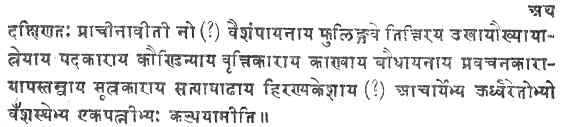
The position which Baudhâyana occupies among the teachers of the Taittirîya-veda has already been discussed in the Introduction to Âpastamba. It has been shown that according to the Brâhmanical tradition preserved by Mahâdeva, the commentator of the Hiranyakesi-sûtras, he composed the first Sûtra for the followers of his Sâkhâ. Internal and external evidence has also been adduced, proving that he certainly was more ancient than Âpastamba and Hiranyakesin. It is now possible to bring forward some further facts bearing on these points. First, in the section on the Tarpana, the libations of water offered to various deities, Rishis, and the manes, II, 5, 9, 14, Kânva Baudhâyana receives his share immediately after the Rishis of the Veda and before Âpastamba, the Sûtrakâra, and Satyâshâdha Hiranyakesin. The same order is observed in the distribution of the offerings at the Sarpabali, described in the Grihya-sûtra 1 , where the following teachers of the Yagur-veda are specially named, viz. Vaisampâyana, Phuliṅgu, Tittiri, Ukha, Aukhya, Âtreya the author of the Pada-text, Kaundinya the author of the commentary, Kânva Baudhâyana the author of the Pravakana, Âpastamba the author of the Sûtra, and Satyâshâdha Hiranyakesin. Neither of these two passages belongs to Baudhâyana. They are both clearly interpolations. But they show that Mahâdeva's statement, which makes Baudhâyana the first expounder of the Kalpa among the Taittirîyavedins, agrees with the tradition of the Baudhâyanîyas themselves. For not only the place allotted to Baudhâyana's name, but still more the title Pravakanakâra which he receives, show that the followers of his school placed him before and above all other teachers of the ritual. The term pravakana, which literally means 'proclaiming or recitation,' has frequently the technical sense of 'oral instruction,' and is applied both to the traditional lore contained in the Brâhmanas, and to the more systematic teaching of the Aṅgas 2 . If, therefore, a teacher is called the author of the Pravakana of a Sâkhâ, that can only mean that he is something more than a common Sûtrakâra, and is considered to be the originator of the whole 'system of instruction among its followers. The epithet Kânva, which Baudhâyana receives in both the passages quoted above, indicates that he belonged to the Vedic Gotra of the Kanvas. It deserves to be noted that Govindasvâmin, too, on I, 3, 5, 13, explains the name Baudhâyana by Kânvâyana 3 .
The style of Baudhâyana's works furnishes, as Dr. Burnell has pointed out 1 , another argument for their high antiquity. Compared with the Sûtras of Âpastamba and Hiranyakesin they are much simpler in their arrangement, and the complete absence of that anxiety to save 'half a vowel' which characterises the fully developed Sûtra-style is very remarkable. The last point has been noticed by Govindasvâmin also. In commenting on I, 2, 3, 17-18, where Baudhâyana first permits students to beg food of men of all castes, and afterwards explains that he means Âryans who follow their lawful occupations, he says 2 , '(If anybody should ask), "Why give two Sûtras, while one Sûtra, ('A student shall ask) Âryans who follow their lawful occupations,' would have sufficed?" (his objection will be) correct. For this teacher is not particularly anxious to make his book short.' In other cases we find a certain awkwardness in the distribution of the subject matter, which probably finds its explanation through the fact that Baudhâyana first attempted to- bring the teaching of the Taittirîyas on the Dharma into a systematic form. Thus the rules on the law of inheritance are given without any apparent necessity and against the custom of the other Sûtrakâras in two different chapters, I, 5, 11, 9-16 and II, 2, 3, 1-44. The section on purification, too, is divided into two separate portions, I, 4, 6-10 and I, 6, 13-15, and the second which treats of the purification of the vessels at sacrifices, properly ought to have been placed into the Srauta-sûtra, not into the Dharma-sûtra. Again, the discussion of several topics is repeatedly interrupted by the introduction of rules belonging to different subjects, and Govindasvâmin's ingenuity is often taxed to the utmost in order to find the reason why certain Sûtras which apparently are unconnected with the main subject have been inserted. A third argument for the great antiquity of Baudhâyana's Sûtras, derived from the archaic character of some of his doctrines, has been discussed in the Introduction to Âpastamba 1 . The number of instances where Baudhâyana's rules are based on a more ancient order of ideas than Âpastamba's might be increased very considerably. But, as now the comparison of the two works is open to all students, I omit the cases contained in the two Dharma-sûtras, and content myself with adducing one more from the less accessible Grihya-sûtras. It is a well-known fact that the ancient Vedic ritual in certain cases admitted Sûdras, and particularly the Rathakâra or carpenter, who, according to all accounts, has Sûdra blood in his veins, to a participation in the Srauta rites. The Taittirîya-brâhmana even gives certain Mantras to be recited by the Rathakâra at the Agnyâdhâna sacrifice 2 . Now Baudhâyana, who, Dh. S. I, 9, 17, 6, derives the origin of the Rathakâras from a Vaisya male and Sûdra female, apparently reckons him amongst the twice-born, and explicitly allows him to receive the sacrament of the initiation. He says, Grihya-sûtra II, 5, 8-9, 'Let him initiate a Brâhmana in spring; a Kshatriya in summer, a Vaisya in autumn, a Rathakâra in the rainy season; or all of them in spring 3 .' But Âpastamba, who shows great hostility against the mixed castes, and emphatically denies the right of Sûdras to be initiated, gives the same rule regarding the seasons for the initiation both in his Grihya and Dharma-sûtras 4 . He, however, omits the Rathakâra in both cases. There can be no doubt that Âpastamba's exclusion of the carpenter, which agrees with the sentiments prevailing in modern Brâhmanical society, is an off-shoot of a later doctrine, and as both he and Baudhâyana belong to the same vidyâvamsa, or spiritual family, this difference may be used as an argument for his posteriority to Baudhâyana. In connexion with this rule of Baudhâyana's it ought to be mentioned that even in the present day certain subdivisions of the modern Sutârs or carpenters actually wear the Brâhmanical thread, and, in spite of the adverse teaching of the Sâstras, find Brâhmans willing to perform the ceremony of investiture for them.
While it thus appears not incredible that Baudhâyana really was the first Sûtrakâra of the Taittirîyas, the numerous quotations which his works contain, permit us to form an idea of the extent of the Vedic and profane literature known to him. Among the Vedic works which he adduces as authorities, or otherwise refers to, the three sections of the Taittirîya-veda, the Samhitâ, the Brâhmana, and the Âranyaka, naturally take the first place. For the Âranyaka he seems to have used the Andhra version, as Dh. S. II, 10, 18, 7, 11 references to the seventy-first Anuvâka of the tenth Prapâthaka occur. Two long passages, Dh. S. I, 2, 4, 3-8; II, 6, 11, 1-8, which apparently have been taken from the Satapatha-brâhmana, testify to his acquaintance with the White Yagur-veda. Baudhâyana does not say expressly that he quotes from the Brâhmana of the Vâgasaneyins, but Govinda has no hesitation in pointing to the Satapatha as their source. It is remarkable that the fact noticeable in Âpastamba's quotation from the Satapatha reappears here, and that the wording of the two quotations does not fully agree with the printed text of the Brâhmana. The differences in the first passage are, no doubt, partly owing to corruptions and interpolations in Baudhâyana's text; but that cannot be said of the second 1 . References to the Sâma-veda and the Sâmans occur repeatedly, and the passage from the Nidâna of Bhâllavins regarding the geographical extent of true Brâhmanical learning, which Vasishtha adduces, is given I, 1, 2, 11-12. From the Rig-veda a few expiatory hymns and verses, such as the Aghamarshana and the Taratsamandîs, are quoted. The Atharva-veda is not referred to by name, but the existence of Âtharvana schools may be inferred from the mention made of the vows called Siras, II, 8, 14, 2. Among the authorities on the Sacred Law, mentioned in the Dharma-sûtra, Kâtya I, 2, 3, 46, Maudgalya II, 2, 4, 8, and Aupagandhani II, 2, 3,33, do not occur in other works of the same class 1 . Hârîta, who is mentioned II, 1, 2, 21, and who probably was a teacher of the Maitrâyanîya school, is named by Vasishtha and Âpastamba also. The Gautama who is quoted I, 1, 2, 7 and II, 2, 4, 17, is, as has been shown in the Introduction to Gautama, most probably the author of the still existing Institutes of Gautama. To the arguments for the latter view, adduced there, I may add that two other passages of the Dharma-sûtra, II, 6, 15 and 26, point to a close connexion between Baudhâyana's and Gautama's works. The former of the two Sutras contains, with the exception of one small clause in the beginning, exactly the same description of the duties of a hermit in the forest as that given by Gautama III, 26-35. The second Sutra states, just as Gautama's rule III, 36, that the venerable teacher (âkâryâh) prescribes one order only, that of the householders. The reason given for this opinion differs, however, according to Baudhâyana, from that adduced in Gautama's text. The almost literal identity of the first long passage makes it not improbable that Baudhâyana borrowed in this instance also from Gautama without noting the source from which he drew. On the other hand, the argument drawn from the fact that the tenth Adhyâya of Prasna III has been taken from Gautama's Sûtra loses its force since, as I have shown above, it is improbable that the third Prasna formed part of Baudhâyana's original work. A metrical work on the Sacred Law seems to be quoted II, 2, 4, 14-15. For, as the second verse, adduced there, says that the penance for one who violated his Guru's bed has been declared above, it seems impossible to assume that the two Slokas belonged to the versified maxims of the Dharma current among the learned Brâhmans. If this quotation is not an interpolation, it proves that, side by side with the Dharma-sutras, metrical treatises on the Sacred Law existed in very early times 1 . One quotation, finally, which gives a verse from the dialogue of the daughters of Usanas and Vrishaparvan seems to have been taken from an epic poem. The verse is actually found in the Mahâbhârata I, 78, 10, and again 34, where the altercation between Sarmishthâ and Devayânî forms part of the Yayâtyupâkhyâna. Considering what has been said above regarding the state of the text of the Dharma-sûtra, and our imperfect knowledge of the history of the Mahâbhârata, it would be hazardous to assert that the verse proves Baudhâyana's acquaintance with Vyâsa's great epic. It will be safer to wait for further proofs that it was known to the Sûtrakâras, before one bases far-going speculations on this hitherto solitary quotation.
The arguments which maybe brought forward to show that Baudhâyana's home lay in Southern India are not as strong as those which permit us to determine the native country of Âpastamba. The portions of the Sutras, known to me, contain no direct mention of the south except in the desanirnaya or disquisition on the countries, Dharma-sûtra I, 1, 2, where certain peculiar customs of the southern Brâhmans are enumerated, and some districts of Southern India, eg. Kaliṅga, are referred to as barbarous countries which must not be visited by Âryans. These utterances show an acquaintance with the south, but by no means prove that Baudhâyana lived there. A more significant fact is that Baudhâyana declares, I, 1, 2, 4, 'going to sea' to be a custom prevailing among the northern Brâhmans, and afterwards, II, I, 22, places that act at the head of the Patanîyas, the more serious offences causing loss of caste. It is probable that by the latter rule he wished to show his stand-point as a southerner. But the most conclusive argument in favour of the southern origin of the Baudhâyanîyas is that they, like the Âpastambîyas and all other adherents of the Taittirîya schools, are entirely confined to the Dekhan, and are not found among the indigenous subdivisions of the Brâhmans in Central and Northern India. This fact is, if not explicitly stated, at least implied by the passage of the Mahârnava quoted in the Introduction to Âpastamba 1 . It is proved by the present state of things, and by the evidence of the land grants of the southern dynasties, several of which have been made in favour of Baudhâyanîyas. Thus we find a grant of Bukkarâya, the well-known ruler of Vigayanagara 2 , dated Sakasamvat 1276 or 1354-5 AD., in which a Brâhmana, studying the Baudhâyanîya-sûtra, is mentioned as the donee of a village in Maisûr. Again, in an inscription of Nandivarman Pallavamalla, which its editor, the Rev. Mr. Foulkes, places in the ninth century A D. 3 , a considerable number of Brâhmanas of the Pravakana-sûtra are named as recipients of the royal bounty, together with some followers of the Âpastambha 4 school. As we have seen that Baudhâyana is called in the Grihya-sûtra the Pravakanakâra, it is not doubtful that the Pravakana-sûtra of this inscription is the Sûtra of his school. The villages which the grantees received from Nandivarman were situated on the Pâlâr river in the Kittûr districts of the Madras Presidency. Besides, the interesting tradition which asserts that Mâdhava-Sâyana, the great commentator of the Vedas, was a Baudhâyanîya 5 is another point which may be brought forward as evidence for the location of the school in Southern India. Further, it must not be forgotten that most and the best MSS. of Baudhâyana's Sûtras are found in Southern India. There are also some faint indications that the Andhra country is the particular district to which Baudhâyana belonged. For his repeated references to voyages by sea and his rule regarding the duty payable on goods imported by sea show that he must have lived in a coast district where sea-borne trade flourished, and the fact that he uses the Andhra recension of the Taittirîya Âranyaka makes it probable that he was an inhabitant of the eastern coast.
My estimate of the distance between Baudhâyana and Âpastamba and of that between the latter and the historical period of India has been given in the Introduction to Âpastamba, pp. xxii and xliii, and I have nothing further to add on that subject. The oldest witness for the existence of the Srauta-sûtra of Baudhâyana is its commentator Bhavasvâmin, whom Dr. Burnell places in the eighth century A. D. The Dharma-sûtra is first quoted by Vigñânesvara, circiter 1080-1100 AD. Several of the passages adduced by him are, however, not traceable in the MSS.
As regards the materials on which the translation is based, I had at my disposal six MSS. of the text and two copies of Govindasvâmin's commentary, the Bodhâyanîya-dharmavivarana 1 , one of which (C. I.) gives the text also. These MSS. belong to two chief groups, a northern and a southern one. The northern group contains two subdivisions. The first comprises (1) D., a MS. bought by me for the Government of Bombay at Ahmadâbâd (no. 6 of the Dekhan College collection of 1868-69), and about one hundred or one hundred and fifty years old; (2) P., an old MS. of my own collection, bought in 1865 at Puna; (3, 4) B. and Bh., two modern transcripts, made for me in Baroda and Bombay, Among these, D. alone is of real value, as P., B., and Bh. faithfully reproduce all its clerical errors and add a good many new ones. The second subdivision of the northern group is represented by K., a modern transcript, made for the Government of Bombay at Kolhâpur in the southern Marâtha country (Elphinstone College collection of 1867-68, Class VI, no. 2). The MSS. of the northern group, which give the vulgata current since the times of Nîlakantha.(1650 A. D.) and Mitramisra (circiter 2 700 A. D.) in Western and Central India, can be easily recognised by the omission of the third Adhyâya of Prasna IV, and by their placing IV, 5, 1 b-25 after IV, 7, 7. One of the chief differences between K. and the other MSS. of the northern group is the omission of II, 5, 8, 4-II, 6, 11, 15 in the latter. The southern group of MSS. is formed by M., a slovenly Devanâgarî transcript of a Grantha MS., no. 610/1929 of the Madras Government collection 1 , and by the text of C. L, a Devanâgarî copy of the MS. of Govindasvâmin's commentary, presented by Dr. Burnell to the India Office library 2 , The second copy of the commentary, C. T., a Telugu paper MS. from Tanjore, I owe to the kindness of Dr. Burnell.
As might be expected, on account of the southern origin of the Baudhâyanîya school, M. gives on the whole the best form of the text. It also carefully marks the Kandikâs 3 in the first two Prasnas, ignoring the Adhyâyas altogether, and contains at the end of each Prasna the first words of each Kandikâ, beginning with the last and ending with the first, after the fashion which prevails in the MSS. of the Taittirîya Samhitâ, Brâhmana, and Âranyaka. Very close to M. comes Govinda's copy, where, however, as in most northern MSS., the Adhyâyas alone are marked. It is, however, perfectly certain that in some very difficult passages, which are disfigured by ancient corruptions, he corrected the text conjecturally 4 In a certain number of cases the northern MSS. present better and older readings than M. and C. I. 5 Under these circumstances it has not been possible to follow the commentary or M. throughout. Though they had to be made the basis, they had in many passages to be set aside in favour of readings of the northern group. In some cases I have also been obliged to make conjectural emendations, which have all been mentioned in the notes. Three Sûtras, I, 8, 16, 13-15, have been left untranslated, because the MSS. offer no safe basis for a conjectural restoration, and the commentary is defective.
Govinda, who, as Dr. Burnell informs me, is said to be a modern writer, seems to have composed his vivarana without the aid of older vrittis. Though he apparently was well acquainted with the writings belonging to the Taittirîya-veda, with the ritual and with the common law-books, he has not succeeded in explaining all the really difficult passages. Sometimes he is clearly mistaken, and frequently he passes by in silence words or whole Sûtras, the sense or the general bearing of which is by no means certain. Though it would be ungrateful on my part to underrate the importance of his work for my translation, I cannot place him in the same rank with Haradatta, the commentator of Âpastamba and Gautama, and can only regret that no older commentary based on the living tradition of the Baudhâyanîyas has been available. If such a work were found, better readings and better explanations of many difficult passages would probably come to light. With the materials at my disposal the translation has been a work of some difficulty, and in trying to settle the text I have often experienced the feeling of insecurity which comes over the decipherer of a difficult inscription when the facsimiles are bad. The short Adhyâya on adoption, given in the appendix to the Dharma-sûtra, has been taken from the Smârta or Grihya-sûtra. It does not belong to Baudhâyana, but is frequently quoted by the writers on civil law, who wrote in the sixteenth and seventeenth centuries of our era.
Suggestions for Further Reading
- Dharma, the Moral and Religious Duties of Hinduism
- Ashrama Dharma in Hinduism
- Good and Evil in Hinduism
- Why is Hinduism Called Sanatana Dharma?
- Wealth and Duty in Hinduism
- The Basis of Morality in Hinduism
- The Bhagavadgita on Karma, the Law of Actions
- Karma Yoga According to the Bhagavadgita
- The Hindu Dharmashastras, Subject Index
- A Brief Note on the Dharmashastras
- The Laws of Manu Chapter 1 to 6
- The Laws of Manu Chapters 7 to 12
- Introduction to the Apastamba
- The Apastamba - Prasna I
- The Apastamba - Prasna II
- Introduction to Gautama Sutras
- The Gautama Sutras, Chapters I to XIV
- The Gautama Sutras Chapters XV to XVIII
- The Vashishta Dharmashastra, introduction
- The Vashishta Dharmashastra, Chapters I - VII
- The Vashishta Dharmashastra, Chapters VIII - XIV
- The Vashishta Dharmashastra, Chapters V - XXII
- The Vashishta Dharmashastra, Chapters XIII - XXX
- Introduction to the Baudhayana DharmasShastra
- The Baudhayana Dharmashastra - PrasnaI (Kandika 1-21)
- The Baudhayana Dharmashastra - PrasnaII (Kandika 1-18)
- The Baudhayana Dharmashastra - PrasnaIII, IV and V
- Essays On Dharma
- Esoteric Mystic Hinduism
- Introduction to Hinduism
- Hindu Way of Life
- Essays On Karma
- Hindu Rites and Rituals
- The Origin of The Sanskrit Language
- Symbolism in Hinduism
- Essays on The Upanishads
- Concepts of Hinduism
- Essays on Atman
- Hindu Festivals
- Spiritual Practice
- Right Living
- Yoga of Sorrow
- Happiness
- Mental Health
- Concepts of Buddhism
- General Essays
Footnotes
xxix:1 I must here state that during my residence in India I have never met with a follower of Baudhâyana's school, and cannot personally vouch for its existence. But many Pandits have assured me that many Baudhâyanîyas are to be found among the Telingana and Karnâtaka Brâhmans.
xxix:2 See Govinda's statement, quoted. above, p. xiii.
xxx:1 See Burnell, Catalogue of a Collection of Sanskrit MS., pp. 24-26, 28, 34-35, and Tanjore Catalogue, pp. 18a-20b, and especially his remarks at pp. 18 b and 20 a.
xxx:2 This title is found in the best copy known to me, Elphinstone College Collection of 1867-68, Class B. I, no. 5, which has been prepared from the MS. of Mr. Limaye at Ashte. The other copies of the work, found in Western India, eg. no. 4 of the same collection and my own copy, are in a bad state, as they are derived from a MS. the leaves of which were out of order.
xxx:3 Burnell, Catalogue of a Collection of Sanskrit MSS., no. LXXXVIII, and Tanjore Catalogue, no. CXVII.
xxxi:1 According to the Elph. Coll. MS., Cl. I, B. 5, and my copy, it runs thus:

xxxi:2 Burnell, Catalogue of a Collection of Sanskrit MSS., no. CXVIII.
xxxii:1 Elphinstone College Collection, no. 5, according to which all quotations have been made, gives three Prasnas, my own MS. two Prasnas. The number of the Khandas is, however, the same.
xxxiv:1 See also Jolly, Sacred Books of the East, vol. vii, p. xix.
xxxiv:2 E.g. Dharma-sûtra III, 5, 7
xxxv:1 Baudhâyana Dharma-sûtra II, 5, 8-9.
xxxvi:1 Baudhâyana Grihya-sûtra IV, 3 (fol. 29, B. 5, Elph. Coll. copy, no. 5),
See also Weber, Hist. Ind. Lit., p. 91 note; Max Müller, Hist. Anc. Sansk. Lit., p. 223; Burnell, Catalogue of a Collection of Sanskrit MSS., p. 14, no. LIII.
xxxvi:2 See Max Müller, Hist. Anc. Sansk. Lit., p. 109.
xxxvi:3 The discovery that Baudhâyana bore also the name Kânva makes it possible p. xxxvii to refer Âpastamba's quotation of an opinion of a Kânva, I, 6, 19, 7, to Baudhâyana, instead of to a teacher of the white Yagur-veda, Sacred Books of the East, vol. ii, p. xxvi.
xxxvii:1 Tanjore Catalogue, p. 20b.

xxxviii:1 Sacred Books of the East, vol. ii, pp. xviii-xx.
xxxviii:2 See Weber, Indische Studien X, 12.

xxxviii:4 Grihya-sûtra II, 4, 10, 5; Dharma-sûtra I, 1, 1, 18.
xxxix:1 Professor Eggeling has lately discussed the question of the discrepancies between Âpastamba's quotations from the Brâhmana of the Vâgasaneyins and the existing text. I can only agree with him that we must wait for a comparison of all those quoted, with both the recensions of the Satapatha, before we draw further inferences from the fact. See Sacred Books of the East, vol. xii, p. xl.
xl:1 Possibly Kâsyapa, whose name occurs in a Sloka, I, 11, 21, 2, may also be an ancient teacher to whom Baudhâyana refers. In the Grihya-sûtra a teacher called Sâlîki is repeatedly quoted, and once, I, 11 (end), his opinion is contrasted with that of Baudhâyana and of Âkârya; i.e. Baudhâyana's teacher. The Grihya-sûtra refers also to Âtreya, Kâsakritsna, and Bâdari.
xli:1 See also West and Bühler, Digest of Hindu Law Cases, p. xxvii, 2nd ed.
xlii:1 Sacred Books of the East, vol. ii, p. xxx; see also L. von Schröder, Maitrâyanîya Samhitâ, p. xxvii.
xlii:2 Journal of the Bombay Branch. of the Royal Asiatic Society, XII, 349-351.
xlii:3 Indian Antiquary, VIII, 273-284.
xlii:4 As all the older inscriptions hitherto published give Âpastambha instead of Âpastamba, I am now inclined to consider the former as the original form of the name.
xlii:5 Burnell, Tanjore Catalogue, p. 20 b, remarks on no. CCXXVI.
xliii:1 It ought to be noted that in the south of India the forms Bodhâyana and Bodhâyanîya are invariably used for Baudhâyana and Baudhâyanîya. But it seems to me that the southerners are in error, as the affix âyana requires vriddhi in the first syllable.
xliv:1 Taylor, Catalogue Raisonnée (!), I, p. 190. The clerical errors in my transcript are exceedingly numerous, and mostly owing to the faulty rendering of the value of the Grantha characters, which seem not to have been familiar to the copyist. There are also some small lacunae, and the last leaf has been lost.
xliv:2 See Burnell, Catalogue of a Collection of MSS., p. 35, no, CXVII.
xliv:3 I alone am responsible for the title Kandikâ, given to the small sections. M. marks only the figures. D. and the better northern MSS. show only breaks at the end of the Kandikâs and their first words at the end of the Prasnas.
xliv:4 See eg. Dharma-sûtra I, 2, 3, 35, note.
xliv:5 See eg. Dharma-sûtra I, 5, 11, 35; II, I, 2, 36; II, 2, 3, 3; II, 2, 4, 10; II, 3, 6, 3; II, 7, 12, 5; III, 9, 2.
Source: The Sacred Laws Of The Âryas As Taught In The Schools Of Âpastamba, Guatama, Vâsishtha, And Baudhâyana Translated By Georg Bühler Part II, Vâsishtha And Baudhâyana Sacred Books Of The East, Vol. 2: Oxford: The Clarendon Press [1882]. The text has been reproduced and reformatted from Sacred-texts.com by Jayaram V for Hinduwebsite.com. While we have made every effort to reproduce the text correctly, we do not guarantee or accept any responsibility for any errors or omissions or inaccuracies in the reproduction of this text.