
Introduction to The Vashishta Dharmashastra
THE Vâsishtha Dharmasâstra is, like that of Gautama, the last remnant of the Sûtras of a Vedic school, which, as far as our knowledge goes at present, has perished, together with the greater part of its writings. We owe the preservation of its Dharma-sûtra probably to the special law schools of India, which, attracted as it would seem by its title and the legend connecting it with Vasishtha Maitrâvaruni, one of the most famous Rishis of the Rig-veda and a redoubtable champion of Brâhmanism, made it one of their standard authorities.
The early existence of a legend according to which the Vâsishtha Dharma-sûtra was considered either to be a work composed by the Rishi Vasishtha, or at least to contain the sum of his teaching on the duty of man, is indicated by several passages of the work itself. For the Dharma-sûtra names Vasishtha, or appeals to his authority on no less than three occasions.
First, we find a rule on lawful interest, which is emphatically ascribed to Vasishtha 1. 'Learn the interest for a money lender,' the Sûtra says, 'declared by the word of Vasishtha; five mâshas (may be taken) for twenty (kârshâpanas every month).' Again, at the end of a long string of rules 2 which contain the observances to be kept by sinners who undergo Krikkhra penances, Vasishtha's name is brought forward as the authority for them, and the last words are, 'Thus speaks the divine Vasishtha.'
Finally, the concluding Sûtra of the whole work 3 gives expression to the devotion felt by the author for the Rishi, 'Adoration to Vasishtha, Satayâtu, the son of Mitra and Varuna and of Urvasî.' The epithets used in this last passage conclusively show that the Vasishtha after whom the Dharma-sûtra is named, is the individual who, according to the Brâhmanical tradition, is the Rishi of a large portion of the seventh Mandala of the Rig-veda and the progenitor of the Vâsishtha clan of Brâhmans, and who in some hymns of the Rig-veda appears as the purohita or domestic priest of king Sudâs and the rival of Visvâmitra, and in other Sûktas as a half mythical being. For the verses Rig-veda VII, 33, 11-14 trace the origin of this Vasishtha to the two sons of Aditi, Mitra and Varuna, and to the Apsaras Urvasî, and contain the outline of the curious, but disgusting story of his marvellous birth, which Sâyana narrates more circumstantially in the commentary on verse 11.
Moreover, the word Satayâtu, which in the Dharma-sûtra is used as an epithet of Vasishtha, occurs Rig-veda VII, 18, 21 in close connexion with the Rishi's name. Sâyana explains it in his commentary on the latter passage as 'the destroyer of many demons,' or, 'he whom many demons seek to destroy,' and takes it as an epithet of the sage Parâsara, who is named together with Vasishtha. It would, however, seem that, if the verse is construed on strictly philological principles, neither Sâyana's interpretation, nor that suggested by the Dharma-sûtra can be accepted, and that Satayâtu has to be taken as a proper name 1. But, however that may be, it is not doubtful that we may safely infer from the expressions used in the last sentence of the Dharma-sûtra, that the Vasishtha to whom the invocation is addressed and the composition of the work is ascribed, either immediately or through the medium of pupils, is the individual named in the Rig-veda.
The connexion of the Dharma-sûtra with one of the Rishis of the Rig-veda which is thus established, possesses a particular interest and importance, because it corroborates the statement of Govindasvâmin, the commentator of Baudhâyana, that the Institutes of Vasishtha were originally studied by and authoritative for the Bahvrikas, the Rigvedins alone, and afterwards became an authority for all Brâhmans 1. In the introduction to Gautama it has been shown that a similar assertion which Govinda makes with regard to the Gautama Dharma-sûtra can be corroborated by a considerable amount of external and internal evidence. It has been pointed out that not only the fact that the spiritual pedigrees of the Khandoga schools enumerate several Gautamas, but also the partiality for texts of the Sâma-veda, which the Institutes of Gautama show on several occasions, strongly support the tradition that the Gautamîya Dharmasâstra originally was the exclusive property of a school of Sâmavedins.
In the case of the Vâsishtha Dharmasâstra indications of the latter kind are, if not entirely wanting, at least very faint. The number of Vedic passages quoted is, no doubt, large; but few among them belong to the class of Mantras which are recited during the performance of grihya rites, and must be taken from the particular recension of the Veda to which the performer belongs. Besides, the texts of this description which actually occur, do not bear the mark of a particular Veda or Sâkhâ. The numerous texts, on the other hand, which are quoted in support or explanation of the rules, are taken impartially from all the three ancient Vedas. For this reason it would be dangerous to use the references to a dozen Rikas in chapters XVII and XXVI, as well as to the legend of Sunahsepa, which is told only in works belonging to the Rig-veda, as a proof that the Vâsishtha Dharmasâstra is the work of a Rigvedin.
Under these circumstances the three passages, mentioning Vasishtha's name, and especially the last which identifies him with the Rishi of the Rig-veda, have a particularly great importance, as they are the only pieces of internal evidence which can be brought forward in favour of Govindasvâmin's valuable statement. But the latter is, even without any further corroboration, credible enough, because no reason is apparent why Govinda should have invented such a story, and because his assertion fully agrees with the well-established facts known about the other existing Dharma-sûtras, which all were composed not for the benefit of the Âryans in general, but in order to regulate the conduct of particular sections of the Brâhmanical, community.
There is, however, one point in Govindasvâmin's statement which requires further elucidation. He says that the Bahvrikas, i.e. the Rigvedins in general, formerly studied the Vâsishtha Dharmasâstra. It might, therefore, be inferred that the work possessed equal authority among the Asvalâyanîyas, the Sâṅkhâyanîyas, the Mândûkâyanas, and all the other schools of the Rig-veda, and that it belonged to the most ancient heirlooms of its adherents. That is, however, improbable for several reasons. For, first, neither the Asvalâyanîyas nor the Sâṅkhâyanîyas of the present day study or attach any special importance to the Vâsishtha Dharmasâstra. Secondly, if the Vâsishtha Dharmasâstra had ever been the common authority on Dharma in all the different schools of the Rig-veda, it would be necessary to ascribe to it an antiquity which it clearly does not possess. All Sûtras were originally composed for a single school only. Where we find that the same Sûtra is adopted by several Karanas, as is the case with the Dharma-sûtra, which both the Âpastambîyas and the Hairanyakesas study, and with the Kayana-sûtra, which the Bhâradvâgas and the Hairanyakesas have in common, it is evident that the later school did not care to compose a treatise of its own on a certain subject, but preferred to take over the composition of an earlier teacher, If, now, a Sûtra on a certain subject were acknowledged by all the schools of one Veda, it would follow that it must belong to the most ancient books of that Veda, and must have been adopted successively by all its later schools. In such a case the Sûtra must certainly show signs of its great antiquity. But if we look for the latter in the Vâsishtha Dharma-sûtra, the trouble will be in vain. Though that work contains a good deal that is archaic, yet, as will be shown presently, its numerous quotations from Vedic writings and older Dharma-sûtras clearly prove that it does not belong to the oldest productions of its class, but takes even among the still existing Institutes of the Sacred Law only a secondary rank. Under these circumstances the correct interpretation of Govindasvâmin's words will be, that according to the Brâhmanical tradition, known to him, some school of Rigvedins, the name of which he did not know, or did not care to give, originally possessed the Vâsishtha Dharmasâstra as its exclusive property, and that the work later, through the action of the special law schools, acquired general authority for all Brâhmans. It is a pity that no authentic information regarding the name of that school of Rigvedins has been handed down. But, considering the fact that Vedic schools are frequently named after Vedic Rishis, it seems not improbable that it was called after the Vasishtha whose authority the Dharma-sûtra invokes, and that we may assume the former existence of a Vâsishtha school, a Sûtra-karana, of the Rig-veda 1, founded perhaps by a teacher of the Vâsishtha gotra. This conjecture, which, it must be confessed, is not supported by any corroborative evidence from the Brâhmanical tradition, will explain why the title-pages of this and of the first part speak of a school of Vâsishtha.
The position of the Vâsishtha Dharma-sûtra in Vedic literature can be defined, to a certain extent, by an analysis of its numerous quotations from the Samhitâs, Brâhmanas, and the older Sûtras. By this means it will become evident that the work belongs to a period when the chief schools of the three ancient Vedas had been formed and some of the still existing Dharma-sûtras had been composed. Faint indications will be found which make it probable that the home of the school to which it belonged, lay in the northern half of India, north of the Narmadâ and of the Vindhyas, As regards the quotations from the Sruti, the revealed texts of the Hindus, they are chiefly taken from the Rig-veda and from three recensions of the Yagur-veda. Passages from the Rig-veda-samhitâ are quoted IV, 21; XVII, 3--4; and XXVI, 5-7. With respect to the quotations in the latter chapter it must, however, be noted that its genuineness is, as will be shown in the sequel, not above suspicion. A Brâhmana of the Rig-veda seems to be referred to in XVII, 2, 32, 35. But the extracts, given there, agree only in part with the text of the Aitareya, and it is probable that they are taken from some lost composition of the same class. A curious Sûtra, II, 35, shows a great resemblance to the explanations of Vedic passages given by Yâska in the Nirukta 1. The passage points either to a connexion of the author with the school of the Nairuktas or, at least, to an acquaintance with its principles. Among the schools of the Yagur-veda, that of the Kathas is twice referred to by name, XII, 29; XXX, 5. But Professor Weber, who kindly looked for the quotations in the Berlin MS. of the Kâthaka, has not been able to find them. A. third passage, I, 37, said to be taken from the Kâturmâsyas, i.e. the portion of a Samhitâ which treats of the Kâturmâsya sacrifices, actually occurs in the Kâthaka. But, as it is likewise found in the Kâturmâsya-kânda of the Maitrâyanîyas, it must remain uncertain from which of the two recensions of the Black Yagur-veda it has been quoted. The chapter on the duties of women, vers. 6-8, contains a long quotation which, in spite of some small discrepancies, seems to have been taken from the Taittirîya-samhitâ of the Black Yagur-veda. Passages of the Taittirîya Âranyaka are quoted or referred to X, 35 and XXIII, 23. The White Yagur-veda is mentioned several times as the Vâgasaneyi-sâkhâ or the Vâgasaneyaka. The former expression occurs III, 19 and XXIII, 13. The quotations, marked as taken from the Vâgasaneyaka, XII, 31, XIV, 46 are found in the Satapatha-brâhmana, and another passage of the same work is quoted I, 45, without a specification of the source. A very clear proof that the author of the Dharma-sûtra knew the Vâgasaneyi-samhitâ is furnished by the Mantra, given II, 34. The text, quoted there, occurs in three different Sâkhâs, that of the Vâgasaneyins, that of the Taittirîyas and the Atharva-veda, and in each shows a few variae lectiones. Its wording in the Vâgasaneyi-samhitâ literally agrees with the version, given in the Sûtra. The Sâma-veda is referred to III, 19, and particular Sâmans are mentioned in the borrowed chapter XXII, 9. A passage from the Nidâna, probably a work on Stomas and metres, which belonged to the Bhâllavins, an ancient school of Sâmavedins, occurs I, 14-16. An Upanishad, connected with the Atharva-veda, the Atharvasiras, is mentioned in the borrowed chapter XXII, 9, and the existence of the Atharva-veda is presupposed, also, by 'the vows called Siras,' which are alluded to in the suspicious chapter XXVI, 11, and are said to be peculiar to the Atharvavedins 1. The chapters, which are undoubtedly genuine, contain no allusion to the fourth Veda.
As regards the older works on Dharma, the author of the Institutes of Vasishtha certainly knew and used a treatise, attributed to Yama, the Dharma-sûtras of Manu, Hârîta and Gautama, and perhaps that of Baudhâyana. With respect to two verses, which, as the Sûtra says, were proclaimed by Pragâpati, XIV, 24, 30, it is somewhat doubtful, if it is meant that they have been taken from a work, attributed to Pragâpati, or that they are merely utterances, supposed to have been made by that deity for the benefit of mankind. The latter view seems, however, the more likely one, as it is customary in the Smritis to ascribe the revelation of social institutions, ceremonies, and penances to Pragâpati, who, in the older works, occupies much the same position as Brahmâ, the creator, in the later religious systems. It is not impossible that some of the references to Yama, e.g. XI, 20, have to be explained in the same manner. But other passages, attributed to Yama, e.g. XVIII, 13-26, seem to have been taken from a work which was considered the production of the Dharmarâga. Of course, none of the Yamasmritis, which exist in the present day, can be meant. The quotations from Manu are numerous 1. They have all been taken from a book attributed to a Manu, and possess a very high interest for the history of the present metrical Manusmriti. For the prose passage from the Mânava, given IV, 5, furnishes the proof that the author of the Vâsishtha Dharmasâstra quotes from a Dharma-sûtra attributed to a Manu, while other quotations show that the Mânava Dharma-sûtra contained, also, verses, some of which, e.g. XIX, 37, were Trishtubhs, and that a large proportion of these verses has been embodied in Bhrigu's version of the Manusmriti. Fifteen years ago 2 I first called attention to Vasishtha's prose quotation from the Mânava, and pointed out that, if the MSS. of the Vâsishtha Dharmasâstra were to be trusted, a small piece of the lost Mânava Dharma-sûtra, on which the present Manusmriti is based, had been found. The incorrectness and the defective state of the materials which I then had at my disposal did not allow me to go further. Since that time several, comparatively speaking, good MSS. of the Institutes of Vâsishtha and many inferior ones have been found, and all, at least all those which I have examined, give the quotation in prose exactly in the same form. The fact that Vasishtha gives, in IV, 5, a prose quotation from Manu may, therefore, be considered as certain 3. Moreover several of the best MSS. show, by adding the particle 'iti' at the end of Sûtra 8, that the quotation from the Mânava is not finished with Sûtra 5, but includes the two verses given in Sûtras 6 and 7 and the second prose passage in Sûtra 8. Among the verses the first is found entire in the metrical Manusmriti, and the second has likewise a representative in that work, though its concluding portion has been altered in such a manner that the permission to slaughter animals at sacrifices has been converted into an absolute prohibition to take animal life. Sûtra 8, which again is in prose, has no counterpart in the metrical Manusmriti, as might be expected from its allowing 'a full-grown ox' or 'a full-grown he-goat' to be killed in honour of a distinguished Brâhmana or Kshatriya guest. A closely corresponding passage is found in the Satapatha-brâhmana, and a verse expressing the same opinion in the Yâgñavalkya Smriti, the versification of a Dharma-sûtra of the White Yagur-veda. As the last part of the quotation resembles the text of the Brâhmana and its language is very archaic, it is quite possible that, though belonging to the passage from the Mânava-sûtra, it contains a Vedic text, taken from some hitherto unknown Brâhmana which Manu adduced in support of his opinion. On this supposition the arrangement of the whole quotation would be as follows. Sûtra 5 would give the original rule of the author of the Mânava in an aphoristic form; Sûtras 6-7 would repeat the same opinion in verse, the latter being probably Slokas current among the Brâhmanical community; and Sûtra 8 would give the Vedic authority for the preceding sentences. This arrangement would be in strict conformity with the plan usually followed by the authors of Dharma-sûtras. But whether Sûtra 8 contains a second original aphorism of the Mânava Dharma-sûtra or a. Vedic passage, it seems in-disputable that the author of the Vâsishtha Dharma-sûtra knew a treatise attributed to a teacher called Manu, which, like all other Dharma-sûtras, was partly written in aphoristic prose and partly in verse. The passage furnishes, therefore, the proof for Professor Max Müller's conjecture that our metrical Manusmriti, like all the older works of the same class, is based on the Dharma-sûtra of a Vedic Sûtra-karana. In connexion with this subject it maybe mentioned that the Institutes of Vasishtha contain, besides the above-mentioned passages, no less than thirty-nine verses 1, which are not marked as quotations, but occur in Bhrigu's metrical Manusamhitâ. Some of them present more or less important variae lectiones. Moreover, there are four verses which, though Vasishtha attributes them to Hârîta and Yama 2, are included in our Manusmriti and treated as utterances of the father of mankind. The bearing of both these facts on the history of the Manusmriti is obvious. But the frequency of the references to or quotations from Manu which Vasishtha makes, teaches another important lesson. Like the fact that Manu is the only individual author to whom Gautama refers 3, it shows that in ancient times Manu's name had as great a charm for the Brahman teachers as it has for those of the present day, and that the--old Mânava Dharma-sûtra was one of the leading works- on the subject, or, perhaps, even held that dominant position which the metrical Manusmriti. actually occupied in the Middle Ages and theoretically occupies in our days. It is interesting to observe that precisely the same inference can be drawn from the early Sanskrit inscriptions. If these speak of individual authors of Smritis, they invariably place Manu's name first 4.
Vasishtha gives only one quotation from Hârîta, II, 6. Hârîta was one of the ancient Sûtrakâras of the Black Yagur-veda, who is known also to Baudhâyana. From a passage which Krishnapandita quotes in elucidation of [paragraph continues] Vasishtha XXIV, 6, I conclude that Hârîta was a Maitrâyanîya 1. The relation of the Vâsishtha Dharma-sûtra to Gautama and Baudhâyana has already been discussed in the introduction to the translation of the former work 2. To the remarks on its connexion with Baudhâyana it must be added that the third Prasna of the Baudhâyana Dharma-sûtra, from which Vasishtha's twenty-second chapter seems to have been borrowed, perhaps does not belong to the original work, but is a later, though presumably a very ancient, addition to the composition of the founder of the Baudhâyana school. The reasons for this opinion will be given below. If Baudhâyana's third Prasna is not genuine, but has been added by a later teacher of that school, the interval between Baudhâyana and the author of the Vâsishtha Dharmasâstra must be a very considerable one. I have, however, to point out that the inference regarding the priority of Baudhâyana to Vasishtha is permissible only on the sup-position that Vasishtha's twenty-second chapter is not a later addition to the latter work, and that, though it is found in all our MSS., this fact is not sufficient to silence all doubts which might be raised with respect to its genuineness; for we shall see presently that other chapters in the section on penances have been tampered with by a later hand. It will, therefore, be advisable not to insist too strongly on the certainty of the conclusion that Vasishtha knew and used Baudhâyana's work.
In the introduction to his translation of the Vishnusmriti 3, Professor Jolly has pointed out two passages of Vasishtha which, as he thinks, have been borrowed from Vishnu, and prove the posteriority of the Vâsishtha Dharmasâstra, if not to the Vishnusmriti, at least to its original, the Kâthaka Dharma-sûtra. He contends that the passage Vasishtha XXVIII, 20-15 is a versification of the Sûtras of Vishnu LVI, which, besides being clumsy, shows a number of corruptions and grammatical mistakes, and that Vasishtha XXVIII, 18--22 has been borrowed from Vishnu LXXXVII. Professor Jolly's assertion regarding the second passage involves, however, a little mistake. For the first two Slokas, Vasishtha XXVIII, 18-19, describe not the gift of the skin of a black antelope, which is mentioned in the first six Sûtras of Vishnu LXXXVII, but the rite of feeding Brâhmans with honey and sesamum grains, which occurs Vishnu XC, 10. The three verses, Vasishtha XXVIII, 20--22, on the other hand, really are the same as those given by Vishnu LXXXVII, 8-10. It is, however, expressly stated in the Vishnusmriti that they contain a quotation, and are not the original composition of the author of the Dharma-sûtra. Hence no inference can be drawn from the recurrence of the same stanzas in the Vâsishtha Dharma-sûtra. As regards the other passage, Vasishtha XXVIII, 10-15, Professor Jolly is quite right in saying that it is a clumsy versification of Vishnu's Sûtras, and it is not at all improbable that Vasishtha's verses may have been immediately derived from the Kâthaka. The further inference as to the priority of the ancient Kâthaka-sûtra to Vasishtha, which Professor Jolly draws from the comparison of the two passages, would also be unimpeachable, if the genuineness of Vasishtha's twenty-eighth chapter were certain. But that is unfortunately not the case. Not only that chapter, but the preceding ones, XXV--XXVII, in fact the whole section on secret penances, are, in my opinion, not only suspicious, but certainly betray the hand of a later restorer and corrector. Everybody who carefully reads the Sanskrit text of the Dharma-sûtra will be struck by the change of the style and the difference in the language which the four chapters on secret penances show, as compared with the preceding and following sections. Throughout the whole of the first twenty-four chapters and in the last two chapters we find a mixture of prose and verse. With one exception in the sixth chapter, where thirty-one verses form the beginning of the section on the rule of conduct, the author follows always one and the same plan in arranging his materials. His own rules are given first in the form of aphorisms, and after these follow the authorities for his doctrines, which consist either of Vedic passages or of verses, the latter being partly quotations taken from individual authors or works, partly specimens of the versified maxims current among the Brâhmans, and sometimes memorial verses composed by the author himself. But chapters XXV--XXVIII contain not a single Sûtra. They are made up entirely of Anushtubh Slokas, and the phrases 1 'I will now declare,' 'Listen to my words,' which are so characteristic of the style of the later metrical Smritis and of the Purânas, occur more frequently than is absolutely necessary. Again, in the first twenty-four and the last two chapters the language is archaic Sanskrit, interspersed here and there with Vedic anomalous forms. But in the four chapters on secret penances we have the common Sanskrit of the metrical Smritis and Purânas, with its incorrect forms, adopted in order to fit inconvenient words into the metre. Nor is this all. The contents of a portion of this suspicious section are merely useless repetitions of matters dealt with already in the preceding chapters, while some verses contain fragmentary rules on a subject which is treated more fully further on. Thus the description of the Krikkhra and Kândrâyana penances, which has been given XXI, 20 and XXIV, 45, is repeated XXVII, 16, 21. Further, the enumeration of the purificatory texts XXVIII, 10-15 is merely an enlargement of XXII, 9. Finally, the verses XXVIII, 16-22 contain detached rules on gifts, and in the next chapter, XXIX, the subject is begun once more and treated at considerable length. Though it would be unwise to assume that all genuine productions of the old Sûtrakâras must, throughout, show regularity and consistency, the differences between the four chapters and the remainder of the work, just pointed out, are, it seems to me, sufficient to warrant the conclusion that they do not belong to the author of the Institutes. Under these circumstances it might be assumed that the whole section is simply an interpolation. But that would be going too far. For, as other Dharma-sûtras show, one or even several chapters on secret penances belonged to such works. Moreover, in the section on women, Vasishtha V, 3-4, the author makes a cross-reference to the rahasyas, the section on secret penances, and quotes by anticipation half a Sloka which is actually found in chapter XXVIII. The inference to be drawn from these facts is, that the section on secret penances is not simply a later addition intended to supply an omission of the first writer, but that, for some reason or other, it has been remodelled. The answer to the question why this was done is suggested, it seems to me, partly by the state of the MSS. of the Vâsishtha Dharmasâstra, and partly by the facts connected with the treatment of ancient works by the Pandits, which my examination of the libraries of Northern India has brought to light 1. MSS. of the Vâsishtha Dharmasâstra are very rare,. and among those found only three are complete. Some stop with chapter X, others with chapter XXI, and a few in the middle of the thirtieth Adhyâya. Moreover, most of them are very corrupt, .and even the best exhibit some Sûtras which are hopeless. These circumstances show clearly that after the extinction of the Vedic school, with which the work originated, the Sûtra was for some time neglected, and existed in a few copies only, perhaps even in a single MS. The materials on which the ancient Hindus wrote, the birch bark and the palm leaves, are so frail that especially the first and last leaves of a Pothî are easily lost or badly damaged. Instances of this kind are common enough in the Gaina and Kasmîr libraries, where the beginning and still more frequently the end of many works have been irretrievably lost. The fate of the Vâsishtha Dharmasâstra, it would seem, has been similar. The facts related above make it probable that the MS. or MSS. which came into the hands of the Pandits of the special law schools, who revived the study of the work, was defective. Pieces of the last leaves which remained, probably showed the extent of the damage done, and the. Pandits set to work at the restoration of the lost portions, just as the Kasmîrian Sâhebrâm Pandit restored the Nîlamata-purâna for Mahârâga Ranavirasimha. They, of course, used the verses which they still found on the fragments, and cleverly supplied the remainder from their knowledge of. Manu and other Smritis, of the Mahâbhârata and the Purânas. This theory, I think, explains all the difficulties which the present state of the section on secret penances raises. Perhaps it may be used also to account for some incongruities observable in chapter XXX. The last two verses, XXX, 9-10, are common-places which are frequently quoted in the Mahâbhârata, the Harivamsa, the Pañkatantra, and modern anthologies. With their baldness of expression and sentiment they present a strong contrast to the preceding solemn passages from the Veda, and look very much like an unlucky attempt at filling up a break at the end of the MS. In connexion with this subject it ought, however, to be mentioned that this restoration of the last part of the Vâsishtha Dharmasâstra must have happened in early times, at least more than a thousand years ago. For the oldest commentators and compilers of digests on law, such as Vigñânesvara 1, who lived at the end of the eleventh century A. D., quote passages from the section on secret penances as the genuine utterances of Vasishtha. These details will suffice to show why I differ from Professor Jolly with respect to his conclusion from the agreement of the verses of Vasishtha XXVIII, 10-15 with the Sûtras of Vishnu LVI.
With the exception of the quotations, the Vâsishtha Dharmasâstra contains no data which could be used either to define its relative position in Sanskrit literature or to connect it with the historical period of India. The occurrence of the word Romaka, XVIII, 4, in some MSS., as the name of a degraded caste of mixed origin, proves nothing,, as other MSS. read Râmaka, and tribes called Rama and Râmatha are mentioned in the Purânas. It would be wrong to assert on such evidence that the Sûtra belonged to the time when the Romans, or rather the Byzantines (Rômaioi), had political relations with India. Nor will it be advisable to adduce the fact that Vasishtha XVI, 10, 14, 15 mentions written documents as a. means of legal proof, in order to establish the 'comparatively late' date of the Sûtra. For though the other Dharma-sûtras do not give any hint that the art of writing was known or in common use in their times, still the state of society which they describe is so advanced that people could not have got on without writing, and the proofs for the antiquity of the Indian alphabets are now much stronger than they were even a short time ago. The silence of Âpastamba and the other Sûtrakâras regarding written documents is probably due to their strict adherence to a general principle under-lying the composition of the Dharma-sûtras. Those points only fall primarily within the scope of the Dharma-sûtras which have some immediate, close connexion with the Dharma, the acquisition of spiritual merit. Hence it sufficed for them to give some general maxims for the fulfilment of the gunadharma of kings, the impartial administration of justice, and to give fuller rules regarding the half-religious ceremony of the swearing in and the examination of witnesses. Judicial technicalities, like the determination of the legal value of written documents, had less importance in their eyes, and were left either to the desâkâra, the custom of the country, or to the Nîti and Artha-sâstras, the Institutes of Polity and of the Arts of common life. It would, also, be easy to rebut attempts at assigning the Vâsishtha Dharma-sûtra to what is usually 'a comparatively late period' by other pieces of so-called internal evidence tending to show that it is an ancient work. Some of the doctrines of the Sûtra undoubtedly belong to an ancient order of ideas. This is particularly observable in the rules regarding the subsidiary sons, which place the offspring even of illicit unions in the class of heirs and members of the family, while adopted sons are relegated to the division of members of the family excluded from inheritance. The same remark applies to the exclusion of all females, with the exception of putrikâs or appointed daughters, from the succession to the property of males, to the permission to re-marry infant widows, and to the law of the Niyoga or the appointment of adult widows, which Vasishtha allows without hesitation, and even extends to the wives of emigrants. But as most of these opinions occur also in some of the decidedly later metrical Smritis, and disputes on these subjects seem to have existed among the various Brâhmanical schools down to a late period, it would be hazardous to use them as arguments for the antiquity of the Sûtra.
The following points bear on the question where the original home of the Vedic school, which produced the Dharma-sûtra, was situated. First, the author declares India north of the Vindhyas, and especially those portions now included in the North-western Provinces, to be the country where holy men and pure customs are to be found, I, 8-16. Secondly, he shows a predilection for those redactions of the Veda and those Sûtras which belong to the northern half of India, viz. for the Kâthaka, the Vâgasaneyi-sâkhâ, and the Sûtras of Manu and Hârîta. Faint as these indications are, I think, they permit us to conclude that the Sûtra belongs to a Karana settled in the north.
As regards the materials on which the subjoined translation is based, I have chiefly relied on the Benares edition of the text, with the commentary of Krishnapandita Dharmâdhikârî, and on a rough edition with the varietas lectionum from the two MSS. of the Bombay Government Collection of 1874-75 1, B. no. 29 and Bh. no. 30, a MS. of the Elphinstone College Collection of 1867-68, E. no. 23 of Class VI, and an imperfect apograph F. in my own collection, which was made in 1864 at Bombay. The rough edition was prepared under my superintendence by Vâmanâkârya Ghalkîkar, now teacher of Sanskrit in the Dekhan College, Puna. When I wrote the translation, the Bombay Government MSS. were not accessible to me. I could only use my own MS. and, thanks to the kindness of Dr. Rost, Colebrooke's MS., I. O. no. 913, from which the now worthless Calcutta editions have been derived either immediately or mediately. These materials belong to two groups. The Bombay MS. B., which comes from Benares, closely agrees with Krishnapandita's text; and E., though purchased at Puna, does not differ much from the two. Bh., which comes from Bhuj in Kakh, and my own MS. F. form. a second group, towards which Colebrooke's MS., I. O. no. 913, also leans. Ultimately both groups are derived from one codex archetypus.
The first group of MSS. gives a fuller and in general a correcter text than the second. But it seems to me that the text of B., and still more Krishnapandita's, has in many places been conjecturally restored, and that the real difficulties have been rather veiled than solved. I have, therefore, frequently preferred the readings offered by the second group, or based on them my conjectural emendations, which have all been given in the notes. To give a translation without having recourse to conjectural emendations was impossible, as a European philologist is unable to avail himself of those wonderful tricks of interpretation which permit an Indian Pandit to extract some kind of meaning from the most desperate passages. In a few cases, where even the best MSS. contain nothing but a conglomerate of meaningless syllables or unconnected words, I have thought it advisable to refrain from all attempts at a restoration of the text, and at a translation. A critical edition of the Vâsishtha Dharmasâstra is very desirable, and I trust that Dr. A. Führer, of St. Xavier's College, Bombay, will soon supply this want. Krishnapandita's commentary, for which he had not the aid of older vrittis, shows considerable learning, and has been of great value to me. I have followed him mostly in the division of the Sûtras, and have frequently given his opinions in the notes, both in cases where I- agree with him and in those where I differ from him, but think his opinion worthy of consideration.
In conclusion, I have to thank Professors R. von Roth, Weber, and Jolly, as well as Dr. L. von Schröder, for the verification of a number of Vedic quotations, which they kindly undertook for me, as I was unable to use my own books of reference during the translation of the work.
Suggestions for Further Reading
- Dharma, the Moral and Religious Duties of Hinduism
- Ashrama Dharma in Hinduism
- Good and Evil in Hinduism
- Why is Hinduism Called Sanatana Dharma?
- Wealth and Duty in Hinduism
- The Basis of Morality in Hinduism
- The Bhagavadgita on Karma, the Law of Actions
- Karma Yoga According to the Bhagavadgita
- The Hindu Dharmashastras, Subject Index
- A Brief Note on the Dharmashastras
- The Laws of Manu Chapter 1 to 6
- The Laws of Manu Chapters 7 to 12
- Introduction to the Apastamba
- The Apastamba - Prasna I
- The Apastamba - Prasna II
- Introduction to Gautama Sutras
- The Gautama Sutras, Chapters I to XIV
- The Gautama Sutras Chapters XV to XVIII
- The Vashishta Dharmashastra, introduction
- The Vashishta Dharmashastra, Chapters I - VII
- The Vashishta Dharmashastra, Chapters VIII - XIV
- The Vashishta Dharmashastra, Chapters V - XXII
- The Vashishta Dharmashastra, Chapters XIII - XXX
- Introduction to the Baudhayana DharmasShastra
- The Baudhayana Dharmashastra - PrasnaI (Kandika 1-21)
- The Baudhayana Dharmashastra - PrasnaII (Kandika 1-18)
- The Baudhayana Dharmashastra - PrasnaIII, IV and V
- Essays On Dharma
- Esoteric Mystic Hinduism
- Introduction to Hinduism
- Hindu Way of Life
- Essays On Karma
- Hindu Rites and Rituals
- The Origin of The Sanskrit Language
- Symbolism in Hinduism
- Essays on The Upanishads
- Concepts of Hinduism
- Essays on Atman
- Hindu Festivals
- Spiritual Practice
- Right Living
- Yoga of Sorrow
- Happiness
- Mental Health
- Concepts of Buddhism
- General Essays
Footnotes
xi:1 Vâsishtha Dharmasâstra II. 51.
xi:2 Vâsishtha Dharmasâstra XXIV, 5.
xi:3 Vâsishtha Dharmasâstra XXX, it. Similar invocations of teachers at the end of Sûtras occur frequently, eg. Âsvalâyana Srauta-sûtra XII, 15, 14; Rig-vidhâna V, 3, 4; Yâska, Nirukta, Roth, p. 226.
xii:1 See Petersburg Dictionary, s. v. satayâtu.
xiii:1 See Sacred Books of the East, vol. ii, p. xlix, note 2. As Govindasvâmin's statements possess a considerable importance, I give here the whole commentary on Baudhâyana I, 1, 2, 6, according to my two MSS., C. I. and CT.:
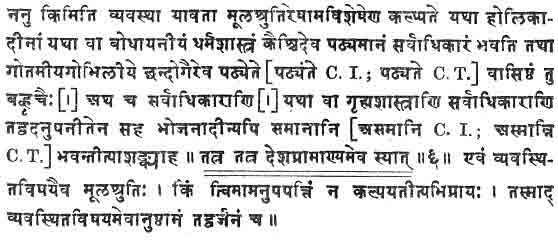
xv:1 A school of Vâsishthas, belonging to the Sâma-veda, certainly existed in ancient times. I have formerly put forward a conjecture that the Vâsishtha Dharmasâstra might belong to that school (Digest of Hindu Law Cases, p. xxii, first edition). But Govindasvâmin's explicit statement makes it evident that it has to be abandoned.
xvi:1 This resemblance has
not escaped Krishnapandita, who says in his commentary,

xvii:1 See Baudhâyana Dharma-sûtra II, 8, 14, 2, note
xviii:1 They occur Vâsishtha Dharmasâstra I, 17; III, 2; IV, 5-8; XI, 23; XII, 16; XIII, 16; XIX, 37; XX, 18; XXIII, 43; XXVI, 8.
xviii:2 Digest of Hindu Law Cases, p. xxxi, note, first edition.
xviii:3 Such, I suppose, will be the opinion of all European scholars. Those Hindus p. xix who allow their religious convictions to get the better of their reason, will perhaps prefer Krishnapandita's ingenious, but unsound explanation of the words iti mânavam, by iti manumatam, 'such is the opinion of Manu.'
xx:1 Vâsishtha Dharmasâstra I, 22; II, 3, 10, 27, 48; III, 5, 11, 60; V, 2; VI, 6, 8, II, 13, 19; VIII, 7, 15; X, 21-22; XI, 27-28, 32, 35; XIII, 48; XIV, 13, 16, 18; XVI, 18, 33-34; XVII, 5, 8; XVIII, 14, 15; XIX, 48; XX, 18; XXV, 4-5, 7; XXVII, 3.
xx:2 Vâsishtha Dharmasâstra 11,-6; XVIII, 14-15; XIX, 48.
xx:3 Sacred Books of the East. vol. ii, p. lvii.
xx:4 See e.g. the grant of Dhruvasena I, dated Samvat, i.e. Guptasamvat 207, Pl. i, l. 7; Ind. Ant., vol. iv. p. 105.
xxi:1 He says:

xxi:2 Sacred Books of the East, vol. ii, pp, liii-lv.
xxi:3 Sacred Books of the East, vol. vii, p. xviii.
xxiii:1 See XXV, 1; XXVII, 10; XXVIII, 10, 20.
xxiv:1 See Report on a Tour in Kasmîr, Journal of the Bombay Branch of the Royal Asiatic Society, vol. xii, p. 33.
xxv:1 Thus Vasishtha XXVIII, y is quoted in the Mitâksharâ on Yâgñavalkya III, 298; XXVIII, 10-15 on Yâgñavalkya III, 309; and XXVIII, 18-19, 2a on Yâgñavalkya III, 310.
xxvii:1 See Report on Sanskrit MSS. 1874-75, p. 11.
Source: The Sacred Laws of the Âryas translated by Georg Bühler Part I: Âpastamba and Guatama (Sacred Books of the East, Volume 2.) [1879]. The text has been reproduced and reformatted from Sacred-texts.com by Jayaram V for Hinduwebsite.com. While we have made every effort to reproduce the text correctly, we do not guarantee or accept any responsibility for any errors or omissions or inaccuracies in the reproduction of this text.