
The Vimanika Shastra Foreword
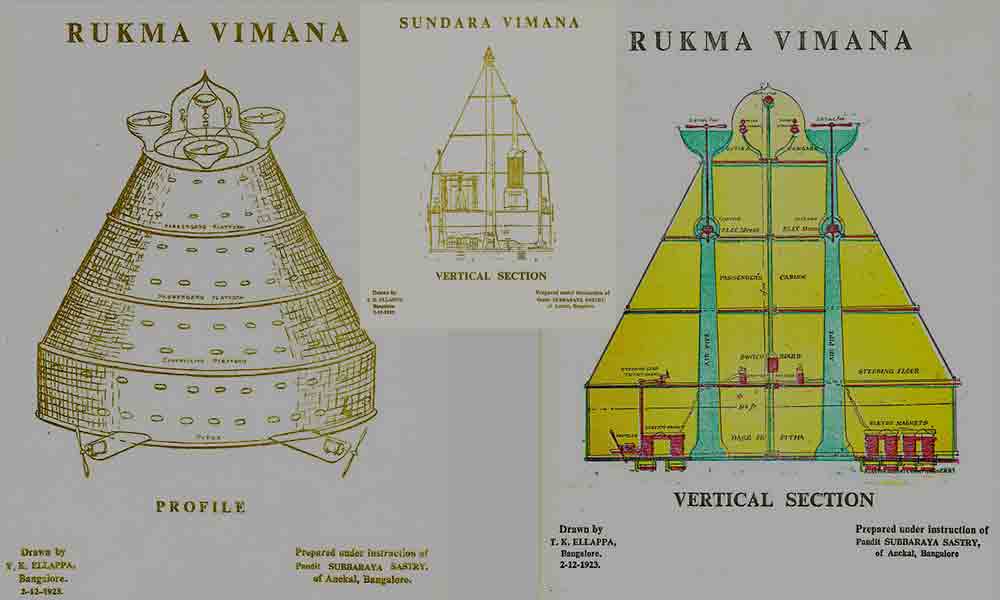
Possible technical details of ancient Vimanas based upon the descriptions in the text
FOREWORD
On 25-8-1952 the Mysore representative of the Press Trust of India, Sri N. N. Sastry, sent up the following report which was published in all the leading dailies of India, and was taken up by Reuter and other World Press News Services:
"Mr. G. R. Josyer, Director of the International Academy of Sanskrit Research in Mysore, in the course of an interview recently, showed some very ancient manuscripts which the Academy had collected. He claimed that the manuscripts were several thousands of years old, compiled by ancient rishis, Bharadwaja, Narada and others, dealing, not with the mysticism of ancient Hindu philosophy of Atman or Brahman, but with more mundane things vital for the existence of man and progress of nations both in times of peace and war.
"Mr. Josyer's manuscripts dealt in elaborate detail about food processing from various indigenous materials like grass, vegetables and leaves for human consumption, particularly during times of famine.
"One manuscript dealt with Aeronautics, construction of various types of aircraft for civil aviation and for warfare. He showed me plans prepared according to directions contained in the manuscript on Aeronautics of three types of aircraft or Vimanas, namely, Rukma, Sundara and Shakuna Vimanas. Five hundred slokas or stanzas dealing with these go into such intricate details about choice and preparation of metals that would be suitable for various parts of vimanas of different types, constructional details, dimensions, designs and weight they could carry, and purposes they could be used for.
"Mr. Josyer showed some types of designs and drawing of a helicopter-type cargo-loading plane, specially meant for carrying combustibles and ammunition, passenger aircraft carrying 400 to 500 persons, double and treble-decked aircraft. Each of these types had been fully described.
"In the section giving about preparation and choice of metals and other materials that should go into such construction of aircraft, details were specified that the aircraft, (these metals are of 16 different alloys), must be "unbreakable, which cannot be cut through, which would not catch fire, and cannot
be destroyed by accidents." Details as to how to make these vimanas in flight invisible through smoke screens are given in Vimanasastra of Maharshi Bharadwaja.
"Further description and method of manufacturing aircraft, which will enable pilots not only to spot enemy aircraft, but also to hear what enemy pilots in their planes were speaking, on principles akin to radar, have all been given in elaborate detail with suitable explanatory notes. There are eight chapters in this book which deal with construction of aircraft, which fly in air, go under water, or float on water.
TRAINING OF PILOTS
"A few slokas deal with qualifications and training of pilots to man these aircraft. These ancient types of aircraft are provided with necessary cameras to take pictures of approaching enemy planes. Yet another set of slokas deals with the kind of food and clothing to be provided for pilots to keep them efficient and fit in air flying conditions.
"Mr. Josyer said he was attempting to publish these manuscripts suitably translated in English.
"Another manuscript dealt with ancient Indian architecture, fully illustrated to facilitate construction. This treatise is ascribed to Maharshi Narada, and gives elaborate details about choice of constructional material for various types of buildings, even 15 storeys high. Sectional drawing has also been provided. A few chapters deal with construction of villages, cities and towns, fortresses, palaces and temples. This manuscript is full of plans and engineering constructional details to guide engineers.
"Yet another manuscript from which Mr. G. R. Josyer read out passages referred to preparation of imitation diamonds and pearls. He also showed me another remarkable manuscript which deals in detail about food processing for invalids, for youth and for old and debilitated persons."
A mild avalanche of letters blew towards us during the following days from all over India. One of the first was from James Burke of "Life International", from Delhi asking if he could come and see the Mss. We replied, "Please wire 1000 dollars, and then come." He was taken aback, and wrote that he thought people here felt honoured by being mentioned in "Life International,"
but that we seemed to be different. We did not reply. Now James Burke is dead; and great "Life International" also is no more! Such is human evanescence!
Miss Jean Lyon, journalist of Toronto and New York, wrote from Delhi that she would visit us. She came and saw the Mss, and recorded her interview with us in her book "Just Half a world Away" in a chapter headed "Science by Sutras", concluding with the charge that we were guilty of a rabid nationalism, seeking to wipe out everything since the Vedas!
That is no way for a journalist to judge persons. We only hold that for Indians, or others, to wipe out the Vedas is absurd! We are neither rabid, nor national. God has created the Earth like a round ball, all its contents forming one compact unit, not a hundred and odd broken units as in the League of Nations. Only in maps is the earth shown broken into 2 hemispheres. If you actually break the Earth into 2 hemi-spheres, you will be having Doomsday!
Ours is not nationalism, rabid or tame, but one world humanism, or world-citizenship. That should not shock Miss Jean Lyon.
Others who wrote to enquire with excited wonder were Governor R. R. Diwakar of Behar, Maharaja of Kashi, Dr. Trivedi of "Searchlight," Patna, Professor Dwivedi of Gorakhpur, Professor Chauhan of Seoni, Professor Theeanee of Madras, Swamy Chaitanya of Mussoorie, H. R. Sharma of Phagwara, Harit Krishna Deb of Calcutta, R. B. Lal of Allahabad, P. S. Bharathi of Ootacamand, Miss McIntyre of Bangalore, M. V. Sharma, Industrialist, Madras, D. V. Potdar of Poona, Raja A. K. N. Singh of Ramnagar, U. P., Rao Bahadur M.A. Rangaswamy, Patna, N. Anandalwar, Bangalore.
S. M. Sharma, editor, wrote in "Searchlight," Patna, "To an eminent Sanskrit scholar, Shri G. R. Josyer, Director of the International Academy of Sanskrit Research, Mysore, we owe the discovery of the manuscript on Vimanas by Maharshi Bharadwaja. Shri Josyer is already more than 70. Many Will share my hope and prayer that the Nehru Goverment would lose no time in acquiring the manuscript, which, according to my information, is most unique." Editor Sharma too is no more!
The Mss. came to us by Divine grace! When on 28-6-1951 we got H. H. the Maharaja of Mysore to inaugurate the International Academy
of Sanskrit Research, evidently it was an auspicious occasion. The Academy has truly attained International fame, and has become known from one end of the globe to the other!
One of the guests coming from Bangalore for the ceremony brought a small manuscript in exercise book form containing the beginning of Maharshi Bharadwaja's "Vymanika Sastra." We were struck by it, and exhibited it along with our other Mss. in various stages of decay, to H. H. The Maharaja and Chief Minister K. C. Reddy and others when we took them round.
After the function the Mss. was returned to the guest, who gave it back to the custodian of Pandit Subbaraya Sastry's literary records, Sri Venkatrama Sastry, B.A., B.L., Advocate of the Bangalore Bar. Subsequently we contacted him, and on our promise of doing our best to publish them, he was good enough to let us have copies of some of the manuscripts. The message of the Press Trust of India was with reference to them. The fan mail resulting therefrom brought enquiries from personages such as Air Commodore Goyal of the Western Command, Bangalore, The Editor of the Kesari and Mahratta, Poona, Major Gadre of Saraswati Mahal, Tanjore, Minister A. G. Ramachandra Rao, Bangalore, Sri Swamy of Bhandarkeri Mutt, M. G. Seth, Bombay, P. D. Padam Chand, Delhi, P. M. Kabali, Bombay, Aeronautical Society of India, Ministry of Scientific and Cultural Affairs, Delhi, the Director General of Civil Aviation, the Hindustan Aircrafts, Ltd.
We then commenced printing the original in Sanskrit, and had made some progress, when suddenly there came a harsh letter from the donor, Sri Venkatrama Sastry, accusing us of exploiting the manuscripts for our personal benefit. Having had no such idea ourselves, it evoked disgust, and we replied that he could take back the manuscripts, and discontinued the printing!
But then letters continued to come from far away, from estimable men avidly interested in the manuscript, and organs of learned Associations and books by scholars of the abstruse began to quote us as intending to bring out the publication. Seigfried Hansch, Deschenes, Canada, Hans Krefft, Berlin, Blaes-Gustaf-Nordquist, Stockholm, Sweden, Bjorn Loven, Innsbruck, Austria, Joachim Rothaner, Kellerburg, Austria, Jan Wallgren, Stockholm, P. Salzmann de la Mar, Eskilstuna, Sweden, Hans-Werner-Von Engel, Bad Gadesberg, West Germany, Sten Lindgren, Stockholm, Lars Eric
[paragraph continues] Helin, Kalender, Gothenburg, Sweden, WM. Dawson & Sons, London, Charles Danois, Kristianstad, Sweden, James Alves, Sao Paulo, Brazil, Torbjorn Holmquist, Vetlanda, Sweden, Ernest Heinrich, Homburg, Klaus Aarsleff Jorgensen, Skellingsted, Denmark, Gosta Karlsson, Stockholm, Peter Bernin, Malmo, Sweden, Dr. Curtis J Mccall, Lake Worth, Florida, Robert Ashley Falk, Auckland, New Zealand, Terry W. Colvin, Evansville, U.S.A., Sven Bertil Hansson, Malmo, Sweden, Kjell Ericson, Borlonge, Maurice T. Caison, North Carolina, M. A. Gresham, Jr. Atlanta, U.S.A. Alan Y. Wilcox, Lauderdale, Florida, Strubes, Copenhagen, Demmark, Alan D. William, Downey, California, Stuve Sundquist, Uppsala, Bo H. Svensson, Sweden, Karen Kesti, Republic WA, U.S.A., Richard Watson, New South Wales, Australia, Ontario College of Art, Toronto, Canada, Dr. Jacq Eskens, Rotterdam, Netherlands, Bernin Co Moberg, Montmartre, Paris, L.S.U. Rydberg, Stockholm, Chairman, E. A. G. Mackay, British Unidentified Flying Object Research Association, London, Mrs. Annica Foxcraft, Transvaal, Oliver Williams, Weimar, Texas, Jan Swagermann, Ship "Johannra", Amsterdam, Robert B. Young, Jr. Radco Incorporated, Houston, Texas, Sam J. Lundwall, Askild and Karnekull, Stockholm, Dr. Cedric Leonard, Oklahoma, Gwendelholm, Stockholm, Michele Bonamici, Milan, Italy, Jose M. Fernandez, Goteborg, Sweden, President Lennort Lidfoss, Spectrum, Forlags, A. B. Danderyd, Sweden.
The "Clima Astral" of Brazil, "The Mexican News" of Mexico, The "Spectrum" and "Pursuit" of U.S.A. and three Swedish books on ancient and astral research, "Kulturer Fore Istiden" by Ivan Troing, "Forntidens Teknik" by H. Kjellson, and "Flygande Tefat" by Max B. Miller, reproduced our original descriptive leaflet, and announced that we expected to publish the remarkable volume. The Maharaja of Mysore invited us, and after offering Tea, wanted the Manuscript for being shown to Dr. Thacker, the National Scientist of India. We reminded him that Sanskritists were averse to parading knowledge before idle curiosity, and that the manuscript had to be translated into English and tested by research, and then only made available for the public gaze. Four scientist Doctors from the Indian Institute of Science, Bangalore, came with a letter of Introduction from the Head of The Department of Power Engineering, Dr. M.A. Tirunarayanan, and sought clarification from us!
It was as if the orange-shaped Earth had become a porcupine, and was shooting its quills at us from all sides, in order to goad us into the task, which we had been reluctant to take up as being too onerous for us!
We had therefore to gather strength from the cumulative good-will of the world-wide public, and gird ourselves up for the strenuous undertaking.
To be really of value the volume had to include the Sanskrit original, its translation in English as demanded by western readers, and sketches showing the designs of the Vimanas for further clarification. It had to be a beautiful volume commensurate with the magnificence of its subject, and the high expectations of the public awaiting its publication.
Thus, at the age of 81 we had to sit up and translate the technical Sanskrit into readable English, and scrutinize the printing of both the Sanskrit and English, involving the strain of multiple proof-reading. The finance required was considerable, and as no help was forthcoming, we had to scrape together the meagre savings of a life-time, procure needful printing equipment at mounting costs, engage labour at emergency rates, and at long last, with the help of Divine grace, are able to herald the birth of the volume, which has been in gestation for over ninety years!
"Vymaanika Shastra" consists of nearly 6000 lines, or 3000 verses of lucid Sanskrit, dealing with the construction of Vimaanas or Aeroplanes. That the vocabulary of ancient Sanskrit could in simple flowing verse depict the technical details with effortless ease is a tribute to the language, and the greatness of the author.
Maharshi Bharadwaja is an august name in the pantheon of Hindu Sages who recorded Indian civilization, in the spiritual, intellectual, and scientific fields in the hoary past. They transmitted knowledge from mouth to mouth, and from ear to ear, for long eras. Written transmission through birch-backs or palm-leaves, or home-made paper, are from this side of a thousand years. Even they are to be found in mangled forms owing to the depredation of time, weather and insect hordes. There is no-written material for the vast volume of Vedas, Upanishads, Shastras, and Puranas, which have come down for over 10000 years as a patrimony, not only for India, but for mankind in general. They remain imbedded in the ether of the sky, to be revealed--like television,--to gifted mediums of occult perception.
Venerable Pandit Subbaraya Sastry, who has left the legacy of manuscript treasures including "Vymanika Shastra", was a simple, orthodox, intellectual
[paragraph continues] Brahmin with spiritual gifts, who was esteemed by all who knew him, Englishmen and anglicised or educated Indians, in various walks of life.
He was a walking lexicon gifted with occult perception. His sole aim was to transmit his knowledge to posterity. He lived a life of poverty, like Socrates, and sought no gains for himself.
In 1885 Mr. B. Suryanarain Rao, B.Sc., M. R. A. S., distinguished Astrologer and Editor, first met him and became his devoted exponent. In 1911 he started a Magazine in Madras named "Bhowthika Kalaa Nidhi," or "Treasure house of physical sciences", and published extracts from the revelations of the venerable scholar. We are in possession of 6 issues of that rare Journal which came to us by Divine grace.
On 1-8-1918 he began to dictate "Vymanika Sastra" to Mr. Venkatachala Sarma, who took down the whole in 23 exercise books up to 23-8-1923.
That gave manuscript shape to Maharshi Bharadwaja's "Vymanika Sastra". Then by a flash of genius he engaged a draughtsman, and got drawings of some varieties of the Vimanas prepared under his instructions, which form an indispensable adjunct to the manuscript proper. That was in 1923. India was then under British rule. Gandhi's Non-co-operation movement was catching fire. And, it is said, Pandit Subbaraya Sastry was arrested! Yeoman efforts procured his release. But his activities had to remain confined. In 1928 he addressed a letter to the Maharaja of Darbbanga for aid in publication of the manuscripts. But the rich in India have got deaf ears, and warped minds! Then, disappointed and broken-hearted, in the early 30's, venerable Subbaraya Sastry passed out of this world, and left it the poorer thereby!
For some 20 years his literary treasures remained as under frigidaire, guarded by his daughter and young Mr. Venkatrama Sastry. Then the Unseen Powers began to play, and the manuscripts were released to light. And at last it has pleased God to enable us to present Maharshi Bharadwaja's "Vymanika Sastra" to the world's elite, and pay our tribute to the memories of Maharshi Bharadwaja and venerable Subbaraya Sastry.
We thank God for His gracious favour. We thank Mr. Venkatrama Sastry who made the manuscript available to us; our first son, G. S. Josyer, M.A., B.ED., who contacted Mr. Venkatrama Sastry and brought the Mss.,
prepared it for the press, and even composed a portion of the Mss., and met an untimely death in the midst of his useful career; our younger son, G. N. Josyer; B.E., who has been helping us in seeing the work through; and our consultants in the course of the work, Sris. Alwar Tirumaliengar and M. A. Tirunarayan, B.E., M.I.E., M. N. Srinivasan, B.Sc, Hons, LL.B., Professor M. A. Tirunarayanan, D.Sc, and Sris M. C. S. Chari, B.Sc., N. Narasimhan, B.E., R. T. Krishnan, B.E., Pandit K. Ramaswamy Iyengar, and Mr. N. N. Sastry of P.T.I., and other associates and assistants.
Sanskrit and English have been our two eyes since some 75 years, and we are placing the unique volume before the elite of the world as an outstanding contribution to world literature from the ever-living past. We hope they will deem it an invaluable addition to their libraries, and find it an ever interesting companion.
The 20th century may be said to be made historic by 2 achievements, the bringing of Moon-rock from outer space, and the publication of "Vymanika Sastra" from the unknown past. The Moon-rock is just rock, not a cluster of shining pebbles from Kimberley of South Africa. But the "Vymanika Sastra" is a Cornucopia of precious formulas for the manufacture of Aeroplanes, which should make Lindbergh, Rolls, Zeppelin, De Havilland, Tupolev, and Harold Gray of Pan American, gape in astonishment, and if duly worked up, herald a new era of Aeroplane manufacture for the benefit of Mankind!
G. R. JOSYER
Hon. Director, International
Academy of
Sanskrit Research,
15-3-1973
Mysore-4, India.
Suggestions for Further Reading
- Essays On Dharma
- Esoteric Mystic Hinduism
- Introduction to Hinduism
- Hindu Way of Life
- Essays On Karma
- Hindu Rites and Rituals
- The Origin of The Sanskrit Language
- Symbolism in Hinduism
- Essays on The Upanishads
- Concepts of Hinduism
- Essays on Atman
- Hindu Festivals
- Spiritual Practice
- Right Living
- Yoga of Sorrow
- Happiness
- Mental Health
- Concepts of Buddhism
- General Essays
Disclaimer: While we have made every effort to reproduce the text correctly, we do not guarantee or accept any responsibility for any errors or omissions or inaccuracies in the reproduction of this text. This text has been reproduced for general reading purposes only and readers are advised to refer the original text for any research or academic studies and references.