
The Vimanika Shastra Sixth Chapter
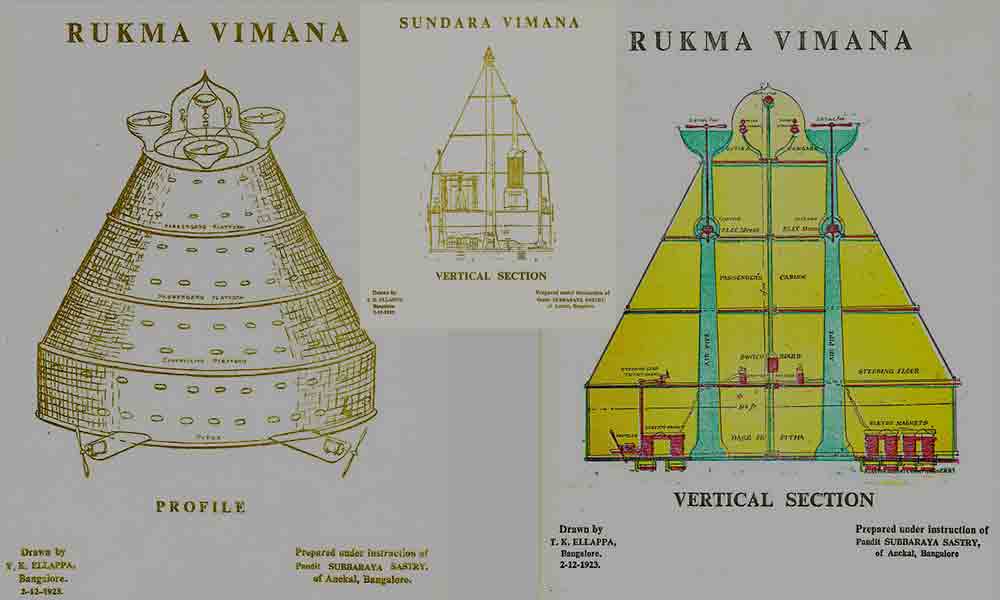
Possible technical details of ancient Vimanas based upon the descriptions in the text
Sixth Chapter
Atha Jaatyadhikaranam: Varieties of Vimaanas.
Maharshi Bharadwaaja:
☞ Jaati tryvidhyam Yugabhedaad Vimaanaanaam. Sootra 1.
"Three types according to changing Yugas."
Bodhaananda Vritti:
According to the differences in yugas, there are three different types of planes:
Having dealt with the constituent mechanical parts of the Vimaana, we shall now deal with the Vimaanas according to their different classes.
The sootra indicates that there are different types of planes, and that they are of 3 types.
In the Krita Yuga, Dharma or Righteousness was four-footed, that is, it was four-square, fully established, all paramount, and it was adhered to implicitly by men. The men were inherently noble-born and were possessed of remarkable powers. Without needing to go through yogic discipline to attain special powers, or practise mantras which secured extraordinary results, the men of that yuga, merely by their devotion to dharma, became Siddhapurushaas or gifted with superhuman powers. They were virtuous men and men of learning and wisdom. Going in the sky with the speed of wind by their own volition was natural to them. The eight super-sensory, and now superhuman, attainments, known as animaa, mahimaa, garimaa, laghimaa, praaptih, praakaamya, eeshatwa, and vashitwa, were all possessed by them. That is, animaa is assumption of infinitesimal shape; mahimaa is growing into gigantic shape; garimaa is becoming astonishingly heavy; laghimaa is becoming weightless; praaptih is securing any desired thing; praakaamyam is becoming rid of desires; eeshatwa is attaining paramountcy; and vashitwa is becoming extremely pliant.
****| I. Krita yuga--1728000 years. | II. Threthaa yuga--1296000 years. |
| III. Dwaapara yuga--864000 years. | IV. Kaliyuga--432000 years. |
Therefore in Krita Yuga, or first epoch, the ancients say, there were none of the three classes of Vimaanas.
Krita Yuga passed; and Tretaa Yuga commenced. Dharma then became limp of one foot. It served with 3 feet only, and grew gradually less efficient. So men's minds became dense, and the conception of Vedic truths, and anima and other super-sensory powers, became scarcer. Therefore, by the corrosion of Dharma or righteousness, men lost the power of flying in the sky with the speed of wind.
Perceiving this, God Mahadeva, desiring to confer the power of understanding the Vedas properly on the Dwijas, or brahmins, kshatriyas, and vysyas, graciously descended on earth in the form of Dakshinaamurthy, and through the instrumentality of Sanaka and other anointed sages, classified the Veda mantras, and then bestowing his benedictory glance on the worshipping Munis or ascetics, he blessed them with the gift of Vedic perception. And then to ensure that they were properly receptive, he embraced them and entered their hearts and illuminated their memories. The munis, overwhelmed by the Divine grace, aglow with horripilation, with voice choked with emotion, praised the Supreme with shata-rudreeya and other hymns, and manifested profound devotion.
Pleased with their receptiveness, divine Dakshinaamurthy, favouring them with a benign glance, and with smile on his face, said to them, "Till now you have been known as "Munis" or ascetics. Henceforth, having by my grace attained insight into the Vedas, you shall be known as "Rishis" or seers. You will cultivate the Vedic mantras, and practising celibacy, you will adore the divine Goddess of the Vedas, and winning her favour, and approaching the Great God Easwara by Yogic Samadhi, ascertain His mind, and by His and my grace, rising to the pinnacle of intellectual vision, become adepts in the meaning and purport of the Vedas; and confirming by them your own experiences and meditative introspection, you will create the Dharmashaastras or moral codes, Puranas and Itihaasas, and physical and material sciences, in conformity to the truths of the Vedas, for the benefit of mankind. And for travelling in the sky, propagate the art of manufacturing Vimaanas, and for attaining wind-speed, evolve Ghutica and Paadukaa methods through Kalpashaastras or scientific treatises."
Then those munis or seers, enshrining in their hearts God Mahadeva in the form of Dakshinaamurthy, produced the Dharmashaastras or ethical codes, epics, chronicles, manuals on rituals, treatises on the arts and sciences, ritualistic and sacrificial codes, in conformity to the Vedas, and propagated them among men. Amongst them it is said that there are six treatises bearing on the manufacture of Vimaanas produced by the ancient seers. In them are described three classes of vimaanas, known as maantrikaas, taantrikaas, and kritakaas, capable of flying everywhere.
It is said in Vimaana Chandrika,
"I shall indicate the different kinds of vimaanas. In Tretaa yuga as men were adepts in mantras or potent hymns, the vimaanas used to be produced by means of maantric knowledge. In Dwaapara yuga as men had developed considerable tantric knowledge, vimaanas were manufactured by means of tantric knowledge. As, both mantra and tantra are deficient in Kaliyuga, the vimaanas are known as kritaka or artificial. Thus, owing to changes in dharma during the yugas, the ancient seers have classified the vimaanas of the 3 yugas as of 3 different types."
"Vyomayaana Tantra" also says,
"By the influence of mantras in Tretaa, vimaanas are of maantrika type. Owing to the prevalence of tantras in Dwaapara, the vimaanas are of taantrika type. Owing to decadence of both mantra and tantra in Kaliyuga, the vimaanas are of artificial type." Thus 3 classes of vimaanas are mentioned in shaastras by ancient seers.
In "Yantra Kalpa" also,
"Vimaanas are classified into mantra and other varieties by experts according to differences in yugas. They are defined as maantrika, taantrika, and kritaka."
The same is expressed in "Kheta yaana pradeepika," and also "Vyoma Yaana Arkaprakaashikaa."
Thus according to shaastras vimaanas are divided into 3 classes, on the basis of differences in the modes of their manufacture.
Maharshi Bharadwaaja:
☞ "Pancha-vimshan Maantrikaaha Pushpakaadi Prabhedena" Sootra 2.
"Maantrika Vimaanas are of Pushpaka and other 25 Varieties."
Bodhaananda Vritti:
In the previous sootra vimaanas were specified as of 3 types owing to differences in the 3 yugas. In this sootra maantrika vimaanas or vimaanas flying by maantrik power are said to be 25.
Shounaka Sootra says,
Maantrika vimaanas in Tretaayuga are 25. Their names are pushpaka, ajamukha, bhraajasvat, jyotirmukha, kowshika, bheeshma, shesha, vajraanga, dyvata, ujvala, kolaahala, archisha, bhooshnu, somaanka, panchavarna, shanmukha, panchabaana, mayoora, shankara, tripura, vasuhaara, panchaanana, ambareesha, trinetra and bherunda.
In Maanibhadrakaarikaa,
The vimaanas of Tretaayuga are 32 of the maantrika type. Their names as given by Maharshi Gowtama are Pushpaka, ajamukha, bhraaja, swayamjyoti, kowshika, bheeshmaka, shesha, vajraanga, dyvata, ujvala, kolaahala, archisha, bhooshnu, somaanka, varnapanchaka, shanmukha, panchabaana, mayoora, shankara priya, tripura, vasuhaara, panchaanana, ambareesha, trinetra, and bherunda, etc.
Maharshi Bharadwaaja:
☞ "Bhyravaadi Bhedaat Tantrikaa-shshat-panchaashat." Sootra 3.
"Taantrika Vimaanas are of Bhyrava and other 56 varieties."
Bodhaananda Vritti:
In previous sootra the names of maantrika vimaanas were mentioned: In this sootra the names of taantrika vimaanas of Dwaapara yuga are mentioned.
In shape, movement and speed there is no difference between maantrika and taantrika vimaanas. There is however one difference in taantrika vimaanas, that is, the way in which the shakti or power at the junction of sky and earth is incorporated.
Lalla also says,
There is only one difference between taantrika vimaanas and maantrika vimaanas: the adaptation of the power of sky and earth. In shape, and movement. variations, they are identical. The taantrika vimaanas are of 56 varieties.
In Shounaka Sootra,
In Dwaapara taantrika vimaanas are 56. Their names are, bhyrava, nandaka, vatuka, virinchi, vynateya, bherunda, makaradwaja, shringaataka, ambareesha, sheshaasya, saimtuka, maatrika, bhraaja, paingala, tittibha, pramatha, bhoorshni, champaka, drownika, rukmapunkha, bhraamani, kakubha, kaalabhyrava, jambuka, garudaasya, gajaasya, vasudeva, shoorasena, veerabaahu, bhusunda, gandaka, shukatunda, kumuda, krownchika, ajagara, panchadala, chumbuka, dundubhi, ambaraasya, maayooraka, bheerunalika, kaamapaala, gandarksha, paariyaatra, shakunta, ravimandana, vyaaghra, mukha, vishnuratha, sowarnika, mruda, dambholi, brihathkunja, mahaanata, etc.
In Maanibhadrakaarikaa:--
In Dwaapara yuga taantrika vimaanas are said to be 56. Their names according to sage Gowtama, are bhyrava, nandaka, vatuka, virinchika, tumbara, vynateya, bherunda, makaradhwaja, shringaataka, ambareesha, sheshaasya, symhika, maatruka, bhraajaka, pyngala, tittibha, pramatha, bhoorshnika, champaka, drownika, rukmapunkha, bhraamanika, kakubha, kaalabhyirava, jambuka, gireesha, garudaasya, gajaasya, vasudeva, shoorasena, veerabaahu, bhusundaka, gandaka, shukatunda, kumuda, krownchika, ajagara, panchadala, chumbaka, dundubhi, ambaraasya, mayoora, bheeru, nalikaa, kaamapaala, gandarksha, paariyaatra, shakuntaka, ravimandana, vyaaghramukha, vishnu ratha, souvarnika, mruda, dambholee, bruhatkunja, mahaanata.
These 56 are taantrika vimaanas of Dwaaparayuga.
Maharshi Bharadwaaja:
☞ "Shakunaadyaah Panchavimshat Kritakaah." Sootra 4.
"Shakuna and other 25 types of Vimaanas are Kritakaah."
Bodhaananda Vritti:
In shape and movements there is no difference in the vimaanas, except in the matter of the use of mantraas and tantraas. The kritaka or artificial vimaanas are of 25 varieties.
According to Shownaka sootra
"Tishyay kritaka bhedaah panchavigamshatih! teshaam naamaanyanukramishyaamah: shakuna sundararukma mandala vakratunda bhadraka ruchaka vyraaja bhaaskara gajaavarta powshkala virinchi nandaka kumuda mandara hamsa shukaasya somaka krownchaka padmaka symhika panchabaana owryaayana pushkara kodandaa iti."
Says "Maanibhadra Kaarikaa":
In Kaliyuga, the kritaka or artificial vimaanas are said to be 25. Their names are given below as indicated by sage Gowtama: shakuna, sundara, rukmaka, mandala, vakratunda, bhadraka, ruchaka, viraajaka, bhaaskara, gajaavarta, powshkala, viranchika, nandaka, kumuda, mandara, hamsa, shukaasya, sowmyaka, krownchaka, padmaka, symhika, panchabaana, owryaayana, pushkara, and kodanda.
Maharshi Bharadwaaja:
☞ "Raaja-lohaadeteshaam Aakaara Rachanaa." Sootra 5.
"These should be built out of Raajaloha."
Bodhaananda Vritti:
These 25 kinds of vimaanas are to be made of Raajaloha metal only.
Says Kriyaasaara,
In manufacturing artificial aeroplanes the best of metals are those known as Ooshmapaa or heat-imbibing or heat resisting metals. Out of them the variety known as Raajaloha or king of metals is most suited to Shakuna and other vimaanas.
Three kinds of metals, soma, soundaala, and maardweeka, in the proportion of 3, 8, and 2, adding borax, to be filled in crucible or smelter, and placed in furnace, and heated to 272 degrees, and melted thoroughly, and churned, will result in the alloy Raajaloha.
Vishwambhara also says,
"In the science of metals, for the manufacture of aeroplanes, 16 types of Ooshmapaa or heat-sucking lohas or metals are the very best. The fourth in that series, is called Raajaloha. Out of that alone should shakuna vimaana be constructed."
The parts of shakuna vimaana are:
Peetha or floor board; hollow mast; three wheeled keelakas with holes; 4 heaters, air-suction pipes, water jacket, oil tank, air heater, chhullee or heater, steam boiler, vidyud-yantra or electric generator, air propelling yantra, vaatapaa yantra or air-suction pipe, dikpradarsha dhwaja or direction indicating banner, shakuna yantra, two wings, tail portion for helping vimaana to rise, owshmyaka yantra or engine, kiranaakarshana math or sun-ray attracting bead. These 28 are parts of Shakuna vimaana.
The construction of the vimaana:
The floor-board or base should be made of levelled Rajaloha sheet, shaped quadrangular, circular, or cradle shaped. The weight of the peetha should be one-hundredth of that of the plane, and its width should be half the height of the vimaana. In the centre of the peetha the hollow mast should be fixed with screw joints.
Lalla defines the mast in "Yantra kalpataru". The stambha or mast should be made of haatakaasya metal and not otherwise.
Haatakaasya metal is described in "Lohatantra": 8 parts of suvarchala or natron, 16 parts of laghu-kshwinka or light zinc, 18 parts of lagbu bambhaari, and 100 parts of copper, filled in smelter, placed in koorma vyaasatika furnace, and with the aid of mahormi bellows boiled to 307 degrees, will yield haatakaasya metal.
p. 91The Peetha
The height of the peetha should be 80 feet. It should be 56 feet in length and breadth, 70 feet high on the north and south sides. The tip should be three-cornered. This is for shakuna vimaana.
Naalastambha or Hollow Mast:
At the bottom the mast should be of 35 feet diameter outside, and 30 feet inside. At the middle the mast should be of 25 feet diameter outside and 20 feet inside. Higher up it should be of 20 feet diameter outside and 15 feet diameter inside; The height of the mast should be 80 feet. It should be made of Raajaloha. In order to fix the mast in the peetha screw joint should be made. And in order to adjust the air-speed as required, 6 wheels should be inserted inside the mast.
The Wheels:
Inside the mast at the height of 4 feet above the peetha, three wheels should be provided, of 15 feet diameter, with holes. The wheels above and below should be fixed with bolts, and unmoving. In order to revolve the middle wheel keys should be fixed outside on the mast, As there are holes in the wheels, as two wheels do not move, and as the middle wheel revolves in a group with the other two wheels, movement of air is, allowed or stopped by the turning of the key outside.
Similarly at the height of 44 feet above the peetha three wheels corresponding to those below should be fixed and operated similarly.
Window dome:
The window dome should be of 15 feet outside circumference. Its inside should be five feet wide and it should be 2 feet high. It should be fixed on the top of the mast.
Sun-crystal:
A sun crystal 7 feet round, and 2 feet wide and 2 feet in height should be fixed so as to crown the window dome.
10 feet above the bottom peetha, on a floor-board 3 inches thick, three floors or tiers should be built, each 14 feet high, with 3 inch
floor-boards, the upper two floors being supported by pillars fixed at 10 feet intervals with screw joints and strong bolts. In the four corners 4 heating yantras should be fixed, 10 feet in circumference and 8 feet high. On the ground floor along the supporting pillars accommodation for passengers should be provided in the form of individual boxes.
On the second floor booths should be constructed to accommodate the anga-yantras, or the various mechanisms recommended for the safety of the vimaana. It should be 60 feet wide and 14 feet high with 3 inch thick ceiling board.
The third floor should be 40 feet wide and 14 feet high.
The partitioning boxes for passengers as well as the booths of the various machines should be divided off by railings starting from the hollow mast to the side walls in all the four directions.
Beneath the ground-floor board a 7 feet high cellar should be constructed. In it the several necessary yantras should be located. In the centre is the foot of the hollow mast. On the four directions from it 4 air pumping machines should be fixed. In order to stimulate them 4 steam engines also should be installed. On the two sides of the vimaana two air expelling machines, and an air heater machine, and 2 machines to keep the heater supplied with air from outside, should be erected.
In order to enable the wings on either side to spread and flap, proper hinges and keys should be provided for, safely fixing them to the sides of the vimaana, and for enabling them to fold and open easily.
The revolving tractor blades in the front should be duly fixed to the heating engine with rods so that they could dispel the wind in front and facilitate the passage of the vimaana.
The wings are two, one on each side, very strongly fixed to the vimaana with bolts and hinges. Each wing should be fixed in a 11 foot scabbard up to 20 feet length, where it would be 10 feet wide, widening further up to 40 feet at the end of its 60 feet length, besides its. first 20 feet of scabbard length.
The tail should be 20 feet long, and 3 feet wide at the start, and 20 feet wide at the end.
The air-blower and heater:
The length of the air-blower should be 15 feet, and width 3 feet. The naalaas or pipes should be 3 feet wide, and their outer circumference should be 4 feet. The rods and hinges and other equipment should be suitably prepared.
The vaatapaa yantra or air blower should be 12 feet long and 9 feet wide. Inside it should be covered with circling wires. A pipe should be fixed inside, for air flow. By the hot oil fumes from the heated tank, the air becomes heated and should be passed into the owshmya yantra or heater, while the cold air from outside should also be let in. Tubes and fixings should be provided in the yantra. In order to emit the fumes of the oil flames to the outside, a 6 inches pipe should be fixed from the yantra to the foot of the mast. Air blowers should be installed with 10 feet wheels to pump in fresh cold air from outside.
To the east of the air machine should be placed a light burner in order to aid combustion of the oil. An electric generator provided with switches should light the burner. When the light is off the oil should be kept duly sealed. A rope should be tied to the tail joint, for the pilot to manipulate the fluttering of the tail to help the ascent or descent of the vimaana. Similarly ropes should be tied to the hinges of the two wings, and passed to the pilot like reins, so that he might spread them out or close them as needed.
Ten feet beneath the passenger floor of the vimaana, to a height of 2 feet from the bottom plate there should be a cellar-like enclosure. The bottom of the vaatanaala mast should be fixed in its centre with firm screw joints. In this cellar should be located two oil tanks 15 feet by 9 feet by 4 feet, with water jackets.
Four bellows of 15 feet by 2 feet by 6 feet, should be provided for storing the air pumped in by the air-blowers, and letting it out as required.
And underneath, on all the four sides wheels of 7 feet circumference should be fixed for the movement of the vimaana on the ground.
This vimaana is named SHAKUNA VIMAANA.
SUNDARA VIMAANA
Maharshi Bharadwaaja:
☞ "Sundarothha." Sootra 6.
"Next Sundara."
Bodhaananda Vritti:
Next Sundara vimaana will be described. It has got 8 constituent parts.
First peetha or ground plate, smoke chimney, 5 gas-engines, bhujya metal pipe, wind blower, electricity generator, and four-faced heater, and vimaana nirnaya, or outer cover.
The Peetha or ground plate:
It should be made of Raajaloha metal only. It should be square or round, and of 100 feet in circumference, or any other desired size. It should be 8 feet thick. Seven times the peetha has to be heated with manchuka or madder root oil. Then spots should be marked in it at 10 feet distance from each other, totalling 24. The size of each kendra or centre is 15 feet. In the centre a dhooma-prasaarana or fume distributing naala or pipe 12 feet high should be erected.
Naalastambha, hollow mast:The naalastambha should be 56 feet high, and 4 feet in diametre. For storing gas, at its base, a 8 feet long, circular, and 4 feet high vessel should be provided. A six feet size water vessel should be arranged. A 4 feet size oil tank should be fixed at its centre. At its foot an electric storing crystal of 1 foot size should be fixed with necessary hinges and keys.
The vessel should be filled with 12 parts of dhoomanjana oil, and 20 parts of shukatundika or bignonia Indica? (egg-plant?) oil, and 9 parts of kulakee or red-arsenic oil. To conduct electricity, two wires should be passed through the pipe and fixed to the crystal. In the middle of the naalastambha or mast, for the smoke fumes to be restrained or speeded out, triple wheels with holes should be fixed. In order to work the wheels from outside, two right turning and left turning wheels
should be attached outside the pole, and connected to the wheels inside. Three wires should be drawn inside the naala and fixed at the foot, the middle, and at the top.
Dhoomodgama Yantra:
Because it ejects smoke fumes with speed it is called Dhoomodgama yantra.
Hima samvardhaka, soma, and sundaala, in the proportion of 32, 25, and 38, should be filled in pipe crucible, placed in chakra-mukha furnace, and with the help of ajaamukha bellows heated to 712 degrees and properly churned. It will yield excellent dhooma-garbha alloy. With that alloy the dhoomodgama yantra should be constructed.
Underneath the centre of the 15 feet long peetha, for the control of the gas fumes a 10 feet high pipe with right revolving wheel should be fixed. On its 2 sides, to south and north, 2 water steam pipes should be erected. At the foot of the 2 pipes 4 feet long 3 feet high pots should be formed for containing the fumes. Two pipes shaped like goblets, 1 foot by 8 feet by 3 feet, should be fixed at the top of the fume container. A water vessel at its foot, and an oil-vessel at its centre, and in front of it the switches of the electric ray crystals, as in the dhooma prasaarana naala stambha.
On either side of the heat tube, two water jackets should be placed. A pipe with wires should be taken from the electric generator and connected to the hinges of the crystals. Electric current of 80 linkas should be passed to the crystals, whose motion will cause friction and generate heat of 100 degrees (kakshyas). Thereby the oil in the vessel will get heated and boil and emit fumes.
The electric power should then be passed through the smoke pipe between the two water jackets. By this the water will be converted into hot steam. The oil fumes should be filled in the oil fume pipe and the steam in the steam pipe. Then by operating the switches, both the fumes will fly up at 500 degree temperature. The switches should restrain the fumes or pump them out as needed. 40 such yantras should be prepared and should be fixed on the peetha in groups on
the four sides. Then connected with the bases of the dhooma-naalas, sundaalas or elephant trunks, one foot wide and 12 feet high should be erected on the four sides, to enable the vimaana to fly with speed.
Sundaala is described by Lallachaarya:
The sundaala should be installed. for using the oil fumes and steam fumes for the motion of the vimaana. There are. varieties of ksheera vrikshaas or milk-trees according to shaastraas. Vata or banyans, manjoosha or madder root, maatanga or citron?, panchashaakhee (five branched), shikhaavalee (crested), taamra sheershnee (copper-crested), brihatkumbhee (big bellied), mahishee, ksheeravallaree, shona parnee (crimson-leaved), vajramukhee, and ksheerinee (milky). From these the ooze or milk should be collected, and in the proportion of 3, 5, 7, 10, 11, 8, 7, 4, 7, 30, 12, filled in a vessel. Then granthi metal, naaga or lead, vajra, bambhaarika, vynateya, kanduru, kudapa, and kundalotpala, these in equal parts should be filled in the vessel in equal proportion to the milk contents, and boiled with 92 degree heat. Then the molten liquid should be filled in the milk-cloth machine, and churned. When cooled and put through the levelling machine, it will yield a strong, soft, cool, heat proof, and uncuttable ash-coloured cloth sheet.
This cloth should be boiled in rouhinee taila or oil of black hellebore for 3 yaamaas or 9 hours, and then washed with water. Then it should be boiled in atasee or linseed oil as before. Then it should be kept in ajaa-mootra or goat's urine for one day and kept in the sun. Then it should be dried and painted with kanakaanjana paint and dried, Then the cloth will glow with a golden hue. With this cloth should be made the shundaala or elephant trunk, 12 feet high, 1 foot round, and with pipe-like opening inside.
Two mechanisms for rolling it and unrolling it should be properly attached to it. By the rolling switch the shundaala will coil round like a snake and remain on the floor. By the unrolling switch it will uncoil and stand erect like a raised arm. From the fume generating yantra connecting links to the shundaala should be provided for the fumes to pass through it to the outside air. And to attract outside air into the sundaala a pump-like arrangement should be provided as in an inflator.
Three switches should be provided as in the water tapping yantra. By revolution of its wheel the fumes will go out through the shundaala and 82 linka of fresh air will come in. The direction in which the fumes will emerge from the shundaala will be the direction of the course of the vimaana. The 3 wheels in the shundaala will cause the vimaana to wheel around or make ascent, or to drop height.
At the foot of each dhoomodgama yantra 2 shundaalas should be duly fixed. And on the 4 sides of the dhoomaprasaarana-naala-stambha 4 shundaalas should be erected.
In order to protect against the intense heat from fire and sun inside and outside the vimaana, it should be provided a covering made of the 6th type of Ooshmapaa loha or heat-proof metal. At the top and bottom and on the sides keys should be provided for the movement of the fumes. 40 such dhoomodgama yantras should be properly fixed in the selected spots of the peetha with screw fittings. The vimaana will be enabled to fly smoothly by so doing.
ELECTRIC DYNAMO
Says Yantra Sarvasva:
There are 32 kinds of yantras for generating electricity, such as by friction, by heating, by waterfall, by combination, by solar rays, etc. Out of these, saamyojaka or production by combination is the one most suitable for vimaanas. Its manufacture is explained by Sage Agastya in Shaktitantra:
The peetha or foot-plate should be made of saamyojaka metal, 35 feet in diametre. 5 spots should be marked in it in a circle, 5 feet in diametre, with a spot in the centre. Vessels should be prepared for each kendra, 4 feet wide, 2 feet high, shaped like a pot. On each a cylindrical pipe 1 foot wide and 1 foot high, should be fixed. The top of the cylinder should be 4 feet wide and round.
Then get a Jyotirmukha or flame-faced lion's skin, duly cleaned, add salt, and placing in the vessel containing spike-grass acid, boil for 5 yaamas or 15 hours. Then wash it with cold water. Then take
oils from the seeds of jyothirmukhee, or staff-tree, momordica charantia, and pot herb, in the proportion of 3, 7, and 16, and mix them in a vessel, add 1/64 part of salt. The skin should be immersed in this oil and kept for 24 days in solar heat. It will get a scarlet sheen. The skin should be cut to the size of the top opening of the vessel cylinder, with 5 openings in it. Cover the cylinder with the skin with bolts. All the 5 vessels should be similarly covered, and placed in the 5 selected centres on the peetha. Then 16 drona measures of asses' urine, 16 linka measures of mined charcoal, 3 linkas of salt, 2 linkas of snake-poison, and 2 linkas of copper, should be filled in the vessel on the eastern side.
Then in the vessel on the western side, 7 vidyudgama mani or load-stone, 13 praana-kshaara or ammonium chloride, 22 hare-dung, should be filled. and made into a decoction. Two parts of camel urine should be mixed with one part of the above. Then 50 linkas of rhinoceros bones, 30 linkas of sulphur, and 16 linkas of tamarind tree salt, and 28 linkas of steel should be added to that. And 117 tatin-mitra manis should be placed in the centre of the vessel.
Next the following materials should be filled in the northern vessel:
Eleven parts of oil of apaamaarga or achyranthus aspera seeds, 32 parts of oil seeds of sarpaasya or mesua ferrea, 40 parts of ayaskaantha or oil of steel, in 83 parts of elephant's urine, all these to be put in the northern vessel and mixed together properly. Then add mercury, symhika salt, and paarvanika or bamboo rice, 30, 20, and 25 palas respectively, or 120, 80, and 100 tolas. Sun-crystal of the 800th type, mentioned in Maniprakarana, cleaned in oil, should be put in the vessel.
Next in the vessel on the southern side, put in grandhika draavaka or long-pepper decoction, panchamukhee draavaka, and shveta-punja or white liquorice decoctions, in proportion of 12, 21, and 16, and mix together, add cows' urine 5 parts more than the above liquids, 47 parts of jyotirmayookha root, 28 linkas of kaanta metal, 28th and 10th kind of kudupa 32 parts. 92 jyotirmanis purified in milk should be placed in it, according to Chaakraayani. This is the southern vessel.
Then in the central vessel electric current should be stored. That vessel should be made of chapala-graahaka metal only.
Chapala-graahaka metal is explained in Lohatantra:
Quick-lime, marble stone, lac, sowraashtra earth, glass, root of the elephant trunk tree, bark of karkata tree, cowries, cubeb pepper gum, in the proportion of 8, 11, 7, 27, 8, 5, 3, 7, and 12 parts of tankana or borax, to be filled in urana crucible, placed in kundodara furnace, and with 3 faced bellows, boiled to 427 degrees, will yield, when poured into the cooler and cooled, chapalagraahaka metal.
The electricity storage vessel should be manufactured as follows: A foot-plate 5 feet long, 8 feet high, 1 foot thick, half-moon shaped, should be made of above metal. The vessel should be shaped like a big pot, with a cylindrical top. It should have a glass covering. 2 pipes 3 feet wide 6 feet high should be fixed in the vessel in the northern and southern sides. They should also be covered with glass. Between the two pipes two wheels with hinges and switches etc. should be fixed. When the switches are put on or turned, causing the two wheels to revolve, electricity will flow from the bottom of the 4 vessels into the two pipes and ascend. Two tubes, 6 inches long, should be prepared, wound round with deer skin, tied with silk thread or silk cloth. The Vajramukhee copper wires cleaned with acids, should be passed through each tube, and taken to the two pipes in the vessel and be fixed with glass cups. 8 palas or 32 tolas of mercury should be placed in the energy container vessel. 391st vidyunmukha mani, wound round with copper wiring with mixing switch, should also be inserted. Then taking the wires in the pipes they should be connected with the wiring of the mani through the kaachakanku hole. In each of the vessels, excepting the middle one, two churning rods should be fixed in the centre. The rods should be made of steel or shakti skandha. They should be 3 feet high and 1 foot thick. Keys should be fixed in them for obverse and reverse churning. To the east of the churning machine wheels should be fixed for raising and lowering. An 8 inches high naala or tube should be fixed. On either side of it should be fixed 5 wheels of 5 inches height, like the wheel of the water lifting machine. 2 inches wide flat pattis made of shakti skandha metal should be passed from the wheels inside the Aavritta-naala to the keys of the wheels in the churning yantra. Then revolving wheels should be attached to the naalas or tubes of the stambha or big pipe. By the turning of these keys, it will operate like the turning of the churning
rod back and forth as in churning curds by drawing and relaxing the rope ends.
Then according to Darpana-shaastra, four vessels, shaped like the bamboo cylinder used on the pounding mortar, should he made out of ghrinyaakarshana glass or solar-heat absorbing glass and fixed on the mouth of the 4 vessels.
The vessel is described by Lallaacharya: 8 inches wide and 1 foot high, and then 2 feet wide and 6 feet high, and at the top a 6 feet wide mouth.
25 palas or 100 tolas of bamboo salt, should be put in it. Then amsupaa mani or solar-ray crystal of the 325th kind, duly cleaned in acid, should be put in it with rice salt. Then rice hay should be spread over it tightly, and facing the sun. The rays from all sides are imbibed by them, and will enter the vessel daily to 105 degrees' strength. If kept thus in the sun for 12 days, 1080 linkas of electric power will be accumulated in each vessel.
In order to store this power in the storage vessel six inches long steel tubes should connect the bottom of the vessel with the storage vessel. They should be covered by deer skin and wound round with silk cloth or yarn. Two copper wires should be passed through the tubes and connected to the storage vessel. 100 palas of mercury should be put in the vessel. And a 391th type of sun crystal duly wired should be placed in the mercury, and the wires coming from the tubes should be connected to it.
The well-oiled keys in the 4 vessels should be revolved with speed, to 200 degrees heat, when the liquids in the vessels will be boiled by the heat rays. Then the keys should be hastened up to 2000 degrees. By the liquids in each vessel 800 linkas of electricity will be generated. The power should be conveyed by the wires in the kaanta metal tubes to the storage vessel. The crystal will absorb and fill the vessel with the power. In front of the storage vessel a five feet long, 3 feet high circular vessel should be installed. It should be covered all round with the bark of vaari-vriksha.
Always water will be flowing in it. So instead of water, water skin is indicated. It will give the vessel the effect of water-immersion. Then in that vessel glass cups containing the decoction of shikhaavalee or lead-wort? or achyranthes aspera?, 18 parts of ayaskaanta or loadstone? or steel acid?, and 12 parts of vajrachumbaka acid, should be placed. Then power should be drawn from the storage vessel through the wires inside the glass-covered tube, and 4 wires with glass wheel key be let into the acid vessels. Then from the bottom of the vessels 2 wires fitted with keys should be taken in a right circle to the front of the smoke-outlet stambha or pipe, and attached to the wires inside the bhujyu metal tube. The wires should also be connected to the keys of the electric friction crystals in the dhoomodgama stambha or pillar, as also to the key in the stambha. Thereby electricity will be spread in all parts of the vimaana. Therefore the vidyud-yantra or electrical machine should be installed in the left side of the vimaana.
Vaata-prasaarana Yantra
Air Spreading Machine.
Kriyaasaara says:
In order to enable the vimaana to ascend, vaataprasaarana yantra is necessary.
Therefore it is now being described. It should be made out of vaatamitra metal only.
Lohatantra describes vaatamitra loha. 13 parts of rasaanjanika or extract of Indian berbery, 27 parts of prabhanjana, and 37 parts of paraankusha, should be filled in sarpaasya or serpent-faced crucible, placed in chakramukha furnace, and with the aid of vaaranaasya bhastrika or bellows, heated to 216 degrees. Then filled in the sameekarana yantra or churner, and next poured out and cooled, it will yield vaatamitra loha, or air-companion metal.
First the foot plate, then the naala-stambha or tubular pole, air pumping wheel with keys, air attracting bellows-like mechanism, and mechanism for contracting and expanding the mouth, out-flow and inflow tubes with keys, covering for the yantras, wind pipes, vaatodgama
pipe, bhastrikonmukha, vaatapoorakeelakas, vaata nirasana pankha keelaakas, or air-expelling fan keys, these 12 are the organs of the yantra.
The Peetha or foot plate.
The peetha should be 6 feet long, 1 foot thick, square or round, with two spots on the northern and southern side of it for erecting three-wheeled tubular poles.
The 3 wheeled naala stambha is described in "Yaana bindu":
Three feet long and 8 feet high tubular poles should be fixed on 2 sides of the peetha or foot-plate. At the foot and the middle and the top of the pole three openings should be provided for fixing 3 wheels.
In the pole should be fixed tubes, one foot wide and 2 feet long, for drawing in air, and wheels 1 foot wide with teeth as in hack-saw, revolving both ways, be fitted to the tubes. The vaata-pooraka or air-filling naala should be fixed in the middle of the wheel. By turning the fly wheel, the wheel will turn, making the naala move up and down sucking in air. The air pumping wheel keys should be thus fixed in the two poles. The keys at the mouth of the bellows should be connected to these keys.
Bellows' mouth mechanism
Taking pig-skin, duly cleaning it with putrajeevi or wild olive oil, boil it for 3 days, wash it with clean water. Smear it with gajadantika oil frequently exposing to sun for 5 days, and fashion out of it a 6 foot bellows, three feet wide at bottom, 4 feet wide in the middle, and 1 foot wide at the mouth. Two keys working conversely to each other should be fixed at the mouth. A stick should be inserted between them. The two keys should be capable of being put into quick motion, or left at rest. By turning the keelakas the piston rod is moved, and from its speed, the bellows' mouth also will start in motion, and also the vaataakarshana naala. By putting the naala at the mouth of the bhastrika or bellows, quick air entry from inside the mouth will occur. By starting all the keelakaas in all the centres there will be airflow in the three wheel tubular stambhas. By turning the
keelakas with 20 heat-degree force, in the naala stambhas air will rush out with 100 shaker speed. From the bellows' mouth also air will blow with 2000 prenkhana or shaker speed. And these air flows will speed the motion of the vimaana. Therefore in front of the vaatodgama yantra 12 such yantras should be installed on the four sides, 3 on each side. And aavarana or covering should be provided for them according to their measurements. And 12 naala stambhas, 3 feet wide and 12 feet high, should be prepared, and fixed on the top covering of the yantras, for the air to flow out. From each stambha air will blow with 2600 prenkhana speed. The yantras are individually prescribed so that some may rest when not required. The high flight will be helped by these machines. Having thus described the individual sources of air supply for the vimaana, we shall now describe the Brihat-stambha or main mast.
It should be 4 feet wide and 30 feet high, and called vaatodgama naala stambha. It should be erected centrally amidst all the yantras. The bhastrikonmukha yantras should be fixed at the foot of the stambha so that the air flows from the yantras could pass into the stambha. The wind-naalaas or pipes should be connected to the stambha-moola fitted with keys. At the opening of the naala-stambha at the top on the 8 inch wide opening a vessel one foot high and 3 feet wide should be fixed. The wind from the stambha or tunnel will pass out through it in wavy billows. The dhoomodgama yantra or smoke pipe should, be provided with triple keys or fixtures, for the expulsion of smoke. and blowing in of air. By operating those keelakas the supply of smoke and air could be controlled according to need. Wind expelling fan wheels should be put in, so that by their quick motion the motion of the vimaana could be facilitated.
Vimaana-aavarana-nirnaya
Covering of the Vimaana
Covering the dhoomodgama yantras and kudyaas or side walls, as in the case of the Shakuna Vimaana, the covering of the Sundara vimaana should be done by raajaloha only. The covering should accommodate the number of partitions or booths required as in Shakuna Vimaana. The location of the 32 component yantras should be determined.
[paragraph continues] In the centre of the booths for locating the four-faced heat machinery, a thirty feet square area should be set apart.. There the four-faced heat yantra should be erected.
Says Yantrasarvasva:
The chaatur-mukha owshnya yantra should be made out of kundodara metal only. Kundodara metal is defined in Lohasarvasva.
Soma, Kanchuka, and shundaala metals in the proportion of 30, 45, and 20 to be taken, cleaned and filled in padma crucible, placed in chhatramukha furnace, and with vaasukee bellows heated to 716 degrees, aa-netraanta, and poured into the yantra for cooling. A blue, fine, light, alloy, capable of bearing 2000 degree heat, and which cannot be blasted even by shataghnee and sahasraghnee canons, and very cold, is kundodara alloy. With this alloy the owshnyaka yantra should be fashioned.
Yantraangas or parts of the Machine.
Peetha or foot-plate, smoke container kunda or vessel, water container, fire oven, turret covering, covering of water container, twin wheels for projecting and restraining smoke, window rods, padmachakras or wheels, aavritta chakra keela, heat indicator, speedometer, time clock, ravaprasaarana keelaka naala or sound transmitting instrument, antardandaaghaata naala, air-bellows, long sundaala pipes, twin copper pipes, air dividing wheel keys, these 18 parts constitute the ooshmyaka yantra.
The peetha, tortoise-shaped, should be 25 feet long and wide. At peethaadi or starting end should be fixed the agni-kosha or fire place, the water vessel in the middle, and the smoke-container should be fixed at the other end.
The 3 koshaas are explained by Budila:
Ravi or copper, manchoulika, and tigma in equal parts should be mixed with kundodara metal, and be made into 3 inches thick pattika or flats. One pattika should be fixed on the peetha. In the fire place, kendra on the peetha a 4 feet long 6 feet high fire-place should be made. For stocking coal or wooden billets, a sort of walled table should be formed. Next a triangular fire-place should be formed,
with rods at the bottom for the ashes to fall down. In between the 2 parts the flat sheet should be fixed, fitted with keelakas or hinges for moving the peetha as desired. Three keelakas should be fixed at the fire place, one to fan the flames and straighten them, one to moderate or stimulate the flames, and one to distribute the flames evenly. A naala or pipe should be fixed on the fire kosa. Another pipe with wiring, is to be fixed at the end of the fire-kosa pattika with a smoke transmitting pipe which will convey the smoke of the fire-place to the jalakosa or water container. From the fire kosa to the covering of the water kosa water pipes should be adjusted. In the water kosa enclosure the heat will rise to 5000 linkas in these tubes. The heated water will then give out hot smoke.
The size of the jalakosa or water container is 8 feet. Three triple-wheeled naalas or pipes should be fixed in the jalakosa: one to restrain the heated smoke from the water, one to amass the smoke, and one to lead the smoke into the dhoomakosa or smoke-container. The Dhoomakosa should be 6 feet wide and 4 feet high. In order to fill the kosha with smoke, necessary fittings should be provided. Above the jalakosa a dome-like covering should be erected. It should be provided with fittings, for folding up and opening out. To the front of the smoke container, two pattikaa wheels with holes should be fixed in order to let out the smoke or to restrain it. In order to operate the wheels two bhraamanee keelakaas or revolving switches should be provided. To the east of the Dhooma-kunda, 8 inches long window bars should be fixed with one inch spacings. Then in front of the yantra, in the middle, at top, at bottom, and on both sides, twin padmachakra keelakas should be fixed for spreading the smoke or restraining it. For storing the wood or coal a hole 11 feet wide should be arranged. The door covering it should be provided with needful fittings. To the north and south of the keelaka the heat-measure and speedometer should be fixed. Above them the timepiece. To the south, a telephonic device called ravaprasaarana or sound ringer, which will give alarm with 1212 sound wave speed, and which gives warnings for the plane's moving, halting, speeding, overspeeding, and danger imminence. An equipment with 5 holes giving 5 different sounds to indicate the above should be installed. On either side of the above, two 6 inches wide, 26 feet tall, Aaghaatha-naalas or pipes should be fixed. Between them two 5 inches thick metal rods are to be adjusted. At the foot, middle, and top of the naalas revolving
wheel keelakas should be fitted. By their revolving, the rods will strike each other. That will increase the speed of the plane. On the top of the naala pipes, air bellows with fittings should be fixed. Thereby the air force in the naalas will shoot up, and the speed of the vimaana will double. Then on the four sides of the heated smoke kosha or container, shundaalas or elephant-trunk-like pipes should be fixed with wheeled keys as in vaatodgama yantra. By filling the shundaalas with the smoke and turning the keys as required, the movement of the vimaana in one direction or another, its gaining height and speeding out or halting, will be facilitated. Keys should be adjusted so as to make the shundaalas coil down like a water hose or keep erect. Two pipes made of 3rd division copper should he wound round the agnikosa, water kosa, and smoke kosa, or fire, water and smoke koshas, in order to absorb the excessive heat in them.
In order to part the wind in front of the vimaana, vaata-vibhajana chakra keela or wind-dividing-wheel fittings should be fixed.
Having thus prepared the chaaturmukhoshmyaka yantra, or four-faced heating machine, it should be installed in the centre of the vimaana. By the air, smoke, and heat of the yantras below, the ascent and flight of the vimaana will be facilitated.
Regarding the speed of the vimaana, we have to consider the speed of smoke and other accessories mathematically, and conclude the possibility of the speed of the vimaana. The speed of the smoke from dhooma yantra is 2113 linkas. The speed of wind from the air blowing machine 2500 linkas. Wind from the naala-stambha blows at the speed of 600 linkas. This is the speed of the forces from the 3 machines on the peetha. Of the forces from the upper portion of the vimaana, from the chatur-mukhoshmyaka yantra, heat force of 3400 linkas emanates. By the four-faced heat yantra, and by operating the keys of the shundaalas, and the force of the wind, smoke and heat machines, the vimaana would be capable of a speed of 400 yojanas or 3600 miles.
This is Sundara Vimaana, and it has been described after consulting ancient works, and according to my humble capacity, says Maharshi Bharadwaaja.
RUKMA VIMAANA
"Atha Rukma Vimaana Nirnayaha"
Next the principles of Rukma Vimaana.
Maharshi Bharadwaaja:
☞ "Rukmascha" Sootra 1.
"Rukma too"
Bodhaananda Vritti:
This vimaana is of golden colour. Therefore it is called Rukma vimaana, Rukma meaning gold. The Rukma should be made out of Raajaloha only. By duly processing, Raajaloha can be made to assume golden colour. That metal should be used for the vimaana.
"Yaana-Bindu" says,
"After first producing golden colour for Raajaloha, the vimaana should be formed."
"Varna-sarvasva" mentions the colouring process:
Praana-kshaara or ammonium chloride 4 parts, wild Bengal gram 32 parts, shashakanda (or lodhra?) benzoin? 18 parts, naaga or lead 20 parts, sea-foam 16 parts, maakshika or iron pyrites 6 parts, panchaanana or iron 20 parts, paara or mercury 15 parts, kshaara-traya or 3 kinds of salt: natron, salt-petre, borax, 28 parts, panchaanana or mica 20 parts, hamsa or silver 17 parts, garada or aconite 8 parts, and panchaamrita or 5 sweets--curds, milk, ghee, sugar, honey, these should be filled in the melter, and after boiling, and drawing the liquid through two outlets, fill in the crucible and place in furnace, and blow to 800 degrees' heat, and then transfer it to the cooler.
That will be Raajaloha, pure, golden-coloured, tensile, and mild. The vimaana, made out of this loha or alloy, will be very beautiful and delightful.
The Peetha
The peetha or ground plate of the Rukma vimaana should be tortoise-shaped, 1000 feet long, and 1 foot thick, or any other desired
size. On its eight sides, 20 feet long spaces should be fixed underneath the peetha. At each centre fixtures like birds' beaks should be attached with revolving keelakas. Then double iron-balls or wheels, in couples, should be fixed in each of the 8 centres.
Ayas-chakra
Lalla gives the form of ayaschakra-pinda:
12 feet long and wide, and 8 kankushtas in weight, they should be made round like a grind-stone. They should be inserted in the beaks at the 8 centres. From each chakra-pinda up to the electrical generator chain wires should be connected with switches.
Batinikaa-Stambha
Or Button-switch pole
One foot wide and 4 feet high poles should be fixed. They should have switches wired up to the electric pole. 8 inches wide wheels should be fixed in the middle of the pole, on either side, with wires. From the electric pole chain wires should enclose the wheels and be fixed in another pole with inside hinges. On the top of the poles should be fixed goblet shaped cups with button-switches like half-blooms with wheels and keys, so that on pressing the button with the thumb the wheels in the other pole will revolve from electric contact. Then the wheels in the electric pole will also revolve, producing 5000 linkas of speed.
Flying
Due to this electrical force, the ayah-pinda wheels beneath the peetha will beat against it and make it rise and move upwards. And by moving the switches of the wheeled poles above the peetha, the poles will revolve with speed, and accelerate the speed of the vimaana. By the concussion of the wheels underneath, and the action of the poles above, the vimaana will move upwards and gain height and fly with dignity.
Electric tube wheels aiding flight:
Above the peetha, naalas or tubes should be fixed at 1 foot intervals. On both sides of each naala toothed wheels 2 feet wide and 1 foot high should be fixed with proper keelakas. Taking electric wires through
the keelakas, and passing over the wheels and reaching the foot of each naala, they should be attached to wheels 3 feet wide and 3 feet high. In the midst of 20 naalas a pole should be fixed in the centre.
Narayana says:
Preparing a pillar 4 feet wide and 4 feet high, and making a 2 feet opening in its middle, fix keelakas at the top, middle, and lower end of the opening. Two keelakas with 6 wheels, with glass coverings, with wires, and naala and leather covering should be fixed at the lower end for attracting electricity. In the middle part of the opening, for transmitting the current, a five-faced keelaka should be fixed, with 5 wheels, glass covering, 2 naala tubes, two wires, attached to 3 rods, and vessel containing veginee oil. By the flow of the current the wheels in the upper end should be made to whirl by properly adjusting keys. In front of the opening a big wheel should be fixed with gumbha keelakas. Similarly wheels should be fixed at the foot of each pillar. On top of them a four inch wide pattika or flat band should be adjusted commencing from the samsarga key chakra up to the front of the electric yantra. By operating that key, power will flow through the wires, and entering the key at the foot of the pillar set the wheels in motion. On the motion of the big wheel the sandhi-wheels in the naala-dandas will also revolve with speed, and the current will enter the 5 faced keelaka, and entering the oil vessel it will gather force, and passing through the 2 naalas, set all the wheels in the pillar in forceful motion, generating 25000 linkas speed, which will give the vimaana 105 krosa or nearly 250 miles speed per ghatika, or 24 minutes.
Having dealt with the mechanism for setting the vimaana in motion, we now consider the mechanism for giving direction to the vimaana in its course. In the 8 diks or directions of the peetha, pillars made of mica and shining like panchakantha, 2 feet thick and 15 feet high should be fixed at intervals of 10 feet. On the pillars should be built the passenger seating arrangements, and booths or locations for the machinery, as in the case of the Sundara Vimaana. The pillars should be made of mica only.
Its production is given in Kriyaasaara:
Shaara-graava or lime 25 parts, kshwinkaasatva or iron-sulphate 30 parts, gunja or wild-liquorice 28 parts, tankana or borax 12 parts,
roudree moola 8 parts, chaandree or kantakaari....solanum xanthocarpum flower salt 2 part, purified shoonya or mica 100 parts,, to be filled in koorma crucible, and heated in paadma furnace with blower to 800 degrees, and then poured into the cooler, will yield mica alloy most useful and attractive. Fashioning the pillars or walls or partitions and booths, and fixing the mechanisms for turning, circling, diving, and manoeuvring, in the fore and middle and aft of the vimaana, it could be moved in any direction as desired.
Lallaacharya says:
In order to make the vimaana change its course from one path to another or one direction to another, revolving keelakas should be fixed on the eight sides of the vimaana. Two keelakas should be made, purva and apara, or right side and left side. They should be fitted together.
By operating it, the vimaana could be made to change its course one way or another. In order to operate the keelaka, at the peetha moola, on the 4 sides crescent shaped naalaas or tubes, 2 feet wide and 2 feet high should be fixed. 4 inches long metal rods should be fixed inside the naalaas on either side. One foot wide and 1 foot high wheels should be fixed in them. They should be wired all around. Such crescent naalas should be fixed on the 4 sides of the peetha. In order to set the wheels in the naalas in motion big wheels should be fixed at the beginning, middle, and end of the naalas. By turning the top wheel with speed the wheels inside the naalas will revolve. That will force the keela-shankus to twist round so as to force the vimaana to change its course in the required direction.
TRIPURA VIMAANA
Maharshi Bharadwaaja:
☞ "Tripurothha." Sootra 2.
"Next Tripura."
Bodhaananda Vritti:
Having explained the vimaanas commencing from Shakuna to Simhikaa, Tripura vimaana will now be dealt with.
This vimaana has 3 enclosures, or aavaranas or tiers. Each aavarana is called "Pura." As it consists of 3 aavaranas it is called "Tripura" vimaana. It is operated by the motive power generated by solar rays.
Narayana also says:
The vimaana which naturally can travel on land, sea, and in the sky by alteration of its structure is called Tripura Vimaana.
It has got 3 parts. The first part can travel on land. The second part can travel under and over water. The 3rd part travels in the sky. By uniting the 3 parts by means of keelakas, the plane can be made to travel in the sky. The plane is divisible into 3 parts so that it might travel on land, sea, or air. The construction of the 1st part is now explained. Tripura vimaana should be made out of Trinetra metal only.
Trinetra loha is explained by Shaakataayana:
Jyotishmatee loha 10 parts, kaanta-mitra 8 parts, vajramukha loha 16 parts, these 3 to be filled in crucible, then adding tankana or borax 5 parts, trynika 7 parts, shrapanikaa 11 parts, maandalika 5 parts, ruchaka or natron 3 parts, mercury 3 parts, then filled in crucible in padmamukha furnace and heated to 631 degrees with trimukhee bellows, the resulting liquid, if poured into cooler, will yield a metal, shining like peacock feather, unburnable, unbreakable, weightless, impregnable by water, fire, air and heat, and indestructible.
With that metal the peetha should be prepared, of any desired size. The following is given as an example. It may be 100 feet wide
and 3 feet thick, round or square. Leaving 20 feet on the western side, at intervals of 10 feet 80 spots should be marked for wheeled boats. 80 feet long, 3 feet wide, 5 feet high boat shaped dronies or containers should be fixed on the marked lines. Three feet wide openings should be made in the top of the dronies, so as to raise the wheel inside them quickly and cover them underneath. There should be fittings which enable the wheels to be lowered on land, and raised and covered underneath when going in water. The wheels should have axle rods with fittings to attract electric power. The axle rods should be 2 feet long and 1 foot thick. The wheels should be 3 feet wide and 1 foot thick, have, 5, 6, or 7 spokes, fixed in the rims, and covered with musheeka up to 4 inches from the edge. Holes with glass coverings should be made in all the wheels. These 12 wheels, or 8, or 6, or 4, should be fixed inside the boat-like structure. For transmitting power wires made of somakaanta loha should be fixed in the holes made in the wheels. In the middle of each wheel electric aaghaata keelakaas should be fixed, and in them chhidraprasaarana keelakas. Over all the chakradronee boats, copper wire pairs should be fixed on both sides, and in the joints of the wheels. Rods should be attached to the wires so that power could be drawn from the wires and passed to the top of the wheels. And power should be passed to the wires underneath the wheels. In climbing hills, and going down slopes, by adjusting the power at the top or the bottom of the wheels, smooth progress is made possible. By adjusting the necessary keelakas it is possible to accelerate the speed, or in going down, to restrain the flow of the current, and put brake on excess speed.
For attracting power from the generator a naala or pipe with wires should be fixed at the front of the peetha through 5 faced wheel keelakas, and the wires should be connected to the fittings at the top and bottom of the wheels, with glass cups.
In order to put covering over the boat formations, pillars should be fixed between each boat line, and covered with mica sheets, as per architectural rules.
Maharshi Bharadwaaja:☞ "Shuddhhaambaraattadhhi." Sootra 3.
"Out of pure mica alone"
Bodhaananda Vritti:
The vimaana should be made out of pure mica alone.
Mica is described in "Dhatu sarvasva ". There are four kinds of mica, white mica, red mica, yellow mica, and black mica. The white mica has 16 varieties. Red mica has 12 varieties. The yellow mica has 7 varieties. And the black mica has 15 varieties. Thus there are 50 varieties in all.
Shownakeeya also says:
We shall now describe the nature of abhraka or mica. They are of 4 castes, like brahmin, kshatriya, vysya, and sudra. They are of 50 varieties. The brahmin mica has 16 varieties. The kshatriya mica has 12 varieties. The vysya mica has 7 varieties. And the sudra mica has 15 varieties, totalling 50 in all. Their names are as follows. The brahmin mica varieties are ravi, ambara, bhraajaka, rochishmaka, pundareeka, virinchika, vajragarbha, koshambara, sowvarchala, somaka, amritanetra, shytyamukba, kuranda, rudraasya, panchodara and rukmagarbha. The kshatriya varieties are shundeeraka, shambara, rekhaasya, owdumbara, bhadraka, panchaasya, amshumukha, raktanetra, manigarbha, rohinika, somaamshaka, and kourmika. The vysya varieties are krishnamukha, shyaamarekha, garalakosha, panchadhaara, ambareeshaka, manigarbha, and krownchaasya. The shoodra varieties are gomukha, kanduraka, showndika, mugdhaasya, vishagarbha, mandooka, thailagarbha, rekhaasya, parvanika, raakaamsuka, praanada, drownika, raktabandhaka, rasagraahaka, vranahaarika.
Out of these, pundareeka from the 1st class, rohinika from the second, panchadhaara from the third, and drownika from the 4th class are good for use in constructing the vimaana. These should first be purified as per rules.
The process of purification is given in "Samskaara Ratnaakara": skandhaaraka or salt of roitleria tinctoria?, shaaranika or rubus salt?, pinjulee or yellow orpiment?, cowries, borax, kaakajanghaa or wild
liquorice?, moss, rowdrikaa, salt-petre, douvaarika, shambara or benzoin, and phosphorus. These should be separately filled in the smelter. The decoctions should be filled in glass vessels. The mica is to be purified with each one of these.
The mica is to be powdered, put in skandhaavaara acid in smelting vessel. It should be boiled for 3 days in fire, and for 3 days in electric heat. Then take the liquid and put it in a bronze vessel, pour in shaaranika acid and keep it in sun for 3 days. Then add pinjulee acid and keep buried in earth for 5 days. Afterwards add cowri acid, and boil in bhoodhara yantra for one day. Then add mustard, and adding borax acid and burning arjuna, myrabolan wood, place it in brown-barked acacia cinders for 3 days. Then add wild liquorice acid and expose it to the full moon rays on the 14th and 15 days. The mica is to be then taken out and washed in hot water. Then add wild corn, and pouring in moss acid place it under earth for 6 days. Then take out the mica, add roudri acid, place the vessel in a big fire-place, and burn in 64 feet of dried cowdung. Next taking out the mica put it in sesamum oil for 1 days, and expose to the sun from morning to sundown. Then take out the mica, wash it clean, put in bronze vessel with salt-petre solution with dattoori or yellow thistle seeds, place it in a heap of burning kundalee or mollugo stricta leaves. Then take out the mica, add dourvaarika acid and bake for a day with hay-fire. Then put the mica in benzoin acid for 3 days. Next add one-fourth as much of camphor, and placing it in the churning machine, churn for a day. Then placing it in Simhaasya crucible cook with boiling water. Add ranjaka or phosphorus acid, 3 palas or 12 tolas of tankana or borax, 12 tolas of lime, 4 tolas of soorana root or tacca, karkotaka 20 tolas, vrishala or onion 28 tolas, koorma-tankanaka 8 palas or 32 tolas, rouhinaka or red sandal 40 tolas, shambara 80 tolas, muchukunda 12 tolas. These cleaned and filled in the crucible, and placed in simhamukha furnace filled with charcoal, and melted with 800 degrees heat will yield a metal shining like a precious stone, very light, unbreakable, unburnable and indestructible.
With that the vimaana is to be constructed.
We shall now consider the parts of the vimaana: 2 feet thick and 3 feet high pillars, painted in different colours and adorned with
pictures, should be prepared, and 80 of them should be fixed in the spaces between the boats. On the pillars 10 feet wide pattikas or sheets, and of the same length as the boats, should be fitted with screws, and two-faced hinges.
In order to accommodate crew and passengers of the vimaana, and store luggage, rooms and partitions should be constructed with decorations. In order to provide secrecy, doors should be provided as also ventilators. Revolving wheels with necessary fittings and switches should be fixed so that by putting on a switch the rooms would revolve. Wheels should be fixed in the lanes between the boats. Air-pipes with wheels should be fixed. In order to ensure supply of air, tubes with wheels, and bellows with wide mouths, leaving 20 junctional centres, should be fixed. In the front, two faced tubular wheels should be fixed to dispel the air downwards or upwards or side ways, at 30 feet intervals from the aavrutta or enclosed pradesha of the vimaana. At the bottom of the vimaana metal balls with chain-wirings should be fixed for operations in the course of flight.
The 1st floor will be 7 feet high, with the roofing duly fixed with nalikaa-keelakas with 10 feet intervals. With 20 feet interval in the middle, wires with beaked ends should be attached to each keela. The fittings should be such as to enable opening and shutting like an umbrella. The cloth covering like a tent top should cover the entire floor.
The second aavarana should be made of trinetra metal.
Maharshi Bharadwaaja:
☞ "Taduparichaanyaha." Sootra 4.
"Another above it."
Bodhaananda Vritti:
Having described the first floor above, now the second floor is being described. The second floor should be slightly smaller than the first floor. If the first floor is 100 feet wide, the second should be 80 feet wide. The floor should be 80 feet wide, and 3 feet thick, and made of trinetra metal. Its fittings should be like those on the first floor, and be duly connected with electric wiring from the generator.
In order to take the vimaana through water, first the wheels at the bottom used for land route should be drawn up, and in order to prevent water coming up, the bottom should be completely covered up with ksheeree-pata or milk cloth. Four inches thick metal rods, 12 inches long, to which wheels 1 foot wide and foot thick, and shaped like frog claws, are fixed, should be adjusted on both sides of the dronee or boat lines. Similarly in the front portion of the vimaana, on both sides two such wheeled rods should be fixed in order to divert water, By switching on power the main wheels will revolve, making all the wheels revolve, and expelling water, and aiding the progress of the vimaana forward.
For the supply of air inside, on the sides of the 2nd floor, should be fixed, air pipes 6 inches wide and made of ksheeree pata or milk cloth, cleaned with acid, from the partitions in the 1st floor upto the top of the vimaana, their tops being covered with revolving metal covers, with air sucking pumps worked by power. The air so pumped into the pipes will fill both the second and 1st floors, and provide air comfort for the crew and passengers of the vimaana.
Above the roofing of the two floors all round, spreading out and closing up keelakas should be fixed. So as to separate the floors, foldable chain fittings should be fixed at 10 feet intervals. Wires from the electrical generator should be connected to the fittings, so that by their operation the floors will be separated, and the separated floors simultaneously move on land and in the air.
In the 2nd floor also cabins, partitions and seating and doors and windows should be constructed as attractively as in the first floor. The enclosing walls of the floor should be 7 feet high from its peetha, and half a foot thick. In order to draw electric current from the third floor two poles should be erected in the back room with transmitter from which wires will pass the current to the various fixtures on the floor.
At the front of the vimaana a mast should be erected. At its foot two bells made of bronze should be fixed in order to indicate time to the crew and passengers. In every room on the floor alarm
chains, as in railways, should be fixed so that the occupants may call for help in times of danger. On hearing the call the crew will rush to the room and attend to the requirements of the passengers. Sound transmitter, image transmitter, direction indicator, time-piece, and cold and heat gauges should be installed on either side of the floor, with necessary cable connections.
Then in order to protect against excessive wind currents, storms, and heat-waves, three machines should be installed at the back, on either side, and on both sides of the turret.
They are described in "Yantra Sarvasva" as three-faced air protection yantra, solar-blaze conditioning yantra, and rain storm protection yantra. Their construction is given here as per shaastras.
First, three-faced air force reducing yantra. It must be made of Vaaruna Metal:
Vaaripanka, vishaari, borax, jaalikaa, mango, vishodara, vaaripanchaka, kshaarasaptaka, kshona, manjula or madder root, godhara, vaarunaasyaka, paarvana or chlorodendrum phlomoides, aruna, kaakatunda, bhoodhara, vaarunaabhraka, natron, kundaaleemukha, lodhra or benzoin, varikudmala or water flower, shaarikaarasa, panchabaanasahodara, lead 5 parts, soorana or tacca, honey 8 parts, vaata, kankanikodara, Sunda, anjana or eye-black, kukkutaandaka, khaadira or brown-barked acacia, loddhruka, simhikaa-mukha, koormajangha, and masoorika or lentil, all these to be cleaned, and filled in crucible, placed in padmamukha furnace, and heated to 700 degrees with 5 faced bellows, poured into equifying yantra and churned, will yield a light, smoke-coloured, impregnable vaaruna metal.
Then it is to be purified, according to "Kriyaasaara." First, place it in shundeera acid (great-leaved laburnum?) and boil for 3 days, and then with kuttinee yantra beat it into flat pattis, make thick decoction of soorana root or tacca, and smear it to 1 inch thickness on it and heat it for 3 yaamaas or 9 hours. Then mritsaara, vaagura, opium, should be boiled together for a day. The concoctions will become red like lac. The metal patti should be smeared with it and heated in the taapana yantra for a yaama or 3 hours. Then keep it
in the sun for a day. Then kantaka or small caltrap, heranda, dhavalodara, and chaaraka, and gingelly should be mixed together, and the oil extracted. The metal should be smeared with it and kept in the sun for 3 days, and then heated in the sun for a day. Then paste the gum of kankola or cubeb pepper 1 inch thick, and stick into it thumb-sized vaatakuthaaraka manis, place in furnace of brown-barked acacia and cool for 9 hours. The metal will become like diamond.
Out of this a cover should be made for the vimaana, with necessary fittings for spreading over and folding up, connected with electric wires drawn from inside the vimaana. The charge of electricity will permeate all over, as well as the manis on the pattika. Three serpent-faced keelakas should be fixed. These will suck in the fierce wind as it blows, and belch it out to the upper regions, so that the wind force on the vimaana will be curbed, and danger therefrom averted.
The rain storm protection yantra should be made of crowncha metal. Says "Kriyaasaara", The metal that can destroy the dravapraanana force of water is krowncha loha. Therefore the varshopasamhaara yantra should be made out of that alone.
Krowncha loha is described in "Mantra Sarvasva" as follows: Jyotirmukha or rose-coloured red-wort 8 parts, tryambaka or copper 11 parts, humsa-tunda 12 parts, camphor 7 parts, tankana or borax 8 parts, sand 4 parts, choorna or lime 12 parts, owrwaara or cucumber?, ruruka 5 parts, patola or snake-gourd 27 parts, and vaardhyushika or sea-foam 1 part, these to be cleaned and placed in crucible, and heated in padma furnace to 512 degrees with 3 faced bellows, poured into churning yantra, and then cooled, will yield, a metal, honey-coloured, light, strong, rain-storm antidote, and heat-impregnated. Extracting oil from the seeds of basil, rukma or yellow thistle, punkha, red wort, trijataa or bael, and pancha-kantaki or 5 thorny trees, the metal should be smeared and heated. The metal is to be made into pattis with kuttinee yantra, make pipes out of them 3 feet wide of the same height as the vimaana, and fix them properly all around. In front of the vimaanaa-avarana also 3 feet high pipes should be fixed with keelakas or hinges. The pipes should be smeared with chana or gram decoction 1 inch thick. On that vajragarbha decoction or triangular spurge milk should be
p. 119smeared thrice, which will make it hard as diamond. On the pipes, at 12 inches intervals, sinjeeta vajra should be smeared and heated by fire. Then thumb-size panchaasya manis which will counteract the effects of water, should be imbedded on the smeared pipes. Then the pipes with proper fittings at both ends should be fixed on the 8 sides of the vimaana. Wires proceeding from the electric generator should be taken through glass tube and connected to the pipes. When the current passes through them to the panchaasya mani, the concentrated force in it blending with the electric force will fiercely oppose the forces of the rain storm and disturb the atmosphere so as to dilute and weaken the storm, and render it ineffective. Therefore the varshopahaaraka yantra should be fixed on the vimaana.
Sooryaathapopasamhaara yantra or the burning-sun protection machine:
It is to be made out of the aathapaashana loha. It is explained in Kriyaasaara: Aatapaashana loha protects against burning sun. Therefore Aatapa samhaara yantra should be made with that metal. "Lohatantra" describes that metal. Owrvaarika, kowshika, gaaruda, soubhadraka, chaandrika, sarpanetra, sringaataka, sowmyaka, chitraloha, vishvodara, panchamukha, virinchi, these twelve metals should be put in equal parts in padma-moosha crucible. Borax 7 parts, chowlika 5 parts, cowree salt 6 parts, kunjara 12 parts, sand 9 parts, camphor 4 parts, cardamom 16 parts, powshnika 10 parts, should be added to them, and placing it in nalikaa furnace heated to 725 degrees with mooshakaasya bhastrika bellows. Then the liquid should be put in, the mixing machine, and afterwards poured into the cooler. The resulting alloy will be light, orange coloured, heat proof, and unbreakable, for the making of sooryaathapopasamhaara yantra, after being duly purified, says Yantrasarvasva.
Kriyaasaara explains its purification:
Ashwaththa or sacred fig tree, mango, plantain, aala or banyan, baadava or peepul, trimukhee, trijata or bael, gunja or wild liquorice, sherinee, onurberah, patolika or snake gourd, the bark of these trees should be powdered, should be filled in vessel with 10 times as much water, and boiled down to one-tenth measure.
Then taking the 11 kinds of salts, bidaa-lavana or table-salt, syndhava or rock-salt, oushara or saline earth, budila salt, maacheepatra salt or
solanum indicum?, praanakshaara panchaka, or 5 urine salts or ammonium chloride? and saamudra or sea-salt, these eleven salts, should be placed in dravaakarshana yantra or dehydration machine and boiled. Taking the previous decoction, add half as much this decoction, put the aatapaashana metal in it and boil for 5 days, then wash with water, and anoint with honey, and place in hot sun for 3 days, then wash it, and use it for producing the yantra.
First pattikas should be made from the metal with kuttinee yantra, 2 feet square, or circle, and 3 feet thick. On that 3 pipes, 1 foot wide and 5 feet high, should be fixed. Three triangular glass bowls should be placed underneath the pipes. In each of them one prastha or seer of somadraavaka or white acacia juice should be filled. In each vessel a heat proof crystal of the 121st class should be cleaned with acid and placed. Then an umbrella shape 10 feet wide should be made out of the metal, and fixed so as to cover the 3 pipes, with revolving keelakas fixed half-a-foot underneath the umbrella cover. Above that 3 kalasas, 3 feet wide and shaped like cooking vessel, should be fixed. At their centre circular chaalapattikas should be fixed. Upon that three cold-diffusing crystals of the 185th number, should be fixed. On them three black mica wheels should be fixed. They should be covered with chandrikaa toolikaa or white silk cotton. On that should be placed a vessel with acid of manjoosha or madder root, in which a heat-resisting crystal is immersed. In the front part the toothed mica wheels fitted with bhraamanee-danda keelakas should be fixed. And in order to revolve that keelaka 3 wheeled keelaka should be fixed. By its motion the umbrella will revolve disturbing the heat wave. Then the heat-absorbing mica wheels will absorb the heat, which, pas-sing down to the madder-root acid, will become cold and get extinguished. And the crew and passengers will be saved from its evil effects.
The Third Floor:
In erecting the 3rd floor of the vimaana, the same procedure as was followed in erecting the second floor should be followed. Like the fixtures in the flooring of the 2nd aavarana and roofing of the 1st aavarana, fixtures should be put in connecting the roofing of the 2nd aavarana and the peetha of the 3rd aavarana. The peetha of the 3rd floor should be 5 feet less than the peetha of the 2nd floor, and be
square or circular like it. The cabins, doors, walls, and furniture on the 3rd floor should be on the same lines as in the 2nd floor. In the north eastern part of the 3rd floor, a cabin should be prepared for housing the electric generator. It should be made out of somaanka loha.
Somaanka loha is explained in "Lohatantra" as follows: Lead, panchaasya, and copper, 7 parts each, Chumbaka or loadstone 9 parts, nalikaa or Indian spikenard bark, sharaanika or rubus salt?, and borax, in equal parts, to be filled in sarpamukha crucible, and placed in naagakunda furnace, filled with coal, and heated to 353 degrees with shashamukha bellows. After melting the liquid should be filled in the mixer, and after churning be poured out to cool. The resulting metal will be a fine, light, electricity-impregnated somaanka loha. Out of that metal pattikas should be made with kuttinee yantra, or hammering yantra.
A cradle-like vessel, 3 feet wide and 8 feet high, should be made out of it, and be covered with a pattika with hinges. On the eastern and northern part of the cover two holes 1 feet wide should be made. The cradle should be fixed in the electric cabin. Below the holes, two peethas should be fixed in the cradle. Two vessels 2 feet wide and 4 feet high should be prepared. Eight goblets 6 inches wide and 1 foot high should be made, and 4 each should be placed in the two vessels, in their four corners. In the middle of the 4 goblets, a big goblet should be placed so as to contact all the four. 2 vessels covered with patties having 5 holes should be placed inside the 2 holes in the cradle cover. Teethed churners 5 inches in size, 8 inches in height, like those of sugarcane machines, 8 in number, should be placed in the 8 goblets in the two vessels in the cradle. 2 churners, bigger than these should be placed in the two central goblets beneath the two holes. Fixtures should be fixed on the central churner so that by their turning all the other churners will turn.
The procedure for extracting electricity out of solar rays is as follows. 8 naalas or tubes should be prepared out of the 192nd kind of amshupa glass. The naalas should be fixed on the 4 corners of each vessel. Panchamukhi karnikaas should be placed on them, filled with rukmapunkhaa shana, and with electric crystals in them. Covering them
with the amshupaa glass cover, 5 spires should be formed on it. The top of each spire should be like an open beak, and in it should be inserted sinjeeraka crystal and amshupaa crystal. On the central spire amshu-mitra mani should be fixed. Above the 4 crystals should be fixed 4 glass tubes made of kiranaakarshana glass, 6 inches wide and 3 feet high. On them should be carefully fixed 4 feet-wide-mouthed vessels, acid cleaned. They should be filled with Rudrajataa-vaala or aristolochia indica linn. Revolving ghutikas should be placed in their centre. The ghutikaas will attract the solar rays and send them through the tubes. The crystals in the spire beaks will suck them in. So does the shinjeera crystal inside, as also the amshu-mitra crystal. The power will be absorbed by the glass-covering, and sent to the electric crystal. Then the karnikas inside will receive it and send down to the central tube with force. When the central churner revolves the other churners also revolve. The power will enter the acid, and the crystals in it will whirl with great speed, intensifying the power force to the extent of 1080 linkas. That force should be collected by the ganapa-yantra in front of the cradle, and stored in the central storage.
The Ganapa-yantra is a machine shaped like Vighneshwara, 1 foot broad, and 3 feet high. From its head a tubular projection like elephant's trunk, covered with glass and with wires inside should be fixed at the front of the cradle, and connected to the Ganapa image from the neck to the navel.
 Vighneshwara
Three-inch toothed wheels should be so fixed that a big wheel at the neck of the image, by force of the current coming through the trunk or proboscis will whirl, setting the other wheels in motion. A coil of wire should be placed in the centre. On it a sapta-shashthi shankha or conch called simhikaa should be placed, with covering made of kravyaada metal. 5 spoonfuls of jeevaavaka acid (ditamine?) should be filled in the conch, and 217
p. 123bhaamukha graamukha manis or beads should be placed inside. 5 umbrellas, 2 inches wide, should be made, and 5 sun-crystals of the size of big liquorice, should be stuck on them. The umbrellas should be fixed on the conch, with amshupa glass covering. This should attract the force of the sun rays, and pass to the crystals on the umbrellas, making the crystals and the umbrellas whirl with fierce force of 1000 linkas, and the force passing to the acid in the conch and the crystal inside, will thence pass westwards, and could be transmitted through wires for any desired use. To measure its exact force a meter should be fixed in, along with thermometer and other needful equipments.
THE GROUND WHEELS
When the vimaana has to move on the ground, the electric current is switched on the electric motor in the hub of each wheel, thus causing the rim to revolve and move the vimaana.
But when entering water the wheels are drawn in by the movements of toothed segment and the pinion, the latter being revolved by an electric motor attached to the shaft. The openings in the bottom of the vimaana are closed by the sliding covers moved by the rack and pinion arrangement, the pinion being worked by an electric motor.
The movements of the hinged joints of the folding links will raise or lower the second floor over the first floor.
ELECTRIC GENERATOR
Two jars are placed on the peetha or stand. Each jar contains five cups filled with acids. Each cup has a churning rod with gear-wheels connected together. The wheels are revolved by hand while starting, and by the generated electric power afterwards. A darpana or mirror and gharshana manis are fixed above the gear wheels. The darpana and the manis absorb the sun's energy and transmit it to the acid cups. The acids, being churned, convert the absorbed energy into electric current, which will pass through the pancha-mukhee naala, or five-way-switch, to different points, and work the machines there.
THE ELECTRIC MOTOR
The electric motor consists of a loop of fine wire coil, with a fine wire cage in the centre. The current from the generator is brought to the wire coil through a glass tube. Suitable wheels are attached to the wire cage to connect to the churning gears of the generator or the shaft of the pinion.
The Simhika shankha on the top of the motor contains an acid and the bhaamukha-graahinee mani or crystal. Five rods with amshupaamitra manis are fitted to the top of the shankha, and toothed wheels are fitted to these rods to revolve together and rub against the inner surface of amshupaa mirror at the top. The solar power absorbed by the mirror is stored in the shankha, and given out by the bhaamukha graahinee mani to the various motors in the vimaana.
 |
Thus concludes the description of Tripura Vimaana. |
 |
 |
And that brings us to the end of the WONDER MANUSCRIPT left behind for the edification of Mankind by the venerable mystic ANEKAL SUBRAAYA SASTRI whose occult powers visualised this much from the "VYMAANIKA SHAASTRA" section of the giant "ENCYCLOPAEDIA OF MACHINES" or "YANTRA SARVASVA" of divine sage
MAHARSHI BHARADWAAJA

Suggestions for Further Reading
- Essays On Dharma
- Esoteric Mystic Hinduism
- Introduction to Hinduism
- Hindu Way of Life
- Essays On Karma
- Hindu Rites and Rituals
- The Origin of The Sanskrit Language
- Symbolism in Hinduism
- Essays on The Upanishads
- Concepts of Hinduism
- Essays on Atman
- Hindu Festivals
- Spiritual Practice
- Right Living
- Yoga of Sorrow
- Happiness
- Mental Health
- Concepts of Buddhism
- General Essays
Disclaimer: While we have made every effort to reproduce the text correctly, we do not guarantee or accept any responsibility for any errors or omissions or inaccuracies in the reproduction of this text. This text has been reproduced for general reading purposes only and readers are advised to refer the original text for any research or academic studies and references.