
THE ZEND-AVESTA PART I THE VENDÎDÂD

Contents
- Fargard I
- Fargard II. Yima (gamshêd)
- Fargard III. The Earth
- Fargard IV. Contracts and Outrages
- Fargard V
- Fargard VI
- Fargard VII
- Fargard VIII
- Fargard IX. The nine nights’ Barashnûm
- Fargard X
- Fargard XI
- Fargard XII
- Fargard XIII. The Dog
- Fargard XIV
- Fargard XV
- Fargard XVI
- Fargard XVII
- Fargard XVIII
- Fargard XIX
- Fargard XX. Thrita, the First Healer
- Fargard XXI. Waters and Light
- Fargard XXII
FARGARD I.

THIS chapter is an enumeration of sixteen lands created by Ahura Mazda, and of as many plagues created in opposition by Angra Mainyu.
Many attempts have been made, not only to identify these sixteen lands, but also to draw historical conclusions from their order of succession, as representing the actual order of the migrations and settlements of the old Iranian tribes[1]. But there is nothing in the text that would authorise us to look to it even for legendary records, much less for real history. We have here nothing more than a geographical description of Iran, such as might be expected in a religious work like the Vendîdâd, that is to say, one that contains mythical lands as well as real countries. It is not easy to decide with perfect certainty, in every case, whether we have to do with a land of the former or of the latter kind, owing partly to our deficient knowledge of the geography of ancient Iran, partly to the fact that names, originally belonging to mythical lands, are often in later times attached to real ones.
Of these sixteen lands there are certainly nine which have really existed, and of which we know the geographical position, as we are able to follow their names from the records of the Achæmenian kings or the works of classical writers down to the map of modern Iran. They are the following:--
[1. Rhode, Die heilige Sage des Zendvolks, p. 61; Heeren, Ideen zur Geschichte, I, p. 498; Lassen, Indische Alterthumskunde I, p. 526; Haug in Bunsen's work, Aegypten's Stellung, V, 2nd part, p. 104; Kiepert, Monatsberichte der Berliner Akademie, 1856, p. 621.--New light was thrown on this record by M. Bréal in his paper 'De la géographie de l'Avesta' (in the Mêlanges de mythologie et de linguistique, p. 187 seq.)]
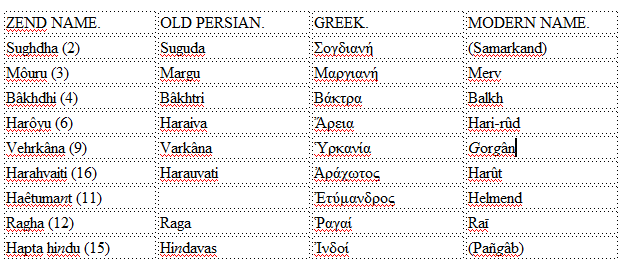
The real existence of Nisâya (5) is certain, although its position cannot be exactly determined (see the note to § 8).
For the other lands we are confined for information to the Pahlavi Commentary. Kakhra(13) is only transliterated, whether the name was then too much known to require any further explanation or too little to allow of any. Urva (8) is described as being Masân ('the land of Masân' or 'the land of the Great'), a name which applied, in the Sassanian ages, to the land around Ispahân (Firdausi, ed. Mohl, V, 270).
For 'Varena, the four-cornered' (14), the Commentary hesitates between the Padashkhvârgar mountains (the Elborz) and Kirmân, a hesitation easily accounted for by the fact that Varena is the seat of the struggle between Azis Dahâka and Thraêtaona, between the storm serpent and the storm god, and was formerly 'the four-sided Heaven' (see Introd. IV, 12, 23). Modern tradition decides in favour of Padashkhvârgar, probably because the serpent was at last bound to Demavand, the highest peak in that chain. The claims of Kirmân were probably founded on the popular etymology of its name, 'the land of snakes.'
'Vaêkereta, of the evil shadows' (8), is identified with Kapul (Cabul); whether rightly or wrongly, we are unable to decide; yet, as it is spoken of only as the seat of the adventures of Keresâspa (see Introd. IV, 2 1), it may be suspected that this assimilation rests merely on the fact that, in later tradition, the legend of Keresâspa was localised in the table-land of Peshyansâi, in Kabulistan (Bund. 30).
In the enumeration there is no apparent order whatever, and Ormazd, in his creations, seems to travel all over the map, forward and backward, without the slightest regard to the cardinal points. Yet, the starting point and the final point have not been arbitrarily chosen: the first land created was 'the Airyana Vaêgô by the Vanguhi Dâitya,' and the last was the land by the Rangha. Now, the Vanguhi and the Rangha were originally the celestial rivers that came down from heaven (as two heavenly Ganggâs) to surround the earth, the one in the east, the other in the west (Bund. XX); this is why the creation begins with a land by the Vanguhi and ends with a land by the Rangha.
In the Sassanian ages, when the Tigris was definitively the border of Iran in the west, the Rangha was identified with it, and the sixteenth land is accordingly described in the Commentary as being Arvastân-i-Rûm, or Roman Mesopotamia. But all the Avesta passages in which the Rangha is cited refer to its mythical nature, as the river in the far-off horizon, as the surrounding Okeanos, and, now and then, still resembling its Vedic homonym, the Rasa, as the river that divides the gods from the fiends.
The first land, the Airyana Vaêgô by the Vanguhi Dâitya, remained to the last a mythical region. It was originally the abode of Yima and of the righteous, that is to say, a particular-form of paradise (see Introd. IV, 38, and Farg. II). Later on, it was looked for in the countries north of Adarbaijan, probably in order that it should be as near as possible to the seat of the Zoroastrian religion, yet. without losing its supernatural character by the counter-evidence of facts. This brought about the division of the Vanguhi Dâitya into two rivers: as the Airyana Vaêgô was localised in the country north of Adarbaijan, the river in it must become identified with the Araxes (Aras); but, at the same time, it continued to surround the world eastward under the name of Veh (Vanguhi), which was the Sassanian name of the Oxus--Indus[1]. It seems that in the time of Herodotus, the Araxes and the Oxus were considered one and the same river[2], as the Oxus and the Indus were later on; this would account for his strange statement that the Araxes, which is confessedly with him the Oxus or Yaxartes, springs from the land of the Matianians, like the Gyndes, and flows eastwards (I, 202; IV, 40; cf. III, 36; IV, 11); and, at the same time, this would account both for how the Airyana Vaêgô could be localised in the basin of the Araxes and how the Oxus could flow eastwards to fall into the Arabian sea.
[1. The Oxus and the Indus were believed to be one and the same river (Bund. l.c.; see Garrez, journal Asiatique, 1869, II, 195 seq.)
2 Running under the Caspian sea, as Arethusa runs under the Sicilian sea and the Rangha itself under the Persian gulf (Bund. XX; cf. Garrez 1.c.)
3. Whether in the time when this Fargard was written, the Airyana {footnote p. 4} Vaêgô was still believed to be in the far-off lands of the rising sun, or already on the banks of the Aras, we leave undecided.]
It follows hence that no historical conclusions can be drawn from this description: it was necessary that it should begin with the Vanguhi and end with the Rangha. To look to it for an account of geographical migrations, is converting cosmology into history.
Of the counter-creations of Angra Mainyu there is little to be said: they are different vices and plagues, which are generally unconnected with the country to the creation of which they answer. Some of them are expressed by {Greek a?'paks lego'mena}, the meaning of which is doubtful or unknown.
If we assume that only lands belonging to the Iranian world were admitted into the list, the mention of the Seven Rivers would indicate that the first Fargard was not composed earlier than the time when the basin of the Indus became a part of Iran, that is, not earlier than the reign of Darius the First.
1. Ahura Mazda[1] spake unto Spitama[2] Zarathustra[3], saying:
2. I have made every land dear to its dwellers, even though it had no charms whatever in it[4]: had I not made every land dear to its dwellers, even though it had no charms whatever in it, then the whole living world would have invaded the Airyana Vaêgô[5].
3 (5). The first of the good lands and countries
[1. See Introd. IV, 4.
2. Literally 'the most beneficent,' an epithet of Zarathustra, which was later mistaken for a family name, 'the Spitamide.'
3. See Introd. IV, 40.
4. 'Every one fancies that the land where he is born and has been brought up is the best and fairest land that I have created.' (Comm.)
5. See following clause. Clause 2 belongs to the Commentary; it is composed of quotations that illustrate the alternative process of the creation: 'First, Ahura Mazda would create a land of such kind that its dwellers might like it, and there could be nothing more delightful. Then he who is all death would bring against it a counter-creation.']
which I, Ahura Mazda, created, was the Airyana Vaêgô[1], by the good river Dâitya[2].
Thereupon came Angra Mainyu, who is all death, and he counter-created by his witchcraft the serpent in the river[3] and winter, a work of the Daêvas[4].
4 (9). There are ten winter months there, two summer months[5]; and those are cold for the waters[6], cold for the earth, cold for the trees[7]. Winter falls there, with the worst of its plagues.
5 (13). The second of the good lands and countries which I, Ahura Mazda, created, was the plains[8] in Sughdha[9].
[1. See the Introd. to the Fargard.
2. 'The good Dâitya.' 'The Dâitîk (Dâitya) comes from Irân Vêg (Airyana Vaêgô), it flows through the mountains of Gorgistân (Georgia,' Bund. p. 51, 19). It was therefore, in the time of the Sassanides, a name of the Araxes.
3. There are many Khrafstras in the Dâitîk, as it is said, The Dâitîk full of Khrafstras' (Bund. p. 51, 20). The serpent in the river was originally the mythical Serpent, Azis, who overthrew and killed the king of Irân Vêg, Yima (see Introd. IV, 18); then it was identified, as appears from the Bundahis, with the snakes that abound on the banks of the Araxes (Morier, A Second journey, p. 250).
4 As Irân Vêg is a place of refuge for mankind and all life from the winter that is to destroy the world (see Farg. II, 21 seq.), winter was thought, by a mythical misunderstanding, to be the counter-creation of Irân Vêg: hence the glacial description of that strange paradise (see the following clause).
5. 'Vendîdâd Sâdah: 'It is known that [in the ordinary course of nature] there are seven months of summer and five of winter' (see Bund. XXV).
6. Some say: 'Even those two months of summer are cold for the waters . . .' (Comm.; cf. Mainyô-i-khard XLIV, 20, and above, n. 4).
7. Vend. Sâdah: 'There reigns the core and heart of winter.'
8. Doubtful: possibly the name of a river (the Zarafshand).
9. Suguda; Sogdiana.]
Thereupon came Angra Mainyu, who is all death, and he counter-created by his witchcraft the fly Skaitya[1], which brings death to the cattle.
6 (17). The third of the good lands and countries which I, Ahura Mazda, created, was the strong, holy Môuru[2].
Thereupon came Angra Mainyu, who is all death, and he counter-created by his witchcraft sinful lusts[3].
7 (21). The fourth of the good lands and countries which I, Ahura Mazda, created, was the beautiful Bâkhdhi[4] with high-lifted banners.
Thereupon came Angra Mainyu, who is all death, and he counter-created by his witchcraft the Bravara[5].
8 (25). The fifth of the good lands and countries which I, Ahura Mazda, created, was Nisâya[6], that lies between Môuru and Bâkhdhi.
Thereupon came Angra Mainyu, who is all death, and he counter-created by his witchcraft the sin of unbelief[7].
9 (29). The sixth of the good lands and countries
[1. A word unknown: possibly 'the cattle fly.' It is a fly that hides itself among the corn and the fodder, and, thence stings with a venomous sting the ox that eats of it (Comm. and Asp.)
2. Margu; Margiana; Merv.
3. Translated according to the Comm. and Asp.
4. Bâkhtri; Bactra; Balkh.
5. 'The corn-carrying ants' (Asp.; cf. Farg. XIV, 5).
6. 'There were several towns of this name, but none between Môuru and Bâkhdhi. But the sentence may be translated also., 'Nisâya between which and Bâkhdhi Môuru lies,' which would point to {Greek Nisai'a}, the capital of Parthia ({Greek Parðau'nisa} Isid. of Charax 12); cf. Pliny 6, 25 (29).
7 'One must believe in the law, and have no doubt whatever about it in the heart, and firmly believe that the good and right law that Ormazd sent to the world is the same law that was brought to us by Zardust' (Saddar I).]
which I, Ahura Mazda, created, was Harôyu[1] with its lake[2].
Thereupon came Angra Mainyu, who is all death, and he counter-created by his witchcraft the stained mosquito[3].
10 (33). The seventh of the good lands and countries which I, Ahura Mazda, created, was Vaêkereta[4], of the evil shadows.
Thereupon came Angra Mainyu, who is all death, and he counter-created by his witchcraft the Pairika Knãthaiti, who clave unto Keresâspa[5].
11 (37). The eighth of the good lands and countries which I, Ahura Mazda, created, was Urva of the rich pastures[6].
Thereupon came Angra Mainyu, who is all death, and he counter-created by his witchcraft the sin of pride[7].
12 (41). The ninth of the good lands and countries which I, Ahura Mazda) created, was Khnenta in Vehrkâna[8].
Thereupon came Angra Mainyu, who is all death, and he counter-created by his witchcraft a sin for which there is no atonement, the unnatural sin[9].
13 (45). The tenth of the good lands and countries which I, Ahura Mazda created, was the beautiful Harahvaiti[10].
[1. Haraiva; Areia; the basin of the Hari river, or Herat.
2. Doubtful.
3. Doubtful.
4. 'Kapul' (Comm.; see the Introd. to the Fargard).
5. See Introd. IV, 21.
6. According to Asp. Tus (in Khorasan); more probably the land around Ispahan. See the Introd. to the Fargard.
7. Or better, tyranny: 'the great are proud there' (Comm.)
8. Varkâna; Hyrcania. 'Khnenta is a river in Vehrkâna' (Comm.); consequently the river Gorgân.
9. See Farg. VIII, 31.
10. Harauvati; {Greek A?ra'xwtos}; Harût.]
Thereupon came Angra Mainyu, who is all death, and he counter-created by his witchcraft a sin for which there is no atonement, the burying of the dead[1].
14 (49). The eleventh of the good lands and countries which I, Ahura Mazda, created, was the bright, glorious Haêtumant[2].
Thereupon came Angra Mainyu, who is all death, and he counter-created by his witchcraft the evil witchcraft of the Yâtus[3].
15 (53). And this is how the Yâtu's nature shows itself: it shows itself by the look[4]; and then, whenever the wizard goes and howls forth his spells[5], most deadly works of witchcraft go forth[6].
16 (59). The twelfth of the good lands and countries which I, Ahura Mazda, created, was Ragha of the three races[7].
Thereupon came Angra Mainyu, who is all death, and he counter-created by his witchcraft the sin of utter unbelief[8].
17 (63). The thirteenth of the good lands and
[1. See Farg. III, 36 seq.
2. The basin of the {Greek E?tu'mandros} or Erymanthus; now Helmend. Cf. Farg. XIX, 39.
3. The wizards; see Introd. IV, 20. The evil eye.
4. As a {Greek Go'es}. Witchcraft is exercised either by the eye or by the voice (Asp.)
5. Vendîdâd Sâdah: 'Then they come forth to kill and to strike to the heart! A gloss cites, as productions of the wizard, I snow and hail' (cf. Hippocrates, De Morbo Sacro I, and Pausanias 2, 34, 4). To that gloss seems to belong the corrupt Zend sentence that follows, and that may mean 'they increase the plague of locusts' (cf. Farg. VII, 2 6).
6. Raï. See Introd. III. 15.
7. They doubt themselves and cause other people to doubt' (Comm.)]
countries which I, Ahura Mazda, created, was the strong, holy Kakhra[1].
Thereupon came Angra Mainyu, who is all death, and he counter-created by his witchcraft a sin for which there is no atonement, the burning of corpses[2].
18 (67). The fourteenth of the good lands and countries which I, Ahura Mazda, created, was the four-cornered Varena[3], for which was born Thraêtaona, who smote Azis Dahâka.
Thereupon came Angra Mainyu, who is all death, and he counter-created by his witchcraft abnormal issues in women[4] and the oppression of foreign rulers[5].
19 (72). The fifteenth of the good lands and countries which I, Ahura Mazda, created, was the Seven Rivers[6].
Thereupon came Angra Mainyu, who is all death, and he counter-created by his witchcraft abnormal issues in women and excessive heat.
20 (76). The sixteenth of the good lands and countries which I, Ahura Mazda, created, was the land by the floods of the Rangha[7], where people live without a head[8].
[1. A land unknown. Asp.: China, which is certainly wrong. There was a town of that name in Khorasan (Karkh).
2. See Farg. VIII, 73.
3. See the Introd. to the Farg.
4. Farg. XVI, 11 seq.
5. Possibly an allusion to Azis Dahâka (Zohâk), who, as a king, represents the foreign conqueror (in later tradition the Tâzî or Arab; possibly in older tradition the Assyrian).
6. The basin of the affluents of the Indus, the modern Pañgâb (= the Five Rivers).
7. 'Arvastân-i-Rûm (Roman Mesopotamia),' (Comm.; see the Introd. to the Farg.)
8. It is interpreted in a figurative sense as meaning 'people who {footnote p. 10} do not hold the chief for a chief' (Comm.), which is the translation for asraosha (Comm. ad XVI, 18), 'rebel against the law,' and would well apply in the Sassanian ages to the non-Mazdean people of Arvastân-i-Rûm. I think we must adopt the literal meaning, and recognise in this passage the source, or at least the oldest form, of those tales about people without a head, with eyes on their shoulders, which Pliny received from the half-Persian Ctesias (Hist. N. VII, 2; V, 8; cf. Aul. Gell. IX, 4; Sanct. August. De Civit. Dei, XVI, 8). Persian geographers mention such people, they place them in the Oriental islands near China, whence they sent ambassadors to the Khan of the Tatars (Ouseley, Catalogue). The mythical origin of those tales may be traced in Indian and Greek mythology (Orm. Ahr. § 222; cf. Pausanias IX, 20).]
Thereupon came Angra Mainyu, who is all death, and he counter-created by his witchcraft winter, a work of the Daêvas[1].
21 (81). There are still other lands and countries, beautiful and deep, desirable and bright, and thriving.
FARGARD II. Yima (Gamshêd).
This Fargard may be divided into two parts.
First part (1-20). Ahura Mazda proposes to Yima, the son of Vîvanghat, to receive the law from him and to bring it to men. On his refusal, he bids him keep his creatures and make them prosper. Yima accordingly makes them thrive and increase, keeps death and disease away from them, and three times enlarges the earth, which bad become too narrow for its inhabitants.
Second part (21 to the end). On the approach of a dire winter, which is to destroy every living creature, Yima, being advised by Ahura, builds a Vara to keep there the seeds of every kind of animals and plants, and the blessed live there a most happy life under his rule.
The tale in the first part refers to Yima as the first man, the first king, and the founder of civilisation (see Introd. IV, 38); the tale in
[1. Vendîdâd Sâdah: 'And the oppression of the land that comes from taoza(?).']
the second part is a combination of the myths of Yima, as the first dead and the king of the dead over whom he rules in a region of bliss, and of old myths about the end of the world. The world, lasting a long year of twelve millenniums, was to end by a dire winter, like the Eddic Fimbul winter, to be followed by an everlasting spring, when men, sent back to earth from the heavens, should enjoy, in an eternal earthly life, the same happiness that they had enjoyed after their death in the realm of Yima. But as in the definitive form which was taken by Mazdean cosmology the world was made to end by fire, its destruction by winter was no longer the last incident of its life, and therefore, the Var of Yima, instead of remaining, as it was originally, the paradise that gives back to earth its inhabitants, came to be nothing more than a sort of Noah's ark (see Introd. IV, 39, and Orm. Ahr. §§ 94, 131, 184, 185).
1.
1. Zarathustra asked Ahura Mazda:
O Ahura Mazda, most beneficent Spirit, Maker of the material world, thou Holy One!
Who was the first mortal, before myself, Zarathustra, with whom thou, Ahura Mazda, didst converse[1], whom thou didst teach the law of Ahura, the law of Zarathustra?
2 (4). Ahura Mazda answered:
The fair Yima, the great shepherd, O holy Zarathustra! he was the first mortal, before thee, Zarathustra, with whom I, Ahura Mazda, did converse, whom I taught the law of Ahura, the law of Zarathustra.
3 (7) Unto him, O Zarathustra, I, Ahura Mazda, spake, saying: 'Well, fair Yima, son of Vîvanghat, be thou the preacher and the bearer of my law!'
And the fair Yima, O Zarathustra, replied unto me, saying:
[1. 'On the law' (Comm.)]
was not born, I was not taught to be the preacher and the bearer of thy law[1].'
4 (11). Then I, Ahura Mazda, said thus unto him, O Zarathustra:
'Since thou wantest not to be the preacher and the bearer of my law, then make thou my worlds thrive, make my worlds increase: undertake thou to nourish, to rule, and to watch over my world.'
5 (14). And the fair Yima replied unto me, O Zarathustra, saying:
'Yes! I will make thy worlds thrive, I will make thy worlds increase. Yes! I will nourish, and rule, and watch over thy world. There shall be, while I am king, neither cold wind nor hot wind, neither disease nor death.'
7 (17)[2]. Then I, Ahura Mazda, brought two implements unto him: a golden ring and a poniard inlaid with gold[3]. Behold, here Yima bears the royal sway!
8 (20). Thus, under the sway of Yima, three hundred winters passed away, and the earth was replenished with flocks and herds, with men and
[1. In the Vedas, Yama, as the first man, is the first priest too; he brought worship here below as well as life, and 'first he stretched out the thread of sacrifice.' Yima had once the same right as his Indian brother to the title of a founder of religion: he lost it as, in the course of the development of Mazdeism, Zarathustra became the titular law-giver (cf. Introd. IV, 40; Orm. Ahr. § x56).
2. The § 6 is composed of unconnected Zend quotations, that are no part of the text and are introduced by the commentator for the purpose of showing that 'although Yima did not teach the law and train pupils, he was nevertheless a faithful and a holy man, and rendered men holy too (?).'
3. As the symbol and the instrument of sovereignty. 'He reigned supreme by the strength of the ring and of the poniard' (Asp.)]
dogs and birds and with red blazing fires, and there was no more room for flocks, herds, and men.
9. Then I warned the fair Yima, saying: 'O fair Yima, son of Vîvanghat, the earth has become full of flocks and herds, of men and dogs and birds and of red blazing fires, and there is no more room for flocks, herds, and men.'
10. Then Yima stepped forward, towards the luminous space, southwards, to meet the sun[1], and (afterwards) he pressed the earth with the golden ring, and bored it with the poniard, speaking thus:
'O Spenta Ârmaiti[2], kindly open asunder and stretch thyself afar, to bear flocks and herds and men.
11. And Yima made the earth grow larger by one-third than it was before, and there came flocks and herds and men, at his will and wish, as many as he wished[3].
[1. Thence is derived the following tradition recorded by G. du Chinon: 'Ils en nomment un qui s'allait tous les jours promener dans le Ciel du Soleil d'où il aportait la sciance des Astres, aprez les avoir visités de si prez. Ils nomment ce grand persormage Gemachid' (Relations nouvelles du Levant, Lyon, 1671, p. 478). There is no direct connexion, as it seems, between the two acts of Yima, namely, between his going to the heaven of the sun and his enlarging the surface of the earth. The meaning of the first is given, perhaps, by the tale about the dream of Cyrus: 'He saw in a dream the sun at his feet: thrice he tried vainly to seize it with his hands, as the sun was rolling and sliding away. The Magi said to him that the threefold effort to seize the sun presaged to him a reign of thirty years' (Dino ap. Cicero, De Divin. I, 23)Yima goes three times to the sun, to take thence royal power for three times three hundred years. In Aryan mythology, the sun is, as is well known, the symbol and source of royalty: Persian kings in particular are 'the brothers of the sun.'
2. The genius of the earth (see Introd. IV, 33).
3. The happiness which Yima made reign on the earth is also {footnote p. 14} described Ys. IX, 4; Yt. IX, 8 seq.; Yt. XV, 15. In the Shâh Nâmah he is the founder of civilisation, of social order, of arts and sciences, and the first builder (cf. § 25 seq.)]
12 (23). Thus, under the sway of Yima, six hundred winters passed away, and the earth was replenished with flocks and herds, with men and dogs and birds and with red blazing fires, and there was no more room for flocks, herds, and men.
13. And I warned the fair Yima, saying: 'O fair Yima, son of Vîvanghat, the earth has become full of flocks and herds, of men and dogs and birds and of red blazing fires, and there is no more room for flocks, herds, and men.'
14. Then Yima stepped forward, towards the luminous space, southwards, to meet the sun, and (afterwards) he pressed the earth with the golden ring, and bored it with the poniard, speaking thus:
'O Spenta Ârmaiti, kindly open asunder and stretch thyself afar, to bear flocks and herds and men.'
15. And Yima made the earth grow larger by two-thirds than it was before, and there came flocks and herds and men, at his will and wish, as many as he wished.
16 (26). Thus, under the sway of Yima, nine hundred winters passed away, and the earth was replenished with flocks and herds, with men and dogs and birds and with red blazing fires, and there was no more room for flocks, herds, and men.
17 (28). And I warned the fair Yima, saying: 'O fair Yima, son of Vîvanghat, the earth has become full of flocks and, herds, of men and dogs and birds and of red blazing fires, and there is no more room for flocks, herds, and men.'
18 (31). Then Yima stepped forward, towards the luminous space, southwards, to meet the sun, and (afterwards) he pressed the earth with the golden ring, and bored it with the poniard, speaking thus:
'O Spenta Ârmaiti, kindly open asunder and stretch thyself afar, to bear flocks and herds and men.)
19 (37). And Yima made the earth grow larger by three-thirds than it was before, and there came flocks and herds and men, at his will and wish, as many as he wished.
II.
21 (42)[1]. The Maker, Ahura Mazda, of high renown[2] in the Airyana Vaêgô, by the good river Dâitya[3], called together a meeting of the celestial gods.
The fair Yima, the good shepherd, of high renown[2] in the Airyana Vaêgô, by the good river Dâitya, called together a meeting of the excellent mortals[4].
To that meeting came Ahura Mazda, of high renown in the Airyana Vaêgô, by the good river Dâitya; he came together with the celestial gods.
To that meeting came, the fair Yima, the good shepherd, of high renown in the Airyana Vaêgô, by the good river Dâitya; he came together with the excellent mortals.
22 (46). And Ahura Mazda spake unto Yima, saying:
'O fair Yima, son of Vîvanghat! Upon the material
[1. § 20 belongs to the Commentary.
2. Or perhaps, 'whose voice was loud,' &c. (while proclaiming the law).
3. See Farg. I, Introd., and notes to § 2.
4. Primitively the souls of the righteous (see Introd. IV, 38).]
world the fatal winters are going to fall, that shall bring the fierce, foul frost; upon the material world the fatal winters[1] are going to fall, that shall make snow-flakes fall thick, even an aredvî deep on the highest tops of mountains[2].
23 (52). And all the three sorts of beasts shall perish, those that live in the wilderness, and those that live on the tops of the mountains, and those that live in the bosom of the dale, under the shelter of stables.
24 (57). Before that winter, those fields would bear plenty of grass for cattle: now with floods that stream, with snows that melt, it will seem a happy land in the world, the land wherein footprints even of sheep may still be seen[3].
25 (61). Therefore make thee a Vara[4], long as a
[1. The Commentary has here: Malkôsân, which is the plural of the Hebrew Malkôs, 'rain;' this seems to be an attempt to identify the Iranian legend with the biblical tradition of the deluge. The attempt was both a success and a failure; Malkôs entered the Iranian mythology and became naturalised there, but it was mistaken for a proper noun, and became the name of a demon, who by witchcraft will let loose a furious winter on the earth to destroy it (Saddar 9). What may be called the diluvial version of the myth is thus summed up in the Mainyô-i-khard: 'By him (Gamshîd) the enclosure of Jam-kard was made; when there is that rain of Malakosãn, as it is declared in the religion, that mankind and the remaining creatures and creations of Hôrmezd, the lord, will mostly perish; then they will open the gate of that enclosure of Jam-kard, and men and cattle and the remaining creatures and creation of the creator Hôrmezd will come from that enclosure and arrange the world again' (XXVII, 27 seq.; edited and translated by E. West).
2. Even where it (the snow) is least, it will be one Vîtasti two fingers deep' (Comm.); that is, fourteen fingers deep.
3. Doubtful.
4. Literally, 'an enclosure.' This Vara is known in later mythology as the Var-Gam-kard, 'the Var made by Yima.']
riding-ground on every side of the square[1], and thither bring the seeds of sheep and oxen, of men, of dogs, of birds, and of red blazing fires.
Therefore make thee a Vara, long as a riding-ground on every side of the square, to be an abode for men; a Vara, long. as a riding-ground on every side of the square, to be a fold for flocks.
26 (65). There thou shalt make waters flow in a bed a hâthra long; there thou shalt settle birds, by the ever-green banks that bear never-failing food. There thou shalt establish dwelling places, consisting of a house with a balcony, a courtyard, and a gallery[2].
27 (70). Thither thou shalt bring the seeds[3] of men and women, of the greatest, best, and finest kinds on this earth; thither thou shalt bring the seeds of every kind of cattle, of the greatest, best, and finest kinds on this earth.
28 (74). Thither thou shalt bring the seeds of every kind of tree, of the greatest, best, and finest kinds on this earth; thither thou shalt bring the seeds of every kind of fruit, the fullest of food and sweetest of odour. All those seeds shalt thou bring, two of ever), kind, to be kept inexhaustible there, so .long as those men shall stay in the Vara.
29 (80). There shall be no humpbacked, none bulged forward there; no impotent, no lunatic; no poverty, no lying; no meanness, no jealousy; no
[1. Two hâthras long on every side' (Comm.) A hâthra is about an English mile.
2. The last three words are {Greek a!'paks lego'mena} of doubtful meaning.
3. To be sown in the ground, and to grow up into life in due time (?see § 41, text and note).]
decayed tooth, no leprous to be confined[1], nor any of the brands wherewith Angra Mainyu stamps the bodies of mortals.
30 (87). In the largest part of the place thou shalt make nine streets, six in the middle part, three in the smallest. To the streets of the largest part thou shalt bring a thousand seeds of men and women; to the streets of the middle part, six hundred; to the streets of the smallest part, three hundred. That Vara thou shalt seal up with the golden ring[2], and thou shalt make a door, and a window self-shining within.
31 (93). Then Yima said within himself: 'How shall I manage to make that Vara which Ahura Mazda has commanded me to make?'
And Ahura Mazda said unto Yima: 'O fair Yima, son of Vîvanghat! Crush the earth with a stamp of thy heel, and then knead it with thy hands, as the potter does when kneading the potter's clay[3].'
[32. And Yima did as Ahura Mazda wished; he crushed the earth with a stamp of his heel, he kneaded it with his hands, as the potter does when kneading the potter's clay[4].]
33 (97). And Yima made a Vara, long as a riding-ground on every side of the square. There he brought the seeds of sheep and oxen, of men, of
[1. See Introd, V, 14.
2. Doubtful.
3. In the Shah Nâmah Gamshîd teaches the Dîvs to make and knead clay; and they build palaces at his bidding. It was his renown, both as a wise king and a great builder, that caused the Musulmans to identify him with Solomon.
4. From the Vendîdâd Sâdah.]
dogs, of birds, and of red blazing fires. He made Vara, long as a riding-ground on every side of the square, to be an abode for men; a Vara, long as a riding-ground on every side of the square, to be a fold for flocks.
34 (101). There he made waters flow in a bed a hâthra long; there he settled birds, by the evergreen banks that bear never-failing food. There he established dwelling places, consisting of a house with a balcony, a courtyard, and a gallery.
35 (106). There he brought the seeds of men and women, of the greatest, best, and finest kinds on this earth; there he brought the seeds of every kind of cattle, of the greatest, best, and finest kinds on this earth.
36 (110). There he brought the seeds of every kind of tree, of the greatest, best, and finest kinds on this earth; there he brought the seeds of every kind of fruit, the fullest of food and sweetest of odour. All those seeds he brought, two of every kind, to be kept inexhaustible there, so long as those men shall stay in the Vara.
37 (116) And there were no humpbacked, none bulged forward there; no impotent, no lunatic; no poverty, no lying; no meanness, no jealousy; no decayed tooth, no leprous to be confined, nor any of the brands wherewith Angra Mainyu stamps the bodies of mortals.
38 (123). In the largest part of the place he made nine streets, six in the middle part, three in the smallest. To the streets of the largest part he brought a thousand seeds of men and women; to the streets of the middle part, six hundred; to the streets of the smallest. part, three hundred. That Vara he sealed up with the golden ring, and he made a door, and a window self-shining within.
39 (129). O Maker of the material world, thou Holy One! What [lights are there to give light[1]] in the Vara which Yima made?
40 (131). Ahura Mazda answered: 'There are uncreated lights and created lights[2]. There the stars, the moon, and the sun are only once (a year) seen to rise and set[3], and a year seems only as a day.
41 (33). 'Every fortieth year, to every couple two are born, a male and a female[4]. And thus it is for every sort of cattle. And the men in the Vara which Yima made live the happiest life[5].'
[1. From the Vendîdâd Sâdah.
2 Heavenly lights and material lights. The Commentary has here the following Zend quotation: 'All uncreated light shines from above; all the created lights shine from below.'
We give here the description of Irân-vêg according to a later source, the Mainyô-i-khard (as translated by West): 'Hôrmezd created Erã-vêz better than the remaining places and districts; and its goodness was this, that men's life is three hundred years; and cattle and sheep, one hundred and fifty years; and their pain and sickness are little, and they do not circulate falsehood, and they make no lamentation and weeping; and the sovereignty of the demon of Avarice, in their body, is little, and in ten men, if they eat one loaf, they are satisfied; and in every forty years, from one woman and one man, one child is born; and their law is goodness, and religion the primeval religion, and when they die, they are righteous (=blessed); and their chief is Gôpatshâh, and the ruler and king is Srôsh' (XLIV, 24).
3. Doubtful.
4. From the seeds deposited in the Vara (see §§ 27 seq., 35 seq.); in the same way as the first human couple grew up, after forty years, in the shape of a Reivas shrub, from the seed of Gayômard received by Spenta Ârmaiti (the Earth. See Bund. XV).
5. 'They live there for 150 years; some say, they never die.' (Comm.) The latter are right, that is to say, are nearer the mythical {footnote p. 21} truth, as the inhabitants of the Vara were primitively the departed and therefore immortal.]
42 (137). O Maker of the material world, thou Holy One! Who is he who brought the law of Mazda into the Vara which Yima made?
Ahura Mazda answered: 'It was the bird Karshipta[1], O holy Zarathustra!'
43 (140). O Maker of the material world, thou Holy One! Who is the lord and ruler there?
Ahura Mazda answered: 'Urvatad-nara[2], O Zarathustra! and thyself, Zarathustra.'
FARGARD III. The Earth.
I (1-6). The five places where the Earth feels most joy.
II (7-11). The five places where the Earth feels most sorrow.
III (12-35). The five things which most rejoice the Earth.
IV (36-42). Corpses ought not to be buried in the Earth.
There is a resemblance as to words between the first and
[1. 'The bird Karshipta dwells in the heavens: were he living on the earth, he would be the king of birds. He brought the law into the Var of Yima, and recites the Avesta in the language of birds' (Bund. XIX and XXIV). As the bird, because of the swiftness of his flight, was often considered an incarnation of lighting, and as thunder was supposed to be the voice of a god speaking from above, the song of the bird was often thought to be the utterance of a god and a revelation (see Orm. Ahr. § 157).
2 Zarathustra had three sons during his lifetime (cf. Introd. IV, 40), Isad-vâstra, Hvare-kithra, and Urvatad-nara, who were respectively the fathers and chiefs of the three classes, priests, warriors, and husbandmen. They play no great part in Mazdean mythology, and are little more than three subdivisions of Zarathustra himself, who was I the first priest, the first warrior, the first husbandman' (Yt. XIII, 88). Zarathustra, as a heavenly priest, was, by right, the ratu in Airyana Vaêgô, where he founded the religion by a sacrifice (Bund. 33 and Introd. III, 15).]
second parts, but there is none as to matter; no clause in the former has its counterpart in the latter. There is more resemblance between the second part and the third; as the first three clauses of the third part (§§ 12, 13, 22) relate to the same things as the second, third, and fourth clauses of the second part (§§ 8, 9, 10).
Parts I and 11 are nothing more than dry enumerations. Part III is more interesting, as it contains two long digressions, the one (§§ 14-21) on funeral laws, the other (§§ 24-33) on the holiness of husbandry. The fourth part of the chapter may he considered as a digression relating to the first clause of the third part (§ 12).
The things which rejoice or grieve the Earth are those that produce fertility and life or sterility and death, either in it or on it.
The subject of this chapter has become a commonplace topic with the Parsis, who have treated it more or less antithetically in the Mainyô-i-khard (chaps. V and VI) and in the Ravaets (Gr. Rav. pp. 434-437).
The second digression (§§ 24-33) is translated in Haug's Essays, p. 235 seq.
I.
1. O Maker of the material world, thou Holy One! Which is the first place where the Earth feels most happy?
Ahura Mazda answered: 'It is the place whereon one of the faithful steps forward, O Spitama Zarathustra! with the holy wood in his hand[1], the baresma[2] in his hand, the holy meat in his hand,
[1. The wood for the fire altar.
2. The baresma (now called barsom) is a bundle of sacred twigs which the priest holds in his hand while reciting the prayers. They were formerly twigs of the pomegranate, date, or tamarind tree, or of any tree that had no thorns, and were plucked with particular ceremonies, which alone made them fit to be used for liturgic purposes (cf. Farg. XIX, 18 seq.) The Parsis in India found it convenient to replace them by brass wires, which, when once consecrated, can be used for an indefinite period. It is the baresma which is alluded to by Strabo, when speaking of the bundle of thin twigs of heath, which the Magi hold in their hand {footnote p. 23} while reciting their hymns ({Greek ta`s dh` e?pfa`s poiou^ntai polu`n xro'non r!a'bdwn muriki'nwn leptw^n de'smhn kate'xoutes, XV, 3, 14).]
the holy mortar[1] in his hand, fulfilling the law with love, and beseeching aloud Mithra, the lord of wide pastures, and Râma Hvâstra[2].'
2, 3 (6-10). O Maker of the material world, thou Holy One! Which is the second place where the Earth feels most happy?
Ahura Mazda answered: 'It is the place whereon one of the faithful erects a house with a priest within, with cattle, with a wife, with children, and good herds within; and wherein afterwards the cattle go on thriving, holiness is thriving[3], fodder is thriving, the dog is thriving, the wife is thriving, the child is thriving, the fire is thriving, and every blessing of life is thriving.'
4 (11). O Maker of the material world, thou Holy One! Which is the third place where the Earth feels most happy?
Ahura Mazda answered: 'It is the place where one of the faithful cultivates most corn, grass, and fruit, O Spitama Zarathustra! where he waters ground that is dry, or dries ground that is too wet.'
5 (15). O Maker of the material world, thou Holy One! Which is the fourth place where the Earth feels most happy?
Ahura Mazda answered: 'It is the place where there is most increase of flocks and herds.'
[1. The Hâvana or mortar used in crushing the Haoma or Hom (see Introd. IV, 28).
2. The god that gives good folds and good pastures to cattle (see Introd. IV, 16).
3. By the performance of worship.]
6 (18). O Maker of the material world, thou Holy One! Which is the fifth place where the Earth feels most happy?
Ahura Mazda answered: 'It is the place where flocks and herds yield most dung.'
II.
7 (21). O Maker of the material world, thou Holy One! Which is the first place where the Earth feels sorest grief?
Ahura Mazda answered: 'It is the neck of Arezûra[1], whereon the hosts of fiends rush forth from the burrow of the Drug[2].'
8 (25). O Maker of the material world, thou Holy One! Which is the second place where the Earth feels sorest grief?
Ahura Mazda answered: 'It is the place wherein most corpses of dogs and of men lie buried[3].
9 (28). O Maker of the material world, thou Holy One! Which is the third place where the Earth feels sorest grief?
Ahura Mazda answered: 'It is the place whereon stand most of those Dakhmas on which corpses of men are deposited[4].'
10. (3 1). O Maker of the material world, thou
[1. The neck of Arezûra (Arezûrahê grîva) is 'a mount at the gate of hell, whence the demons rush forth' (Bund. 22, 16); it is also called I the head of Arezûra' (Farg. XIX, 45), or , the back of Arezûra' (Bund. 21,17). Arezûra was first the name of a fiend who was killed by Gayômard (Mainyô-i-khard XXVII, 15); and mount Arezûra was most likely the mountain to which he was bound, as Azi Dahâka was to Demâvend (see Introd. IV, 18).
2. Hell.
3. See Introd. V, 9.
4. With regard to Dakhmas, see Introd. V, 10. 'Nor is the Earth happy at that place whereon stands a Dakhma with corpses upon it; for that patch of ground will never be clean again fill the day of {footnote p. 25} resurrection' (Gr. Rav. 435, 437). Although the erection of Dakhmas is enjoined by the law, yet the Dakhma in itself is as unclean as any spot on the earth can be, since it is always in contact with the dead (cf. Farg. VII, 55). The impurity which would otherwise be scattered over the whole world, is thus brought together to one and the same spot. Yet even that spot, in spite of the Ravaet, is not to lie defiled for ever, as every fifty years the Dakhmas ought to be pulled down, so that their sites may be restored to their natural purity (V. i. Farg. V11, 49 seq. and this Farg. § 13).]
Holy One! Which is the fourth place where the Earth feels sorest grief?
Ahura Mazda answered: 'It is the place wherein are most burrows of the creatures of Angra Mainyu[1].'
11 (34). O Maker of the material world, thou Holy One! Which is the fifth place where the Earth feels sorest grief?
Ahura Mazda answered: 'It is the place whereon the wife and children of one of the faithful[2], O Spitama Zarathustra! are driven along the way of captivity, the dry, the dusty way, and lift up a voice of wailing.'
III.
12 (38). O Maker of the material world, thou Holy One! Who is the first that rejoices the Earth with greatest joy?
Ahura Mazda answered: 'It is he who digs out of it most corpses of dogs and men[3].'
13 (41). O Maker of the material world, thou
[1. 'Where there are most Khrafstras' (Comm.); cf. Introd. V, II.
2. Killed by an enemy.
3. There is no counterpart given to the first grief (§ 7), because, as the Commentary naively expresses it, 'it is not possible so to dig out hell, which will be done at the end of the world' (Bund. 31, sub fin.)]
Holy One! Who is the second that rejoices the Earth with greatest joy?
Ahura Mazda answered: 'It is he who pulls down most of those Dakhmas on which corpses of men are deposited.'
14 (44). Let no man alone by himself carry a corpse[1]. If a man alone by himself carry a corpse, the Nasu[2] rushes upon him, to defile him, from the nose of the dead, from the eye, from the tongue, from the jaws, from the sexual organ, from the hinder parts. This Drug, this Nasu, falls upon him, stains him even to the end of the nails, and he is unclean, thenceforth, for ever and ever.
15 (49). O Maker of the material world, thou Holy One! What shall be the place of that man who has carried a corpse alone[3]?
Ahura Mazda answered: 'It shall be the place on this earth wherein is least water and fewest plants, whereof the ground is the cleanest and the driest and the least passed through by flocks and herds, by Fire, the son of Ahura Mazda, by the consecrated bundles of baresma, and by the faithful.'
[1. No ceremony in general can be performed by one man alone. Two Mobeds are wanted to perform the Vendîdâd service, two priests for the Barashnûm, two persons for the Sag-dîd (Anquetil, II, 584 n.) It is never good that the faithful should be alone, as the fiend is always lurking about, ready to take advantage of any moment of inattention. If the faithful be alone, there is no one to make up for any negligence and to prevent mischief arising from it. Never is the danger greater than in the present case, when the fiend is close at hand, and in direct contact with the faithful.
2. See Introd. V, 3.
3. As the Nasu has taken hold of him, he has become a Nasu incarnate, and must no longer be allowed to come into contact with men, whom he would defile.]
6 (55). O Maker of the material world, thou Holy One! How far from the fire? How far from the water? How far from the consecrated bundles of baresma? How far from the faithful?
17 (5 7). Ahura Mazda answered: 'Thirty paces from the fire, thirty paces from the water, thirty paces from the consecrated bundles of baresma, three paces from the faithful.
18, 19 (58-63). 'There, on that place, shall the Worshippers of Mazda erect an enclosure', and therein shall they establish him with food, therein shall they establish him with clothes, with the coarsest food and with the most worn-out clothes. That food he shall live on, those clothes he shall wear, and thus shall they let him live, until he has grown to the age of a Hana, or of a Zaurura, or of a Pairista-khshudra[2].
20, 21 (64-71). 'And when he has grown to the age of a Hana, or of a Zaurura, or of a Pairista-khshudra, then the worshippers of Mazda shall order a man strong, vigorous, and skilful[3], to flay the skin off his body and cut the head off his neck[4], on the top of the mountain: and they shall deliver his corpse unto the greediest of the corpse-eating creatures made by Ahura Mazda, to the greedy ravens, with these words: "The man here has repented of all his evil thoughts, words, and deeds.
[1. The Armest-gâh, the place for the unclean; see Introd. V, 15.
2. Hana means, literally, 'an old man;' Zaurura, 'a man broken down by age;' Pairista-khshudra, 'one whose seed is dried up.' These words seem to have acquired the technical meanings of 'fifty, sixty, and seventy years old.'
3. 'Trained to operations of that sort' (Comm.); a headsman.
4. Cf. Farg. IX, 49, text and note.]
If he has committed any other evil. deed, it is remitted by his repentance[1]: if he has committed no other evil deed, he is absolved by his repentance, for ever and ever[2]."'
22 (72). O Maker of the material world, thou Holy One! Who is the third that rejoices the Earth with greatest joy?
Ahura Mazda answered: 'It is he who fills up most burrows of the creatures of Angra Mainyu.'
23 (75). O Maker of the material world, thou Holy One! Who is the fourth that rejoices the Earth with greatest joy?
Ahura Mazda answered: 'It is he who cultivates most corn, grass, and fruit, O Spitama Zarathustra! who waters ground that is dry, or dries ground that is too wet[3].
24 (79). 'Unhappy is the land that has long lain unsown with the seed of the sower and wants a good husbandman, like a well-shapen maiden who has long gone childless and wants a good husband.
25 (84). 'He who would till the earth, O Spitama Zarathustra! with the left arm and the right, with the right arm and the left, unto him will she bring
[1. The performance of the Patet. See Introd. V, 22.
2. It seems as if the law had formerly directed that he should be immediately put to death; but that afterwards, when the rigour of the law had abated, the object which had previously been fulfilled by his death, was then attained by his confinement. He was allowed to live in confinement till he was old and all but dead, and he was put to death by the law, just before he would have died in the usual course of nature (see §§ 19, 20). Certain Ravaets put the 'carrier alone' among the number of the margarzân (East India Office Library, Zend MSS. VIII, 144); he is not only to be punished in this world, but in the other too; he is condemned to feed in hell on corpses of men (Ardâ Vîrâf 38).
3. Cf. § 4.]
forth plenty, like a loving bride on her bed, unto her beloved; the bride will bring forth children, the earth will bring forth plenty of fruit.
26, 27 (87-90). 'He who would till the earth, O Spitama Zarathustra! with the left arm and the right, with the right arm and the left, unto him thus says the Earth: "O thou man! who dost till me with the left arm and the right, with the right arm and the left [hither shall people ever come and beg (for bread[1])], here shall I ever go on bearing, bringing forth all manner of food, bringing forth profusion of corn[2]. "
28, 29 (91-95). 'He who does not till the earth, O Spitama Zarathustra! with the left arm and the right, with the right arm and the left, unto him thus says the Earth: "O thou man I who dost not till me with the left arm and the right, with the right arm and the left, ever shalt thou stand at the door of the stranger, among those who beg for bread; ever shalt thou wait there for the refuse that is brought unto thee[3], brought by those who have profusion of wealth."'
30 (96). O Maker of the material world, thou Holy One! What is the food that fills the law of Mazda[4]?
Ahura Mazda answered: 'It is sowing corn again and again, O Spitama Zarathustra!
31 (99). 'He who sows corn, sows holiness: he
[1. From the Vendîdâd Sâdah.
2. Or 'bearing corn first for thee.' 'When something good grows up, it will grow up for thee first' (Comm.)
3. They take for themselves what is good and send to thee what is bad' (Comm.)
4. Literally, 'What is the stomach of the law?']
makes the law of Mazda grow higher and higher: he makes the law of Mazda as fat as he can with a hundred acts of adoration, a thousand oblations, ten thousand sacrifices[1].
32 (105). 'When barley is coming forth, the Daêvas start up[2]; when the corn is growing rank[3], then faint the Daêvas hearts; when the corn is being ground[4], the Daêvas groan; when wheat is coming forth, the Daêvas are destroyed. In that house they can no longer stay, from that house they are beaten away, wherein wheat is thus coming forth[5]. It is as though red hot iron were turned about in their throats, when there is plenty of corn.
33 (111). 'Then let (the priest) teach people this holy saying: "No one who does not eat, has strength to do works of holiness, strength to do works of husbandry, strength to beget children. By eating every material creature lives, by not eating it dies away[6]."'
34 (116). O Maker of the material world, thou Holy One! Who is the fifth that rejoices the Earth with greatest joy?
[1. The translation 'acts of adoration' and 'oblations' is doubtful: the words in the text {Greek a?'paks lego'mena}, which are traditionally translated 'feet' and 'breasts.' The Commentary has as follows: 'He makes the law of Mazda as fat as a child could be made by means of a hundred feet, that is to say, of fifty servants walking to rock him; of a thousand breasts, that is, of five hundred nurses; of ten thousand sacrifices performed for his weal.'
2. John Barleycorn got up again,
And sore surpris'd them all.3. Doubtful; possibly, 'When sudhus (a sort of grain) is coming forth.'
4. Doubtful; possibly, 'When pistra (a sort of grain) is coming forth.'
5. Doubtful.
6. See Farg. IV, 47.]
Ahura Mazda answered: '[It is he who tilling the earth, O Spitama Zarathustra! kindly and piously gives[1] to one of the faithful.]
35 (118). 'He who tilling the earth, O Spitama Zarathustra! would not kindly and piously give to one of the faithful, he shall fall down into the darkness of Spenta Ârmaiti[2], down into the world of woe, the dismal realm, down into the house of hell.'
IV.
36 (122). O Maker of the material world, thou Holy One! If a man shall bury in the earth either the corpse of a dog or the corpse of a man, and if he shall not disinter it within half a year, what is the penalty that he shall pay?
Ahura Mazda answered: 'Five hundred stripes with the Aspahê-astra[3], five hundred stripes with the Sraoshô-karana.'
37 (126). O Maker of the material world, thou Holy One! If a man shall bury in the earth either the corpse of a dog or the corpse of a man, and if he shall not disinter it within a year, what is the penalty that he shall pay?
Ahura Mazda answered: 'A thousand stripes with the Aspahê-astra, a thousand stripes with the Sraoshô-karana.'
38 (130). O Maker of the material world, thou Holy One! If a man shall bury in the earth either the corpse of a dog or the corpse of a man, and if he shall not disinter it within the second year, what
[1. The Ashô-dâd or alms. The bracketed clause is from the Vendîdâd Sâdah.
2. The earth.
3. See Introd. V, 19.]
is the penalty for it? What is the atonement for it? What is the cleansing from it?
39 (135). Ahura Mazda answered: 'For that deed there is nothing that can pay, nothing that can atone, nothing that can cleanse from it; it is a trespass for which there is no atonement, for ever and ever.'
40 (137). When is it so?
'It is so, if the sinner be a professor of the law of Mazda, or one who has been taught in it[1]. But if he be not a professor of the law of Mazda, nor one who has been taught in it[2], then this law of Mazda takes his sin from him, if he confesses it[3] and resolves never to commit again such forbidden deeds.
41 (142). 'The law of Mazda indeed, O Spitama Zarathustra! takes away from him who confesses it the bonds of his sin[4]; it takes away (the sin of) breach of trust[5]; it takes away (the sin of) murdering one of the faithful[6]; it takes away (the sin of) burying a corpse[7]; it takes away (the sin of)
[1. As he must have known that he was committing sin.
2. If he did not know that he was committing sin.
3. If he makes Patet (see Introd. V, 22), and says to himself, 'I will never henceforth sin again' (Comm.)
4. If not knowingly committed; see § 40 and the following notes.
5. Draosha: refusing to give back a deposit (Comm. ad IV, x): 'He knows that it is forbidden to steal, but he fancies that robbing the rich to give to the poor is a pious deed' (Comm.)
6. Or better, 'a Mazdean,' but one who has committed a capital crime; I he knows that it is allowed to kill the margarzân, but he does not know that it is not allowed to do so without an order from the judge! Cf. VIII, 74 note.
7. 'He knows that it is forbidden to bury a corpse; but he fancies that if one manages so that dogs or foxes may not take it to the fire and to the water, he behaves piously' (Comm.) See Introd. V, 9.]
deeds for which, there is no atonement; it takes away the heaviest -penalties of sin[1]; it takes away any sin that may be sinned.
42 (149). 'In the same way the law of Mazda, O Spitama Zarathustra! cleanses the faithful from every evil thought, word, and deed, as a swift-rushing mighty wind cleanses the plain[2].
'So let all the deeds thou doest be henceforth good, O Zarathustra! a full atonement for thy sin is effected by means of the-law of Mazda.'
FARGARD IV. Contracts and Outrages.
- 1-16. Contracts (see Introd. V, 17):--
- 2. Classification of contracts;
- 3-4. Damages for breach of contract;
- 5-10. Kinsmen responsible;
- 11-16. Penalties for breach of contract.
- 17-55. Outrages (see Introd. V, 18)
- 18-21. Menaces;
- 22-25. Assaults;
- 26-29. Blows;
- 30-33. Wounds;
- 34-36. Wounds causing blood to flow;
- 37-39. Broken bones;
- 40-43. Manslaughter;
- 46, 49 (bis)-55. False oaths.
Clauses 44-45 refer to contracts, and ought to be placed after § 16. Clauses 47-49, which are in praise of physical weal, have been probably misplaced here from the preceding Fargard (see Farg. III, 33). The right order of this chapter would, therefore, seem to be as follows: 1-16; 44-45 17-43; 46; 49 (bis)-55.
[1. Or, possibly, 'the sin of usury.' He knows that it is lawful to take high interest' but 'he does not know that it is not lawful to do so from the faithful, (Comm.)
2 'From chaff' (Comm.)]
I.
1. He that does not restore (a thing lent), when it is asked for back again, steals the thing; he robs the man[1]. So he does every day, every night, as long as he keeps in his house his neighbour's property, as. though it were his own[2].
II a.
2 (4). O Maker of 'the material world, thou Holy One! How many in number are thy contracts, O Ahura Mazda?
Ahura Mazda answered: 'They are six in number[3]. The first is the word-contract[4]; the second
[1. 'He is a thief when he takes with a view not to restore; he is a robber when, being asked to restore, he answers, I will not'(Comm.)
2. Every moment that he holds it unlawfully, he steals it anew. 'The basest thing with Persians is to lie; the next to it is to be in debt, for this reason among many others, that he who is so, must needs sink to lying at last' (Herod. I, x83). The debtor in question is of course the debtor of bad faith, 'he who says to a man, Give me this, I will restore it to thee at the proper time, and he says to himself, I will not restore it' (Comm.)
The following classification is in fact twofold, the contracts being defined in the first two clauses by their mode of being entered into, and in the last four by their amount. Yet it appears from the following clauses that even the word-contract and the hand-contract became at last, or were misunderstood as, indicative of a certain amount. The commentators, however, were unable to determine that amount, or, at least, they do not state how much it was, which they do with regard to the last four.
4. The contract entered into by simple word of mouth. 'The immortal Zartust Isfitamân asked of the good, beneficent Hormazd, "Which is the worst of the sins that men commit?" The good, beneficent Hormazd answered, "There is no sin worse than when a man, having given his word to another, there being no witness but myself, Hormazd, one of them breaks his word and says, I don't know anything about it...there is no sin worse than this?' (Gr. Rav. 94).]
is the hand-contract[1]; the third is the contract to the amount of a sheep[2]; the fourth is the contract to the amount of an ox[3] the fifth is the contract to the amount of a man[4] the sixth is the contract to the amount of a field[5], a field in good land, a fruitful one, in good bearing[6]."
II b.
3 (13). If a man make the Word-contract a mere word[7], it shall be redeemed by the hand-contract; he shall give in pledge[8] the amount of the hand-contract.
4 (16). The hand-contract[9] shall be redeemed by the sheep-contract; he shall give in pledge the amount of the sheep-contract. The sheep-contract shall be redeemed by the ox-contract; he shall give in pledge the amount of the ox-contract. The ox-contract shall be redeemed by the man-contract; he
[1. 'When they strike hand in hand and make then agreement by word' (Gr. Rav. 1. 1.) It would be of interest to know whether word and hand are to be taken in the strict meaning or if they allude to certain formulas and gestures like those in the Roman stipulatio.
2. 'Viz. to the amount of 3 istîrs [in weight],' (Comm.) An istîr ({Greek stath'r}) is as much as 4 dirhems ({Greek draxmh'}). On the value of the dirhem, see Introd. V, 22.
3. 'To the amount of 12 istîrs (=48 dirhems),' (Comm.)
4. 'To the amount of 500 istîrs. (= 2000 dirhems).' The exact translation would be rather, 'The contract to the amount of a human being,' as the term is applied to promises of marriage and to the contract between teacher and pupil.
5. 'Upwards of 500 istîrs.'
6. A sort of gloss added to define more accurately the value of the object and to indicate that it is greater than that of the preceding one.
7. If he fail to fulfil it.
8. Or, 'as damages (?).'
9. 'The breach of the hand-contract.']
shall give in pledge the amount of the man-contract. The man-contract shall be redeemed by the field-contract; he shall give in pledge the amount of the field-contract.
II c.
5 (24). O Maker of the material world, thou Holy One! If a man break the word-contract, how many are involved in his sin[1]?
Ahura Mazda answered: 'His sin makes, his Nabânazdistas[2] answerable for the[3] three hundred-fold atonement.'
6 (26). O Maker of the material world, thou Holy One! If a man break the hand-contract, how many are involved in his sin?
Ahura Mazda answered: 'His sin makes his Nabânazdistas answerable for the six hundred-fold atonement[4].'
[1. Literally, how much is involved? The joint responsibility of the family was a principle in the Persian law, as it was in the old German law, which agrees with the statement in Am. Marcellinus: 'Leges apud eos impendio formidatae, et abominandae aliae, per quas ob noxam unius omnis propinquitas perit' (XXIII, 6).
2. The next of kin to the ninth degree.
3. See § 11. This passage seems to have puzzled tradition. The Commentary says, 'How long, how many years, has one to fear for the breach of a word-contract?--the Nabânazdistas have to fear for three hundred years;' but it does not explain farther the nature of that fear; it only tries to reduce the circle of that liability to narrower limits: 'only the son born after the breach is liable for it; the righteous are not liable for it; when the father dies, the son, if righteous, has nothing to fear from it.' And finally, the Ravaets leave the kinsmen wholly aside; the penalty falling entirely upon the real offender, and the number denoting only the duration of his punishment in hell: 'He who breaks a word-contract, his soul shall abide for three hundred years in hell' (Gr. Rav. 94).
4. See § 12. 'His soul shall abide for six hundred years in hell' (Gr. Rav. 1. 1.)]
7 (28). O Maker of the material world, thou Holy One! If a man break the sheep-contract, how many are involved in his sin?
Ahura Mazda answered: 'His sin makes his Nabânazdistas answerable for the seven hundred-fold atonement[1]!
8 (30). O Maker of the material world, thou Holy One! If a man break the ox-contract, how many are involved in his sin?
Ahura Mazda answered: 'His sin makes his Nabânazdistas answerable for the eight hundred-fold atonement[2].'
9 (32). O Maker of the material world, thou Holy One! If a man break the man-contract, how many are involved in his sin?
Ahura Mazda answered: 'His sin makes his Nabânazdistas answerable for the nine hundred-fold atonement[3].'
10 (34). O Maker of the material world, thou Holy One! If a man break the field-contract, how many are involved in his sin?
Ahura Mazda answered: 'His sin makes his Nabânazdistas answerable for the thousand-fold atonement[4].'
II d.
11 (36). O Maker of the material world, thou Holy One! If a man break the word-contract, what is the penalty that he shall pay?
Ahura Mazda answered: 'Three hundred stripes
[1. See § 13. 'His soul shall abide for seven hundred years in hell' (Gr. Rav. 1. 1.)
2. See § 14. 'His soul shall abide for eight hundred years in hell.'
3. See § 15. His soul shall abide for nine hundred years in hell.'
4. See § 16. His soul shall abide for a 'thousand years in hell.']
with the Aspahê-astra, three hundred stripes with the Sraoshô-karana[1].'
12 (39). O Maker of the material world, thou Holy One[1] If a man break the hand-contract, what is the penalty that he shall pay?
Ahura Mazda answered: 'Six hundred stripes with the Aspahê-astra, six hundred stripes with the Sraoshô-karana[2].'
13 (42). O Maker of the material world, thou Holy One! If a man break the sheep-contract, what is the penalty that he shall pay?
Ahura Mazda answered: 'Seven hundred stripes with the Aspahê-astra, seven hundred stripes with the Sraoshô-karana[3].'
14 (45). O Maker of the material world, thou Holy One! If a man break the ox-contract, what is the penalty that he shall pay?
Ahura Mazda answered: 'Eight hundred stripes with the Aspahê-astra, eight hundred stripes with the Sraoshô-karana[4].'
15 (48). O Maker of the material world, thou Holy One! If a man break the man-contract, what is the penalty that he shall pay?
Ahura Mazda answered: 'Nine hundred stripes with the Aspahê-astra, nine hundred stripes with the Sraoshô-karana[5].'
16 (51). O Maker of the material world, thou Holy One! If a man break the field-contract, what is the penalty that he shall pay?
[1. One tanâfûhr and a half, that is 1800, dirhems.
2. Three tanâfûhrs, or 3600 dirhems.
3. Three tanâfûhrs and a half, or 4200 dirhems.
4. Four tanâfûhrs, or 4800 dirhems.
5. Four tanâfûhrs and a half, or 5400 dirhems.]
Ahura Mazda answered: 'A thousand stripes with the Aspahê-astra, a thousand stripes with the Sraoshô-karana[1].'
III a.
17 (54). If a man rise up to smite a man, it is an Âgerepta[2]. If a man come upon a man to smite him, it is an Avaoirista. If a man actually smite a man with evil aforethought, it is an Aredus. Upon the fifth Aredus[3] he becomes a Peshôtanu[4].
18 (58). O Maker of the material world, thou Holy One! He that committeth an Âgerepta, what penalty shall he pay?
Ahura Mazda answered: 'Five stripes with the Aspahê-astra, five stripes with the Sraoshô-karana; on the second Âgerepta, ten stripes with the Aspahê-astra, ten stripes with the Sraoshô-karana; on the third, fifteen stripes with the Aspahê-astra, fifteen stripes with the Sraoshô-karana.
[1. Five tanâfûhrs, or 6000 dirhems.
In this paragraph are defined the first three of the eight outrages with which the rest of the Fargard deals. Only these three are defined, because they are designated by technical terms. We subjoin the definitions of them found in a Sanskrit translation of a Patet (Paris, Bibl. Nat. f. B. 5, 154), in which their etymological meanings are better preserved than in the Zend definition itself:--
Âgerepta, 'seizing,' is when a man seizes a weapon with a view to smite another.
Avaoirista, 'brandishing,' is when a man brandishes a weapon with a view to smite another.
Aredus is when a man actually smites another with a weapon, but without wounding him, or inflicts a wound which is healed within three days.
3. Viz. on the sixth commission of it, as appears from § 28.
4. He shall receive two hundred stripes, or shall pay 1200 dirhems (see Introd. V, 19).]
19 (63). 'On the fourth, thirty stripes with the Aspahê-astra, thirty stripes with the Sraoshô-karana; on the fifth, fifty stripes with the Aspahê-astra, fifty stripes with the Sraoshô-karana; on the sixth, sixty stripes with the Aspahê-astra, sixty stripes with the Sraoshô-karana; on the seventh, ninety stripes with the Aspahê-astra, ninety stripes with the Sraoshô-karana.'
20 (67). If a man commit an Âgerepta for the eighth time, without having atoned for the preceding, what penalty shall he pay?
Ahura Mazda answered: 'He is a Peshôtanu: two hundred stripes with the Aspahê-astra, two hundred stripes with the Sraoshô-karana.'
21 (70). If a man commit an Âgerepta[1] and refuse to atone for it[2], what penalty shall he pay?
Ahura Mazda answered: 'He is a Peshôtanu: two hundred stripes with the Aspahê-astra, two hundred stripes with the Sraoshô-karana.'
22 (73). O Maker of the material world, thou Holy One! If a man commit an Avaoirista, what penalty shall he pay?
Ahura Mazda answered: 'Ten stripes with the Aspahê-astra, ten stripes with the Sraoshô-karana; on the second Avaoirista, fifteen stripes with the Aspahê-astra, fifteen stripes with the Sraoshô-karana.
23 (75). 'On the third, thirty stripes with the Aspahê-astra, thirty stripes with the Sraoshô-karana; on the fourth, fifty stripes with the Aspahê-astra, fifty stripes with the Sraoshô-karana; on the fifth, seventy stripes with the Aspahê-astra, seventy
[1. Even though the Âgerepta has been committed for the first time.
2. If he does not offer himself to bear the penalty, and does not perform the Patet (see Introd. V, 22).]
stripes with the Sraoshô-karana; on the sixth, ninety stripes with the Aspahê-astra, ninety stripes with the Sraoshô-karana.'
24 (76). O Maker of the material world, thou Holy One! If a man commit an Avaoirista for the seventh time, without having atoned for the preceding, what penalty shall he pay?
Ahura Mazda answered: 'He is a Peshôtanu: two hundred stripes with the Aspahê-astra, two hundred stripes with the Sraoshô-karana.'
25 (77). O Maker of the material world, thou Holy One! If a man commit an Avaoirista, and refuse to atone for it, what penalty shall he pay?
Ahura Mazda answered: 'He is a Peshôtanu: two hundred stripes with the Aspahê-astra, two hundred stripes with the Sraoshô-karana.
26 (79). O Maker of the material world, thou Holy One! If a man commit an Aredus, what penalty shall he pay?
Ahura Mazda answered: 'Fifteen stripes with the Aspahê-astra, fifteen stripes with the Sraoshô-karana.
27 (81). 'On the second Aredus, thirty stripes with the Aspahê-astra, thirty stripes with the Sraoshô-karana; on the third, fifty stripes with the Aspahê-astra, fifty stripes with the Sraoshô-karana; on the fourth, seventy stripes, with the Aspahê-astra, seventy stripes with the Sraoshô-karana; on the fifth, ninety stripes with the Aspahê-astra, ninety stripes with the Sraoshô-karana.
28. O Maker of the material world, thou Holy One! If a man commit an Aredus for the sixth time, without having atoned for the preceding, what penalty shall he pay?
Ahura Mazda answered: 'He is a Peshôtanu: two hundred stripes with the Aspahê-astra, two hundred stripes with the Sraoshô-karana.'
29 (82). O Maker of the material world, thou Holy One! If a man commit an Aredus, and refuse to atone for it, what penalty shall he pay?
Ahura Mazda answered: 'He is a Peshôtanu: two hundred stripes with the Aspahê-astra, two hundred stripes with the Sraoshô-karana.'
30 (85). O Maker of the material world, thou Holy One! If a man smite another and hurt him sorely, what is the penalty that he shall pay?
31 (87). Ahura Mazda answered: 'Thirty stripes with the Aspahê-astra, thirty stripes with the Sraoshô-karana; the second time, fifty stripes with the Aspahê-astra, fifty stripes with the Sraoshô-karana; the third time, seventy stripes with the Aspahê-astra, seventy stripes with the Sraoshô-karana; the fourth time, ninety stripes with the Aspahê-astra, ninety stripes with the Sraoshô-karana.'
32 (89). If a man commit that deed for the fifth time, without having atoned for the preceding, what is the penalty that he shall pay?
Ahura Mazda answered: 'He is a Peshôtanu: two hundred stripes with the Aspahê-astra, two hundred stripes with the Sraoshô-karana.'
33 (90). If a man commit that deed and refuse to atone for it, what is the penalty that he shall pay?
Ahura Mazda answered: 'He is a Peshôtanu: two hundred stripes with the Aspahê-astra, two hundred stripes with the Sraoshô-karana.'
34 (93). O Maker of the material world, thou Holy One! If a man smite another so that the blood comes, what is the penalty that he shall pay?
Ahura Mazda answered: 'Fifty stripes with the Aspahê-astra, fifty stripes with the Sraoshô-karana; the second time, seventy stripes with the Aspahê-astra, seventy stripes with the Sraoshô-karana; the third time, ninety stripes with the Aspahê-astra, ninety stripes with the Sraoshô-karana.'
35 (95). If he commit that deed for the fourth time, without having atoned for the preceding, what is the penalty that he shall pay?
Ahura Mazda answered: 'He is a Peshôtanu: two hundred stripes with the Aspahê-astra, two hundred stripes with the Sraoshô-karana.'
36 (96). O Maker of the material world, thou Holy One! If a man smite another so that the blood comes, and if he refuse to atone for it, what is the penalty that he shall pay?
Ahura Mazda answered: 'He is a Peshôtanu: two hundred stripes with the Aspahê-astra, two hundred stripes with the Sraoshô-karana.'
57 (99). O Maker of the material world, thou Holy One! If a man smite another so that he breaks a bone, what is the penalty that he shall pay?
Ahura Mazda answered: 'Seventy stripes with the Aspahê-astra, seventy stripes with the Sraoshô-karana; the second time, ninety stripes with the Aspahê-astra, ninety stripes with the Sraoshô-karana.'
38 (102). If he commit that deed for the third time, without having atoned for the preceding, what is the penalty that he shall pay?
Ahura Mazda answered: 'He is a Peshôtanu: two hundred stripes with the Aspahê-astra, two hundred stripes with the Sraoshô-karana.'
39 (104). O Maker of the material world, thou Holy One! If a man smite another so that he breaks a bone, and if he refuse to atone for it, what is the penalty that he shall pay?
Ahura Mazda answered: 'He is a Peshôtanu: two hundred stripes with the Aspahê-astra, two hundred stripes with the Sraoshô-karana.'
40 (106). O Maker of the material world, thou Holy One! If a man smite another so that he ,gives up the ghost, what is the penalty that he shall pay?
Ahura Mazda answered: 'Ninety stripes with the Aspahê-astra, ninety stripes with the Sraoshô-karana.'
41 (109). If he commit that deed again, without having atoned for the preceding, what is the penalty that he shall pay?
Ahura Mazda answered: 'He is a Peshôtanu: two hundred stripes with the Aspahê-astra, two hundred stripes with the Sraoshô-karana.'
42 (112). O Maker of the material world, thou Holy One! If a man smite another so that he gives up the ghost, and if he refuse to atone for it, what is the penalty that he shall pay?
Ahura Mazda answered: 'He is a Peshôtanu: two hundred stripes with the Aspahê-astra, two hundred stripes with the Sraoshô-karana.'
43 (115). And they shall thenceforth in their doings walk after the way of holiness, after the word of holiness, after the ordinance of holiness.
II e[1].
44 (118). If men of the same fait h, either friends or brothers, come to an agreement together, that one may obtain from the other, either goods[2], or a wife[3], or knowledge[4], let him who wants to have goods have them delivered to him; let him who wants to have a wife receive and wed her; let him who wants to have knowledge be taught the holy word.
45 (123). He shall learn on, during the first part of the day and the last, during the first part of the night and the last, that his mind may be increased in knowledge and wax strong in holiness: so shall he sit up, giving thanks and praying to the gods, that he may be increased in knowledge: he shall rest during the middle part of the day, during the middle part of the night, and thus shall he continue until he can say all the words which former Aêthrapaitis[5] have said.
III b.
46 (128). Before the water and the blazing fire
[1. We return here to contracts; the proper place of §§ 44-45 is after § 16.
2. The goods-contract is a general expression for the sheep, ox, and field-contracts (see above, § 2).
3. Woman is an object of contract, like cattle or fields; she is disposed of by contracts of the fifth sort, being more valuable than cattle and less so than fields. She is sold by her father or her guardian, often from the cradle. 'Instances are not wanting of the betrothal of a boy of three years of age to a girl of two' (see Dosabhoy Framjee's work on The Parsecs, p. 77; cf. 'A Bill to Define and Amend the Law relating to Succession, Inheritance, Marriage, &c.,' Bombay, 1864).
4 The contract between pupil and teacher falls into the same class (the man-contract, see p. 35, n. 4).
5. A teaching priest (Parsi Hêrbad).
6. Doubtful. This clause is intended, as it seems, against false {footnote p. 46} oaths. The water and the blazing fire are the water and the fire before which the oath is taken (see § 54 n.); putting aside §§ 47-49, which are misplaced from Farg. III, 34, one comes to § 50, in which the penalty for a false oath is described.]
O Spitama Zarathustra! let no one make bold to deny having received from his neighbour the ox or the garment (he has received from him).
47 (130).... Verily I say it unto thee, O Spitama Zarathustra! the man who has a wife is far above him who begets no sons[1]; he who keeps a house is far above him who has none; he who has children is far above the childless man; he who has riches is far above him who has none.
48 (1324). And of two men, he who fills himself with meat is filled with the good spirit[2] much more than he who does not do so[3]; the latter is all but dead; the former is above him by the worth of an Asperena[4] , by the worth of a sheep, by the worth of an ox, by the worth of a man.
49 (137). It is this man that can strive against the onsets of Astô-vîdhôtu[5]; that can strive against
[1. 'In Persia there are prizes given by the king to those who have most children' (Herod. I, 136). . 'He who has no child, the bridge (of paradise) shall be barred to him. The first question the angels there will ask him is, whether he has left in this world a substitute for himself; if he answers, No, they will pass by and he will stay at the head of the bridge, full of grief and sorrow'(Saddar 18; Hyde 19). The primitive meaning of this belief is explained by Brahmanical doctrine; the man without a son falls into hell, because there is nobody to pay him the family worship.
2. Or, 'with Vôhu Manô,' who is at the same time the god of good thoughts and the god of cattle (see Introd. IV, 33).
3. 'There are people who strive to pass a day without eating, and who abstain from any meat; we strive too and abstain, namely, from any sin in deed, thought, or word: ... in other religions, they fast from bread; in ours, we fast from sin' (Saddar 83; Hyde 25).
4. A dirhem.
5. See Introd. IV, 26.]
the self-moving arrow[1]; that can strive against the winter fiend, with thinnest garment on; that can strive against the wicked tyrant and smite him on the head; it is this man that can strive against the ungodly Ashemaogha who does not eat[2].'
49 (bis).... The very first time when that deed[3] has been done, without waiting until it is done again[4].
50 (143). Down there[5] the pain for that deed shall be as hard as any in this world: should one cut off the limbs from his perishable body with knives of brass, yet still worse shall it be.
51 (146). Down there the pain for that deed shall be as hard as any in this world: should one nail[6] his perishable body with nails of brass, yet still worse shall it be.
52 (149). Down there the pain for that deed shall be as hard as any in this world: should one by force throw his perishable body headlong down a precipice a hundred times the height of a man, yet still worse shall it be.
53 052). Down there the pain or that deed shall be as hard as any in this world: should one by force impale[7] his perishable body, yet still worse shall it be.
54 (154). Down there the pain for that deed shall be as hard as any in this world: to wit, that deed which is done, when a man, knowingly lying, confronts the brimstoned, golden[8], truth-knowing[9]
[1. See Introd. IV, 26.
2 See Introd. III, 10.
3. The taking of a false oath.
4. See Introd. V, 18.
5. In hell.
6. Doubtful.
7. Doubtful.
8. The water before which the oath is taken contains some incense, brimstone, and one danak of molten gold (Gr. Rav. 101).
9. Doubtful. Possibly 'bright!]
water with an appeal unto Rashnu[1] and a lie unto Mithra[2].
55 (156). O Maker of the material world, thou Holy One! He who, knowingly lying, confronts the brimstoned, golden, truth-knowing water with an appeal unto Rashnu and a lie unto Mithra, what is the penalty that he shall pay[3]?
Ahura Mazda answered: 'Seven hundred stripes with the Aspahê-astra, seven hundred stripes with the Sraoshô-karana.'
FARGARD V.
This chapter and the following ones, to the end of the twelfth, deal chiefly with uncleanness arising from the dead, and with the means of removing it from men and things.
The subjects treated in this Fargard are as follows:--
I (1-7). If a man defile the fire or the earth involuntarily, or unconsciously, it is no sin.
II (8-9). Water and fire do not kill.
III (10-14). Disposal of the dead during winter.
IV (15-20). How the Dakhmas are cleansed by water from the heavens.
V (21-26). On the excellence of purity and of the law that shows how to recover it, when lost.
VI (27-38). On the defiling power of the Nasu being greater or less, according to the greater or less dignity of the being that dies.
VII (39-44). On the management of sacrificial implements defiled by the dead.
[1. The god of truth. The formula is as follows: 'Before the Amshaspand Bahman, before the Amshaspand Ardibehesht, here lighted up . . . &c., I swear that I have nothing of what is thine, N. son of N., neither gold, nor silver, nor brass, nor clothes, nor an), of the things created by Ormazd' (l. l. 96).
2. See Introd. IV, 8. He is a Mithra-drug, 'one who lies to Mithra.'
3. In this world.]
VIII (45-62). On the treatment of a woman who has been delivered of a still-born child; and what is to be done with her clothes.
I a.
1. There dies a man in the depths of the vale: a bird takes flight from the top of the mountain down into the depths of the vale, and it eats up the corpse of the dead man there: then, up it flies from the depths of the vale to the top of the mountain: it flies to some one of the trees there, of the hard-wooded or the soft-wooded, and upon that tree it vomits, it deposits dung, it drops pieces from the corpse.
2 (7). Now, lo! here is a man coming up from the depths of the vale to the top of the mountain; he comes to the tree whereon the bird is sitting; from that tree he wants to take wood for the fire. He fells the tree, he hews the tree, he splits it into logs, and then he lights it in the. fire, the son of Ahura Mazda. What is the penalty that he shall pay[1]?
3 (11). Ahura Mazda answered: 'There is no sin upon a man for any dead matter that has been brought by dogs, by birds, by wolves, by winds, or by flies.
4 (12). 'For were there sin upon a man for any dead matter that might have been brought by dogs, by birds, by wolves, by winds, or by flies, how soon this material world of mine would have in it only Peshôtanus, shut out from the way of holiness,
[1. For defiling the fire by bringing dead matter into it, see Farg. VII, 25 seq. The Vendîdâd Sâdah has here, 'Put ye only proper and well-examined fuel (in the fire).' For the purification of unclean wood, see Farg. VII, 28 seq.
2. 'People. guilty of death' (Comm.; cf. Introd. V, 19).]
whose souls will cry and wail[1]! so numberless are the beings that die upon the face of the earth.'
I b.
5 (15). O Maker of the material world, thou Holy One! Here is a man watering a corn field. The water streams down the field; it streams again; it streams a third time; and the fourth time, a dog, a fox, or a wolf carries a corpse into the bed of the stream: what is the penalty that the man shall pay[2]?
6 (19). Ahura Mazda answered: 'There is no sin upon a man for any dead matter that has been brought by dogs, by birds, by wolves, by winds, or by flies.
7 (20). 'For were there sin upon a man for any dead matter that might have been brought by dogs, by birds, by wolves, by winds, or by flies, how soon this material world of mine would have in it only Peshôtanus, shut out from the way of, holiness, whose souls will cry and wail! so numberless are the beings that die upon the face of the earth.'
II a.
8 (23). O Maker of the material world, thou Holy One! Does water kill[3]?
[1. After their death, 'When the soul, crying and beaten off, is driven far away from paradise' (Comm.) Possibly, 'Whose soul shall fly (from paradise) amid howls' (cf. Farg. XIII, 8).
2. For defiling the earth and the water: 'If a man wants to irrigate a field, he must first look after the water-channel, whether there is dead matter in it or not . . . . . If the water, unknown to him, comes to a corpse, there is no sin upon him. If he has not looked after the rivulet and the stream, he is unclean' (Saddar 75; Hyde 85).
3. Water and fire belong to the holy part of the world, and come {footnote p. 51} from God: how then is it that they kill? 'Let a Gueber light a sacred fire for a hundred years, if he once fall into it, he shall be burnt.' Even the Mobeds, if we may trust Elisaeus, complained that the fire would burn them without regard for their piety, when to adore it they came too near (Vartan's War, p. 211 of the French translation by l'Abeeé Garabed). The answer was that it is not the fire nor the water that kills, but the demon of Death and Fate. 'Nothing whatever that I created in the world, said Ormazd, does harm to man; it is the bad Nâi (lege Vâi) that kills the man' (Gr. Rav. 124).]
Ahura Mazda answered: 'Water kills no man: Astô-vîdhôtu[1] ties the noose around his neck , and, thus tied, Vaya[2] carries him off: then the flood takes him up[3], the flood takes him down[4], the flood throws him ashore; then birds feed upon him, and chance brings him here, or brings him there[5].'
II b.
9 (29). O Maker of the material world, thou Holy One! Does fire kill?
Ahura Mazda answered: 'Fire kills no man: Astô-vîdhôtu ties the noose around his neck, and, thus tied, Vaya carries him off The fire burns up life and limb, and then chance brings him here, or brings him there[6].'
10 (34). O Maker of the material world, thou Holy One! If the summer is past and the winter has come, what shall the worshippers of Mazda do[7]?
[1. Literally, 'binds him;' see Introd. IV, 26; cf. Farg. XIX, 29. 2 'The bad Vâi' (Comm.); see Introd. IV, 17.
3. To the surface.
4 To the bottom.
5. Or perhaps, 'When he departs, it is by the will of Destiny that he departs' (Comm.)
6. See preceding note.
7 In case a man dies during the snowy season, while it is difficult {footnote p. 52} or impossible to take the corpse to the Dakhma, which usually stands far from inhabited places. The same case is treated more clearly and fully in Farg. VIII, 4 seq.]
Ahura Mazda answered: 'In every house? in every borough[1], they shall raise three small houses for the dead[2].'
11 (37). O Maker of the material world, thou Holy One! How large shall be those houses for the dead?
Ahura Mazda answered: 'Large enough not to strike the skull, or the feet, or the hands of the man, if he[3] should stand erect, and hold out his feet, and stretch out his hands: such shall be, according to the law, the houses for the dead.
12 (41). 'And they shall let the lifeless body lie there, for two nights, or for three nights, or a month long, until the birds-begin to fly[4], the plants to grow, the floods to flow, and the wind to dry up the waters from off the earth[5].
13 (44). 'And as soon as the birds begin to fly, the plants to grow, the floods to flow, and the wind to dry up the waters from off the earth, then the worshippers of Mazda shall lay down the dead (on the Dakhma) his eyes towards the sun.
14 (46). 'If the worshippers of Mazda have not, within a year, laid down the dead (on the Dakhma),
[1. In every isolated house, in every group of houses.
Thence is derived the modern usage of the Zâd-marg, a small mud house where the corpse is laid, to lie there till it can be taken to the Dakhma (Anquetil, Zend-Avesta II, 583). The object of that provision is to remove the uncleanness of the dead from the place of the living. An older form of the same provision is found in Farg. VIII, 8.
2. 'Being in life' (Comm.)
3. To come back.
4. 'Until the winter is past' (Comm.)]
his eyes towards the sun, thou shalt prescribe for that trespass the same penalty as for the murder of one of the faithful. [And there shall it lie] until the corpse has been rained on, until the Dakhma has been rained on, until the unclean remains have been rained on, until the birds have eaten up the corpse.
IV.
15 (49). O Maker of the material world, thou Holy One! Is it true that thou, Ahura Mazda, sendest the waters from the sea Vouru-kasha[1] down with the wind and with the clouds?
16 (51). That thou, Ahura Mazda, makest them flow down to the corpses[2]? that thou, Ahura Mazda, makest them flow down to the Dakhmas? that thou, Ahura Mazda, makest them flow down to the unclean remains? that thou, Ahura Mazda, makest them flow down to the bones? and that then thou, Ahura Mazda, makest them flow back unseen? that thou, Ahura Mazda, makest them flow back to the sea Pûitika[3]?
17 (53). Ahura Mazda answered It is even so
[1. The sea above, the clouds. See Introd. IV, 11.
2. Zoroaster seems to wonder that Ormazd fears so little to infringe his own laws by defiling waters with the dead. In a Ravaet, he asks him bluntly why he forbids, men to take corpses to the water, while he himself sends rain to the Dakhmas (Gr. Rav. 125).
3. The sea where waters are purified before going back to their heavenly seat, the sea Vouru-kasha (see § 19). Pûitika, 'the clean,' is very likely to have been originally a name or epithet of the sea Vouru-kasha. When the mythic geography of Mazdeism was reduced into a system, the epithet took a separate existence, as it gave a ready answer to that question, which, it may be, was raised first by the name itself: 'Where are the waters cleansed which have been defiled her below, and which we see falling again to us pure and clean?']
as thou hast said, O righteous Zarathustra! I, Ahura Mazda, send the waters from the sea Vouru-kasha down with the wind and with the clouds.
18 (55). I, Ahura Mazda, make them stream down to the corpses; I, Ahura Mazda, make them stream down to the Dakhmas; I, Ahura Mazda, make them stream down to the unclean remains; I, Ahura Mazda, make them stream down to the bones; then I, Ahura Mazda, make them flow back unseen; I, Ahura Mazda, make them flow back to the sea Pûitika[1].
19 (56). 'The waters stand there boiling, boiling up in the heart of, the sea Pûitika, and, when cleansed there, they run back again from the sea Pûitika to the sea Vouru-kasha, towards the well-watered tree[2], whereon grow the seeds of my plants of every kind [by hundreds, by thousands, by hundreds of thousands].
20(60). 'Those plants, I, Ahura Mazda, rain down upon the earth[2], to bring food to the faithful, and fodder to the beneficent cow; to bring food to my people that they may live on it, and fodder to the beneficent cow.'
[1. In later mythology, the sea Vouru-kasha and the sea Pûitika were assimilated to the Arabian sea and to the gulf of Oman: the moving to and fro of the waters from heaven to earth and from the earth to heaven was interpreted as the coming and going of the tide (Bund. XIII).
2. The tree of all seeds (Harvisptokhm), which grows in the middle of the sea Vouru-kasha; the seeds of all plants are on it. There is a godlike bird, the Sinamru, sitting on that tree; whenever he flies off the tree, there grow out of it a thousand boughs; whenever he alights on it, there break a thousand boughs, the seeds of which are scattered about, and rained down on the earth by Tistar (Tistrya), the rain-god (Yt. XII, 17; Minokhired LXII, 37 seq.; Bundahis XXVII; cf. Farg. XX, 4 seq.)]
V
21 (63). 'This[1] is the best of all things, this is the fairest of all things, even as thou hast said, O righteous Zarathustra!'
With these words the holy Ahura Mazda rejoiced the holy Zarathustra[2]: 'Purity is for man, next to life, the greatest good[3], that purity that is procured by the law of Mazda to him who cleanses his own self with good thoughts, words, and deeds[4].'
22 (68). O Maker of the material world, thou Holy One! This law, this fiend-destroying law of Zarathustra, by what greatness, goodness, and fairness is it great, good, and fair above all other utterances?
23 (69). Ahura Mazda answered: 'As much above all other floods as is the sea Vouru-kasha, so much above all other utterances in greatness, goodness, and fairness is this law, this fiend-destroying law of Zarathustra.
24 (70). 'As much as a great stream flows swifter than a slender rivulet, so much above all other utterances in greatness, goodness, and fairness is this law, this fiend-destroying law of Zarathustra.
'As high as the great tree[5] stands above the small plants it overshadows, so high above all other
[1. The cleansing, the purification.
2. 'When Zoroaster saw that man is able to escape sin by performing good works, he was filled with joy' (Comm.)
3. As uncleanness is nothing less than a form of death (see Introd. V, 3).
4. That is to say, 'Who performs the rites of cleansing according to the prescriptions of the law.'
5. 'The royal cypress above small herbs' (Comm.)]
utterances in greatness, goodness, and fairness is this law, this fiend-destroying law of Zarathustra.
25, 26 (73-81). 'As high as heaven is above the earth that it compasses around, so high above all other utterances is this law, this fiend-destroying law of Mazda.
'[Therefore], when the Ratu has been applied to when the Sraoshâ-varez has been applied to[2]; whether for a draona-service[3] that has been undertaken[4], or for one that has not been undertaken[5]; whether for a draona that has been offered up, or for one that has not been offered up; whether for a draona that has been shared, or for one that has not been shared[6]; the Ratu has power to remit him
[1. 'To take the rule' (Comm.), which probably means, 'to know what sort of penance he must undergo;' as, when a man has sinned with the tongue or with the hand, the Dastur (or Ratu) must prescribe for him the expiation that the sin requires. The Ratu is the chief priest, the spiritual head of the community.
2. 'To weep for his crime' (Comm.), which may mean, 'to recite to him the Patet, or, to receive at his hand the proper number of stripes.' It is difficult to say exactly what were the functions of the Sraoshâ-varez, which seem to have been twofold. The cock is compared to him, as being 'the one who sets the world in motion,' and wakes men for prayer (Farg. XVIII, 14, text and note), which would make him a sort of Zoroastrian Muezzin; at the same time he is the priest of penance. His name may refer to either of his functions, according as, it is translated, 'the one who causes hearing,' or 'the executor of punishment;' in the, first case he would be the priest who pronounces the favete linguis, the srâushat; in the other case he would be the priest who wields the Sraoshô-karana (see Introd. V, 19).
3 A service in honour of any of the angels, or of deceased persons, in which small cakes, called draona, are consecrated in their names, and then. given to those present to eat.
4 When it ought not to be.
5. When it ought to be.
6. The meaning of the sentence is not certain; it alludes to {footnote p. 57} religious customs which are not well known. The Commentary interprets it as amounting to, 'Whether he has thought what he ought not to have thought, or has not "thought what he ought to have thought; whether he has said what he ought not to have said, or has not said what he ought to have said; whether he has done what he ought not to have done, or has not done what he ought to have done.']
one-third of the penalty he had to pay[1]: if he has committed any other evil deed, it is remitted by his repentance; if he has committed, no other evil deed, he is absolved by his repentance for ever and ever[2].'
VI.
27 (82). O Maker of the material world, thou Holy One! If there be a number of men resting in the same place, on adjoining carpets, on adjoining pillows, be there two men near one another, or five, or fifty, or a hundred, close by one another; and of those people one happens to die; how many of them does the Drug Nasu envelope with infection, pollution, and uncleanness[3]?
28 (86). Ahura Mazda answered: 'If the dead one be a priest, the Drug-Nasu rushes forth[4], O Spitama Zarathustra! she falls on the eleventh and defiles the ten[5].
[1. When the Ratu remits one-third of the sin, God remits the whole of it (Saddar 29).
2. Cf. Farg. III, 21.
3. See Introd. V, 3.
4. In opposition to the. case when the dead one is an Ashemaogha (§ 35), as no Nasu issues then.
5. Literally, 'If she falls on the eleventh, she defiles the tenth.' The word if refers to the 'supposition that there are eleven persons at least, and the words 'she defiles the tenth' must be understood to mean 'she defiles to the tenth.' In the Ravaets, the Avesta distinctions are lost, and the defiling power of the Nasu is the same, whatever may have been the rank of the dead: 'If there be a {footnote p. 58} number of people sleeping in the same place, and if one of them happen to die, all those around him, in any direction, as far as the eleventh, become unclean if they have been in contact with one another' (Gr. Rav. 470).]
'If the dead one be a warrior, the Drug Nasu rushes forth, O Spitama Zarathustra! she falls on the tenth and defiles the nine.
'If the dead one be a husbandman, the Drug Nasu rushes forth, O Spitama Zarathustra! she falls on the ninth and defiles the eight.
29 (92). 'If it be a shepherd's dog, the Drug Nasu rushes forth, O Spitama Zarathustra! she falls on the eighth and defiles the seven.
'If it be a house dog, the Drug Nasu rushes forth, O Spitama Zarathustra! she falls on the seventh and defiles the six.
30 (96). 'If it be a Vohunazga dog[1], the Drug Nasu rushes forth, O Spitama Zarathustra! she falls on the sixth and defiles the five.
'If it be a young dog[2], the Drug Nasu rushes forth, O Spitama Zarathustra! she falls on the fifth and defiles the four.
31 000). 'If it be a Sukuruna dog[3], the Drug Nasu rushes forth, O Spitama Zarathustra! she falls on the fourth and defiles the three.
'If it be a Gazu dog[4], the Drug Nasu rushes forth, O Spitama Zarathustra! she falls on the third and defiles the two.
32 (104). 'If it be an Aiwizu dog, the Drug
[1. A dog without a master (see Farg. XIII, 19). A dog not more than four months old.
3 According to Aspendiârji, a siyâ-gosh, or 'black-eared' lynx, the messenger of the lion.
4 This name and the two following, Aiwizu and Vîzu, are left untranslated, not being clear, in the Pahlavi translation.]
Nasu rushes forth, O Spitama Zarathustra! she falls on the second and defiles the next.
'If it be a Vîzu dog, the Drug Nasu rushes forth, O Spitama Zarathustra! she falls on the next, she defiles the next.'
33 (108). O Maker of the material world, thou Holy One! If it be an Urupi dog[1], how many of the creatures of the good spirit does it directly defile, how many does it indirectly defile in dying?
34 (110). Ahura Mazda answered: 'An Urupi dog does neither directly nor indirectly defile any of the creatures of the good spirit, but him who smites and kills it; to him the uncleanness clings for ever and ever[2].'
35 (113). O Maker of the material world, thou Holy One! If the dead one be a wicked, two-footed ruffian, an ungodly Ashemaogha[3] how many of the creatures of the good spirit does he directly defile, how many does he indirectly defile in dying?
36 (115). Ahura Mazda answered: 'No more than a frog does whose venom is dried up, and that has been dead more than a year[4]. Whilst alive, indeed, O Spitama Zarathustra! that wicked, two-legged
[1. A weasel. The weasel is one of the creatures of Ahura, for 'it has been created to fight against the serpent garza and the other khrafstras that live in holes' (Bund. 47, 8).
2. Not that the unclean one cannot be cleansed, but that his uncleanness does not pass from him to another.
3. See Introd. IV, 10; V, 11.
4. The frog is a creature of Ahriman's, and one of the most hateful; for, in the sea Vouru-kasha, it goes swimming around the white Hom, the tree of everlasting life, and would gnaw it down, but for the godlike fish Kar-mâhî, that keeps watch and guards the tree wherever the frog would slip in (Bund. XVIII; cf. Orm. Ahr. § 146).]
ruffian, that ungodly Ashemaogha, directly defiles the creatures of the good spirit, and indirectly defiles them.
37 (119). 'Whilst alive he smites the water[1]; whilst alive he blows out the fire[2]; whilst alive he carries off the cow[3]; whilst alive he smites the faithful man with a deadly blow, that parts the soul from the body[4]; not so will he do when dead.
38 (120). 'Whilst alive, indeed, O Spitama Zarathustra! that wicked, two-legged ruffian, that ungodly Ashemaogha, never ceases depriving the faithful man of his food, of his clothing, of his house, of his bed, of his vessels[5]; not so will he do when dead.'
VII.
39 (122). O Maker of the material world, thou Holy One! When into Our houses here below we have brought the fire, the baresma, the cups, the Haoma, and the mortar[6], O holy Ahura Mazda! if it come to pass that either a dog or a man dies there, what shall the worshippers of Mazda do?
40 (125). Ahura Mazda answered: 'Out of the house, O Spitama Zarathustra! shall they take the fire, the baresma, the cups, the Haoma, and the mortar; they shall take the dead one out to the proper place[7] whereto, according to the law, corpses must be brought, to be devoured there.'
41 (128). O Maker of the material world, thou
[1. By defiling it (a capital crime; see Introd. V, 8, and Farg. VII, 25).
2. He extinguishes the Bahrâm fire (a capital crime; Introd. V, 9).
3. As a cattle-lifter.
4 As an assassin.
5. By defiling or by stealing them.
6. In order to perform a sacrifice.
7 The Dakhma.]
Holy One! When shall they bring back the fire into the house wherein the man has died?
42 (129). Ahura Mazda answered: 'They shall wait for nine nights in winter, for a month in summer, and then they shall bring back the fire to the house wherein the man has died.'
43 030. O Maker of the material world, thou Holy One! And if they shall bring back the fire to the house wherein the man has died, within the nine nights, or within the month, what penalty shall they pay?
44 (134). Ahura Mazda answered: 'They shall be Peshôtanus: two hundred stripes with the Aspahê-astra, two hundred stripes with the Sraoshô-karana.'
VIII.
45 (135)[1]. O Maker of the material world, thou Holy One! If in the house of a worshipper of Mazda there be a woman with child, and if being a month gone, or two, or three, or four, or five, or six, or seven, or eight, or nine, or ten months gone, she bring forth a still-born child, what shall the worshippers of Mazda do?
40 (139). Ahura Mazda answered: 'The place in that Mazdean house whereof the ground is the cleanest and the driest, and the least passed through by. flocks and herds, by Fire, the son of Ahura Mazda, by the consecrated bundles of baresma, and by the faithful;'--
47 (143). O Maker of the material world, thou Holy One! How far from the fire? How far from the water? How far from the consecrated bundles of baresma? How far from the faithful?
[1. §§ 45-54 = Farg. VII, 60-69.]
48 (144). Ahura Mazda answered: 'Thirty paces from the fire; thirty paces from the water; thirty paces from. the consecrated bundles of baresma; three paces from the faithful;--
49 (145). 'On that place shall the worshippers of Mazda erect an enclosure[1], and therein shall they establish her with food, therein shall they establish her with clothes.'
50 (147). O Maker of the material world, thou Holy One! What is the food that the woman shall first take?
51 (148). Ahura Mazda answered: 'She shall drink gômêz[2] mixed with ashes, three cups of it, or six, or nine, to wash over the grave within her womb.
52 (151). 'Afterwards she may drink boiling[3] milk of mares, cows, sheep, or goats, with pap or without pap[4]; she may take cooked meat without water, bread without wafer, and wine without water[5].'
53 (154). O Maker of the material world, thou Holy One! How long shall she remain so? How long shall she live only on that sort of meat, bread, and wine?
54 (155). Ahura Mazda answered: 'Three nights
[1. The Armêst-gâh (cf. Farg. III, 15 seq., and Introd. V, 15).
2. Urine of the ox: it destroys the Nasu in her womb (Introd. V, 5). The ashes work to the same end, as they are taken from the Bahrâm fire (Comm.), the earthly representative of the fire of lightning, and the most powerful destroyer of fiends (see Introd. V, 8, and Farg. VIII, 80 seq.) Three cups, or six, or nine, according to her strength' (Asp.)
3. Doubtful.
4. Doubtful.
5. See Introd. V, 13. 'The water would be defiled;' cf. Farg. VII, 70 seq.]
long shall she remain so; three nights long shall she live on that sort of meat, bread, and wine. Then, when three nights have passed, she shall wash her body, she shall wash her clothes, with gômêz and water, by the nine holes[1], and thus shall she be clean.'
55 (15 7). O Maker of the material world, thou Holy One! How long shall she remain so? How long, after the three nights have gone, shall she sit confined, and live separated from the rest of the worshippers of Mazda, as to her seat, her food, and her clothing?
56 (158). Ahura Mazda answered: 'Nine nights long shall she remain so: nine nights long, after the three nights have gone, shall she sit confined, and live separated from the rest of the worshippers of Mazda, as to her seat, her food, and her clothing. Then, when the nine nights have gone, she shall wash her body, and cleanse her clothes with gômêz and water[2].'
57 (160)[3]. O Maker of the material world, thou Holy One! Can those clothes, when once washed and cleansed, ever be used either by a Zaotar, or by a Hâvanan, or by an Âtare-vakhsha, or by a Frabaretar, or by an Âbered, or by an Âsnâtar, or by a
[1. She shall perform the nine nights' Barashnûm, for the details of which see Farg. IX.
2. The modern custom is somewhat different: 'If a woman brings forth a still-born child, after a pregnancy of one month to ten months, the first food she shall take is nîrang (= gômêz) ... fire and ashes; and she is not allowed until the fourth day to take water or salt, or any food that is cooked with water or salt: on the fourth day they give her nîrang, that she may cleanse herself and wash her clothes with it, and she is not allowed to wash herself and her clothes with water until the forty-first day' (Gr. Rav. 568).
3. §§ 57-62 = Farg. VII, 7-22.]
Rathwiskar, or by a Sraoshâ-varez[1], or by any priest, warrior, or husbandman[2]?
58 (162). Ahura Mazda answered: 'Never can those clothes, even when washed and cleansed, be used either by a Zaotar, or by a Hâvanan, or by an Âtare-vakhsha, or by a Frabaretar, or by an Âbered, or by an Âsnâtar, or by w Rathwiskar, or by a Sraoshâ-varez, or by any priest, warrior, or husbandman.
59 (164). 'But if there be in a Mazdean house a woman who is in her sickness, or a man who has become unfit for work[3], and who must sit in the place of infirmity[4], those clothes shall serve for their coverings and for their sheets[5], until they can withdraw and move their hands[6].
[1. These are the names of the different priests who were engaged in the sacrifices. The Hâvanan strains the Haoma; the Âtare-vakhsha kindles the fire; the Frabaretar brings all that is necessary for the sacrifice (Anquetil); the Âbered brings the water (Anquetil and Zand-Pahlavi Glossary, 21); the Âsnâtar cleanses the vessels. Those are the priests who are entrusted with the preparatory or accessory proceedings; the essential duties are performed by the Zaotar and the Rathwiskar, the former chanting the hymns and saying the prayers, the latter performing the various operations during the sacrifice. Nowadays there are only two priests, the Zaotar (Zûtî) and the Rathwiskar (Raspî), the latter performing all the accessory services formerly performed by several priests. As to the Sraoshâ-varez, see above, § 25, note 2.
2 In short, by any of the faithful, when in state of purity.
3 An Armêst; literally, 'an infirm person,' that is to say, one who is unclean, during the time of his uncleanness (Farg. IX, 33 seq.), when all work is forbidden to him (cf. Introd. V, 15).
4. The Armêst-gâh (cf. Introd. V, x5).
5. The clothing defiled by the dead can only serve for Dashtân women, even after it has been washed and exposed for six months to the light of the sun and of the moon (Saddar 91 , cf. Farg. VII, 10 seq.)
6. Until they are clean. The unclean must have their hands {footnote p. 65} wrapped in an old piece of linen, lest they should touch and defile anything clean.]
60 (168). 'Ahura Mazda, indeed, does not allow us to waste anything of value that we may have, not even so much as an Asperena's[1] weight of thread, not even so much as a maid lets fall in spinning.
61 (170). 'Whosoever throws any clothing on a dead body[2], even so much as a maid lets fall in spinning, is not a pious man whilst alive, nor shall he, when dead, have a place in the happy realm[3].
62 (174). 'He shall go away into the world of the fiends, into that dark world[4], made of darkness, the offspring of darkness[5]. To that world, to the
[1. See Farg. IV, 48, note 4.
2. Cf. Farg. VIII, 23 seq. It appears from those passages that the dead must lie on the mountain naked, or 'clothed only with the light or heaven' (Farg. VI, 51). The modern custom is to clothe them with old clothing (Dadabhai Naoroji, Manners and Customs of the Parsis, p. 15). 'When a man dies and receives the order (to depart), the older the shroud they make for him, the better. It must be old, worn out, but well washed: they must not lay anything new on the dead. For it is said in the Zend Vendîdâd, If they put on the dead even so much as a thread from the distaff more than is necessary, every thread shall become in the other world a black snake clinging to the heart of him who made that shroud, and even the dead shall rise against him and seize him by the skirt, and say, That shroud which thou madest for me has become food for worms and vermin' (Saddar 12). The Greeks entertained quite different ideas, and dressed the dead in their gayest attire, as if for a feast. Yet the difference is only in appearance; for, after the fourth day, when the soul is in heaven, then rich garments are offered up to it, which it will wear in its celestial life (Saddar 87, Hyde 64).
3. The Behesht or paradise.
4. 'Where darkness can be seized with the hand' (Comm.; cf. Aogemaidê 28); something more than the 'visible darkness.'
5. The Commentary has, 'the place of those who impregnate {footnote p. 66} darkness, for the Drug who conceives seed from the sinner comes from that place' (cf. Farg. XVIII, 30 seq.)]
dismal realm, you are delivered by your own doings, by your own souls, O sinners!'
FARGARD VI.
I (1-9). How long the earth remains unclean, when defiled by the dead.
II (10-25). Penalties for defiling the ground with dead matter.
III (26-41). Purification of the different sorts of water, when defiled by the dead.
IV (42-43). Purification of the Haoma.
V (44-51). The place for corpses; the Dakhmas.
I.
1. How long shall the ground lie fallow whereon dogs or men have died?
Ahura Mazda answered: 'A year long shall the ground lie fallow whereon dogs or men have died, O holy Zarathustra!
2 (3). 'A year long shall no worshipper of Mazda sow or water that part of the ground whereon dogs or men have died; he may sow as he likes the rest of the ground; he may water it as he likes[1].
3 (5). 'If within the year they shall sow or water the ground whereon dogs or men have died, the sin is the same as if they had brought dead matter to the water, to the earth., and to the plants[2].'
4 (7). O 'Maker of the material world, thou Holy One! If worshippers of Mazda shall sow or water,
[1. Cf. Farg. VII, 45 seq.
2. To the water which they pour out, to the earth which they plough, to the plants which they sow' (Comm.)]
within the year, the ground whereon dogs or men have died, what is the penalty that they shall pay?
5 (9). Ahura Mazda answered: 'They are Peshôtanus: two hundred stripes with the Aspahê-astra, two hundred stripes with the Sraoshô-karana.
6 (10). O Maker of the material world, thou Holy One! If worshippers of Mazda want to make the ground fit to be tilled again[2], that they may water it, sow it, and plough it, what shall they do?
7 (12). Ahura Mazda answered: 'They shall look on the ground for any bones, hair, flesh, dung, or ,blood that may be there.'
8 (13). O Maker of the material world, thou Holy One! If they shall not look on the ground for any bones, hair, flesh, dung, or blood that may be there, what is the penalty that they shall pay?
9 (15). Ahura Mazda answered: 'They are Peshôtanus: two hundred stripes with the Aspahê-astra, two hundred stripes with the Sraoshô-karana.'
II.
10. (16). O Maker of the material world, thou Holy One! If a man shall throw on the ground a bone of a dead dog, or of a dead man, as large as the top joint of the little finger, and if grease or marrow flow from it on to the ground, what penalty shall he pay?
11 (18). Ahura Mazda answered: 'Thirty stripes with the Aspahê-astra, thirty stripes with the Sraoshô-karana.'
[1. 'If they plough and sow it, one tanâfûhr (see Introd. V, 19); if they pour water on it, one tanâfûhr; if they, plough, sow, and water it 'two tanâfûhrs' (Comm.)
2 Even when a year's space is past, the ground is not free ipso facto.]
12 (20). O Maker of the material world, thou Holy One! If a man shall throw on the ground a bone of a dead dog, or of a dead man, as large as the top joint of the fore-finger, and if grease or marrow flow from it on to the ground, what penalty shall he pay?
13 (24). Ahura Mazda answered: 'Fifty stripes with the Aspahê-astra, fifty stripes with the Sraoshô-karana.'
14 (25). O Maker of the material world, thou Holy One! If a man shall throw on the ground a bone of a dead dog, or of a dead man, as large as the top joint of the middle finger, and if grease or marrow flow from it on to the ground, what penalty shall he pay?
15 (29). Ahura Mazda answered: 'Seventy stripes with the Aspahê-astra, seventy stripes with the Sraoshô-karana.'
16 (30). O Maker of the material world, thou Holy One! If a man shall throw on the ground a bone of a dead dog, or of a dead man, as large as a finger or as a rib, and if grease or marrow flow from it on to the ground, what penalty shall he pay?
17 (34). Ahura Mazda answered: 'Ninety stripes with the Aspahê-astra, ninety stripes with the Sraoshô-karana.'
18 (35). O Maker of the material world, thou Holy One! If a man shall throw on the ground a bone of a dead dog, or of a dead man, as large as two fingers or as two ribs, and if grease or marrow flow from it on to the ground, what penalty shall he pay?
19 (39). Ahura Mazda answered: 'He is a Peshôtanu: two hundred stripes with the Aspahê-astra, two hundred stripes with the Sraoshô-karana.'
20 (40). ( Maker of the material world, thou Holy One! If a man shall throw on the ground a bone of a dead dog, or of a dead man, as large as an arm-bone or as a thigh-bone, and if grease or marrow flow from it on to the ground, what penalty shall he pay?
21 (44). Ahura Mazda answered . 'Four hundred stripes with the Aspahê-astra, four hundred stripes with the Sraoshô-karana.'
22 (45). O Maker of the material world, thou Holy One! If a man shall throw on the ground a bone of a dead dog, or of a dead man, as large as a man's skull, and if grease or marrow flow from it on to the ground, what penalty shall he pay?
23 (49). Ahura Mazda answered: 'Six hundred stripes with the Aspahê-astra, six hundred stripes with the Sraoshô-karana.'
24 (50). O Maker of the material world, thou Holy One! If a man shall throw on the ground the whole body of a dead dog, or of a dead man, and if grease or marrow flow from it on to the ground, what penalty shall he pay?
25 (53). Ahura Mazda answered: 'A thousand stripes with the Aspahê-astra, a thousand stripes with the Sraoshô-karana.'
III.
26 (54). O Maker of the material world, thou Holy One! If a worshipper of Mazda, walking, or running, or riding, or driving, come upon a corpse in a stream of running water, what shall he do?
27 (56). Ahura Mazda answered: 'Taking off his shoes, putting off his clothes, boldly, O Zarathustra! he shall enter the river, and take the dead out of the water; he shall go down into the water ankle-deep, knee-deep, waist-deep, or a man's full depth, till he can reach the dead body[1].'
28 (61). O Maker of the material world, thou Holy One! If, however, the body be already falling to pieces and rotting, what shall the worshipper of Mazda do?
29 (63). Ahura Mazda answered: 'He shall draw out of the water as much of the corpse as he can grasp with both hands, and he shall lay it down on the dry ground; no sin attaches to him for any bone, hair, grease, flesh, dung, or blood that may drop back into the water.'
30 (65). O Maker of the material world, thou Holy One! What part of the water in a pond does the Drug Nasu defile with infection, pollution, and uncleanness?
31 (66). Ahura Mazda answered: 'Six steps on each of the four sides. As long as the corpse has not been taken out of the water, so long shall that water be unclean and unfit to drink. They shall, therefore, take the corpse out of the pond, and lay it down on the dry ground.
32 (69). 'And of the water they shalt draw off the half, or the, third, or the fourth, or the fifth part, according as they are able; and after the corpse has been taken out and the water has been drawn off, the rest of the water is clean, and both cattle and men may drink of it at their pleasure, as before.'
33 (72). O Maker of the material world, thou
[1. If he is able to draw out the corpse and does so, it is a pious deed worth a tanâfûhr (that is, one by which a tanâfûhr sin can be cancelled); if he is able to draw it out and does not do so, it is a tanâfûhr sin. Gûgôsasp says, It is a margarzân sin (a capital crime).' (Comm.)]
Holy One! What part of the water in a well does the Drug Nasu defile with infection, pollution, and uncleanness?
34 (73). Ahura Mazda answered: 'As long as the corpse has not been taken out of the water[1], so long shall that water be unclean and unfit to drink. They shall, therefore, take the corpse out of the well, and lay it down on the dry ground.
35 (73). 'And of the water in the well they shall draw off the half, or the third, or the fourth, or the fifth part, according as they are able; and after the corpse has been taken out and the water has been .drawn off, the rest of the water is clean, and both cattle and men may drink of it at their pleasure, as before.'
36 (74). O Maker of the material world, thou Holy One! What part of a sheet of snow or hail does the Drug Nasu defile with infection, pollution, and uncleanness?
37 (75). Ahura Mazda answered: 'Three steps on each of the four sides. As long as the corpse has not been taken out of the water, so long shall that water be unclean and unfit to drink. They shall, therefore, take the corpse out of the water, and lay it down on the dry ground.
38 (78). 'After the corpse has been taken out, and the snow or the hail has melted, the water is clean, and both cattle and men may drink of it at their pleasure, as before.'
39 (79). O Maker of the material world, thou Holy One! What part of the water of a running
[1. All the water in the well is unclean, 'as the well has the length and breadth of a man's stature' (Brouillons d'Anquetil, Vendîdâd, p. 206).]
does the Drug Nasu defile with infection pollution, and uncleanness?
40 (80). Ahura Mazda answered: 'Three steps down the stream, nine steps tip the stream, six steps across. As long as the corpse has not been taken out of the water, so long shall the water be unclean and unfit to drink. They shall, therefore, take the corpse out of the water, and lay it down on the dry ground.
41 (83). 'After the corpse has been taken out and the stream has flowed three times', the water is clean, and both cattle and men may drink of it at their pleasure, as before.'
IV.
42 (84). O Maker of the material world, thou Holy One! Can the Haoma that has been touched by the corpse of a dead dog, or the corpse of a dead man, be made clean again?
40 (85). Ahura Mazda answered: 'It can, O holy Zarathustra! If it has been strained for the Sacrifice, no corpse that has been brought unto it, makes corruption or death enter it[2]. If it has not been strained for the sacrifice, the stem is defiled the length of four fingers. That length of stem shall be buried in the ground, in the middle of the house, for a year long. When the year is passed, the faithful may drink of its juice at their pleasure, as before.'
V.
44 (92). O Maker of the material world, thou
[1. When three waves have passed.
2. Because the Haoma is the plant of life; when strained for the sacrifice, it is the king of healing plants (Bund. XXIV); the dead shall become immortal by tasting of the white Haoma (ib. 31).]
Holy One! Whither shall we bring, where shall we lay the bodies of the dead, O Ahura Mazda?
45 (93). Ahura Mazda answered: 'On the highest summits[1], where they know there are always corpse-eating dogs and corpse-eating birds, O holy Zarathustra!
46 (95). 'There shall the worshippers of Mazda fasten the corpse, by the feet and by the hair, with brass, stones, or lead, lest the corpse-eating dogs and the corpse-eating birds shall go and carry the bones to the water and to the trees.
47 (98). 'If they shall not fasten the corpse, so that the corpse-eating dogs and the corpse-eating birds may go and carry the bones to the water and to the trees, what is the penalty that they shall pay?'
48 (100). Ahura Mazda answered: 'They shall be Peshôtanus: two hundred stripes with the Aspahê-astra, two hundred stripes with the Sraoshô-karana.'
49 (101). O Maker of the material world, thou Holy-one[2]! Whither shall we bring, where shall we lay the bones of the dead, O Ahura Mazda?
50 (102). Ahura Mazda answered: the worshippers of Mazda shall erect a building[3] out of the reach of the dog, of the fox, and of the wolf, and wherein rain-water cannot stay[4].
[1. 'On the top of a mountain' (Comm.) See Introd. V, 10; cf. VIII, 10.
2. The foregoing clauses (§§ 44-47) refer to the place where the corpse must be laid; the following (49-51) refer to the building, which must be erected on that place, if possible, to receive the corpse.
3. The Dakhma.
4. The rain-water that washes away the remains of corpses (V, 16 seq.) must not remain on the Dakhmas (cf. Comm. ad VIII, 7), {footnote p. 74} but is brought out through trenches dug , for that purpose (cf. Introd. V,10).]
51 (105). 'Such a building shall they erect, if they can afford it, with stones, mortar, and earth'; if they cannot afford it, they shall lay down the dead man on the ground, on his carpet and his pillow, clothed with the light of heaven, and beholding the sun.'
FARGARD VII.
I (1-5). How long after death the Nasu falls upon the dead.
II (6-9). How far the defiling power of the Nasu extends.
III (10-22). Cleansing of clothes defiled by the dead.
IV (23-24). Eating of corpses an abomination.
V (25-27). Bringing corpses to fire or water an abomination.
VI (28-35). Cleansing of wood and corn defiled by the dead.
VII a (36-40). Physicians; their probation.
VII b (40-44). Their fees.
VIII (45-59). Purification of the earth, of the Dakhmas. The Dakhmas and the Daêvas.
IX (60-72). Treatment of a woman who has brought forth a still-born child.
X (73-75). Cleansing of vessels defiled by the dead.
XI (76). Cleansing of the cow.
XII (77). Unclean libations.
This chapter would offer tolerable unity, but for a digression on medicine, which would be better placed as an introduction to the last three chapters, Sections II and IX, parts of which have already been found in Fargard V, are more suitably placed here. This chapter, as a whole, deals with the action of the Drug Nasu, from the moment she takes hold of the corpse, and shows how and when the several objects she has defiled become clean, namely, clothes, wood, corn, earth, women, vessels, and cows.
I.
1. Zarathustra asked Ahura Mazda: 'O Ahura Mazda, most beneficent Spirit, Maker of the material
[1. This word is doubtful.]
world, thou Holy One! When a man dies, at what moment does the Drug Nasu rush upon him[1]?'
2 (3). Ahura Mazda answered: 'Directly after death, as soon as the soul has left the body, O Spitama Zarathustra! the Drug Nasu comes and rushes upon him, from the regions of the north[2], in the shape of a raging fly, with knees and tail sticking out, all stained with stains, and like unto the foulest Khrafstras[3].
[3. 'On him she stays until the dog has seen the corpse[4] or eaten it up, or until the flesh-eating birds have taken flight towards it[5]. When the dog has seen it or eaten it up, or when the flesh-eating birds have taken flight towards it, then the Drug Nasu rushes away to the regions of the north in the shape of a raging fly, with knees and tail sticking out, all stained with stains, and like unto the foulest Khrafstras.']
4 (5). O Maker of the material world, thou Holy One! If the man has been killed by a dog, or by a wolf, or by witchcraft, or by the artifices of hatred[6], or by falling down a precipice, or by the law[7], or by a murderer, or by the noose[8], how long after death does the Drug Nasu come and rush upon the dead?
[1. See Introd. V, 3.
2. Hell lies in the north; cf. XIX, 1; Yt. XXII, 25; Bundahis 36, 12.
3. See Introd. V, 3.
4. Until the Sag-dîd has been performed (see Introd. V, 4).
5. The Sag-dîd may be performed by birds of prey as well as by dogs (see Introd. V, 4). The dog smites the Nasu when it brings its muzzle near to the dead, the bird (mountain hawk, sparrow or eagle) when its shadow passes over the body (Comm. ad § 2; Cf. § 29). § 3 is from the Vendîdâd Sâdah.
6. 'By poison' (Comm.).
7. Literally, 'by men;' that is to say, put to death by the community according to law (Comm.)
8. If he has strangled himself. Or possibly, 'by want.']
5 (6). Ahura Mazda answered: 'At the next watch after death[1], the Drug Nasu comes and rushes upon the dead, from the regions of the north, in the shape of a raging fly, with knees and tail sticking out, all stained with stains, and like unto the foulest Khrafstras.'
II[2].
6 (7). O Maker of the material world, thou Holy One! If there be a number of men resting in the same place, on adjoining carpets, on adjoining pillows, be there two men near one another, or five, or fifty, or a hundred, close by one another; and of those people one happens to die; how many of them does the Drug Nasu envelope with infection, pollution, and uncleanness?
7 (11). Ahura Mazda answered If the dead one be a priest, the Drug Nasu rushes forth, O Spitama Zarathustra! she falls on the eleventh and defiles the ten.
'If the dead one be a warrior, the Drug Nasu rushes forth, O Spitama Zarathustra! she falls on the tenth and defiles the nine.
'If the dead one be a husbandman, the Drug Nasu rushes forth, O Spitama Zarathustra! she falls on the ninth and defiles the eight.
8 (17). 'If it be a shepherd's dog, the Drug Nasu rushes forth, O Spitama Zarathustra! she falls on the eighth and defiles the seven.
[1. The day is divided into five watches or ratu. If the man dies a natural death, the Drug comes directly; if the death be violent and unlocked for, the Drug is taken unawares, and it requires time for her to be warned of it and to come.
2. §§ 6-9 = Farg. V, 27-30.]
If it be a house dog, the Drug Nasu rushes forth, O Spitama Zarathustra! she falls on the seventh and defiles the six.
9 (21). 'If it be a Vohunazga dog, the Drug Nasu rushes forth, O Spitama Zarathustra! she falls on the sixth and defiles the five.
If it be a young dog, the Drug Nasu rushes forth, O Spitama Zarathustra! she falls on the fifth and defiles the four[1].'
. . . 'those clothes shall serve for their coverings and for their sheets[2].' . . .
10 (26). O Maker of the material world, thou Holy One! What part of his bedding[3] and pillow does the Drug Nasu defile with infection, uncleanness, and pollution?
11 (27). Ahura Mazda answered: 'The Drug Nasu defiles with infection, uncleanness, and pollution the upper sheet and the inner garment[4].'
12 (28). O Maker of the material world, thou Holy One! Can that garment be made clean, O holy Ahura Mazda! that has been touched by the carcase of a dog or the corpse of a man?
13 (29). Ahura Mazda answered: 'It can, O holy Zarathustra!'
How so?
[1. This enumeration is less complete than that in the fifth Fargard, as it comprises only the first four sorts of dogs, viz. only those that can perform the Sag-dîd (Comm. ad § 2).
2. This phrase, which forms part of § 19, is wrongly inserted here.
3. The bedding on which he has died.
4. That is to say, only those clothes which have been in direct contact with the dead.]
'If, indeed, the garment has been defiled with seed, or sweat, or dirt, or vomit, the worshippers of Mazda shall rend it to pieces, and bury it under the ground[1].
14 (33). 'But if it has not been defiled with seed, or sweat, or dirt, or vomit, then the worshippers of Mazda shall wash it with gômêz.
15 (35). 'If it be leather, they shall wash it with gômêz three times, they shall rub it with earth three times, they shall wash it with water three times, and afterwards they shall expose it to the air for three months at the window of the house.
'If it be woven cloth, they shall wash it with gômêz six times[2], they shall rub it with earth six times, they shall wash it with water six times, and afterwards they shall expose it to the air for six months at the window of the house.
16 (37). 'The spring named Ardvî Sûra, O Spitama Zarathustra! that spring of mine, purifies the seed in man, the fruit in a woman's womb, the milk in a woman's breast[3].'
17[4] (41). O Maker of the material world, thou Holy One! Can those clothes, when once washed and cleansed, ever be used either by a Zaotar, or by a Hâvanan, or by an Âtare-vakhsha, or by a Frabaretar, or by an Âbered, or by an Âsnâtar, or by a Rathwiskar, or by a Sraoshâ-varez, or by any priest, warrior, or husbandman?
[1. According to the Commentary only that part which has been defiled is rent off; the rest may still be used.
2. See Introd. V, 16.
3. This clause is a quotation from Yasna LXV, 5, intended {to} illustrate the cleansing power of water. Ardvî Sûra is the Goddess of the waters.
4. §§ 17-22 = Farg. V, 57-62.]
18 (43). Ahura Mazda answered: 'Never can those clothes, even when washed and cleansed, be used either by a Zaotar, or by a Hâvanan, or by an Âtare-vakhsha, or by a Frabaretar, or by an Âbered, or by an Âsnâtar, or by a Rathwiskar, or by a Sraoshâ-varez, or by any priest, warrior, or husbandman.
19 (45). 'But if there be in a Mazdean house a woman who is in her sickness, or a man who has become unfit for work, and who must sit in the place of infirmity, those clothes shall serve for their coverings and for their sheets, until they can withdraw and move their hands.
20 (49). 'Ahura Mazda, indeed, does not allow us to waste anything of value that we may have, not even so much as an Asperena's weight of thread, not even so much as a maid lets fall in spinning.
21 (52). 'Whosoever throws any clothing on a dead body, even so much as a maid lets fall in spinning, is not a pious man whilst alive, nor shall he, when dead, have a place in the happy realm.
22 (55). 'He shall go away into the world of the fiends, into that dark world, made of darkness, the offspring of darkness. To that world, to the dismal realm, you are delivered by your own doings, by your own souls, O sinners!'
IV.
2 (59). O 'Maker of the material world, thou Holy One! Can he be clean again who has eaten of the carcase of a dog or of the carcase of a man[1]?
[1. The carcase-eater lodges the Nasu in himself; he becomes a Nasu, and therefore must be destroyed; cf. infra § 76 seq.]
24 (60). Ahura Mazda answered: 'He cannot, O holy Zarathustra! His burrow[1] shall be dug out, his life shall be torn out, his bright eyes shall be put out; the Drug Nasu falls upon him, takes hold of him even to the end of the nails, and he is unclean, thenceforth, for ever and ever[2].'
V.
25 (65). O Maker of the material world, thou Holy One! Can he be clean again, O holy Ahura Mazda! who has brought a corpse with filth into the waters, or unto the fire, and made either unclean?
26 (66). Ahura Mazda answered: 'He cannot, O holy Zarathustra! Those wicked ones it is, those men turned to Nasus[3], that most increase gnats and locusts,; those wicked ones it is, those men turned to Nasus, that most increase the grass-destroying drought.
27 (69). 'Those wicked ones it is, those men turned to Nasus, that increase most the power of the winter, produced by the fiends, the cattle-killing, thick-snowing, overflowing, the piercing,
[1. His house, as he is assimilated to a devouring Khrafstra.
2 Till the resurrection. 'It is prescribed in the Vendîdâd that if a man shall eat of a carcase, his house and family shall be destroyed, his heart shall be torn out of his body, his eyes shall be put out, and his soul shall abide in hell till the resurrection' (Saddar 71, Hyde 7 9). 'He who eats of a carcase with sinful intent is both unclean and margarzân; Barashnûm and Nîreng are of no avail for him, he must die. If there has been no sinful intent, he may wash himself; one may give him the ashes and the gômêz (Comm.); he is unclean, he is not margarzân' (Old Rav. 115 b).
3. Doubtful; possibly, 'those Nasu-makers.'
4. 'It is said in the Avesta that when there are many gnats and locusts it is owing to corpses having been brought to water and to fire' (Saddar 72, Hyde 80).]
fierce, mischievous winter[1]. Upon them comes and rushes the Drug Nasu, she takes hold of them even to the end of the nails, and they are unclean, thenceforth, for ever and ever[2].
VI.
28 (72). O Maker of the material world, thou Holy One! Can the wood be made clean, O holy Ahura Mazda! whereunto dead matter has been brought from a dead dog, or from a dead man?
29 (73). Ahura Mazda answered: 'It can, O holy Zarathustra!'
How so?
'If the Nasu has not yet been smitten[3] by the corpse-eating dogs, or by the corpse-eating birds[4], they shall lay down, apart on the (,round, the wood on the length of a Vîtasti[5] all around the dead matter, if the wood be dry; on the length of a Frârâthni[6] all around, if it be wet; then they shall sprinkle it once over with water, and it shall be clean[7].
[1. 'In the same way (by the bringing of corpses to water and to fire), winter grows colder, and summer grows warmer' (Saddar 72, Hyde 80).
2 Whoever shall do that deed, shall pay for it in this world and in the next; they shall flay his body in the presence of the assembly, they shall tear him limb from limb, and his corpse shall be thrown away to dogs and ravens, . . . and when his soul comes to the other world, he shall suffer tortures from the dêvs (Gr. Rav. p. 123).
3. That is to say, if the Sag-dîd has not yet been performed.
4. See above, p. 75, n. 5.
5. Twelve fingers.
6. The Frârâthni is, as it seems, as much. as one foot (fourteen fingers, Vd. II, 22, Comm.)
7. 'After a year,' according to the Commentary.]
30 (78). 'But if the Nasu has already been smitten[1] by the corpse-eating dogs, or by the corpse-eating birds, they shall lay down, apart on the ground, the wood on the length of a Frârâthni all around the dead matter, if the wood be dry; on the length of a Frâbâzu[2] all around, if it be wet; then they shall sprinkle it once over with water, and it shall be clean.
31 (81). 'This is the quantity of wood around the dead matter, that they shall lay down, apart on the ground, according as the wood is dry or wet; according as it is hard or soft; they shall sprinkle it once over with water, and it shall be clean.'
32 (83). O Maker of the material world, thou Holy One! Can the corn or the fodder be made clean, O holy Ahura Mazda! whereunto dead matter has been brought from a dead dog, or from a dead man?
33 (84). Ahura Mazda answered: 'It can, O holy Zarathustra!'
How so?
'If the Nasu has not yet been smitten by the corpse-eating dogs, or by the corpse-eating birds, they shall lay down, apart on the ground, the corn on the length of a Frârâthni all around the dead matter, if the corn be dry; on the length of a Frâbâzu all
[1. It appears from the similar passages (VIII, 35, 36, and 98, 99) and from the general principles of uncleanness (see Introd. V, 16) that the words 'If the Nasu has not yet been smitten,' in § 29, have been misplaced there from § 30, and that the corresponding words in § 30 belong to § 29; because uncleanness spreads less far, when the Sag-dîd has taken place.
2 A measure of unknown extent; 'an arm's length,' it would seem.]
around if it be wet; then they shall sprinkle it once over with water, and it shall be clean.
34 (89). 'But if the Nasu has already been smitten[1] by the corpse-eating dogs, or by the corpse-eating birds, they shall lay down, apart on the ground, the corn on the length of a Frâbâzu all around the dead matter, if the corn be dry; on the length of a Vîbâzu[2] all around, if it be wet; then they shall sprinkle it once over with water, and it shall be clean.
35 (92). 'This is the quantity of corn around the dead matter, that they shall lay down, apart on the ground, according as the corn is dry or wet; according as it is sown or not sown; according as it is reaped or not reaped; according as it is ground or not ground[3]; according as it is (kneaded)[4] or not kneaded; they shall sprinkle it once over with water, And it shall be clean.'
VII a.
36 (94). O Maker of the material world, thou Holy One! If a worshipper of Mazda want to practice the art of healing, on whom shall he first his skill? on worshippers of Mazda or on worshippers of the Daêvas?
37 (96). Ahura Mazda answered: 'On worshippers of the Daêvas shall he first prove himself,
[1. The same observation applies to the first words of §§ 33, 34, as was observed of §§ 29, 30.
2. A measure of unknown extent; 'an ell,' it would seem.
3. This clause is preceded and followed, in the Vendîdâd Sâdah, by clauses which seem to refer to the process of grinding being more or less advanced.
4. This word is supplied, as it appears, from the context, and from the Pahlavi translation, to be wanting.]
rather than on worshippers of Mazda. If he treat with the knife a worshipper of the Daêvas and he die; if he treat with the knife a second worshipper of the Daêvas and he die; if he treat with the knife for the third time a worshipper of the Daêvas and he die, he is unfit to practise the art of healing for ever and ever.
38 (99). 'Let him therefore never attend any worshipper of Mazda; let him never treat with the knife any worshipper of Mazda, nor wound him with the knife. If he shall ever attend any worshipper of Mazda, if he shall ever treat with the knife any worshipper of Mazda, and wound him with the knife, he shall pay for it the same penalty as is paid for wilful murder[1].
39 (102). 'If he treat with the knife a worshipper of the Daêvas and he recover; if he treat with the knife a second worshipper of the Daêvas and he recover; if for the third time he treat with the knife a worshipper of the Daêvas and he recover; then he is fit to practise the art of healing for ever and ever[2].
40 (104). 'He may henceforth at his will, attend worshippers of Mazda; he may at his will treat with the knife worshippers of Mazda, and heal them with the knife.
VII b.
41 (105). 'A healer shall heal a priest for a holy
[1. For baodhô-varsta, which word is wrongly understood by the Parsis as the designation of a penalty, consisting in the amputation of six fingers (Asp.)
2. 'Some say, One who has been qualified may become disqualified; one who has been disqualified shall never become qualified' (Comm. ad § 43).]
{p. 85}
blessing[1]; he shall heal the master of a house for the value of an ox of low value; he shall heal the lord of a borough[2] for the value of an ox of average value; he shall heal the lord of a town for the value of an ox of high value; he shall heal the lord of a province for the value of a chariot and four[3].
42 (110). 'He shall heal the wife of the master of a house for the value of a she-ass; he shall heal the wife of the lord of a borough for the value of a cow; he shall heal the wife of the lord of a town for the value of a mare; he shall heal the wife of the lord of a province for the value of a she-camel.
43 (114) 'He shall heal the son of the lord of a borough for the value of an ox of high value; he shall heal an ox of high value for the value of an ox of average value; he shall heal an ox of average value for that of an ox of low value; he shall heal an ox of low value for the value of a sheep; he shall heal a sheep for the value of a meal of meat[4].
44 (118). 'If several healers offer themselves together, O Spitama Zarathustra! namely, one who heals with the knife, one who heals with herbs, and one who heals with the holy word[5], it is this one
[1. 'Thus he will become holy (i.e. he will go to paradise); there no equivalent in money. Some say, It is given when the priest has not 3000 stîrs' (Comm.)
2. A group of several houses; Aspendiârji and Anquetil say, 'a street.'
3. 'A value of seventy stîrs' (Comm.)
4. Cf. the tariff of fees for the. cleanser, Farg. IX, 37 seq.
5. 'By spells' (Comm.; cf. Odyssea XIX, 457). This classification was not unknown to Asclepios: he relieved the sick 'now with caressing spells, now with soothing drink or balsam, now with the knife' (Pindaros, Pyth. III, 51).]
who will best drive away sickness from the body of the faithful[1].'
VIII.
45 (122). O Maker of the material world, thou Holy One! How long after the corpse of a dead man has been laid down on the ground, clothed with the light of heaven and beholding the sun, Is the ground itself again[2]?
46 (123). Ahura Mazda answered: 'When the corpse of a dead man has lain on the ground for a year, clothed with the light of heaven, and beholding the sun, then the ground is itself again, O holy Zarathustra[3]!'
47 (124). O Maker of the material world, thou Holy One! How long after the corpse of a dead man has been buried in the earth, is the earth itself again?
48 (125). Ahura Mazda answered: 'When the corpse of a dead man has lain buried in the earth for fifty years, O Spitama Zarathustra! then the earth is itself again[4].'
49 (126). O Maker of the material world, thou Holy One! How long after the corpse of a dead
[1. 'It may be that he may not relieve, but he will not harm' (Comm.) The Vendîdâd Sâdah, instead of 'it is this one,' &c, reads as follows: 'Let them address themselves to the one who heals with the holy word; for he is the best healer among all healers, who heals by the holy word; this one it is who will drive away sickness from the body of the faithful.' The treatment by the holy word seems not to consist only in the recitation of spells, but the spells must be accompanied by the ceremony of the Barashnûm (see Farg. XXII and Introd. V, 14).
2. Restored to the purity of its nature, and fit to till; as it remains Nasu till that time.
3. See Farg. VI, 1 seq.
4. Cf. Farg. III, 36 seq.]
man has been laid down on a Dakhma, is the ground, whereon the Dakhma stands, itself again?
50 (127). Ahura Mazda answered: 'Not until the dust of the corpse, O Spitama Zarathustra! has mingled with the dust of the earth'. Urge every one in the material world, O Spitama Zarathustra! to pull down Dakhmas[2].
51 (129). 'He who should pull down Dakhmas, even so much thereof as the size of his own body, his sins in thought, word, and deed are remitted as they would be by a Patet; his sins in thought, word, and deed are atoned for[3]
52 (132). 'Not for his soul shall the two spirits ,wage war with one another[4]; and when he enters the blissful world, the stars, the moon, and the sun shall rejoice in him; and I, Ahura Mazda, shall rejoice in him, saying: "Hail, O man! thou who hast just passed from the decaying world into the undecaying one!"'
55[5] (137). O Maker of the material world, thou
[1. A space of time estimated at fifty years (Comm.) Cf. Farg. III, 13.
2. Cf. Farg. III, 9, text and note, and § 13.
3. 'A tanâfûhr sin is remitted thereby' (Comm.)
4 When a man dies, hell and paradise, fiends and gods struggle for the possession of his soul: Astôvîdhôtus, Vîzaresha, and the bad Vayu drag the souls of the wicked to hell; Mithra, Sraosha, Rashnu, and the good Vayu take the souls of the good to paradise (see Farg. XIX, 29 seq.; Yt. XXII; Mainyô-i-khard II). The struggle lasts for three days and three nights (the sadis), during which time the relatives of the dead offer up prayers and sacrifices to Sraosha, Rashnu, and Vayu, to assure him their protection (cf. IX, 56).
5. §§ 53, 54 belong to the Commentary; they are composed of disconnected quotations, part of which refers to the different deeds by which a tanâfûhr sin may be redeemed, while the other part refers to the rules of what may be called the book-keeping of good actions and sins.]
Holy One! Where are the fiends? Where are the worshippers of the fiends? What is the place whereon the troops of fiends rush together? What is the place whereon the troops of fiends come rushing along? What is the place whereon they rush together to kill their fifties and their hundreds, their hundreds and their thousands, their thousands and their tens of thousands, their tens of thousands and their myriads of myriads?
56 (138). Ahura Mazda answered: 'Those Dakhmas that are built upon the face of the earth, O Spitama Zarathustra! and whereon are laid the corpses Of dead men, that is the place where the fiends are, that is the place whereon the troops of fiends rush together, that is the place whereon the troops of fiends come rushing along, that is the place whereon they rush together to kill their fifties and their hundreds, their hundreds and their thousands, their thousands and their tens of thousands, their tens of thousands and their myriads of myriads.
57 (140). 'On those Dakhmas, O Spitama Zarathustra! those fiends take food and void filth, (eating up corpses) in the same way as you, men, in the material world, eat cooked meal and cooked meat. It is, as it were, the smell of their feeding that you smell there, O men!
58 (143). 'Thus the fiends revel on there, until that stench is rooted in the Dakhmas. Thus from the Dakhmas arise the infection of diseases, itch, hot fever, humours[1], cold fever, rickets, and hair untimely white. There death has most power on man, from the hour when the sun is down.
[1. Doubtful (naêza).]
59 (148). 'And if there be people of evil spirit who do not seek for better spirit, the Gainis[1] make those diseases grow stronger by a third[2], on their thighs, on their hands, on their plaited hair[3].'
IX.
60[4] (151). O Maker of the material world, thou Holy One! If in the house of a worshipper of Mazda there be a woman with child, and if being a month gone, or two, or three, or four, or five, or six, or seven, or eight, or nine, or ten months gone, she bring forth a still-born child, what shall the worshippers of Mazda do?
61 (155). Ahura Mazda answered: 'The place in that Mazdean house whereof the ground is the cleanest and the driest, and the least passed through by flocks and herds, by Fire, the son of Ahura Mazda, by the consecrated bundles of baresma, and by the faithful;'--
62 (158). O Maker of the material world, thou Holy One! How far from the fire? How far from the water? How far from the consecrated bundles of baresma? How far from the faithful?
63 (159). Ahura Mazda answered: 'Thirty paces from the fire; thirty paces from the water; thirty paces from the consecrated bundles of baresma three paces from the faithful;'--
[1. 'The Gahi' (Comm.) The Gaini seems to be the Gahi as bringing sickness (cf. Farg. XXI, 2).
2. The general meaning of the sentence is that the Dakhmas are seats of infection, of which the action becomes worse and stronger when people live in impiety and vices.
3 Doubtful.
4. §§ 60-69 = Farg. V, 45-54.]
64 (160). 'On that place shall the worshippers of Mazda erect an enclosure, and therein shall they establish her with food, therein shall they establish her with clothes.'
65 (162). O Maker of the material world, thou Holy One! What is the food that the woman shall first take?
66 (163). Ahura Mazda answered: 'She shall drink gômêz mixed with ashes, three cups of it, or six, or nine, to wash over the grave in her womb.
67 (166). 'Afterwards she may drink boiling milk of mares, cows, sheep, or goats, with pap or without pap; she may take cooked meat without water, bread without water, and wine without water.'
68 (169). O Maker of the material world, thou Holy One! How long shall she remain so? How long shall she live only on that sort of meat, bread, and wine?
69 (170). Ahura Mazda answered: 'Three nights long shall she remain so; three nights long shall she live on that sort of meat, bread, and wine. Then, when three nights have passed, she shall wash her body, she shall wash her clothes, with gômêz and water, by the nine holes, and thus shall she be clean.'
70 O 72). O Maker of the material world, thou Holy One! But if fever befall her unclean body, if that twofold plague, hunger and thirst, befall her, may she be allowed to drink water?
71 (175). Ahura Mazda answered: 'She may; the first thing for her is to have her life saved. Having been allowed by one of the holy men, by a holy faithful man, who knows the holy knowledge[1], she shall drink of the strength-giving water. But you, worshippers of Mazda, fix ye the penalty for it. The Ratu being applied to, the Sraoshâ-varez being applied to[2], shall prescribe the penalty to be paid[3].'
72 (181). What is the penalty to be paid?
Ahura Mazda answered: 'The deed is that of a Peshôtanu: two hundred stripes with the Aspahê-astra, two hundred stripes with the Sraoshô-karana[4].'
X.
73 (183). O Maker of the material world, thou Holy One! Can the eating vessels be made clean that have been touched by the carcase of a dog, or by the corpse of a man?
74 (184). Ahura Mazda answered: 'They can, O holy Zarathustra!'
How so?
'If they be of gold, you shall wash them once with gômêz, you shall rub them once with earth, you shall wash them once with water, and they shall be clean.
'If they be of silver, you shall wash them twice with gômêz, you shall rub them twice with earth, you shall wash them twice with water, and they shall be clean.
[75. 'If they be of brass, you shall wash them thrice with gômêz, you shall rub them thrice with
[1. The Dastur.
2. See Farg. V, 25.
3. For the water having been defiled.
4. A penalty to be undergone by the husband, at least in modern practice: 'If through fear of death or of serious illness she has drunk water before the appointed time, her husband shall make Patet for her fault before the Dastur' (Old Rav. 98 b).]
earth, you shall wash them thrice with water, and they shall be clean.
'If they be of steel, you shall wash them four times with gômêz, you shall rub them four times with earth, you shall wash them four times with water, and they shall be clean.
'If they be of stone, you shall wash them six times with gômêz, you shall rub them six times with earth, you shall wash them six times with water, and they shall be clean[1].]
'If they be of earth, of wood, or of clay, they are unclean for ever and ever[2].'
XI.
76 (189). O Maker of the material world, thou Holy One! Can the cow be made clean that has eaten of the carcase of a dog, or of the corpse of a mail?
77 (190). Ahura Mazda answered: 'She can, O holy Zarathustra! The priest shall not, within a year, take from her to the baresma neither the milk and cheese that accompany the libation, nor the meat that accompanies the libation[3]. When a year has passed, then the faithful may eat of her as before[4].'
XII.
78 (193), Who is he, O holy Ahura Mazda! who,
[1. From the Vendîdâd Sâdah.
2 See Introd. V, 16.
3. The offering of the libation waters (Zaothra) is accompanied with offerings of milk, cheese, and meat, which the priest eats holding the baresma in his hand.
4. 'Whatever comes from her, if dropped, is clean; if taken, unclean. If she be big with young, the young is born clean, if conceived before her eating of the corpse; if conceived afterwards, it is born unclean' (Comm.)]
with a godly intent, with a godly wish, goes astray from the ways of God? Who is he who, with a godly intent, falls into the ways of the Drug[1]?
79 (194). Ahura Mazda answered: 'The one who, with a godly intent, with a godly wish, goes astray from the ways of God; the one who with a godly intent falls into the ways of the Drug, is he who offers up for libation water defiled by the dead; or who 'Offers up libations in the dead of the night[2].'
FARGARD VIII.
I (1-3). Purification of the house where a man has died.
II (4-13). Funerals.
III (14-22). Purification of the ways along which the corps-has been carried.
IV (23-25). No clothes to be wasted on a corpse.
V (26-32). Unlawful lusts.
VI (33-34). A corpse when dried up does not contaminate.
VII (35-72). Purification of the man defiled by the dead.
VIII (73-80). Purification of the fire defiled by the dead.
IX (81-96). The Bahrâm fire.
X (97-107). Purification in the wilderness.
This chapter, putting aside section V, may be entitled: Funerals and Purification. Logical order may easily be introduced into it, by arranging the sections as follows: I, IV, II, III, VI, VII, X, VIII, IX.
I.
1. If a dog or a man die under the timber-work of a house or the wattlings of a hut, what shall the worshippers of Mazda do?
[1. Possibly, works for the Drug.
2. 'From what hour may the good waters be offered up? From sunrise to sunset. He who offers up the good waters after sunset, before sunrise, does no better deed than if he should shed them downright into the jaws of the venomous snake' (Nîrangistân, in the Zand-Pahlavi Glossary, p. 76).]
2 (4). Ahura Mazda answered: 'They shall look for a Dakhma, they shall look for a Dakhma all around. If they find it easier, to remove the dead than to remove the house, they shall take out the dead, they shall let the house stand, and shall perfume it with Urvâsni, or Vohu-gaona, or Vohu-kereti, or Hadhâ-naêpata, or any other sweet-smelling plant[1].
3 (8). 'If they find it easier to remove the house than to remove the dead[2], they shall take away the house, they shall let the dead lie on the spot, and shall perfume the house with Urvâsni, or Vohu-gaona, or Vohu-kereti, or Hadhâ-naêpata, or any other sweet-smelling plant.'
II.
4 (11). O Maker of the material world, thou Holy One! If in the house of a worshipper of Mazda a dog or a man happens to die, and it is raining[3], or snowing, or blowing[4], or the darkness is coming on, when flocks and men lose their way, what shall the worshippers of Mazda do[4]?
[1. 'So, when a dog or a man dies, the first thing to do is to take the corpse out (from the house), and to purify the house, inside and outside, with perfumes burnt on the fire' (Comm.) Cf. XI, 4. Urvâsni is the râsan plant, a sort of garlic; Vohu-gaona, Vohu-kereti, and Hadhâ-naêpata are respectively (according to Aspendiârji) benzoin, aloe, and pomegranate.
2. If the house is simply a hut or a tent.
3. 'No corpse must be taken to the Dakhma when rain is falling, or threatening. If one is overtaken by rain on the way, if there be a place to lay it down, they shall lay it down; if there be none, they must go on and take it to the Dakhma, they must not retrace their steps. . . . When arrived at the Dakhma, if they find it full of water, they may nevertheless lay down the corpse' (Comm.)
4. If it is the season of rain or snow, Cf. V, 10. seq.]
5 (14). Ahura Mazda answered: 'The place in that house whereof the ground is the cleanest and the driest, and the least passed through by flocks and herds, by Fire, the son of Ahura Mazda, by the consecrated bundles of baresma, and by the faithful;'--
6 (16). O Maker of the material world, thou Holy One! How far from the fire? How far from the water? How far from the consecrated bundles of baresma? How far from the faithful?
7 (17). Ahura Mazda answered: 'Thirty paces from the fire; thirty paces from the water; thirty paces from the consecrated bundles of baresma; three paces from the faithful;--
8 (18). 'On that place they shall dig a grave, half a foot deep if the earth be hard, half the height of a man if it be soft; [they shall cover the surface of the grave with ashes or cowdung][1]; they shall cover the surface of it with dust of bricks, of stones, or of dry earth[2].
9 (21). 'And they shall let the lifeless body lie there, for two nights, or three nights, or a month long, until the birds begin to fly, the plants to grow, the floods to flow, and the wind to dry up the waters from off the earth.
10 (23). 'And when the birds begin to fly, the plants to grow, the floods to flow, and the wind to dry up the waters from off the earth, then the worshippers of Mazda shall make a breach in the wall
[1. Vendîdâd Sâdah.
2. In the similar case in V, 10, it is prescribed to isolate the corpse in a permanent dead house (the Zâd-marg); the rule prescribed here seems to be older, as it is now obsolete; it was besides less convenient.]
of the house[1], and they shall call for two men, strong and skilful[2], and those, having stripped their clothes off[3], shall take the body to the building of clay, stones, and mortar[4], raised on a place where they know there are always corpse-eating dogs and corpse-eating birds.
11 (29). 'Afterwards the corpse-bearers shall sit down, three paces from the dead; then the holy Ratu[5] shall proclaim to the worshippers of Mazda thus: "Let the worshippers of Mazda here bring the urine wherewith the corpse-bearers there shall wash their hair and their bodies!"'
12 (32). O Maker of the material world, thou Holy One! Which is the urine wherewith the corpse-bearers shall wash their hair and their bodies? Is it of sheep or of oxen? Is it of man or of woman?
13 (35). Ahura Mazda answered: 'It is of sheep or of oxen; not of man nor of woman, except these two: the nearest kinsman (of the dead) or his nearest kinswoman. The worshippers of Mazda
[1. 'The master and mistress of the house are carried away through a breach (made in the wall of the house); others through the door' (Comm.) In some parts of Germany the dead must not be carried away through the usual house-door, as the dead and the living must not pass through the same door.
2. The corpse-bearers or nasu-kasha. 'The corpse must be carried by two persons (see Farg. III, 13 seq.), no matter who they are; they may be a man and a woman, or two women' (Comm.)
3. 'As they are exchanged for the special clothes in which they carry corpses' (Comm.), the so-called gâmah-i dakhma, 'the Dakhma clothes.'
4. The Dakhma (see Farg. VI, 50 seq.)
5. The priest who directs the funerals, the chief of the Nasu-kashas' (Comm.)]
shall therefore procure the urine wherewith the corpse-bearers shall wash their hair and their bodies[1].'
III.
14 (38). O Maker of the material world, thou Holy One! Can the way, whereon the carcases of dogs or corpses of men have been carried, be passed through again by flocks and herds, by men and women, by Fire, the son of Ahura Mazda, by the consecrated bundles of baresma, and by the faithful?
15 (40). Ahura Mazda answered: 'It cannot be passed through again by flocks and herds, nor by men and women, nor by Fire, the son of Ahura Mazda, nor by the consecrated bundles of baresma, nor by the faithful.
16 (41). 'You shall therefore cause the yellow dog with four eyes, or the white dog with yellow ears[2], to go three times through that way[3]. When either the yellow dog with four eyes, or the white dog with yellow ears, is brought there, then the Drug Nasu flies away to the regions of the north, in the shape of a raging fly, with knees and tail sticking out, all stained with stains, and like unto the foulest Khrafstras[4].
17 (45). 'If the dog goes unwillingly, they shall use the yellow dog with four eyes, or the white
[1. When back in the village they perform the regular Barashnûm with consecrated gômêz (Comm.)
2. See Introd. V, 4.
3. 'Afrag says, the dog goes straight along the length of the way. Maidyô-mâh says, he goes across it from side to side' (Comm.)
4. Cf. Farg. VII, 3.]
dog with yellow ears: to go six times[1] through that way. When either the yellow dog with four eyes, or the white dog with yellow ears, is brought there, then the Drug Nasu flies away to the regions of the north, in the shape of a raging fly, with knees and tail sticking out, all stained with stains, and like unto the foulest Khrafstras.
18 (47). 'If the dog goes unwillingly, they shall cause the yellow dog with four eyes, or the white dog with yellow ears, to go nine times through that way. When either the yellow dog with four eyes, or. the white dog with yellow ears, has been brought there, then the Drug Nasu flies away to the regions of the north, in the shape of a raging fly, with knees and tail sticking out, all stained with stains, and like unto the foulest Khrafstras.
19 (49). 'An Âthravan shall first go along the way and shall say aloud these fiend-smiting words: "Yathâ ahû vairyô[2]:--the will of the Lord is the law of holiness; the riches of Vohu-manô[3] shall be given to him who works in this world for Mazda, and wields according to the will of Ahura the power he gave to him to relieve the poor.
20 (52). '"Kem nâ mazdâ:--whom hast thou placed to protect me, O Mazda! while the hate of
[1. 'Three times suffice if the dog goes of his own accord; if he goes by force, it counts as nothing; if he goes but with reluctance, that shall suffice' (Comm. ad § 18).
2. A prayer in frequent use, and considered of great efficacy, generally known as the Ahuna Vairya or Honover. It was by reciting it that Ormazd in his first conflict with Ahriman drove him back to hell (Bund. I).
3. Of paradise, as Vohu-manô (Good Thought) is the doorkeeper of heaven (cf. Farg. XIX, 31).]
the fiend is grasping me? Whom but thy Âtar and Vohu-manô[1], by whose work the holy world goes on? Reveal to me the rules of thy law!
'"Ke verethrem gâ:--who is he who will smite the fiend in order to maintain thy ordinances? Teach me clearly thy rules for this world and for the next, that Sraosha[2] may come with Vohu-manô and help whomsoever thou pleasest.
21 (60). '"Keep us from our hater, O Mazda and Ârmaiti Spenta! Perish, O fiendish Drug! Perish, O brood of the fiend! Perish, O world of the fiend! Perish away, O Drug! Rush away, O Drug! Perish away, O Drug! Perish away to the regions of the north, never more to give unto death the living world of the holy spirit!"
22.(63). 'Then the worshippers of Mazda may at their will bring by those ways sheep and oxen, men and women, and Fire, the son of Ahura Mazda, the consecrated bundles of baresma, and the faithful.
'The worshippers of Mazda may afterwards[3] prepare meals with meat and wine in that house; it shall be clean, and there will be no sin, as before.'
IV.
23 (65). O Maker of the material world, thou Holy One! If a man shall throw clothes, either of
[1. When Ahriman broke into the world he was repelled by Âtar and Vohu-manô (Yasht XIII, 77; cf. Orm. Ahr. § 107).
2. Sraosha fights for the soul of the good after death (see p. 87, note 4). Kem nâ mazdâ and ke verethrem gâ are lines taken the Gâthas (Yasna XLVI, 7; XLIV, 16) and diverted from their primitive meaning to suit the present case.
3. On the fourth day. For three days and nights after the death it is forbidden to cook meat in the house (Comm.)]
skin or woven, upon a dead body, enough to cover the feet, what is the penalty that he shall pay[1]?
Ahura Mazda answered: 'Four hundred stripes with the Aspahê-astra, four hundred stripes with the Sraoshô-karana.'
24 (68). O Maker of the material world, thou Holy One! If a man shall throw clothes, either of skin or woven, upon a dead body, enough to cover both legs, what is the penalty that he shall pay?
Ahura Mazda answered: 'Six hundred stripes with the Aspahê-astra, six hundred stripes with the Sraoshô-karana.'
25 (71). O Maker of the material world, thou Holy One! If a man shall throw clothes, either of skin or woven, upon a dead body, enough to cover the whole body, what is the penalty that he shall pay?
Ahura Mazda answered: 'A thousand stripes with the Aspahê-astra, a thousand stripes with the Sraoshô-karana.'
V.
26 (74). O Maker of the material world, thou Holy One! If a man involuntarily emits his seed, what is the penalty that he shall pay?
Ahura Mazda answered: 'Eight hundred stripes with the Aspahê-astra, eight hundred stripes with the Sraoshô-karana.'
27 (77). O Maker of the material world, thou Holy One! If a man voluntarily emits his seed, what is the penalty for it? What is the atonement for it? What is the cleansing from it?
[1. See Farg. V, 60; VII, 2 0.]
Ahura Mazda answered: 'For that deed there is nothing that can pay, nothing that can atone, nothing that can cleanse from it; it is a trespass for which there is no atonement, for ever and ever.'
28 (83). When is it so?
'It is so, if the sinner be a professor of the law of Mazda, or one who has been taught in it. But if he be not a professor of the law of Mazda, nor one who has been taught in it, then this law of Mazda takes his sin from him, if he confesses it and resolves never to commit again such forbidden deeds.
29 (88). 'The law of Mazda indeed, O Spitama Zarathustra! takes away from him who confesses it the bonds of his sin; it takes away (the sin of) breach of trust; it takes away (the sin of) murdering one of the faithful; it takes away (the sin of) burying a corpse; it takes away (the sin of) deeds for which there is no atonement; it takes away the heaviest penalties of sin; it takes away any sin that may be sinned.
30 (95). 'In the same way the law of Mazda, O Spitama Zarathustra! cleanses the faithful from every evil thought, word, and deed, as a swift-rushing mighty wind cleanses the plain.
'So let all the deeds thou doest be henceforth good, O Zarathustra! a full atonement for thy sin is effected by means of the law of Mazda[1].'
31 (98). O Maker of the material world, thou only One! Who is the man that is a Daêva? Who is he that is a worshipper of the Daêva? that is a male paramour of the Daêvas? that is a female paramour of the Daêvas? that is a she-Daêva?
[1. See Farg. III, 38-42, text and notes.]
that is in his inmost self a Daêva? that is in his whole being a Daêva[1]? Who is he that is a Daêva before he dies, and becomes one of the unseen Daêvas after death[2]?
32 (102). Ahura Mazda answered: 'The man that lies with mankind as man lies with womankind, or as woman lies with mankind, is the man that is a Daêva; this one is the man that is a worshipper of the Daêvas, that is a male paramour of the Daêvas, that is a female paramour of the Daêva, that is a she-Daêva; this is the man that is in his inmost self a Daêva, that is in his whole being a Daêva; this is the man that is a Daêva before he dies, and becomes one of the unseen Daêvas after death: so is he, whether he has lain with mankind as mankind, or as womankind[3].'
[1. The text has a Vîspô-daêva, a curious expression which comes from the time when daêva still meant 'a god' (see Introd. IV, 4I). In the time of the Indo-Iranian, nay, as early as the time of the Indo-European religion, it was the custom, beside special invocations to the several gods, to address one to all the gods, for fear of the resentment of those who might have been forgotten or ignored; thus the Greeks never failed to invoke all gods and goddesses ({Greek ðeoi^s pa^si kai` pa'sais}); in the same way the Indian invoked visvê devâs, 'all the gods,' which, in course of time, gave rise to a special class of gods. Hence, in Mazdeism, arose a class of fiends, the vîspê daêva; but tradition lost the meaning of the word, and the vîspô daêva became 'one who is entirely a Daêva by his wickedness' (Comm.)
2 Demons are often the restless souls of the wicked, excluded from heaven. The Persian sect of the Mahâbâdians believed that the soul that had not spoken and done good became an Ahriman or gin (Dabistân).
3. The guilty may be killed by any one, without an order from the Dastur (see § 74 n.), and by this execution, an ordinary capital crime may be redeemed (Comm. ad VII, 52).]
VI.
33 (107). O Maker of the material world, thou Holy One! Shall the man be clean who has touched a corpse that has been dried up and dead more than a year?
34 (108). Ahura Mazda answered: 'He shall. The dry mingles not with the dry[1]. Should the dry mingle with the dry, how soon this material world of mine would have in it only Peshôtanus, shut out from the way of holiness, and whose souls will cry and wail! so numberless are the beings that die upon the face of the earth[2].'
VII.
35 (111). O Maker of the material world, thou Holy One! Can the man be made clean that is touched the corpse of a dog or the corpse of a man?
36 (113). Ahura Mazda answered: 'He can, O holy Zarathustra!'
How so?
'If the Nasu has already been smitten by the corpse-eating dogs, or by the corpse-eating birds,
[1. See Introd. V. This principle still prevails even with Musulman Persians: 'Pour encourir leur immondicité dans l'attouchement des Chretiens et autres idolatres, il est nécessaire que s'ils les touchent, leurs vétements soient mouillés. C'est à cause, disent-ils, qu'étans secs l'immondicité ne s'attache pas; . . . . ce qui est cause que dans les villes où leurs Mullas et Docteurs ont plus d'autorité, ils font par fois défendre par leurs Kans que lorsqu'il pleut, les Chrétiens ne sortent pas de leurs maisons, de crainte que par accident, venans à les heurter, ils ne soient rendus immondes' (G. du Chinon, p. 88 seq.; cf. Chardin).
2. See Farg. V, 4.]
he shall cleanse his body with gômêz and water, and he shall be clean[1].
37 (117). 'If the Nasu has not yet been smitten by the corpse-eating dogs, or by the corpse-eating birds[2], then the worshippers of Mazda shall dig three holes in the ground[3], and he shall thereupon wash his body with gômêz, not with water. They shall then lift and bring my dog[4], they shall bring him (thus shall it be done and not otherwise) in front of the man[5].
38 (121). 'The worshippers of Mazda shall dig three other holes[6] in the ground, and he shall thereupon, wash his body with gômêz, not with water. They shall then lift and bring my dog, they shall bring him (thus shall it be done and not otherwise) in front of the man. Then they shall wait until he is dried[7] even to the last hair on the top of his head.
39 (125). 'They shall dig three more holes[8] in the ground, and he shall thereupon wash his body with water, not with gômêz.
40 (127). 'He shall first wash his hands; if his
[1. If the Sag-dîd has been performed, a simple ghosel is enough (see Introd. V, 16).
2. If the Sag-dîd has not been performed, the Barashnûm is necessary (see Introd. V, 16).
3. The first three holes, which contain gômêz. For the disposition of the holes, see the following Fargard.
4. Three times; every time that the unclean one passes from one hole to another (Comm. ad IX, 32).
5. To look at him, or, rather, at the Nasu in him, whilst the priest sings the 'fiend-smiting spells.'
6. Containing gômêz too.
7. He rubs himself dry with handfuls of dust (see IX, 29 seq.)
8. Containing water.]
hands be not first washed, he makes the whole of his body unclean. When he has washed his hands three times, after his hands have been washed, thou shalt sprinkle with water the forepart of his skull.'
41 (131). O Maker of the material world, thou Holy One! When the good waters reach the forepart of the skull, whereon does the Drug Nasu rush[1]?
Ahura Mazda answered: 'In front, between the brows, the Drug Nasu rushes.'
42 (134). O Maker of the material world, thou Holy One! When the good waters reach in front between the brows, whereon does the Drug Nasu rush?
Ahura Mazda answered: 'On the back part of the skull the Drug Nasu rushes.'
43 (13 7). O Maker of the material world, thou Holy One! When the good waters reach the back part of the skull, whereon does the Drug Nasu rush?
Ahura Mazda answered: 'In front, on the jaws, the Drug Nasu rushes.'
44 (140). O Maker of the material world, thou Holy One! When the good waters reach in front, on the jaws, whereon does the Drug Nasu rush?
Ahura Mazda answered: 'Upon the right ear the Drug Nasu rushes.'
45 (143). O Maker of the material world, thou Holy One! When the good waters reach the right ear, whereon does the Drug Nasu rush?
[1. The Nasu is expelled symmetrically, from limb to limb, from the right side of the body to the left, from the forepart to the back parts, and she flies, thus pursued, downwards from the top of the head to the tips of the toes.]
Ahura Mazda answered: 'Upon the left ear the Drug Nasu rushes.'
46 (146). O Maker of the material world, thou Holy One! When the good waters reach the left ear, whereon does the Drug Nasu rush?
Ahura Mazda answered: 'Upon the right shoulder the Drug Nasu rushes.'
47 (149). O Maker of the material world, thou Holy One! When the good waters reach the right shoulder, whereon does the Drug Nasu rush?
Ahura Mazda answered: 'Upon the left shoulder the Drug Nasu rushes.'
48 (152). O Maker of the material world, thou Holy One! When the good waters reach the left shoulder, whereon does the Drug Nasu rush?
Ahura Mazda answered: 'Upon the right arm-pit the Drug Nasu rushes.'
49 (155). O Maker of the material world, thou Holy One! When the good waters reach the right arm-pit, whereon does the Drug Nasu rush?
Ahura Mazda answered: 'Upon the left arm-pit the Drug Nasu rushes.'
50 (158). O Maker of the material world, thou Holy One! When the good waters reach the left arm-pit, whereon does the Drug Nasu rush?
Ahura Mazda answered In front, upon the chest, the Drug Nasu rushes.'
51 (161). O Maker of the material world, thou Holy One! When the good waters reach the chest in front, whereon does the Drug Nasu rush?
Ahura Mazda answered: 'Upon the back the Drug Nasu rushes.'
52 (164). O Maker of the material world, thou Holy One! When the good waters reach the back, whereon does the Drug Nasu rush?
Ahura Mazda answered: 'Upon the right nipple the Drug Nasu rushes.'
53 (167). O Maker of the material world, thou Holy One! When the good waters reach the right nipple, whereon does the Drug Nasu rush?'
Ahura Mazda answered: 'Upon the left nipple the Drug Nasu rushes.'
54 (170). O Maker of the material world, thou Holy One! When the good waters reach the left nipple, whereon does the Drug Nasu rush?
Ahura Mazda answered: 'Upon the right rib the Drug Nasu rushes.'
55 (173). O Maker of the material world, thou Holy One! When the good waters reach the right rib, whereon does the Drug Nasu rush?
Ahura Mazda answered: 'Upon the left rib the Drug Nasu rushes.'
56 (176). O Maker of the material world, thou Holy One! When the good waters reach the left rib, whereon does the Drug Nasu rush?
Ahura Mazda answered: 'Upon the right hip the Drug Nasu rushes.'
57 (179). O Maker of the material world, thou Holy One! When the good waters reach the right hip, whereon does the Drug Nasu rush?
Ahura Mazda answered: 'Upon the left hip the Drug Nasu rushes.'
58 (182). O Maker of the material world, thou Holy One! When the good waters reach the left hip, whereon does the Drug Nasu rush?
Ahura Mazda answered: 'Upon the sexual parts the Drug Nasu rushes. If the unclean one be a man, thou shalt sprinkle him first behind, then before; if the unclean one be a woman, thou shalt sprinkle her first before, then behind.
59 (187). O Maker of the material world, thou Holy One! When the good waters reach the sexual parts, whereon does the Drug Nasu rush?
Ahura Mazda answered: 'Upon the right thigh the Drug Nasu rushes.'
60 (190). O Maker of the material world, thou Holy One! When the good waters reach the right thigh, whereon does the Drug Nasu rush?
Ahura Mazda answered: 'Upon the left thigh the Drug Nasu rushes.'
61 (193). O Maker of the material world, thou Holy One! When the good waters reach the left thigh, whereon does the Drug Nasu rush?
Ahura Mazda answered: 'Upon the right knee the Drug Nasu rushes.'
62 (196). O Maker of the material world, thou Holy One! When the good waters reach the right knee, whereon does the Drug Nasu rush?
Ahura Mazda answered: 'Upon the left knee the Drug Nasu rushes.'
63 (199). O Maker of the material world, thou Holy One! When the good waters reach the left knee, whereon does the Drug Nasu rush?
Ahura Mazda answered: 'Upon the right leg the Drug Nasu rushes.'
64 (202). O Maker of the material world, thou Holy One! When the good waters reach the right leg, whereon does the Drug Nasu rush?
Ahura Mazda answered: 'Upon the left leg the Drug Nasu rushes.'
65 (205). O Maker of the material world, thou Holy One! When the good waters reach the left leg, whereon does the Drug Nasu rush?
Ahura Mazda answered: 'Upon the right ankle the Drug Nasu rushes.'
66 (208). O Maker of the material world, thou Holy One! When the good waters reach the right ankle, whereon does the Drug Nasu rush?
Ahura Mazda answered: 'Upon the left ankle the Drug Nasu rushes.'
67 (211). O Maker of the material world, thou Holy One! When the good waters reach the left ankle, whereon does the Drug Nasu rush?
Ahura Mazda answered: 'Upon the right instep the Drug Nasu rushes.'
68 (214). O Maker of the material world, thou Holy One! When the good waters reach the right instep, whereon does the Drug Nasu rush?
Ahura Mazda answered: 'Upon the left instep the Drug Nasu rushes.'
69 (217). O Maker of the material world, thou Holy One! When the good waters reach the left instep, whereon does the Drug Nasu rush?
Ahura Mazda answered: 'She is driven to the sole of the foot, where what is seen of her is like the wing of a fly.
70 (220). 'He shall press his toes upon the ground, and shall raise up his heels; thou shalt sprinkle his right sole with water; then the Drug Nasu rushes upon the left sole. Thou shalt sprinkle the left sole with water; then the Drug Nasu is driven to the toes, where what is seen of her is like the wing of a fly.
71 (225). 'He shall press his heels upon the ground and shall raise up his toes; thou shalt sprinkle his right toe with water; then the Drug Nasu rushes upon the left toe. Thou shalt sprinkle the left toe with water; then the Drug Nasu flies away to the regions of the north, in the shape of a raging fly, with knees and tail sticking out, all stained with stains, and like unto the foulest Khrafstras.
[72. 'And thou shalt say aloud these fiend-smiting and most-healing words:
'"The will of the Lord is the law of holiness," &c.
'"Whom hast thou placed to protect me, O Mazda! while the hate of the fiend is grasping me?" &c.
'"Who is he who will smite the fiend in order to maintain thy ordinances?" &c.[1]
'"Keep us from our hater, O Mazda and Ârmaiti Spenta! Perish, O fiendish Drug! Perish, O brood of the fiend! Perish, O world of the fiend! Perish away, O Drug! Rush away, O Drug! Perish away, O Drug! Perish away to the regions of the north, never more to give unto death the living world of the holy spirit[2]!"']
VIII.
73 (229). O Maker of the material world, thou Holy One! If worshippers of Mazda, walking, or running, or riding, or driving, come upon a corpse-burning fire, whereon a corpse is being cooked or roasted, what shall they do?
74(233). Ahura Mazda answered: 'They shall kill the man that burns the corpse; surely they shall
[1. As in §§ 19, 20. From the Vendîdâd Sâdah.]
kill him[1]. They shall take off the cauldron, they shall take off the tripod.
75 (237). 'Then they shall kindle wood from that fire; either wood of those trees that have the seed of fire in them, or bundles of the very wood that was prepared for that fire; and they shall separate and disperse it, that it may die out the sooner.
76 (242). 'Thus they shall lay a first bundle on the ground[2], a Vîtasti[3] away from the corpse-burning fire, and they shall separate and disperse it, that it may die out the sooner.
77 (245). 'They shall lay down, a second bundle on the ground, a Vîtasti away from the corpse-burning fire, and they shall separate and disperse it, that it may die out the sooner.
'They shall lay down a third bundle on the ground, a Vîtasti away from the corpse-burning fire, and they shall separate and disperse it, that it may die out the sooner.
'They shall lay down a fourth bundle on the ground, a Vîtasti away from the corpse-burning fire, and they shall separate and disperse it, that it may die out the sooner.
[1. 'He who burns Nasâ (dead matter) must be killed. Burning or roasting Nasâ from the dead is a capital crime. . . . Four men can be put to death by any one without an order from the Dastur: the Nasâ-burner, the highwayman, the Sodomite, and the criminal taken in the deed' (Comm.)
2. In a hole dug for that purpose; such is at least the custom nowadays. The ceremony seems to be an imitation of the Barashnûm. The unclean fire, represented by the nine bundles, passes through the nine holes, as the unclean man does (see above, § 37 seq. and Farg. IX, 12 seq.), and leaves at each of them some of the uncleanness it has contracted.
3. A span of twelve fingers.]
'They shall lay down a fifth bundle on the ground, a Vîtasti away from the corpse-burning fire, and they shall separate and disperse it, that it may die out the sooner.
'They shall lay down a sixth bundle on the ground, a Vîtasti away from the corpse-burning fire, and they shall separate and disperse it, that it -may die out the sooner.
'They shall lay down a seventh bundle on the ground, a Vîtasti away from the corpse-burning fire, and they shall separate and disperse it, that it may die out the sooner.
'They shall lay down an eighth bundle on the ground, a Vîtasti away from the corpse-burning fire, and they shall separate and disperse it, that it may die out the sooner.
78 (245). 'They shall lay down a ninth bundle on the ground, a Vîtasti away from the corpse-burning fire, and they shall separate and disperse it, that it may die out the sooner.
79, 80 (246). 'If a man shall then piously bring unto the fire, O Spitama Zarathustra! wood of Urvâsna, or Vohu-gaona, or Vohu-kereti, or Hadhâ-naêpata, or any other sweet-smelling wood, wheresoever the wind shall bring the perfume of the fire, thereunto Fire, the son of Ahura Mazda, shall go and kill thousands of unseen Daêvas, thousands of fiends, the brood of darkness, thousands of couples of Yâtus and Pairikas[1].'
IX.
81 (251) O Maker of the material world, thou Holy One! If a man bring a corpse-burning fire
[1. See Introd. IV, 20-21.]
to the Dâityô-gâtu[1], what shall be his reward when his soul has parted with his body?
Ahura Mazda answered: 'His reward shall be the same as if he had, here below, brought ten thousand fire-brands to the Dâityô-gâtu.'
82 (254). O Maker of the material world, thou Holy One! If a man bring to the Dâityô-gâtu the fire wherein excrement has been burnt[2], what shall be his reward when his soul has parted with his body?
Ahura Mazda answered: 'His reward shall be the same as if he had, here below, brought a thousand fire-brands to the Dâityô-gâtu.'
83 (257). O Maker of the material world, thou Holy One! If a man bring to the Dâityô-gâtu the fire wherein cowdung has been burnt[3], what shall be his reward when his soul has parted with his body?
Ahura Mazda answered: 'His reward shall be the same as if he had, here below, brought five hundred fire-brands to the Dâityô-gâtu.'
84 (258). O Maker of the material world, thou Holy One! If a man bring to the Dâityô-gâtu the fire from the kiln of a brick-maker[4], what shall be
[1. 'The proper abode,' the Bahrâm fire (see Introd. V, 8). The Bahrâm fire is composed of a thousand and one fires belonging to sixteen different classes (ninety-one corpse-burning fires, eighty dyers' fires, &c.) As the earthly representative of the heavenly fire, it is the sacred centre to which every earthly fire longs to return, in order to be united again, as much as possible, with its native abode. The more it has been defiled by worldly uses, the greater is the merit acquired by freeing it from defilement.
2. 'The fire of the lac-makers and of the dyers' (Asp. and Gr. Rav. 120).
3. 'The fire of a bath,' according, to Aspendiârji; but see Introd. V, 8.
4. Or, 'from a lime-kiln' (Comm.)]
his reward when his soul has parted with his body?
Ahura Mazda answered: 'His reward shall be the same as if he had, here below, brought four hundred fire-brands to the Dâityô-gâtu'
85 (259). O Maker of the material world, thou Holy One! If a man bring to the Dâityô-gâtu the fire from a potter's kiln, what shall be his reward when his soul has parted with his body?
Ahura Mazda answered: 'His reward shall be the same as if he had, here below, brought to the Dâityô-gâtu as many fire-brands as there were pots baked in that fire[1].'
86 (260). O Maker of the material world, thou Holy One! If a man bring to the Dâityô-gâtu the fire of the reapers[1], what shall be his reward when his soul has parted with his body?
Ahura Mazda answered: 'His reward shall be the same as if he had, here below, brought to the Dâityô-gâtu as many fire-brands as there were plants in the crop[1].'
87 (261). O Maker of the material world, thou Holy One! If a man bring to the Dâityô-gâtu the fire of a goldsmith, what shall be his reward when his soul has parted with his body?
Ahura Mazda answered: 'His reward shall be the same as if he had, here below, brought a hundred fire-brands to the Dâityô-gâtu.'
88 (262). O Maker of the material world, thou Holy One! If a man bring to the Dâityô-gâtu the fire of a silversmith, what shall be his reward when his soul has parted with his body?
[1. Doubtful.]
Ahura Mazda answered: 'His reward shall be the same as if he had, here below, brought ninety fire-brands to the Dâityô-gâtu.'
89 (263). O Maker of the material world, thou Holy One! If a man bring to the Dâityô-gâtu the fire of a worker in brass, what shall be his reward when his soul has parted with his body?
Ahura Mazda answered: 'His reward shall be the same as if he had, here below, brought eighty fire-brands to the Dâityô-gâtu.'
go (264). O Maker of the material world, thou Holy One! If a man bring to the Dâityô-gâtu the fire of a blacksmith, what shall be his reward when his soul has parted with his body?
Ahura Mazda answered: 'His reward shall be the same as if he had, here below, brought seventy fire-brands to the Dâityô-gâtu.'
91 (265). O Maker of the material world, thou Holy One! If a man bring to the Dâityô-gâtu the fire of an oven[1], what shall be his reward when his soul has parted from his body?
Ahura Mazda answered: 'His reward shall be the same as if he had, here below, brought sixty fire-brands to the Dâityô-gâtu.'
92 (266). O Maker of the material world, thou Holy One! If a man bring to the Dâityô-gâtu the fire from under a cauldron[2], what shall be his reward when his soul has parted with his body?
Ahura Mazda answered: 'His reward shall be the same as if he had, here below, brought fifty fire-brands to the Dâityô-gâtu.'
93 (267). O Maker of the material world, thou
[1. A baker's fire.
2. The kitchen-fire.]
Holy One! If a man bring to the Dâityô-gâtu the fire from an encampment[1], what shall be his reward when his soul has parted with his body?
Ahura Mazda answered: 'His reward shall be the same as if he had, here below, brought forty fire-brands to the Dâityô-gâtu.'
94 (268). O Maker of the material world, thou Holy One! If a man bring a herdsman's fire to the Dâityô-gâtu, what shall be his reward when his soul has parted with his body?
Ahura Mazda answered: 'His reward shall be the same as it he had, here below, brought thirty fire-brands to the Dâityô-gâtu.'
[95 (269)[2]. O Maker of the material world, thou Holy One! If a man bring to the Dâityô-gâtu the fire of the field[3], what shall be his reward when his soul has parted with his body?
Ahura Mazda answered: 'His reward shall be the same as if he had, here below, brought twenty fire-brands to the Dâityô-gâtu.']
96 (270). O Maker of the material world, thou Holy One! If a man bring to the Dâityô-gâtu the fire of his own hearth, what shall be his reward when his soul has parted with his body?
Ahura Mazda answered: 'His reward shall be the same as if he had, here below, brought ten fire-brands to the Dâityô-gâtu.'
X.
97 (270) O Maker of the material world, thou Holy One! Can a man be made clean, O holy
[1. Doubtful.
2. From the Vendîdâd Sâdah.
3. The hunter's fire.]
Ahura Mazda! who has touched a corpse in a distant place in the fields[1]?
98 (272). Ahura Mazda answered: 'He can, O holy Zarathustra.'
How so?
'If the Nasu has already been smitten by the corpse-eating dogs or the corpse-eating birds, he shall wash his body with gômêz; he shall wash it thirty times, he shall rub it dry with the hand thirty times, beginning every time with the head[2].
99 (278). 'If the Nasu has not yet been smitten by the corpse-eating dogs or the corpse-eating birds, he shall wash his body with gômêz; he shall wash it fifteen times, he shall rub it dry with the hand fifteen times 3.
100 (280). Then he shall run a distance of a Hâthra[4]. He shall run until he meets some man on his way, then he shall cry out aloud: "Here am I, one who has touched the corpse of a man, without any wilful sin of mind, tongue, or hand, and who wishes to be made clean." Thus shall he run until he overtakes the man. If the man will not cleanse him, he takes upon his own head the third of his trespass.
101 (287). 'Then he shall run another Hâthra, he shall run off again until he overtakes a man; if
[1. Where the regular process of purification cannot be performed.
2. If the Sag-dîd has been performed, the Sî-shû (thirtyfold washing) is enough. Cf. above, ff. 35, 36.
3. If the Sag-dîd has not been performed, he cleanses himself in a summary way till he comes to a place where the Barashnûm can be performed.
4. See p. 17, n. 1.]
the man will not cleanse him, he takes upon his own head the half of his trespass.
102 (291). 'Then he shall run a third Hâthra, he shall run off a third time until he overtakes a man; if the man will not cleanse him, he takes upon his own head the whole of his trespass.
103 (294). 'Thus shall he run forwards until he comes near a house, a borough, a town, an inhabited district, and he shall cry out with a loud voice: "Here am I, one who has touched the corpse of a man, without any wilful sin of mind, tongue, or hand, and who wishes to be made clean." If they will not cleanse him, he shall cleanse his body with gômêz and water; thus shall he be clean[1].'
104 (300). O Maker of the material world, thou Holy One! If he found water on his way, the water requires an atonement[2]; what is the penalty that he shall pay?
105 (303). Ahura Mazda answered: 'Four hundred stripes with the Aspahê-astra, four hundred stripes with the Sraoshô-karana. '
106 (304). O Maker of the material world, thou Holy One! If he found trees[3] on his way, the fire requires an atonement; what is the penalty he shall pay?
Ahura Mazda answered: 'Four hundred stripes with the Aspahê-astra, four hundred stripes with the Sraoshô-karana.
[1. 'He may then attend to his business; be may work and till; some say he must abstain from sacrifice (till he has undergone the Barashnûm),' (Comm.)
2. As he defiled it by crossing it.
3. 'Trees fit for the fire' (Comm.) If he touches those trees, the fire to which they are brought becomes unclean by his fault.]
107 (308). 'This is the penalty, this is the atonement, which saves him who submits to it; he who does not submit to it, shall surely be an inhabitant in the mansion of the Drug[1].'
FARGARD IX. The nine nights' Barashnûm.
I a (1-11). Description of the place for cleansing the unclean (the Barashnûm-gâh).
I b (12-36). Description of the cleansing.
II (37-44). Fees of the cleanser.
III (47-57). The false cleanser; his punishment.
§§ 45, 46 belong better to the following Fargard.
The ceremony described in this Fargard is known among the Parsis as Barashnûm nû shaba, or 'nine nights' Barashnûm, because it lasts for nine nights (see § 35)[2]. It is the great purification, the most efficacious of all; it not only makes the defiled man clean, but it opens to him the heavens (see Farg. XIX, 33; cf. Introd. V, 16). So, although it was formerly intended only for the man defiled by the dead, it became, during the Parsi period, a pious work which might be performed without any corpse having been touched; nay, its performance was prescribed, once at least, at the time of the Nû zûdî (at the age of fifteen, when the young Parsi becomes a member of the community), in order to wash away the natural uncleanness that has been contracted in the maternal womb (Saddar 36, Hyde 40)[3].
I a.
1. Zarathustra asked Ahura Mazda: 'O most
[1. Hell. cf. Farg. XIV, 18.
2. As to the word Barashnûm, it seems not to refer to the ceremony itself, and to be nothing more than the Zend word bareshnûm, 'the top of the head, the skull,' the part of the body that is first to be washed (§ 15).
3. For the plan of the Barashnûm-gâh, see Anquetil II, p. 450.]
beneficent Spirit, Maker of the material world, thou Holy One! How shall they manage here below; who want to cleanse the body of one defiled by the dead?'
2 (4). Ahura Mazda answered: 'A godly man, O Spitama Zarathustra! who speaks truth, who learns the Holy Word, and who knows best the rites of cleansing according to the law of Mazda[1], such a man shall fell the trees off the surface of the ground on a space of nine Vîbâzus[2] square.
3 (9). 'It should be the part of the ground where there is least water and where there are fewest trees, the part which is the cleanest and driest, and the least passed through by sheep and oxen, and by Fire, the son of Ahura Mazda, by the consecrated bundles of baresma, and by the faithful.'
4 (11). How far from the fire? How far from the water? How far from the consecrated bundles of baresma? How far from the faithful?
5 (12). Ahura Mazda answered: 'Thirty paces from the fire, thirty paces from the water, thirty paces from the consecrated bundles of baresma, three paces from the faithful.
6 (13). 'Then thou shalt dig a hole, two fingers deep if the summer has come, four fingers deep if the winter and ice have come[3].
7 (14). 'Thou shalt dig a second hole, two fingers deep if the summer has come, four fingers deep if the winter and ice have come.
'Thou shalt dig a third hole, two fingers deep if the summer has come, four fingers deep if the winter and ice have come.
[1. A priest.
2. The Vîbâzu seems to have been as much as ten paces. See Introd. V, 16.]
'Thou shalt dig a fourth hole, two fingers deep if the summer has come, four fingers deep if the winter and ice have come.
'Thou shalt dig a fifth hole, two fingers deep if the summer has come, four fingers deep if the winter and ice have come.
'Thou shalt dig a sixth hole[1], two fingers deep if the summer has come, four fingers deep if the winter and ice have come.'
8 (14). How far from one another?
'One pace.'
How much is the pace?
'As much as three feet.
9 (16). 'Then thou shalt dig three holes more[2], two fingers deep if the summer has come, four fingers deep if the winter and ice have come.'
How far from the former six?
'Three paces.'
What sort of paces?
'Such as are taken in walking.'
How much are those (three) paces?
'As much as nine feet.
10 (22). 'Then thou shalt draw a furrow all around with a metal knife.'
How far from the holes?
'Three paces.'
What sort of paces?
'Such as are taken in walking.'
[1. These six holes contain gômêz. 'The holes must be dug from the north to the south' (Comm.)
2. The three holes to contain water.]
How much are those (three) paces?
9 As much as nine feet.
11 (24). 'Thou shalt draw twelve furrows[1]; three of which thou shalt draw around (the first) three holes; three thou shalt draw around (the first) six holes; three thou shalt draw around the nine holes; three thou shalt draw around the three holes, outside the six holes[2] . At each of the three times nine feet[3], thou shalt place stones as steps to the holes; or potsherds, or stumps, or clods, or any hard matter[4].'
I b.
12 (31). 'Then the unclean one shall walk to the holes; thou, O Zarathustra! shalt stand outside by the furrow, and thou shalt recite, Nemaskâ yâ
[1. 'The furrows must be drawn during the day; they must be drawn with a knife; they must be drawn with recitation of spells. While drawing the furrows the cleanser recites three Ashem-vohus ("holiness is the best of all good," &c.), the Fravarânê ("I declare myself a worshipper of Mazda, a follower of Zarathustra, a foe of the fiend," &c.), the Khshnûman of Serosh, and the Big of Serosh; they must be drawn from the north' (Comm. ad § 32). The furrow, or kesh, plays a greater part in the Mazdean liturgy than in any other. By means of the furrow, drawn with proper spells, and according to the laws of spiritual war, man either besieges the fiend or intrenches himself against him (cf. Farg. XVII, 5). In the present case the Drug, being shut up inside the kesh and thus excluded from the world outside, and being driven back, step by step, by the strength of the holy water and spells, finds at last no place of refuge but hell, and the world is freed from her presence.
2. 'The three holes for water, the six holes for gômêz' (Comm.)
3. The nine feet between the holes containing gômêz and those containing water, the nine feet between the first holes and the furrows, and the nine feet between the last hole and the furrows.
4. That the foot of the unclean one may not touch the earth (see Introd. V, 10).]
ârmaitis îzâkâ[1]; and the unclean one shall repeat, Nemaskâ yâ ârmaitis îzâkâ.
13 (35). 'The Drug becomes weaker and weaker at every one of those words which are to smite the fiend Angra Mainyu, to smite Aêshma of the bloody spear[2], to smite the Mâzainya fiends[3], to smite all the fiends.
14 (40). 'Then thou shalt sprinkle him with gômêz from a spoon of brass or of lead; thou shalt take a stick with nine knots[4], O Spitama Zarathustra! and thou shalt fasten the leaden spoon to the upper part of the stick.
15 (43). 'They shall wash his hands first. If his hands be not washed first, he makes his whole body unclean. When he has washed his hands three times, after his hands have been washed, thou shalt sprinkle the forepart of his skull; then the Drug Nasu rushes in front, between his brows[5].
16 (50). 'Thou shalt sprinkle him in front between the brows; then the Drug Nasu rushes upon the back part of the skull.
'Thou shalt sprinkle the back part of the skull; then the Drug Nasu rushes upon the jaws.
'Thou shalt sprinkle the jaws; then the Drug Nasu rushes upon the right ear.
17 (56). 'Thou shalt sprinkle the right ear; then the Drug Nasu rushes upon the left ear.
'Thou shalt sprinkle the left ear; then the Drug Nasu rushes upon the right shoulder.
[1. Yasna XLIX, 10.
2. See Introd. IV, 22.
3. See Introd. IV, 23.
4. So long that the cleanser may take gômêz or water from the holes, and sprinkle the unclean one, without touching him and without going inside the furrows.
5. Cf. Farg. VIII, 40-71.]
'Thou shalt sprinkle the right shoulder; then the Drug Nasu rushes upon the left shoulder.
'Thou shalt sprinkle the left shoulder; then the Drug Nasu rushes upon the right arm-pit.
18 (64). 'Thou shalt sprinkle the right armpit; then the Drug Nasu rushes upon the left arm-pit.
'Thou shalt sprinkle the left arm-pit; then the Drug Nasu rushes upon the chest.
'Thou shalt sprinkle the chest; then the Drug Nasu rushes upon the back.
19 (70). 'Thou shalt sprinkle the back; then the Drug Nasu rushes upon the right nipple.
'Thou shalt sprinkle the right nipple; then the Drug Nasu rushes upon the left nipple.
'Thou shalt sprinkle the left nipple; then the Drug Nasu rushes upon the right rib.
20 (76). 'Thou shalt sprinkle the right rib; then the Drug Nasu rushes upon the left rib.
'Thou shalt sprinkle the left rib; then the Drug Nasu rushes upon the right hip.
'Thou shalt sprinkle the right hip; then the Drug Nasu rushes upon the left hip.
21 (82). 'Thou shalt sprinkle the left hip; then the Drug Nasu rushes upon the sexual parts.
'Thou shalt sprinkle the sexual parts. If the unclean one be a man, thou shalt sprinkle him first behind, then before; if the unclean one be a woman, thou shalt sprinkle her first before, then behind; then the Drug Nasu rushes upon the right thigh.
22 (88). 'Thou shalt sprinkle the right thigh; then the Drug Nasu rushes upon the left thigh.
'Thou shalt sprinkle the left thigh; then the Drug Nasu rushes upon the right knee.
Thou shalt sprinkle the right knee; then the Drug Nasu rushes upon the left knee.
23 (94). 'Thou shalt sprinkle the left knee; then the Drug Nasu rushes upon the right leg.
'Thou shalt sprinkle the right leg; then the Drug Nasu rushes upon the left leg.
'Thou shalt sprinkle the left leg; then the Drug Nasu rushes upon the right ankle.
'Thou shalt sprinkle the right ankle; then the Drug Nasu rushes upon the left ankle.
24 (102). 'Thou shalt sprinkle the left ankle; then the Drug Nasu rushes upon the right instep.
'Thou shalt sprinkle the right instep; then the Drug Nasu rushes upon the left instep.
'Thou shalt sprinkle the left instep; then the Drug Nasu is driven to the sole of the foot, where what is seen of her is like the wing of a fly.
25 (108). 'He shall press his toes upon the ground and shall raise up his heels; thou shalt sprinkle his right sole; then the Drug Nasu rushes upon the left sole.
'Thou shalt sprinkle the left sole; then the Drug Nasu is driven to the toes, where what is seen of her is like the wing of a fly.
26 (113). 'He shall press his heels upon the ground And shall raise up his toes; thou shalt sprinkle his right toe; then the Drug Nasu rushes upon the left toe.
'Thou shalt sprinkle the left toe; then the Drug Nasu flies away to the regions of the north, in the shape of a raging fly, with knees and tail sticking out, all stained with stains, and like unto the foulest Khrafstras.
27 (118). 'And thou shalt say those fiend-smiting and most-healing words:--
'"Yathâ ahû vairyô:--The will of the Lord is the law of holiness; the riches of Vohu-manô shall be given to him who works in this world for Mazda, and wields according to the will of Ahura the power he gave to him to relieve the poor.
'"Kem nâ mazdâ':--Whom hast thou placed to protect me, O Mazda! while the hate of the fiend is grasping me? Whom, but thy Âtar and Vohu-manô, by whose work the holy world goes on? Reveal to me the rules of thy law!
'"Ke verethrem gâ:--Who is he who will smite the fiend in order to maintain thy ordinances.? Teach me clearly thy rules for this world and for the next, that Sraosha may come with Vohu-manô and help whomsoever thou pleasest.
'"Keep us from our hater, O Mazda and Ârmaiti Spenta! Perish, O fiendish Drug! Perish, O brood of the fiend! Perish, O world of the fiend! Perish away, O Drug! Rush away, O Drug! Perish away, O Drug! Perish away to the regions of the north, never more to give unto death the living world of the holy spirit[1]!"
28 (119). 'At the first hole the man becomes freer from the Nasu; then thou shalt say those fiend-smiting and most-healing words:--"Yathâ ahû vairyô," &c.[2]
'At the second hole he becomes freer from the Nasu; then thou shalt say those fiend-smiting and most-healing words:--"Yathâ ahû vairyô," &c.
[1. Cf. Farg. VIII, 19-21.
2. As in preceding clause.]
'At the third hole he becomes freer from the Nasu; then thou shalt say those fiend-smiting and most-healing words:--"Yathâ ahû vairyô," &c.
'At the fourth hole he becomes freer from the Nasu; then thou shalt say those fiend-smiting and most-healing words:--"Yathâ ahû vairyô," &c.
'At the fifth hole he becomes freer from the Nasu; then thou shalt say those fiend-smiting and most-healing words:--"Yathâ ahû vairyô," &c.
'At the sixth hole he becomes freer from the Nasu; then thou shalt say those fiend-smiting and most-healing words:--"Yathâ ahû vairyô," &c.
29 (120). 'Afterwards the unclean one shall sit down, inside the furrows[1], outside the furrows of the six holes, four fingers from those furrows. There he shall cleanse his body with thick handfuls of dust.
30 (123). 'Fifteen times shall they take up dust from the ground for him to rub his body, and they shall wait there until he is dry even to the last hair on his head.
31 (125). 'When his body is dry, then he shall step over the holes (containing water). At the first hole he shall wash his body once with water; at the second hole he shall wash his body twice with water; at the third hole he shall wash his body thrice with water.
32 (130). 'Then he shall perfume (his body)[2] with perfumes from Urvâsna, or Vohu-gaona, or Vohu-kereti, or Hadhâ-naêpata, or from any sweet-smelling
[1. Between the furrows of the six holes containing gômêz and the furrows of the holes containing water.
2. Or, possibly, 'his clothes' (see Farg. XIX, 24).]
plant; then he shall put on his clothes, and shall go back to his house.
33 (133). 'He shall sit down there in the place of infirmity[1], inside the house, apart from the other worshippers of Mazda. He shall not go near the fire, nor near the water, nor near the earth, nor near the cow, nor near the trees, nor near the faithful, either man or woman. Thus shall he continue until three nights have passed. When three nights have passed, he shall wash his body, he shall wash his clothes with gômêz and water to make them clean.
34 (137). 'Then he shall sit down again in the place of infirmity, inside the house, apart from the other worshippers of Mazda. He shall not go near the fire, nor near the water, nor near the earth, nor near the cow, nor near the trees, nor near the faithful, either man or woman. Thus shall he continue until six nights have passed. When six nights have passed, he shall wash his body, he shall wash his clothes with gômêz and water to make them clean.
35 (141). 'Then he shall sit down again in the place of infirmity, inside the house, apart from the other worshippers of Mazda. He shall not go near the fire, nor near the water, nor near the earth, nor near the cow, nor near the trees, nor near the faithful, either man or woman. Thus shall he continue, until nine nights have passed. When nine nights have passed, he shall wash his body, he shall wash his clothes with gômêz and water to make them clean.
36 (145). 'He may thenceforth go near the fire, near the water, near the earth, near the cow, near
[1. The Armêst-gâh (see Introd. V, 15).]
the trees, and near the faithful, either man or woman.
II.[1]
37 (146). 'Thou shalt cleanse a priest for a holy blessing[2]; thou shalt cleanse the lord of a province for the value of a camel of high value; thou shalt cleanse the lord of a town for the value of a stallion; thou shalt cleanse the lord of a borough for the value of a bull; thou shalt cleanse the master of a house for the value of a cow three years old.
38 (150). 'Thou shalt cleanse the wife of the master of a house for the value of a ploughing[3] cow; thou shalt cleanse a menial for the value of a draught cow[4]; thou shalt cleanse a young child for the value of a lamb.
39 (154). 'These are the different cattle that the worshippers of Mazda shall give to him who has cleansed them, if they can afford it; if they cannot afford it, they shall give him any other reward that may make him leave their houses well-pleased with them, and free from anger.
40 (157). 'For if the man who has cleansed them leave their houses displeased with them, and full of anger, then the Drug Nasu enters them by the nose, by the eyes, by the tongue, by the jaws, by the sexual organs, by the hinder parts.
41 (159). 'And the Drug Nasu rushes upon them even to the end of the nails, and they are unclean thenceforth for ever and ever.
'It grieves the sun indeed, O Spitama Zarathustra!
[1. Cf. the tariff for the fees of physicians, Farg. VII, 41-43.
2. See Farg. VII, 41, note.
3. Doubtful.
4. Doubtful.]
to shine upon a man defiled by the dead; it grieves the moon, it grieves the stars.
42 (162). 'That man delights them, O Spitama Zarathustra! who cleanses from the Nasu those whom she has defiled; he delights the fire, he delights the water, he delights the earth, he delights the cow, he delights the trees, he delights the faithful, both men and women.'
43 (164). Zarathustra asked Ahura Mazda: 'O Maker of the material world, thou Holy One! What shall be his reward, after his soul has parted from his body, who has cleansed from the Nasu any one defiled by her?'
44 (166). Ahura Mazda answered: 'The welfare of the blessed abode thou canst promise to that man, for his reward in the other world.'
45[1] (167). Zarathustra asked Ahura Mazda: 'O Maker of the material world, thou Holy One! How shall I fight against that Drug who from the dead rushes upon the living? How shall I fight against that Nasu who from the dead defiles the living?'
46 (169). Ahura Mazda answered: 'Say aloud those words in the Gâthas that are to be said twice; say aloud those words in the Gâthas that are to be said thrice; say aloud those words in the Gâthas that are to be said four times; and the Drug shall fade away like the self-moving arrow[2], like the carpet of the earth[3] when the year is over like its garment[3] which lasts a season.'
[1. This clause and the following one as far as 'and the Drug' are further developed in the following Fargard.
2. See Introd. IV, 26.
3. The grass.]
III.
47 (172). O Maker of the material world, thou Holy One! If a man who does not know the rites of cleansing according to the law of Mazda, offers to cleanse the unclean, what shall the worshippers of Mazda do? How shall I then fight against that Drug who from the dead rushes upon the living? How shall I fight against that Drug who from the dead defiles the living?'
48 (175). Ahura Mazda answered: 'Then, O Spitama Zarathustra! the Drug Nasu waxes stronger than she was before. Stronger then are sickness and death and the working of the fiend than they were before.'
49 (177). O Maker of the material world, thou Holy One! What is the penalty that he shall pay?
Ahura Mazda answered: 'The worshippers of Mazda shall bind him; they shall bind his hands first; then they shall strip him of his clothes, they shall flay him alive, they shall cut off his head, and they shall give over his corpse unto the greediest of the birds of the beneficent spirit, unto the corpse-eating birds, unto the ravens, with these words[1]:--
'"The man here has repented of all his evil thoughts, words, and deeds.
50 (183). '"If he has committed any other evil
[1. 'The cleanser who has not performed the cleansing according to the rites, shall be taken to a desert place; there they shall nail him with four nails, they shall take off the skin from his body, and cut off his head. If he has performed Patet for his sin, he shall be holy (that is, he shall go to paradise); if he has not performed Patet, he shall stay in hell till the day of resurrection' (Fraser Ravaet, p. 398). Cf. Farg. III, 20 seq.]
deed it is remitted by his repentance; if he has committed no other evil deed, he is absolved by his repentance for ever and ever[1]."'
51 (18 7). Who is he, O Ahura Mazda! who threatens to take away fulness and increase from the world, and to bring in sickness and death?
52 (188). Ahura Mazda answered: 'It is the ungodly Ashemaogha[2], O Spitama Zarathustra! who in this material world cleanses the unclean without knowing the rites of cleansing according to the law of Mazda.
53 (190). 'For until then, O Spitama Zarathustra! sweetness and fatness would flow out from that land and from those fields, with health and healing, with fulness and increase and growth, and a growing of corn and grass[3].'
54 (191). O Maker of the material world, thou Holy One! When are sweetness and fatness to come back again to that land and to those fields, with health and healing, with fulness and increase and growth, and a growing of corn and grass?
55, 56 (192, 193). Ahura Mazda answered: 'Sweetness and fatness will never come back again to that land and to those fields, with health and healing, with fulness and increase and growth, and a growing of corn and grass, until that ungodly Ashemaogha has been put to death, and the holy Sraosha has been in that place, offered up a sacrifice[4], for three
[1. See Farg. III, 20 seq., and Introd. V.
2. See Introd. IV.
3. Cf. XIII, 52 seq.
4. The so-called zanda ravân, 'the sacrifice that makes the soul living,' that is to say, that makes it enter heaven. It is probably to be performed only in case the sinner has performed the Patet (see the note to § 49).]
days and three nights, with fire blazing, with baresma tied up, and with Haoma uplifted.
57 (196). 'Then sweetness and fatness will come back again to that land and to those fields, with health and healing, with fulness and increase and growth, and a growing of corn and grass.'
FARGARD X.
During the process of cleansing, the voice works with the hand. The spells which must be recited while the unclean one is cleansing himself have already been mentioned in the preceding Fargard, but we find here a detailed list of spells which are to be spoken twice, or thrice, or four times. The exact time when they are to be uttered is not mentioned, and we do not know whether they are to accompany those prescribed in the last Fargard, and are, therefore, to be repeated as often as the unclean one is washed, or whether they are only intended to close the whole ceremony.
These spells, like the former ones, are taken from the hymns or Gâthas, the oldest and holiest part of the Avesta. They were not written for this particular purpose, but, as happens in all religions, advantage was taken of whatever there might be in the old sacred hymns which could be more or less easily applied to the special circumstances of the case. The recitation of these lines is followed by an exorcism, written in the ordinary language of the Avesta, which has been expressly composed for the occasion.
1. Zarathustra asked Ahura Mazda: 'O Ahura Mazda! most beneficent spirit, Maker of the material world, thou Holy One! How shall I fight against that Drug who from the dead rushes upon the living? How shall I fight against that Drug who from the dead defiles the living?'
2 (3). Ahura Mazda answered: 'Say aloud those words in the Gâthas that are to be said twice[1]; say
[1. The so-called bis-âmrûta.]
aloud those words in the Gâthas that are to be said thrice[1]; say aloud those words in the Gâthas that are to be said four times[2].'
3 (7). O Maker of the material world, thou Holy One! Which are those words in the Gâthas that are to be said twice?
4 (10). Ahura Mazda answered: 'These are the words in the Gâthas that are to be said twice, and thou shalt twice say them aloud:--
ahyâ yâsâ ... urvânem (Yasna XXVIII, 2),
humatenãm . . . mahî (Yas. 35.2, 2),
ashahyâ âad sairê . . . ahubyâ (Yas. 35, 8),
yathâ tû î . . . ahurâ (Yas. 39, 4),
humâim thwâ. . . hudaustemâ (Yas. XLI, 3),
thwôi staotaraskâ . . . ahurâ (Yas. XLI, 5),
ustâ ahmâi ... mananghô (Yas. XLIII, 1),
spentâ mainyû . . . ahurô (Yas. XLVII, 1),
vohu khshathrem . . . vareshânê (Yas. LI, 1),
vahistâ îstis . . . skyaothanâkâ (Yas. LIII, 1).
5 (10). 'And after thou hast twice said those words, thou shalt say aloud these fiend-smiting and most-healing words:--
'"I drive away Angra Mainyu from this house, from this borough, from this town, from this land; from the very body of the man defiled by the dead, from the very body of the woman defiled by the dead; from the master of house, from the lord of the borough, from the lord of the town, from the lord of the land; from the whole of the holy world.
6 (12). '"I drive away the Nasu, I drive away direct defilement, I drive away indirect defilement, from this house, from this borough, from this town,
[1. The thris-âmrûta.
2. The kathrus-âmrûta.]
from this land; from the very body of the man defiled by the dead, from the very body of the woman defiled by the dead; from the master of the house, from the lord of the borough, from the lord of the town, from the lord of the land; from the whole of the holy world."'
7 (13). O Maker of the material world, thou Holy One! Which are those words in the Gâthas that are to be said thrice?
8 (16). Ahura Mazda answered: 'These are the words in the Gâthas that are to be said thrice, and thou shalt thrice say them aloud:--
ashem vohu ... (Yas. XXVII, 14),
ye sevistô ... paitî (Yas. 38, 11),
hukhshathrôtemâi . . . vahistâi (Yas. 35, 5),
duzvarenâis . . . vahyô (Yas. LIII, 9).
9 (16). 'After thou hast thrice said those words, thou shalt say aloud these fiend-smiting and most-healing words:--
'"I drive away Indra[1], I drive away Sauru[1], I drive away the daêva Naunghaithya[1], from this house, from this borough, from this town, from this land; from the very body of the man defiled by the dead, from the very body of the woman defiled by the dead; from the master of the house, from the lord of the borough, from the lord of the town, from the lord of the land; from the whole of the holy world.
10 (18). I drive away Tauru[2], I drive away Zairi[2], from this house, from this borough, from this town, from this land; from the very body of the man defiled by the dead, from the very body of the
[1. See Introd. IV, 41.
2. See Introd. IV, 34.]
woman defiled by the dead; from the master of the house, from the lord of the borough, from the lord of the town, from the lord of the land; from the whole of the holy world."'
11 (19). O Maker of the material world, thou Holy One! Which are those words in the Gâthas that are to be said four times?
12 (22). Ahura Mazda answered These are the words in the Gâthas that are to be said four times, and-thou shalt four times say them aloud:--
yathâ ahû vairyô . . .[1] (Yas. 37 13),
mazdâ ad môi . . . dau ahûm[2] (Yas. 34, 15),
â airyamâ ishyô . . . masatâ mazdau[3] (Yas. LIV, 1).
13 (22). 'After thou hast said those words four times, thou shalt say aloud these fiend-smiting and most-healing words:--
'"I drive away Aêshma, the fiend of the wounding spear[4], I drive away the daêva Akatasha[5], from this house, from this borough, from this town, from this land; from the very body of the man defiled by the dead, from the very body of the woman defiled by the dead; from the master of the house, from the lord of the borough, from the lord of the town, from the lord of the land; from the whole of the holy world.
14 (24). I drive away the Varenya daêvas[6], I drive away the wind-daêva[7], from this house, from
[1. Translated Farg. VIII, 19.
2. Translated Farg. XI, 14
3. Translated Farg. XX, 11.
4. See Introd. IV, 22.
5. 'The worker of evil,' a personification of the evil powers, it may be a mere name of Ahriman.
6. See Introd. IV, 23. The demon Vâteh, who raises storms (Brouillons d'Anquetil).]
this borough, from this town, from this land; from the very body of the man defiled by the dead, from the very body of the woman defiled by the dead; from the master of the house, from the lord of the borough, from the lord of the town, from the lord of the land; from the whole of the holy world."
15 (25). 'These are the words in the Gâthas that are to be said twice; these are the words in the Gâthas that are to be said thrice; these are the words in the Gâthas that are to be said four times.
16 (26). 'These are the words that smite down Angra Mainyu; these are the words that smite down Aêshma, the fiend of the wounding spear; these are the words that smite down the Mâzainya daêvas[1]; these are the words that smite down all the daêvas.
17 (30). 'These are the words that stand against that Drug, against that Nasu, who from the dead rushes upon the living, who from the dead defiles the living.
18 (32). 'Therefore, O Zarathustra! thou shalt dig nine holes[2] in the part of the ground where there is least water and where there are fewest trees; where there is nothing that may be food either for man or beast; for purity, is for man, next to life, the greatest good; that purity that is procured
[1. According to tradition, 'the Dîvs in Mazanderan;' Mazanderan is known, in fact, as a land of fiends and sorcerers; a reputation for which it is very likely indebted to the neighbouring mount Damâvand, to which Azis Dahâka is said to be bound. Yet one may doubt whether it gave its name to the Mâzainya daêvas, or if it took its name from them. Mâzainya was, most probably, like Varenya, an epithet of the Dîvs, which, in course of time, became the name of a class of demons.
2. The nine holes for the Barashnûm; see above, p. 120, § 6 seq.]
by the law of Mazda for him who cleanses himself with good thoughts, words, and deeds.
19 (38). 'Make thyself pure, O righteous man! any one in the world here below can win purity for himself, namely, when he cleanses himself with good thoughts, words, and deeds.
20. 'The will of the Lord is the law of holiness,' &c.[1]
'Whom hast thou placed to protect me, O Mazda! while the hate of the fiend is grasping me?' &c.
'Who is he who will smite the fiend in order to maintain thy ordinances?" &c.
'Keep us from our hater, O Mazda and Ârmaiti Spenta! Perish, O fiendish Drug! . . . Perish away to the regions of the north, never more to give unto death the living world of the holy spirit!'
FARGARD XI.
This chapter, like the preceding, is composed of spells intended to drive away the Nasu. But they are of a more special character, as they refer to the particular objects to be cleansed, such as the house, the fire, the water, &c. Each incantation consists of two parts, a line from the Gâthas which alludes, or rather is made to allude, to the particular object, and a general exorcism, in the usual dialect, which is the same for all the objects.
1. Zarathustra asked Ahura Mazda: 'O Ahura Mazda! most beneficent spirit, Maker of the material world, thou Holy One! How shall I cleanse the house? how the fire? how the water? how the earth? how the cow? how the tree? how the faithful man and the faithful woman? how the stars? how the moon? how the sun? how the boundless light?
[1. The rest as in Farg. VIII, 19, 20.]
how all good things, made by Mazda, the offspring of the holy principle?'
2 (4). Ahura Mazda answered: 'Thou shalt chant the cleansing words, and the house shall be clean; clean shall be the fire, clean the water, clean the earth, clean the cow, clean the tree, clean the faithful man. and the faithful woman, clean the stars, clean the moon, clean the sun, clean the boundless light, clean all good things, made by Mazda, the offspring of the holy principle.
3 (7). 'So thou shalt say these fiend-smiting and most-healing words; thou shalt chant the Ahuna-Vairya five times: "The will of the Lord is the law of holiness," &c.
'The Ahuna-Vairya preserves the person of man: "The will of the Lord is the law of holiness," &c.
'"Whom hast thou placed to protect me, O Mazda! while the hate of the fiend is grasping me?" &c.
'"Who is he who will smite the fiend in order to maintain thy ordinances?" &c.
'"Keep us from our hater, O Mazda and Ârmaiti Spenta!" &c.,
4 (9). 'If thou wantest to cleanse the house, say these words aloud: "He is my greatest support as long as lasts this dreary world[2]."
'If thou wantest to cleanse the fire, say these words aloud: "Thy fire, first of all, do we approach with worship, O Ahura Mazda[3]!"
[1. As in Farg. VIII, 19, 20.
2. Yasna XLIX, 1, The allusion is not quite clear, but there seems to be a comparison between the small house of. man and that great house the world.
3. Yasna, 36, 1.]
5 (13). 'If thou wantest to cleanse the water, say these words aloud: "Waters we worship, the waters in the tree, the waters in the stream, the waters in the rain[1]."
'If thou wantest to cleanse the earth, say these words aloud: "This earth we worship, this earth with the women, this earth which bears us and those women who are thine, O Ahura[2]!"
6 (17). 'If thou wantest to cleanse the cow, say these words aloud: "For the cow we order thee to do these most excellent deeds, that she may have a resting place and fodder[3]."
'If thou wantest to cleanse the trees, say these words aloud: "Out of him[4], through his holiness Mazda made the plants grow up[5]."
7 (21). 'If thou wantest to cleanse the faithful man or the faithful woman, say these words aloud: "May the beloved Airyaman come hither, for the men and women of Zarathustra to rejoice, for the faithful to rejoice; with the desirable reward that is won by means of the law, and with that boon for holiness that is vouchsafed by Ahura[6]!"
[1. Yasna 38, 3.
2. Yasna 38, 1. 'Who are thine,' that is, 'who are thy wives;' these women are, or rather were, the rivers in heaven, which were considered as the wives of the heaven-god; the rain waters are called 'Ahura's spouses,' Ahurânîs (Yasna LXVIII); cf. Orm. Ahr. § 32 and Introd. IV. Tradition wrongly recognises in these women the Faroers of godly men.
3. Yasna 35, 4. 'Let those excellent deeds be done for the behoof of cattle, that is to say, let stables be made, and water and fodder be given' (Comm.)
4. The first-born bull from whose body, after his death, grew up all kinds of plants (Bund. IV; cf. Orm. Ahr. § 129 seq.)
5. Yasna XLVIII, 6.
6. Cf. Farg. XVII, 5.
7. Yasna LIV, 1. Cf. Farg. XX, 11. There is no special spell for the cleansing of the sun, the moon, the stars, and the boundless {footnote p. 141} light (see §§ I, 2), because they are not defiled by the unclean one, they are only pained by seeing him (Farg. IX, 41); as soon as he is clean, they are freed from the pain.]
8 (25). 'Then thou shalt say these fiend-smiting and most-healing words. Thou shalt chant the Ahuna-Vairya eight times:--
'"The will of the Lord is the law of holiness," &c.
'"Whom hast thou placed to protect me, O Mazda?" &c.
'"Who is he who will smite the fiend?" &c.
"'Keep us from our hater, O Mazda!" &c.[1]
9 (26). 'I drive away Aêshma[2], I drive away the Nasu, I drive away direct defilement, I drive away indirect defilement.
[I drive away Khrû, I drive away Khrûighni[3]; I drive away Bûidhi, I drive away Bûidhiza[4]; I drive away Kundi, I drive away Kundiza.[5]]
'I drive away the yellow Bûshyãsta, I drive away the long-handed Bûshyãsta[6]; [I drive away Mûidhi[7], I drive away Kapasti.[8]]
[1. As in Farg. VIII, 19, 20.
2. See Introd. IV, 22.
3. 'Khrû and Khrûighni are not met with elsewhere; their names mean, apparently, 'wound' and 'the wounding one;' whether they belonged to concrete mythology, or were mere abstractions, is difficult to decide. They may have been mere names or epithets of Aêshma khrûidru, 'Aêshma of the wounding spear.'
4. Bûidhiza is 'the offspring of Bûidhi,' but the meaning of Bûidhi is unknown.
5. Kundiza is 'the offspring of Kundi;' Kundi is contracted from Kavandi or Kavanda; the Indian homonym kavandha means literally 'a tub,' and by a mythical metaphor 'a raining cloud' (Rig-veda V, 85, 3; IX, 74, 7); he becomes then the demon in the cloud (Farg, XIX, 41). He is known in Greek mythology under the name of {Greek Ka'avðos}; (Kuhn, Herabkunft des Feuers, p. 134).
6. See Introd. IV, 24; cf. Farg. XVIII, 16.
7. A demon unknown. Aspendiârji translates it by 'Destruction.'
8. Unknown. Aspendiârji calls it 'Revenge.']
{p. 142}
'I drive away the Pairika[1] that comes upon the fire, upon the water, upon the earth, upon the cow, upon the tree. I drive away the demon of uncleanness that comes upon the fire, upon the water, upon the earth, upon the cow, upon the tree.
10 (32). 'I drive thee away, O mischievous Angra Mainyu! from the fire, from the water, from the earth, from the cow, from the tree, from the faithful man and from the faithful woman, from the stars, from the moon, from the sun, from the boundless light, from all good things, made by Mazda, the offspring of the holy principle.
11 (33). 'Then thou shalt say these fiend-smiting and most-healing -words; thou shalt chant four Ahuna-Vairyas:--
'"The will of the Lord is the law of holiness," &c.
'"Whom hast thou placed to protect me?" &c.
'"Who is he who will smite the fiend?" &c.
'"Keep us from our hater, O Mazda!" &c.[2]
12 (34). 'Away is Aêshma driven; away is the Nasu driven; away is direct defilement; away is indirect defilement driven.
['Away is Khrû, away is Khrûighni driven; away is Bûidhi, away is Bûidhiza driven; away is Kundi, away is Kundiza driven.]
'Away is Bûshyãsta driven, the yellow; away is Bûshyãsta driven, the long-handed; [away is Mûidhi, away is Kapasti driven.]
'Away is the Pairika driven that comes upon the fire, upon the water, upon the earth, upon the cow, upon the tree. Away is the demon of uncleanness driven that comes upon the fire, upon the water, upon the earth, upon the cow, upon the tree.
[1. See Introd, IV, 21.
2. As in Farg. VIII, 19, 20.]
13 (40). 'Away art thou driven, O mischievous Angra Mainyu! from the fire, from the water, from the earth, from the cow, from the tree, from the faithful man and from the faithful woman, from the stars, from the moon, from the sun, from the boundless light, from all good things, made by Mazda, the offspring of the holy principle.
14 (41). 'Then thou shalt say these fiend-smiting and most-healing words; thou shalt chant "Mazdâ ad môi" four times: "O Mazda! teach me excellent words and excellent works, that through the good thought and the holiness of him who offers thee due praise, thou mayest, O Lord! make the world thrive for ever and ever, at thy will, under thy sovereign rule[1]."
15. 'I drive away Aêshma, I drive away the Nasu,' &c.[2]
16. 'I drive thee away, O mischievous Angra Mainyu! from the fire, from the water,' &c.[3]
17. 'Then thou shalt say these fiend-smiting and most-healing words; thou shalt chant the Airyama-ishyô four times: "May the beloved Airyaman come hither!" &c.[4]
18. 'Away is Aêshma driven; away is the Nasu driven,' &c.[5]
19. 'Away art thou driven, O mischievous Angra Mainyu! from the fire, from the water,' &c.[6]
20. 'Then thou shalt say these fiend-smiting and most-healing words; thou shalt chant five Ahuna-Vairyas:--
"The will of the Lord is the law of holiness," &c.
[1. Yasna 34, 15.
2. The rest as in § 9.
3. The rest as in § 10.
4 As in § 7.
5. As in § 12.
6. As in § 13.]
'"Whom hast thou placed to protect me?" &c.
'"Who is he who will smite the fiend?" &c.[1]
'"Keep us from our hater, O Mazda and Ârmaiti Spenta! Perish, O fiendish Drug! Perish, O brood of the fiend! Perish, O world of the fiend! Perish away, O Drug! Rush away, O Drug! Perish away, O Drug! Perish away to the regions of the north, never more to give unto death the living world of the holy spirit! "'
FARGARD XII.
This chapter is found only in the Vendîdâd Sâdah; it is missing in the Zend-Pahlavi Vendîdâd. This is owing, as it seems, only to the accidental loss of some folios in the one manuscript from which all the copies as yet known have been derived; and, in fact, even in the most ancient manuscripts the following Fargard is numbered the thirteenth (Westergaard, Zend-Avesta, preface, p. 5).
The directions in the preceding chapter are general, and do not depend on the relationship of the faithful with the deceased person; but those in this Fargard are of a special character, and apply only to the near relatives of the dead. Their object is to determine how long the time of 'staying' (upaman) should last for different relatives. What is meant by this word is not explained; but, as the word upaman is usually employed to indicate the staying of the unclean in the Armêst-gâh, apart from the faithful and from every clean object, it seems to follow that the relatives of a dead person were considered unclean from the mere fact of being related to him, and were, on this account, shut out of the frequented parts of the house. So, besides the general uncleanness arising from actual contact with a corpse, there was another form of uncleanness arising from relationship with the dead. The natural link that connects the members of one and the same family is of such a kind that no one can die without death entering all of them. Whether this is the primitive form of mourning, or only a later form of it, we will not discuss here.
[1. See Farg. VIII, 19, 20.]
On the other hand, the house is unclean too, at least with regard to the relatives; for the time of 'staying' is followed by a purification of the house, that is not to be confounded with that described in the eighth Fargard, which takes place directly after the death and, as it appears, opens the house again only to those who were not connected with the dead man. Even nowadays, in Persia, the house where a relative has died is unlucky, and is looked upon with even more repugnance than is shown in the Avesta. The son deserts the house where his father has died; he could not live and walk in it, 'the unlucky step,' the bad qadîm is in it; 'every man's house must die with him;' therefore, he lets it fall into ruin, and builds another house farther off[1]; a custom to which there seems to be some allusion in the Pahlavi Commentary (ad I, 9).
1. If one's father or mother dies, how long shall they stay[2], the son for the father, the daughter for her mother? How long for the righteous? How long for the sinners[3]?
Ahura Mazda answered: 'They shall stay thirty days for the righteous, sixty days for the sinners.'
2 (5). O Maker of the material world, thou Holy One! How shall I cleanse the house? How shall it be clean again?
Ahura Mazda answered: 'They shall wash their bodies three times, they shall wash their clothes three times, they shall chant the Gâthas three times; they shall offer up a sacrifice to my Fire, they shall offer up the bundles of baresma, they shall bring libations to the good waters; then the house shall be clean, and then the waters may enter, then the fire may enter, and then the Amesha-Spentas may enter[4], O Spitama Zarathustra!'
[1. Chardin, Voyages, III, p. 7, 33 (ed. d'Amsterdam, 1711). Cf. Polack, Persien (I, p. 52).
2. See the Introd. to the Farg.
3. How long if the dead person died in a state of holiness? Now long if in the state of a Peshôtanu?
4. All the other objects over which the Amesha-Spentas preside (such as the cow, the metals, &c.)]
(9). If one's son or daughter dies, how long shall they stay, the father for his son, the mother for her daughter? How long for the righteous? How long for the sinners?
Ahura Mazda answered: 'They shall stay thirty days for the righteous, sixty days for the sinners.'
4 (13). O Maker of the material world, thou Holy One! How shall I cleanse the house? How shall it be clean again?
Ahura Mazda answered: 'They shall wash their bodies three times, they shall wash their clothes three times, they shall chant the Gâthas three times; they shall offer up a sacrifice to my Fire, they shall offer up the bundles of baresma, they shall bring libations to the good waters; then the house shall be clean, and then the waters may enter, then the fire may enter, and then the Amesha-Spentas may enter, O Spitama Zarathustra!'
5 (17). If one's brother or sister dies, how long shall they stay, the brother for his brother, the sister for her sister? How long for the righteous? How long for the sinners?
Ahura Mazda answered: 'They shall stay thirty days for the righteous, sixty days for the sinners.'
6 (21). O Maker of the material world, thou Holy One! How shall I cleanse the house? How shall it be clean again?
Ahura Mazda answered: 'They shall wash their bodies three times, they shall wash their clothes three times, they shall chant the Gâthas three times; they shall offer up a sacrifice to my Fire, they shall offer up the bundles of baresma, they shall bring libations to the good waters; then the house shall be clean, and then the waters may enter, then the fire may enter, and then the Amesha-Spentas may enter, O Spitama Zarathustra!'
7 (25). If the master of the house[1] dies, or if the mistress of the house dies, how long shall they stay? How long for the righteous? How long for the sinners?
Ahura Mazda answered: 'They[2] shall stay six months for the righteous, a year for the sinners.'
8 (28). O Maker of the material world, thou Holy One! How shall I cleanse the house? How shall it be clean again?
Ahura Mazda answered: 'They shall wash their bodies three times, they shall wash their clothes three times, they shall chant the Gâthas three times; they shall offer up a sacrifice to my Fire, they shall offer up the bundles of baresma, they shall bring libations to the good waters; then the house shall be clean, and then the waters may enter, then the fire may enter, and then the Amesha-Spentas may enter, O Spitama Zarathustra!'
9 (31). If one's grandfather or grandmother dies, how long shall they stay, the grandson for his grandfather, the granddaughter for her grandmother? How long for the righteous? How long for the sinners?
Ahura Mazda answered: 'They shall stay twenty-five days for the righteous, fifty days for the sinners.'
10 (34). O Maker of the material world, thou Holy One! How shall I cleanse the house? How shall it be clean again?
Ahura Mazda answered: 'They shall wash their
[1. The chief of the family, the pater familias.
2. All the familia, both relatives and servants.]
bodies three times, they shall wash their clothes three times, they shall chant the Gâthas three times; they shall offer up a sacrifice to my Fire, they shall offer up the bundles of baresma, they shall bring libations to the good waters; then the house shall be clean, and then the waters may enter, then the fire may enter, and then the Amesha-Spentas may enter, O Spitama Zarathustra!'
11 (37). If one's grandson or granddaughter dies, how long shall they stay, the grandfather for his grandson, the grandmother for her granddaughter? How long for the righteous? How long for the sinners?
Ahura Mazda answered: 'They shall stay twenty-five days for the righteous, fifty days for the sinners.'
12 (40). O Maker of the material world, thou Holy One! How shall I cleanse the house? How shall it be clean again?
Ahura Mazda answered: 'They shall wash their bodies three times, they shall wash their clothes three times, they shall chant the Gâthas three times; they shall offer up a sacrifice to my Fire, they shall offer up the bundles of baresma, they shall bring libations to the good waters; then the house shall be clean, and then the waters-may enter, then the fire may enter, and then the Amesha-Spentas may enter, O Spitama Zarathustra!'
13 (43). If one's uncle or aunt dies, how long shall they stay, the nephew for his uncle, the niece for her aunt? How long for the righteous? How long for the sinners?
Ahura Mazda answered: 'They shall stay twenty days for the righteous, forty days for the sinners.'
14 (45). O Maker of the material world, thou Holy One! How shall I cleanse the house? How shall it be clean again?'
Ahura Mazda answered: 'They shall wash their bodies three times, they shall wash their clothes three times, they shall chant the Gâthas three times; they shall offer up a sacrifice to my Fire, they shall offer up the bundles of baresma, they shall bring libations to the good waters; then the house shall be clean, and then the waters may enter, then the fire may enter, and then the Amesha-Spentas may enter, O Spitama Zarathustra!'
15 (48). If one's male cousin or female cousin dies, how long shall they stay? How long for the righteous? How long for the sinners?
Ahura Mazda answered: 'They shall stay fifteen days for the righteous, thirty days for the sinners.'
16 (50). O Maker of the material world, thou Holy One! How shall I cleanse the house? How shall it be clean again?
Ahura Mazda answered: 'They shall wash their bodies three times, they shall wash their clothes three times, they shall chant the Gâthas three times; they shall offer up a sacrifice to my Fire, they shall offer up the bundles of baresma, they shall bring libations to the good waters; then the house shall be clean, and then the waters may enter, then the fire may enter, and then the Amesha-Spentas may enter, O Spitama Zarathustra!'
17 (53). If the son or the daughter of a cousin dies, how long shall they stay? How long for the righteous? How long for the sinners?
Ahura Mazda answered: 'They shall stay ten days for the righteous, twenty days for the sinners.'
18 (55). O Maker of the material world, thou Holy One! How shall I cleanse the house? How shall it be clean again?
Ahura Mazda answered: 'They shall wash their bodies three times, they shall wash their clothes three times, they shall chant the Gâthas three times; they shall offer up a sacrifice to my Fire, they shall, offer up the bundles of baresma, they shall bring libations to the good waters; then the house shall be clean, and then the waters may enter, then the fire may enter, and then the Amesha-Spentas may enter, O Spitama Zarathustra!'
19 (58). If the grandson of a cousin or the granddaughter of a cousin dies, how long shall they stay? How long for the righteous? How long for the sinners?
Ahura Mazda answered: 'They shall stay five days for the righteous, ten days for the sinners.'
20 (60). O Maker of the material world, thou Holy One! How shall I cleanse the house? How shall it be clean again?
Ahura Mazda answered: 'They shall wash their bodies three times, they shall wash their clothes three times, they shall chant the Gâthas three times; they shall offer up a sacrifice to my Fire, they shall offer up the bundles of baresma, they shall bring libations to the good waters; then the house shall be clean, and then the waters may enter, then the fire may enter, and then the Amesha-Spentas may enter, O Spitama Zarathustra!'
21 (63). If a stranger dies who does not profess the true faith, or the true law[1], what part of the
[1. The case of a stranger (no relative) who professes the true faith is not provided for here, because it has been sufficiently considered in the preceding chapters.]
creation of the good spirit does he directly defile (in dying)? What part does he indirectly defile?
22[1] (65). Ahura Mazda answered: 'No more than a frog does whose venom is dried up, and that has been dead more than a year. Whilst alive, indeed, O Spitama Zarathustra! that wicked, two-legged ruffian, that ungodly Ashemaogha, directly defiles the creatures of the good spirit, and indirectly defiles them.
23 (70). 'Whilst alive he smites the, water; whilst alive he blows out the fire; Whilst alive he carries off the cow; whilst alive he smites the faithful man with a deadly blow, that parts the soul from the body; not so will he do when dead.
24 (71). 'Whilst alive, indeed, O Spitama Zarathustra! that wicked, two-legged ruffian, that ungodly Ashemaogha, never ceases depriving the faithful man of his food, of his clothing, of his house, of his bed, of his vessels; not so will he do when dead.'
FARGARD XIII. The Dog.
I (1-7). The dog of Ormazd and the dog of Ahriman.
(a. 1-4). The dog Vanghâpara ('the hedge-hog').
(b. 4-7). The dog Zairimyangura (' the tortoise').
II (8-16). Offences against the dog.
III (17-19). On the several duties of the dog.
IV (20-28). On the food due to the dog.
V (29-38). On the mad dog; how he is to be kept, and cured.
VI (39-40). On the excellence of the dog.
VII (41-43). On the wolf-dog.
[1. §§ 22-24 are the same as Farg. V, 36-38.]
VIII (44-48). On the virtues and vices of the dog.
IX (49-50). Praise of the dog.
X (50-54). The water dog.
See Introd. IV, 35.
I a.
1. Which is the good creature among the creatures of the good spirit that from midnight till the sun is up goes and kills thousands of the creatures of the evil spirit?
2 (3). Ahura Mazda answered: 'The dog with the prickly back, with the long and thin muzzle, the dog Vanghâpara[1], which evil-speaking people call the Duzaka[2]; this is the good creature among the creatures of the good spirit that from midnight till the sun is up goes and kills thousands of the creatures of the evil spirit.
3 (6). 'And whosoever, O Zarathustra! shall kill, the dog with the prickly back, with the long and thin muzzle, the dog Vanghâpara, which evil-speaking people call the Duzaka, kills his own soul for nine generations, nor shall he find a way over the Kinvad bridge[3], unless he has, while alive, atoned for his sin by offering up a sacrifice to Sraosha[4].
[1. The hedge-hog. As it struggles from midnight till the dawn, this supposes the existence of a myth, in which the rays of the sun, beginning from midnight to pierce the veil of darkness, were compared to the prickles of a heavenly hedge-hog.
2. Duzaka is the popular name of the hedge-hog (Pets. zuzah). The name Vanghâpara must have referred to its mythical qualities. It is not without importance which name is given to it: 'When called by its high name, it is powerful' (Comm.); cf. § 6, and Farg. XVIII, 15. The nature of every being lies partly in its name.
3 The bridge leading to paradise; see Farg. XIX, 30.
4. Cf. § 54. Aspendiârji translates: 'He cannot atone for it in his life even by performing a sacrifice to Sraosha.']
4 (10). O Maker of the material world, thou Holy One! If a man kill the dog with the prickly back, with the long and thin muzzle, the dog Vanghâpara, which evil-speaking people call the Duzaka, what is the penalty that he shall pay?
Ahura Mazda answered: 'A thousand stripes with the Aspahê-astra, a thousand stripes with the Sraoshô-karana.'
I b.
5 (13). Which is the evil creature among the creatures of the evil spirit that from midnight till the sun is up goes and kills thousands of the creatures of the good spirit?
6 (15). Ahura Mazda answered: "The daêva Zairimyangura[1], which evil-speaking people call the Zairimyâka[2], this is the evil creature among the creatures of the evil spirit that from midnight till the sun is up goes and kills thousands of the creatures of the good spirit.
7 (18). 'And whosoever, O Zarathustra! shall kill the daêva Zairimyangura, which evil-speaking people call the Zairimyâka, his sins in thought, word, and deed are redeemed as they would be by a Patet; his sins in thought, word, and deed are atoned for.
II.
8 (21). 'Whosoever shall smite either a shepherd's dog, or a house dog, or a Vohunazga dog[3], or
[1. The tortoise (Asp.)
2. 'When not so called it is less strong' (Comm.) Zairimyâka is a lucky name, as it is connected with a word (zairimya) which denotes the freshness of water and verdure; and it seems to designate the tortoise as 'the fresh-water creature' (Asp.); therefore the name is corrected into I the injurer (?) of fresh water.'
3. See § 19 n.]
a trained dog[1], his soul when passing to the other world, shall fly[2] amid louder howling and fiercer pursuing than the sheep does when the wolf rushes upon it in the lofty forest.
9 (24). 'No soul will come and meet his departing soul and help it through the howls and pursuit[3] in the other world; nor will the dogs that keep the Kinvad bridge[4] help his departing soul through the howls and pursuit in the other world.
10 (26). 'If a man shall smite a shepherd's dog so that it becomes unfit for work, if he shall cut off its ear or its paw, and thereupon a thief or a wolf break in and carry away sheep from the fold, without the dog giving any warning, the man shall pay for the lost sheep, and he shall pay for the wound of the dog as for wilful wounding[5].
11 (31). 'If a man shall smite a house dog so that it becomes unfit for work, if he shall cut off its ear or its paw, and thereupon a thief or a wolf break in and carry away goods from the house, without the dog giving any warning, the man shall pay for the lost goods, and he shall pay for the wound of the dog as for wilful wounding.'
12 (36). O Maker of the material world, thou Holy One! If a man shall smite a shepherd's dog. so that it gives up the ghost and the soul parts from the body, what is the penalty that he shall pay?
Ahura Mazda answered: 'Eight hundred stripes with the Aspahê-astra, eight hundred stripes with the Sraoshô-karana.'
[1. A hunting dog(?).
2 'From paradise'(Comm.)
3. Of the Dîvs.
4. See Introd. V, 4.
5. 'Baodhô-varsta; see Farg. VII, 38 n.]
13 (39). O Maker of the material world, thou Holy One! If a man shall smite a house dog so that it gives up the ghost and the soul parts from the body, what is the penalty that he shall pay?
Ahura Mazda answered: 'Seven hundred stripes with the Aspahê-astra, seven hundred stripes with the Sraoshô-karana.'
14 (42). O Maker of the material world, thou Holy One! If a man shall smite a Vohunazga dog so that it gives up the ghost and the soul parts from the body, what is the penalty that he shall pay?
Ahura Mazda answered: 'Six hundred stripes with the Aspahê-astra, six hundred stripes with the Sraoshô-karana.'
15 (45). O Maker of the material world, thou Holy One! If a man shall smite a young dog[1] so that it gives up the ghost and the soul parts from the body, what is the penalty that he shall pay?
Ahura Mazda answered: 'Five hundred stripes with the Aspahê-astra, five hundred stripes with the Sraoshô-karana.'
16 (48). 'This is the penalty for the murder of a Gazu dog, of a Vîzu dog[2], of a Sukuruna dog[3], of a sharp-toothed Urupi dog[4], of a swift-running Raopi[5] dog; this is the penalty for the murder of any kind of dog but the water dog[6]'
[1. A dog not older than four months.
2. Unknown. Cf. V, 31, 32.
3. A lynx. Cf. V, 3
4. A weazel. Cf. V, 33.
5. A fox. The fox belongs to the good creation, as he fights against the demon Khava (Bund. XIX; cf. Orm. Ahr. § 228).
6. The beaver. 'For the penalty in that case is most heavy' (Comm.) Cf. § 52 seq. and Farg. XIV.]
III.
17 (49). O Maker of the material world, thou Holy One! Which is the dog that must be called a shepherd's dog?
Ahura Mazda answered: 'It is the dog who goes a Yugyêsti[1] round about the fold, watching for the thief and the wolf.'
18 (51). O Maker of the material world, thou Holy One! Which is the dog that must be called a house dog?
Ahura Mazda answered: 'It is the dog who goes a Hâthra round about the house, watching for the thief and the wolf.'
19 (53). O Maker of the material world, thou Holy One! Which is the dog that must be called a Vohunazga dog?
Ahura Mazda answered: 'It is the dog who claims none of those talents, and only seeks for his subsistence[2].'
IV.
20 (55). O Maker of the material world, thou Holy One! If a man give bad food to a shepherd's dog, of what sin is he guilty?
Ahura Mazda answered: 'It is the same guilt as though he should serve bad food to a master of a house of the first rank[3].'
[1. A measure unknown; it seems to have been the average distance of fourteen houses (see the gloss ad § 17 in the Introd. V, 4, Farg. XV, 45, and Bund. p. 31, 7).
2. 'He cannot do the same as the shepherd's dog and the house dog do, but he catches Khrafstras and smites the Nasu' (Comm.) It is 'the dog without a master' (gharîb), the vagrant dog; he is held in great esteem (§ 22) and is one of the dogs who can be used for the Sag-dîd (Introd. V, 4).
3. Invited as a guest.]
21 (57). O Maker of the material world, thou Holy One! If a man give bad food to a house dog, of what sin is he guilty?
Ahura Mazda answered: 'It is the same guilt as though he should serve bad food to a master of a house of middle rank.'
22 (59). O Maker of the material world, thou Holy One! If a man give bad food to a Vohunazga dog, of what sin is he guilty?
Ahura Mazda answered: 'It is the same guilt as though he should serve bad food to a holy man, in the character of a priest[1], who should come to his house.'
23 (61). O Maker of the material world, thou Holy One! If a man give bad food to a young dog, of what sin is he guilty?
Ahura Mazda answered: 'It is the same guilt as though he should serve bad food to a young man, born of pious parents, and who can answer for himself[2].'
24 (63). O Maker of the material world, thou Holy One! If a man shall give bad food to a shepherd's dog, what is the penalty that he shall pay?
Ahura Mazda answered: 'He is a Peshôtanu: two hundred stripes with the Aspahê-astra, two hundred stripes with the Sraoshô-karana[3].'
[1. The Vohunazga dog has no domicile, therefore he is not compared with the master of a house; as he smites the Nasu, he is like a holy man, of the wandering class, a sort of begging friar.
2. Probably, 'Who has performed the nû-zûd, fifteen years old.' The young dog enters the community of the faithful at the age of four months, when he can smite the Nasu.
3. 'I also saw the soul of a man, whom demons, just like dogs, ever tear. That man gives bread to the dogs, and they eat it not; {footnote p. 158} but they ever devour the breast, legs, belly, and thighs of the man. And I asked thus: What sin was committed by this body, whose soul suffers so severe a punishment? Srôsh the pious and Âtarô the angel said thus: This is the soul of that wicked man who, in the world, kept back the food of the dogs of shepherds and householders; or beat and killed them' (Ardai Virâf XLVIII, translated by Haug).]
25 (66). O Maker of the material world, thou Holy One! If a man shall give bad food to a house dog, what is the penalty that he shall pay?
Ahura Mazda answered: 'Ninety stripes with the Aspahê-astra, ninety stripes with the Sraoshô-karana.'
26 (69). O Maker of the material world, thou Holy One! If a man shall give bad food to a Vohunazga dog, what is the penalty that he shall pay?
Ahura Mazda answered: 'Seventy stripes with the Aspahê-astra, seventy stripes with the Sraoshô-karana.'
27 (72). O Maker of the material world, thou Holy One! If a man shall give bad food to a young dog, what is the penalty that he shall pay?
Ahura Mazda answered: 'Fifty stripes with the Aspahê-astra, fifty stripes with the Sraoshô-karana.
28 (75). 'For it is the dog, of all the creatures of the good spirit, that most quickly decays into age, while not eating near eating people, and watching goods none of which it receives. Bring ye unto him milk and fat with meat; this is the right food for the dog[1].'
[1. 'Whenever one eats bread one must put aside three mouthfuls and give them to the dog . . . for among all the poor there is none poorer than the dog' (Saddar V; Hyde 35).]
V.
29 (80). O Maker of the material world, thou Holy One! If there be in the house of a worshipper of Mazda a mad dog, or one that bites without barking, what shall the worshippers of Mazda do?
30 (82). Ahura Mazda answered: 'They shall put a wooden collar around his neck, and they shall tie him to a post, an asti[1] thick if the wood be hard, two astis thick if it be soft. To that post they shall tie him; by the two sides[2] of the collar they shall tie him.
31 (86). 'If they shall not do so, and the mad dog, or the dog that bites without barking, smite a sheep or wound a man, the dog shall pay for it as for wilful murder[3].
32 (88). 'If the dog shall smite a sheep or wound a man, they shall cut off his right ear. If he shall smite another sheep or wound another man, they shall cut off his left ear.
33 (90). If he shalt smite a third sheep or wound a third man, they shall cut off his right foot[4]. If he shall smite a fourth sheep or wound a fourth man, they shall cut off his left foot.
[1. A measure of unknown amount. Aspendiârji reads isti, 'a brick' thick.
2. By the forepart and the back part of it.
3. As there is no essential difference between man and beast, the beast must answer for its guilt. According to Solon's law, the dog who has bitten any one must be delivered to him tied up to a block four cubits long (Plutarchus, Solon 24); the horse who has killed a man is put to death (Eusebius, Prep. Evang. 5).
4. They only cut off a piece of flesh from the foot' (Brouillons d'Anquetil).]
34 (92). 'If he shall for the fifth time smite a sheep or wound a man, they shall cut off his tail.
'Therefore they shall tie him to the post; by the two sides of the collar they shall tie him. If they shall not do so, and the mad dog, or the dog that bites without barking, smite a sheep or wound a man, he shall pay for it as for wilful murder.'
35 (97). O Maker of the material world, thou Holy One! If there be in the house of a worshipper of Mazda a scentless dog, or a mad dog, what shall the worshippers of Mazda do?
Ahura Mazda answered: 'They shall attend him to heal him, in the same manner as they would do for one of the faithful.'
36 (100). O Maker of the material world, thou Holy One! If they try to heal him and fail, what shall the worshippers of Mazda do?
37 (102). Ahura Mazda answered: 'They shall put a wooden collar around his neck, and they shall tie him to a post, an asti thick if the wood be hard, two astis thick if it be soft. To that post they shall tie him; by the two sides of the collar they shall tie him.
38 (102). 'If they shall not do so, and the scentless dog fall into a hole, or a well, or a precipice, or a river, or a canal, and he be wounded and die thereof, they shall be Peshôtanus.
VI.
39 (106). 'The dog, O Spitama Zarathustra! I, Ahura Mazda, have made self-clothed and self-shod, watchful, wakeful, and sharp-toothed, born to take his food from man and to watch over man's goods. I, Ahura Mazda, have made the dog strong of body against the evil-doer, and watchful over your goods, when he is of sound mind.
40 (112). 'And whosoever shall awake at his voice, neither shall the thief nor the wolf steal anything from his house, without his being warned, the. wolf shall be smitten and torn to pieces; he is driven away, he flees away.'
VII.
41 (115). O Maker of the material world, thou Holy One! Which, of the two wolves deserves more to be killed, the one that is born of a he-dog and of a she-wolf, or the one that is born of a she-dog and of a he-wolf?
Ahura Mazda answered: 'Of these two wolves, the one that is born of a he-dog and of a she-wolf deserves more to be killed than the one that is born of a she-dog and of a he-wolf.
42 (117). 'For there are born of a he-dog and of a she-wolf such dogs as fall on the shepherd's dog, on the house dog, on the Vohunazga dog, on the trained dog, and destroy the folds; such dogs are born as are more murderous, more mischievous, more destructive to the folds than any other dogs.
43 (121). 'And there are born of a he-dog and of a she-wolf such wolves as fall on the shepherd's dog, on the house dog, on the Vohunazga dog, on the trained dog, and destroy the folds; such wolves are born as are more murderous, more mischievous, more destructive to the folds than any other wolves.
VIII.
44 (124). 'A dog has the characters of eight different sorts of people --
He has the character of a priest,
'He has the character of a warrior,
'He has the character of a husbandman,
'He has the character of a strolling singer,
'He has the character of a thief,
'He has the character of a wild beast,
'He has the character of a courtezan,
'He has the character of a child.
45 (126). 'He eats broken food, like a priest[1]; he is grateful, like a priest; he is easily satisfied[2], like a priest; he wants only a small piece of bread, like a priest; in these things he is like unto a priest.
'He marches in front, like a warrior; he fights for the beneficent cow, like a warrior[3]; he goes first out of the house, like a warrior[4]; in these things he is like unto a warrior.
46 (135). 'He is watchful and sleeps lightly, like a husbandman; he goes first out of the house, like a husbandman[5]; he returns last into the house, like a husbandman[6]; in these things he is like unto a husbandman.
'He sings like a strolling singer; he is intrusive[7], like a strolling singer; he is meagre, like a strolling singer; he is poor, like a strolling singer; in these things he is like unto a strolling singer.
47 (143). 'He likes darkness, like a thief; he prowls about in darkness, like a thief; he is a shameless
[1. A wandering priest (see p. 157, n. 1).
2. Doubtful.
3. 'He keeps away the wolf and the thief' (Comm.)
4. This clause is, as it seems, repeated here by mistake from § 46.
5. When taking the cattle out of the stables.
6. When bringing the cattle back to the stables.
7. Doubtful.]
eater, like a thief;. he is an unfaithful keeper, like a thief[1]; in these things he is like unto a thief
'He likes darkness, like a wild beast[2]; he prowls about in darkness, like a wild beast; he is a shameless eater, like a wild beast; he is an unfaithful keeper, like a wild beast; in these things he is like unto a wild beast.
48 (153). 'He sings, like a courtezan; he is intrusive, like a courtezan; he walks about the roads, like a courtezan; he is meagre, like a courtezan; he is poor, like a courtezan; in these things he is like unto a courtezan.
'He likes sleeping, like a child; he is apt to run away[3], like a child; he is full of tongue, like a child; he goes on all fours[4], like a child; in these things he is like unto a child.
IX.
49 (163). 'If those two dogs of mine, the shepherd's dog and the house dog, pass by the house of any of my faithful people, let them never be kept away from it.
'For no house could subsist on the earth made by Ahura, but for those two dogs of mine, the shepherd's dog and the house dog[5].'
X.
50 (166). O Maker of the material world, thou
[1. 'When one trusts him with something, he eats it' (Comm.)
2. According to Asp.
3. He is fearful.
4. Doubtful.
5. 'But for the dog not a single head of cattle would remain in existence' (Saddar 31; Hyde 35).]
Holy One! When a dog dies, with marrow and seed[1] dried up, whereto does his ghost go?
5 1 (167). Ahura Mazda answered: 'It passes to the spring of the waters[2], O Spitama Zarathustra! and there out of every thousand dogs and every thousand she-dogs, two water dogs are formed, a water dog and a water she-dog[3].
52 (170). 'He who kills a water dog brings about a drought that dries up pastures. Before that time, O Spitama Zarathustra! sweetness and fatness would flow out from that land and from those fields, with health and healing, with fulness and increase and growth, and a growing of corn and grass.
53 (171). O Maker of the material world, thou Holy One! When are sweetness and fatness to come back again to that land and to those fields, with health and healing, with fulness and increase and growth, and a growing of corn and grass?
54, 55 (172). Ahura Mazda answered: 'Sweetness and fatness will never come back again to that land and to those fields, with health and healing, with fulness and increase and growth, and a growing of corn and grass, until the murderer of the water dog has been smitten to death and the holy soul of the dog has been offered up a sacrifice, for three days
[1. Marrow is the seat of life, the spine is 'the column and the spring of life' (Yt. X, 7 1); the sperm comes from it (Bundahis XVI). The same theory prevailed in India, where the sperm 'is called maggâ-samudbhava, 'what is born from marrow;' it was followed by Plato (Timaeus 74, 91; cf. Plut. De Plac. Philos. V, 3, 4), and disproved by Aristotle (De Part. Anim. III, 7).
2. To the spring of Ardvî Sûra, the goddess of waters.
3. There is therefore in a single water dog as much life and holiness as in a thousand dogs. This accounts for the following.]
and three nights with fire blazing, with baresma tied up, and with Haoma uplifted[1].
56 (174). ['Then sweetness and fatness will come back again to the land and to those fields, with health and healing, with fulness and increase and growth, and a growing of corn and grass[2].]
FARGARD XIV.
This Fargard is nothing more than an appendix to the last clauses in the preceding Fargard (§ 50 seq.) How the murder of a water dog may be atoned for is described in it at full length. As the water dog is the holiest of all dogs[3], and, as it were, a link between the dog and God, the process of atonement must be one of an extraordinary character. It is this chapter, more than any other, which may make it doubtful whether the legislation of the Vendîdâd has ever existed as real and living law. See, however, Introduction V, 20.
1. Zarathustra asked Ahura Mazda: 'O Ahura Mazda, most beneficent Spirit, Maker of the material world, thou Holy One! He who smites one of those water dogs that are born one from a thousand dogs and a thousand she-dogs[4], so that he gives up the ghost and the soul parts from the body, what is the penalty that he shall pay?'
2 (4). Ahura Mazda answered: 'He shall pay ten thousand stripes with the Aspahê-astra, ten thousand stripes with the Sraoshô-karana[6].
[1. The zanda ravân, the same sacrifice as is offered up for three days and three nights after the death of a man for the salvation of his soul. Cf. p. 132, n. 4.
2. Cf. Farg. IX, 53-57.
3. See preceding page; cf. Introd. IV, 35, and Orm. Ahr. § 230.
4. See preceding Fargard, § 51.
5. He shall pay 50 tanâfûhrs (= 15000 istîrs = 60000 dirhems; {footnote p. 166} see Introd. V, 2 1). 'If he can afford it, he will alone in the manner stated in the Avesta; if he cannot afford it, it will be sufficient to perform a complete Izasnê (sacrifice),' (Comm.)]
'He shall godly and piously bring unto the fire of Ahura Mazda[1] ten thousand loads of hard, well dried, well examined[2] wood, as an atonement unto the soul (of the water dog).
3 (6). 'He shall godly and piously bring unto the fire of Ahura Mazda ten thousand loads of soft wood, of Urvâsna, Vohu-gaona, Vohu-kereti, Hadhâ-naêpata[3], or any sweet-scented plant, as an atonement unto the soul (of the water dog).
4 (7). 'He shall godly and piously tie and consecrate ten thousand bundles of baresma; he shall offer up to the good waters ten thousand Zaothra libations with the Haoma and the sacred meat[4], cleanly prepared and well strained, cleanly prepared and well strained by a pious man[5], as an atonement unto the soul (of the water dog).
5 (9). 'He shall kill ten thousand snakes of those that go upon the belly; he shall kill ten thousand
[1. To the altar of the Bahrâm fire.
2. It is forbidden to take any ill-smelling thing to the fire and to kindle it on it; it is forbidden to kindle green wood, and even though the wood were hard and dry, one must examine it three times, lest there may be any hair or any unclean matter upon it' (Gr. Rav.) Although the pious Ardâ Virâf had always taken the utmost care never to put on the fire any wood but such as was seven years old, yet, when he entered paradise, Atar, the genius of fire, shewed him reproachfully a large tank full of the water which that wood had exuded (see Ardâ Virâf X).
3. See above, p. 94, n. 1.
4. Possibly milk.
5. A Mobed called sardâr, 'chief,' who prepares, cleanses, and disposes everything for the performance of the Yasna (Comm. and Anquetil, Brouillons ad Farg. XVIII, 72).]
snakes of those that have the shape of a dog[1]; he shall kill ten thousand tortoises; he shall kill ten thousand land frogs[2]; he shall kill ten thousand water frogs; he shall kill ten thousand corn-carrying ants[3]; he shall kill ten thousand ants of those that bite and dig holes and work mischief[4].
6 (16). 'He shall kill ten thousand earth worms; he shall kill ten thousand horrid flies[5].
'He shall fill up ten thousand holes for the unclean[6].
[1. 'Mâr bânak snakes: they are dog-like, because they sit on their hindparts' (Comm.) The cat seems to be the animal intended by this name. In a paraphrase of this passage in a Parsi Ravaet, the cat is numbered amongst the Khrafstras which it is enjoined to kill to redeem a sin (India Office Library, VIII, 13); cf. G. du Chinon, p. 462: 'Les animaux que les Gaures ont en horreur sont les serpents, les couleuvres, les lezars, et autres de cette espece, les crapaux, les grenouïlles, les écrevisses, les rats et souris, et sur tout le chat.'
2. 'Those that can go out of water and live on the dry ground' (Comm.) 'Pour les grenouïlles et crapaux, ils disent que ce sont ceux (eux?) qui sont cause de ce que les hommes meurent, gâtans les eaus où ils habitent continuellement, et que d'autant plus qu'il y en a dans le païs, d'autant plus les eaus causent-elles des maladies et enfin la mort,' G. du Chinon, p. 465.
3. 'Un jour que j'étois surpris de la guerre qu'ils font aux fourmis, ils me dirent que ces animaux ne faisaient que voler par des amas des grains plus qu'il n'étoit nécessaire pour leur nourriture,' G. du Chinon, p. 464. Firdusi protested against the proscription: 'Do no harm to the corn-carrying ant; a living thing it is, and its life is dear to it.' The celebrated high-priest of the Parsis, the late Moola Firooz, entered those lines into his Pand Nâmah, which may be token better days for this wise and careful creature.
4. Doubtful. The Commentary has, 'that is, dârak ants (wood ants; termites?).'
5. Corpse flies.
6. 'The holes at which the unclean are washed' (Comm.; cf. IX, 6 seq.)]
'He shall godly and piously give to godly men twice seven sets of implements for the fire, as an atonement unto the soul (of the water dog), namely:
7 (20). 'Two (loads of the) proper materials for fire[1]; a broom[2]; a pair of tongs; a pair of round bellows[3] extended at the bottom, contracted at the top; an adze with a sharp edge and a sharp-pointed handle[4], a saw with sharp teeth and a sharp-pointed handle, by means of which the worshippers of Mazda procure wood for the fire of Ahura Mazda.
8 (26). 'He shall godly and piously give to godly men a set of the priestly instruments of which the priests make use, as an atonement unto the soul (of the water dog), namely: The Astra[5], the meat-vessel[6], the Paitidâna[7], the Khrafstraghna[8], the
[1. Doubtful: the intended materials would be two loads of wood, and two loads of incense to burn upon the wood (Asp.)
2. To cleanse the Atash-dân or fire-vessel (Yasna IX, 1).
3. Or, a fan.
4. Asp.; literally, 'sharp-kneed.'
5. The Aspahê-astra; see Introd. V, 19.
6. Possibly, the milk-vessel.
7. As everything that goes out of man is unclean, his breath defiles all that it touches; priests, therefore, while on duty, and even laymen, while praying or eating, must wear a mouth-veil, the Paitidâna (Parsi Penôm), consisting 'of two pieces of white cotton cloth, hanging loosely from the bridge of the nose to, at least, two inches below the mouth, and tied with two strings at the back of the head' (Haug, Essays, 2nd ed. p. 243, n. 1; cf. Comm. ad Farg. XVIII, 1, and Anquetil II, 530). This principle appears not to have been peculiar to the Zoroastrian Aryans, for the Slavonian priest in Arkona was enjoined to go out of the temple, whenever he wanted to draw breath, 'lest the presence of the god should be defiled by contact with mortal breath' (ne dei presentia mortalis spiritus contagio pollueretur, Saxo Grammaticus, ap. Klek, Einleitung in die Slavische Literatur, p. 105). Cf. Introd. V, 8.
8. The 'Khrafstra-killer;' an instrument for killing snakes, &c.]
Sraoshô-karana[1], the cup for the Myazda[2], the cups for the juice[3], the mortar made according to the rules, the Haoma cups[4], and the baresma.
9 (32). 'He shall godly and piously give to godly men a set of all the war implements of which the warriors make use[5], as an atonement unto the soul (of the water dog); the first being a javelin[6], the second a knife[7], the third a club, the fourth a bow[8], the fifth a quiver[9] with shoulder-belt and thirty brass-headed arrows[10], the sixth a sling with arm-string and with thirty sling stones, the seventh a cuirass[11], the eighth a hauberk[12], the ninth a tunic[13], the tenth a helmet, the eleventh a girdle, the twelfth a pair of greaves[14].
[1. See Introd. V; 19.
2. Doubtful.
3. The cup in which the juice of the hom and of the urvarân (the twigs of hadhâ-naêpata which are pounded together with the hom) is received from the mortar (Comm.)
4. The cup on which twigs of Haoma are laid before being pounded, the so-called tashtah (Anquetil II, 533); 'some say, the hom-strainer' [a saucer with nine holes], Comm.
5. The armament detailed in the text agrees partly with that of the Persians and Medians described by Herodotos (VII, 61, 62). It would be desirable for archaeologists to ascertain to what time and, if possible, to what province this description refers, as such information might throw some light upon the age of this part of the Avesta at least.
6. {Greek Ai?xmu`s de` Braxe'as ei^xon.}
7. {Greek E?gxeiri'dia para` to`n deksio`n mhro`n paraiwpeu'mena e?k th^s zw'nhs.}
8. {Greek To'ksa de` mega'la.}
9. Doubtful.
10. {Greek O?ïstou`s de` kalami'nous.}
11. {Greek Lepi'dos sidhre'hs o?'psin i?xðuoeide'os.}
12. 'Going from the helm to the cuirass' (Comm.)
13. 'Under the cuirass' (Comm.);{Greek peri` de` to` sw^ma kiðw^nas xeiri dwtou`s poiki'lous}.
14. {Greek Peri` de` ta` ske'lea a?naksuri'das.}]
10 (41). 'He shall godly and piously give to godly men a set of all the implements of which the husbandmen make use, as an atonement unto the soul (of the water dog), namely: A plough with share and yoke[1], an ox whip[2], a mortar of stone, a hand-mill for grinding corn,
11 (48). 'A spade for digging and tilling; one measure of silver and one measure of gold.'
O Maker of the material world, thou Holy One! How much silver?
Ahura Mazda answered: 'The price of a stallion:'
O Maker of the material world, thou Holy One! How much gold?
Ahura Mazda answered: 'The price of a camel.
12 (54). 'He shall godly and piously procure a rill of running water for godly husbandmen, as an atonement unto the soul (of the water dog).'
O Maker of the material world, thou Holy One! How large is the rill?
Ahura Mazda answered: 'The depth of a dog, and the breadth of a dog[3].
13 (57). 'He shall godly and piously give a piece of arable land to godly men, as an atonement unto the soul (of the water dog).'
O Maker of the material world, thou Holy One! How large is the piece of land?
Ahura Mazda answered: 'As much as can be watered with such a rill on both sides[4].
14 (60). 'He shall godly and piously procure for godly men a house with ox-stalls, with nine
[1. Doubtful.
2. Doubtful.
3. Which is estimated 'a foot deep, a foot broad,' (Comm.)
4. Doubtful.]
hâthras and nine nematas[1], as an atonement unto the soul (of the water dog)[2].'
O Maker of the material world, thou Holy One I How large is the house?
Ahura Mazda answered: 'Twelve Vîtâras[3] in the largest part of the house, nine Vîtâras in the middle part, six Vîtâras in the smallest part.
'He shall godly and piously give to godly men godly beds with cushions, as an atonement unto the soul (of the water dog),
15 (64). 'He shall godly and piously give to a godly man a virgin maid, whom no man has known, as an atonement unto the soul (of the water dog).'
O Maker of the material world, thou Holy One! What maid?
Ahura Mazda answered: 'A sister or a daughter of his, at the age of puberty, with ear-rings in her ears, and past her fifteenth year.
16 (67). 'He shall godly and piously give to holy men twice seven head of small cattle, as an atonement unto the soul (of the water dog).
He shall bring up twice seven whelps.
He shall throw twice seven bridges over canals.
17 (70). 'He shall put into repair twice nine stables that are out of repair.
'He shall cleanse twice nine dogs from skin humours, hair wax, vermin[4], and all the diseases that are produced on the body of a dog.
[1. Meaning unknown.
2. He shall build a caravansary, which is considered a pious work (Mainyô-i-khard IV, 6; 37, 36).
3. A word of unknown meaning; probably a measure, but possibly 'a passage or alley.'
4. Those three words are doubtful.]
'He shall treat twice nine godly men to their fill of meat, bread, strong, drink, and wine.
18 (73). 'This is the atonement, this is the penalty that he shall undergo to atone for the deed that he has done.
'If he shall undergo it, he shall enter the world of the holy ones: if he shall not undergo it, he shall fall down into the world of the wicked, into that dark world, made of darkness, the offspring of darkness[1].'
FARGARD XV.
I (1-8). On five sins the commission of which makes the sinner a Peshôtanu.
II (9-19). On unlawful unions and attempts to procure miscarriage.
III (20-45). On the treatment of a female dog big with young.
IV (46-51). On the breeding of dogs.
I.
1. How many are the sins that men commit and that, being committed and not confessed, nor atoned for, make their committer a Peshôtanu[2]?
2 (4). Ahura Mazda answered: 'There are five such sins, O holy Zarathustra! It is the first of these sins that men commit when a man teaches one of the faithful a foreign, wrong creed[3], a foreign wrong law, and he does so with a full knowledge and conscience of the sin: this is a sin that makes him a Peshôtanu.
[1. Cf. Farg. V, 62.
2 See Introd. V, 19.
3 Literally, 'another wrong creed;' the Commentary has, that is, a creed that is not ours.' See Introd. III, 10.]'
3 (9). 'It is the second of these sins that men commit when a man gives too hard bones or too hot food to a shepherd's dog or to a house dog;
4 (11). 'If the bones stick in the dog's. teeth or stop in his throat, or if the hot food burn his mouth or his tongue, so that mischief follows therefrom, and the dog dies, this is a sin that makes the man a Peshôtanu[1].
5 (16). "It is the third of these sins that men commit when a man smites a female dog big with young or affrights her by running after her, with shouting or with clapping of hands[2];
6 (18). 'If the female dog fall into a hole, or a well, or a precipice, or a river, or a canal, so that mischief follows therefrom, and she dies, this is a sin that makes the man a Peshôtanu 3.
7 (22). 'It is the fourth of these sins that men commit when a man has intercourse with a woman who has an issue of blood, either out of the ordinary course or at the usual period: this is a sin that makes him a Peshôtanu[4].
8 (25). 'It is the fifth of these sins that men commit when a man has intercourse with a woman quick with child[5], whether the milk has already
[1. He who gives too hot food to a dog, so as to burn his throat is margarzân (guilty of death); he who gives bones to a dog so as to tear his throat is margarzân (Gr. Rav. 639).
2. Or, 'with stamping on the ground' (? Saddar 31).
3. If a female dog is big with young and a man shouts or throws stones at her, so that the whelps come to mischief and die, he is margarzân (Gr. Rav. 639).
4. See Farg. XVI, 14 seq.
5. When she has been pregnant for four months and ten days, as it is then that the child is formed and a soul is added to its body (Anquetil 11, 563).]
come to her breasts or has not yet come: if mischief follow therefrom, and she die, this is a sin that makes the man a Peshôtanu[1].
II.
9 (30). 'If a man come near unto a damsel, either dependent on the chief of the family or not dependent, either delivered unto a husband or not delivered[2] , and she conceives by him, let her not, from dread of the people, produce in herself the menses, against the course of nature, by means of water and plants[3].
10 (34). 'And if the damsel, from dread of the people, shall produce in herself the menses against the course of nature, by means of water and plants, there is a sin upon her head[4].
11 (36). 'If a man come near unto a damsel, either dependent on the chief of the family or not dependent, either delivered unto a husband or not delivered, and she conceives by him, let her not,
[1. Or better, 'if the child die.' 'If a man come to his wife [during her pregnancy] so that she is injured and bring forth a still-born child, he is margarzân' (Old Rav. 115 b).
2. Whether she has a husband in the house of her own parents or has none; whether she has entered from the house of her own parents into the house of a husband [depending on another chief of family] or has not' (Comm.)
3. By means of drugs.
4. 'It is a tanâfûhr sin for her: it is sin on sin' (the first sin being to have allowed herself to be seduced), Comm. 'If there has been no sin in her (if she has been forced), and if a man, knowing her shame, wants to take it off her; he shall call together her father, mother, sisters, brothers, husband, the servants, the menials, and the master and the mistress of the house, and he shall say, "This woman is with child by me, and I rejoice in it;" and they shall answer, "We know it, and we are glad that her shame is taken off her;" and he shall support her as a husband does' (Comm.)]
from dread of the people, destroy the fruit in her womb.
12 (38). 'And if the damsel, from dread of the people, shall destroy the fruit in her womb, the sin is on both the father and herself, the murder is on both the father and herself; both the father and herself shall pay the penalty for wilful murder[1].
13 (40). 'If a man come near unto a damsel, either dependent on the chief of the family or not dependent, either delivered unto a husband or not delivered, and she conceives by him, and she says, "I have conceived by thee;" and he replies, "Go then to the old woman[2] and apply to her that she may procure thee miscarriage;"
14 (43). 'And the damsel goes to the old woman and applies to her that she may procure her miscarriage; and the old woman brings her some Banga, or Shaêta, or Ghnâna, or Fraspâta[3], or some other of the drugs that produce miscarriage and [the man says], "Cause thy fruit to perish!" and she causes her fruit to perish; the sin is on the head of all three, the man, the damsel, and the old woman.
III.
15 (49). 'If a man come near unto a damsel, either dependent on the chief of the family or not dependent, either delivered unto. a husband or not
[1. For baodhô-varsta; see above, p. 84, § 38, and n. 1.
2. The nurse (Asp.)
3. Banga is bang or mang, a narcotic made from hempseed; shaêta means literally gold, and must have been some yellow plant or liquor; ghnâna is 'that which kills [the fruit in the womb];' fraspâta is 'that which expels [the fruit] so that it perishes' (Comm.)]
delivered, and she conceives by him, so long shall he support her, until the child is born.
16 (54). 'If he shall not support her, so that the child comes to mischief[1], for want of proper support, he shall pay the penalty for wilful murder.'
17 (54). O Maker of the material world, thou Holy One! If she be near her time and be lying on the high road, which is the worshipper of Mazda that shall support her?
18 (56). Ahura Mazda answered: 'It a man come near unto a damsel, either dependent on the chief of the family or not dependent, either delivered unto a husband or not delivered, and she conceives by him, so long shall he support her, until the child is born[2].
19 (58). 'If he shall not support her[3] . . . .
'It lies with the faithful to look in the same way after every pregnant female, either two-footed or four-footed, either woman or female dog.'
20 (61). O Maker of the material world, thou Holy One! If (a female dog[4]) be near her time and be lying on the high road, which is the worshipper of Mazda that shall support her?
21 (63). Ahura Mazda answered: 'He whose house stands-nearest, the care of supporting her is
[1. And dies.
2. § 18 = § 15.
3. The sentence is left unfinished: Aspendiârji fills it with the words in § 16, 'so that the child,' &c. It seems as if §§ 17, 18 were no part of the original text, and as if § 17 were a mere repetition of § 20, which being wrongly interpreted as referring to a woman would have brought about the repetition of § 15 as an answer. See § 20.
4. The subject is wanting in the text: it is supplied from the Commentary as the sense requires it.]
his[1]; so long shall he support her until the whelps are born.
22 (65). 'If he shall not support her, so that the whelps come to mischief, for want of proper support, he shall pay the penalty for wilful murder.'
23 (68). O Maker of the material world, thou Holy One! If a female dog be near her time and be lying in a camel-stall, which is the worshipper of Mazda. that shall support her?
24 (70) Ahura Mazda answered: 'He who built the camel-stall or who holds it[2], the care of supporting her is his; so long shall he support her, until the whelps are born.
25 (76). 'If he shall not support her, so that the whelps come to mischief, for want of proper support, he shall pay the penalty for wilful murder.'
26 (77). O Maker of the material world, thou Holy One! If a female dog be near her time and be lying in a horse-stall, which is the worshipper of Mazda that shall support her?
27 (78). Ahura Mazda answered: 'He who built the horse-stall or who holds it, the care of supporting her is his; so long shall he support her, until the whelps are born.
28 (81). 'If he shall not support her, so that the whelps come to mischief, for want of proper support, he shall pay the penalty for wilful murder.'
29 (84). O Maker of the material world, thou
[1. The female dog is lying on the high road: the man whose house has its door nearest shall take care of her. If she dies, be shall carry her off [to dispose of the body according to the law]. One must support her for at least three nights: if one cannot support her any longer, one intrusts her to a richer man'(Comm. and Asp.)
2. 'In pledge or for rent' (Asp.; cf. Comm. ad § 42).]
Holy One! If a female dog be near her time and be lying in an ox-stall, which is the worshipper of Mazda that shall support her?
30 (86). Ahura Mazda answered: 'He who built the ox-stall or who holds it, the care of supporting her is his; so long shall he support her, until the whelps are born.
31 (89). 'If he shall not support her, so that the whelps come to mischief, for want of proper support, he shall pay the penalty for wilful murder.'
32 (92). O Maker of the material world, thou Holy One! If a female dog be near her time and be lying in a sheep-fold, which is the worshipper of Mazda that shall support her?
33 (94). Ahura Mazda answered: 'He who built the sheep-fold or who holds it, the care of supporting her is his; so long shall he support her, until the whelps are born.
34 (97). 'If he shall not support her so that the whelps come to mischief, for want of proper support, he shall pay the penalty for wilful murder.'
35 (100). O Maker of the material world, thou Holy One! If a female dog be near her time and be lying on the earth-wall[1], which is the worshipper of Mazda that shall support her?
36 (102). Ahura Mazda answered: 'He who erected the wall or who holds it, the care of supporting her is his; so long shall he support her, until the whelps are born.
37 (105). 'If he shall not support her, so that the whelps come to mischief, for want of proper support, he shall pay the penalty for wilful murder.'
[1. The wall around the house.]
38 (108). O Maker of the Material world, thou Holy One! If a female dog be near her time and be lying in the moat[1], which is the worshipper of Mazda that shall support her?
39 (110). Ahura Mazda answered: 'He who dug the moat or who holds it, the care of supporting her is his; so long shall he support her, until the whelps are born.
40 (112). 'If he shall not support her, so that the whelps come to mischief, for want of proper support, he shall pay the penalty for wilful murder.'
41 (113). O Maker of the material world, thou Holy One! If a female dog be near her time and be lying in the middle of a pasture-field, which is the worshipper of Mazda that shall support her?
42 (115). Ahura Mazda answered: 'He who sowed the pasture-field or who holds it, the care of supporting her is his.
413 (117). 'He shall with kind charity[2] take her to rest upon a litter of any foliage fit for a litter; so long shall he support her, until the young dogs are capable of self-defence and self-subsistence.'
44 (122). O Maker of the material world, thou Holy One! When are the dogs capable of self-defence and self-subsistence?
45 (123). Ahura Mazda answered: 'When they are able to run about in a circuit of twice seven houses around[3]. Then they may be let loose, whether it be winter or summer.
'Young dogs ought to be supported for six months, children for seven years.
[1. The moat before the earth-wall.
2. Doubtful.
3. Probably the distance of one yugyêsti; cf. Farg. XIII, 17.]
'Âtar[1], the son of Ahura Mazda, watches as well (over a pregnant female dog) as he does over a woman.'
IV.
46 (127). O Maker of the material world, thou Holy One! If worshippers of Mazda want to have a female dog so covered that the offspring shall be one of a strong nature, what shall they do?
47 (129). Ahura Mazda answered: 'They shall dig a hole in the earth, in the middle of the fold, half a foot deep if the earth be hard, half the height of a man if the earth be soft.
48 (131). 'They shall first tie up the female dog there, far from children and from the Fire, the son of Ahura Mazda[2], and they shall watch by her until a dog comes there from anywhere. They shall afterwards let another dog come near her, and then a third besides[3], each being kept apart from the former, lest they should assail one another.
49 (134)[4]. 'The female dog being thus covered by three dogs, grows big with young, and the milk comes to her teats and she brings forth a young one that is born from (three) dogs.'
50 (135). He who smites a female dog who has been covered by three dogs, and who has already milk, and who shall bring forth a young one born from (three) dogs, what is the penalty that he shall pay?
[1. The fire: when a woman is in labour, one lights up a great fire in order to protect her and her child from the fiends (Introd.. V, 13).
2. 'From children, lest she shall bite them; from the fire, lest it shall hurt her' (Comm.)
3. Cf. Justinus III, 4: maturiorem fiaturam conceptionern rati, si earn singulae per plures viros experirentur.
4. The text of this and the following clause is corrupt, and the meaning doubtful.]
51 (137). Ahura Mazda answered: 'Seven hundred stripes with the Aspahê-astra, seven hundred stripes with the Sraoshô-karana.'
FARGARD XVI.
I (1-11). On the uncleanness of women during their sickness.
II (11-12). How it can be removed.
III (13-18). Sundry laws relating to the same matter. See Introd. V, 12.
I.
1. O Maker of the material world, thou Holy One! If there be in the house of a worshipper of Mazda a woman who has an issue of blood, either out of the ordinary course or at the usual period, what shall the worshippers of Mazda do?
2 (3). Ahura Mazda answered: 'They shall clear the way[1] of the wood there, both in growing trees and in logs[2]; they shall strew dry dust on the ground[3]; and they shall erect a building there[4], higher than the house by a half, or a third, or a fourth, or a fifth part, lest her look should fall upon the fire[5].'
3 (9). O Maker of the material world, thou Holy One! How far from the fire? How far from the water? How far from the consecrated bundles of baresma? How far from the faithful?
4 (10). Ahura Mazda answered: 'Fifteen paces from the fire, fifteen paces from the water, fifteen
[1. The way to the Dashtânistân (see Introd. V, 12).
2. Lest the wood shall be touched and defiled by the woman on her way to the Dashtânistân.
3. Lest the earth shall be touched and defiled by her. Cf. Farg. IX, 11, and Introd. V, 10.
4. The Dashtânistân.
5. See Introd. V, 12.]
paces from the consecrated bundles of baresma, three paces from the faithful.'
5 (11). O Maker of the material world, thou Holy One! How far from her shall he stay, who brings food to a woman who has an issue of blood, either out of the ordinary course or at the usual period?
6 (12). Ahura Mazda answered: 'Three paces[1] from her shall he stay, who brings food to a woman who has an issue of blood, either out of the ordinary course or at the usual period.'
In what kind of vessels shall he bring the food? In what kind of vessels shall he bring the bread?
'In vessels of brass, or of lead, or of any common metal[2].'
7 (15). How much food shall he bring to her? How much bread shall he bring?
'(Only) two danares[3] of long bread, and one danare of milk pap, lest she should gather strength[4].
'If a child has just touched her, they shall first wash his hands and then his body[5].
8 (21). 'If she still see blood after three nights
[1. The food is held out to her from a distance in a metal spoon.
2. Earthen vessels, when defiled, cannot be made clean; but metal vessels can (see Farg. VII, 73 seq.)
3. A danare is, according to Anquetil, as much as four tolas, a tola is from 105 to 175 grains.
4. 'Sôshyôs says: For three nights cooked meat is not allowed to her, lest the issue shall grow stronger.' As the fiend is in her, any strength she may gain accrues to Ahriman.
5. A child whom she suckles. The meaning is, Even a child, if he has touched her, must undergo the rites of cleansing. The general rule is given in the Commentary: 'Whoever has touched a Dashtân woman must wash his body and his clothes with gômêz and water.' The ceremony in question is the simple Ghosel, not the Barashnûm, since the woman herself performs the former only (vide infra, § 11 seq.; cf. Introd. V, 16).]
have passed, she shall it in the place of infirmity until four nights have passed.
If she still see blood after four nights have passed, she shall sit in the place of infirmity until five nights, have passed.
9. 'If she still see blood after five nights have passed, she shall sit in the place of infirmity until six nights have passed.
'If she still see blood after six nights have passed, she shall sit in the place of infirmity until seven nights have passed.
10. 'If she still see blood after seven nights have passed, she shall sit in the place of infirmity until eight nights have passed.
'If she still see, blood after, eight nights have passed, she shall sit in the place of infirmity until nine nights have passed.
11. 'If she still see blood after nine nights have passed, this is a work of the Daêvas which they have performed for the worship and glorification of the Daêvas[1].'
II.
'The worshippers of Mazda shall clear the way[2] of the wood there, both in growing trees and in logs;
12 (26). 'They shall dig three holes in the earth, and they shall wash the woman with gômêz by two of those holes and with water by the third.
'They shall kill Khrafstras, to wit: two hundred corn-carrying ants, if it be summer; two hundred of
[1. See Introd. V, 12.
2. The way to , the Barashnûm-gâh, where the cleansing takes place.]
any other sort of the Khrafstras made by Angra Mainyu, if it be winter[1].'
III.
13 (30). If a worshipper of Mazda shall suppress the issue of a woman who has an issue of blood, either out of the ordinary course or at the usual period, what is the penalty that he shall pay?
Ahura Mazda answered: 'He is a Peshôtanu: two hundred stripes with the Aspahê-astra, two hundred stripes with the Sraoshô-karana.'
14 (33). O Maker of the material world, thou Holy One! If a man shall again and again wilfully touch the body of a woman who has an issue of blood, either out of the ordinary course or at the usual period, so that the ordinary issue turns to the dye of the unusual one, or the unusual issue to the dye of the ordinary one, what is the penalty that he shall pay?
15 (36). Ahura Mazda answered: 'For the first time he comes near unto her, for the first time he lies by her, thirty stripes with the Aspahê-astra, thirty stripes with the Sraoshô-karana; for the second time he comes near unto her, for the second time he lies by her, fifty stripes with the Aspahê-astra, fifty stripes with the Sraoshô-karana; for the third time he comes near unto her, for the third time he lies by her, seventy stripes with the Aspahê-astra, seventy stripes with the Sraoshô-karana.'
16. For the fourth time he comes near unto her, for the fourth time he lies by her, if he shall press the body under her clothes, if he shall press the
[1. See Introd. IV, 35.]
unclean thigh, but without sexual intercourse) what is the penalty that he shall pay?
Ahura Mazda answered: 'Ninety stripes with the Aspahê-astra, ninety stripes with the Sraoshô-karana.
17 (39). 'Whosoever shall lie in sexual inter course with a woman who has an issue of blood, either out of the ordinary course or at the usual period, does no better deed than if he should burn the corpse of his own son, born of his own body and dead of naêza[1], and drop its fat into the fire[2].
18 (41). All such sinners, embodiments of the Drug, are scorners of the law: all scorners of the law are rebels against the Lord; all rebels against the Lord are ungodly men; and any ungodly man shall pay for it with his life[3].'
FARGARD XVII. Hair and Nails.
Anything that has been separated from the body of man is considered dead matter (Introd. V, 12), and is accordingly supposed to fall into the possession of the demon and to become the abode of death and uncleanness. Therefore, hair and nails, as soon as cut off, are at once the property of Ahriman, and the demon has to be driven away from them by spells, in the same way as he is from the bodies of the dead. They are withdrawn from his power by
[1. A disease (Farg. VII, 58). There is another word naêza, 'a spear,' so that one may translate also 'killed by the spear' (Asp.)
2. 'Not that the two deeds are equal, but neither is good' (Comm.) The sin in question is a simple tanâfûhr (Farg. XV, 7), and therefore can be atoned for by punishment and repentance, whereas the burning of a corpse is a crime for which there is no atonement (Farg. I, 17; VIII, 73 seq.; Introd. V, 8).
3. Literally, 'is a Peshôtanu;' 'he is a tanâfûhr sinner, that is to say, margarzân (worthy of death),' Comm.]
the recital of certain prayers, and by being deposited in the earth inside consecrated circles, which are drawn around them as an intrenchment against the fiend (see above, p. 122, n. 1).
This chapter, which has given full scope to the ironical humour of many, is an invaluable document in the eyes of the mythologist, as he finds in it, if not the origin and explanation, at least the oldest record of world-wide superstitions. Not only in Bombay, but all over the world, people are found who believe that hair and nails are weapons in the hands of the evil one. The Esthonians, on the shores of the Baltic, take the utmost care not to drop the parings of their nails on the ground, lest the devil should pick them up, to make a visor to his cap, which will give him full power to injure men, unless the sign of the cross has been made over them[1]. The Gauchos in the Chilian pampas fear to throw their hair to the winds, but deposit it in holes dug in a wall[2]. In Liége good people are advised not to throw away their hair, nor to leave it in the teeth of the comb, lest a witch take hold of it and cast a spell over them[3].
I.
1. Zarathustra asked Ahura Mazda: 'O Ahura Mazda, most beneficent Spirit, Maker of the material world, thou Holy One! Which is the most deadly deed whereby a man increases most the baleful strength of the Daêvas, as he would do by offering them a sacrifice?'
2 (3). Ahura Mazda answered: 'It is when a man here below combing his hair or shaving it off, or paring off his nails drops them[4] in a hole or in a crack[5].
[1. Cf. infra, 'Thou shalt chant the Ahuna-Vairya,' &c., §§ 6, 8, 9.
2. Cf. infra, §§ 5, 7.
3. Mélusine, Recueil de Mythologie populaire, publié par H. Gaidoz et E. Rolland, Paris, 1878; pp. 79, 549, 583. To the same train of ideas seems to belong the Eddic myth of Naglfar, the fatal ship wrought out of the nails of the dead, which is to take the crew of the demon to the shore of the earth when the last day of the world is come (Gylfaginning, 51).
4. Without performing the requisite ceremonies.
5. Doubtful.]
3 (6). 'Then for want of the lawful rites being observed, Daêvas are produced in the earth; for want of the lawful rites being observed, those Khrafstras are produced in the earth which men call lice, and which eat up the corn in the corn-field and the clothes in the wardrobe.
4 (10). 'Therefore, O Zarathustra! whenever here below thou shalt comb thy hair or shave it off, or pare off thy nails, thou shalt take them away ten paces from the faithful, twenty paces from the fire, thirty paces from the water, fifty paces from the consecrated bundles of baresma.
5 (13). 'Then thou shalt dig a hole, a disti[1] deep if the earth be hard, a vîtasti deep if it be soft; thou shalt take the hair down there and thou shalt say aloud these fiend-smiting words: "Out of him by his piety Mazda made the plants grow up[2]."
6 (17). 'Thereupon thou shalt draw three furrows with a knife of metal around the hole, or six furrows or nine, and thou shall chant the Ahuna-Vairya three times, or six, or nine.
II.
7 (19). 'For the nails, thou shalt dig a hole, out
[1. A disti = ten fingers. A vîtasti = twelve fingers.
2. See above, X1, 6; the choice of this line was determined by the presence of the word plants in it: man was considered a microcosm, and every element in him was supposed to come from a similar element in nature, to which it was to return after death, and whence it was to come back again at the time of the resurrection: his bones from the earth, his blood from the water, his hair from the trees, his life from the fire (Bundahis 31, Ulamâi Islâm); an old Aryan theory, traces of which are also to be found in India (Rig-veda XL, 16, 3), in Greece (Ilias VII. 99; Empedocles, fr. 3 7 8; cf. Epicharmus ap. Plut. Consol. ad Apoll. 15), and in Scandinavia (Edda, Grimnismal 40).]
of the house, as deep as the top joint of the little finger; thou shalt take the nails down there and thou shalt say aloud these fiend-smiting words: "The words that are heard from the pious in holiness and good thought[1]."
8 (24). 'Then thou shalt draw three furrows with a knife of metal around the hole, or six furrows or nine, and thou shalt chant the Ahuna-Vairya three times, or six, or nine.
9 (26). 'And then: "Look here, O Ashô-zusta bird[2]! here are the nails for thee: look at the nails here! May they be for thee so many spears, knives, bows, falcon-winged arrows, and sling-stones against the Mâzainya Daêvas[3]!"
10 (29). 'If those nails have not been dedicated (to the bird), they shall be in the hands of the Mâzainya Daêva so many spears, knives, bows, falcon-winged arrows, and sling stones (against the Mâzainya Daêvas)[4].
[1. Yasna 33, 7. There is here only a play upon the word sruyê, 'is heard,' which chances to be homonymous with the dual of srva, 'nails of both hands.'
2. 'The owl,' according to modern tradition. The word literally means 'friend of holiness.' 'For the bird Ashôzusta they recite the Avesta formula; if they recite it, the fiends tremble and do not take up the nails; but if the nails have had no spell uttered over them, the fiends and wizards use them as arrows against the bird Ashôzusta and kill him. Therefore, when the nails have had a spell uttered over them, the bird takes and eats them up, that the fiends may not do any harm by their means' (Bundahis XIX).
3. See above, p. 137, n. 1. The nails are cut in two and the fragments are put in the hole with the point directed towards the north, that is to say, against the breasts of the Dêvs (see above, p. 75, n. 2). See Anquetil, Zend-Avesta II, 117; India Office Library, VIII, 80.
4. Repeated by mistake from § 10.]
11 (30). 'All such sinners, embodiments of the Drug, are scorners of the law: all scorners of the law are rebels against the Lord: all rebels against the Lord are ungodly men; and any ungodly man shall pay for it with his life[1].'
FARGARD XVIII.
I (1-13). On the unworthy priest and enticers to heresy.
II (14-29). The holiness of the cock.
III (30-60). The four paramours of the Drug.
IV (61-71). On unlawful lusts. The text and the Pahlavi commentary of this Fargard are translated in Haug's Essays, pp. 243 seq., 364 seq.
I.
1. There is many a one, O holy Zarathustra!' said Ahura Mazda, 'who wears a Paitidâna[2] but who has not girded his loins with the law[3]; when such a man says, "I am an Âthravan," he lies; do not call him an Âthravan, O holy Zarathustra!' thus said Ahura Mazda.
2 He holds a Khrafstraghna in his hand, but he has not girded his loins with the law; when he says, "I am an Âthravan," he lies; do not call him an Âthravan, O holy Zarathustra!' thus said Ahura Mazda.
[1. See preceding Fargard, § 18.
2. See above, p. 168, n. 7.
3. The word translated girded is the word used of the Kôstî, the sacred girdle which the Parsi must never part with (see § 54); the full meaning, therefore, is, 'girded with the law as with a Kôstî' (cf. Yasna IX, 26 [81]), that is to say, 'never forsaking the law,' or, as the Commentary expresses it, 'one whose thought is all on the law' (cf. § 5).
4. See above, p. 168, n. 8.]
3 (7). 'He holds a twig[1] in his hand, but he has not girded his loins with the law; when he says, "I am an Âthravan," he lies; do not call him an Âthravan, O holy Zarathustra!' thus said Ahura Mazda.
4 (9). 'He wields the Astra mairya[2], but he has not girded his loins with the law; when he says, "I am an Âthravan," he lies; do not call him an Âthravan, O holy Zarathustra!' thus said Ahura Mazda.
5 (11). 'He who sleeps {on--? jbh} throughout the night, who does not perform the Yasna nor chant the hymns, who does not worship by word or by deed, who does neither learn nor teach, with a longing for (everlasting) life, he lies when he says, "I am an Âthravan," do not call him an Âthravan, O holy Zarathustra!' thus said Ahura Mazda.
6 (14). 'Him thou shalt call an Âthravan, O holy Zarathustra! who throughout the night sits up and demands of the holy Wisdom[3], which makes man free from anxiety, with dilated heart, and cheerful at the head of the Kinvat bridge[4], and which makes him reach that world, that holy world. that excellent world, the world of paradise.
7 (18). '(Therefore) demand of me, thou upright one! of me, who am the Maker, the best of all beings, the most knowing, the most pleased in answering what is asked of me; demand of me, that
[1. The bundles of baresma or the urvarân (see p. 22, n. 2; p. 169, n. 3).
2. The Aspahê-astra; see Introd. V, 19.
3. That is to say, studies the law and learns from those who know it (cf. Introd. V, 2).
4. See Farg. XIX, 30. 'It gives him a stout heart, when standing before the Kinvat bridge' (Comm.)]
thou mayst be the better, that thou mayst be the happier[1].'
8 (21). Zarathustra asked Ahura Mazda: 'O Maker of the material world, thou Holy One! What is it that makes the unseen power of Death increase?'
9 (22). Ahura Mazda answered: 'It is the man that teaches a wrong law[2]; it is the man who continues for three years[3] without wearing the sacred girdle[4], without chanting the Gâthas, without worshipping the good waters.
10 (25). 'And he who should set that man at
[1. See Introd. V, 2.
2. 'The deceiver Ashemaogha' (Comm.); the heretic. Cf. Farg. XV, 2, and Introd. III, 10.
3. Doubtful.
4. The Kôstî, which must be worn by every Parsi, man or woman, from their fifteenth year of age (see below, § 54 seq.); it is the badge of the faithful, the girdle by which he is united both with Ormazd and with his fellow believers. He who does not wear it must be refused water and bread by the members of the community; he who wears it becomes a participator in the merit of all the good deeds performed all over the Zarathustrian world (Saddar 10 and 46; Hyde 10 and 50). The Kôstî consists 'of seventy-two interwoven filaments, and should three times circumvent the waist. . . . Each of the threads is equal in value to one of the seventy-two Hâhs of the Izashnê; each of the twelve threads in the six lesser cords is equal in value to the dawâzdih hamâist . . .; each of the lesser cords is equal in value to one of the six Gahanbârs; each of the three circumventions of the loins is equal in value to humat, good thought, hukhat, good speech, huaresta, good work; the binding of each of the four knots upon it confers pleasure on each of the four elements, fire, air, water, and the earth' (Edal Daru, apud Wilson, The Parsi Religion Unfolded, p. 163). In the Brahmanical system also the faithful are bound to their god by means of a sacred girdle, the Mekhalâ.
Another piece of clothing which every Parsi is enjoined to wear is the Sadarah, or sacred shirt, a muslin shirt with short sleeves, that does not reach lower than the hips, with a small pocket at the opening in front of the shirt (see § 54 seq.)]
liberty, when bound in prison[1], does no better deed than if he should flay a man alive and cut off his head[2].
11 (2 7). 'The blessing uttered on a wicked, ungodly Ashemaogha does not go past the mouth (of the blesser); the blessing for two Ashemaoghas does not go past his tongue; the blessing for three is no word at all; the blessing for four is a curse against himself.
12 (29). 'Whosoever should give some Haoma juice to a wicked, ungodly Ashemaogha, or some Myazda consecrated with blessings, does no better deed than if he should lead a thousand horse against the cities of the worshippers of Mazda, and should slaughter the men thereof, and drive off the cattle as plunder.
II.
13 (32). 'Demand of me, thou upright one! of me, who am the Maker, the best of all beings, the most knowing, the most pleased in answering what is asked of me; demand of me, that thou mayst be the better, that thou mayst be the happier.'
14 (33). Zarathustra asked Ahura Mazda: 'Who is the Sraosha-varez[3] of Sraosha? the holy, strong Sraosha, who is the incarnate Word, a mighty-speared and lordly god.'
[1. See Introd. III, 10. Cf. § 12.
2. Doubtful. The Commentary seems to understand the sentence as follows: 'He who should free him from hell would thus perform no less a feat than if he should cut off the head of a man and then make him alive again.'
3. 'Who is he who sets the world in motion?'(Comm.) See above, p. 56, n. 2.
4. See Introd. IV, 31.]
15 (34). Ahura Mazda answered: 'It is the bird named Parôdars[1], which. ill-speaking people call Kahrkatâs[2], O holy Zarathustra! the bird that lifts up his voice against the mighty dawn:
16 (37). '"Arise, O men! recite the Ashem yad vahistem that smites down the Daêvas[3]. Lo! here is Bûshyãsta, the long-handed[4], coming upon you, who lulls to sleep again the whole living world, as soon as it has awoke: 'Sleep!' she says, 'sleep on, O man! the time[5] is not yet come.'"
17 (41). 'For the three excellent things be never slack, namely, good thoughts, good words, and good deeds; for the three abominable things be ever slack, namely, bad thoughts, bad words, and bad deeds."
18 (43). 'In the first part of the night, Fire, the son of Ahura Mazda, calls the master of the house for help, saying:
19 (43). '"Up! arise, thou master of the house! put on thy girdle on thy clothes, wash thy hands, take wood, bring it unto me, and let me burn bright
[1. 'He who foresees' the coming dawn; the cock.
2 'When he is not called so, he is powerful' (Comm.) Cf. XIII, 2, 6.
3. The cock is called 'the drum of the world.' As crowing in the dawn that dazzles away the fiends, he shared with it the honour of the victory, and was believed to crow away the demons: 'The cock was created to fight against the fiends and wizards; ... he is with the dog an ally of Srôsh against demons' (Bundahis XIX) 'No demon can enter a house in which there is a cock: and, above all, should this bird come to the residence of a demon, and move his tongue to chaunt the praise's of the glorious and exalted Creator, that instant the evil spirit takes to flight' (Mirkhond, History of the Early Kings of Persia, translated by Shea, p. 57; cf. Saddar 32, Hyde 35, and J. Ovington, A Voyage to Suratt, 1696, p. 371).
4. See Introd. IV, 24.
5. 'To perform thy religious duties' (Comm.)]
with the clean wood, carried by thy well-washed hands[1]. Here comes Âzi[2], made by the Daêvas, who is about to strive against me, and wants to put out my life."
20 (46). 'In the second part of the night, Fire, the son of Ahura Mazda, calls the husbandman for help, saying:
21 (46). '"Up! arise, thou husbandman! Put on thy girdle on thy clothes, wash thy hands, take wood, bring it unto me, and let me burn bright with the clean wood, carried by thy well-washed hands. Here comes Âzi, made by the Daêvas, who is about to strive against me, and wants to put out my life."
22 (48). 'In the third part of the night, Fire, the son of Ahura Mazda, calls the holy Sraosha for help, saying: "Come thou, holy, tall-formed Sraosha, [then he brings unto me some clean wood with his well-washed hands][3]: here comes Âzi, made by the Daêvas, who is about to strive against me, and wants to put out my life."
23 (50). 'And then the holy Sraosha wakes up the bird named Parôdars, which ill-speaking people call Kahrkatâs, and the bird lifts up his voice against the mighty dawn:
24 (52). '"Arise, O men! recite the Ashem yad vahistem that smites down the Daêvas. Lo! here is Bûshyãsta, the long-handed, coming upon you, who lulls to sleep again the whole living world as
[1. The Parsi, as soon as he has risen, must put on the Kôstî, wash his hands, and put wood on the fire.
2 See Introd. IV, 19.
3. The text seems to be corrupt: it must probably be emendated into I bring into me . . .']
soon as it has awoke: 'Sleep!' she says, 'sleep on, O man! the time is not yet come."'
25 (52). '"For the three excellent things be never slack, namely, good thoughts, good words, and good deeds; for the three abominable things be ever slack, namely, bad thoughts, bad words, and bad deeds."
26 (53). 'And then bed-fellows address one another: "Rise up, here is the cock calling me up." Whichever of the two first gets up shall first enter paradise: whichever of the two shall first, with well-washed hands, bring clean wood unto the Fire, the son of Ahura Mazda, the Fire, well pleased with him and not angry, and fed as it required, will thus bless him:
27 (58). '"May herds of oxen grow for thee, and increase of sons: may thy mind be master of its vow, may thy soul be master of its vow, and mayst thou live on in the joy of the soul all the nights of thy life."
'This is the blessing which the Fire speaks unto him who brings him dry wood, well examined by the light of the day, well cleansed with godly intent.
28 (64). 'And whosoever will kindly and piously present one of the faithful with a pair of these my Parôdars birds, a male and a female, it is as though he had given[1] a house with a hundred columns, a thousand beams, ten thousand large windows, ten thousand small windows.
29 (67). 'And whosoever shall give to my Parôdars bird his fill of meat, I, Ahura Mazda, need not
[1. 'In the day of recompense' (Comm.); he shall be rewarded as though he had given a house, &c. . . . he shall receive such a house in paradise.]
interrogate him any longer; he shall directly go to paradise.'
III.
30 (70). The holy Sraosha asked the Drug, with his club uplifted against her: 'O thou wretched and wicked Drug! Thou then, alone in the material world, dost bear offspring without any male coming unto thee?'
31 (74). Then the Drug demon, the guileful one, answered: 'O holy, tall-formed Sraosha! It is not so, nor do I, alone in the material world, bear offspring without any male coming unto me.
32 (77). 'There are four males who are mine.
'And they make me conceive progeny as other males make their females.'
33 (78). The holy Sraosha asked the Drug, with his club uplifted against her: 'O thou wretched and wicked Drug! Who is the first of those males of thine?'
34 (79). Then the Drug demon, the guileful one, answered: 'O holy, tall-formed Sraosha! He is the first of my males who, being entreated by one of the faithful, does not give him anything, be it ever so little, of the riches he has treasured up'.
35 (82). 'That man makes me conceive progeny as other males make their females.'
36 (83). The holy Sraosha asked the Drug, with his club uplifted against her: 'O thou wretched and wicked Drug! What is the thing that can counteract that?'
37 (84). Then the Drug demon, the guileful one, answered: 'O holy, tall-formed Sraosha! This is
[1. Cf. Farg. III, 34.]
the thing that counteracts it, namely, when a man unasked, kindly and piously, gives to one of the faithful something, be it ever so little, of the riches he has treasured up.
38 (87). 'He does thereby as thoroughly destroy the fruit of my womb as a four-footed wolf does, who tears the child out of a mother's womb.'
39 (88). The holy Sraosha asked the Drug, with his club uplifted against her: 'O thou wretched and wicked Drug! Who is the second of those males of thine?'
40 (89). Then the Drug demon, the guileful one, answered 'O holy, tall-formed Sraosha! He is the second of my males who, making water, lets it fall along the upper forepart of his foot.
41 (92). 'That man makes me conceive progeny as other males make their females.'
42 (93). The holy Sraosha asked the Drug, with his club uplifted against her: 'O thou wretched and wicked Drug! What is the thing that can counteract that?'
43 (94). Then the Drug demon, the guileful one, answered: 'O holy, tall-formed Sraosha! This is the thing that counteracts it, namely, when the man rising up[1] and stepping three steps further off, shall say three Ahuna-Vairya, two humatanãm, three hukhshathrôtemãm, and then chant the Ahuna-Vairya and offer up one Yênhê hâtãm.
[1. 'Nec stando mingens . . . facile visitur Persa' (Amm. Marc. XXIII, 6); Ardâ Virâf XXIV; Mainyô-i-khard II, 39; Saddar 56, Hyde 60. Cf. Manu IV, 47 seq., and Polack, Persien I, 67: 'Von einem in Paris weilenden Perser hinterbrachte man dem König, um seine Emancipation und Abtrünnigkeit vom Gesetz zu beweisen. dass er Schweinefleisch esse und stehend die Function verrichte.']
44 (98). 'He does thereby as thoroughly destroy the fruit of my womb as a four-footed wolf does, who tears the child out of a mother's womb.'
45 (99). The holy Sraosha asked the Drug, with his club uplifted against her: 'O thou wretched and wicked Drug! Who is the third of those males of thine?'
46 (100). Then the Drug demon, the guileful one, answered: 'O holy, tall-formed Sraosha! He is the third of my males who during his sleep emits seed.
47 (102). 'That man makes me conceive progeny as other males make their females.'
48 (103). The holy Sraosha asked the Drug, with his club uplifted against her: 'O thou wretched and wicked Drug! What is the thing that can counteract that?'
49 (104). Then the Drug demon, the guileful one, answered: 'O holy, tall-formed Sraosha! this is the thing that counteracts it, namely, if the man, when he has risen from sleep, shall say three Ahuna-Vairya, two humatanãm, three hukhshathrôtemãm, and then chant the Ahuna-Vairya and offer up one Yênhê hâtãm.
50 (107). 'He does thereby as thoroughly destroy the fruit of my womb as a four-footed wolf does who tears the child out of a mother's womb.'
51 (108). Then he shall speak unto Spenta Ârmaiti[1], saying: 'O Spenta Ârmaiti, this man do I deliver unto thee; this man deliver thou back unto me, against the mighty day of resurrection; deliver him back as one who knows the Gâthas, who
[1. The genius of the earth (cf. Farg. II, 10).]
{p. 199}
knows the Yasna, and the revealed law[1], a wise and clever man, who is the Word incarnate.
52 (112). 'Then thou shalt call his name "Fire-creature, Fire-seed, Fire-offspring, Fire-land," or any name wherein is the word Fire[1].'
53 (113). The holy Sraosha asked the Drug, with his club uplifted against her: 'O thou wretched and wicked Drug! Who is the fourth of those males of thine?'
54 (114). Then the Drug demon, the guileful one, answered: 'O holy, tall-formed Sraosha! This one is my fourth male who, either man or woman, being more than fifteen years of age, walks without wearing the sacred girdle and the sacred shirt[3].
55 (115). 'At the fourth step[4] we Daêvas, at once, wither him even to the tongue and the marrow, and he goes thenceforth with power to destroy the world of the holy spirit, and he destroys it like the Yâtus and the Zandas[5].'
56 (117). The holy Sraosha asked the Drug, with his club uplifted against her: 'O thou wretched and wicked Drug, what is the thing that can counteract that?'
57 (118). Then the Drug demon, the guileful one, answered: 'O holy, tall-formed Sraosha! There is no means of counteracting it;
[1. Literally, 'the answers made to the questions (of Zarathustra).'
2. Cf. Introd. IV, 30, and Orm. Ahr. § 205.
3. The Kôstî and the Sadarah; see above, p. 191, n. 4. It is the sin known as kushâd duvârisnî (Mainyô-i-khard II, 35; Ardâ Vîrâf XXV, 6).
4. 'Going three steps without Kôstî is only a three Sraoshô-karana sin; from the fourth step, it is a tanâfûhr sin' (Comm.)
5. For the Yâtus, see Introd. IV, 20; the zanda is a hobgoblin.]
58 (120). 'When a man or a woman, being more than fifteen years of age, walks without wearing the sacred girdle or the sacred shirt.
59 (120). 'At the fourth step we Daêvas, at once, wither him even to the tongue and the marrow, and he goes thenceforth with power to destroy the world of the holy spirit, and he destroys it like the Yâtus and the Zandas.'
IV.
60 (122). Demand of me, thou upright one! of me who am the Maker, the best of all beings, the most knowing, the most pleased in answering what is asked of me; demand of me that thou mayst be the better, that thou mayst be the happier.
61 (123). Zarathustra asked Ahura Mazda: 'Who grieves thee with the sorest grief? Who pains thee with the sorest pain?'
62 (124). Ahura Mazda answered: 'It is the Gahi[1], O Spitama Zarathustra! who goes a-whoring after the faithful and the unfaithful, after the worshippers of Mazda and the worshippers of the Daêvas, after the wicked and the righteous[2].
6 3 (12 5). 'Her look dries up one third of the mighty floods that run from the mountains; her look withers one third of the beautiful, golden hued, growing plants;
64 (12 7). 'Her look withers one third of the grass
[1. The courtezan, as an incarnation of the female demon Gahi (see Introd. IV, 15).
2 '[Whether she gives up her body to the faithful or to the unfaithful], there is no difference; when she has been with three men, she is guilty of death' (Comm.)]
{p. 201}
wherewith Spenta Ârmaiti[1] is clad[2], and her touch withers in the faithful one third of his good thoughts, of his good words, of his good deeds, one third of his strength, of his fiend-killing power, and of his holiness[3].
65 (129). 'Verily I say unto thee, O Spitama Zarathustra! such creatures ought to be killed even more than gliding snakes[4], than howling wolves, than the wild she-wolf that falls upon the fold, or than the she-frog that falls upon the waters with her thousandfold brood.'
66 (133). Demand of me, thou upright one! of me who am the Maker, the best of all beings, the most knowing, the most pleased in answering what is asked of me; demand of me that thou mayst be the better, that thou mayst be the happier.
67-68 (133). Zarathustra asked Ahura Mazda: 'If a man shall come unto a woman who has an issue of blood, either out of the ordinary course or at the usual period, and he does so wittingly and knowingly[5], and she allows it wilfully, wittingly, and
[1. The earth.
2. Doubtful. The Pahlavi translation has, 'One third of the strength of Spenta Ârmaiti.'
3. 'If a Gahi (courtezan) look at running waters, they fall; if at trees, they are stunted; if she converse with a pious man, his intelligence and his holiness are withered by it' (Saddar 67; Hyde 74). Cf. Manu IV, 40 seq.
4. It is written in the law (the Avesta): 'O Zartust Isfitamân! with regard to woman, I say to thee that any woman that has given up her body to two men in one day is sooner to be killed than a wolf, a lion, or a snake: any one who kills such a woman will gain as much merit by it as if he had provided with wood a thousand fire-temples, or destroyed the dens of adders, scorpions, lions, wolves, or snakes' (Old Rav. 59 b).
5. 'Knowing her state and knowing that it is a sin' (Comm.)]
knowingly, what is the atonement for it, what is the penalty that he shall pay to atone for the deed they have done?'
69 (136). Ahura Mazda answered: 'If a man shall come unto a woman who has an issue of blood, either out of the ordinary course or at the usual period, and he does so wittingly and knowingly, and she allows it wilfully, wittingly, and knowingly;
70 (137). 'He shall slay a thousand head of small cattle; he shall godly and piously offer up to the fire[1] the entrails[2] thereof together with Zaothra-libations; he shall bring the shoulder bones to the good waters[3].
71 (140). 'He shall godly and piously bring unto the fire a thousand loads of soft wood, of Urvâsna, Vohu-gaona, Vohu-kereti, Hadhâ-naêpata, or of any sweet-scented plant[4].
72 (142). 'He shall tie and consecrate a thousand bundles of baresma; he shall godly and piously offer up to the good waters a thousand Zaothra-libations, together with the Haoma and the meat, cleanly prepared and well strained by a pious man, together with the roots of the tree known as Hadhâ-naêpata[5].
73 (144). 'He shall kill a thousand snakes of
[1. To the Bahrain fire.
2. The ômentum (afsman) or epipleon. Strabo, XV, 13: {Greek tou^ e?pi'plou ti mikro`n tiðe'ssi, w!s le'gousi' tines, e?pi` to' pu^r}. 'Ascending six steps they showed me in a Room adjoining to the temple, their Fire which they fed with Wood, and sometimes Burn on it the Fat of the Sheep's Tail.' A Voyage Round the World, Dr. J. F. Gemelli, 1698.
3. The meat is eaten by the faithful (Asp.); cf. Herod. I, 132.
4. Cf. Farg. XIV, 3 seq.
5. See above, p. 94, n. 1.]
those that go upon the belly, two thousand of the other kind[1]: he shall kill a thousand land frogs and two thousand water frogs; he shall kill a thousand corn-carrying ants and two thousand of the other kind[2].
74 (147). 'He shall throw thirty bridges over canals; he shall undergo a thousand stripes with the Aspahê-astra, a thousand stripes with the Sraoshô-karana[3].
75 (149). 'This is the atonement, this is the penalty that he shall pay to atone for the deed that he has done.
76 (i50). 'If he shall pay it, he shall enter the world of the holy ones; if he shall not pay it, he shall fall down into the world of the wicked, into that dark world, made of darkness, the offspring of darkness[4].'
FARGARD XIX.
I (1-11). Angra Mainyu attempts to kill Zarathustra, and, when he fails, tempts him. Zarathustra withstands both assaults with weapons both material and spiritual.
II (I1-43). Zarathustra applies to Ahura Mazda for a revelation of the law. He is taught how the fiend may be repelled, how the creation of Mazda is to be worshipped, how uncleanness is to be washed away, and what becomes of the soul after death.
III (43-47). Angra Mainyu and his host, driven to despair, and feeling themselves powerless, flee down into hell.
This chapter may be entitled 'The Revelation,' and considered as the frame-work of the Vendîdâd, the remainder of which should have its place between the first and the third part; as the first part
[1. 'Two thousand mâr bânak' (Comm.) See above, p. 157, n. 1.
2. 'Two thousand dârak' (Comm.) See above, p. 157, n. 4.
3. Five tanâfûhrs, that is, six thousand dirhems.
4. §§ 75, 76 = Farg. XIV, 18.]
shows the fiend's struggles to prevent the revelation, and the third shows the effects of it; the second being, as it were, an abstract of the law, an abridged Vendîdâd.
The text and the Pahlavi commentary of this Fargard are translated in Haug's Essays, p. 253 seq., p. 333 seq., and p. 379 seq.
I.
1. From the region of the north, from the regions of the north I, forth rushed Angra Mainyu, the deadly, the Daêva of the Daêvas[2]. And thus spake the guileful one, he the evil-doer Angra Mainyu, the deadly: 'Drug, rush down upon him! destroy the holy Zarathustra!' The Drug came rushing along, the demon Bûiti[3], the unseen death, the hell-born.
2 (5). Zarathustra chanted aloud the Ahuna-Vairya[4]: 'The will of the Lord is the law of holiness; the riches of Vohu-manô shall be given to him who works in this world for Mazda, and wields according to the will of Ahura the power he gave to him to relieve the poor.'
(He added): 'Offer up prayers to the good waters of the good Dâitya[5]!
'Profess the law of the worshippers of Mazda!'
The Drug dismayed, rushed away, the demon Bûiti, the unseen death, the hell-born.
[1. From hell; cf. p. 75, n. 2.
2 'The fiend of fiends,' the arch-fiend.
3. 'How does death enter the body of man? There are several Druges from Ahriman, who come into the body and the soul of man: one of whom is a Drug known as Bût; she is the forerunner of death; when the time of the end is at hand, she produces in the body of man such excessive heat that he falls ill' (Dâdâr i Dâdûkht, British Museum, Add. 8994, 130 a).
4. See above, p. 98, n. 2.
5. The river in Airyana Vaêgô; see Farg. I, 3, and Introd. III, 15.]
3 (7). And the Drug, the guileful one, said unto Angra Mainyu: 'O baneful Angra Mainyu! I see no way to kill him, so great is the glory of the holy Zarathustra.'
Zarathustra saw (all this) from within his soul: 'The evil-doing Daêvas and Drvants[1] (thought he) take counsel together for my death.'
4 (11). Up started Zarathustra, forward went Zarathustra, unshaken by the evil spirit, by the hardness of his malignant riddles[2], swinging stones in his hand, stones as big as a house[3], which he obtained from the Maker, Ahura Mazda, he the holy Zarathustra.
'At what on this wide, round earth, whose ends lie afar, at what dost thou swing (those stones), thou who standest by the river Darega[4], upon the mountains, in the mansion of Pourusaspa[5]?'
5 (16). Thus Zarathustra answered Angra Mainyu: 'O evil-doer, Angra Mainyu! I will smite the creation of the Daêva; I will smite the Nasu, a creature of the Daêva; I will smite the Pairika Knãthaiti[6], till the fiend-smiter Saoshyant come up to life out
[1. See Introd. IV, 22.
2. This is a fragment of an old myth in which Zarathustra and Angra Mainyu played respectively the parts of Oedipus and the Sphinx. See, for further explanation, Orm. Ahr. §§ 163-165.
3. See Introd. IV, 40. The Commentary has, 'Some say, those stones are the Ahuna-Vairya.' In another attempt to account for a mythical expression, which was no longer understood, those thunderbolts were turned into the nine-knotted stick used in the Barashnûm. (see Farg. IX, 14; Comm and Asp.)
4. See Introd. III, 15.
5. The father of Zarathustra.
6. Cf. Farg. I, 10, and Introd. IV, 21.]
of the lake Kãsava, from the region of the dawn, from the regions of the dawn[1].'
6 (20). Again to him said the guileful one, the
Maker of the evil world, Angra Mainyu: 'Do not destroy my creatures, O holy Zarathustra! Thou art the son of Pourusaspa[2], just born of thy mother[3]. Renounce the good law of the worshippers of Mazda, and thou shalt gain such a boon as the murderer[4] gained, the ruler of the nations.'
7 (24). Thus in answer to him said Spitama Zarathustra: 'No! never will I renounce the good law of the worshippers of Mazda, though my body, my life, my soul should burst!'
8 (27). Again to him said the guileful one, the Maker of the evil world, Angra Mainyu: 'By whose Word wilt thou strike, by whose Word wilt thou repel, by whose weapon will the good creatures (strike and repel) my creation who am Angra Mainyu?'
9 (29). Thus in answer to him said Spitama Zarathustra: 'The sacred mortar, the sacred cup, the Haoma, the Words taught by Mazda, these are my weapons, my best weapons! By this Word will I strike, by this Word will I repel, by this weapon the good creatures (will strike and repel thee), O evil-doer, Angra Mainyu! To me Spenta Mainyu gave it, he gave it to me in the boundless Time[5];
[1. See Introd. IV, 39-40.
2. 'I know thee' (Comm.)
3. Doubtful (cf. § 46); possibly, 'I was invoked by thy mother.' The Commentary has, 'Some explain thus: Thy forefathers worshipped me: worship me also.'
4. Ajis Dahâka or Zohâk, who, as a legendary king, is said to have ruled the world for a thousand years (Introd. IV, 11).
5. See Introd. IV, 42. The Ahuna-Vairya was revealed before {footnote p. 207} the creation of the world (Yasna XIX), and consequently in the boundless Time.]
to me the Amesha Spentas, the all-ruling, the all-beneficent, gave it.'
10 (35). Zarathustra chanted aloud the Ahuna-Vairya. The holy Zarathustra said aloud 'This I ask thee: teach me the truth, O Lord[1]! . . .
II.
11 (37). Zarathustra asked Ahura Mazda: 'O Ahura Mazda, most beneficent spirit, Maker of the, material world, thou Holy One! [he was sitting by the Darega, on the mountain[2], praying to Ahura Mazda, to the good Vohu-manô, to Asha Vahista, Khshathra Vairya, and Spenta. Ârmaiti;]
12 (39). How shall I make the world free from that Drug, from the evil-doer Angra Mainyu? How shall I drive away direct defilement? How-indirect defilement? How shall I drive the Nasu from the house of the worshippers of Mazda? How shall I cleanse the faithful man? How shall I cleanse the faithful woman?'
13 (42). Ahura Mazda answered. 'Invoke, O Zarathustra! the good law of Mazda.
'Invoke, O Zarathustra! the Amesha Spentas who rule over the seven Karshvares of the earth[3].
'Invoke, O Zarathustra! the sovereign Heaven, the boundless Time[4], and Vayu[5], whose action is most high.
[1. This verse is the beginning of a Gâtha (Yasna XLIV), in which Zarathustra applies to Ahura Mazda to be taught the mysteries of the world and of the law.
2. See § 4 and Introd. III, 15.
3. See Introd. IV, 7.
4. See Introd. IV, 42.
5 See Introd, IV, 15.]
'Invoke, O Zarathustra! the powerful Wind, made by Mazda, and Spenta [Ârmaiti][1], the fair daughter of Ahura Mazda.
14 (46). 'Invoke, O Zarathustra! my Fravashi[2], who am Ahura Mazda, the greatest, the best, the fairest of all beings, the most solid[3], the most intelligent, the best shapen, the highest in holiness, and whose soul is the holy Word[4]!
'Invoke, O Zarathustra! this creation of mine, who am Ahura Mazda.'
15 (50). Zarathustra took those words from me, (and said): 'I invoke the holy creation of Ahura Mazda.
'I invoke Mithra[5]', the lord of wide pastures, a god armed with beautiful weapons, with the most glorious of all weapons, with the most fiend-smiting of all weapons.
'I invoke the holy, tall-formed Sraosha[6], who wields a club in his hand, to bear upon the heads of the fiends.
16 (54). 'I invoke the most glorious holy Word.
'I invoke the sovereign Heaven, the boundless Time, and Vayu, whose action is most high.
'I invoke the mighty Wind, made by Mazda, and Spenta (Ârmaiti), the fair daughter of Ahura Mazda.
'I invoke the good law of Mazda, the fiend-destroying law of Zarathustra.'
17 (58). Zarathustra asked Ahura Mazda: 'O Maker of the good world, Ahura Mazda! With
[1. See Introd. IV, 30.
2. See Introd. IV, 37.
3. See Introd. IV, 5.
4. Mãthra Spenta; see Introd. IV, 40.
5. See Introd. IV, 8.
6. See Introd. IV, 31, and cf. Farg. XVIII, 22 seq.]
what manner of sacrifice shall I worship, with what manner of sacrifice shall I worship and forward this creation of Ahura Mazda?'
18 (60). Ahura Mazda answered: 'Go, O Spitama Zarathustra! towards that tree[1] that is beautiful, high-growing, and mighty amongst the high-growing trees, and say thou these words: "Hail to thee! O good, holy tree, made by Mazda! Ashem, vohu[2]!"
19 (63). 'Let the faithful man cut off a twig of baresma, long as a ploughshare, thick as a barley-corn[3]. The faithful one, holding it in his left hand, shall not leave off keeping his eyes upon it[4], whilst he is offering up the sacrifice to Ahura Mazda and to the Amesha-Spentas, and to the high and beautiful golden Haomas, and to Vohu-manô[5] and to the good Râta[6], made by Mazda, holy and excellent[7].'
20 (67). Zarathustra asked Ahura Mazda: 'O thou, all-knowing Ahura Mazda! thou art never asleep, never intoxicated, thou Ahura Mazda! Vohu-manô[5] gets directly defiled: Vohu-manô gets indirectly defiled;
[1. The tree, whatever it is, from which the baresma is taken. See p. 22, n. 2.
2. See § 22.
3. Doubtful.
4. The Parsis are recommended to keep their eyes on the baresma during the sacrifice: 'A man is offering the Darûn, he has said all the required Avesta, but be has not looked at the baresma: what is the rule? It would have been better if he had looked at it: however he may proceed to the meal' (Old Rav. 97 b).
5. See Introd. IV, 7.
6. See Introd. IV, 30.
7. Doubtful. Possibly, 'While he is offering up the high and beautiful Haomas, and Vohu-manô (good thoughts) and the good Râta (sacrificial presents).'
8. Vohu-manô is often used as a designation of the faithful one, literally, 'the good-minded;' this is the meaning which is given to it in this passage by the Commentary, and it certainly belongs {footnote p. 210} to it in the second part of § 25; but in the first part of the same clause it is translated 'clothes,' a meaning which is not unlikely in itself, as Vohu-manô, being the Amshaspand of cattle, may designate, and in fact did designate, the skins of cattle and leather (Comm. ad Farg. XVIII, 2). On the whole the description in the text applies to the cleansing both of the man and of the clothes, and Vohu-manô sometimes means the one, and sometimes the other.]
the Daêvas defile him from the bodies smitten by the Daêvas[1]: let Vohu-manô be made clean.'
21 (70). Ahura Mazda answered: 'Thou shalt take some gômêz from a bull ungelded and such as the law requires it[2]; thou shalt take the man who is to be cleansed[3] to the field made by Ahura[4], and the man that is to cleanse him shall draw the furrows[5].
22 (73). 'He shall recite a hundred Ashem vohu: "Holiness is the best of all good. Happy, happy the man who is holy with perfect holiness!"
'He shall chant two, hundred Ahuna-Vairya:
"The will of the Lord is the law of holiness; the riches of Vohu-manô shall be given to him who works in this world for Mazda, and wields according to the will of Ahura the power he gave to him to relieve the poor."
'He shall wash Vohu-manô four times with the gômêz from the ox, and twice with the water made by Mazda[6].
[1. From dead bodies.
2. The so-called Varasiô: 'it must be of a white colour; if a single hair on its body be found other than white, the animal is rejected as unfit for the purpose' (Sorâbji Kâvasji Khambâtâ, in the Indian Antiquary, VII, i 80).
3. Or better, 'the things that are to be cleansed.'
4. The place of the cleansing, the Barashnûm-gâh (see Farg. IX, 3).
5. See Farg. IX, 10.
6. This can hardly refer to the cleansing of the man, as the man {footnote p. 211} ought to be washed six times with gômêz and three times with water (see Farg. VIII, 37 seq.; IX, 28 seq.)]
23 (76). 'Thus Vohu-manô shall be made clean, and clean shall be the man. Then he shall take up Vohu-manô[1] with his left arm and his right, with his right arm and his left: and thou shalt lay down Vohu-manô under the mighty structure of the bright heavens, by the light of the stars made by the gods, until nine nights have passed away[2].
24 (80). 'When nine nights have passed away, thou shalt bring libations unto the fire, thou shalt bring hard wood unto the fire, thou shalt bring incense of Vohu-gaona unto the fire, and thou shalt perfume Vohu-manô therewith.
25 (82). 'Thus shall Vohu-manô become clean, thus shall the man be clean[3]: he shall take up Vohu-manô with the right arm and the left, with the left arm and the right, and Vohu-manô[4] shall say aloud: "Glory be to Ahura Mazda! Glory be to the Amesha-Spentas! Glory be to all the other holy beings."'
26 (85). Zarathustra asked Ahura Mazda: 'O thou all-knowing Ahura Mazda: Should I urge upon the godly man, should I urge upon the godly woman, should I urge upon the wicked Daêva-worshipper who lives in sin, that they have once to leave behind them the earth made by Ahura,
[1. 'The clothes' (Comm.)
2. The clothes of the unclean shall be exposed to the air for nine nights, all the time while he himself is confined in the Armêst-gâh. The rules for the cleansing of clothes that have been worn by the dead himself are different (see Farg. VII, 12 seq.)
3. 'Thus Vohu-manô shall be clean--the clothes; thus the man shall be clean--he who wears those clothes' (Comm.)
4. The faithful one.]
that they have to leave the water that runs, the corn that grows, and all the rest of their wealth[1]?'
Ahura Mazda answered: 'Thou shouldst, O holy Zarathustra.'
27 (89). O Maker of the material world, thou Holy One! Where are the rewards given? Where does the rewarding take place? Where is the rewarding fulfilled? Whereto do men come to take the reward that, in their life in the material world, they have won for their souls?
28 (90). Ahura Mazda answered: 'When the man is dead, when his time is over, then the hellish, evil-doing Daêvas assail him; and when the third night is gone, when the dawn appears and brightens up, and makes Mithra, the god with beautiful weapons, reach the all-happy mountains, and the sun is rising:
29 (94). 'Then the fiend, named Vîzaresha, carries off in bonds[2] the souls of the wicked Daêva-worshippers who live in sin. The soul enters the way made by Time, and open both to the wicked and to the righteous. At the head of the Kinvad bridge, the holy bridge made by Mazda[3], they ask for their spirits and souls the
[1.
'Linquenda tellus, et domus et placens
Uxor, nec harum, quas colis arborum. . . .'The translation is doubtful in its details; yet there is little doubt that the sentence refers to future life (cf. § 227). Aspendiârji translates, 'Shall the godly man . . . arise (from the dead) . . . ?' which seems to be the meaning of the Pahlavi Commentary too.
2. 'Every one has a noose cast around his neck: when a man dies, if he has been a righteous man, the noose falls from his neck; if a wicked, they drag him with that noose down into hell' (Comm.; cf. Farg. V, 8, and Introd. IV, 26).
The Kinvad bridge extends over hell and leads to paradise: for the souls of the righteous it widens to the length of nine javelins; {footnote p. 213} for the souls of the wicked it narrows to a thread, and they fall down into hell (cf. Ardâ Virâf V, 1). This bridge is known in many mythologies; it is the Sirath bridge of the Musulmans; not long ago they sang in Yorkshire of 'the Brig o' Dread, na brader than a thread' (Thoms, Anecdotes, 89), and even nowadays the peasant in Nièvre tells of a little board--
'Pas pu longue, pas pu large
Qu'un ch'veu de la Sainte Viarge,'which was put by Saint Jean d'Archange between the earth and paradise:
'Ceux qu'saront la raison (= l'oraison?) d'Dieu
Par dessus passeront.
Ceux qu'la sauront pas
An bout mourront.' (Mélusine, p. 70.)]
reward for the worldly goods which they gave away here below[1].
30 (98) Then comes the well-shapen, strong and tall formed maid[2], with the dogs at her sides[3], one who can distinguish[4], who is graceful[5], who does what she wants, and is of high understanding.
'She makes the soul of the righteous one go up above the Hara-berezati[6]; above the Kinvad bridge she places it in the presence of the heavenly gods themselves.
31 (102). up rises Vohu-manô[7] from his golden seat: Vohu-manô exclaims: "How hast thou come to us, thou holy one, from that decaying world into this undecaying one[8]?"
[1. Cf. Farg. III, 34, 35; XVIII, 33 seq.
2. The soul of the dead, on the fourth day, finds itself in the presence of a maid, of divine beauty or fiendish ugliness, according as he himself was good or bad, and she leads him into heaven or hell: this maid is his own conscience (Yasht XXII).
3. The dogs that keep the Kinvad bridge (see Farg. XIII, 9).
4. The good from the wicked.
5. Doubtful.
6. The heavenly mountain, whence the sun rises, and upon which the abode of the gods rests.
7. The door-keeper of paradise; a Zoroastrian Saint-Pierre.
8 Cf. Farg. VII, 52.]
32 (105). 'Gladly pass the souls of the righteous to the golden seat of Ahura Mazda, to the golden seat of the Amesha-Spentas, to the Garô-nmânem[1], the abode of Ahura Mazda, the abode of the Amesha-Spentas, the abode of all the other holy beings.
33 (108). 'As to the godly man that has been cleansed[2], the wicked evil-doing Daêvas tremble in the perfume of his soul after death, as a sheep does on which a wolf is falling[3].
34 (110). 'The souls of the righteous are gathered together there: Nairyô-sangha[4] is with them; a friend of Ahura Mazda is Nairyô-sangha.
'Do thou thyself invoke, O Zarathustra! this world of Ahura Mazda.'
35 (114). Zarathustra took those words from Ahura Mazda: 'I invoke the holy world, made by Ahura Mazda.
'I invoke the earth made by Ahura, the water made by Mazda, the holy trees.
'I invoke the sea Vouru-kasha,[5]
'I invoke the shining sky.
'I invoke the eternal and sovereign luminous space[6].
[1. The Garothmân of the Parsis; literally, 'the house of songs.'
2. That has performed the Barashnûm.
3. 'Ormazd is all perfume, Ahriman is infection and stench (Bundahis I; Eznig, Refutatio Haeresiarum II); the souls of their followers partake of the same qualities, and by the performance of the Barashnûm both the body and the soul are perfumed and sweetened.
4. The messenger of Ahura Mazda (cf. Farg. XXII, 7).
5. See Introd. IV, 11.
6. See Introd. IV, 42.]
36 (120). 'I invoke the bright, all glorious, blissful abode of the holy ones.
'I invoke the Garô-nmânem, the abode of Ahura Mazda, the abode invoke of the Amesha-Spentas, the abode of all the other holy beings.
'I invoke the sovereign place of eternal weal[1], and the Kinvad bridge made by Mazda.
37 (123) 'I invoke the good Saoka[2], whose looks go far and wide.
'I invoke the mighty Fravashis[3] of the righteous.
'I invoke the whole creation of weal.
'I invoke Verethraghna[4], made by Ahura, who, wears the glory made by Mazda[5].
'I invoke Tistrya[6], the bright and glorious star, in the shape of a golden-horned bull.
38 (127). , I invoke the holy, beneficent Gâthas[7], who rule over the ratus[8]:
'I invoke the Ahunavaiti Gâtha;
'I invoke the Ustavaiti Gâtha;
'I invoke the Spenta-mainyu Gâtha;
'I invoke the Vohu-khshathra Gâtha; it
[1. Misvâna gâtva, another name of the heavenly spaces; it designates heaven as the abode and source Of all blessings, of all savah, or saoka.
2. A personification of the Ormazdean weal,
3. See Introd. IV, 37.
4. See Introd. IV, 14, and Yasht XIV.
5 The hvarenô or light of sovereignty (Introd. IV, 11).
6. See Introd. IV, 13, and Yasht VIII.
7. The five collections of hymns which form the oldest and holiest part of the Yasna and of the Avesta (Yasna XXVIII-34; XLIII-XLVI; XLVII-L; LI; LIII); they are named after their first words.
8. The chiefs of creation (Introd. IV, 35); 'they rule over the their means that other beings are ratus insomuch as it is by invoked' (Comm.)]
'I invoke the Vahistôisti Gâtha.
39 (129). 'I invoke the Karshvares of Arzahê and Savahê;
'I invoke the Karshvares of Fradadhafshu and Vidadhafshu;
'I invoke the Karshvares of Vourubaresti and Vouruzaresti;
'I invoke the bright Hvaniratha[1];
'I invoke the bright, glorious Haêtumant[2];
'I invoke the good Ashi[3];
['I invoke the good Kisti[4]]
'I invoke the most right Kista[5];
'I invoke the glory of the Aryan regions[6];
'I invoke the glory of the bright Yima, the great shepherd[7].
40 (133). 'Let him be worshipped with sacrifice, let him be gladdened, gratified, and satisfied, the holy Sraosha, the tall-formed, fiend-smiting, holy Sraosha[8].
'Bring libations unto the Fire, bring hard wood unto the Fire, bring incense of Vohu-gaona unto the Fire.
'Offer up the sacrifice to the Vâzista fire, which
[1. See Introd. IV, 7.
2. See Farg. I, 14.
3. See Introd. IV, 30.
4. An angel of knowledge; the clause is found only in the Vendîdâd Sâdah.
5. Religious knowledge.
6. The light of sovereignty, hvarenô, which if secured by the Aryans makes them rule over their enemies (cf. Introd. IV, 11).
7. See Introd. IV, 18, and Farg. II.
6. This praise of Sraosha was probably introduced here with reference to the great part he plays in the fate of the soul after death, and to the performance of the sadis ritual (see above, p. 87, n. 4).]
smites the fiend Spengaghra[1]: bring unto it the cooked meat and the offerings of boiling milk[2].
4, (137). Offer up the sacrifice to the holy Sraosha, that the holy Sraosha may smite down the fiend Kunda[3], who is drunken without drinking. He will fall upon the men of the Drug, the slothful ones[4], the wicked, Daêva-worshippers, who live in sin.
[42[5]. 'I invoke the Kara fish[6], who lives beneath waters in the bottom of the deep lakes.
I invoke the ancient and sovereign Merezu[7], the greatest seat of battle in the creation of the two spirits[8].
'I invoke the seven bright Sravah[9] with their sons and their flocks.
III.
43. They run about to and fro, their minds waver to and fro[10], Angra Mainyu the deadly, the
[1. See Introd. IV. 13.
2. Doubtful.
3. The same as Kundi; see Farg. XI, 9.
4. Those who neglect their religious duties. The translation is doubtful.
5. From the Vendîdâd Sâdah. The clause may have belonged to the original text; it, is preceded by another clause which certainly did not belong to it, and part of which is cited in the Commentary ad Farg. VIII, 103, where it would have been more suitably placed: 'When he has been cleansed in the next inhabited place, he may then sow and till the pasture fields, as food for the sheep and as food for the ox.'
6. The Kar-mâhî (see above, p. 59, n. 4).
7. According to Professor Justi, 'the milky way' (Handbuch der Zendsprache s. v.), an Iranian representative of the Eddic Bifrost. There is much probability in that translation.
8. Doubtful.
9. A word of unknown meaning.
10. Up and down, in hope and despair.]
Daêva of the Daêvas; Indra the Daêva, Sâuru the Daêva, Naunghaithya the Daêva, Taurvi and Zairi[1], Aêshma of the wounding spear[2], Akatasha the Daêva[3], Zaurva[4], baneful to the fathers, Bûiti the Daêva[5], Driwi[6] the Daêva, Daiwi[7] the Daêva, Kasvi[8] the Daêva, Paitisha[8] the most Daêva-like amongst the Daêvas.]
44 (140). 'And he said, the guileful, the evildoing Daêva, Angra Mainyu the deadly: "What! let the wicked, evil-doing Daêvas gather together at the head of Arezûra[10]."
45 (141). 'They rush, they run away, the wicked, evil-doing Daêvas; they run away with shouts, the wicked, evil-doing Daêvas; they run away casting the evil eye, the wicked, evil-doing Daêvas: "Let us gather together at the head of Arezûra!
46 (143). '"For he is just born the holy Zarathustra, in the house of Pourushaspa. How can we procure his death? He is the stroke that fells the fiends: he is a counter-fiend to the fiends; he is a Drug to the Drug. Down are the Daêva-worshippers, the Nasu made by the Daêva, the false-speaking Lie!"
47 (147). 'They run away, they rush away, the wicked, evil-doing Daêvas, into the depths of the dark, horrid world of hell.
[1. See Introd. IV, 34.
2. See Introd. IV, 22.
3. See above, p. 136, n. 5.
4. Old age.
5. See above, p. 204, n. 3.
6. Poverty; see above, Farg. II, 29.
7. Lying; see above, Farg. II, 29.
8. Meanness; see above, Farg. II, 29.
9. 'Opposition, or counter-action,' a personification of the doings of Ahriman and of his marring power.
10. At the gate of hell; see above, p. 24, n. 1.]
'Ashem vohu: Holiness is the best of all good.'
FARGARD XX. Thrita, the First Healer.
Thrita was the first who drove back death and disease, as Ahura Mazda had brought to him down from heaven ten thousand healing plants that bad been growing up around the tree of eternal life, the white Hôm or Gaokerena.
This Thrita is mentioned only once again in the Avesta, in Yasna IX, 7, where he appears to have been one of the first priests of Haoma. This accounts for his medical skill; as Haoma is a source of life and health, his first priests must have been the first healers.
Thrita was originally the same as Thraêtaona[1]. On one hand, we see that in the Rig-veda the great feat of Thraêtaona is ascribed to Trita as well as to Traitâna, and Trita Âptya, 'the son of the waters,' was as well the celestial priest who pours Haoma into rain as the celestial hero who kills the snake in storms. On the other hand, we see that Thraêtaona fulfilled the same functions as Thrita: according to Hamza he was the inventor of medicine[2]; the Tavids[3] against sickness are inscribed with his name, and we find in the Avesta itself the Fravashi of Thraêtaona invoked 'against itch, hot fever, humours, cold fever[4], vâvareshi, against the plagues created by the serpent[5].' We see from this passage that disease was understood as coming from the serpent; in other words, that it was considered a sort of poisoning[6], and this is the reason why the
[1. See Introd. IV, 14.
2. Ed. Gottwaldt, p. 23; cf. Mirkhond, Early Kings of Persia, Shea, p. 152.
3. Formulas of exorcism.
4. Cf. Farg. VII, 58.
5. Yasht XIII, 131.
6. This theory, which modern science would not utterly reject, accounts for the great part which the serpent plays in the worship of Asklepios; as sickness comes from him, from him too must or may come the healing.]
killer of the serpent was invoked to act against it. Thus Thrita-Thraêtaona had a double right to the title of the first of the healers, both as a priest of Haoma and as the conqueror of the serpent[1].
1. Zarathustra asked Ahura Mazda: 'Ahura Mazda, most beneficent Spirit, Maker of the material world, thou Holy One! Who was he who first of the healthful[2], the wise, the happy, the wealthy, the glorious, the strong men of yore[3], drove back sickness to sickness, drove back death to death[4], and first turned away the point of the poniard and the fire of fever from the bodies of mortals.'
2 (11). Ahura Mazda answered: 'Thrita it was who first of the healthful, the wise, the happy, the wealthy, the glorious, the strong man of yore, drove back sickness to sickness, drove back death to death, and first turned away the point of the poniard and the fire of fever from the bodies of mortals.
3 (12). 'He asked for a source of remedies[5]; he obtained it from Khshathra-Vairya[6], to withstand sickness and to withstand death, to withstand pain and fever, to withstand the disease[7], rottenness and
[1. It seems as if in the Vedas, too, Trita had been a healing god (Rig-veda VIII, 47, 13 seq.)
2. Whom no weapon could wound, like Isfendiâr (Comm.)
3. Or better, Paradhâta (or Pêshdâd), 'the kings of yore,' which became the name of the first Iranian dynasty.
4. 'That is to say, who kept sickness in bonds, who kept death in bonds' (Comm.)
5. Doubtful.
6. As Khshathra-Vairya presides over metals, it was a knife he received, 'of which the point and the base were set in gold.' He was therefore the first who healed with the knife (cf. Farg. VII, 44); and it appears from § 4 that he was also the first who healed with herbs, As for the healing with the holy word, see Farg. XXII.
7. Doubtful.]
infection which Angra Mainyu had created witchcraft against the bodies of mortals[1].
4 (15). 'And I Ahura Mazda brought down the healing plants that, by many hundreds, by many thousands, by many myriads, grow up all around the one Gaokerena[2].
5 (18). All this (health) do we call by our blessing-spells, by our prayers, by our praises, upon the bodies of mortals[3].
7 (19)[4]. 'To thee, O Sickness, I say avaunt! to thee, O Death, I say avaunt! to thee, O Pain, I say avaunt! to thee, O Fever, I say avaunt! to thee, O Disease, I say avaunt[5]!
[1. The Vendîdâd Sâdah has here eight names of diseases: to withstand Sârana (head-ache), to withstand Sârastya (cold fever), to withstand Azana, to withstand Azahva, to withstand Kurugha, to withstand Azivâka, to withstand Duruka, and to withstand Astairya.
2 The white Hôm, which is the king of healing plants (see Introd. IV, 28). The healing plants are said to have been created ten thousand in number, in order to oppose so many diseases that had been created by Ahriman (Bundahis IX; cf. Farg XXII, 2). In India also, healing plants are said to have come down from heaven: 'Whilst coming down from heaven, the plants said: He will never suffer any wound, the mortal whom we both touch' (Rig-veda X, 97, 17; cf. Haurvatât et Ameretât, §§ 46-47).
3. Or possibly, All those (plants) do we bless, all those (plants) do we pray, all those (plants) do we praise, for (the weal of) the bodies of mortals.
4 Vendîdâd Sâdah: 6. To withstand sickness, to withstand death, to withstand pain, to withstand fever, to withstand Sârana, to withstand Sârastya, to withstand Azana, to withstand Azahva, to withstand Kurugha, to withstand Azivâka, to withstand Duruka, to withstand Astairya, to withstand the. disease, rottenness, and infection which Angra Mainyu has created by his witchcraft against the bodies of mortals.
5. Vendîdâd Sâdah: To thee O Sârana, I say avaunt I to thee, {footnote p. 222} O Sârastya, I say avaunt! to thee, O Azana, I say avaunt! to thee, O Azahva, I say avaunt! to thee, O Kurugha, I say avaunt! to thee, O Azivâka, I say avaunt! to thee, O Duruka, I say avaunt! to thee, O Astairya, I say avaunt!]
8 (21). 'By their might may we smite down the Drug! By their might may we smite the Drug! May they give to us strength and power, O Ahura[1]!
9[2] (23). 'I drive away sickness, I drive away death, I drive away pain and fever[3], I drive away the disease, rottenness, and infection which Angra Mainyu has created by his witchcraft against the bodies of mortals.
10 (25). 'I drive away all manner of diseases and deaths, all the Yâtus and Pairikas[4], and all the wicked Gainis[5].
11 (26). 'May the much-desired Airyaman[6]; come here, for the men and women of Zarathustra to rejoice, for the faithful to rejoice; with the desirable reward that is won by means of the law, and with that boon for holiness that is vouchsafed by Ahura!
12 (29). 'May the much-desired Airyaman smite
[1. This clause is borrowed, with some alteration, from Yasna 31 4; the original text is, 'May the strong power come to me, by the might of which we may smite down the Drug!'
2. The Vendîdâd Sâdah has, 'I drive away Ishirê, I drive away Aghûirê, I drive away Aghra, I drive away Ughra.'
3. The Vendîdâd Sâdah has, 'I drive away Sârana, I drive away Sârastya, I drive away Azana, I drive away Azahva, I drive away Kurugha, I drive away Azivâka, I drive away Duruka, I drive away Astairya.'
4. See Introd. IV, 20-21.
5. 'Gai' (Comm.), that is Gahi (see Introd. IV, 5); cf. p. 89, note 1, and Farg. XXII, 2, note.
6. Or better, 'Airyaman, the bestower of good.' On Airyaman, see Farg. XXII. Clauses 11-12 are borrowed from Yasna LIV, 1, and form the prayer known as Airyama-ishyô.]
all manner of diseases and deaths, all the Yâtus and Pairikas, and all the wicked Gainis.'
[13. Yathâ ahû vairyô:--the will of the Lord is the law of holiness; the riches of Vohu-manô shall be given to him who works in this world for Mazda, and wields according to the will of Ahura the power he gave to him to relieve the poor.
Kem nâ mazdâ:--whom hast thou placed to protect me, O Mazda! while the hate of the fiend is grasping me? Whom but thy Atar and Vohu-manô, by whose work the holy world goes on? Reveal to me the rules of thy law!
Ke verethrem gâ:--who is he who will smite the fiend in order to maintain thy ordinances? Teach me clearly thy rules for this world and for the next, that Sraosha may come with Vohu-manô and help whomsoever thou pleasest.
Keep us from our hater, O Mazda and Ârmaiti Spenta! Perish, O fiendish Drug! Perish, O brood of the fiend! Perish, O world of the fiend! Perish away, O Drug! Perish away to the regions of the north, never more to give unto death the living world of the holy spirit!][1]
FARGARD XXI. Waters and Light.
I (1). Praise of the holy bull.
II (2-3). Invocation addressed to rain as a healing power.
III a (4-7). Joint invocation addressed to the waters and to the light of the sun.
III b (8-11). Joint invocation addressed to the waters and to the light of the moon.
[1. From the Vendîdâd Sâdah.]
{p. 224}
III c (12-17). Joint invocation addressed to the waters and to the light of the stars.
IV (18-21). Spells against disease.
I.
1. Hail, holy bull[1]! Hail to thee, beneficent bull! Hail to thee, who makest increase! Flail to thee, who makest growth! Hail to thee, who dost bestow thy gifts upon the excellent faithful, and who wilt bestow them on the faithful yet unborn! Hail to thee, whom the Gahi kills[2] , and the ungodly Ashemaogha, and the wicked tyrant.
II.
2 (3). 'Come, come on, O clouds, along the sky, through the air, down on the earth, by thousands of drops, by myriads of drops:' thus say, O holy Zarathustra! 'to destroy sickness altogether, to destroy death altogether, to destroy altogether the sickness made by the Gaini[3], to destroy altogether the death made by the Gaini, to destroy altogether Gadha and Apagadha[4].
3 (9). 'If death come at eve, may healing come at daybreak!
'If death come at daybreak, may healing come at night!
[1. The primeval bull who was created by Ormazd and killed by Ahriman with the help of the Gahi. The praise of the holy bull serves as an introduction to the praise of the waters. There were old myths in which a cloud was compared to a bull in the atmosphere, from whom rain was supposed to come. (See Orm. Ahr. § 122 seq.; cf. Introd. V, 5. Clause 1 is to be recited when one meets an ox or any kind of cattle, Gr. Rav. 386.)
2. Possibly, 'who dost kill the Gahi' (by means of gômêz).
3 The Gahi (see Farg. XX, 10) as bringing sickness (cf. Farg. VII, 59).
4 Names of diseases.]
'If death come at night, may healing come at dawn!
'Let showers shower down new waters, new earth, new trees, new health, and new healing powers.
III a.
4 (15). 'As the sea Vouru-kasha is the gathering place of waters[1], rise up, go up the aerial way and go down on the earth; go down on the earth and go up the aerial way[2]. Rise up and roll along! thou in whose rising and growing Ahura Mazda made the aerial way[3].
5 (20). 'Up! rise up and roll along! thou swift-horsed sun, above Hara Berezaiti, and produce light for the world (and mayst thou [O man!] rise up there, if thou art to abide in Garô-nmânem[4])[5], along the path made by Mazda, along the way made by the gods, the watery way they opened.
[1. Waters and light are believed to flow from the same spring and in the same bed: 'As light rises up from Hara Berezaiti [Alborz, the mountain by which the earth is surrounded], so waters spring up from it and come back to it' (Bund. XX); every day the sun, moon, and stars rise up from Alborz, and every day all the waters on the earth come back together to the sea Vouru-kasha, and there collected come down again to the earth from the peaks of Alborz (Bund. VII, Gr. Rav. 431; cf. Farg. V, 15 seq.) As light comes from three different sources, the sun, the moon, and the stars, the waters are invoked three times, first in company with the sun, then with the moon, lastly with the stars, as if there should be three different movements of the rain connected with the three movements of light.
2. Waters come down from the sky to the earth and come up back from the earth to the sky (see Farg. V, 15 seq.)
3. Doubtful.
4. 'If thou art a righteous man' (Comm.)
5. The translation of this clause is doubtful.]
6 (23). 'And thou shalt keep away the evil by this holy spell[1]: Of thee [O child!] I will cleanse the birth and growth; of thee [O woman!] I will make the body and the strength pure; I make thee a woman rich in children and rich in milk;
7 (27). 'A woman[2] rich in seed, in milk, in fat, in marrow, and in offspring. I shall make for thee a thousand springs flow and run towards the pastures that will give food to the child.
III b.
8 (30). 'As the sea Vouru-kasha is the gathering place of waters, rise up, go up the aerial way, and go down on the earth; go down on the earth and go up the aerial way, Rise up and roll along! thou in whose rising and growing Ahura Mazda made the earth[3].
9 (31). Up! rise up, thou moon, that dost keep in thee the seed of the bull[4], rise up above Hara Berezaiti, and produce light for the world (and mayst thou [O man!] rise up there, if thou art to
[1. Doubtful; the text is corrupt. The spell refers to the cleansing and generative power of the waters; cf. the invocation to Ardvî Sûra, Farg. VII, 16: the waters are supposed to make females fertile as they make the earth. This spell was probably pronounced to facilitate childbirth.
2. Or better, 'a female;' there are, in the text, two words for 'milk,' the one referring to the milk of women, the other to the milk of cows.
3. Doubtful.
4. When the bull died, 'what was bright and strong in his seed was brought to the sphere of the moon, and when it was cleansed there in the light of the astre, two creatures were shaped with it, a male and a female, from which came two hundred and seventy-two kinds of animals' (Bund. IV, X; cf. Orm. Ahr. §§ 125 and 127).]
abide in Garô-nmânem), along the path made by Mazda, along the way made by the gods, the watery way they opened.
10 (32). And thou shalt keep away the evil by this holy spell: Of thee [O child!] I will cleanse the birth and growth; of thee [O woman!] I will make the body and the strength pure; I make thee a woman rich in children and rich in milk;
11 (32). A woman rich in seed, in milk, in fat, in marrow, and in offspring. I shall make for thee a thousand springs flow and run towards the pastures that will give food to the child.
III c.
12 (32). 'As the sea Vouru-kasha is the gathering place of waters, rise up, go up the aerial way, and go down on the earth; go down on the earth and go up the aerial way. Rise up and roll along! thou in whose rising and growing Ahura Mazda made everything grow[1].
13 (33). 'Up! rise up, ye stars, that have in you the seed of waters[2] , rise up above Hara Berezaiti, and produce light for the world (and mayst thou [O man!] rise up there, if thou art to abide in Garô-nmânem), along the path made by Mazda, along the way made by the gods, the watery way they opened.
14 (34). 'And thou shalt keep away the evil by this holy spell: Of thee [O child!] I will cleanse the birth and growth; of thee [O woman!] I will make
[1. Doubtful.
2. When Tistrya, the storm god who gives rain, became a star (see Introd. IV, 36), it was thought that there was a relation between the stars and rain.]
the body and the strength pure; I make thee a woman rich in children and rich in milk;
15 (34). 'A woman rich in seed, in milk, in fat, in marrow, and in offspring. I shall make for thee a thousand springs flow and run towards the pastures that will give food to the child.
16(34). 'As the sea Vouru-kasha is the gathering place of waters, rise up and gather together, go up the aerial way and go down on the earth; go down on the earth and go up the aerial way. Rise up and roll along!
17 (35). 'Up! rise up! away will the Kahvuzi[1] fly and cry, away will Ayêhi[2] fly and cry, away will the Gahi, who is addicted to the Yâtu, fly and cry.
IV.
[18. 'I drive away Ishirê, I drive away Aghûirê, I drive away Aghra, I drive away Ughra; I drive away sickness, I drive away death, I drive away pain and fever; I drive away Sârana, I drive away Sârasti, I drive away Azana, I drive away Azahva, I drive away Kurugha, I drive away Azivâka, I drive away Duruka, I drive away Astairya; I drive away the disease, rottenness, and infection which Angra Mainyu has created by his witchcraft against the bodies of mortals.
19. 'I drive away all manner of diseases and deaths, all the Yâtus and Pairikas, and all the wicked Gainis.
20. 'May the much-desired Airyaman come here, for the men and women of Zarathustra to rejoice, for the faithful to rejoice; with the desirable reward
[1. 'He who diminishes light, Ahriman' (Comm.)
2. 'Sterility, Ahriman' (Comm.)]
that is won by means of the law, and with that boon for holiness that is vouchsafed by Ahura!
21. 'May the much-desired Airyaman smite all manner of diseases and deaths, all the Yâtus and Pairikas, and all the wicked Gainis.
22. 'Yathâ ahû vairyô:--the will of the Lord . . . [1].
'Kem nâ mazdâ:--whom hast thou placed to protect me . . . [1]?
'Ke verethrem gâ:--who is he who will smite the fiend . . . [1]?
23. 'Keep us from our hater, O Mazda and Ârmaiti Spenta! Perish, O fiendish Drug! Perish, O brood of the fiend! Perish, O world of the fiend! Perish away, O Drug! Perish, away to the regions of the north, never more to give unto death the living world of the holy spirit!'
FARGARD XXII.
Angra Mainyu creates 99,999 diseases: Ahura Mazda applies for healing to the holy word and to Airyaman.
Airyaman is an old Indo-Iranian god: in the Rig-veda he is an Âditya (Aryaman), who is seldom invoked alone, but nearly always in company with Mitra and Varuna. His name, like Mitra's, means, 'the friend,' and, like Mitra, he is the god of heavenly light, kind, beneficent, and helpful to man.
In the Avesta the word Airyaman has the same meaning as in the Veda; but. the character of the god is more fully developed, and whereas he has no distinct personality in the Vedic hymns, he appears here in the character of a healing god, which is derived in a very natural manner from his primitive and general character.
Airyaman abides in a mansion called the mansion of Airyaman (Airyamnô nmânem), which is the same as 'the bright mansion in
[1. As in preceding Fargard, § 13.]
which Mitra, Aryaman, Varuna abide,' according to the Vedas, that is to say, the sky. In later Parsism, Airyaman appears as 'the Ized of Heaven[1].'
This Fargard is unfinished or, more correctly, the end of it is understood. Airyaman, called out from his mansion, comes and digs nine furrows. It is no doubt in order to perform the Barashnûm[2] or some ceremony of that kind, in order to cleanse the unclean, that is to say, the sick man, and to restore him to health by virtue of the Nirang and of the holy word. The Fargard ends therefore with spells against sickness and against death.
I.
1. Ahura Mazda spake unto Spitama Zarathustra, saying: 'I, Ahura Mazda, the Maker of all good things, when I made this mansion[4], the beautiful, the shining, seen afar (there may I go up, there may I pass!)
2 (5). 'Then the ruffian looked at me[5]; the ruffian Angra Mainyu, the deadly, wrought by his witchcraft nine diseases, and ninety, and nine hundred, and nine thousand, and nine times ten thousand diseases. So mayst thou heal me, O Mãthra Spenta[6], thou most glorious one!
3 (8). 'Unto thee will I give in return a thousand fleet, swift-running steeds; offer them up[7] as a sacrifice unto the good Saoka[8], made by Mazda and holy.
'Unto thee will I give in return a thousand fleet,
[1. Aspendiârji.
2. See Farg. IX; cf. infra, § 20, n.
3. See Introd. V, 14.
4. 'The Garotman' (Comm.), paradise.
5. And cast on me the evil eye; 'it was by casting the evil eye on the good creatures of Ormazd that Ahriman corrupted them' (Eznig, Refutatio Haeresiarum. II).
6. The holy word.
7. Possibly, 'I offer them up as a sacrifice.'
8. An incarnation of weal; here invoked as procuring health.]
high-humped camels; offer them up as a sacrifice unto the good Saoka, made by Mazda and holy.
4 (12). 'Unto thee will I give in return a thousand brown oxen that do not push I; offer them up as a sacrifice unto the good Saoka, made by Mazda and holy.
'Unto thee will I give in return a thousand young of all species of small cattle; offer them up as a sacrifice unto Saoka, made by Mazda and holy.
5 (16). 'And I will bless thee with the fair, holy blessing-spell, the friendly, holy blessing-spell, that makes the empty swell to fulness and the full to overflowing, that comes to help him who was sickening, and makes the sick man sound again.
6 (20). 'Mãthra Spenta, the all-glorious, replied unto me: "How shall I heal thee? How shall I drive away from thee those nine diseases, and those ninety, those nine hundred, those nine thousand, and those nine times ten thousand diseases?"'
II.
7 (22). The Maker Ahura Mazda called for Nairyô-sangha[2]: Go thou, Nairyô-sangha, the herald, and drive towards the mansion of Airyaman, and speak thus unto him:
8 (23). Thus speaks Ahura Mazda, the Holy One, unto thee: 'I, Ahura Mazda, the Maker of all good things when I made this mansion, the
[1. Possibly, 'in which there is no blemish.'
2. The messenger of Ahura Mazda. He was originally the same as the Vedic Narâ-sansa, a name of Agni, chiefly as the sacrificial fire, that is, as the messenger that goes from the heavens to the earth, and from the earth to the heavens. Mazdeism still knows that he is a form of Âtar, the Fire (Yasna XVII. 11 [68]).]
beautiful, the shining, seen afar (there may I go up, there may I pass!)
9 (24). 'Then the ruffian looked at me; the ruffian Angra Mainyu, the deadly, wrought by his witchcraft nine diseases, and ninety, and nine hundred, and nine thousand, and nine times ten thousand diseases. So mayst thou heal me, O Airyaman, the much-desired!
10 (26). 'Unto thee will I give in return a thousand fleet, swift-running steeds; offer them up as a sacrifice unto the good Saoka, made by Mazda and holy.
'Unto thee will I give in return a thousand fleet, high-humped camels; offer them up as a sacrifice unto the good Saoka, made by Mazda and holy.
11 (30). 'Unto thee will I give in return a thousand brown oxen that do not push; offer them up as a sacrifice unto the good Saoka, made by Mazda and holy.
'Unto thee will I give in return a thousand young of all species of small cattle; offer them up as a sacrifice unto the good Saoka, made by Mazda and holy.
12 (34). 'And I will bless thee with the fair, holy blessing-spell, the friendly, holy blessing-spell, that makes the empty swell to fulness and the full to overflowing, that comes to help him who was sickening, and makes the sick man sound again.'
III.
13 (38). In obedience to Ahura's words he went, Nairyô-sangha, the herald; he drove towards the mansion of Airyaman, he spake unto Airyaman, saying:
14 (38). Thus speaks Ahura Mazda, the Holy One, unto thee: 'I, Ahura Mazda, the Maker of all good things, when I made this mansion, the beautiful, the shining, seen afar (there may I go up, there may I pass!)
15 (39). 'Then the ruffian looked at me; the ruffian Angra Mainyu the deadly, wrought by his witchcraft nine diseases, and ninety, and nine hundred, and nine thousand, and nine times ten thousand diseases. So mayst thou heal me, O Airyaman, the much-desired!
16 (40). 'Unto thee will I give in return a thousand fleet, swift-running steeds; offer them up as a sacrifice unto the good Saoka, made by Mazda and holy.
Unto thee will I give in return a thousand fleet, high-humped camels; offer them up as a sacrifice unto the good Saoka, made by Mazda and holy.
17 (44). 'Unto thee will I give in return a thousand brown oxen that do not push; offer them up as a sacrifice unto the good Saoka, made by Mazda and holy.
'Unto thee will I give in return a thousand young of all species of small cattle; offer them up as a sacrifice unto the good Saoka, made by Mazda and holy.
18 (48). 'And I will bless thee with the fair, holy blessing-spell, the friendly, holy blessing-spell, that makes the empty swell to fulness and the full to overflowing, that comes to help him who was sickening, and makes the sick man sound again.'
IV.
19 (52). Quickly was it done, nor was it long, eagerly set off the much-desired Airyaman, towards the mountain of the holy questions[1], towards the forest of the holy questions.
20 (54). Nine stallions brought he with him, the much-desired Airyaman[2].
Nine camels brought he with him, the much desired Airyaman.
Nine bulls brought he with him, the much desired Airyaman.
Nine head of small cattle brought he with him, the much-desired Airyaman.
He brought with him the nine twigs[3]; he drew along nine furrows[4].
[21[5]. 'I drive away Ishirê!, I drive away Aghûirê, I drive away Aghra, I drive away Ughra; I drive away sickness, I drive away death, I drive away pain and fever; I drive away Sârana, I drive away Sârastya, I drive away Azana, I drive away Asahva, I drive away Kurugha, I drive away Azivâka, I drive away Duruka, I drive away Astairya; I drive away the disease, rottenness, and infection which Angra Mainyu has created by his witchcraft against the bodies of mortals.
22. A drive away all manner of diseases and deaths, all the Yâtus and Pairikas, and all the wicked Gainis.
[1. The mountain where 'the holy conversations' between Ormazd and Zoroaster took place (cf. Farg. XIX, 11, and Introd. 40).
2. According to Aspendiârji, 'He brought with him the strength of nine stallions,' to infuse it into the sick man (cf. Yasht VIII, 2 4).
3. That is to say, 'the nine-knotted stick' (Asp.; cf. Farg. IX, 14).
4. To perform the Barashnûm, 'the great service of the Nirang-Dîn, through which all evil, moral and natural, including evil passions, disease, and death will be removed' (Wilson, The Parsi Religion, p. 341).
5. From the Vendîdâd Sâdah.]
23. 'May the much-desired Airyaman come here for the men and women of Zarathustra to rejoice, for the faithful to rejoice; with the desirable reward that is won by means of the law, and with that boon for holiness that is vouchsafed by Ahura.
24. 'May the much-desired Airyaman smite all manner of diseases and deaths, all the Yâtus and Pairikas, and all the wicked Gainis.
25. 'Yathâ ahû vairyô:--the will of the Lord is the law of holiness; the riches of Vohu-manô shall be given to him who works in this world for Mazda, and wields according to the will of Ahura the power he gave him to relieve the poor.
'Kem nâ mazdâ:--whom hast thou placed to protect me, O Mazda! while the hate of the fiend is grasping me? Whom but thy Âtar and Vohu-manô, by whose work the holy world goes on? Reveal to me the rules of thy law!
'Ke verethrem gâ:--who is he who will smite the fiend in order to maintain thy ordinances? Teach me clearly thy rules for this world and for the next, that Sraosha may come with Vohu-manô and help whomsoever thou pleasest.
'Keep us from our hater, O Mazda and Ârmaiti Spenta! Perish, O fiendish Drug! Perish, O brood of the fiend! Perish, O world of the fiend! Perish away, O Drug! Perish away to the regions of the north, never more to give unto death the living world of the holy spirit!']
Suggestions for Further Reading
- Part I: Avesta- Vendidad
- Part II: Khorda Avesta: Book of Common Prayers Part 1
- Part II: Khorda Avesta: Book of Common Prayers Part 2
- Part II: Nyayis Avesta: Book of Begging Prayers
- Part III: Avesta: Yasna
- Part III: Avesta: Visperad
- Part III: Avesta Fragments
- The Bundahishn
- Shayest Na-Shayest
- Zand-i Vohuman Yasht
- The Epistles of Manuskihar
- Dadestan-i Denig
- Menog-i Khrad
- Sad Dar
- The Yatkar-I-Zariran Or Memoirs Of Zarir
- Essays On Dharma
- Esoteric Mystic Hinduism
- Introduction to Hinduism
- Hindu Way of Life
- Essays On Karma
- Hindu Rites and Rituals
- The Origin of The Sanskrit Language
- Symbolism in Hinduism
- Essays on The Upanishads
- Concepts of Hinduism
- Essays on Atman
- Hindu Festivals
- Spiritual Practice
- Right Living
- Yoga of Sorrow
- Happiness
- Mental Health
- Concepts of Buddhism
- General Essays
THE ZEND-AVESTA PART I THE VENDÎDÂD TRANSLATED BY JAMES DARMESTETER Sacred Books of the East, Volume 4. Oxford University Press [1880]