
Gender Equality and Status Of Women In Zoroastrianism
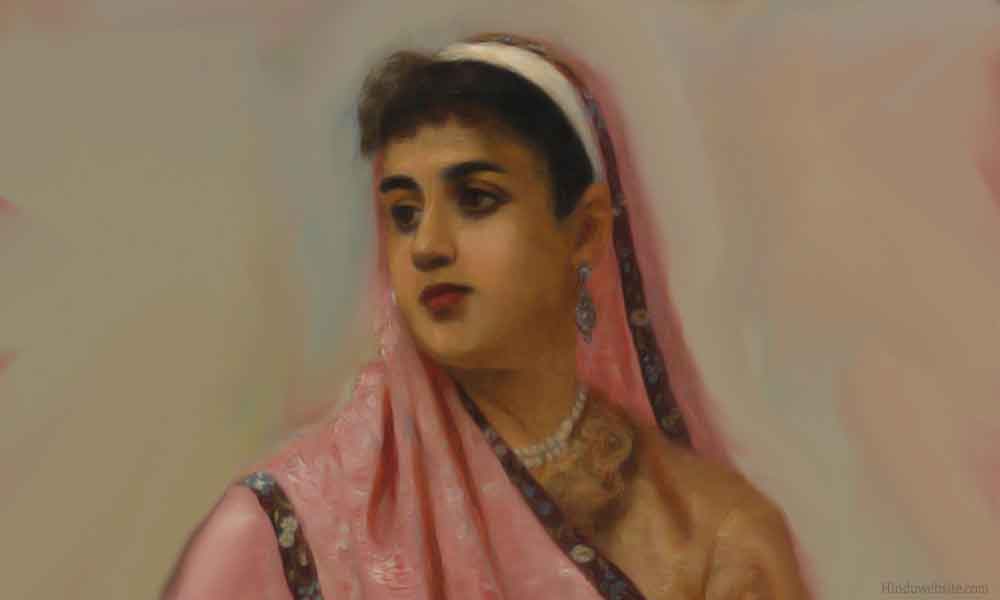
The Painting of a Parsi Woman by Raja Ravi Varma - Modified for Hinduwebsite.com
Zoroastrian religion does not discriminate between men and women. Leaving aside the differences with regard to religious observances and role responsibilities, both the sexes are treated equally in the religious texts. Unlike in the Vedic religion there is no preferential treatment for male children. There is no such argument that male children are necessary for the deliverance of parents into the ancestral world.
The initiation ceremony, Naujot is performed for both male and female children. Of the six Immortal Beings created by God, three are feminine and three are masculine. According to the Bundhahisn, "the sky, metal, wind, and fire are male, and are never otherwise; the water, earth, plants, and fish are female, and are never otherwise; the remaining creation consists of male and female." Both men and women have equal importance in protecting the sanctity and divinity of the world. Children are advised to honor both mother and father equally.
Creation of Man and Woman
According to the Zoroastrian theories of creation, both men and women originated from the seed of Gayomard, the primeval man. When he was attacked by the evil forces, before passing away, he gave forth seed. The seed developed into Matro (Mashye) and Matroyao (Mashyane). They grew up from the earth like a plant united below the waist, whereby it was difficult to know who was male who was female. Ahura Mazda separated them from each other and changed them from plant into the shape of man. To them He said, "You are man, you are the ancestry of the world, and you are created perfect in devotion by me; perform devotedly the duty of the law, think good thoughts, speak good words, do good deeds, and worship no demons!" After receiving instructions from God they decided to follow His commandments. However soon they were attacked by the evil forces and their minds were corrupted. The Bundhahishn narrates the subsequent events in the following manner.
17. Owing to the gracelessness which they practiced, the demons became more oppressive, and they themselves carried on unnatural malice between themselves; they advanced one against the other, and smote and tore their hair and cheeks.
18. Then the demons shouted out of the darkness thus: 'You are man; worship the demon! so that your demon of malice may repose.'
19. Mashye went forth and milked a cow's milk, and poured it out towards the northern quarter; through that the demons became more powerful, and owing to them they both became so dry-backed that in fifty winters they had no desire for intercourse, and though they had had intercourse they would have had no children.
20. And on the completion of fifty years the source of desire arose, first in Mashye and then in Mashyane, for Mashye said to Mashyane thus: 'When I see thy shame my desires arise.' Then Mashyane spoke thus: 'Brother Mashye! when I see thy great desire I am also agitated.'
21. Afterwards, it became their mutual wish that the satisfaction of their desires should be accomplished, as they reflected thus: 'Our duty even for those fifty years was this.'
22. From them was born in nine months a pair, male and female; and owing to tenderness for offspring the mother devoured one, and the father one. 23. And, afterwards, Ohrmazd took tenderness for offspring away from them, so that one may nourish a child, and the child may remain.
Code of conduct for women
Zoroastrian scriptures suggest that women are prone to the temptations of evil and therefore should be kept under regular watch. Women are expected to follow the example of Spenta Aramaiti and cultivate the qualities of love, devotion, sincerity and perfection. According to Arda Viraf, women who are desirous of going to heaven should honor water, fire, earth, trees, cattle and sheep and all the good creations of God. They should perform the religious ceremonies sincerely and offer prayers and service to God and the spiritual beings. They should show reverence and obedience to their husbands and lords and should practice the faith of Mazdayasnians without doubt. They should practice good thoughts, good words and good actions and abstain from sin. Adultery and unnatural intercourse are regarded as sins of heinous kind.
The Denkard classifies women on the basis of their conduct into four classes: "good as well as bad; not bad, and good; not good, and bad; and neither good nor bad. From among these any woman who is not bad and is good should be selected to manage household affairs and to give happiness and comfort to the master of the house. And to keep oneself free from unhappiness she who is good and bad ought not to be obtained; and (men) should positively keep aloof from choosing, from among the two descriptions of women mentioned above, her who is not good and is bad, over her who is neither good nor bad."
The Meno-i-Khard describes the best of women as "The woman who is young, who is properly disposed, who is faithful, who is respected, who is good-natured, who enlivens the house, whose modesty and awe are virtuous, a friend of her own father and elders, husband and guardian, handsome and replete with animation is chief over the women who are her own associates."
On Treating One's Wife
In Book5, Chapter 18 of the same text, we come across the following instruction on how to treat married women by their husbands.
- The wife of one's choice who is tied by a marriage ceremony should always be treated with affection and without niggardliness.
- One should strive to increase progeny by going to her
- She should be made a sharer in the good gained from righteous deeds.
- A maiden wife should be given good dowry. And a wife who was previously widow should be given lesser dowry.
- One should maintain physical intimacy and have sexual intercourse with her several times. No limit is prescribed, but thrice a month is considered reasonable.
- As far as possible both men and women should avoid second spouse. Such an act is not considered meritorius.
Advise during Menstruation
Menstruation and childbirth are viewed as a major sources of pollution in Zoroasrianism. Women are advised to maintain seclusion and avoid contact with everything. According to the Vendidad, Ahura Mazda himself gave the following instruction to women as to the question of what they should do at the time of menstruation. He answered that menstruating women "shall clear the way of the wood there, both plants and trees; they shall strew dry dust on the ground; and they shall isolate a half, or a third, or a fourth, or a fifth part of the house, lest her look should fall upon the fire.'
As to the question of how much distance they should maintain with things and people, he replied that they should stay "'Fifteen paces from the fire, fifteen paces from the water, fifteen paces from the consecrated bundles of Baresma and three paces from the faithful. The women who bring food to such women should maintain a distance of three paces. The food and drink should be brought to them in vessels of brass or lead or any metal. If a child touches them during this period, his body and hands should be washed.
He also prescribed in the same text the number of day they should remain in seclusion depending upon how long the condition prevailed. Severe penalties have been prescribed in the text for men who touch women during this period. Having intercourse with menstruating women used to attract severe penalties in the ancient world. In the Arda Viraf there is a description of a man suffering from an agonizing punishment in hell for such a sin. The Vendidad ascribes the following instruction to Ahura Mazda Himself, "Whosoever shall lie in sexual intercourse with a woman who has the whites or sees blood does no better deed than as if he should burn the corpse of his own son, born of his own body and dead of naeza, and drop its fat into the fire."
Laws of Inheritance
The following laws of inheritance are mentioned in Dadestan-i Denig (Ch.62).
1. As to the sixty-first question and reply, that which you ask is thus: How stand the shares in the inheritance (mirato) of property among those of the good religion, and how is it necessary for them to stand therein?
2. The reply is this, that in the possession of wealth the wealth reaches higher or lower, just like water when it goes in a stream on a declivity, but when the passage shall be closed at the bottom it goes back on the running water (puy-avo), and then it does not go to its after-course.
3. When there is nothing otherwise in the will and private, property goes to a wife or daughter who is privileged; if one gives her anything by will then she does not obtain the share (dash) pertaining to her.
4. Whenever a share for a son is not provided by it, every one has so much and the wife who may be a privileged one has twice as much; and the share of that one of the sons, or even the wife of a son, who is blind in both eyes, or crippled in both feet, or maimed in both his hands, is twice as much as that of one who is sound.
5. And it is needful that he who was in the father's guardianship shall remain in guardianship, as when a father or mother is decrepit and causing awe (chagarin), or of a nurture different from that of the guardian -- or a child of his brother or sister, or a father, or one without nurture apart from him, is without a guardian -- the ready guardianship of a capable man, and the shelter and nourishment that have become inadequate are as indispensably forthcoming from the possessors of wealth, of those who have taken the property, as that taking was indispensable.
6. If there be no son of that man, but there be a daughter or wife of his, and if some of the affairs of the man are such as render a woman not suitable for the guardianship, it is necessary to appoint a family guardian; if there be, moreover, no wife or daughter of his it is necessary to appoint an adopted son.
Marriages
Zoroastrian scriptures prohibit inter religious marriages (Denkard Bk.3). Followers are urged to marry within the religion to ensure the practice of righteousness without any complications. The texts suggest to select women who are wise and modest and firmly anchored in the religion. As for the son-in-laws they should be good natured, honest and experienced, even though they may be poor (Counsels of Adarbad Mahraspandan).
Suggestions for Further Reading
- Zoroastrianism, Life After Death And The Nature of Heaven and Hell
- Zoroastrianism, The Battle Between Good and Evil
- Ahura Mazda Or Ohrmazd, the Zoroastrian God
- Amesha Spentas or Ameshaspands
- Asha, The Zoroastrian Concept of Truth and Universal Order
- Important Beliefs of Zoroastrianism
- The Old Iranian Calendars, Part 1
- Zoroastrianism - Main Concepts
- Zoroastrianism, Cosmogony Or Theories of Creation
- The Zoroastrian Cosmology
- Zoroastrinaism - The Zoroastrian Creed - An Overview
- Zoroastrianism - Genesis and Zoroastrian Calendar
- Zoroastrianism - Overview Of The Zoroastrian Doctrine
- Untitled 1
- Zoroastrianism - Important Zoroastrian or Parsi Festivals
- Funeral Ceremonies, Death and Disposal Of The Dead in Zoroastrianism
- Zoroastrianism - The Funeral Ceremonies of the Parsees, Part 1
- Gender Equality and Status Of Women In Zoroastrianism
- Zoroastrianism, On Good and Bad Religions
- The History of Zoroastrianism
- Asuras and Daevas the Indo Iranian Connection
- Zoroastrianism Links, Resources and Websites
- The Sacred Literature Of Zoroastrianism
- An Overview Of Zoroastrian Religion
- Important Practices of Zoroastrian Religion
- Zoroastrian Priests
- The Nature of Sin, Types of Sin and Expiation of Sin
- Space And Time In Zoroastrianism
- Life and works of Zarathushtra
- Zoroastrianism Main Beliefs
- Zarathushtra - Zoroaster
- Zoroastrianism, Zoroastrian, Links and Web Resources
- Zoroaster, Zarathushtra, Zarathustra
- Essays On Dharma
- Esoteric Mystic Hinduism
- Introduction to Hinduism
- Hindu Way of Life
- Essays On Karma
- Hindu Rites and Rituals
- The Origin of The Sanskrit Language
- Symbolism in Hinduism
- Essays on The Upanishads
- Concepts of Hinduism
- Essays on Atman
- Hindu Festivals
- Spiritual Practice
- Right Living
- Yoga of Sorrow
- Happiness
- Mental Health
- Concepts of Buddhism
- General Essays