
The Religion of the Indus Valley Civilization
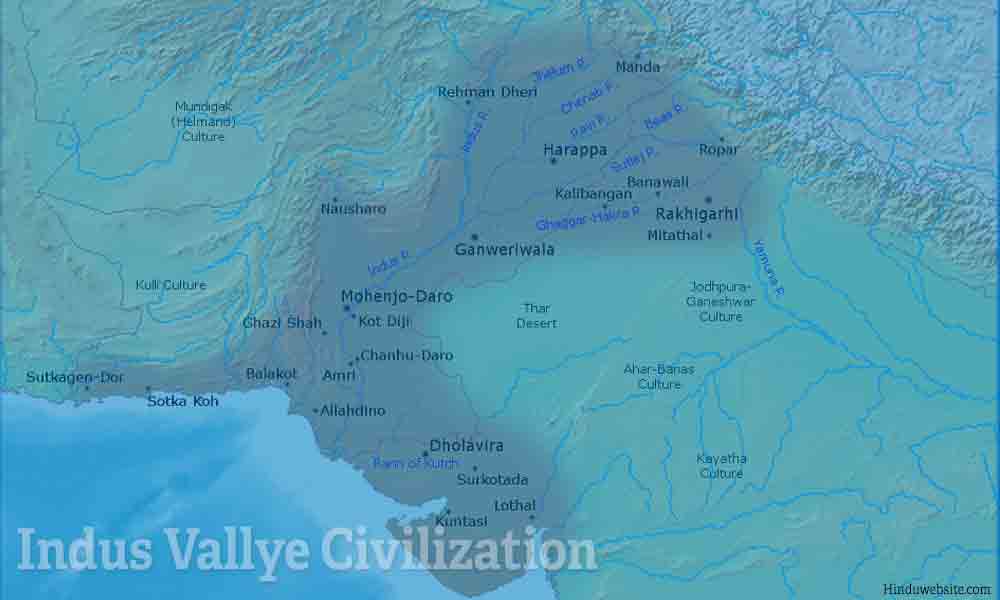
The Geographical Area of Indus Valley Civilization in its Mature Phase
We have very little information about the religious life of the Indus valley people. During it's hey days the Indus valley civilization covered an area in the Indian subcontinent that was larger than the present day Europe. The civilization flourished roughly between 3500 BC and 2000 BC, with its antecedents dating as far back as 7000 -6000 BC during the Neolithic period.
The Indus valley civilization was essentially an urban civilization, characterized by well planned cities, built according to the needs of the people who inhabited them and the geographical and climatic challenges they faced. They built high rise structures, knew agriculture, pottery and metallurgy, familiar with drainage and water supply systems and traded with other peoples by navigating in boats along the river routes and also probably across the seas.
 The discovery of Indus valley civilization brought the Indian subcontinent
into limelight as home to one of the most ancient human civilizations
and gave scope to many scholars to present an argument that the
Indian subcontinent, as a land of racial, ethnic and linguistic
diversity from time immemorial and as a land that stood in the way
of waves of migrating prehistoric nomads and adventurers of stone
age, might be the cradle of human civilization. While it is true
that the Harappn and Mohenjodaro cities might have flourished around
3000 BC, the fact that they were well planned cities lends credence
to the argument that the urban planning and the level of sophistication
that went into its execution, could not have been possible without
corresponding development in various fields spread over a period
of several centuries. It is debatable whether the technology and
the knowledge that went into the construction of such great cities
was wholly indigenous or foreign. Some aspects of our knowledge
of base numbers, metallurgy, astrology and some elements of Hinduism,
yoga and others schools of philosophy might have been part of the
legacy left by this great and mysterious civilization, about which
we presently know so little.
The discovery of Indus valley civilization brought the Indian subcontinent
into limelight as home to one of the most ancient human civilizations
and gave scope to many scholars to present an argument that the
Indian subcontinent, as a land of racial, ethnic and linguistic
diversity from time immemorial and as a land that stood in the way
of waves of migrating prehistoric nomads and adventurers of stone
age, might be the cradle of human civilization. While it is true
that the Harappn and Mohenjodaro cities might have flourished around
3000 BC, the fact that they were well planned cities lends credence
to the argument that the urban planning and the level of sophistication
that went into its execution, could not have been possible without
corresponding development in various fields spread over a period
of several centuries. It is debatable whether the technology and
the knowledge that went into the construction of such great cities
was wholly indigenous or foreign. Some aspects of our knowledge
of base numbers, metallurgy, astrology and some elements of Hinduism,
yoga and others schools of philosophy might have been part of the
legacy left by this great and mysterious civilization, about which
we presently know so little.
The Indus valley civilization is now increasingly referred to as Sindhu Saraswathi Civilization. This is based on the consensus opinion among many Indologists that the Indus valley civilization was probably part of Vedic civilization or not much different from it, an idea that also confronts and repudiates the classical Aryan invasion theory in support of the hypothesis that both the Indus and Vedic cultures were established by indigenous people, some of whom might have even migrated to areas outside the Indian subcontinent and played their role in the development of independent civilizations as far away as Greece and Europe.
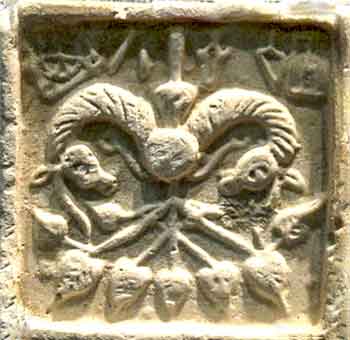
Whatever may be the truth, the Indus people built a vast civilization that disappeared mysteriously by 1800 BC and was replaced by Vedic culture in parts of India. They had knowledge of a written script which is yet to be deciphered and which they used in their seals. About 500 such seals were found at various Indus sites. We do not know for what specific purpose they were used. It is possible that the Indus people might have used them to mark their merchandise, as emblems of authority or as tokens of commercial contracts. The seals, along with other artifacts such as stone statues and terracotta figures, provide some clues about the religious beliefs of the Indus people based on which we can draw the following conclusions.
Major Religious Beliefs of the Indus People
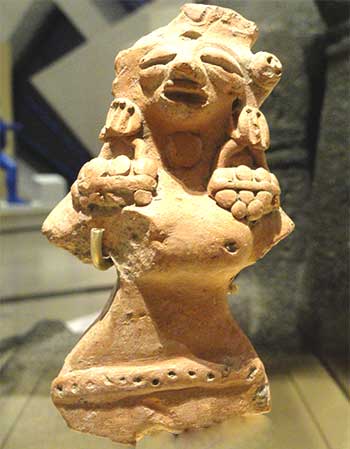 1. The Indus people probably worshipped Mother Goddess, in addition
to male and female deities.
1. The Indus people probably worshipped Mother Goddess, in addition
to male and female deities.
2. They worshipped a father God who
might be a progenitor of the race and probably was a prototype of
Siva as the Lord of the Animals.
3. They were familiar with some
form of yoga and meditation.
4. They believed in some kind of
a tree of life, which is depicted in the seals as a Pipal or Acacia
tree, defended by a guardian spirit against an evil force symbolized
as a tiger. In seals, the guardian spirit is depicted variously
as a bull, a snake, a goat, a mythical creature or animal.
5.
They worshipped fertility symbols such as round stones and pierced
stones, a practice that probably preceded the worship of Siva and
Parvathi in the form Sivalinga.
6. They might have also believed
in magical rituals, charms and amulets, and so also in spirits and
demons.
7. They mostly cremated the dead along with some objects
as offerings for use in their after lives.
8. The great bath
of Mohenjo-Daro, or the much larger one found recently at the Dholavira
site in Kutch, was probably a prototype Kovil or sacred tank which
are found in the ancient temples of southern India, where people
might have taken purification baths or participated collectively
in some kind of ritual baths on important occasions.
9. Going by the number of animals in the Indus seals and the presence of baths suggest that they might have used water and animals in sacrificial rituals as offerings or for expiation and ritual cleansing.
10. If we accept that the Vedic people had some historic affinity with the Indus Valley Civilization which some believe to be true, it lends credence to the possibility that Indus people might have practiced some rudimentary or even elaborate forms of sacrificial ceremonies to propitiate their gods. Since they had the knowledge of brick making and geometric designs, they might have used it to build sacrificial altars. However, so far no sacrificial altars or pits were found in the excavations at the Indus Valley sites.
Who were the Indus People?
According to some historians the Indus people were probably Dravidians, who lived in ancient times in parts of north western India, Afghanistan, parts of the Mediterranean, Central Asia and Europe. According to another view, the Indus people were probably Aryans, whose civilization was a precursor to the Vedic civilization that was established in India by a subsequent wave of Vedic Aryans. According to some they were Sumerians. Some historians also suggested that the people of Indus valley probably shared an affinity with the ancient Egyptians and other African cultures. According to Professor Spyridon Marinatos, the Indus civilization was probably similar to that of ancient Greece. Both worshipped Mother Goddess and the Bull played an important role in their religious lives. Based on the skeletal studies, some have reached the conclusion that the Indus people represented a mixture of different racial groups ranging from the Mediterranean type to the Australoid and the Mongoloid, while a majority of them were similar in features to the Dravidians of southern India. The finding of some Indus type seals at other sites outside the Indian subcontinent, such as Ur, Kish, Tell Asmar, Umma, Lagash, Susa etc., suggest that the Indus people maintained contact with many cultures in Western Asia, including the people of Israel and probably there was an exchange of merchandise, ideas, beliefs and also people.
Connection with Hinduism
Hinduism richly derived its current knowledge not only from major sectarian traditions of India such as Brahmanism, Shaivism and Vaishnavism but also from many rural and tribal traditions that were prevalent in various parts of the Indian subcontinent since the earliest times. We do not know which beliefs and practices or the religious traditions of the Indus Valley Civilization found their way into present day Hinduism. Some historians question whether the religion of the Indus Valley people can be categorized at all as the earliest known aspect of Hinduism. They would prefer to begin with Vedism or Shaivism.
In doing so, they miss an important and unmistakable point regarding the very identity and definition of Hinduism and how it emerged as a major world religion. The truth is by historic as well as legal definition Hinduism represents all the native faiths that originated in India, except Buddhism, Jainism and Sikhism. Going by this definition, whatever faith or religion the Indus people practiced automatically falls under purview of Hinduism, and thereby becomes the earliest known, historic aspect or tradition of Hinduism or Sanatana Dharma.
The Dravidian Connection With Ur or "Uru"
Currently, people who speak Dravidian languages, namely Telugu, Tamil, Kannada and Malayalam are located in south India. It is believed that these languages originated independent of Sanskrit, which is believed to be the offshoot of the same stock of languages that gave birth to Greek, Latin, German, French, Russian, English and other Indo-European languages. It is believed that at some time the Dravidians lived on the northern fringes of the Indian subcontinent, before they moved deeper into the southern and the eastern territories for reasons unknown. It is interesting to note that the generic name for a town or a city or a near by village in some Dravidian languages such as Telugu and Tamil is "ur" or "uru", which sounds similar to the name "Ur," the first known urban settlement in human history, which was found in Mesopotamia.
When someone is travelling to another place, people may say, "He is going to a 'ur' or 'uru.'" If they do not know where he is going and want to know, they may ask "which 'ur' are you going?" Hundreds and perhaps thousands of place names in the southern states of India also end with the suffix "ur" or "uru" such as Bangalore (pronounced as Bangalur), Mysore, Belur or Tanjore (pronounced as Tanjaur) or Chittoor (pronounced as Chittur). Closely related to it is the word "pur" or "pura" meaning a town or city, as in Singapore (originally pronounced as Singapur or Singapura) or Tripura. It is difficult to accept that this could be a mere coincidence. This is an interesting subject, which is worth investigating and perhaps requires a detailed academic research.
Suggestions for Further Reading
- Hinduism, ancient history
- The Alternate History of Mohenjodaro, the Movie
- History of Hinduism, medieval period
- Hinduism, modern history
- Battle over history
- The Aryan invasion
- Atheism in ancient India
- The Bravery of Ancient Indians
- Religious Tolerance in Ancient India
- The biggest holocaust in world history
- A brief history of Afghanistan
- Historians and Indian history
- The Arthashastra of Kautilya
- Megasthanese's Indica or Indika
- The Rise of Shaivism
- Essays On Dharma
- Esoteric Mystic Hinduism
- Introduction to Hinduism
- Hindu Way of Life
- Essays On Karma
- Hindu Rites and Rituals
- The Origin of The Sanskrit Language
- Symbolism in Hinduism
- Essays on The Upanishads
- Concepts of Hinduism
- Essays on Atman
- Hindu Festivals
- Spiritual Practice
- Right Living
- Yoga of Sorrow
- Happiness
- Mental Health
- Concepts of Buddhism
- General Essays
The Indus valley images in this article are made available under the Creative Commons CC0 1.0 Universal Public Domain Dedication