The Coming Age of Darkness: Evil's Evolutionary Advantage in Kaliyuga
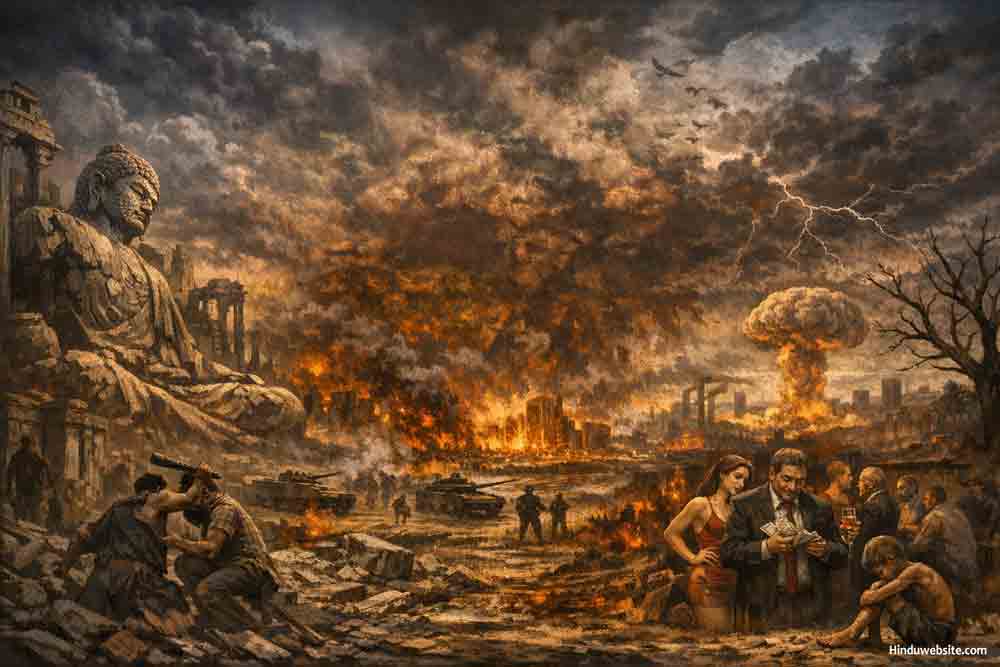
Summary: If creation follows mechanistic evolution without divine moral guidance, Nature promotes survival traits like aggression, deception, and ruthlessness over compassion and morality. Natural selection favors the strongest and most adaptable, not the kindest or most ethical. As traditional family and societal institutions decline, Nature's agenda reasserts dominance, unleashing competitive brutality. Current signs, rising crime, declining religious values, glorification of criminals in media, indicate humanity's trajectory toward an asura-dominated age unless spiritual wisdom prevails over survival instincts through conscious choice and sacrifice.
Note: To understand this article, you may need basic knowledge of Darwin's theory of evolution, the process of Natural selection and the Hindu concept of Nature or Prakriti, which is explained below in the prologue. Kali Yuga is believed to be the age of darkness when evil ascends before the final destruction. I have also explained its core characteristics.
Prologue: Nature is the Mother. We call her Prakriti, Shakti, Devi, the Divine Source from which the worlds arise. And yet she is a dependent power: she functions by God’s intelligence and proceeds by laws already laid down in the order of things. In Samkhya, she appears as an immense automaton, as if a giant intelligence, ceaselessly manifesting what lies hidden in a set of causes. Therefore, the scientific language used here is not offered as science, but as a bridge for intuition, a way to sense correspondences and patterns in the play of creation.
Core Characteristics of Kali Yuga
From scriptures like Vishnu Purana, Bhagavata Purana, Kalki Purana, we understand that the following developments manifest in the fourth and final epoch of Kaliyuga
- Truth becomes rare
- Leaders become corrupt and self-serving
- Violence and deception rise
- Family structures weaken
- Spirituality becomes ritualistic or commercialized
- People value wealth, power, and pleasure over virtue
- Good people feel isolated or endangered
This article echoes many of these classical themes , especially the idea that Nature’s survival instincts overpower humanity’s higher nature, leading to an asura-like age.
Points to ponder
- Your excellent character will manifest in you when you transcend selfishness.
- Evil is on the rise and will continue to rise if unchecked.
- Your hidden Self will not reveal itself to you until you understand your divine Nature.
- We are humans only when we have humanity.
- Humans must rise above Nature to rise above the Earth and reach the stars.
Let us agree with the atheists, for argument’s sake, that there is no Creator, or, as some Hindu traditions believe, even if He exists, He may not actively participate in creation but remain a passive Witness.
Let us also go with the scientists and accept the theory that life evolved upon Earth, and that natural selection creates the evolutionary pressure upon living forms, forcing them to adapt to their environment and ensuring the survival of the fittest.
Let us also accept that Nature derives its diversity through genetic mutations and relies on natural selection to ensure that the most able, suitable, and adaptable among them further its agenda.
Nature as the Natural Terminator
From science, we also learn that Nature is an open-ended mechanical system that makes use of physical, chemical, and biological processes and creates life through trial and error.
In other words, if you combine oxygen with hydrogen, there will be water. If you drop some organic molecules into it, then eventually, by a random process, they are concocted into protein molecules, peptides, nucleotides, and DNA, resulting in the emergence of life.
Even the Samkhyas, those ancient Indian philosophers who looked at creation in terms of numbers and practiced yoga to subdue Nature, held similar beliefs. They postulated that Nature was an automaton that produced nothing new. All effects were hidden in their causes, ready to manifest when favorable circumstances arose. When the causes were activated by some force, their effects manifested spontaneously, just as seeds germinate when ideal conditions arise.
Thus, life, though seemingly random, acts like a mathematical formula unraveling itself, as many known and unknown conditions and processes conspire to ensure its progression and continuity. Everything that happens in this world is precipitated by causes that may not be predictable, but can be traceable and identifiable. If this were untrue, humanity would not have progressed this far or succeeded in establishing a great civilization.
According to the theory of evolution, once forms are created, Nature leaves it to them to compete with others and prove their worthiness to thrive in a harsh environment, using various skills of survival and self-preservation.
Those who adapt well to their environment and solve their problems effectively will succeed and survive. Those who fail will eventually perish, like the millions of species that appeared on Earth and vanished without a trace.
Using natural selection as a tool, Nature ensures not only the survival of its fittest creations, but also the survival of the best within each able group.
Thus, some form of transformation and evolution happens both at the level of the species and at the individual level within each species.
The stronger ones dominate, while the weaker ones submit. The stronger ones corner resources and make themselves still stronger and more formidable. The weaker ones survive if they align their interests with those of the strong and serve them, and they disappear if they fail to adapt and improve.
If we accept that Nature is the source of all creation, and that it achieves its goals mechanically according to certain preexisting universal laws of physics, chemistry, and biology, then upon further introspection we will reach an inescapable observation: the future of humanity may not be that pleasant, nor offer enough reasons to celebrate. Here is why.
The Four Unmistakable Truths of Life
1. Nature promotes strength and dominance. If Nature has its way, it chooses those who are fit to survive, those who are more chameleon-like or snake-like than deer- or rabbit-like. What it means is that it promotes pure strength, brute power, shrewdness, exceptional problem-solving skills, viciousness, anger, aggression, dominance, intimidation, deception, competitiveness, ruthlessness, selfishness, self-interest, self-preservation, violence, distrust, and similar qualities. The history of our planet shows that these are the most cherished qualities of survival. These are the qualities that ensure the survival of individuals through famines, pestilence, and economic scarcity. Those who do not fulfill these conditions may end up either as food for the dominant species or as a resource, an accessory, or both.
2. Nature does not give much weight to love, morality, or compassion. There is a lot of truth in the saying that nice people finish last. From the theory of natural selection, we learn that morality is not in Nature’s agenda, except as a strategy. Nature does not promote gentle qualities such as altruistic love or compassion because, from the perspective of survival, such qualities are the least helpful. Promoting morality or humanity is not Nature’s aim; promoting strength, aggression, and dominance is. Nature does not promote good people, but people endowed with the best survival and problem-solving skills, people for whom morality is not as important as surviving and succeeding. From Nature’s perspective, a species may use good behavior (as in the case of a dog), or cooperative and collective effort, as a strategy for survival rather than as a moral or social issue. In other words, Nature expects that you do not do good for goodness’ sake or join hands with others for altruistic reasons, but to improve your chances of survival and earn the approval and trust of others. In Nature’s agenda, you have to use your goodness as a survival tactic, or as part of your strategy, to create the impression that you are trustworthy, dependable, and acceptable, whereas, in truth, your agenda may be to beat everyone in the game and corner all the good things in life, while keeping a close eye on your enemies and competitors. Thus, from Nature’s perspective, conforming to social norms or winning the approval of others is a good strategy, whereas going against society, or standing out in a crowd, is supported only if you have the strength and ability.
3. Nature favors the indiscriminate use of intelligence in survival. According to the principles of natural selection, Nature creates intelligence not because it wants to promote wisdom and understanding, but because it wants species to develop problem-solving skills and resolve their problems by all means, whether those means are morally correct, socially acceptable, or not. In other words, those who use their knowledge and intelligence solely to solve their problems, with flexibility and without being burdened by social and moral concerns, stand a better chance of resolving their problems, reaching their goals, and surviving the competition. Nature perfects the art of deception among species. It has no issues or moral dilemmas about crooks, scammers, shrewd people, street-smart types, cheaters, deceivers, and the like who misuse their intelligence, since they fit perfectly into its agenda and play the game of survival better than those who disobey its laws and try to remain honest, righteous, straightforward, and truthful.
4. Nature overtakes whenever traditional institutions of family and society decline. Early in the growth of human civilization, our ancestors understood the harsh realities of life and the need for balance and order in society. Therefore, they devised laws (dharma) to govern human conduct and protect the weak from the strong, and they established the institutions of family and society to protect individuals from the brutality of Nature and the evils inherent in our existence. So long as these institutions remain strong, you can expect order and regularity (rta) in the world. However, when they become weak or lose their hold upon people, Nature springs back into action and manifests its agenda fully. Of late, we have lost sight of our traditional moral values. The institutions of family and society have also suffered a great decline. Thus, today there is no moral compass. There are no institutions to train people, from an early age, in the virtues of morality. In recent times, some governments have tried to venture into these areas and replace them by dictating policy. These experiments are bound to fail because governments are largely controlled by Nature’s preferred children, and their primary goal is to remain in power and control resources rather than help common people from an altruistic motive. Governments promote the fittest with the help of the weakest. That is the sad truth.
Why things are deteriorating?
These four points should make it abundantly clear, by now, why it is such a constant struggle for us to live in this world and face numerous problems, not only from the elements, but also from our own kind.
We actually live in a dog-eat-dog world. The community in which you live, the people you see in the streets and in public places, are not actually your friends or well-wishers. To them, you are a total stranger who fits into one of their stereotypes, based on your looks or your accent. Your welfare is the least of their problems.
The government that controls you is interested in regulating your life and making you subservient to its agenda, rather than truly helping you.
Your friends are not your true friends. Your relations are not your true relations. You cannot really trust any stranger. Nowadays, you cannot even stand safely on a railway platform, because someone may push you from behind onto the track, just for fun, or because they do not like your looks or your religion.
You cannot travel safely to many places in the world because there are rapists, cheaters, pickpockets, and kidnappers.
These things are happening because people are gradually bartering away their humanity and morality to ensure their survival, thereby coming increasingly under the influence of survival instincts promoted by Nature. In their anxiety to secure their lives, most people have lost their only protection against Nature: their humanity and their essential good nature.
A dispassionate observer will not fail to notice that Nature is winning and humanity is losing. We might have destroyed all the ancient forests in the world, but we are unable to do away with the forest that thrives in our minds. As a species, we have lost the high moral ground. In our struggle for survival, we have failed to transcend Nature and manifest the qualities of our higher nature, altruism, humanity, and spirituality. To ensure our survival, we have plundered the earth and destroyed many aspects of Nature, but not the seed of self-destruction that is deeply ingrained in us.
We could have been the guardian angels of this earth and of the entire solar system, protecting all life forms, since life is precious, and we have yet to detect any life on any planet we know.
Instead, we chose to follow the path of least resistance.
With the wealth we have, we could have eliminated poverty and built large spaceships to explore the universe. Instead, we chose to spend a vast portion of our wealth building nuclear missiles, massive weapon systems, and large armies, thus playing out Nature’s agenda that a species is secure only when it is strong.
The signs of darkness
We are clearly heading toward a dark future. We are probably on the verge of entering a great age of asuras, if we have not entered it already. From now on, asuras will rule the earth. They will dominate every sphere of our lives, including our religions. They will be our spiritual, political, and economic leaders. They will shape our destinies and control our lives. They will dominate our thinking, ideologies, and philosophies. The norms of asuras (asura niti) will become the universal norm. This will be the twilight age of humankind, in which darkness will be mixed with light until light slowly fades away, leaving only darkness.
Here are a few indications of this.
- An increasing number of people are indulging in the most heinous crimes.
- Most people do not care whether their actions and decisions impact the lives of other people.
- Present-day leaders are mostly interested in their power and position rather than in the welfare of the people. Most of them live and act by survival instinct and excel in the art of deception and duplicity. So it is with sportspeople who cheat, celebrities who lead double lives, and smart media types who manipulate us with false propaganda and selective reporting.
- Most of the successful business organizations and the multinationals today are managed and dominated by Nature's corporate stereotypes, who excel in the game of survival. They silence their hearts and rule with their minds. They are ruthless and relentless in the game of winning. For them, winning and succeeding by all means alone matter. They do not care whether you are creative or talented, unless you fit into their culture of leadership and get along with their mission and values.
- There is a gradual and overall decline of religious and moral values. Religious people are increasingly judged as prejudiced, chauvinistic, narrow-minded, repressed, communal, or even dangerous.
The coming age of darkness - the rise of a new Atlantis
Envision a world with triple today’s population and one-third of today’s resources. Imagine the extent of competition it will trigger, the number of wars it will unleash, and the destabilization it may cause.
Imagine how intense and competitive life is going to be in the coming years and decades.
The world population today is over seven billion. In 1900, it was about 1.5 billion. This means that, in a hundred years, the population rose by more than four times. At the same rate, the population should be over 25 billion by the beginning of the next century. However, current projections show that growth may slow down, and the world population will be around 12–15 billion by that time.
Whatever the actual numbers may be, population growth will coincide with a great depletion of natural resources. What it means is that more people will have to compete for fewer and fewer resources, including food and other essential commodities.
This in itself can unleash a very dangerous and high-stakes game of survival and competition not only among individuals but also among nations and vested groups.
Today, in some countries like India, if a student earns less than 90% average marks in an examination, it is very difficult for her to secure admission into a good college or university. Imagine what will happen when the world population goes up to 12 billion or more, and the average cutoff marks are going to be about 98%.
If Nature prevails and humanity fails to rise above its agenda, we can expect the following to happen, though not with 100% certainty (because who can predict the future with 100% certainty?).
Nature will bring out the worst in humanity People will ruthlessly try to outwit each other to survive and succeed. A majority of people will increasingly become aggressive, brutal, and violent, and use their knowledge and intelligence to survive and succeed against all odds. Religions will become weak and lose their hold. They may even become tools in the hands of the selfish and the fraudulent. There will be clamor for releasing criminals and passing laws to show leniency for certain crimes. The traditional institution of marriage will be broadened to include other forms of marriage. Families will become less significant as people seek freedom through non-binding relationships. Good people become an endangered species as they fail to compete effectively. Leaders will perfect their art of survival and deception. The world will witness an intense power struggle among various nations competing for limited resources.
Conclusion
We have a higher nature. It is the only way by which we can rise above Nature and stay clear of its aims. Through spirituality, we can rise above selfishness and show our humanity. It is the best way to bring order and regularity to our lives and to the world in which we live. The eternal tradition, known as Hinduism, is difficult to practice because it emphatically declares that if you live selfishly for yourself, you become an asura (demon). If you live selflessly to uphold creation and the order and regularity of life, you become a god, or a divine being.
Our people knew the designs of Nature. Our ancient seers, who lived amid forests and observed them closely, knew intuitively what Nature was up to. Therefore, they suggested that we should live our lives as a sacrifice.
If we live according to the ideals of Nature; if we weaken our family and social institutions; if we forget God; if we live solely for ourselves; if we loosen the hold of our collective wisdom upon our lives, then you now know what to expect from the world in which our children, and their children, are going to live. If Nature is our only recourse, and if we choose to promote decadence in the name of progress, this is the scenario that will eventually emerge upon earth.
If you have any doubts, please consider the following.
- Who are the role models for people today?
- Who appear mostly in the news stories?
- Who occupies the primetime news on the television channels?
- Why is the present world so obsessed with the lives of cheaters, liars, deceivers, rapists, criminal gangs, politicians with charisma and shrewdness (rather than intelligence and values), drug mafias, mentally insane, sexually perverted, and morally depraved human beings?
- Why do we make movies about them and then give them awards?
- Why are our literature, movies, and television serials mostly about the vicious and evil characters?
- Why are we glamorizing crime and criminals?
- Why do we want to protect the rights of criminals, but make light of religious people?
- Why do we give so much attention and even pay admiration to a terrorist, a cop killer, a child killer, a child molester, a rapist, an illegal immigrant who crosses the border with drugs, or an arsonist?
- When was the last time you heard about a person who lived righteously, believed in God, and tried to help others?
- When was the last time you really helped a good person to do more good?
Attribution: Image for this article created with AI