The Ten Gurus of Sikhism and Their Contribution
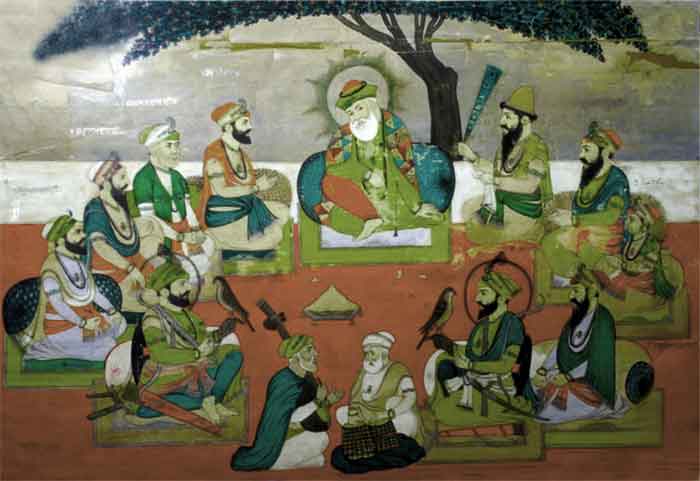
Summary: This page presents a structured historical overview of the ten Sikh Gurus and their profound contributions to the evolution of Sikhism . Beginning with Guru Nanak’s founding mission and universal spiritual message, the narrative traces the development of Sikh scripture, social reforms, community institutions, and the shaping of Sikh identity. Key milestones include Guru Angad’s creation of Gurmukhi, Guru Amardas’s establishment of langar, Guru Arjan’s compilation of the Adi Granth, Guru Har Gobind’s doctrine of miri‑piri, and Guru Gobind Singh’s formation of the Khalsa and finalization of the Guru Granth Sahib as the eternal Guru. The page highlights each Guru’s unique role in strengthening Sikh faith, culture, and resilience.
"India was once again blessed by God with Guru Nanak, possessed of all attributes of a prophet, a complete and perfect human being. Guru Nanak's appearance in the world was no less than that of Prophet Abraham 5000 years ago."
1. Guru Nanak (1469-1539): Compared to Buddhism and Jainism, Sikhism is of recent origin. It was founded by Guru Nanak, who was born at Talwandi in the Punjab in A.D. 1469. During his lifetime, he visited many sacred places in India, Central Asia, and the Middle East, including Mecca. He was well-versed in the scriptures of all the major religions, including Christianity and Judaism. He preached a liberal path, which is known today as Sikhism, that derived its inspiration mainly from Hinduism, but in many ways was a synthesis of both Islam and Hinduism. His teachings in the form of religious hymns are preserved in the Guru Granth Sahib, which is the sacred scripture of the Sikhs. Guru Nanak passed away in A.D.1538 and was followed by a succession of nine gurus whose names are mentioned below:
2. Guru Angad (1504-52). He is credited with the invention of Gurumukhi.
3. Guru Amardas (1552-74). It is said that he originally started the tradition of Langar, the social kitchen, to remove caste distinctions and establish social harmony among his followers.
4. Guru Ramdas (1574-81). He was the son-in-law of Guru Amardas. He founded the city of Ramdaspur, which is now known as Amritsar. The construction of Guru Harminder Sahib (the Golden Temple) began here during his time.
5. Guru Arjan (1581-1606). He was the youngest son of Guru Ramdas. He compiled the Adi Granth, which is the most important segment of the Guru Granth Sahib. He made Sikhism very popular during his lifetime and thereby attracted the attention of the Mughal Emperors.
6. Guru Har Gobind (1606-45). Son of Guru Arjan, he perfected the dress code introduced by his father and started the tradition of wearing two swords, one signifying his political (amiri) authority and the other his religious (Fakiri). He tried to organize the Sikhs and the Hindus against the Mughals, for which he had to face the wrath of the Mughal Emperor, Jehangir.
7. Guru Har Rai (1630-1661): He supported Dara Shukoh, the elder brother of Aurangzeb, in his conflict with the latter, and had to pay dearly for it. His son was held hostage by Aurangzeb, and Har Rai could not secure his release.
8. Guru Har Krishan (1661-64): He was the second son of Guru Har Rai, who succeeded his father at the age of five under unfortunate circumstances since his brother was taken away as a hostage by the Mughals. The Mughal Emperor also summoned him to Delhi, and he died shortly thereafter at the age of eight.
9. Guru Teg Bahadur (1675-1708): Though he was able to spread Sikhism to a greater degree, Sikhism also suffered from schism during his time. Aurangzeb executed him for his defiance of the Mughal authority. We are told that when he was in prison awaiting his execution, Guru Teg Bahadur predicted the coming of the Western powers to the Indian subcontinent and the downfall of the Mughals.
10. Guru Gobind Singh (1675-1708): He was the tenth and the last Guru and also the most famous after Guru Nanak. He was born in Patna. Because of the execution of his father, he became the Guru at the age of nine. He organized the Sikhs into the Khalsa to oppose the tyranny of the Mughals. He began the tradition of adding the suffix 'Singh' to the names of the Sikhs. He introduced the baptism of the sword, abolished the succession of the Gurus, and made the Guru Granth Sahib the symbol of the Guru himself. He spent most of his time opposing the Mughals, to whom he lost his two sons, and finally, he himself was assassinated by a Pathan at Nanded in the present-day Maharashtra. Swami Vivekananda called him rightly "the most glorious hero of our race."