
Om, Aum, Pranava or Nada in Mantra and Yoga Traditions
The syllable Om1, also known as Aum and Pranava, is the most sacred symbol of Hinduism, Buddhism, Jainism, Sikhism and Zoroastrianism. It is used both as a symbol and as a sound in religious worship, ritual chanting, performance of sacraments and rituals, yoga and tantra. In Hinduism it is venerated as Brāhman in the form of word (askshara) and sound (sabda).
In actual practice it is rarely chanted in isolation and mostly in association with other mantras, prayers, names of gods and goddesses, either as a suffix or a prefix, under the belief that doing so would enhance their potency, vibrancy, sanctity and purity. According to Mantrayoga Samhita, Om by itself has no potency if it is chanted by someone who has not been initiated on the spiritual path by a guru. It remains ineffective as a vehicle of self-realization, unless it is personally imparted by an enlightened master (guru) to an initiate as a part of a seed (bija) mantra. A similar view is held by some modern sects like the Rahdasaomi Satsang. The Taittirya Samhita describes its use and significance in the Vedic rituals in the following manner:
"Aum is Brāhman. Aum is all. Aum, this verily, is compliance. on uttering, 'recite', they recite. With Aum, they sing the saman chants. With Aum, som, they recite the prayers. With Aum the Advaryu priest utters the response. With Aum one assents to the offering to fire. Withy Aum a Brāhmana begins to recite, may I obtain Brāhman; thus wishing, Brāhman, verily, does he obtains."
The origin of Om or Aum
There are many theories regarding the origin of the syllable Om. Max Mueller proposed that it might have been derived from an ancient word "Avam", which was used in prehistoric times in the sense of "that" to refer to distant objects. According to Swami Sankarananda, the word might have been derived from "Soma", the name of an important deity who is mentioned in the Vedas frequently and with whom many esoteric rituals are associated. The word is also linked to the sound of breath and a subtle and high potency universal vibration which can be heard internally in the subtle planes as a deep sound (pranava nada) by the adepts all the time. It is possible that the word might have been integrated into Vedic religion from some ascetic tradition of ancient India. The Chandogya Upanishad narrates how the syllable Aum issued forth from Brahma as he brooded upon the worlds he created in the initial stages of creation. From his brooding first emerged the threefold knowledge (trayi vidya) and then the syllables bhur, bhuvah and suvah. When he brooded upon them (bhur, bhuvah and suvah), the syllable Aum issued forth from them. Thus symbolically, Aum represents the entire creation manifested in the three planes, namely the earth, the mid region and the heaven.
Historical development
The word Om is not mentioned directly in the earliest hymns of the Rigveda, but it is mentioned in the other Vedas and several Upanishads associated with them. Initially, in the early Vedic period, because of the sanctity associated with it, the word was kept as a secret and never uttered in public. It was used in private conversations and passed on from teacher to disciple or father to son directly and in secrecy. It was also not used in the rituals. Because it was not permitted to use the word directly, some early Upanishads referred to it indirectly as the udgita (upsound) or pranava (calling out), alluding to its significance in regulated breathing and religious chanting respectively. Other expressions used in the scriptures in reference to it are vācaka (symbol), tārāka (crossing) and akshara (imperishable word). It is also described as Brāhman in sound form (Sabda Brāhman). In the Bhagavadgita Lord Krishna declares that of the utterances He is the monosyllable Aum.
Pranava and Udgita
In the Vedic scriptures, the word is mentioned for the first time openly in the first hymn of the Shukla (white) Yajurveda. Some believe this may be a later day interjection, since in the Taittiriya Samhita (5.2.8) of the White Yajurveda, it is sill mentioned indirectly as a divine quality (deva lakshna) having three modes of expression (tri-alikhita), an expression that is commonly associated with Aum. We find increasing references to it in many Upanishads that were composed in the Post Rigvedic period such as Brihadaranyaka, Chandogya, Taittiriya and Mandukya Upanishads. These Upanishads draw its symbolic significance by associating it with the Universal Self or Supreme Brāhman. They directly refer to it as Om, Aum, Udgita, Pranava and Omkara. In some verses of the Brihadaranyaka Upanishad, Om is used as an affirmation in the sense of "Yes I agree." The Chandogya Upanishad (section 3) informs the various ways in which udgita can be meditated and the benefits arising from them. It declares that by meditating upon it one can dispel darkness and fear, gain strength, become rich in food and gain immortality. In some verses it equates Aum with the space (akasa).
Patanjali's Yogasutra states that Isvara (the Self) is expressed as Pranava . Its continuous chanting (japa) would lead to the mastery of the right knowledge and removal of interruptions (antarayas) which arise in the form of distractions (vikshepas) such as disease and dullness. Yoga tradition holds that chanting of the word continuously would bring many benefits, such as purification of the mind, the body and the environment, removal of the sins, equanimity of the mind, removal of desires, delusion and attachment and attainment of all the four aims of human life, namely obligatory duty(dharma), wealth (artha), pleasure (kama) and liberation (moksha).
Aum and Om in the Upanishads
Both the major and minor Upanishads repeatedly mention the symbolic and spiritual significance of Aum or Om and recommend meditation upon it as the means to achieve the state of Brāhman. Descriptions of aum in various major and minor Upanishads are mentioned below.
The Mandukya Upanishad
In the Vedic literature we find a gradual evolution of Aum from Om. The word aum was used for the first time in the Mandukya Upanishad to explain Brāhman as the only and the ultimate reality, a concept that became the basis subsequently for the emergence of Advaita Vedanta or the philosophy of monism. Gaudapada expounded this philosophy through his commentary on the Upanishads whcih is known as Mandukya Karika.
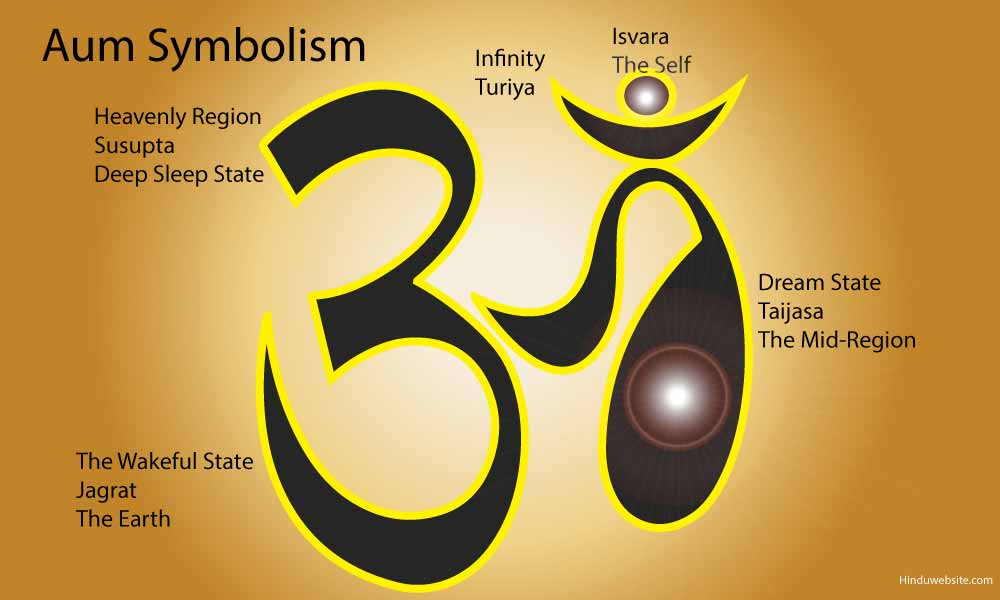
In its very opening verse, the Mandukya Upanishad describes the significance of Aum in which it declares Omkara as everything (idam sarvam), the past, the present and the future and also whatever there is beyond the threefold time. As the ultimate Brāhman it has four quarters, the waking state (jagrata) presided by Vaisvanara (universal man), the dream state (svapna) presided by taijasa (illumined being), deep sleep state (susupta) presided by prajna (intelligent being) and the transcendental state (turiya) presided by the individual Self (atman) which in reality is but Brāhman Himself.
We can see these four states being represented in the syllable AUM. The waking state is represented by the first letter A, the dream state by the second letter U, the deep sleep state by the third letter M and the fourth state (Self) by the syllable AUM itself. Like Patanjali, Gaudapada equates Aum with Isvara and suggests that by worshipping Him as Aum we will transcend suffering.
The fourfold nature of Aum is also represented truthfully in the symbol of Aum, which consists of four curves and one circle. The four curves represent the four states of consciousness and the circle represent the Self. The lower curve represents the waking state, the middle curve the dream state, the upper curve the deep sleep state, the semi circle detached from these three represent the transcendental state while the circle above all is the witnessing Self or the Supreme Self. Symbolism of Aum is depicted in the diagram above.
The Brihadaranyaka Upanishad
The Briahadaranyaka Upanishad begins with the word Aum. In some verses it refers to it as udgita and declares the proper way to chant it is in conjunction with speech and with deep upper breath (or inhalation in which the chest is pulled up). The Chandogya Upanishad suggests, in the form of a story (section 2), the best way to meditate upon the udgita in order to stabilize the mind. It begins with how the gods tried various methods in vain to meditate upon the udgita and how they were disturbed victoriously in various ways by the demons, till the gods found the right method to meditate upon it as the breath. When the gods began meditating in this manner, the demons tried to disturb them and were instantly destroyed as if they hit themselves against a solid rock. In the next section (3.7) of the Upanishad we find the threefold symbolism of the udgita, "Heaven (dyaur) is ut, atmosphere (antarisksham) is gi and earth (prithvi) is tha. The sun is ut, the air gi and the fire tha. The Samaveda is ut, the Yajurveda gi and the Rigveda, tha." To dispel any doubt we may have as to the true meaning of udgita, the Upanishad emphatically states, "Now verily, what is the udgita is the Aum. What is Aum is the udgita."
In The Maitri upanishad
The Maitri upanishad (4.22) explains how we can attain non-sound (asabda) through the sound (sabda) by meditating upon Aum in different ways. In one method, moving upward by it one ascends to the non-sound and becomes immortal. According to another method, by closing the ears with the thumbs one can hear the sound of the space within the heart in seven different ways, namely the sound of a flowing river, the sound of a moving wheel, the sound of bell, of a brass vessel, the croaking of frogs, the sound of rain and the sound of speech. He who hears these different sounds within himself will ultimately merge with the supreme non-sound and become immortal. Thus, with the help of sabda (sound) Brāhman he attains para (supreme) Brāhman. The Upanishad also describes the end of meditation on Aum as the state which is tranquil, soundless, fearless, without sorrow (asokam), blissful, satisfied, steadfast, unmoving, immortal, unshaking, enduring and which is comparable to Vishnu because it is both lower and higher than everything and also soundless and void. This state is attained by using the body as the bow, Aum as the arrow, the mind as its point and darkness as the mark. When darkness is pierced with the arrow of Aum one reaches that which is not enveloped in darkness where Brāhman sparkles like a wheel of fire, of the color of sun, full of vigor and beyond darkness
The Atharvasikha Upanishad
The Atharvasikha Upanishad suggests that meditation has to be done on the single letter Om because it is in itself the mantra for meditation. Its four legs are the four devas and the four Vedas while the syllable itself is equal to Para Brāhman (Ultimate reality). It states, "The five gods Brahma, Vishnu, Rudra, Ishwara and Shiva should be worshipped in the form of pranava (Aa + Uu+ Ma + half sound + Bindu.)" Aum is known as "pranava" because it makes everyone bow before it and as Omkara because it sends forth the currents of the life-force upward. The Upanishad identifies the constituent sounds of the syllable Aum with Brahma, Vishnu and Siva, and Brāhman, and explains their symbolism in the following manner.
- The sound a represents the earth, the hymn of praise (ric), Rigveda, Brahma, the eight deities known as Vasus, the sacred Gayatri mantra, the garhyapatya fire, the color of red and dedicated to Brahma.
- The sound u refers to the atmosphere (antariksha), the sacrificial formula known as Yajus, the Yajurveda, god Vishnu, the atmospheric deities known as Rudras, the meter trishtbhu, the dakshina fire, brightness, and dedicated to Rudra.
- The sound m represents heaven, the sacred chant saman, the Samaveda, god Vishnu, the 12 solar deities known as Adityas, the meter jagati, the ahavaniya fire, the color black and dedicated to Vishnu.
- The nasalized half part of the sound m which is let out while chanting Aum is described as the Atharvan chants, the Atharvaveda, the fire of universal destruction, the wind gods known as Maruts, the universal Virat, lightning like, multicolored and dedicated to Brāhman or Purusha.
Aum in the Tantras and the minor Upanishads
The tantras describe the primordial sound Aum as pure vibration (spanda), without cause and the source of all sounds and vibrations. They explain the origin of primeval sounds like dhvani , nada and subtle alphabets called matrikas and their association with Siva and Shakti. The Shārada Tilaka Tantra reveals the source of all sounds to be the bindu (point) which has three constituent parts, namely nada (subtle sound), bija (seed) and bindu (point). Nada has the predominance of Siva consciousness (Siva), bindu has the predominance of energy or Shakti while bija contains both of them in equal parts. The Kirana Tantra describes Aum as divine in itself, which resides in the throat of Siva and which is the root of all mantras and also the source of all speech (vac).
The Amritabindu Upanishad distinguishes between the audible Om (svara) and the inaudible Om (asvara), which is imperceptible in the conscious world but perceptible in the subtle planes in deeper states of meditation. The audible Om is perishable (kshara), whereas the subtle one is imperishable (akshara). Only by meditating upon the latter, it is possible to reach the state of equanimity and experience oneness with God. The Amritanadabindu Upanishad describes Om as the chariot to reach the Absolute. By chanting the sacred sound, disengaged from the first three letters of Aum, one enters into the subtle state through the last letter m which is also the bindu (the seed or focal point). Withdrawing the senses, practicing breath control, seated on the ground, free from defects and guarding oneself from harmful thoughts, one should focus one's attention fully on Om and contemplate upon it. The Om should not be exhaled because it has the ability to purify and remove the defects.
The Nadabindu Upanishad describes Aum as a resplendent humming sound (Vairaja pranava), having four parts through which one can reach the inner sound (nada) in the right ear. When it is heard all external sounds disappear and one is able to listen to various subtle sounds whereby he becomes a videhamukta (freed from the body).
According to the Hamsa (swan) Upanishad, nada manifests itself as ten different sounds, which are heard by adepts and yogis in the subtle planes in the progressive stages of their spiritual advancement. Hearing them is a sure sign of success on the path. These sounds are the sound of cini, of cini-cini, of bell, of conch, of harp, of cymbals, of flute, of kettle drum, of tabor and of thunder clap. Of these only the last one should be cultivated. Different physical symptoms said to arise in the mind and the body as these sounds are heard, such as shaking of the head and sweetness in the mouth. When finally the last mentioned sound (thunder clap) is heard, one becomes identical with the transcendental Self (para Brāhman). The tantra shastras recognize Aum as the seed (bija) mantra and suggest its association with other mantras and names of Siva, Shakti and other divinities so as to increase their potency and vibration and hasten the process of purification and self-realization. Some of the well known and powerful mantras which are used in association with Aum as the prefix are mentioned below.
- Om namah Sivayah
- Om namo bhagavate Vasudevaya
- Om Ganesaya namah or Om namoh Ganesaya
- Om namo Pundarikakshaya
- Om srimatre namah
- Om sat-cit-ekam-brahma
- Om Durgaih namah
The Mahanirvana Tantra speaks about the significance of "soham" or "hamsa", used in both meditation and chanting as the means to self-realization. Both the words symbolize the ultimate reality hidden in the manifest creation and contain in themselves both the masculine and feminine aspects of creation, namely Siva and Shakti, represented by the sounds "ham" and "sa" respectively. Hamsa, means the swan and also " I am He". It is equated with the sound of natural breathing because the sound of our natural breathing is very similar to the sound of hamsa. When chanted repeatedly hamsa (I am He) sounds like soham (He is I am) or vice versa. Thus it is said that by breathing naturally every living being chants unknowingly and spontaneously, one of the most powerful mantras in the world, which is regarded as the pranava itself. Through breath all beings continuously worship God, remind themselves of their true nature and connection with God and identify themselves with Him, although they may or may not be aware of it at all. We find a similar explanation in the Dhyanabindu Upanishad, which describes the chanting of hamsa as ajpa gayatri or the unchanted gayatri
Om in Buddhism
Buddhism recognizes neither the individual Self nor the universal Self. The Buddha prohibited the Vedic practice of using mantras and magical spells for personal or spiritual gains. However with the emergence of Mahayana and Vajrayana Buddhism the practice of using mantras in chants and meditation as a means of self-protection, purification and spiritual well being became a regular practice in some sects of Buddhism. One of the most famous mantras found in Buddhism is the lotus mantra which begins with the word Om. It is chanted as, "Om mani padmeham". There are also other mantras beginning with Om which are used by the Buddhist monks in various parts of the world, such as, Om wagishwari hum, Om dhrung svaha, Om vajrapani hum and Om vajrasattva hum. For the Buddhists the word Aum or Om does not represent the absolute reality nor an eternal self. Instead it represents the outer aspects of a living being, namely the body, the speech and the mind respectively.
Suggestions for Further Reading
- Om, Aum, Pranava or Nada in Mantra and Yoga Traditions
- Brahmacharya or Celibacy in Hinduism
- Atheism and Materialism in Ancient India
- Solving the Hindu Caste System
- How To Choose Your Spiritual Guru?
- Creation in Hinduism As a Transformative Evolutionary Process
- Wealth and Duty in Hinduism
- Do You Have Any Plans For Your Rebirth or Reincarnation?
- Understanding Death and Impermanence
- Lessons from the Dance of Kali, the Mother Nature
- Letting your God live in You - The True Essence of the Hindu Way of Life
- prajnanam brahma - Brahman is Intelligence
- Maslow's Hierarchy Of Needs From The Perspective Of Hinduism
- The Defintion and Concept of Maya in Hinduism
- The Meaning of Nirvana
- Self-knowledge, Difficulties in Knowing Yourself
- Hinduism - Sex and Gurus
- The Construction of Hinduism
- The Meaning and Significance of Heart in Hinduism
- The Origin and Significance of the Epic Mahabharata
- The True Meaning of Prakriti in Hinduism
- Three Myths about Hinduism
- What is Your Notion of God?
- Why Hinduism is a Preferred Choice for Educated Hindus
- Essays On Dharma
- Esoteric Mystic Hinduism
- Introduction to Hinduism
- Hindu Way of Life
- Essays On Karma
- Hindu Rites and Rituals
- The Origin of The Sanskrit Language
- Symbolism in Hinduism
- Essays on The Upanishads
- Concepts of Hinduism
- Essays on Atman
- Hindu Festivals
- Spiritual Practice
- Right Living
- Yoga of Sorrow
- Happiness
- Mental Health
- Concepts of Buddhism
- General Essays