
Radha Soami Satsang Beas
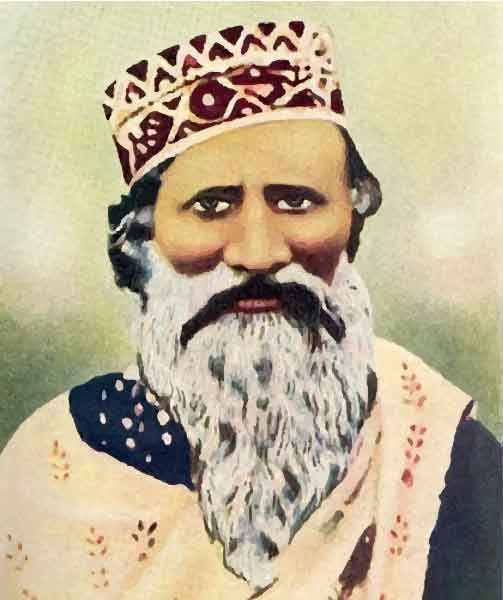
An Image Attributed to Swamiji Maharaj Shiv Dayal Singh
The Radha Soami Satsang, a spiritual organization, was founded by Shri Shiv Dayal Singh or Soamiji Maharaj in 1861. Although traces of Radha Soami tradition can be found in the teachings of earlier masters like Kabir, Shri Shiv Dayal Singh is considered to be its first Satguru, whom his followers regard as the Supreme Being Himself in human form.
Shri Shiv Dayal Singh was born in a khatri family in Agra in 1818. From an early age he had a spiritual bent of mind and showed interest in doing spiritual practice. As a student he learned Hindi, Urdu, Persian and Gurumukhi and also acquired some proficiency in Sanskrit. He was married to Naraiani Devi at an early age. After completing his school education, he worked for a government officer at Banda as a Persian expert which he left to work as a teacher. His spiritual yearning was so strong that he could not get involved with worldly life. So he decided to leave aside everything and devote his life to spiritual matters.
In the beginning, Soamiji Maharaj was disinterested in inviting large gatherings for his satsangs (spiritual gatherings). However he changed his mind following a suggestion from one of his close disciples and opened his satsang to the public in February, 1861. As more and more people joined the congregation, Soamiji Maharaj named it as Radhasomi Satsang, again based on a suggestion made by Hazur Maharaj who by now was convinced that his guru was none other than Radhasaomi himself. For the next several years Soami Maharaj held satsangs regularly in the house of Hazur Maharaj. By the time he passed away in 1878, the movement had three thousand followers.
The Philosophy and Teachings of Radha Soami Satsang
The teachings of Radha Soami satsang are known as Sant Mat meaning the teachings of saints. Following are the salient features of Sant Mat and techniques associated with the teachings are called Surat Sabda yoga..
Supreme Bein
According to Shri Dayal Singh, the highest God or the Supreme Being is Sat Purush Radha Soami. He is the highest reality, higher than Brahman, Allah and the God of Christianity and Judaism. There is no scripture or religion that describes him adequately. He belongs to the highest region while the scriptures, religions, incarnations and gods mentioned above come from lower regions. He is the highest and ultimate reality. The worlds are manifested by Him through a gradual succession of planes which are called Grand Regions. His state prior to creation is the supreme state of sunn samadhi or soundless self-absorption. Waking up from this state he produced a divine sound current (shabd), from which emerged different regions, gods, beings and objects.
Cosmology
After waking up from sunn samadhi, the Supreme Being created divne sound current and manifested Four Grand Regions. The highest1 or the fourth grand region is called Nirmal-Chaitanya-Desh or the Peaceful Dynamic Region. In it are located Radha Soamipad, Agamlok, Alakhlok and Satlok. These are pure spiritual worlds of light, love, bliss and peace. They are not subject to dissolution. Kal is a manifestation of the Supreme Being. He has both mind and matter. His spiritual energy is known as Adya. Kal created both the third and second grand regions. The third world is a combination of spirit and subtle matter where the spirit is predominating while the second is a combination of matter and spirit where matter is predominating.
Using his spiritual energy Kal transformed himself into Niranjan and Jyoti and created the third Grand Region known as And-desh. It has three sub-regions of Brahma, Vishnu and Mahesh. Then he created the second grand region known as Brahmand, using his Adya and Akshar Purush (latent spiritual energy). This region is a combination of spirit, mind and pure matter (maya). It has three sub-regions, Sunna, Trikuti and Sahasdal Kanwal. It is pervaded by the Universal Mind and qualified by five tattvas (principles) and three gunas (qualities). Finally Kal created Pind-desh or the First Grand Region. It is the material and physical world with a nerve center and nine apertures in which is encased the Surat (the soul or the spirit entity).In this world the soul is deeply enmeshed in matter and the only way it can escape from there is through the help of Guru and by finding the flow of Shabd or divine sound current.
Soul or Sura
The soul is atomic in nature, but shares the same qualities as those of the Supreme Being. During creation it descends from above through various higher regions into the physical world (Pind-desh), below the Sahasdal Kanwal, the lower most sub region of the Brahmanad. Here it gets involved with maya, the five tattvas, the three gunas, the mind and matter. In this state it is called jiva or being. Its loses its freedom and become subject to birth, death and rebirth and the duality of pleasure and pain. Under the influence of Kal it assumes many forms, develops attachment, desires, delusion and egoism. Its true nature becomes buried under many layers of ignorance and suffering.
Shabd .
It is the eternal divine sound current, the first manifestation of Supreme Being. All creation and the four grand regions emerged from it. It is an ever reverberating inaudible sound that pervades the whole creation and resonates in all beings as an undercurrent. It can be heard within oneself through devotion to one's guru and by chanting of holy name (nam) given by him during one's initiation. Its physical aspect is nam or the holy name which is known to the Guru and who alone can reveal it to a disciple.2
Salvation
By repeating the holy name and listening to the shabd in a deep spiritual state of withdrawal, a devotee can join the flow of this current and travel through various higher regions to reach Radha Soamipad or the highest abode. Besides repeating the holy name received from the Guru, a devotee also has to live his or her life according to the percepts of Radha Soami teachings. Shri Dayal Singh emphasized the need for a virtuous and devotional life to eradicate one's past karma and control the body and the mind to experience within oneself the divine sound current or Shabd.
Sant Satguru :
The Santsatguru is a manifestation of the Supreme Being in human form. Liberation of the jivas can happen only through his grace. Though he is in a human form, a guru should never be treated like a human being. He personifies the Shabd and through him the Supreme Being communicates with the jivas, bestows his grace and helps them to liberate themselves from the bonds of Pind-desh and the exploitation of Kal. The Satguru is responsible for the karma of his disciples. At the time of initiation he actually takes upon himself the karma of the initiate and connects him or her to the divine sound current. Without him it is not possible to listen to the sound or escape from the bonds of material life. Shri Dayal Singh did not appreciate any religion or religious sect that did not place emphasis on the importance of a living guru.3 It is said that according to this sect, one should consider a guru as a real guru only after one has an inner experience with the help of the guru and till such time he should be treated as a guide or trainer.
Bhakti or Devotion
Bhakti is of two types, guru-bhakti, that is devotion to guru and shabd-bhakti devotion to Shabd. Both are very important and key to one's release from the bondage. Guru-bhakti facilitates shabd-bhakti because guru connects the jiva with the Shabd and through the Shabd with the Supreme Being. Through devotion to guru a jiva obtains dhun (the sound) and through it dham (the region) and dhani (master or the Supreme Being).
Religious Practices
Shri Shiv Dayal Singh did not appreciate people who professed atheism nor those who indulged in rituals, pilgrimages, fasting, worship of illusory objects such as idols, rivers, trees and plants. He declared that some practices such as idol worship and fasting had their own significance in the past but outlived their purpose now and hence practicing them would be a waste of time. Instead he encouraged his followers to have faith in their guru. He also believed that the Vedas came from the Third Grand Region and therefore were neither infallible nor absolute. He advised people against worshipping holy scriptures such as the Adigranth and the forms of past gurus as salvation could be attained only through a living guru. He was also critical of certain religious practices followed in other religions such as Islam, Christianity and Jainism. According to him Jainism placed more emphasis on self-denial while Christianity emerged from the third region of Kal and maya. He also advised people against book knowledge and intellectual pursuit of religion and religious scriptures without the help of a guru.
Surat Shabd Yoga
Radha Soami sect believes that the means to salvation is practice of Surat Shabd Yoga which involves initiation into a holy name by the Guru and devotional chanting of the holy name to find the current of divine sound (shabd) within oneself. This sound is not an imaginary sound or mythical sound. It is an omnipotent and omnipresent divine sound that reverberates continuously throughout the four regions and can be actually heard by any individual with due practice and through the grace of his guru. The Surat Shabd Yoga is easy to practice and can be practiced by any one irrespective of caste and creed or gender and economic status. However its success will greatly depend upon how much love is generated in one's heart towards the Supreme Being and the Satguru
Later Developments
Soamiji Maharaj did not name any particular successor. So after his death the movement branched off into several directions. In the opinion of some this worked to its advantage as the movement spread far and wide with the help of many satsangs each headed by a separate satguru. Some of these satsangs were based in Agra and identified as Agra lineage.
Jaimal Sing, one of the disciples of Soamiji, established a satsang in Punjab near the village Beas on the northern bank of the river Beas which is considered to be the most popular of all the Radha Soami Satsangs in the world today with a large number of followers. He was succeeded by other gurus, all Sikh by birth, who drew heavily from the Granth Sahib the holy book of the Sikhs and imparted to the movement a certain Sikh flavor which perhaps Soamiji Maharaj would not have approved and which is certainly not appreciated by the orthodox Sikh community who believe that the lineage of true Satgurus ended some 300 years ago. Maharaj Gurinder Singh is the current leader of this satsang. He has consolidated the movement in the west by traveling extensively and increased the number of followers in the west. He has also limited the age of initiation to 25. The dera or the camp established at Beas has also expanded since. It has a 300-bed hospital which provides free medical care to the members of the satsang as well as others.
The movement is not entirely without controversy. There are allegations that the original traditions of the movement have been greatly diluted and that the gurus lack the merit and wisdom of the earlier masters. Serious doubts have been raised form time to time about the spiritual status of some of the self-proclaimed gurus heading different factions. In some sub sects the initiation ceremony is said to be done mechanically according to an initiation instruction manual by persons other than the Guru himself acting as his proxy and that those who initiate others into the movement lack the spiritual merit. The Dera at Beas is also mired in security issues due to threats posed to its guru, which has created some alienation between the guru and his satsangis.
Suggestions for Further Reading
- The History, Teachings and Philosophy of Swaminarayan Sect
- Spiritual Masters, Saints and Great Souls of Hinduism
- Significance of Gurus in Hinduism
- The Future of Hinduism
- The Role of Asceticism in the Development of Hinduism
- Main Sects and Schools of Hinduism
- Hinduism and Diversity
- Gods and Goddesses of Hinduism
- Ajivikas - Their History and Philosophy
- Hinduism and Religious Tolerance
- History of Atheism in Ancient India
- Religious Tolerance in Ancient India
- Was Bhakti Movement Anti Women?
- Symbolic Significance Of The Vedic Gods and Goddesses
- Saivism or Shaivism - Basic Concepts
- Aspects, Emanations, Incarnations and Forms of God Vishnu
- Symbolic Significance of Numbers in Hinduism
- The Belief of Reincarnation of Soul in Hinduism
- The True Meaning Of Renunciation According To Hinduism
- The Symbolic Significance of Puja Or Worship In Hinduism
- Introduction to the Upanishads of Hinduism
- Origin, Principles, Practice and Types of Yoga
- Essays On Dharma
- Esoteric Mystic Hinduism
- Introduction to Hinduism
- Hindu Way of Life
- Essays On Karma
- Hindu Rites and Rituals
- The Origin of The Sanskrit Language
- Symbolism in Hinduism
- Essays on The Upanishads
- Concepts of Hinduism
- Essays on Atman
- Hindu Festivals
- Spiritual Practice
- Right Living
- Yoga of Sorrow
- Happiness
- Mental Health
- Concepts of Buddhism
- General Essays
Footnotes
1. The number system is somewhat confusing. In some texts of this sect the highest region is mentioned as the first region and the lowest as the fourth. Whatever be the numbering system, it is important for the readers to understand that the highest region is of the Supreme Being and the lowest of humans and other physical beings and objects.
2. There is a growing concern among the followers of some sub sects within this movement that the initiation is often done by people acting on behalf of a guru who have themselves never experienced the inner sound.
3. The insistence of having a living guru poses its own challenges for the movement. Since there are so many splinter groups within the movement one wonders whether all the groups are headed by a self-realized master and what if some of them have none.