
Hindu Manners, Customs And Ceremonies
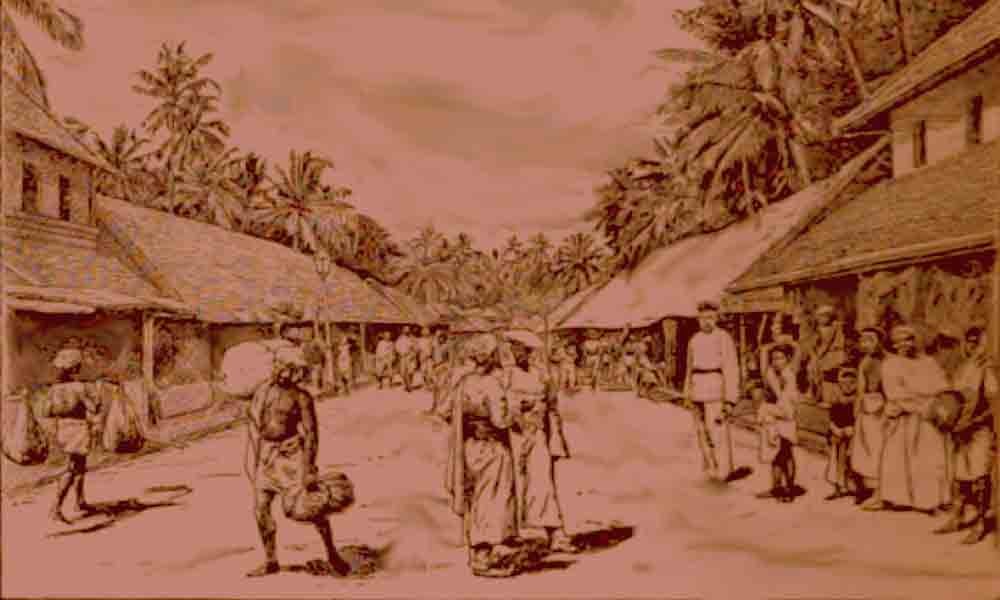
Bazaar in Trivendrum, Kerala, in British Times
Introduction
The following is a reproduction of the first five chapters of the book entitled Hindu Manners, Customs and Ceremonies by Abbe J.A. Dubois. They deal with the caste system and the social conditions prevailing in India nearly 200 years ago. The book was originally written in French during the author's stay in the British India between 1792 and 1823. It was subsequently translated into English by Henry K. Beauchamp and published in 1906. Abbe Dubois' work is a sincere but somewhat prejudiced and misconstrued documentation of the conditions prevailing in India during his stay in the country as a Christian Missionary. As he himself admitted, the main motivation for his work was his belief that "a faithful picture of the wickedness and incongruities of polytheism and idolatry would by its very ugliness help greatly to set off the beauties and perfections of Christianity."
We do not know how far he succeeded in his mission to contrast the so called "ugliness" of Hinduism with his dogmatic notions of Christianity. However, during the course of his work and probably his stay in the country, Abbe Duboi tried his best, though he did not seem to succeed fully, to look at Hindu society with the eyes of an educated and well informed native. Evidently, he was hopeful of the emergence of Christianity as the future religion of the Indians, but took care not to show his prejudices while discussing some historical and traditional aspects of Hinduism. In the first part of the book he presented comprehensive information on the Hindu caste system with particular emphasis on the the castes that lived on the fringes of Hindu society and which could be targeted for missionary activity. While doing so he could hardly suppress his disgust against some castes and communities for their beliefs, rituals and life styles.
We cannot say that his work truly represents the conditions prevailing in India during his stay. Undoubtedly it contains many half truths and sweeping statements. All the same, it carries some historical value and offers valuable insights for people interested in knowing the conditions prevailing in southern India, in the early 19th century. The author is well aware of the diversity of Indian society and the difficulties involved in documenting it accurately, which he himself admitted. In order to maintain objectivity, he said to have adopted the life style of Hindus, including their way of dressing. The book is not without exaggerations and errors of judgment. But from a historical perspective, it deserves a careful study.
Jayaram V
Hinduwebsite.com
Contents
|| Chapter 1 || Chapter 2 || Chapter 3 || Chapter 4 || Chapter 5 ||
GENERAL VIEW OF SOCIETY IN INDIA, AND GENERAL REMARKS ON THE CASTE SYSTEM
CHAPTER I

Division and Subdivision of Castes. — Castes peculiar to Certain Pro- vinces. — Particular Usages of some Castes. — Division of Castes founded on Parentage. — Subordination of Castes. — Outward Signs of certain Castes. — Division of Caste-groups into Right-hand and Left-hand.
The word caste is derived from the Portuguese, and is used in Europe to designate the different tribes or classes into which the people of India are divided 1. The most ordinary classification, and at the same time the most ancient, divides them into four main castes. The first and most distinguished of all is that of Brahmana, or Brahmins ; the second in rank is that of Kshatriyas, or Rajahs ; the third the Vaisyas, or Landholders and Mer- chants ; and the fourth the Sudras, or Cultivators and Menials.
The functions proper to each of these four main castes are : for Brahmins, priesthood and its various duties ; for Kshatriyas, military service in all its branches ; for Vaisyas, agriculture, trade, and cattle-breeding ; and for Sudras, general servitude. But I will describe more fully hereafter the several social distinctions which are attached to each of them.
1 The Sanskrit word is Varna = colour, thus showing that upon the difference of colour between the Aryan Brahmins and the aboriginal inhabitants the distinction of caste was originally founded. — Pope.
THE FOUR MAIN CASTES
Each of the four main castes is subdivided into many others, the number of which it is difficult to determine because the subdivisions vary according to locality, and a sub-caste existing in one province is not necessarily found in another.
Amongst the Brahmins of the south of the Peninsula, for example, there are to be found three or four principal divisions, and each of these again is subdivided into at least twenty others. The lines of demarcation between them are so well defined as to prevent any kind of union between one sub-caste and another, especially in the case of marriage.
The Kshatriyas and Vaisyas are also split up into many divisions and subdivisions. In Southern India neither Kshatriyas nor Vaisyas are very numerous ; but there are considerable numbers of the former in Northern India. Howbeit, the Brahmins assert that the true Kshatriya caste no longer exists, and that those who pass for such are in reality a debased race.
The Sudra caste is divided into most sub-castes. Nobody in any of the provinces where I have lived has ever been able to inform me as to the exact number and names of them. It is a common saying, however, that there are 18 chief sub-castes, which are again split up into 108 lesser divisions.
The Sudras are the most numerous of the four main castes. They form, in fact, the mass of the population, and added to the Pariahs, or Outcastes, they represent at least nine-tenths of the inhabitants. When we consider that the Sudras possess almost a monopoly of the various forms of artisan employment and manual labour, and that in India no person can exercise two professions at a time, it is not surprising that the numerous individuals who form this main caste are distributed over so many distinct branches.
However, there are several classes of Sudras that exist only in certain provinces. Of all the provinces that I lived in, the Dravidian, or Tamil, country is the one where the ramifications of caste appeared to me most numerous. There are not nearly so many ramifications of caste in Mysore or the Deccan. Nowhere in these latter provinces have I come across castes corresponding to those which are known in the Tamil country under the names of MoodeUy, Agambady, Nattaman, Totiyar, Udaiyan, VcUeyen, Upiliyen, Pollen, and several others 1 .
CASTES PECULIAR TO CERTAIN PROVINCES
It should be remarked, however, that those Sudra castes which are occupied exclusively in employments indispens- able to all civilized societies are to be found everywhere under names varying with the languages of different localities. Of such I may cite, amongst others, the gar- deners, the shepherds, the weavers, the Panchalas (the five castes of artisans, comprising the carpenters, gold- smiths, blacksmiths, founders, and in general all workers in metals), the manufacturers and venders of oil, the fishermen, the potters, the washermen, the barbers, and some others. All these form part of the great main caste of Sudras ; but the different castes of cultivators hold the first rank and disdainfully regard as their inferiors all those belonging to the professions just mentioned, refusing to eat with those who practise them.
In some districts there are castes which are not to be met with elsewhere, and which may be distinguished by peculiarities of their own. I am not aware, for example, that the very remarkable caste of Nairs, whose women enjoy the privilege of possessing several husbands, is to be found anywhere but in Travancore 2 . Amongst these same people, again, is another distinct caste called Nambudiri, which observes one abominable and revolting custom. The girls of this caste are usually married before the age of puberty ; but if a girl who has arrived at an age when the signs of puberty are apparent happens to die before having had intercourse with a man, caste custom rigorously demands that the inanimate corpse of the deceased shall be subjected to a monstrous connexion. For this purpose the girl's parents are obliged to procure by a present of money some wretched fellow willing to consummate such a disgusting form of marriage : for were the marriage not consummated the family would consider itself dishonoured.
1 Moodelly, ' chief man ' or highly respectable trader. Agambady, he who performs menial offices in temples or palaces. Nattaman, a caste of cultivators. Totiyar, a caste of labourers. Udaiyan, a potter. Yaleyen, a fisherman. Upiliyen, salt manufacturer. Fallen, agriculturist. — Ed.
2 It would be more correct to say West Coast. Moreover, although Xair women are commonly described as polyandrous, they are not really so, for though they enjoy the privilege of changing their husbands, they do not entertain more than one husband at a time. — Ed.
CASTES PECULIAR TO CERTAIN PROVINCES
The caste of Kullars, or robbers, who exercise their calling as an hereditary right, is found only in the Marava country, which borders on the coast, or fishing, districts. The rulers of the country are of the same caste. They regard a robber's occupation as discreditable neither to themselves nor to their fellow castemen, for the simple reason that they consider robbery a duty and a right sanctioned by descent. They are not ashamed of their caste or occupation, and if one were to ask of a Kullar to what people he belonged he would coolly answer, ' I am a robber ! ' This caste is looked upon in the district of Madura, where it is widely diffused, as one of the most distinguished among the Sudras.
There exists in the same part of the country another caste, known as the Totiyars, in which brothers, uncles, nephews, and other near relations are all entitled to possess their wives in common.
In Eastern Mysore there is a caste called Morsa-Okkala- Makkalu, in which, when the mother of a family gives her eldest daughter in marriage, she is obliged to submit to the amputation of two joints of the middle finger and of the ring finger of the right hand. And if the bride's mother be dead, the bridegroom's mother, or in default of her the mother of the nearest relative, must submit to this eruel mutilation 1 .
1 Whatever may have been the case in the days of the Abbe, these customs no longer exist. In regard to this, Mr. W. Logan, in his Manual of Malabar, writes thus : ' To make tardy retribution — if it deserves such a name — to women who die unmarried, the corpse, it is said, cannot be burnt till a tali string (the Hindu equivalent of the wedding- ring of Europe) is tied round the neck of the corpse, while lying on the funeral pile, by a competent relative. Nambudiris are exceedingly reticent in regard to their funeral ceremonies and observances, and the Abbe Dubois' account of what was related to him regarding other observances at this strange funeral-pile marriage requires confirmation.' Careful inquiries made of the leading members of the Nambudiri com- munity and of others in Malabar who have an intimate knowledge of Nambudiri customs have convinced me that the Abbe must have mis- understood his informant in regard to the practice which he records here. What is done in such a case is merely to perform the religious rites, usually associated with Hindu marriages, over the dead body of the woman before the corpse is cremated. By marriage here is meant merely the tying of the tali (the emblem of marriage) and not the act of consummation of marriage. — Ed.
SPECIAL CASTE CUSTOMS
Many other castes exist in various districts which are distinguished by practices no less foolish than those above mentioned.
Generally speaking, there are few castes which are not distinguished by some special custom quite apart from the peculiar religious usages and ceremonies which the com- munity may prescribe to guarantee or sanction civil con- tracts. In the cut and colour of their clothes and in the style of wearing them, in the peculiar shape of their jewels and in the manner in which they are displayed on various parts of the person, the various castes have many rules, each possessing its own significance. Some observe rites of their own in their funeral and marriage ceremonies : others possess ornaments which they alone may use, or flags of certain colours, for various ceremonies, which no other caste may carry. Yet, absurd as some of these practices may appear, they arouse neither contempt nor dislike in members of other castes which do not admit them. The most perfect toleration is the rule in such matters. As long as a caste conforms on the whole to the recognized rules of decorum it is permitted to follow its own bent in its domestic affairs without interruption, and no other castes ever think of blaming or even criticizing it, although its practices may be in direct opposition to their own.
There are, nevertheless, some customs which, although scrupulously observed in the countries where they exist, are so strongly opposed to the rules of decency and decorum generally laid down that they are spoken of with dis- approbation and sometimes with horror by the rest of the community. The following may be mentioned among practices of this nature.
In the interior of Mysore, women are obliged to accom- pany the male inmates of the house whenever the latter retire for the calls of nature, and to cleanse them with water afterwards. This practice, which is naturally viewed
1 This custom is no longer observed ; instead of the two ringers being amputated, they are now merely bound together and thus rendered unfit for use. — Ed.
USE OF INTOXICATING LIQUORS
with disgust in other parts of the country, is here regarded as a sign of good breeding and is most carefully observed 1 .
The use of intoxicating liquors, which is condemned by respectable people throughout almost the whole of India, is nevertheless permitted amongst the people who dwell in the jungles and hill tracts of the West Coast. There the leading castes of Sudras, not excepting even the women and children, openly drink arrack, the brandy of the country, and toddy, the fermented juice of the palm. Each inhabitant in those parts has his toddy-dealer, who regularly brings him a daily supply and takes in return an equivalent in grain at harvest time.
The Brahmin inhabitants of these parts are forbidden a like indulgence under the penalty of exclusion from caste. But they supply the defect by opium, the use of which, although universally interdicted elsewhere, is never- theless considered much less objectionable than the use of intoxicating liquors.
The people of these damp and unhealthy districts have no doubt learnt by experience that a moderate use of spirits or opium is necessary for the preservation of health, and that it protects them, partially at any rate, against the ill effects of the malarious miasma amidst which they are obliged to live. Nothing indeed but absolute necessity could have induced them to contravene in this way one of the most venerable precepts of Hindu civilization.
The various classes of Sudras who dwell in the hills of the Carnatic observe amongst their domestic regulations a practice as peculiar as it is disgusting. Both men and women pass their lives in a state of uncleanness and never wash their clothes. When once they have put on cloths fresh from the looms of the weavers they do not leave them off until the material actually drops from rottenness. One can imagine the filthy condition of these cloths after they have been worn day and night for several months soaked with perspiration and soiled with dirt, especially in the case of the women, who continually use them for wiping their hands, and who never change their garments until wear and tear have rendered them absolutely useless.
1 If this custom ever existed, the spread of education has effectually put a stop to it. — Ed.
A SABBATH OF THE 'LINGAYATS'
Yet this revolting habit is most religiously observed, and, if anybody were so rash as to wash but once in water the cloths with which he or she is covered, exclusion from caste would be the inevitable consequence. This custom, however, may be due to the scarcity of water, for in this part of the country there are only a few stagnant ponds, which would very soon be contaminated if all the in- habitants of a village were allowed to wash their garments in them.
Many religious customs are followed only by certain sects, and are of purely local character. For instance, it is only in the districts of Western Mysore that I have observed Monday in each week kept nearly in the same way as Sunday is among Christians. On that day the villagers abstain from ordinary labour, and particularly from such as, like ploughing, requires the use of oxen and kine. Monday is consecrated to Basava (the Bull), and is set apart for the special worship of that deity. Hence it is a day of rest for their cattle rather than for themselves.
This practice, however, is not in vogue except in the districts where the Lingayats, or followers of Siva 1 , pre- dominate. This sect pays more particular homage to the Bull than the rest of the Hindus ; and, in the districts where it predominates, not only keeps up the strict observ- ance of the day thus consecrated to the divinity, but forces other castes to follow its example.
Independently of the divisions and subdivisions common to all castes, one may further observe in each caste close family alliances cemented by intermarriage. Hindus of good family avoid as far as possible intermarriage with families outside their own circle. They always aim at marrying their children into the families which are already
1 Mr. L. Rice, in his Mysore and Coorg, remarks : ' Lingayats : The distinctive mark of this caste is the wearing on the person of a Jangama lingam, or portable linga. It is a small black stone about the size of an acorn, and is enshrined in a silver box of peculiar shape, which is worn suspended from the neck or tied round the arm. The followers of Basava (the founder of the sect, whose name literally means Bull, was in fact regarded as the incarnation of Nandi, the bull of Siva) are properly called Liugavantas, but Lingayats has become a well-known designation, though not used by themselves, the name Sivabhakta or Sivachar being one they generally assume.' — Ed.
CLOSE MARRIAGE RELATIONSHIPS 21
allied to them, and the nearer the relationship the more easily are marriages contracted. A widower is remarried to his deceased wife's sister, an uncle marries his niece, and a first cousin his first cousin. Persons so related possess an exclusive privilege of intermarrying, upon the ground of such relationship ; and, if they choose, they can prevent any other union and enforce their own pre- ferential right, however old, unsuited, infirm, and poor they may be 1 .
In this connexion, however, several strange and ridiculous distinctions are made. An uncle may marry the daughter of his sister, but in no case may he marry the daughter of his brother. A brother's children may marry a sister's children, but the children of two brothers or of two sisters may not intermarry. Among descendants from the same stock the male line always has the right of contracting marriage with the female line ; but the children of the same line may never intermarry.
The reason given for this custom is that children of the male line, as also those of the female line, continue from generation to generation to call themselves brothers and sisters for as long a time as it is publicly recognized that they spring from the same stock. A man would be marry- ing his sister, it would be said, if the children of either the male or the female line intermarried amongst themselves ; whereas the children of the male line do not call the children of the female line brothers and sisters, and vice versa, but call each other by special names expressive of the relation- ship. Thus a man can, and even must, marry the daughter of his sister, but never the daughter of his brother. A male first cousin marries a female first cousin, the daughter of his maternal aunt ; but in no case may he marry the daughter of his paternal uncle.
This rule is universally and invariably observed by all castes, from the Brahmin to the Pariah. It is obligatory on the male line to unite itself with the female line. Agree- ably to this a custom has arisen which so far as I know is peculiar to the Brahmins. They are all supposed to know the gotram or stock from which they spring : that is to say, they know who was the ancient Muni or devotee from whom they descend, and they always take care, in order to avoid intermarriage with a female descendant of this remote priestly ancestor, to marry into a gotram other than their own.
1 This custom is gradually giving way now amongst the higher castes. —Ed.
VAISYAS AND SUDRAS
Hindus who cannot contract a suitable marriage amongst their own relations are nevertheless bound to marry in their own caste, and even in that subdivision of it to which they belong. In no case are they permitted to contract marriages with strangers. Furthermore, persons belonging to a caste in one part of the country cannot contract marriages with persons of the same caste in another part, even though they may be precisely the same castes under different names. Thus the Tamil Yedeyers and the Canarese Uppareru would never consent to take wives from the Telugu Gollavaru and the Tamil Pillay, although the first two are, except for their names, identical with the second two.
The most distinguished of the four main castes into which the Hindus were originally separated by their first legislators is, as we have before remarked, that of the Brahmins. After them come the Kshatriyas, or Rajahs. Superiority of rank is at present warmly contested between the Vaisyas, or merchants, and the Sudras, or cultivators. The former appear to have almost entirely lost their superiority except in the Hindu books, where they are invariably placed before the Sudras. In ordinary life the latter hold themselves to be superior to the Vaisyas, and consider themselves privileged to mark their superiority in many respects by treating them with contumely.
With regard to the Vaisya caste an almost incredible but nevertheless well-attested peculiarity is everywhere observable. There is not a pretty woman to be found in the caste. I have never had much to do with the women of the Vaisya caste ; I cannot therefore without injustice venture to add my testimony to that of others on this subject ; but I confess that the few Vaisya women I have seen from time to time were not such as to afford me an ocular refutation of the popular prejudice. However, Vaisya women are generally wealthy, and they manage to make up for their lack of beauty by their elegant attire.
SUB-DIVISIONS OF CASTES
Even the Brahmins do not hold the highest social rank undisputed. The Panchalas, or five classes of artisans already mentioned, refuse, in some districts, to acknow- ledge Brahmin predominance, although these five classes themselves are considered to be of very low rank amongst the Sudras and are everywhere held in contempt. Brahmin predominance is also still more warmly contested by the Jains, of whom I have treated in one of the Appendices to this work.
As to the particular subdivisions of each caste it is difficult to decide the order of hierarchy observed amongst them. Sub-castes which are despised in one district are often greatly esteemed in another, according as they con- duct themselves with greater propriety or follow more important callings. Thus the caste to which the ruler of a country belongs, however low it may be considered elsewhere, ranks amongst the highest in the ruler's own dominions, and every member of it derives some reflection of dignity from its chief.
After all, public opinion is the surest guide of caste superiority amongst the Sudras, and a very slight acquain- tance with the customs of a province and with the private life of its inhabitants will suffice for fixing the position which each caste has acquired by common consent.
In general it will be found that those castes are most honoured who are particular in keeping themselves pure by constant bathing and by abstaining from animal food, who are exact in the observance of marriage regula- tions, who keep their women shut up and punish them severely when they err, and who resolutely maintain the customs and privileges of their order.
Of all the Hindus the Brahmins strive most to keep up appearances of outward and inward purity by frequent ablutions and severe abstinence not only from meat and everything that has contained the principle of life, but also from several natural products of the earth which prejudice and superstition teach them to be impure and defiling. It is chiefly to the scrupulous observance of such customs that the Brahmins owe the predominance of their illustrious order, and the reverence and respect with which they are everywhere treated.
RIGHHT-HAND AND LEFT-HAND FACTIONS
Amongst the different classes of Sudras, those who permit widow remarriage are considered the most abject, and. except the Pariahs, I know very few castes in which such marriages are allowed to take place openly and with the sanction of the caste l .
The division into castes is the paramount distinction amongst the Hindus ; but there is still another division, that of sects. The two best known are those of Siva and Vishnu, which are again divided into a large number of others.
There are several castes, too, which may be distinguished by certain marks painted on the forehead or other parts of the body.
The first three of the four main castes, that is to say the Brahmins, Kshatriyas, and Vaisyas, are distinguished by a thin cord hung across from the left shoulder to the right hip. But this cord is also worn by the Jains and even by the Panchalas, or five castes of artisans, so one is apt to be deceived by it.
From what has been said it will appear that the name of a caste forms after all its best indication. It was thus that the tribes of Israel were distinguished. The names of several of the Hindu castes have a known meaning ; but for the most part they date from such ancient times that it is impossible to find out their significance.
There is yet another division more general than any I have referred to yet, namely, that into Right-hand and Left-hand factions. This appears to be but a modern invention, since it is not mentioned in any of the ancient books of the country ; and I have been assured that it is unknown in Northern India. Be that as it may, I do not believe that any idea of this baneful institution, as it exists at the present day, ever entered the heads of those wise lawgivers who considered they had found in caste distinc- tions the best guarantee for the observance of the laws which they prescribed for the people.
This division into Right-hand and Left-hand factions, whoever invented it, has turned out to be the most direful disturber of the public peace. It has proved a perpetual source of riots, and the cause of endless animosity amongst the natives.
1 Remarriage of virgin widows is one of the foremost planks in the platform of Social Reform, but it is opposed violently by the ortho- dox. — En.
OPPOSITION BETWEEN FACTIONS
Most castes belong either to the Left-hand or Right-hand faction. The former comprises the Vaisyas or trading classes, the Panchalas or artisan classes, and some of the low Sudra castes. It also contains the lowest caste, namely, the Chucklers or leather- workers, who are looked upon as its chief support.
To the Right-hand faction belong most of the higher castes of Sudras. The Pariahs are its chief support, as a proof of which they glory in the title Valangai-Mougattar, or friends of the Right-hand. In the disputes and con- flicts which so often take place between the two factions it is always the Pariahs who make the most disturbance and do the most damage.
The Brahmins, Rajahs, and several classes of Sudras are content to remain neutral, and take no part in these quarrels. They are often chosen as arbiters in the differ- ences which the two factions have to settle between them- selves.
The opposition between the two factions arises from certain exclusive privileges to which both lay claim. But as these alleged privileges are nowhere clearly defined and recognized, they result in confusion and uncertainty, and are with difficulty capable of settlement. In these circum- stances one cannot hope to conciliate both parties ; all that one can do is to endeavour to compromise matters as far as possible.
When one faction trespasses on the so-called rights of the other, tumults arise which spread gradually over large tracts of territory, afford opportunity for excesses of all kinds, and generally end in bloody conflicts. The Hindu, ordinarily so timid and gentle in all other circumstances of life, seems to change his nature completely on occasions like these. There is no danger that he will not brave in maintaining what he calls his rights, and rather than sacrifice a tittle of them he will expose himself without fear to the risk of losing his life.
I have several times witnessed instances of these popular insurrections excited by the mutual pretensions of the two
factions and pushed to such an extreme of fury that the presence of a military force has been insufficient to quell them, to allay the clamour, or to control the excesses in which the contending factions consider themselves entitled to indulge.
RIOTOUS DISTURBANCES
Occasionally, when the magistrates fail to effect a re- conciliation by peaceful means, it is necessary to resort to force in order to suppress the disturbances. I have some- times seen these rioters stand up against several discharges of artillery without exhibiting any sign of submission. And when at last the armed force has succeeded in restoring order it is only for a time. At the very first opportunity the rioters are at work again, regardless of the punishment they have received, and quite ready to renew the conflict as obstinately as before. Such are the excesses to which the mild and peaceful Hindu abandons himself when his courage is aroused by religious and political fanaticism.
The rights and privileges for which the Hindus are ready to fight such sanguinary battles appear highly ridiculous, especially to a European. Perhaps the sole cause of the contest is the right to wear slippers or to ride through the streets in a palanquin or on horseback during marriage festivals. Sometimes it is the privilege of being escorted on certain occasions by armed retainers, sometimes that of having a trumpet sounded in front of a procession, or of being accompanied by native musicians at public cere- monies. Perhaps it is simply the particular kind of musical instrument suitable to such occasions that is in dispute ; or perhaps it may be the right of carrying flags of certain colours or certain devices during these ceremonies. Such at any rate are a few of the privileges for which Hindus are ready to cut each other's throats.
It not unfrequently happens that one faction makes an attack on the rights, real or pretended, of the other. There- upon the trouble begins, and soon becomes general if it is not appeased at the very outset by prudent and vigorous measures on the part of the magistracy.
I could instance very many examples bearing on this fatal distinction between Right-hand and Left-hand ; but what I have already said is enough to show the spirit which animates the Hindus in this matter. I once witnessed
PETTY CAUSES OF DISPUTE
a dispute of this nature between the Pariahs and Chuckhrs, or leather-workers. There seemed reason to fear such disastrous consequences throughout the whole district in question, that many of the more peaceful inhabitants began to desert their villages and to carry away their goods and chattels to a place of safety, just as is done when the country is threatened by the near approach of a Mahratta army. However, matters did not reach this extremity. The principal inhabitants of the district opportunely offered to arbitrate in the matter, and they succeeded by diplomacy and conciliation in smoothing away the difficulties and in appeasing the two factions, who were only awaiting the signal to attack each other.
One would not easily guess the cause of this formidable commotion. It simply arose from the fact that a Chuckler had dared to appear at a public ceremony with red flowers stuck in his turban, a privilege which the Pariahs alleged to belong exclusively to the Right-hand faction 1 !
CHAPTER II
Advantages resulting from Caste Divisions. — Similar Divisions amongst many Ancient Nations.
Many persons studyso imperfectly the spirit and character of the different nations that inhabit the earth, and the in- fluence of climate on their manners, customs, predilections, and usages, that they are astonished to find how widely such nations differ from each other. Trammelled by the prejudices of their own surroundings, such persons think nothing well regulated that is not included in the polity and government of their own country. They would like to see all nations of the earth placed on precisely the same footing as themselves. Everything which differs from their own customs they consider either uncivilized or ridiculous.
1 These faction fights have gradually disappeared under the civilizing influences of education and good government ; and if they ever occur at all, are confined to the lowest castes and never spread beyond the limits of a village. The distinctions between the two factions, however, still exist. — Ed.
PREJUDICES AGAINST CASTE
Now, although man's nature is pretty much the same all the world over, it is subject to so many differentiations caused by soil, climate, food, religion, education, and other circumstances peculiar to different countries, that the system of civilization adopted by one people would plunge another into a state of barbarism and cause its complete downfall.
I have heard some persons, sensible enough in other respects, but imbued with all the prejudices that they have brought with them from Europe, pronounce what appears to me an altogether erroneous judgement in the matter of caste divisions amongst the Hindus. In their opinion, caste is not only useless to the body politic, it is also ridi- culous, and even calculated to bring trouble and disorder on the people. For my part, having lived many years on friendly terms with the Hindus, I have been able to study their national life and character closely, and I have arrived at a quite opposite decision on this subject of caste. I believe caste division to be in many respects the chef- d'oeuvre, the happiest effort, of Hindu legislation. I am persuaded that it is simply and solely due to the distribu- tion of the people into castes that India did not lapse into a state of barbarism, and that she preserved and perfected the arts and sciences of civilization whilst most other nations of the earth remained in a state of barbarism. I do not consider caste to be free from many great draw- backs ; but I believe that the resulting advantages, in the case of a nation constituted like the Hindus, more than outweigh the resulting evils.
To establish the justice of this contention we have only to glance at the condition of the various races of men who live in the same latitude as the Hindus, and to consider the past and present status of those among them whose natural disposition and character have not been influenced for good by the purifying doctrines of Revealed Religion. We can judge what the Hindus would have been like, had they not been held within the pale of social duty by caste regulations, if we glance at neighbouring nations west of the Peninsula and east of it beyond the Ganges as far as China. In China itself a temperate climate and a form of government peculiarly adapted to a people unlike any other in the world have produced the same effect as the distinction of caste among the Hindus.
ADVANTAGES OF CASTE
After much careful thought I can discover no other reason except caste which accounts for the Hindus not having fallen into the same state of barbarism as their neighbours and as almost all nations inhabiting the torrid zone. Caste assigns to each individual his own profession or calling ; and the handing down of this system from father to son, from generation to generation, makes it impossible for any person or his descendants to change the condition of life which the law assigns to him for any other. Such an institution was probably the only means that the most clear-sighted prudence could devise for main- taining a state of civilization amongst a people endowed with the peculiar characteristics of the Hindus.
We can picture what would become of the Hindus if they were not kept within the bounds of duty by the rules and penalties of caste, by looking at the position of the Pariahs, or outcastes of India, who, checked by no moral restraint, abandon themselves to their natural propensities. Anybody who has studied the conduct and character of the people of this class — which, by the way. is the largest of any in India 2 — will agree with me that a State consist- ing entirely of such inhabitants could not long endure, and could not fail to lapse before long into a condition of barbarism. For my own part, being perfectly familiar with this class, and acquainted with its natural predilections and sentiments, I am persuaded that a nation of Pariahs left to themselves would speedily become worse than the hordes of cannibals who wander in the vast wastes of Africa, and would soon take to devouring each other.
I am no less convinced that if the Hindus were not kept within the limits of duty and obedience by the system of caste, and by the penal regulations attached to each phase of it, they would soon become just what the Pariahs are, and probably something still worse. The whole country
1 This is true only of Southern India, where the Pariahs number 5,000,000. They form one-seventh of the total population of the Madras Presidency. Of late years the degraded condition of these outcastes has attracted much attention, ami a great deal is now being done to elevate them morally and materially. — Ed.
THE FOUNDATIONS OF CASTE
would necessarily fall into a stale of hopeless anarchy, and, before the present generation disappeared, this nation, so polished under present conditions, would have to be reckoned amongst the most uncivilized of the world. The legislators of India, whoever they may have been, were far too wise and too well acquainted with the natural character of the people for whom they prescribed laws to leave it to the discretion or fancy of each individual to cultivate what knowledge he pleased, or to exercise, as seemed best to him, any of the various professions, arts, or industries which are necessary for the preservation and well-being of a State.
They set out from that cardinal principle common to all ancient legislators, that no person should be useless to the commonwealth. At the same time they recognized that they were dealing with a people who were indolent and careless by nature, and whose propensity to be apathetic was so aggravated by the climate in which they lived, that unless every individual had a profession or employment rigidly imposed upon him, the social fabric could not hold together and must quickly fall into the most deplorable state of anarchy. These ancient lawgivers, therefore, being well aware of the danger caused by religious and political innovations, and being anxious to establish durable and inviolable rules for the different castes comprising the Hindu nation, saw no surer way of attaining their object than by combining in an unmistakable manner those two great foundations of orderly government, religion and politics. Accordingly there is not one of their ancient usages, not one of their observances, which has not some religious principle or object attached to it. Everything, indeed, is governed by superstition and has religion for its motive. The style of greeting, the mode of dressing, the cut of clothes, the shape of ornaments and their manner of adjustment, the various details of the toilette, the archi- tecture of houses, the corners where the hearth is placed and where the cooking pots must stand, the manner of going to bed and of sleeping, the forms of civility and politeness that must be observed : all these are severely regulated.
CASTE IN PALESTINE AND EGYPT
During the many years that I studied Hindu customs, 1 cannot say that I ever observed a single one, however unimportant and simple, and, I may add, however filthy and disgusting, which did not rest on some religious prin- ciple or other. Nothing is left to chance ; everything is laid down by rule, and the foundation of all their customs is purely and simply religion. It is for this reason that the Hindus hold all their customs and usages to be inviolable, for, being essentially religious, they consider them as sacred as religion itself.
And, be it noted, this plan of dividing the people into castes is not confined to the lawgivers of India. The wisest and most famous of all lawgivers, Moses, availed himself of the same institution, as being the one which offered him the best means of governing the intractable and rebellious people of whom he had been appointed the patriarch.
The division of the people into castes existed also amongst the Egyptians. With them, as with the Hindus, the law assigned an occupation to each individual, which was handed down from father to son. It was forbidden to any man to have two professions, or to change his own. Each caste had a special quarter assigned to it, and people of a different caste were prohibited from settling there. Nevertheless there was this difference between the Egyptians and the Hindus : with the former all castes and all pro- fessions were held in esteem ; all employments, even of the meanest kind, were alike regarded as honourable ; and, although the priestly and military castes possessed peculiar privileges, nobody would have considered it anything but criminal to despise the classes whose work, whatever it happened to be, contributed to the general good 1 . With the Hindus, on the other hand, there are professions and callings to which prejudice attaches such degradation that those who follow them are universally despised by those castes which in the public estimation exercise higher functions.
It must here be remarked, however, that the four great professions without which a civilized nation could not exist, namely, the army, agriculture, commerce, and weaving, are held everywhere in the highest esteem. All castes, from the Brahmin to the Pariah, are permitted to follow the first three, and the fourth can be followed by all the principal classes of Sudras 1 .
1 See what the illustrious Bossuet says on this point in his DivcuiM* sur VHistoire UniverseUe, Part III. — Dubois.
CASTE AMONGST ANCIENT NATIONS
These same caste distinctions observable amongst Hindus exist likewise, with some differences, amongst the Arabs and Tartars. Probably, indeed, they were common to the majority of ancient nations. Cecrops, it will be remembered, separated the people of Athens into four tribes or classes, while their great lawgiver, Solon, upheld this distinction and strengthened it in several ways. Numa Pompilius, again, could devise no better way of putting an end to the racial hatred between Sabines and Romans than by separat- ing the body of the people into different castes and classes. The result of his policy was just what he had desired. Both Sabines and Romans, once amalgamated in this manner, forgot their national differences and thought only of those of their class or caste.
Those who instituted the caste system could not but perceive that with nations in an embryonic stage the more class distinctions there are the more order and symmetry there must be, and the more easy it is to exercise control and preserve order. This, indeed, is the result which caste classification amongst the Hindus has achieved. The shame which would reflect on a whole caste if the faults of one of its individual members went unpunished guarantees that the caste will execute justice, defend its own honour, and keep all its members within the bounds of duty. For, be it noted, every caste has its own laws and regulations, or rather, we may say, its own customs, in accordance with which the severest justice is meted out, just as it was by the patriarchs of old.
Thus in several castes adultery is punishable by death 2 . Girls or widows who succumb to temptation are made to suffer the same penalty as those who have seduced them. The largest temple of the town of Conjeeveram, in the Carnatic, an immense building, was constructed, so it is said, by a rich Brahmin who had been convicted of having had illicit intercourse with a low-caste Pariah woman. He was, however, sentenced to this severe penalty, not so much on account of the immorality of his action, seeing that in the opinion of the Brahmins it was not immoral at all, but on account of the low-caste person who had been the partner of his incontinence. There are various kinds of delinquencies in connexion with which a caste may take proceedings, not only against the principal offenders, but against those who have taken any part whatever in them. Thus it is caste authority which, by means of its wise rules and prerogatives, preserves good order, suppresses vice, and saves Hindus from sinking into a state of barbarism.
1 This statement is not quite correct, for in Southern India, at any rate, some classes of Pariahs are most expert weavers, and are honoured as such throughout the country. — Ed.
2 This of course is no longer allowed by law. — Ed.
CASTE PENALTIES
It may also be said that caste regulations counteract to a great extent the evil effects which would otherwise be produced on the national character by a religion that encourages the most unlicensed depravity of morals, as well in the decorations of its temples as in its dogmas and ritual.
In India, where the princes and the aristocracy live in extreme indolence, attaching little importance to making their dependants happy and taking small pains to inculcate in them a sense of right and wrong, there are no other means of attaining these desirable ends and preserving good order than by authoritative rulings of the caste system. The worst of it is, these powers are not suffi- ciently wide, or rather they are too often relaxed. Many castes exercise them with severity in cases that are for the most part frivolous, but display an easy and culpable indulgence towards real and serious delinquencies. On the other hand, caste authority is often a check against abuses which the despotic rulers of the country are too apt to indulge in. Sometimes one may see, as the result of a caste order, the tradesmen and merchants of a whole district closing their shops, the labourers abandoning their fields, or the artisans leaving their workshops, all because of some petty insult or of some petty extortion suffered by some member of their caste ; and the aggrieved people will remain obstinately in this state of opposition until the injury has been atoned for and those responsible for it punished.
PURITY OF HINDI' DESCENT
Another advantage resulting from the caste system is the hereditary continuation of families and that purity of descent which is a peculiarity of the Hindus, and which consists in never mixing the blood of one family or caste with that of another. Marriages are confined to parties belonging to the same family, or at any rate the same caste. In India, at any rate, there can be no room for the reproach, so often deserved in European countries, that families have deteriorated by alliances with persons of low or unknown extraction. A Hindu of high caste can, without citing his title or producing his genealogical tree, trace his descent back for more than two thousand years without fear of contradiction. He can also, without any other passport than that of his high caste, and in spite of his poverty, present himself anywhere ; and he would be more courted for a marriage alliance than any richer man of less pure descent. Nevertheless, it is not to be denied that there are some districts where the people are not quite so particular about their marriages, though such laxity is blamed and held up to shame as an outrage on propriety, while those guilty of it take very good care to conceal it as much as possible from the public.
Further, one would be justified in asserting that it is to caste distinctions that India owes the preservation of her arts and industries. For the same reason she would have reached a high standard of perfection in them had not the avarice of her rulers prevented it. It was chiefly to attain this object that the Egyptians were divided into castes, and that their laws assigned the particular place which each individual should occupy in the commonwealth. Their lawgivers no doubt considered that by this means all arts and industries would continue to improve from generation to generation, for men must needs do well that which they have always been in the habit of seeing done and which they have been constantly practising from their youth.
This perfection in arts and manufactures would un- doubtedly have been attained by so industrious a people as the Hindus, if, as I have before remarked, the cupidity of their rulers had not acted as a check. As a matter of fact, no sooner has an artisan gained the reputation of excelling in his craft than he is at once carried off by order of the sovereign, taken to the palace, and there confined for the rest of his life, forced to toil without remission and with little or no reward. Under these circumstances, which are common to all parts of India under the government of native princes, it is hardly surprising that every art and industry is extinguished and all healthy competition deadened. This is the chief and almost the only reason why progress in the arts has been so slow among the Hindus, and why in this respect they are now far behind other nations who did not become civilized for many cen- turies after themselves.
HINDU ARTS AND MANUFACTURES
Their workmen certainly lack neither industry nor skill. In the European settlements, where they are paid according to their merit, many native artisans are to be met with whose work would do credit to the best artisans of the West. Moreover they feel no necessity to use the many European tools, whose nomenclature alone requires special study. One or two axes, as many saws and planes, all of them so rudely fashioned that a European workman would be able to do nothing with them — these are almost the only instruments that are to be seen in the hands of Hindu carpenters. The working materials of a journeyman gold- smith usually comprise a tiny anvil, a crucible, two or three small hammers, and as many files. With such simple tools the patient Hindu, thanks to his industry, can produce specimens of work which are often not to be distinguished from those imported at great expense from foreign countries. To what a standard of excellence would these men have attained if they had been from the earliest times subjected to good masters !
In order to form a just idea of what the Hindus would have done with their arts and manufactures if their natural industry had been properly encouraged, we have only to visit the workshop of one of their weavers or of one of their printers on cloth and carefully examine the instru- ments with which they produce those superb muslins, those superfine cloths, those beautiful coloured piece-goods, which are everywhere admired, and which in Europe occupy a high place among the principal articles of adornment. In manufacturing these magnificent stuffs the artisan uses
COHESION OF CASTE COMMUNITIES
his feet almost as much as his hands. Furthermore the weaving loom, and the whole apparatus for spinning the thread before it is woven, as well as the rest of the tools which he uses for the work, are so simple and so few that altogether they would hardly comprise a load for one man. Indeed it is by no means a rare sight to see one of these weavers changing his abode, and carrying on his back all that is necessary for setting to work the moment he arrives at his new home.
Their printed calicoes, which are not less admired than their muslins, are manufactured in an equally simple manner. Three or four bamboos to stretch the cloth, as many brushes for applying the colours, with a few pieces of potsherd to contain them, and a hollow stone for pounding them : these are pretty well all their stock in trade.
I will venture to express one other remark on the political advantages resulting from caste distinctions. In India parental authority is but little respected : and parents, overcome doubtless by that apathetic indifference which characterizes Hindus generally, are at little pains, as I shall show later on, to inspire those feelings of filial reverence which constitute family happiness by enchaining the affec- tions of the children to the authors of their existence. Outward affection appears to exist between brothers and sisters, but in reality it is neither very strong nor very sincere. It quickly vanishes after the death of their parents, and subsequently, we may say, they only come together to fight and to quarrel. Thus, as the ties of blood relationship formed so insecure a bond between different members of a community, and guaranteed no such mutual assistance and support as were needed, it became necessary to bring families together in large caste communities, the individual members of which had a common interest in protecting, supporting, and defending each other. It was thus that the links of the Hindu social chain were so strongly and ingeniously forged that nothing was able to break them.
CASTE SENTENCES
This was the object which the ancient lawgivers of India attained by establishing the caste system, and they thereby acquired a title to honour unexampled in the history of the world. Their work lias stood the test of thousands of years, and lias survived the lapse of time and the many revolutions to which this portion of the globe has been subjected. The Hindus have often passed beneath the yoke of foreign invaders, whose religions, laws, and customs have been very different from their own ; yet all efforts to impose foreign institutions on the people of India have been futile, and foreign occupation has never dealt more than a feeble blow against Indian custom. Above all, and before all, it was the caste system which protected them. Its authority was extensive enough to include sentences of death, as I have before remarked. The story is told, and the truth of it is incontestable, that a man of the Rajput caste was a few years ago compelled by the people of his own caste and by the principal inhabitants of his place of abode to execute, with his own hand, a sentence of death passed on his daughter. This unhappy girl had been dis- covered in the arms of a youth, who would have suffered the same penalty had he not evaded it by sudden flight.
Nevertheless, although the penalty of death may be inflicted by some castes under certain circumstances, this form of punishment is seldom resorted to nowadays. When- ever it is thought to be indispensable, it is the father or the brother who is expected to execute it, in secrecy. Generally speaking, however, recourse is had by prefer- ence to the imposition of a fine and to various ignominious corporal punishments. As regards these latter, we may note as examples the punishments inflicted on women w T ho have forfeited their honour, such as shaving their heads, compelling them to ride through the public streets mounted on asses and with their faces turned towards the tail, forcing them to stand a long time with a basket of mud on their heads before the assembled caste people, throwing into their faces the ordure of cattle, breaking the cotton thread of those possessing the right to wear it, and ex- communicating the guilty from their caste \
1 The infliction of such punishments might nowadays be followed by prosecution in the Civil and Criminal Courts. — Ed.
CHAPTER III
Expulsion from Caste. — Cases in which such Degradation is inflicted. — By whom inflicted. — Restoration to Caste. — Methods of effecting it.
Of all kinds of punishment the hardest and most un- bearable for a Hindu is that which cuts him off and expels him from his caste. Those whose duty it is to inflict it are the gurus, of whom I shall have more to say in a sub- sequent chapter, and, in default of them, the caste headmen. These latter are usually to be found in every district, and it is to them that all doubtful or difficult questions affecting the caste system are referred. They call in, in order to help them to decide such questions, a few elders who are versed in the intricacies of the matters in dispute.
This expulsion from caste, which follows either an in- fringement of caste usages or some public offence calculated if left unpunished to bring dishonour on the whole com- munity, is a kind of social excommunication, which deprives the unhappy person who suffers it of all intercourse with his fellow-creatures. It renders him, as it were, dead to the world, and leaves him nothing in common with the rest of society. In losing his caste he loses not only his relations and friends, but often his wife and his children, who would rather leave him to his fate than share his disgrace with him. Nobody dare eat with him or even give him a drop of water. If he has marriageable daughters nobody asks them in marriage, and in like manner his sons are refused wives. He has to take it for granted that wherever he goes he will be avoided, pointed at with scorn, and regarded as an outcaste.
If after losing caste a Hindu could obtain admission into an inferior caste, his punishment would in some degree be tolerable ; but even this humiliating compensation is denied to him. A simple Sudra with any notions of honour and propriety would never associate or even speak with a Brahmin degraded in this manner. It is necessary, there- fore, for an outcaste to seek asylum in the lowest caste of Pariahs if he fail to obtain restoration to his own ; or else he is obliged to associate with persons of doubtful caste. There are always people of this kind, especially in the quarters inhabited by Europeans; and unhappy is the man who puts trust in them ! A caste Hindu is often a thief and a bad character, but a Hindu without caste is almost always a rogue.
EXPULSION FROM CASTE
Expulsion from caste is generally put in force without much formality. Sometimes it is due merely to personal hatred or caprice. Thus, when persons refuse, without any apparent justification, to attend the funeral or marriage ceremonies of their relations or friends, or when they happen not to invite the latter on similar occasions, the individuals thus slighted never fail to take proceedings in order to obtain satisfaction for the insult offered to them, and the arbitrators called in to decide the case usually pass a decree of excommunication. When a case is thus settled by arbitration, however, a sentence of excommunication does not bring upon the guilty person the same disgrace and the same penalties which are the lot of those whose offence offers no room for compromise.
Otherwise it matters little whether the offence be deli- berate, whether it be serious or trivial, in determining that a person shall pay this degrading penalty. A Pariah who concealed his origin, mixed with other Hindus, entered their houses and ate with them without being recognized, would render those who had thus been brought into con- tact with him liable to ignominious expulsion from their caste. At the same time a Pariah guilty of such a daring act would inevitably be murdered on the spot, if his enter- tainers recognized him.
A Sudra, too, who indulged in illicit intercourse witli a Pariah woman would be rigorously expelled from caste if his offence became known.
A number of Brahmins assembled together for some family ceremony once admitted to their feast, without being aware of it, a Sudra who had gained admittance on the false assertion that he belonged to their caste. On the circumstance being discovered, these Brahmins were one and all outcasted, and were unable to obtain reinstatement until they had gone through all kinds of formalities and been subjected to considerable expense.
INSTANCES OF CASTE VIOLATION
I once witnessed amongst the Gollavarus, or shepherds, an instance of even greater severity. A marriage had been arranged, and, in the presence of the family concerned, certain ceremonies which were equivalent to betrothal amongst ourselves had taken place. Before the actual celebration of the marriage, which was fixed for a con- siderable time afterwards, the bridegroom died. The parents of the girl, who was very young and pretty, there- upon married her to another man. This was in direct violation of the custom of the caste, which condemns to perpetual widowhood girls thus betrothed, even when, as in this case, the future bridegroom dies before marriage has been consummated. The consequence was that all the persons who had taken part in the second ceremony were expelled from caste, and nobody would contract marriage or have any intercourse whatever with them. A long time afterwards I met several of them, well advanced in age, who had been for this reason alone unable to obtain husbands or wives, as the case might be.
Let me relate another instance. Eleven Brahmins travelling in company were obliged to cross a district devastated by war. They arrived hungry and tired in a village, which, contrary to their expectations, they found deserted. They had with them a small quantity of rice, but they could find no other pots to boil it in than some which had been left in the house of the village washerman. To touch these would constitute in the case of Brahmins an almost ineffaceable defilement. Nevertheless, suffering from hunger as they were, they swore mutual secrecy, and after washing and scouring the pots a hundred times they prepared their food in them. The rice was served and the repast consumed by all but one, who refused to partake of it, and who had no sooner returned home than he pro- ceeded to denounce the ten others to the chief Brahmins of the village. The news of such a scandal spread quickly, and gave rise to a great commotion amongst all classes of the inhabitants. An assembly was held. The delinquents were summoned and forced to appear. Warned before- hand, however, of the proceedings that were to be in- stituted against them, they took counsel together and agreed to answer unanimously, when called upon to explain, that it was the accuser himself who had committed the heinous sin and who had imputed it to them falsely and maliciously. The testimony of ten persons was calculated to carry more weight than that of one. The accused were consequently acquitted, while the accuser alone was igno- niiniously expelled from caste by the headmen, who, though they were perfectly sure of his innocence, were indignant at his treacherous disclosure.
ATTACHMENT TO CASTE
From what has been said, it will no longer be surprising to learn that Hindus are as much, nay, even more, attached to their caste than the gentry of Europe are to their rank. Prone to using the most disgustingly abusive language in their quarrels, they nevertheless easily forgive and forget such insulting epithets ; but if one should say of another that he is a man without caste, the insult would never be forgiven or forgotten.
This strict and universal observance of caste and caste usages forms practically their whole social law. A very great number of people are to be found amongst them, to whom death would appear far more desirable than life, if, for example, the latter were sustained by eating cow's flesh or any food prepared by Pariahs and outcastes.
It is this same caste feeling which gives rise to the con- tempt and aversion which they display towards all foreign nations, and especially towards Europeans, who, being as a rule but slightly acquainted with the customs and pre- judices of the country, are constantly violating them. Owing to such conduct the Hindus look upon them as barbarians totally ignorant of all principles of honour and good breeding.
In several cases, at least, restoration to caste is an impossibility. But when the sentence of excommunication has been passed merely by relations, the culprit conciliates the principal members of his family and prostrates himself in a humble posture, and with signs of repentance, before his assembled castemen. He then listens without com- plaint to the rebukes which are showered upon him, receives the blows to which he is oftentimes condemned, and pays the fine which it is thought fit to impose upon him. Finally, after having solemnly promised to wipe out by good con- duct the taint resulting from his degrading punishment, he sheds tears of repentance, performs the sasktanga before the assembly, and then serves a feast to the persons present.
THE 'SASHTANGA'
When all this is finished lie is looked upon as reinstated.
The sashta?iga, by the way, is a sign or salute expressing humility, which is not only recognized amongst the Hindus and other Asiatic nations, but was in use amongst more ancient peoples. Instances of it are quoted in Scripture, where this extraordinary mark of respect is known as adoration, even when it is paid to simple mortals. {Vide Genesis xviii. 2 ; xix. 1 ; xxxiii. 3 ; xlii. 6 ; xliii. 26 ; 1. 18, &c, &c.) In the same way the Egyptians, Chaldeans, and other nations mentioned in Holy Writ were acquainted with this method of reverent salutation and observed it under the same circumstances as the Hindus. As I shall often have occasion in this work to mention the sashtanga 1 will give here a definition of it. The person who performs it lies prostrate, his face on the ground and his arms ex- tended beyond his head. It is called sashtanga from the prostration of the six members, because, when it is performed, the feet, the knees, the stomach, the chest, the forehead, and the arms must touch the earth. It is thus that pro- strations are made before persons of high degree, such as princes and priests. Children sometimes prostrate them- selves thus before their fathers. It is by no means rare to see Sudras of different classes performing sashtanga before Brahmins ; and it often happens that princes, before engaging an enemy, thus prostrate themselves before their armies drawn up in battle array \
When expulsion from caste is the result of some heinous offence, the guilty person who is readmitted into caste has to submit to one or other of the following ordeals : his tongue is slightly burnt with a piece of heated gold ; he is branded indelibly on different parts of his body with red- hot iron ; he is made to walk barefooted over red-hot embers ; or he is compelled to crawl several times under the belly of a cow. Finally, to complete his purification, he is made to drink the pancha-gavia. These words, of which a more detailed explanation will be given later on, signify literally the five things or substances derived from the
1 Here and elsewhere the Abbe makes the mistake of interpreting saslUanga to mean ' the six angas,' or ' parts of the body.' Sashtanga (Saashtanga) really means with the eight jxirt* of the body, which are the two hands, the two feet, two knees, forehead, and breast. — Ed
UNPARDONABLE SINS OE CASTE
body of a cow ; namely, milk, curds, ghee (clarified butter), dung and urine, which are mixed together. The last- named, urine, is looked upon as the most efficacious for purifying any kind of uncleanness. I have often seen superstitious Hindus following the cows to pasture, waiting for the moment when they could collect the precious liquid in vessels of brass, and carrying it away while still warm to their houses. I have also seen them waiting to catch it in the hollow of their hands, drinking some of it and rubbing their faces and heads with the rest. Rubbing it in this way is supposed to wash away all external uncleanness, and drinking it to cleanse all internal impurity. When this disgusting ceremony of the pa?icha-gavia is over, the person who has been reinstated is expected to give a great feast to the Brahmins who have collected from all parts to witness it. Presents of more or less value are also expected by them, and not until these are forthcoming does the guilty person obtain all his rights and privileges again.
There are certain offences so heinous in the sight of Hindus, however, as to leave no hope of reinstatement to those who commit them. Such, for example, would be the crime of a Brahmin who had openly cohabited with a Pariah woman. Were the woman of any other caste, I believe that it would be possible for a guilty person, by getting rid of her and by repudiating any children he had had by her, to obtain pardon, after performing many purifying ceremonies and expending much money. But hopeless would be the case of the man who under any circumstances had eaten of cow's flesh. There would be no hope of pardon for him, even supposing he had com- mitted such an awful sacrilege under compulsion.
It would be possible to cite several instances of strange and inflexible severity in the punishment of caste offences. When the last Mussulman Prince reigned in Mysore and sought to proselytize the whole Peninsula, he began by having several Brahmins forcibly circumcised, compelling them afterwards to eat cow's flesh as an unequivocal token of their renunciation of caste. Subsequently the people were freed from the yoke of this tyrant, and many of those who had been compelled to embrace the Mahomedan religion made every possible effort, and offered very large sums, to be readmitted to Hinduism. .Assemblies were held in different parts of the country to thoroughly consider their cases. It was everywhere decided that it was quite possible to purify the uncleanness of circumcision and of intercourse with Mussulmans. But the crime of eating cow's flesh, even under compulsion, was unanimously declared to be irredeemable and not to be effaced either by presents, or by fire, or by the pancha-gavia.
THE 'UNPARDONABLE SIN' OF HINDUISM
A similar decision was given in the case of Sudras who found themselves in the same position, and who, after trying all possible means, were not more successful. One and all, therefore, were obliged to remain Mahomedans.
A Hindu, of whatever caste, who has once had the misfortune to be excommunicated, can never altogether get rid of the stain of his disgrace. If he ever gets into trouble his excommunication is always thrown in his teeth.
CHAPTER IV
Antiquity and Origin of Caste.
Apparently there is no existing institution older than the caste system of the Hindus. Greek and Latin authors who have written about India concur in thinking that it has been in force from time immemorial ; and certainly the unswerving observance of its rules seems to me an almost incontestable proof of its antiquity \ Under a solemn and unceasing obligation as the Hindus are to respect its usages, new and strange customs are things unheard of in their country. Any person who attempted to introduce such innovations would excite universal resentment and opposi- tion, and would be branded as a dangerous person.
1 Dr. Muir, in Old Sanskrit Texts, vol. i. p. 159, reviewing the texts which he had cited on this subject, says : — ' First, we have the set of accounts in which the four castes are said to have sprung from pro- genitors who were separately created ; but in regard to the manner of their creation we find the greatest diversity of statement. The most common story is that the castes issued from the mouth, arms, thighs, and feet of Purusha, or Brahma. The oldest extant passage in which this idea occurs, and from which all the later myths of a similar tenor have no doubt been borrowed, is to be found in the Purusha Sukta ; but it is doubtful whether, in the form in which it is there represented, this representation is anything more than an allegory. In some of the texts from the Bhagavata Purana traces of the same allegorical character may be perceived ; but in Manu and the Puranas the mystical import of the Yedic text disappears, and the figurative narration is hardened into a literal statement of fact. In the chapters of the Vishnu, Vayu, and Miirkandeya Puranas, where castes arc described as coeval with
CASTE IN THE PURANAS
creation, and as having been naturally distinguished by different guruu, or qualities, involving varieties of moral character, we are nevertheless allowed to infer that those qualities exerted no influence on the classes in which they were inherent, as the condition of the whole race during the Krita age is described as one of uniform perfection and happiness ; while the actual separation into castes did not take place, according to the Vayu Purana, until men had become deteriorated in the Treta age.
' Second, in various passages from the Brahmanas epic poems, and Puranas, the creation of mankind is described without the least allusion to any separate production of the progenitors of the four castes. And whilst in the chapters where they relate the distinct formations of the tastes, the Puranas assign different natural dispositions to each class, they elsewhere represent all mankind as being at the creation uniformly distinguished by the quality of passion. In one text men are said to be the offspring of Vivasat ; in another his son Mami is said to be their progenitor, whilst in a third they are said to be descended from a female of the same name. The passage which declares Manu to have been the father of the human race explicitly affirms that men of all the four castes were descended from him. In another remarkable text the Mahabharata categorically asserts that originally there was no distinction of classes, the existing distribution having arisen out of differences of character and occupation. In these circumstances, we may fairly conclude that the separate origination of the four castes was far from being an article of belief universally received by Indian antiquity.'
The following is the categorical assertion in the Mahabharata (Santi parvan) above referred to. It occurs in the course of a discussion on caste between Bhrigu and Bharadwaja. Bhrigu, replying to a question put by Bharadwaja, says: 'The colour [varna) of the Brahmins was white ; that of the Kshatriyas red ; that of the Vaisyas yellow, and that of the Sudras black.' Bharadwaja here rejoins, * If the caste {varna) of the four classes is distinguished by their colour {varna), then a confusion of all the castes is observable. . . .' Bhrigu replies, ' There is no differ- ence of castes : this world, having been at hist created by Brahma entirely Brahmanic, became (afterwards) separated into tastes in con- sequence of works. Those Brahmins (lit. twice-born men) who were fond of sensual pleasure, fiery, irascible, prone to violence, who had forsaken their duty and were red limbed, fell into the condition of Kshatriyas. Those Brahmins who derived their livelihood from kine, who were yellow, who subsisted by agriculture, and who neglected to practise their duties, entered into the state of Vaisyas. Those Brahmins who wen- addicted to mischief and falsehood, who were COVetoUS, who lived by all kinds of work, who were black and had fallen from purity, sank into the condition of Sudras.' — Ed.
ANTIQUITY OF CASTE CEREMONIES
The task, however, would be such a difficult one that I can hardly believe that any proposal of the kind would ever enter an intelligent person's head. Everything is always done in exactly the same way ; even the minutest details are invested with a solemn importance of their own, because a Hindu is convinced that it is only by paying rigorous attention to small details that more momentous concerns are safeguarded. Indeed, there is not another nation on earth which can pride itself on having so long preserved intact its social customs and regulations.
The Hindu legislators of old had the good sense to give stability to these customs and regulations by associating with them many outward ceremonies, which, by fixing them in the minds of the people, ensured their more faithful observance. These ceremonies are invariably observed, and have never been allowed to degenerate into mere forms that can be neglected without grave consequences. Failure to perform a single one of them, however unimpoitant it might appear, would never go unpunished.
One cannot fail to remark how very similar some of these ceremonies are to those which were performed long ago amongst other nations. Thus the Hindu precepts about cleanness and uncleanness, as also the means em- ployed for preserving the one and effacing the other, are similar in many respects to those of the ancient Hebrews. The rule about marrying in one's caste, and even in one's family, was specifically imposed upon the Jews in the laws which Moses gave them from God \ This rule, too, was in force a long time before that, for it appears to have been general amongst the Chaldeans. We find also in Holy Writ that Abraham espoused his niece, and that the holy patriarch sent into a far country for a maiden of his own family as a wife for his son Isaac. Again, Isaac and his wife Rebecca found it difficult to pardon their son Esau for marrying amongst strangers, that is, amongst the Canaanites ; and they sent their son Jacob away into a distant land to seek a wife from amongst their own people.
In the same way to-day, Hindus residing in a foreign country will journey hundreds of leagues to their native land in search of wives for their sons.
1 Numbers xxxvi. 5-12.
TRADITIONAL ORIGIN OF CASTE
Again, as to the caste system, Moses, as is well known, established it amongst the Hebrews in accordance with the commands of God. This holy lawgiver had, during his long sojourn in Egypt, observed the system as estab- lished in that country, and had doubtless recognized the good that resulted from it. Apparently, in executing the divine order with respect to it he simply adapted and per- fected the system which was in force in Egypt.
The Indian caste system is of still older origin. The Hindu sacred writings record that the author of it was the God Brahma, to whom they attribute the creation of the world, and who is said to have established this system when he peopled the earth. The Brahmins were the pro- duct of his brain ; the Kshatriyas or Rajahs issued from his shoulders ; the Vaisyas from his belly ; and the Sudras from his feet.
It is easy to understand the allegorical signification of this legend, in which one can distinctly trace the relative degrees of subordination of the different castes. The Brahmins, destined to fulfil the high functions of spiritual priesthood and to show the way of salvation to their fellow- men, issue from the head of the Creator ; the Kshatriyas, endowed with physical force and destined to undergo the fatigues of war, have their origin in the shoulders and arms of Brahma ; the Vaisyas, whose duty it is to provide the food, the clothing, and other bodily necessities of man, are born in the belly of the god ; and the Sudras, whose lot is servitude and rude labour in the fields, issue from his feet.
Besides this traditional origin of the different castes, known to all Hindus, there is another to be found in their books, which traces the institution back to the time of the Flood. For, it should be noted, this terrible world-renovat - ing disaster is as well known to the Hindus as it was to Moses. On this important subject, however, I shall have more to say subsequently ; suffice it to remark that a celebrated personage, reverenced by the Hindus, and known to them as Mahanuvu, escaped the calamity in an ark, in which were also the seven famous Penitents of India. After the Flood, according to Hindu writers, this saviour of the human race divided mankind into different castes, as they exist at the present day *.
CASTE SUBDIVISIONS
The many subdivisions into which these four great original castes were broken up date undoubtedly from later times. They were due to the absolute necessity of assigning to each person in a special manner his particular place in the social organization. There are some Hindu authors who assert that the individuals composing the first ramifications of the large Sudra caste were the bastard offspring of the other higher castes, and owed their origin to illicit intercourse with the widows of the four great caste divisions. It is said that these bastard children, born of a Brahmin father and a Kshatriya mother, or of a Vaisya father and a Sudra mother, &c, were not recog- nized by any of the four primary castes, and so they were placed in other caste categories and were assigned special employments, more or less humble, according to their extraction.
A few of these many subdivisions are said to be of quite recent origin. For instance, the five artisan classes are said to have originally formed only one class, as also the barbers and washermen, the Gollavarus and Kurubas, and a large number of others who in recent times have split up into new sub-castes.
CHAPTER V
The Lower Classes of Sudras. — Pariahs. — Chucklers, or Cobblers, and others equally low. — Contempt in which they are held. — Pariahs strictly speaking Slaves. — Washermen, Barbers, and some others. — Disrepute into which Mechanical Skill has fallen. — Nomads and Vagabonds. — Gypsies. — Quacks. — Jugglers. — Wild Tribes, &c.
We have already remarked that amongst the immense number of classes of which the Sudra caste is composed, it is impossible to give precedence to any one class in par- ticular ; the natives themselves not being agreed on that point, and the social scale varying in different parts of the country. There are certain classes, however, who, owing to the depth of degradation into which they have fallen, are looked upon as almost another race of beings, altogether outside the pale of society ; and they are perfectly ready to acknowledge their own comparative inferiority. The best known and most numerous of these castes is the Parayer, as it is called in Tamil, the word from which the European name Pariah is derived l . The particulars which I am about to give of this class will form most striking contrasts with those I shall relate subsequently about the Brahmins, and will serve to demonstrate a point to which I shall often refer, namely, how incapable the Hindus are of showing any moderation in their caste customs and observances.
1 The appellation Mahanuim is well worthy of remark. It is a com- pound of two words — Maha great, and Nuvu, which undoubtedly is the same as Noah. — Dubois.
THE PARIAH CASTE
Their contempt and aversion for these social outcastes are as extreme, on the one hand, as are the respect and veneration which they pay, on the other, to those whom their superstitions have invested with god-like attributes. Throughout the whole of India the Pariahs are looked upon as slaves by other castes, and are treated with great harsh- ness. Hardly anywhere are they allowed to cultivate the soil for their own benefit, but are obliged to hire themselves out to the other castes, who in return for a minimum wage exact the hardest tasks from them.
Furthermore, their masters may beat them at pleasure ; the poor wretches having no right either to complain or to obtain redress for that or any other ill-treatment their masters may impose on them. In fact, these Pariahs are the born slaves of India ; and had I to choose between the two sad fates of being a slave in one of our colonies or a Pariah here, I should unhesitatingly prefer the former.
This class is the most numerous of all, and in conjunc- tion with that of the Chucklers, or cobblers, represents at least a quarter of the population. It is painful to think that its members, though so degraded, are yet the most useful of all. On them the whole agricultural work of the country devolves 2 , and they have also other tasks to per- forin which are still harder and more indispensable.
1 Parayen means one that beats the drum [parai).— Ed.
2 This is the case only in certain districts of Southern [ndia, such as Chingleput and Tanjore. An appreciable percentage »>! the Pariah-, has now migrated to the towns, where they serve as domestic servants in European and Eurasian households.— Ed.
ABJECT CONDITION OF PARIAHS
However, notwithstanding the miserable condition of these wretched Pariahs, they are never heard to murmur, or to complain of their low estate. Still less do they ever dream of trying to improve their lot, by combining together, and forcing the other classes to treat them with that common respect which one man owes to another. The idea that he was born to be in subjection to the other castes is so ingrained in his mind that it never occurs to the Pariah to think that his fate is anything but irrevocable. Nothing will ever persuade him that men are all made of the same clay, or that he has the right to insist on better treatment than that which is meted out to him 1 .
They live in hopeless poverty, and the greater number lack sufficient means to procure even the coarsest clothing. They go about almost naked, or at best clothed in the most hideous rags.
They live from hand to mouth the whole year round, and rarely know one day how they will procure food for the next. When they happen to have any money, they invariably spend it at once, and make a point of doing no work as long as they have anything left to live on.
In a few districts they are allowed to cultivate the soil on their own account, but in such cases they are almost always the poorest of their class. Pariahs who hire them- selves out as labourers earn, at any rate, enough to live on ; and their food, though often of the coarsest description, is sufficient to satisfy the cravings of hunger. But those who are their own masters, and cultivate land for them- selves, are so indolent and careless that their harvests, even in the most favourable seasons, are only sufficient to feed them for half the year.
The contempt and aversion with which the other castes — and particularly the Brahmins — regard these unfortunate people are carried to such an excess that in many places their presence, or even their footprints, are considered sufficient to defile the whole neighbourhood. They are forbidden to cross a street in which Brahmins are living.
1 The Christian missionaries in India have done and are doing much to elevate the condition and character of this class. In Madras city there are now Pariah associations, and also a journal specially represent- ing; Pariah interests. — Ed.
DEFILEMENT BY CONTACT WITH PARIAHS
Should they be so ill-advised as to do so. the Latter would have the right, not to strike them themselves, because they could not do so without defilement, or even touch them with the end of a long stick, but to order them to be severely beaten by other people. A Pariah who had the audacity to enter a Brahmin's house might possibly be murdered on the spot. A revolting crime of this sort has been actually perpetrated in States under the rule of native princes without a voice being raised in expostulation
Any one who has been touched, whether inadvertently or purposely, by a Pariah is defiled by that single act, and may hold no communication with any person what- soever until he has been purified by bathing, or by other ceremonies more or less important according to the status and customs of his caste. It would be contamination to eat with any members of this class ; to touch food pre- pared by them, or even to drink water which they have drawn ; to use an earthen vessel which they have held in their hands ; to set foot inside one of their houses, or to allow them to enter houses other than their own. Each of these acts would contaminate the person affected by it, and before being readmitted to his own caste such a person would have to go through many exacting and expensive formalities. Should it be proved that any one had had any connexion with a Pariah woman he would be treated with even greater severity. Nevertheless, the disgust which these Pariahs inspire is not so intense in some parts of the country as in others. The feeling is most strongly developed in the southern and western districts of the Peninsula ; in the north it is less apparent. In the northern part of Mysore the other classes of Sudras allow Pariahs to ap- proach them, and even permit them to enter that part of the house which is used for cattle. Indeed, in some places custom is so far relaxed that a Pariah may venture to put his head and one foot, but one foot only, inside the room occupied by the master of the house. It is said that still further north the difference between this and other Sudra castes gradually diminishes, until at last it disappears altogether.
1 Even to this day a Pariah is not allowed to pass a Brahmin Btreel in a village, though nobody can prevent, or prevents, his approaching or passing by a Brahmin's house in towns. The Pariahs, on their part, will under no circumstances allow a Brahmin to pass through their jxircherries (collections of Pariah huts), as they firmly believe that it will lead to their ruin. — Ed.
THE ORIGIN OF PARIAHS
The origin of this degraded class can be traced to a very early period, as it is mentioned in the most ancient Puranas. The Pariahs were most probably composed, in the first instance, of all the disreputable individuals of different classes of society, who, on account of various offences, had forfeited their right to associate with respectable men. They formed a class apart, and having nothing to fear and less to lose, they gave themselves up, without restraint, to their natural tendencies towards vice and excess, in which they continue to live at the present day.
In very early days, however, the separation between Pariahs and the other castes does not appear to have been so marked as at present. Though relegated to the lowest grade in the social scale, they were not then placed abso- lutely outside and beyond it, the line of demarcation between them and the Sudras being almost imperceptible. Indeed, they are even to this day considered to be the direct descendants of the better class of agricultural labourers. The Tamil Vellalers and the Okkala-makkalu- kanarey do not disdain to call them their children. But one thing is quite certain, that if these classes share a common origin with the Pariahs and acknowledge the same, their actions by no means corroborate their words, and their treatment of the Pariahs leaves much to be desired.
Europeans are obliged to have Pariahs for their servants, because no native of any other caste would condescend to do such menial work as is exacted by their masters. For instance, it would be very difficult to find amongst the Sudras any one who would demean himself by blacking or greasing boots and shoes, emptying and cleansing chamber utensils, brushing and arranging hair, &c. ; and certainly no one could be found who for any consideration whatever would consent to cook food for them, as this would necessi- tate touching beef, which is constantly to be seen on the tables of Europeans, who thereby show an open disregard of the feelings and prejudices of the people amongst whom
PARIAHS AS DOMESTIC SERVANTS
they live. Foreigners are therefore obliged to have recourse to Pariahs to perform this important domestic service. If the kind of food which they do not scruple to eat lowers Europeans in the eyes of the superstitious native, much more are they lowered by the social status of the people by whom they are served. For it is a fact recognized by all Hindus that none but a Pariah would dare to eat food prepared by Pariahs.
It is undeniable that this want of consideration on the part of Europeans — or rather the necessity to which they are reduced of employing Pariahs as servants — renders them most obnoxious to other classes of natives, and greatly diminishes the general respect for the white man. It being impossible to procure servants of a better caste, foreigners have of necessity to put up with members of this inferior class, who are dishonest, incapable of any attachment to their masters, and unworthy of confidence. Sudras who become servants of Europeans are almost in- variably vicious and unprincipled, as devoid of all feeling of honour as they are wanting in resource ; in fact, they are the scum of their class and of society at large. No respectable or self-respecting Sudra would ever consent to enter a service where he would be in danger of being mis- taken for a Pariah, or would have to consort with Pariahs. Amongst other reasons which contribute largely to the dislike that natives of a better class entertain for domestic service under Europeans, is the feeling that their masters keep them at such a great distance, and are generally haughty and even cruel in their demeanour towards them. But above all things they dread being kicked by a Euro- pean, not because this particular form of ill-treatment is physically more painful than any other, but because they have a horror of being defiled by contact with anything so unclean as a leather boot or shoe. Pariahs, accustomed from their childhood to slavery, put up patiently with affronts of this kind which other natives, who have more pride and self-respect, are unable to endure.
Under other circumstances, it should be remarked, domestic service in India is by no means regarded as degrading. The servant has his meals with his master, the maid with her mistress, and both go through life on an almost equal footing. The conduct of Europeans being in this respect so totally different, natives who have any sense of decency or self-respect feel the greatest repugnance to taking service with them. One cannot wonder therefore that only the very dregs of the population will undertake the work.
OCCUPATIONS OP PARIAHS
But to return to the Pariahs. One is bound to confess that the evil reputation which is borne by this class is in many respects well deserved, by reason of the low conduct and habits of its members. A great many of these un- fortunate people bind themselves for life, with their wives and children, to the ryots, or agricultural classes, who set them to the hardest labour and treat them with the greatest harshness. The village scavengers, who are obliged to clean out the public latrines, to sweep the streets, and to remove all rubbish, invariably belong to this class. These men, known in the south by the name of totis, are, however, generally somewhat more humanely treated than the other Pariahs, because, in addition to the dirty work above mentioned, they are employed in letting the water into the tanks and channels for irrigating the rice fields ; and on this account they are treated with some considera- tion by the rest of the villagers. Amongst the Pariahs who are not agricultural slaves there are some who groom and feed the horses of private individuals, or those used in the army ; some are in charge of elephants ; others tend cattle ; others are messengers and carriers ; while others, again, do ordinary manual work. Within recent times Pariahs have been allowed to enlist in the European and Native armies, and some of them have risen to high rank, for in point of courage and bravery they are in no way inferior to any other caste. Yet their bringing up puts them at a great disadvantage in acquiring other qualifications necessary for the making of a good soldier, for they are induced with difficulty to conform to military discipline, and are absolutely deficient in all sense of honour \
1 The Abbe is too sweeping in many of his statements about Pariahs. For instance, in these days at any rate, the Pariah Sepoys in the Madras army are extremely well disciplined, especially the corps of Sappers. —Ed.
THEIR VICE AND UNCLEANLINESS
Pariahs, being thus convinced that they have nothing to lose or gain in public estimation, abandon themselves without shame or restraint to vice of all kinds, and the greatest lawlessness prevails amongst them, for which they do not feel the least shame. One might almost say that, in the matter of vice, they outstrip all others in brutality, as the Brahmins do in malice. Their habits of uncleanli- ness are disgusting. Their huts, a mass of filth and alive with insects and vermin, are, if possible, even more loath- some than their persons. Their harsh and forbidding features clearly reveal their character, but even these are an insufficient indication of the coarseness of their minds and manners. They are much addicted to drunkenness, a vice peculiarly abhorrent to other Hindus. They in- toxicate themselves usually with the juice of the palm- tree, called toddy, which they drink after it has fermented, and it is then more spirituous. In spite of its horrible stench they imbibe it as if the nauseous liquid were nectar. Drunken quarrels are of frequent occurrence amongst them, and their wives are often sufferers, the unhappy creatures being nearly beaten to death, even when in a state of pregnancy. It is to this brutality and violence of their husbands that I attribute the frequent miscarriages to which Pariah wives are subject, and which are much more common amongst them than amongst women of any other caste.
What chiefly disgusts other natives is the revolting nature of the food which the Pariahs eat. Attracted by the smell, they will collect in crowds round any carrion, and contend for the spoil with dogs, jackals, crows, and other carnivorous animals. They then divide the semi- putrid flesh, and carry it away to their huts, where they devour it, often without rice or anything else to disguise the flavour. That the animal should have died of disease is of no consequence to them, and they sometimes secretly poison cows or buffaloes that they may subsequently feast on the foul, putrefying remains. The carcases of animals that die in a village belong by right to the toti or scavenger, who sells the flesh at a very low price to the other Pariahs in the neighbourhood. When it is impossible to consume in one day the stock of meat thus obtained, they dry the remainder in the sun, and keep it in their huts until they run short of olhcr food. There arc few Pariah houses where one does not see festoons of these horrible fragments hanging up ; and though the Pariahs themselves do not seem to be affected by the smell, travellers passing near their villages quickly perceive it and can tell at once the caste of the people living there. This horrible food is, no doubt, the cause of the greater part of the contagious diseases which decimate them, and from which their neigh- bours are free.
FOOD EATEN BY PARIAHS
Is it to be wondered at, after what has just been stated, that other castes should hold this in abhorrence ? Can they be blamed for refusing to hold any communication with such savages, or for obliging them to keep themselves aloof and to live in separate hamlets ? It is true that with regard to these Pariahs the other Hindus are apt to carry their views to excess ; but as we have already pointed out, and shall often have to point out again, the natural in- stinct of the natives of India seems to run to extremes in all cases.
The condition of the Pariahs, which is not really slavery as it is known amongst us, resembles to a certain extent that of the serfs of France and other countries of Northern Europe in olden times. This state of bondage is at its worst along the coast of Malabar, as are several other customs peculiar to the country *. The reason is that Malabar, owing to its position, has generally escaped the invasions and revolutions which have so often devastated the rest of India, and has thus managed to preserve un- altered many ancient institutions, which in other parts have fallen into disuse.
1 Things in this respect have, of course, changed a great deal for the better since the Abbe wrote. — Ed.
PARIAH SLAVERY
Of these the two most remarkable are proprietary rights and slavery. These two systems are apparently insepar- able one from the other : and, indeed, one may well say, no land without lord. All the Pariahs born in the country are serfs for life, from father to son, and are part and parcel of the land on which they are born. The land-owner can sell them along with the soil, and can dispose of them when and how he pleases. This proprietary right and this system of serfdom have existed from the remotest times, and exist still amongst the Nairs, the Coorgs, and the Tulus, the three aboriginal tribes of the Malabar coast. This is, I believe, the only province in India where pro- prietary right has been preserved intact until the present day. Everywhere else the soil belongs to the ruler, and the cultivator is merely his tenant. The lands which he tills are given to him or taken away from him according to the w r ill of the Government for the time being. On the Malabar coast, however, the lands belong to those who have inherited them from their forefathers, and these in their turn possess the right of handing them down to their descendants. Here the lands may be alienated, sold, given away, or disposed of according to the will of the owners. In a word, the jus utendi et abutendi, which is the basis of proprietary right, belongs entirely to them. Every landed proprietor in that country possesses a community of Pariahs to cultivate his fields, who are actually his slaves and form an integral part of his property. All children born of these Pariahs are serfs by birth, just as their parents were ; and their master has the right, if he choose, to sell or dispose of parents and children in any way that he pleases. If one of these Pariahs escapes and takes service under another master, his real master can recover him anywhere as his own property. If a proprietor happens to possess more slaves than he requires for cultivat- ing his land, he sells some to other landlords who are less fortunate than himself. It is by no means uncommon to see a debtor, who is unable to pay his debts in hard cash, satisfy his creditors by handing over to them a number of his Pariah slaves. The price of these is not exorbitant. A male still young enough to work will fetch three rupees and a hundred seers of rice, which is about the value of a bullock.
But the landed proprietors do not usually sell their slaves except in cases of great emergency ; and even then they can only sell them within the borders of their own country. In no case have they a right to export them for sale to foreigners.
Each land- owner in the province of Malabar lives in a house that is isolated in the middle of his estate. Here he dwells, surrounded by his community of Pariah serfs, who are always remarkably submissive to him. Some land-owners possess over a hundred of them. They treat them usually in the most humane manner. They give them only such work as their age or strength permits ; feed them on the same rice that they themselves eat ; give them in marriage when they come of age ; and every year provide them with clothing, four or five yards of cloth for the women and a coarse woollen blanket for the men.
HUMANE TREATMENT OF SLAVES
In Malabar it is only the Pariahs who are thus condemned to perpetual slavery ; but then there are no free men amongst them. All are born slaves from generation to generation. They have not even a right to buy their own freedom ; and if they wish to secure their indepen- dence they can only do so by escaping secretly from the country. All the same, I have not heard that they often resort to this extremity. They are accustomed from father to son to this state of servitude ; they are kindly treated by their masters ; they eat the same food as they do ; they are never forced to do tasks beyond their strength ; and thus they have no notion of what freedom or inde- pendence means, and are happily resigned to their lot. They look upon their master as their father, and consider themselves to belong to his family. As a matter of fact, their physical condition, which is the only thing that appeals to their senses, is much better than that of their brethren who are free. At any rate, the Pariah slave of Malabar is certain of a living, the supreme requirement of nature, whereas the free Pariah of other provinces lives for half his time in actual want of the meanest subsistence, and is often exposed to death from starvation l .
It is indeed a piteous sight, the abject and half-starved condition in which this wretched caste, the most numerous of all, drags out its existence. It is true that amongst
1 The slaves spoken of here are not Pariahs but Cherumars, who claim to be somewhat superior in rank to the Pariahs. From 1792 the East India Company steadily endeavoured to emancipate the Cherumars. In 1843 an Emancipation Act was passed, but it was explained to the Cherumars that it was their interest, as well as their duty, to remain with their masters if treated kindly. ' Sections 370, 371, &c. of the Indian Penal Code,' writes Mr. Logan in his Malabar Manual, 'which came into force on Jan. 1, 1862, dealt the real final blow at slavery in India.' — Ed.
PARIAH IMPROVIDENCE
Pariahs it is an invariable rule, almost a point of honour, to spend everything they earn and to take no thought for the morrow. The majority of them, men and women, are never clothed in anything but old rags. But in order to obtain a true idea of their abject misery one must live amongst them, as I have been obliged to do. About half of my various congregations consisted of Pariah Christians. Wherever I went I was constantly called in to administer the last consolations of religion to people of this class. On reaching the hut to which my duty led me, I was often obliged to creep in on my hands and knees, so low was the entrance door to the wretched hovel. When once inside, I could only partially avoid the sickening smell by holding to my nose a handkerchief soaked in the strongest vinegar. I would find there a mere skeleton, perhaps lying on the bare ground, though more often crouching on a rotten piece of matting, with a stone or a block of wood as a pillow. The miserable creature would have for cloth- ing a rag tied round the loins, and for covering a coarse and tattered blanket that left half the body naked. I would seat myself on the ground by his side, and the first words I heard would be : ' Father, I am dying of cold and hunger.' I would spend a quarter of an hour or so by him, and at last leave this sad spectacle with my heart torn asunder by the sadness and hopelessness of it all, and my body covered in every part with insects and vermin. Yet, after all, this was the least inconvenience that I suffered, for I could rid myself of them by changing my clothes and taking a hot bath. The only thing that really afflicted me was having to stand face to face with such a spectacle of utter misery and all its attendant horrors, and possessing no means of affording any save the most inadequate remedies.
Oh ! if those who are blessed with this world's goods, and who are so inclined to create imaginary troubles for themselves because they have no real ones ; if the dis- contented and ambitious who are always ready to grumble and complain of their fate, because perchance they have only the mere necessaries and are unable to procure the luxuries and pleasures of life ; if they would only pause for a moment and contemplate this harrowing picture of want and misery, liovv much more gratefully would they appreciate the lot that Providence has assigned to them !
THE PALLERS
As for myself, for the first ten or twelve years that 1 was in India, I lived in such abject poverty that I had hardly sufficient means to procure the bare necessaries of life ; but even then I was as happy and contented as I am now that I am better off. Besides the consolations which my religion gave me under these trying circumstances, my reason found me others in the reflection that nineteen- twentieths of the people among whom I was living were bearing far greater trials of all kinds than any that I was called on to endure.
Besides the Pariahs, who are to be found all over the Peninsula, there are in certain provinces other clashes composed of individuals who equal and even surpass them in depravity of mind and customs, and in the contempt in which they are held. Such, for instance, is the caste of Palters, who are only found in Madura and in the neigh- bourhood of Cape Comorin. The Pallers consider them- selves superior to the Pariahs, inasmuch as they do not eat the flesh of the cow ; but the Pariahs look on them as altogether their inferiors, because they are the scum of the Left-hand faction, whilst they themselves are the mainstay of the Right-hand.
These two classes of degraded beings can never agree, and wherever they are found in fairly equal numbers, the disputes and quarrels amongst them are interminable. They lead the same sort of life, enjoy an equal share of public opprobrium, and both are obliged to live far apart from all other classes of the inhabitants.
Amongst the forests on the Malabar coast there lives a tribe which, incredible as it may seem, surpasses the two of which I have just spoken in degradation and squalid misery. They are called Puliahs, and are looked upon as below the level of the beasts which share this wild country with them. They are not even allowed to build them- selves huts to protect themselves from the inclemencies of the weather. A sort of lean-to, supported by four bamboo poles and open at the sides, serves as a shelter for some of them, and keeps off the rain, though it does not screen them from the wind. Most of them, however, make for themselves what may be called nests in the brandies of the thickest-foliaged trees, where they perch like birds of prey for the greater part of the twenty-four hours. They are not even allowed to walk peaceably along the high- roads. If they see any one coming towards them, they are bound to utter a certain cry and to go a long way round to avoid passing him. A hundred paces is the very nearest they may approach any one of a different caste. If a Nair, who always carries arms, meets one of these unhappy people on the road, he is entitled to stab him on the spot 1 . The Puliahs live an absolutely savage life, and have no communication whatever with the rest of the world.
THE PULIAHS AND CHUCKLERS
The Chucklers, or cobblers, are also considered inferior to the Pariahs all over the Peninsula, and, as a matter of fact, they show that they are of a lower grade by their more debased ideas, their greater ignorance and brutality. They are also much more addicted to drunkenness and debauchery. Their orgies take place principally in the evening, and their villages resound, far into the night, with the yells and quarrels which result from their intoxica- tion. Nothing will persuade them to work as long as they have anything to drink ; they only return to their labour when they have absolutely no further means of satisfying their ruling passion. Thus they spend their time in alter- nate bouts of work and drunkenness. The women of this wretched class do not allow their husbands to outshine them in any vice, and are quite as much addicted to drunken- ness as the men. Their modesty and general behaviour may therefore be easily imagined. The very Pariahs refuse to have anything to do with the Chucklers, and do not admit them to any of their feasts.
There is one class amongst the Pariahs which rules all the rest of the caste. These are the Valluvas 2 , who are called the Brahmins of the Pariahs in mockery. They keep themselves quite distinct from the others, and only inter- marry in their own class. They consider themselves as the gurus, or spiritual advisers, of the rest. It is they who preside at all the marriages and other religious cere- monies of the Pariahs. They predict all the absurdities mentioned in the Hindu almanac, such as lucky and un- lucky days, favourable or unfavourable moments for beginning a fresh undertaking, and other prophecies of a like nature. But they are forbidden to meddle with anything pertaining to astronomy, such as the foretelling of eclipses, changes of the moon, &c, this prerogative belonging exclusively to the Brahmins.
1 No native is nowadays allowed to carry arms without a licence. But even now the Puliahs are forbidden to approach a person of higher caste. They always stand at a distance of 20 to 30 yards. — Ed.
2 These are sometimes physicians and astrologers. — Ed.
BARBERS AND WASHERMEN
There are other classes too, which, though a trifle higher in the Hindu social scale, are for all that not treated with much more respect. Firstly, amongst the Sudras there are those who follow servile occupations, or at least occupa- tions dependent on the public ; secondly, those who per- form low and disgusting offices, which expose them to frequent defilements ; and, thirdly, there are the nomadic tribes, who are always wandering about the country, having no fixed abode.
Amongst the first I place the barbers and the washer- men. There are men belonging to these two employments in every village, and no one exercising the same profession can come from another village to work in theirs without their express permission. Their employments are trans- mitted from father to son, and those who pursue them form two distinct castes.
The barber's business is to trim the beard, shave the head, pare the nails on hands and feet, and clean the ears of all the inhabitants of his village. In several of the southern provinces the inhabitants have all the hair on different parts of their bodies shaved off, with the excep- tion of the eye-brows ; and this custom is always observed by Brahmins on marriage days and other solemn occasions '. The barbers are also the surgeons of the country. What- ever be the nature of the operation that they are called on to perform, their razor is their only instrument, if it is a question of amputation ; or a sort of stiletto, which they use for paring nails, if they have to open an abscess, or the like. They are also the only accredited fiddlers ; and they share with the Pariahs the exclusive right of playing wind instruments, as will be seen presently.
1 This custom of shaving the hair from all parts of the body, for ceremonies where absolute purity is required, is not peculiar to the Brahmins ; it was also common amongst the Jews, for the same reason, and was part of their ceremonial law (Numbers viii. 6, 7). — Dubois.
THEIR DESPISED CONDITION
As to the washermen, their business is much the same here as everywhere else, except for the extreme filthiness of the rags that are entrusted to them to be cleaned.
Those engaged in these two occupations are in such a dependent position that they dare not refuse to work for any one who chooses to employ them. They are paid in kind at harvest time by each inhabitant of their village. No doubt the contempt in which they are held by men of other castes, who look upon them as menials, is due partly to this state of subjection, and also to the uncleanness of the things which they are compelled to handle.
The potters also are a very low class, being absolutely uneducated.
The five castes of artisans, of which I have already spoken, and also, as a rule, all those employed in mechanical or ornamental arts, are very much looked down upon and despised.
The Moochis, or tanners, though better educated and more refined than any of the preceding classes, are not much higher in the social scale. The other Sudras never allow them to join in their feasts ; indeed, they would hardly condescend to give them a drop of water to drink. This feeling of repulsion is caused by the defilement which ensues from their constantly handling the skins of dead animals.
As a rule, the mechanical and the liberal arts, such as music, painting, and sculpture, are placed on very much the same level, and those who follow these professions, which are left entirely to the lower castes of the Sudras, are looked upon with equal disfavour 1 .
As far as I know, only the Moochis take up painting as a profession. Instrumental music, and particularly that of wind instruments, is left exclusively, as I have already mentioned, to the barbers and Pariahs 1 . The little pro- gress that is made in these arts is no doubt due to the small amount of encouragement which they receive. As for painting, one never sees anything but daubs. The Hindus are quite satisfied if their artists can draw designs of striking figures painted in the most vivid colours. Our best engravings, if they are uncoloured, or our finest miniatures or landscapes, are quite valueless in their eyes.
1 Those who follow these liberal arts are treated with more respect in these clays. At all events, they are not looked upon with disfavour. There are now many Brahmins in Southern India who are professional musicians, though they play on certain instruments only. — Ki>.
BINDU PAINTING AND MUSIC
Though the Hindus much enjoy listening to music, and introduce it freely into all their public and private cere- monies, both religious and social, yet it must be admitted that this charming art is here still in its infancy. I should say Hindus are no further advanced in it now than they were two or three thousand years ago. They do not expect their musicians to produce harmonious tunes when they play at their feasts and ceremonies, for their dull ears would certainly not appreciate them. What they like is plenty of noise and plenty of shrill piercing sounds. Their musicians are certainly able to comply with their wishes in this respect. Such discordant noises are infinitely more pleasing to them than our melodious airs, which possess no charm whatever for them. Of all our various instru- ments, they care only for drums and trumpets. Their vocal music, too, is not a whit more pleasing to European ears than their instrumental. Their songs are chiefly remarkable for uninspiring monotony ; and though they have a scale like ours, composed of seven notes, they have not tried to produce from it those harmonies and combina- tions which fall so deliciously on our ears.
Why is it, it may well be asked, that it should be considered shameful to play on wind instruments in India ? I suppose it is on account of the defilement which the players contract by putting such instruments to their mouths after they have once been touched by saliva, which, as I shall show presently, is the one excretion from the human body for which Hindus display invincible horror. There is by no means the same feeling with regard to stringed instruments. In fact, you may often hear Brahmins singing and accompanying themselves on a sort of lute which is known by the name of vina.
1 Classes superior to the barbers and Pariahs also play wind instru- ments at the present time. — Ed.
MUSICAL INSTRUMENTS
This instrument has a rather agree- able tone, and would be still more pleasing if the sounds extracted from it were more varied. It has always been a favourite amongst the better classes ; and its invention must date from an extremely remote period, for it is often mentioned in Hindu books, where the gods themselves are represented as playing on the vina to soothe themselves with its sweet melodies. It is generally taught by Brah- mins ; and as their lessons are very expensive, and they persuade their pupils that a great many are necessary in order to attain proficiency, it is obvious that none but the rich can afford themselves this pleasure.
The vina of the Hindus is probably the same as the cithara l , or harp, of the Jews, in playing which King David excelled, and with which he produced those melo- dies which soothed and calmed his unfortunate master Saul, after God had given Saul up as a prey to his evil passions.
Besides the vina, the Brahmins have another stringed instrument called Icinnahra, which is something like a guitar, and the tone of which is not unpleasant.
The Hindus do not use gut for the strings of their in- struments, as Europeans do. They would not dare to touch anything so impure, for if they did they would con- sider themselves defiled by the contact. To avoid such a serious impurity they use metal strings.
I will now turn to the nomadic castes, which swell the number of wretched and degraded beings amongst the nation I am describing. Without any fixed abode, wander- ing about from one country to another, the individuals of which these vagabond tribes are composed pay little or no attention to the various customs which are obligatory on every respectable Hindu ; and this is why they are so cordially detested.
One of the largest of these castes is that which is known in the south by the name of Kuravers or Kurumarus. This is subdivided into two branches, one of which carries on a trade in salt. Gangs of men bring this article from the coast and distribute it in the interior of the country, using asses, of which they possess considerable numbers, as their means of transport. As soon as they have sold or bartered this commodity, they reload the asses with different kinds of grain, for which there is a ready sale on the coast, and start off again at once. Thus their whole lives are spent in hurrying from one country to another without settling down in any place.
1 The Mahomedans of Northern India have a stringed instrument known as cithar. — Ed.
WANDERING TRIBES
The occupation of the second branch of these Kuravers is to make baskets and mats of osier and bamboo, and other similar utensils which are used in Hindu households. They are obliged to be perpetually moving from one place to another to find work, and are without any fixed abode.
The Kuravers are also the fortune-tellers of the country. They speak a language peculiar to themselves, which is unintelligible to any other Hindu. Their manners and customs have much in common with those of the wandering tribes that are known in England as Gypsies, and in France as Egyptians, or Bohemians. Their women tell the fortunes of those who consult them and are willing to pay them. The person who wishes to learn his fate seats himself in front of the soothsayer and holds out his hand, while she beats a little drum, invokes all her gods or evil spirits, and gabbles aloud a succession of fantastic words. These preliminaries over, she studies with the most scrupulous attention the lines on the hand of the simple-minded person who is consulting her, and finally predicts the good or evil fortune that is in store for him. Many attempts have been made to trace the origin of these wandering tribes, who are to be found telling fortunes all over the world. The general opinion appears to be that they origin- ally came from Egypt, but this view might possibly be changed if these Kuravers of India were to be closely examined, and their language, manners, and customs com- pared with those of the Gypsies and Bohemians.
The Kuraver women also tattoo the designs of flowers and animals which decorate the arms of most young Hindu women. The tattooing is done by first delicately tracing the desired objects on the skin, then pricking the outline gently with a needle, and immediately after rubbing in the juice of certain plants, whereby the design becomes indelible.
THE KALLA-BANTRUS
The Kurumarus are much addicted to stealing, and from this tribe come the professional thieves and pickpockets known by the name of Kalla-bantrus. These people make a study of the art of stealing, and all the dodges of their infamous profession are instilled into them from their youth. To this end their parents teach them to lie obsti- nately, and train them to suffer tortures rather than divulge what it is to their interest to hide. Far from being ashamed of their profession, the Kalla-bantrus glory in it, and when they have nothing to fear they take the greatest pleasure in boasting of the clever thefts they have committed in various places. Those who, caught in the act, have been badly hurt, or who have been deprived by the magistrates of nose, ears, or right hand, show their scars and mutila- tions with pride, as proofs of their courage and intrepidity ; and these men are usually the chosen heads of their caste.
They always commit their depredations at night. Noise- lessly entering a village, they place sentinels along the different roads, while they select the houses that can be entered with the least risk. These they creep into, and in a few minutes strip them of all the metal vessels and other valuables they can find, including the gold and silver ornaments which the sleeping women and children wear round their necks. They never break open the doors of the houses, for that would make too much noise and so lead to their detection. Their plan is to pierce the mud wall of the house with a sharp iron instrument specially made for the purpose, with which they can in a few moments easily make a hole large enough for a man to creep through. They are so clever that they generally manage to carry out their depredations without being either seen or heard by any one. But if they happen to be surprised, the Kalla- bantrus make a desperate resistance and do their best to escape. If one of their number is killed in the scrimmage, they will run any risk to obtain possession of the corpse. They then cut off the head and carry it away with them to avoid discovery.
In the provinces which are governed by native princes, these villains are, to a certain extent, protected by the authorities, who countenance their depredations in return for a stipulated sum, or on condition that they pay the value of half the booty that they steal to the revenue collector of the locality. But as such an understanding could not possibly be anything more than tacit in any civilized country, this infamous arrangement is kept secret. The culprits, therefore, can expect no compensation to be publicly awarded them by the magistrates for the wounds and mutilations which they may suffer in the course of their nocturnal raids ; but these same magistrates will do their best to screen or palliate their offences, the profits of which they share, and will always protect their clients from well-deserved punishment when they appear before them in court.
THE KALLA-BANTRUS AS THIEVES
The last Mussulman prince who governed Mysore had a regular regiment of Kalla-bantrus in his service, whom he employed, not to fight amongst his troops, but to despoil the enemy's camp during the night, to steal the horses, carry off any valuables they could find amongst the officers' baggage, spike the enemy's guns, and act as spies. They were paid according to their skill and success. In times of peace they were sent into neighbouring States to pilfer for the benefit of their master, and also to report on the pro- ceedings of the rulers. The minor native princes called Poligars always employ a number of these ruffians for the same purposes.
In the provinces where these Kalla-bantrus are coun- tenanced by the Government, the unfortunate inhabitants have no other means of protecting themselves from their depredations than by making an agreement with the head of the gang to pay him an annual tax of a quarter of a rupee and a fowl per house, in consideration of which he becomes responsible for all the thefts committed by his people in villages which are thus, so to say, insured 1 .
Besides the Kalla-bantrus of the Kurumaru caste, the province of Mysore is infested by another caste of thieves, called Kanojis, who are no less dreaded than the others.
But of all the nomadic castes which wander about the country, the best known and most detested is the Lambadis, or Sukalers, or Brinjaris. No one knows the origin of this caste. The members of it have different manners and
1 This, of course, is no longer allowed. The thieving classes have, under a more rigid system of police, been compelled to take to more lawful pursuits. — En.
THE LAMBADIS
customs, and also a different religion and language from all the other castes of Hindus. Certain points of resem- blance, however, which are to be found between them and the Mahrattas, lead one to believe that they must have sprung from these people in the first instance, and have inherited from them their propensities for rapine and theft, and their utter disregard for the rights of property when they think they are stronger than their victims and are safe from retributory justice. However, the severe sen- tences that the magistrates have latterly passed on them in several districts have exercised a salutary influence. They no longer dare to rob and steal openly. But the lonely traveller who meets them in some lonely spot had better beware, especially if they have reason to think that he would be worth plundering.
In time of war they attach themselves to the army where discipline is least strict. They come swarming in from all parts, hoping, in the general disorder and confusion, to be able to thieve with impunity. They make themselves very useful by keeping the market well supplied with the pro- visions that they have stolen on the march. They hire themselves and their large herds of cattle to whichever contending party will pay them best, acting as carriers of the supplies and baggage of the army. They were thus employed, to the number of several thousands, by the English in their last war with the Sultan of Mysore. The English, however, had occasion to regret having taken these untrustworthy and ill-disciplined people into their service, when they saw them ravaging the country through which they passed and causing more annoyance than the whole of the enemy's army. The frequent and severe punishments that were inflicted on their chiefs had no restraining effect whatever on the rest of the horde. They had been attracted solely by the hope of plunder, and thought little of the regular wages and other inducements which had been promised them.
In times of peace these professional brigands occupy themselves in trading in grain and salt, which they convey from one part of the country to the other on their bullocks ; but at the least whisper of war, or the slightest sign of coming trouble, they are at once on the look-out, ready to take advantage in the first moment of confusion of any opportunity for pillaging. In fact, the unfortunate in- habitants of the country fear an invasion of a hostile army far less than they do a sudden irruption of these terrible Lambadis.
HUMAN SACRIFICES
Of all the castes of the Hindus this particular one is acknowledged to be the most brutal. The natural proclivities of its members for evil are clearly indicated by their ill-favoured, wild appearance and their coarse, hard- featured countenances, these characteristics being as noticeable in the women as in the men. In all parts of India they are under the special supervision of the police, because there is only too much reason for mistrusting them.
Their women are, for the most part, very ugly and revoltingly dirty. Amongst other glaring vices they are supposed to be much addicted to incontinency ; and they are reputed to sometimes band themselves together in search of men whom they compel by force to satisfy their lewd desires.
The Lambadis are accused of the still more atrocious crime of offering up human sacrifices. When they wish to perform this horrible act, it is said, they secretly carry off the first person they meet. Having conducted the victim to some lonely spot, they dig a hole in which they bury him up to the neck. While he is still alive they make a sort of lamp of dough made of flour, which they place on his head. This they fill with oil, and light four wicks in it. Having done this, the men and women join hands, and, forming a circle, dance round their victim, singing and making a great noise, till he expires.
Amongst other curious customs of this odious caste is one that obliges them to drink no water which is not drawn from springs or wells. The water from rivers or tanks being thus forbidden, they are obliged in a case of absolute necessity to dig a little hole by the side of a tank or river and take the water that filters through, which by this means is supposed to become spring water.
Another nomadic caste is that of the Wuddars, whose trade is to dig wells, tanks, and canals, and to repair dykes. They, too, have to travel about in search of work. This caste is also much despised. The manners of the individuals composing it are as low as their origin, and their minds as uncultivated as their manners. Their extreme uncouthness may, perhaps, account for the low estimation in which they are held.
THE PAKANATTIS
In Mysore, and in the north-west of the Carnatic, another caste of nomads is to be met with, known as Pakanattis. They speak Telugu, and originally formed part of the caste of Gollavarus, or shepherds, and were agriculturists. They took to their present kind of life about a hundred and fifty years ago, and like it so much that it would be impossible to persuade them to change it for any regular occupation. The cause of their secession from the rest of their caste was that one of their headmen was grievously insulted by the governor of the province in which they lived. As they never received any redress at all commensurate with the affront, they determined to avenge themselves by deserting their homes in a body, and thus bringing all the agricul- tural work of the country to a standstill. From that time to this they have never attempted to return to their former mode of life, but are always wandering from place to place without settling anywhere. Some of their headmen, with whom I have conversed, have told me that they number about two thousand families, half of whom wander through the Telugu country and the rest through Mysore. The headmen meet from time to time to settle the differences which frequently arise amongst the members. However, the Pakanattis are the quietest and best behaved of all the wandering tribes. They are kept in excellent order ; and though they always go about in bands, theft and pillage are unknown amongst them, and if any of them are found guilty of either, they are severely punished by the rest. They are all most miserably poor ; the better off possess a few buffaloes and cows, the milk of which they sell, but the greater number of them are professional herbalists. They collect plants, roots, and other things in the different countries that they wander through, such as are used for medicine or dyes, or for salves, &c, for horses and cattle. These they sell in the bazaars, and the little money that they thus earn helps them considerably. They supplement their livelihood by hunting, fishing, begging, and charlatanry.
NOMADIC CAMPS
All these tribes live entirely isolated from the rest of the world, with whom they hold no communication, except in order to obtain the bare necessaries of life. They lead for the most part a pastoral life, and their headmen occa- sionally possess considerable herds of eattle, consisting of bullocks, buffaloes, and asses. They travel in bands of ten, twenty, thirty, or more families. They shelter themselves under bamboo or osier mats, which they carry everywhere with them. Each family has its own mat tent, seven or eight feet long, four or five feet broad, and three or four feet high, in which father, mother, children, poultry, and sometimes even pigs, are housed, or rather huddled together, this being their only protection against bad weather. They always choose woods or lonely places as sites for their camps, so that no one can see what goes on amongst them. Besides their mat tents and the other necessaries for camp- ing, they always take care to be provided with small stores of grain, as well as with the household utensils necessary for preparing and cooking their food. Those who possess beasts of burden make them carry the greater part of their goods and chattels, but the unfortunate wTetches who have no other means of transport are compelled to carry alj their worldly possessions, that is to say, the necessaries for housing and feeding themselves. I have seen the husband carrying on his head and shoulders the tent, the provisions, and some earthen vessels, whilst the wife, her body half uncovered, carried an infant on her back, hanging behind her in the upper part of her cotton garment ; on her head was the mortar for husking the rice ; while follow- ing her came a child bending under the weight of the rest of the household chattels.
I have often seen this sad spectacle, and always with deep feelings of pity. Such is the kind of life which many Hindus are accustomed to, and which they bear without murmuring or complaining, and without even appearing to envy those whose lives are spent in pleasanter places.
NOMAD SELF-GOVERNMENT
Each one of these nomadic tribes has its own habits, laws, and customs ; and each forms a small and perfectly independent republic of its own, governed by such rules and regulations as seem best to them. Nothing is known by the outside world of what happens amongst them. The chiefs of each caste are elected or dismissed by a majority of votes. They are commissioned, during the time that their authority lasts, to enforce the caste rules, to settle disputes, and to punish all misdemeanour and crime. But however heinous offences may be, they never involve the penalty of death or mutilation. The guilty person has only either to pay a fine, or suffer a severe flogging or some other corporal punishment. Travelling ceaselessly from one country to another, these vagrant families pay no tax to any Government : the majority possess nothing, and they have consequently no need of the protection of a prince to guard them against spoliation. Further, they have no claims to take before the courts, since they administer justice themselves ; and being with- out any ambition, they ask neither pardon nor favour from any prince. All these nomadic tribes stink in the nostrils of other Hindus, owing to the kind of life which they lead, to the small esteem in which they hold the religious practices observed by other castes, and, lastly, to the vulgar vices to which they are enslaved. But the heaviest indictment against them is their excessive intemperance in eating and drinking. With the exception of cow's flesh, they eat in- discriminately of every kind of food, even the most revolt- ing, such as the flesh of foxes, cats, rats, snakes, crows, &c. Both men and women drink to excess toddy and arrack, i.e. the spirit of the country, and they will consume every kind of liquor and enervating drug which they can procure.
The majority of these vagabonds live in a state of ex- treme poverty. When no other resource remains to them they beg, or else send their women to earn their livelihood by prostitution.
Among the degraded beings who form the dregs of society in India must be classed the jugglers, the charlatans, mountebanks, conjurers, acrobats, rope-dancers, &c. There are two or three castes which practise these professions, travelling from country to country to find patrons or dupes. It is not surprising, with a people so credulous and endued with such a love of the marvellous as the Hindus, that such impostors should abound. They are regarded as magicians and sorcerers, as men versed in witchcraft and all the occult sciences, and are viewed with fear and distrust ; while the hatred in which they arc held is much greater than is
JUGGLERS AND QUACKS
accorded in Europe to people of the same description. Some of these charlatans carry on a trade with a credulous public in quack medicines and universal panaceas. They may often be heard in the street haranguing the multitude and extolling their wares. They even surpass our own quacks in effrontery and barefaced imposture. Others are conjurers or acrobats ; and both one and the other perform really astonishing feats of legerdemain and agility. Euro- pean jugglers would certainly have to lower their colours before them.
The best known of these castes is that of the Bombers or Dombarus. To the earnings which the men make by their industry the women also add the sums that they gain by the most shameless immorality ; their favours, if such a word be applicable, are accorded to any one who likes to pay for them. However, in spite of all this, the Dombers lead a wretched life ; and their extreme poverty is caused by their boundless intemperance. They always spend in eating and drinking much more than they actually possess ; and when all their means are exhausted they have recourse to begging.
Other troops of vagabonds of the same class adopt the profession of travelling actors. I once met a large party who were representing the ten Avatars (or incarnations) of Vishnu, on which subject they had composed as many sacred plays. The greater number of them, however, play obscene and ridiculous farces in the streets, with boards and trestles for their stage ; or else they exhibit marionettes, which they place in disgusting postures, making them give utterance to the most pitiable and filthy nonsense. These shows are exactly suited to the taste and comprehension of the stupid crowd which forms the audience. Hindu players have learned from experience that they can never rivet the attention of the public except at the expense of decency, modesty, or good sense l .
1 At the present time there are many Indian theatrical companies formed somewhat after the fashion of European companies. Their performances, too, have improved a great deal since the Abbe's time. — Ed.
SNAKE-CHARMERS 75
Some Hindu jugglers turn their attention to snake- charming, especially with cobras, the most poisonous of all. These they teach to dance, or to move in rhythm to music ; and they perform what appear to be the most alarming tricks with these deadly reptiles. In spite of all their care and skill it sometimes happens that they are bitten ; and this would infallibly cost them their lives, did they not take the precaution to excite the snake every morning, forcing it to bite several times through a thick piece of stuff so that it may rid itself of the venom that re-forms daily in its fangs. They also pose as possessors of the secret of enchanting snakes, pretending that they can attract them with the sound of their flutes. This craft was practiced elsewhere in the very earliest times, as may be gathered from a passage in Holy Scripture, where the obstinacy of a hardened sinner is likened to that of a deaf adder that shuts its ears to the voice of the charmer. Be that as it may, I can vouch for it that the pretended power of Hindu snake-charmers is a mere imposture. They keep a few trained tame snakes, which are accustomed to come to them at the sound of a flute, and when they have settled the amount of their reward with the persons who think, or have been persuaded, that there are snakes in the vicinity of their houses, they place one of these tame reptiles in some corner, taking care not to be observed. One of the conditions on which they always insist is that any snake which they charm out of a hole shall not be killed, but shall be handed over to them. This point settled, the charmer seats himself on the ground and begins to play on his flute, turning first to one side, then to the other. The snake, on hearing these familiar sounds, comes out of its hiding-place, and crawls towards its master, gliding quietly into the basket in which it is usually shut up. The charmer then takes his reward and goes off in search of other dupes
1 Even to this clay there is a class of village servants called Kudimis, whose business it is to collect medicinal herbs and other plants that might be required by the people. These Krtdijnix arc also professional snake-catchers, and are supposed to possess infallible antidotes against snake- poison . — Ed.
JUNGLE TRIBES
I will now give some particulars about the wild tribes which inhabit the jungles and mountains in the south of India. They are divided into several castes, each of which is composed of various communities. They are fairly numerous in many places in the Malabar hills, or Western Ghauts, where they are known by the generic name of Kadu-Kurumbars. These savages live in the forests, but have no fixed abode. After staying a year or two in one place they move on to another. Having selected the spot for their temporary sojourn, they surround it with a kind of hedge, and each family chooses a little patch of ground, which is dug up with a sharp piece of wood hardened in the fire. There they sow small seeds, and a great many pumpkins, cucumbers, and other vegetables ; and on these they live for two or three months in the year. They have little or no intercourse with the more civilized inhabitants of the neighbourhood. The latter indeed prefer to keep them at a distance from their houses, as they stand in con- siderable dread of them, looking upon them as sorcerers or mischievous people, whom it is unlucky even to meet. If they suspect a Kadu-Kurumbar of having brought about illness or any other mishap by his spells, they punish him severely, sometimes even putting him to death.
During the rains these savages take shelter in miserable huts. Some find refuge in caves, or holes in the rocks, or in the hollow trunks of old trees. In fine weather they camp out in the open. At night each clan assembles at a given spot, and enormous fires are lit to keep off the cold and to scare away wild beasts. Men, women, and children all sleep huddled together anyhow. The poor wretches wear no clothes, a woman's only covering being a few leaves sewn together and tied round the waist. Knowing only of the simple necessities of existence, they find enough to satisfy their wants in the forest. Roots and other natural products of the earth, snakes and animals that they can snare or catch, honey that they find on the rugged rocks or in the tops of trees, which they climb with the agility of monkeys; all these furnish them with the means of satisfying the cravings of hunger. Less intelligent even than the natives of Africa, these savages of India do not possess bows and arrows, which they do not know how to use.
THE KADU-KURUMBARS
It is to them that the dwellers in the plains apply when they require wood with which to build their houses. The jungle tribes supply them with all materials of this kind, in exchange for a few valueless objects, such as copper or brass bangles, small quantities of grain, or a little tobacco to smoke l .
Both men and women occupy themselves in making reed or bamboo mats, baskets, hampers, and other household articles, which they exchange with the inhabitants of more civilized parts for salt, pepper, grain, &c.
According to the people of the plains, these savages can, by means of witchcraft and enchantments, charm all the tigers, elephants, and venomous snakes which share the forests with them, so that they need never fear their attacks.
Their children are accustomed from their earliest infancy to the hard life to which nature appears to have condemned them. The very day after their confinement the women are obliged to scour the woods with their husbands in order to find the day's food. Before starting they suckle the new-born child, and make a hole in the ground, in which they put a layer of teak leaves. The leaves are so rough that if they rub the skin ever so gently they draw blood. In this hard bed the poor little creature is laid, and there it remains till its mother returns in the evening. On the fifth or sixth day after birth they begin to accustom their infants to eat solid food ; and in order to harden them at once to endure inclement weather, they wash them every morning in cold dew, which they collect from the trees and plants. Until the infants can walk, they are left by them- selves from morning till night, quite naked, exposed to sun, wind, rain, and air, and buried in the holes which serve them for cradles.
The whole religion of these savages seems to consist in the worship of bhootams, or evil spirits, which worship they perform in a way peculiar to themselves. They pay no regard whatever to the rest of the Hindu deities.
Besides the Kadu-Kurumbars there is another tribe of savages living in the forests and mountains of the Carnatic, and known by the name of Irulers, or in some places Soligurus. Their habits are identical with those of the Kadu-Kurumbars. They lead the same kind of life, have the same religion, customs, and prejudices ; in fact, one may say that the difference between the two tribes exists only in name.
1 These transactions are now regulated by the forest laws. — En.
THE MALAI-KONDIGARUS
In several parts of Malabar a tribe is to be found called the Malai-Kondigaru, which, though as wild as those men- tioned above, has perhaps a little more in common with civilized humanity. They live in the forests, and their principal occupation is to extract the juice of the palm- tree, part of which they drink, the rest they sell. The women climb the trees to obtain it, and they do so in a surprisingly agile manner. These people always go about naked. The women only wear a little rag, which flutters about in the wind and most imperfectly covers that portion of their bodies which it is supposed to hide. During one of the expeditions which the last Sultan of Mysore made into the mountains, he met a horde of these savages, and was much shocked at their state of nudity ; for, however depraved Mahomedans may be in their private life, nothing can equal the decency and modesty of their conduct in public. They are horrified at word or look that even verges on indecency or immodesty, especially on the part of their women. The Sultan therefore caused the head- men of the Malai-Kondigarus to be brought before him, and asked them why they and their women did not cover their bodies more decently. They excused themselves on the plea of poverty, and that it was the custom of their caste. Tippu replied that he must require them to wear clothing like the other inhabitants of the country, and that if they had not the means wherewith to buy it, he would every year provide them gratuitously with the cotton cloths necessary for the purpose. The savages, however, though urged by the Sultan, made humble remonstrances, and begged hard to be allowed to dispense with the encum- brance of clothing. They finally told him that if they were forced to wear clothing, contrary to the rules of their caste, they would all leave the country rather than put up with so great an inconvenience ; they preferred to go and live in some other distant forest, where they would be allowed to follow their customs unmolested. The Sultan was accordingly obliged to give way.
In and around Coorg is another tribe of savages known by the name of Yeruvaru. It is akin to the Pariah caste, and is composed of several communities scattered about in the jungles. These people, however, work for their
THE YERUVARUS
living, and make themselves useful to the rest of the popula- tion. They leave their homes to get food from the more civilized inhabitants of the neighbourhood, who, in return for a small quantity of rice given as wages, make them work hard at agricultural pursuits. The indolence of these savages is such, however, that as long as there is a handful of rice in their huts they absolutely refuse to work, and will only return to it when their supply of grain is entirely exhausted. Nevertheless, the other inhabitants are obliged to keep on good terms with them, because they perform all the hardest manual labour, and because if one of them was affronted or thought himself ill-treated, all the rest of the clan would take his part, and leave their usual abode and hide in the forest. The civilized inhabitants, to whom they are thus indispensable, would not be able to persuade them to resume their work until they had made friendly overtures and agreed to pay damages. These wild yet simple-minded people find it so difficult to procure the bare necessaries of life that they never even think of small luxuries which most other Hindus are so fond of, such as betel, tobacco, oil to anoint their heads, &c. They do not even appear to envy those who enjoy them, and are satisfied if they can get a little salt and pepper to flavour the taste- less vegetables and roots which form the principal part of their food.
All these wild tribes are gentle and peaceable by nature. They do not understand the use of weapons of any sort, and the sight of a stranger is sometimes sufficient to put to flight a whole community. No doubt the climate in which they live is in a great measure responsible for their timid, lazy, and indolent character. They are very unlike the savages who people the vast forests of America or Africa, inasmuch as they do not know what war means, and appear to be quite incapable of returning evil for evil. For, of course, no sane person believes the accusa- tion brought against them that they can injure their neighbours by means of spells and enchantments. Hidden in thick forests, or in dens and caves in the rocks, they fear nothing in the world so much as the approach of a civilized being, and far from envying the happiness which the latter boasts of having found in the society of his fellow- men, they shun any intercourse with him, fearing lest he should try to rob them of their liberty and independence, and lest they should be condemned to submit to a civilization which to them is only another term for bondage.
At the same time, these wild tribes of Hindus retain a few of the prejudices of their fellow-countrymen. For instance, they are divided into castes, they never eat beef, they have similar ideas about defilement and purifica- tion, and they keep the principal regulations relating to them.
Suggestions for Further Reading
- Hinduism and Caste System
- Caste system the bane of Hinduism
- Secularism in ancient India
- The Hindu Marriage, Past and Present
- Hinduism and Polygamy
- Hinduism and polytheism
- The status of women in Hinduism
- The History, Teachings and Philosophy of Swaminarayan Sect
- Spiritual Masters, Saints and Great Souls of Hinduism
- Significance of Gurus in Hinduism
- The Future of Hinduism
- The Role of Asceticism in the Development of Hinduism
- Main Sects and Schools of Hinduism
- Hinduism and Diversity
- Gods and Goddesses of Hinduism
- Ajivikas - Their History and Philosophy
- Hinduism and Religious Tolerance
- History of Atheism in Ancient India
- Religious Tolerance in Ancient India
- Was Bhakti Movement Anti Women?
- Symbolic Significance Of The Vedic Gods and Goddesses
- Saivism or Shaivism - Basic Concepts
- Aspects, Emanations, Incarnations and Forms of God Vishnu
- Symbolic Significance of Numbers in Hinduism
- The Belief of Reincarnation of Soul in Hinduism
- The True Meaning Of Renunciation According To Hinduism
- The Symbolic Significance of Puja Or Worship In Hinduism
- Introduction to the Upanishads of Hinduism
- Origin, Principles, Practice and Types of Yoga
- Essays On Dharma
- Esoteric Mystic Hinduism
- Introduction to Hinduism
- Hindu Way of Life
- Essays On Karma
- Hindu Rites and Rituals
- The Origin of The Sanskrit Language
- Symbolism in Hinduism
- Essays on The Upanishads
- Concepts of Hinduism
- Essays on Atman
- Hindu Festivals
- Spiritual Practice
- Right Living
- Yoga of Sorrow
- Happiness
- Mental Health
- Concepts of Buddhism
- General Essays
Source: Hindu Manners, Customs And Ceremonies by the Abbe J.A.Dubois. Translated from the author's later French MS and edited with notes, corrections and biography Henry K. Beauchamp, Cle. Fellow of the University of Madras J Fellow of the Royal Histrocial Society, member of the Royal Asiatic Society with a prefatory note by the Right Hon. F. Max Muller and a portriat. Third edition, Oxford, 1906. Printed at the Clarendon Press by Horace Hart, M.A. Printer to the University. This work has been reformatted and rearranged at Hinduwebsite.com by Jayaram V for reader's convenience.