
Hindu God Murugan, Kumaraswami, Skanda or Ayyappa
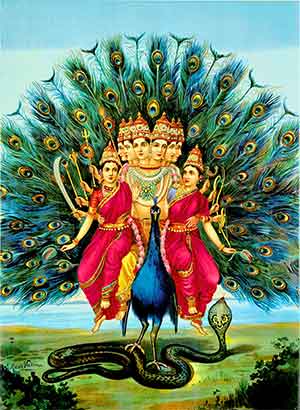
Kumaraswami, also known as Skanda, Murugan, Ayyappa and Subramanyaswami, is the elder son of Shiva and Parvathi. He is the commander in chief of the Shiva's army (gana). He was born with a purpose.
Historically, he is an ancient deity. Coins depicting his images belonging to the early Christian era and minted by the Kushanas were found in northwestern India.
His exploits as a warrior, his conflicts with Indra, his association with southern India and his status as the son of Shiva, allude to the rising importance of Saivism the changes that happened within the Vedic tradiion in ancient India, following the decline of the Vedic gods and their relegation to a secondary status as Dikpalas or rulers of directions.
Unlike Ganesha, Kumaraswami has a well built physique, darker complexion, and warrior like demeanor. In the images, he radiates strength and charm. Described as intelligent, knowledgeable, and swift in action, he uses a fullfeathered peacock as his personal vehicle.
According to the legends, he was created by Shiva and Parvathi to slay a demon by the name Tarakasura. After he was born, Shiva made him the commander in chief of his armies and instructed him to fight the demon. Though he was young, he fought bravely and slew the demon, for which he earned the title Tarkari.
As a boy he was suckled by the six divine mothers of the constellation known as Krittika (Pleaides) and thus came to be known as Kartikeya. As the elder son of Shiva he is addressed fondly as Kumara, which means a boy of eternal youth.
Since he is generally pleasant and peaceful, unlike the hyperactive Ganesha, he is also called Santakumara. Because he is very aggressive and a ferocious against his enemies during wars, he is called Skanda, which means he who attacks. He became Krauchabhetta after breaking apart a mountain called Krauncha. He is also known as Guha (the secret), Gangeya (son of Ganga) and Swaminatha.
In the images he is shown with six heads and twelve arms or with one head and two arms.
He is also depicted variously as sitting on his knees, seated on a pedestal with his Shaktis, standing by the side of his peacock or riding upon it.
The peacock is generally shown as holding a snake or standing upon its hood. Valli and Devasena, daugher of Indra, are his consorts or Shaktis.
His temples are generally located on the hill tops, suggestive of his association with Shiva who himself is a mountain dweller. Presently, compared to Ganesha, Kumaraswami is not that popular. However his popularity has increased in recent time immensely because of his connection with Swami Ayyappa.
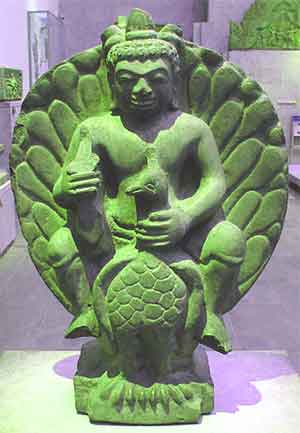
Swami Ayyappa: There is a famous temple in Kerala, on the top of a hill at Sabarimalai, which houses the famous deity, Swami Ayyappa. He is visited by millions of devotees every year during the winter season. In order to see this god devotees undergo many austerities and observations. They wear black clothes, observe 40 days of strict austerities and vows of celibacy and trek through a deep forest carrying their meager belongings and chanting all the way the name of Ayyappa.
According to the legends his original name was Manikanthan. He was created by the combined power of Vishnu and Shiva. Because of this he is also called Hariharaputra, the son of Hari and Hara.
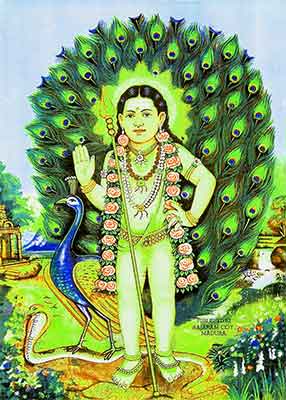
He was created specially for the purpose of killing a demoness called Mahisha who was the wife of Mahishasura, whom goddess Durga killed previously and who after the death of her husband, cried for revenge and started giving a lot of trouble to the gods.
Both Vishnu and Shiva decided to manifest Manikanthan and deal with this demoness. After he was created, Manikanthan was brought up by a king called Rajasekharan as his own son. At the age of twelve, Manikanthan slew the demoness and then disappeared having giving instructions to his father to build a temple in his name on the top of the hill.
This temple is today famous as the temple of Ayyappa of Sabarimalai. Many people believe him to be an incarnation of Kumaraswami.
Suggestions for Further Reading
- Hindu Gods - Lord Ganesha
- God and Self in Hinduism
- Goddesses of Hinduism, Their Symbolism and Significance
- Purusharthas in Hinduism
- The History, Antiquity and Chronology of Hinduism
- Ashrama Dharma in Hinduism
- Hinduism and Buddhism
- Death and Afterlife in Hinduism
- Hinduism and Divorce
- Hinduism and Adultery
- Hinduism, Food and Fasting
- The Future of Hinduism
- Good and Evil in Hinduism
- The Hindu Marriage, Past and Present
- What is Maya in Hinduism?
- The Origin and Definition of Hindu
- Hinduism and Polygamy
- Hinduism and polytheism
- Hinduism and Premarital Relationships
- God and Soul, Atma and Paramatma, in Hinduism
- About Suicides in Hinduism
- Religious Tolerance in Hinduism
- Violence and Abuse in Hinduism
- Traditional Status of Women in Hinduism
- Ashtanga Yoga of Patanjali
- About Hanuman or Anjaneya
- Hinduism and Same-sex Marriage
- Perspectives on What Karma Means
- Hinduism - The Role of Shakti in Creation
- Significance of Happiness in Hinduism
- Hindu God Lord Shiva (Siva) - the Destroyer
- The Role of Archakas, Temple Priests, in Hinduism
- Hinduism - Gods and Goddess in the Vedas
- Essays On Dharma
- Esoteric Mystic Hinduism
- Introduction to Hinduism
- Hindu Way of Life
- Essays On Karma
- Hindu Rites and Rituals
- The Origin of The Sanskrit Language
- Symbolism in Hinduism
- Essays on The Upanishads
- Concepts of Hinduism
- Essays on Atman
- Hindu Festivals
- Spiritual Practice
- Right Living
- Yoga of Sorrow
- Happiness
- Mental Health
- Concepts of Buddhism
- General Essays
This image of Kumaraswamy used for this article are either in public domain or licensed under the Creative Commons Attribution-Share Alike 3.0 Unported license.