
The Mandukya Upanishad
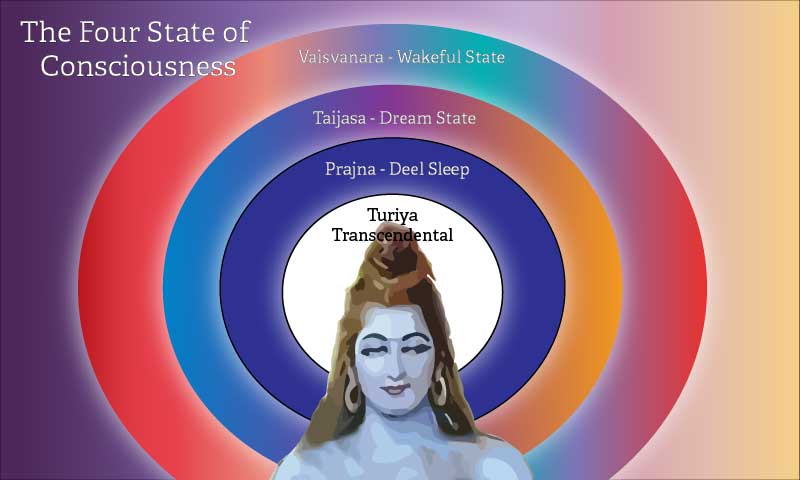
The Mandukya Upanishad belongs to the Atharvaveda. Although it contains only 12 verses, the Mandukya Upanishad occupies an important place in the development of Indian philosophical thought, following a commentary or Karika on it by Gaudapada, who is believed to be a teacher of Adi Shankaracharya's teacher.
Gaudapada's Karika on the Upanishad became the basis for the emergence of the Advaita Vedanta or the philosophy of monism, according to which Brahman alone is the truth and the rest is an illusion. The Upanishad deals with the symbolic significance of the sacred syllable Aum and its correlation with the four states of consciousness, namely the wakeful consciousness, dream state, the state of deep sleep or dreamless sleep and the state of transcendental consciousness in which all divisions and duality disappears and the self alone exists in its pure state, all by itself.
1. This syllable AUM is verily all this
This is the explanation about AUM:
The past, the present and the future are AUM,
And That beyond these three is also AUM.
2. Brahman is indeed all this.
This self in us is also Brahman.
And this self has four planes.
3. Vaisvanara is the first stage.
Wakeful, outwardly conscious,
With seven limbs and nineteen mouths,
He is the enjoyer of the gross objects.
4. Taijasa is the second stage.
Dreaming, inwardly conscious,
With seven limbs and nineteen mouths,
He is the enjoyer of the subtle objects.
5. In deep sleep, seeking no desires,
Dreaming no dreams, unified into
The mass of greater consciousness,
Full of bliss, enjoying bliss only,
Face turned towards Chetasa,
Is Pragna the third stage.
6. This is the Master of All, the Omniscient,
The Inmost Dweller and source of
Creation and destruction of all beings.
7. Conscious neither internally nor externally,
Nor either ways, neither ordinary consciousness,
Nor the greater and the deeper consciousness,
Invisible, otherworldly, incomprehensible,
Without qualities, beyond all thoughts,
Indescribable, the unified soul in essence,
Peaceful, auspicious, without duality,
Is the fourth stage, that self, that is to be known.
8. The same Atman is AUM among the syllables,
Each syllable in the word AUM is a stage. They
Are the letter A, the letter U and the letter M.
9. The wakeful Vaishwanara is the
First letter "A", being the first letter and
All pervasive. He who knows thus realizes
All his desires and becomes foremost too.
10. The dreaming Taizasa is the second
Letter "U", being superior and situated in
The middle. He who knows thus attains
Knowledge and children equally and none
In his family would be ignorant of Brahman
11. In the world of deep sleep, Pragna, is the
Third letter "M", being the limit and the end of
All diversity. He who knows thus is free from
All diversity and becomes one with the Self.
12. The fourth state is without parts and entanglements
Not bound to this world, It is auspicious and non-dual
Thus the form of AUM is verily the Self itself
He who knows thus enters into his own Self by himself.
The End
Suggestions for Further Reading
- The Samkhya Philosophy and 24 Principles of Creation
- The Bhagavadgita On The Problem Of Sorrow
- The Concept of Atman or Eternal Soul in Hinduism
- The Practice of Atma Yoga Or The Yoga Of Self
- The Problem of Maya Or Illusion and How To Deal With It
- Belief In Atman, The Eternal Soul Or The Inner Self
- Brahman, The Highest God Of Hinduism
- The Bhagavad Gita Original Translations
- The Bhagavadgita, Philosophy and Concepts
- Bhakti yoga or the Yoga of Devotion
- Hinduism And The Evolution of Life And Consciousness
- Why to Study the Bhagavadgita Parts 1 to 4
- The Triple Gunas, Sattva, Rajas and Tamas
- The Practice of Tantra and Tantric Ritual in Hinduism and Buddhism
- The Tradition Of Gurus and Gurukulas in Hinduism
- Origin, Definition and Introduction to Hinduism
- Hinduism, Way of Life, Beliefs and Practices
- A Summary of the Bhagavadgita
- Avatar, the Reincarnation of God Upon Earth
- The Bhagavadgita on Karma, the Law of Actions
- The Mandukya Upanishad
- The Bhagavadgita On The Mind And Its Control
- Symbolic Significance of Numbers in Hinduism
- The Belief of Reincarnation of Soul in Hinduism
- The True Meaning Of Renunciation According To Hinduism
- The Symbolic Significance of Puja Or Worship In Hinduism
- Introduction to the Upanishads of Hinduism
- Origin, Principles, Practice and Types of Yoga
- Hinduism and the Belief in one God
- Essays On Dharma
- Esoteric Mystic Hinduism
- Introduction to Hinduism
- Hindu Way of Life
- Essays On Karma
- Hindu Rites and Rituals
- The Origin of The Sanskrit Language
- Symbolism in Hinduism
- Essays on The Upanishads
- Concepts of Hinduism
- Essays on Atman
- Hindu Festivals
- Spiritual Practice
- Right Living
- Yoga of Sorrow
- Happiness
- Mental Health
- Concepts of Buddhism
- General Essays