
Evolution Theories of Hinduism
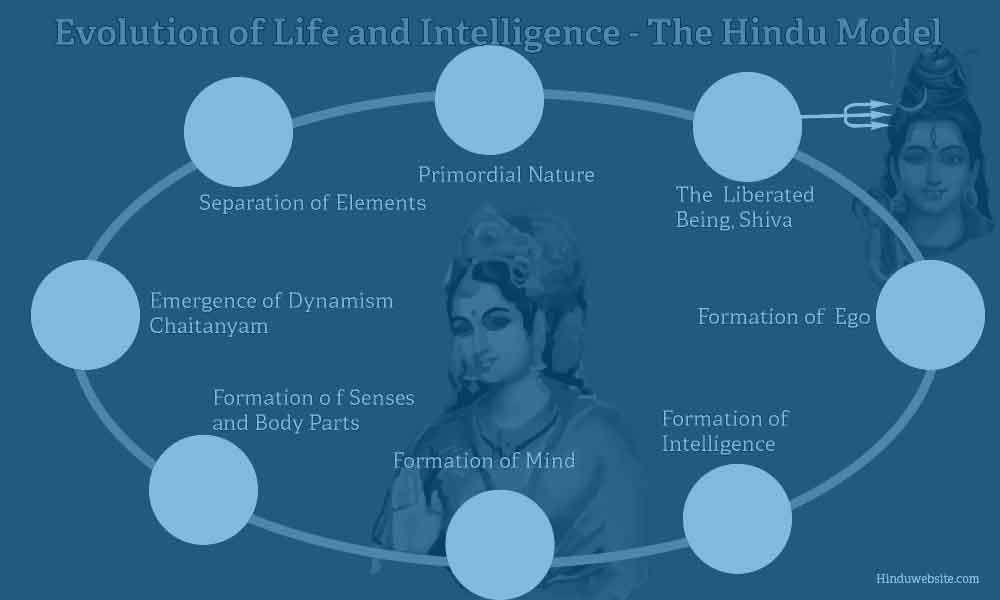
The evolution of life in Hinduism through the transformative and diversification process of Prakriti is not only about the evolution of the physical body, but also the evolution of the mind, ego, and intelligence in which desire and dynamism are the first manifestations, bondage and delusion, the intermediary, and liberation, the final. Jayaram V
Hinduism believes in the concept of evolution of life on earth. Although it is not the same as the one known to modern science, in many ways and in a very fundamental sense, it is not much different from the latter but wider in scope. The Hindu theory of evolution speaks about the evolution of not only physical life but also consciousness and intelligence
Modern science speaks of physical evolution and the evolution of nervous system, starting with simple life forms and proceeding to more organized and complex beings with well developed and self-regulating biological and mental mechanisms. Man is so far the known and the ultimate product of this very complex and continuous process.
Hinduism, on the other hand, presents a broad spectrum of the physical, mental and spiritual evolution of life on earth. Evolution in Hinduism is an integral and natural aspect of creation, which starts not with the emergence of life forms, but with the formation of matter itself as a movement of Nature under the will of God. It does not happen just on earth but universally from the highest to the lowest planes of existence. Creation, preservation, concealment, expression, and destruction are its fundamental driving and supporting mechanisms in which different realities (tattva) appear and disappear to create the illusion of duality, separation, impermanence, and diversity. On earth it is controlled and regulated not only by life but also by Death itself, which is also known as Time (kala). It speaks of the evolution of the beings from a state of ignorance to a state of illumination through progressive and successive intermediate states of partial ignorance and partial illumination. It alludes to a process that proceeds through several primary and secondary stages. For brevity and convenience, we have grouped them into seven stages (please refer to the illustration above). However, there can be more stages and more detailed processes which the scope of this essay does not allow us to discuss.
The seven stages of evolution
The first stage in the evolution of forms consists of the activation of Primordial Nature (mula Prakriti) and separation of the five base elements (mahabhutas), namely earth, fire, water, air, and space, and the activation of the three dormant modes (gunas) of dynamism, namely, sattva (the positive forward force), rajas (the balancing will force), and tamas (the negative, regressive or obstructive force). The admixture of these results in the emergence of inert and inanimate world. This is the first stage. In this phase tamas is predominant in the manifested objects.
The second stage consists of the emergence of life in the form of small organisms guided by the Rajasic force of desire for self-preservation and the tamasic force of instinct and impulse. It is followed by the emergence of body parts (karmendriyas) and one or more senses (jnanendriyas). The organisms at this stage possess one or more senses and limited perception. This is the third stage of the evolution (parinamam) of Prakriti.
In the fourth stage the organisms develop the lower or the primitive mind (manas) whereby they possess some awareness and limited ability to store memories, think, and act, which lead to the formation, development and strengthening of individual centers of consciousness in physical bodies that are mostly and vastly very inert and unconscious and driven by the force of blind instinct and natural impulse. The 2,3, and 4 are the stages in which rajas begins to predominate over tamas.
In the next two stages, organisms develop limited intelligence (buddhi) in varying degrees which results in the consolidation and concretization of individual consciousness into individual egos with the ability to act under their own individual and independent wills powered by the energy of desires, and the instinct of survival. This is the stage in which human beings emerge with varying degrees of knowledge and intelligence. It is also the stage where the beings possess well developed gross and subtle bodies, and sattva begins to gain ascendance over rajas and tamas.
The seventh phase consists of the development of discriminating awareness (parisilanatmaka buddhi) among human beings as they perceive the world around and learn through enquiry and exploration to discriminate truth from falsehood, and understand the causes of their suffering and their resolution. Some renounce the world and practice austerities, which leads to the gradual surrender and ultimate dissolution of their egos into Truth, Consciousness and Bliss. Beings in the liberated state possess soul consciousness or pure intelligence. They overcome the duality, including the duality of life and death, and cause and effect. It means they step into the shoes of the Creator and develop immense powers to create as well as destroy worlds and realities by mere thoughts. They will have resplendent ethereal bodies filled with pure light (suddha sattva).
The scientific model of evolution vs. Hinduism model
Thus, as we can see, the evolutionary process which we find in Hinduism is a transformative process of Nature from the primordial and unmanifested state (asambhutam) into a full blown and diversified manifested state (sambhutam). It is not only a physical process involving the evolution and emergence of the body and its parts, but also a subtle process involving the evolution and emergence of consciousness, individuality, intelligence and discriminating awareness. The process encompasses the evolution of the gross body as well as the subtle bodies. While science heavily rests upon the evolution of the physical being, Hinduism goes a step further to explain a more comprehensive and holistic vision of the evolution of the mental, intelligent, and spiritual being.
Science is yet to come to terms with the theory that man can consciously and willingly direct his evolution through the exercise of his will, intelligence and choice, whereas in Hinduism there is no such self-limiting belief. Science is yet to acknowledge that all creations of humans, including the intelligence they create through the so called "artificial" means, is part of Nature and an expression of Nature, and Nature works through humans and other beings as much as it works on its own to fulfill its designs and further the process of evolution. However according to the tenets of Hinduism, evolution is very much a product of individual effort that can be consciously willed and controlled under the guidance of an enlightened and discerning wisdom.
According to science, evolution is a process directed by Nature for its own inexplicable ends. It tries to maintain balance in the physical world and evolves forms that are progressively competent and mutually self-destructive. The evolving beings are at the best experimental models in its gigantic laboratory. Here each individual being has little freedom to determine its own evolutionary course or that of its species, and it has to participate passively in the drama authored and directed by Nature. Science cannot even definitively confirm whether Nature is an intelligent and self-guiding system or an accidental association of random processes.
In contrast, Hinduism explains the process of evolution from a wider perspective. It views the whole subject on a universal scale, going beyond the visible and the manifest forms of life to explain the mechanism that is responsible for the creation of not just the earth or its beings, but the entire universe in which exist different planes of reality and consciousness.
The vision that we come across in the scriptures is much wider and comprehensive. In them Nature is a powerful agent, an eternal indestructible but mutable entity that plays a very dominant role so long as an individual being is willing to remain under its control. When wisdom and insight prevail, the beings realize their folly and try to escape from its field of influence to return to their true essence, which is pure intelligence.
In the mortal world, only humans have such an ability and direct opportunity. Through their will and sincere efforts, they can succeed in overcoming their limitations that are imposed upon them by Nature and achieve liberation from its overwhelming and deluding dominance.
Evolution and involution
Thus, Hinduism interprets the process of evolution both from within and without, both as a mechanism of Nature and a product of self-effort, with a hidden purpose, which is the ultimate liberation of the soul. The objective is accomplished through the withdrawal of the senses and purification of the mind and the body. The transformation begins with a new awareness of the Self and the responsibility to detach the Self from external confusion, commotion, and surface reality. It leads to the gradual withdrawal of the being from the external world and a journey into itself and its core beingness. The next step involves elimination of all forms of desires, egoistic effort and impure thoughts, preferably under the guidance of an advanced being who has purified and upgraded his consciousness and awareness through self-effort and inner evolution. In the third stage one has to make desireless effort through detachment, devotion and self-surrender to realize the Highest Truth.
From unreality towards reality, from darkness towards light and from death to deathlessness: these are the chief aims of the terrestrial evolution of life in this world. Its primary objective is liberation, not control and domination, and immortality, not survival. It is a movement away from primeval Nature, and towards light and boundlessness. Its aim is not to render the being into a fit instrument under the control of Nature, or into a better player in the game of survival, but to establish the divinity in the being through the purification of intelligence so that it can transcend Nature, both within and without and attain immortality by returning to its pure and original intelligence.
Evolution is the expression of each individual being seeking to escape from the cycle of births and deaths and regain its lost glory. The process is neither instantaneous nor uniform, neither uniformly progressive nor easily predictable. There is no one particular way. There is no particular result. The paths are many and so also the methods as well as the outcomes.
There are no definitive standards here, except those that are sanctioned by the laws of creation. Intuitive awareness may help us to predict the possibilities and explore the opportunities. But the limitations are always there. The difficulties on the path are innumerable. Only an enlightened soul-intelligence can guide us safely across the mirage of life. So long as the being (jiva) is in love with its own chains and its distracting dreams, desires and faulty actions, the embodied soul has no escape and no hope from his own illusions.
The laws of evolution are applicable to all beings both in the mortal worlds and in the worlds of devas and the demons, for they too are a part of the creative and evolutionary process. The plants, animals, and the worlds of mere forms too evolve in their own limited ways towards light and delight.
The advantages of human life
In this play of God, humans have certain rare advantages. In the chain of evolution, they stand at an important threshold. Rare and precious indeed is the mortal life, which is attained after innumerable births and deaths, and which sometimes even gods envy for the opportunities it offers to humans not only to surpass themselves but also the gods and celestial beings to reach world of Brahman. While those worlds are fixed until the end of creation, the mortal world is impermanent and changeable. Hence, the opportunity to achieve liberation is inherent and integrated in its very design.
However, Nature does not let the humans achieve liberation without struggling and undergoing fundamental transformation in their core consciousness, knowledge and awareness. The pitfalls on the way are also many. By their wrong actions beings may falter and fall temporarily on the path and descend into the lower worlds, taking birth as animals, birds, insects, trees or plants. In extreme cases, they may also degenerate into demons and evil spirits. However, it is not the end. The beings who descend into hells and lower life forms can ascend again into higher life forms through good actions or with the help of the compassion and forgiveness of spiritual people.
The key to liberation is the right exercise of buddhi or discerning wisdom. When intelligence becomes sharp, the mind becomes stable, as people make right choices and follow righteous paths. It is by knowing the reality from unreality, truth from falsehood, right action from wrong action, right knowledge from wrong knowledge, one can ensure progress towards the state of supreme intelligence or the all knowing awareness. None can help him in this process except himself and his wisdom. In this great effort, the Self is one's own friend as well as one's own enemy. Those who fail to discriminate truth from falsehood have to relearn the same lessons until they become adepts in their knowledge of discrimination. They must have balance in their minds and bodies, without ignoring or giving up their worldly duties and responsibilities. Humans must participate in God's creation as his active agents to manifest his intent and will and uphold the order and regularity of the world. Those who fail to do so have to live with the consequences (karma). The Isa Upanishad (I.1.3) clearly warns those who want to shun the world and ignore their obligatory duties. "Demonic worlds enveloped in blinding darkness they enter after death those who are the slayer of the self." So does Lord Krishna in the Bhagavad-Gita, (Chapter 9, 14 and 16).
Evolution from here on, the vision of modern seers
According to Hinduism evolution happens both in the macrocosm and the microcosm, without any correlation between the two. Thus beings can quickly evolve even in a primitive world through self-effort and intelligent actions, while the world itself may have to wait for Time to reveal the will of God and push further the wheels of progress.
Shri Aurobindo was one of the contemporary seers of modern Hinduism who saw the vision of supermen evolving out of the present race of humans and establishing the foundation for a new world of super humans to emerge. With the awareness of an awakened soul who saw within himself the supramental designs of the universe, he declared that man could hasten his own evolution from the state of an ignorant consciousness being struck in an animal body struggling to express itself to the august state of a supramental consciousness manifesting itself in a divine and immortal body of light and bliss. He even prophesied that it would be possible to attain immortality at the cellular level of the human body by making each cell self-conscious in itself.
"To know, possess and be the divine being in an animal and egoistic consciousness, to convert our twilit or obscure physical mentality into the plenary supramental illumination.- this is offered to us as the manifestation of God in matter and the goal of Nature in her terrestrial evolution," he wrote.
Thus, it can be concluded that Hinduism believes in the cyclical nature of life as a result of the descent of consciousness into matter through association and diversification and its subsequent ascent into spirit through isolation and integration. Evolution happens through the involvement of consciousness in matter and liberation through their disassociation. From unity to diversity and then to unity. This is the intended order. Creation begins with the retrogressive process of the descent of the Universal Self into a playground of names, forms, and modifications, and ends in progressive phases with its ascent from the world of illusion into the reality of an eternal and indivisible state. Each being that comes into existence into the manifest worlds is in a state of transformative flux, with a hidden intent and purpose, to seek liberation from ignorance, darkness, delusion, and mortality, and move towards knowledge, light and immortality through a process of purification and illumination. Thus, the Self descends into the morass of mortal world to move the wheels of creation and bides its time until it is liberated
In Hinduism we learn that everything in creation has a purpose and a role. Existence is characterized by duality. Nothing can exist without an opposite. Creation and destruction are part of the same duality. The ultimate aim of all this is to facilitate the forward movement of life. Creation hides in its bosom the seeds of destruction and destruction hides in its design creation as the effect. If the birth of an individual is creation, his death is destruction in which is again hidden the source of his rebirth. It is through this repeated process of creation and destruction that individual beings evolve gradually through tiers and stages. The One indivisible Self, divides Himself into many in order to become One again. "In a word, godhead; to remake ourselves in the divine image."
The same is true with regard to cause and effect. They are inseparable. In the cause itself is hidden its effect, which only Time can reveal. Those who transcend Time by transcending Death (Kala) can bridge that duality and instantaneously precipitate an effect from its cause without the intervention of Time. It is what we call the ultimate Siddhi or the highest perfection, which is considered the power of God (divya shakti) or the Miracle of Manifestation (maha shrishti). That power is yours when you have the highest and purest intelligence beyond all duality, division and separation.
This in brief is the story of evolution in Hinduism.
Suggestions for Further Reading
- The Coming Age of Darkness - Why Evil Will Triumphs
- Pollution and Evolution
- The Process of evolution by Aurobindo
- The Superman by Sri Aurobindo
- The seven principles of man by Dr.Annie Besant
- The jivas or souls of Jainism
- Pudugala and Paramanu, The Atomic Theory of Jainism
- Death and Afterlife in Hinduism
- The Significance of Animals in Hinduism and Hindu Ceremonies
- The Origin and Development of Siddhas and Siddha Tradition
- Beware the Gods are Here
- The Samkhya Philosophy and 24 Principles of Creation
- The Bhagavadgita On The Problem Of Sorrow
- The Concept of Atman or Eternal Soul in Hinduism
- The Practice of Atma Yoga Or The Yoga Of Self
- The Problem of Maya Or Illusion and How To Deal With It
- Belief In Atman, The Eternal Soul Or The Inner Self
- Brahman, The Highest God Of Hinduism
- The Bhagavad Gita Original Translations
- The Bhagavadgita, Philosophy and Concepts
- Bhakti yoga or the Yoga of Devotion
- Hinduism And The Evolution of Life And Consciousness
- Why to Study the Bhagavadgita Parts 1 to 4
- The Triple Gunas, Sattva, Rajas and Tamas
- The Practice of Tantra and Tantric Ritual in Hinduism and Buddhism
- The Tradition Of Gurus and Gurukulas in Hinduism
- Origin, Definition and Introduction to Hinduism
- Hinduism, Way of Life, Beliefs and Practices
- A Summary of the Bhagavadgita
- Avatar, the Reincarnation of God Upon Earth
- The Bhagavadgita on Karma, the Law of Actions
- The Mandukya Upanishad
- The Bhagavadgita On The Mind And Its Control
- Symbolic Significance of Numbers in Hinduism
- The Belief of Reincarnation of Soul in Hinduism
- The True Meaning Of Renunciation According To Hinduism
- The Symbolic Significance of Puja Or Worship In Hinduism
- Introduction to the Upanishads of Hinduism
- Origin, Principles, Practice and Types of Yoga
- Hinduism and the Belief in one God
- Essays On Dharma
- Esoteric Mystic Hinduism
- Introduction to Hinduism
- Hindu Way of Life
- Essays On Karma
- Hindu Rites and Rituals
- The Origin of The Sanskrit Language
- Symbolism in Hinduism
- Essays on The Upanishads
- Concepts of Hinduism
- Essays on Atman
- Hindu Festivals
- Spiritual Practice
- Right Living
- Yoga of Sorrow
- Happiness
- Mental Health
- Concepts of Buddhism
- General Essays