
The Three Methods of Divine Communication
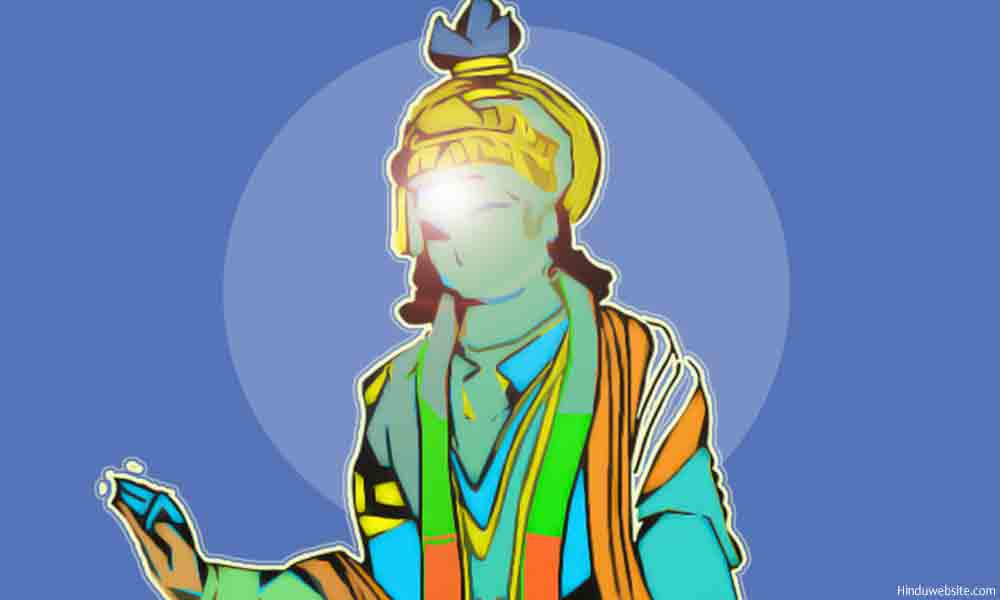
Bhagavadgita, Chapter 2 - Verse 10
10. Then Hrisikesa smiling, O Bharata, said these words to him in the middle of the two armies.
There is a lot of symbolic significance hidden in the narrative account of the Bhagavadgita. The scripture can be truly interpreted at various levels. The characters and ideas in it can be explained from various points of view. In the scripture, apart from Lord Krishna, one comes across three important personalities who participate in the divine discourse and receive the knowledge.
Symbolically, the three individuals represent the three methods by which man can receive divine knowledge from God. Arjuna represents the first method. He is the direct recipient of the Gita. Sanjaya represents the second method. He receives it through clairvoyance, while Dhritarashtra, the blind king receives it through the word of Sanjaya.
1. The direct method
This communication happened between Krishna and Arjuna. It is very rare that God directly speaks to humans in person and in a physical form. It happens once in a millennium or so in the history of humanity, and to highly evolved souls who are born for a purpose. There were few people in human history to whom God appeared in physical form and conversed them. Arjuna had that encounter with God, which lasted for a long time. He was a blessed soul who earned that rare honor because of his past deeds and the grace of Krishna. He saw not only his physical form but also his universal form.
2. The psychic method
God also communicates with humans through intuition, dreams and psychic or extra-sensory perception. In the Bhagavadgita, Sanjaya received the divine knowledge through this method. Sitting far from the battlefield, he was able to listen to the conversation between the Krishna and Arjuna. Although this method is more common than the previous one, it happens only in case of adepts who master their minds and bodies and perfect their spiritual practice. Through that perfection, they attain many supernatural abilities (siddhis), such as clairvoyance and telepathy. Sanjaya was a spiritual person who renounced the world and lived piously in the contemplation of God. He had the purity and perfection. Therefore, he was able to divine the communication between Krishna and Arjuna. History is replete with instances where people received divine knowledge through their psychic powers.
3. The verbal method
This is the most common method in which divine knowledge is received through verbal, oral or written communication from another person or source. Much of our religious and spiritual knowledge is acquired by people through this method only. For example, the knowledge of the Vedas was conveyed by Brahma to the seers. They, in turn, preserved the knowledge as the Vedas so that others can know them and participate in God’s work upon earth. In the Bhagavadgita, divine knowledge was transmitted to Dhritarashtra in this manner through Sanjaya.
Dhritarashtra was a blind king whose heart was polluted by envy, anger and selfishness. His blindness in the Gita symbolically represents his ignorance or spiritual blindness. He was an imperfect soul, who was driven by his desires and attachments. It is well known that it was actually his blind passion for power and his partiality towards his children which ultimately led to the battle of Mahabharata. Dhritarashtra symbolizes the fallen man, the ignorant person, the bound soul who is caught in the dualities of worldly life.
Perhaps, for such reasons and to help him cleanse himself Lord Krishna allowed him to listen to the discourse and redeem himself. However, as it happens with worldly people, the knowledge did not fully sink into the deluded mind of Dhritarashtra. He heard what he wanted to listen and ignored the rest as his attention was elsewhere and his mind was drawn towards his children and their activities in the battlefield.
The three methods are still relevant today. We must begin with the last method to acquire scriptural and spiritual knowledge by reading scriptures and listening to the discourses of spiritual masters. As our practice deepens, we may begin to receive divine knowledge through other means, in our dreams, deep meditative states and through intuition. If you are lucky, you may even get a glimpse of God himself.
Note : These commentaries are not part of the Bhagavadgita Complete Translation.
Suggestions for Further Reading
- The Samkhya Philosophy and 24 Principles of Creation
- The Bhagavadgita On The Problem Of Sorrow
- The Concept of Atman or Eternal Soul in Hinduism
- The Practice of Atma Yoga Or The Yoga Of Self
- The Problem of Maya Or Illusion and How To Deal With It
- Belief In Atman, The Eternal Soul Or The Inner Self
- Brahman, The Highest God Of Hinduism
- The Bhagavad Gita Original Translations
- The Bhagavadgita, Philosophy and Concepts
- Bhakti yoga or the Yoga of Devotion
- Hinduism And The Evolution of Life And Consciousness
- Why to Study the Bhagavadgita Parts 1 to 4
- The Triple Gunas, Sattva, Rajas and Tamas
- The Practice of Tantra and Tantric Ritual in Hinduism and Buddhism
- The Tradition Of Gurus and Gurukulas in Hinduism
- Origin, Definition and Introduction to Hinduism
- Hinduism, Way of Life, Beliefs and Practices
- A Summary of the Bhagavadgita
- Avatar, the Reincarnation of God Upon Earth
- The Bhagavadgita on Karma, the Law of Actions
- The Mandukya Upanishad
- The Bhagavadgita On The Mind And Its Control
- Symbolic Significance of Numbers in Hinduism
- The Belief of Reincarnation of Soul in Hinduism
- The True Meaning Of Renunciation According To Hinduism
- The Symbolic Significance of Puja Or Worship In Hinduism
- Introduction to the Upanishads of Hinduism
- Origin, Principles, Practice and Types of Yoga
- Hinduism and the Belief in one God
- Essays On Dharma
- Esoteric Mystic Hinduism
- Introduction to Hinduism
- Hindu Way of Life
- Essays On Karma
- Hindu Rites and Rituals
- The Origin of The Sanskrit Language
- Symbolism in Hinduism
- Essays on The Upanishads
- Concepts of Hinduism
- Essays on Atman
- Hindu Festivals
- Spiritual Practice
- Right Living
- Yoga of Sorrow
- Happiness
- Mental Health
- Concepts of Buddhism
- General Essays