Hinduism and Extraterrestrial Creation: Nature's Intelligence
Summary: If intelligent aliens created life on Earth, Hindu philosophy remains unshaken because ultimate creation traces to either God or Nature, regardless of intermediary agents. Hindu cosmology presents three compatible scenarios: God as both efficient and material cause; God as catalyst with Nature manifesting diversity; or Nature's aspects (including intelligent beings) participating in ongoing creation. Whether humans or aliens create life, they express Nature's intelligence. Current humanity approaches "Creation 2.0" through artificial intelligence and potential planetary colonization, continuing Nature's evolutionary agenda where intelligence enables beings to transcend mechanical natural processes and shape cosmic destiny deliberately.
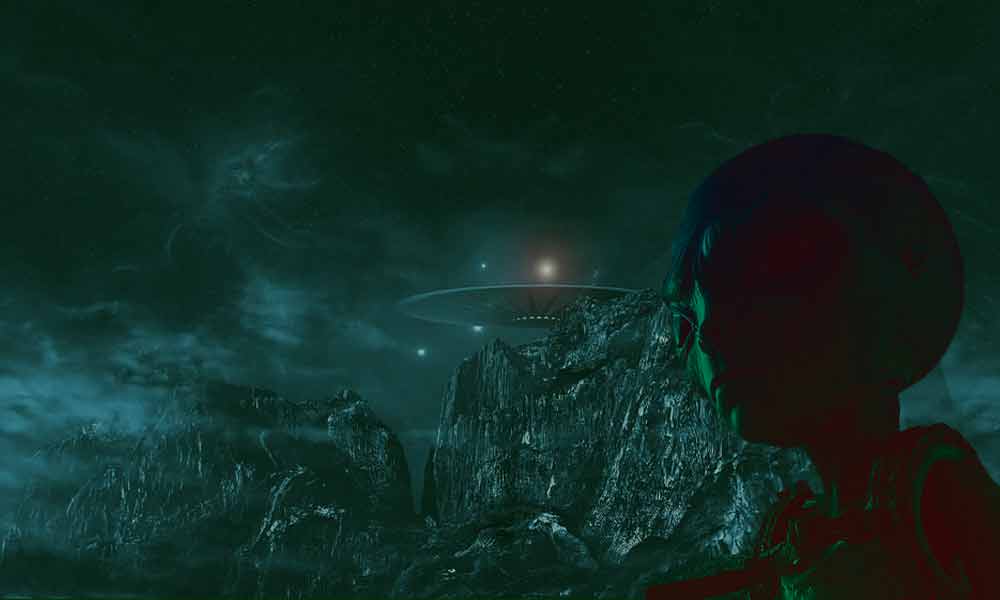
The science fiction film Prometheus gives the impression that life on Earth might have been created artificially by intelligent aliens from another planet and that they might have used Earth as an experimental laboratory or a nature park to produce various life forms and study or test them. While we do not know whether it ever happened, it is possible that we, human beings, may extend life to other planets in the near future and follow a similar course.
We may establish colonies, create life forms, and exploit their resources. If we can do it with our knowledge and intelligence, we cannot rule out the possibility that some aliens can do the same. This leads to some interesting speculation about God and the nature of creation. The first question we may have to answer in this regard is: if it is true, what are its implications for our religions and our age-old belief systems?
I cannot speak for other religions, but from the perspective of Hinduism, this theory does not alter our beliefs or our theories of creation as presented in our scriptures. In Hinduism, there are many schools and sects, each having a long history, tradition, and belief system of its own. Most of them portray God as either the direct or indirect source of creation. Most of the narratives that deal with creation do not present it as instantaneous, but rather as a gradual process of separation and diversification, accomplished by the deluding power of Nature in stages under the impetus provided by God.
Thus, the first material objects appear with the differentiation of the five elements. Then, primitive life forms appear without senses. Next, some life forms appear with one or more senses, followed by beings having a mind, self-awareness (ego), and, finally, intelligence. In other words, two eternal entities are involved in creation: God and Nature. God is pure consciousness endowed with Supreme Intelligence. Nature is an aggregate of diverse component realities known as tattvas. The highest of them is natural intelligence, which only humans possess on Earth. Intelligence gives us the ability to discern things, think rationally, and make decisions for ourselves. Therefore, it also binds us to the law of karma.
In Nature, or even in creation, three types of actions are self-evident: natural or mechanical actions, intelligent actions, and chance events or acts of God. The Samkhya school of Hinduism presents Nature as a blind or mechanical force, which is also accepted partially by other schools. The argument is that Nature, unlike God, has no will and produces nothing new; all the effects it produces are already hidden in their causes. The natural laws, such as the laws of physics, chemistry, and mathematics, are great examples of Nature's automated functionality. In other words, Nature is a programmed entity, an automaton, a blind force that manifests what is already present in it in seed form. Once it is triggered, it springs into action and produces whatever effects or modifications are hidden within its domain.
This mechanical aspect of Nature is more evident in the case of lower life forms, which are guided mostly by instincts and natural impulses. The force of Nature is very strong in them. However, the equation changes with the emergence of intelligent beings, who have the intelligence and ability to make their own decisions and change the course of Nature, and even creation, if necessary. They are subject to Nature, but have a mind of their own. With their intelligence, they can arrest the processes of Nature, imitate them, improve upon them, and even create new processes. With them in charge of the world, natural intelligence assumes control of life on Earth. With the help of intelligence, they begin to interfere with the processes of creation and even Nature to achieve their own desired ends.
With our ordinary knowledge and intelligence, we cannot fathom the role of God in creation. We may discern it in the random acts of God (daivikam) that shape our destinies on Earth, or in the chance events that change the course of life, as has happened several times in the past. For example, no amount of intelligence can explain the disappearance of dinosaurs from Earth or the emergence of human beings from primitive human groups. Someday, our scientists may find the causes, but they will not know why those events happened. Perhaps chance played a role there, just as chance plays an important role in major genetic mutations that occur on Earth regularly. However, while such events are inexplicable in rational terms, we can clearly discern the role of Nature and intelligence in creation, in our lives and in the world in general. Every living being is a creator in its own way. We create our lives. We create our future. We create our thoughts and actions. We even create our idols, which we worship as God in image form. We are thus creators of our little worlds, the lords of our minds and bodies. Most life forms imitate Nature or follow its methods to create or procreate, but we, human beings, have the ability and intelligence to subvert Nature and create things according to our will and vision. Our creativity stems from our intelligence. This intelligence is part of Nature. We have it because Nature assembled its aspects in our minds and bodies. While we may take credit for our creations, actions, and achievements, in truth, their primary source is Nature alone.
Three possible scenarios of creation
Thus, from the above discussion, the following scenarios of creation emerge. These are speculations or possible outcomes and should not be interpreted as prophetic certainties.
- God may be the efficient as well as the material cause of creation. With His supreme intelligence and inviolable will, He manifests Nature, individual beings, and, through them, all the diversity that we experience through our senses. With His indomitable and indestructible power, He controls and regulates everything, establishes order and regularity (rta), decides how long the worlds should last, and when they should be destroyed. This is one school of opinion that holds God as the source of all.
- In the diluted version, we may regard God only as the efficient cause and passive Witness. By His very presence, He provides the impetus to Nature, which is the material cause and the source of all manifestation and diversity. Triggered by the mere presence of God or souls, Nature manifests the worlds and beings and upholds them until the end of creation. This is another school that recognizes an equal, if not greater, role for Nature in creation.
- In the more complex version, presented by this author, and which is perfectly in harmony with either of the above, we may recognize the role of not only Nature but also its aspects in facilitating creation. This is based on the premise that whatever is produced by the aspects (tattvas) of Nature is also part of Nature alone. Whatever we create with our minds, bodies, knowledge, and intelligence, out of desires and our individual wills, is also part of Nature's creation. Therefore, in life, not only Nature but also its aspects and entities take part. For example, if someday we create life on a planet like Mars, we may either take credit for it or ascribe it to Nature, from which we derive our intelligence. From this perspective, it does not matter whether God was the creator, Nature, or some intelligent group of beings. The direct source may be humans or some aliens, but the ultimate source is either Nature alone or perhaps both God and Nature.
Natural vs. artificial intelligence
Life on Earth is not artificial. It is created by Nature, even if we assume that it was created by a group of intelligent aliens from a faraway planet, because their ultimate source is also Nature alone. Whatever creation has happened so far on Earth, with the direct involvement of Nature, let us call it Creation 1.0. Whatever creation may happen from now on, because of our knowledge and intelligence, let us call it Creation 2.0. Going by the way Nature works, Creation 2.0 is going to be very disadvantageous to human beings, since most likely they will be surpassed and outnumbered in every respect by the very beings they may create in the future, either naturally or artificially. In fact, we are already on our way to creating artificial intelligence, which is going to be far superior to our own. Those who possess it, like the robot in Prometheus, will not only set in motion a new phase of evolution but will probably also learn to control the world and humanity like never before, just as we learned to control Nature, which created us, by studying it and understanding it.
This is not science fiction. This is a theoretical possibility. If the current trends are any indication, we are already on course for Creation 2.0. Nature is not going to manifest life on other planets in our solar system. It may perhaps happen over a few million years if we let Nature have its way, but we are not going to wait until then. Human beings will do it in much less time, provided they manage to survive against their own wickedness and evil impulses and succeed in transcending their animal nature and shortsightedness. A great destiny awaits humanity, provided they are willing to rise to the task and take responsibility for the universe they know, and which they can claim as theirs, instead of waiting for the destruction of the planet so that they can ascend to a heavenly world in great rapture. In the present context, the odds are heavily against them. The world seems to be set on a self-destructive path, and our intelligence seems, thus far, to be ineffective against it.