
Bhagavadgita: 17. The Yoga of the Threefold Division of Faith
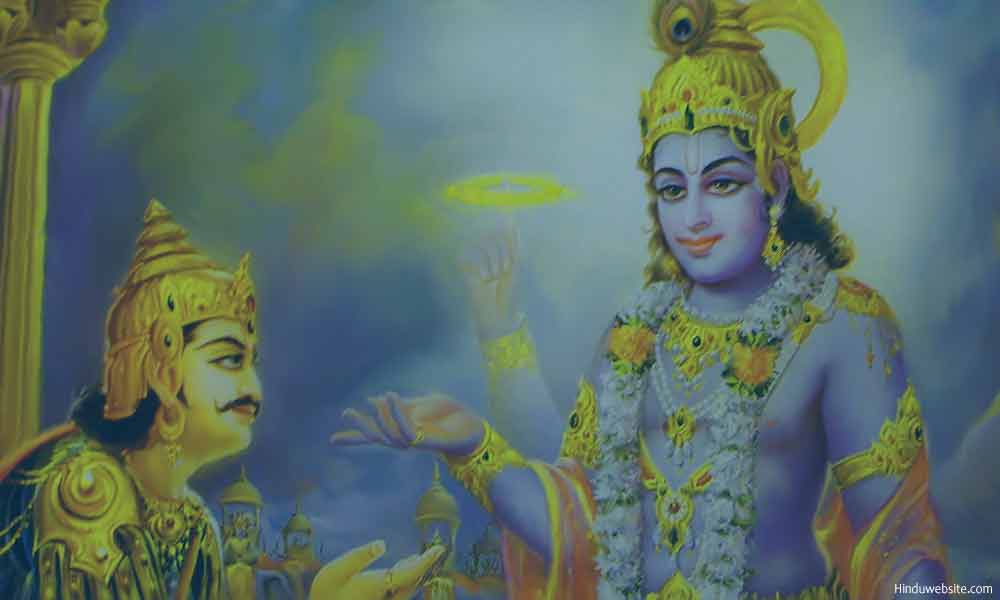
Summary: This chapter deal with the influence of the triple gunas upon the faith, austerity, charity and the natural disposition of the people. The faith of a person is determined by his purity. The purest ones worship Supreme Brahman and follow rights methods of worship and spirituality. The impure ones worship lower gods and follow extreme methods.
Shraddha Traya Vibhaga Yoga
1. Said Arjuna, Those who give up the scriptural injunctions, but continue to worship you with full faith, what is their devotion O Krishna? Is it sattvic, rajasic or tamasic ?
2. Replied Lord Supreme, In three ways exists the faith of the embodied according to their own nature, sattva, rajas and also tamas. Now, hear that from Me.
3. Everywhere, O Bharata, faith is in accordance with one's (level of) purity. A person is made up of his faith. As his faith, so is he. .
4. The sattva people worship gods. The rajasic ones worship Yakshas and Rakshasas (celestial spirits and demons), and the remaining tamasic people worship fallen spirits and ghosts.
5. Against scriptural injunctions perform harmful penances those ascetic people, filled with conceit, egoism, desire, passion and strength.
6. Subjecting the entire body to senseless torture, and along with it all the elements there in, including Me also who is situated with in the body. Know them to be certainly demonic in nature.
7. Food is also found to be tasty in three ways, as are sacrifices, austerity and charity. The difference amongst them, now listen.
8. Increasing longevity, purity, strength, health, happiness and taste, juicy, oily, durable in nature, is the food liked by sattvic people.
9. Bitter, sour, salty, hot and spicy, burning, is the food liked by rajasic people, which gives them unhappiness, sorrow and disease.
10. Stored and devoid of any juices, dried, foul smelling, decomposed, left over and indigestible food is dearer to the men of tamasic nature.
11. The yagna, which is performed without the desire for the fruit of the yagna, that yagna is certainly performed with the mind fixed in sattva nature.
12. Desiring the fruit of action, for the purpose of display and show, the sacrifice that is performed, O Bharata, know it to be of rajasic nature.
13. Without proper order, without the distribution of food, without mantras, without charity to the priests, devoid of faith, the yagna becomes recognized as tamasic in nature.
14. Worship of gods, of the twice born, of the spiritual teacher and of the knowledgeable; celibacy and non cruelty, this is called austerity of the body.
15. Dispassionate words that are truthful, pleasant and beneficial and also used in the recitation of the Vedic scriptures , this is said to be austerity of speech.
16. Mental satisfaction, gentleness, silence, self-control, purification of thoughts, this is called the austerity of mind.
17. When performed with exceptional faith, this austerity of three kinds, by men who have no desire for the fruit of their actions, is called sattvic.
18. Austerity that is performed for gaining popularity and honor and also for display is regarded in this world as rajasic, which is also unstable and distracted (or without concentration).
19. The austerity that is performed out of foolishness, struggle and by self torture, with an intention to harm others, this is referred as tamasic in nature.
20. The charity that is worth giving, given without any expectation, according to the time and place and to the deserving person, is remembered as sattvic.
21. The charity which is given for the sake of a reciprocal advantage or with the expectation of a result, or given in return (for some advantage or gain), or given grudgingly or with difficulty, that charity is to be remembered as rajasic.
22. That charity which is given without consideration for the time and place, to undeserving persons, without due respects, without proper knowledge, is said to be tamasic in nature.
23. ' AUM TAT SAT'- thus was specified Brahman in three ways in the chanting of the Brahmins in the past, while studying the Vedas and performing Yagnas.
24. Therefore the followers of Brahman always start their sacrifices, charities, austerities and actions with OM as specified in the scriptures.
25. Uttering 'TAT' thus, without desiring the fruit of their actions, they perform sacrifices, austerities, charities and various other sacrifices who intend to achieve salvation.
26. The word 'SAT' is used to denote the sense of Truth as well as the sense of the follower of Truth. O Partha, the word 'SAT' is also used to denote truthful actions.
27. It is said that 'SAT' is situated in sacrifice, austerity and charity. Work performed for the sake of truth is also referred as 'SAT'
28. Without faith whatever sacrifice that is offered, charity given, or austerity performed are said to be 'ASAT' (false), here and hereafter, O Partha.
Thus ends the seventeenth chapter named the Yoga of the Threefold Division of Qualities in the Upanishad of the divine Bhagavad-Gita , the knowledge of the Absolute, the yogic scripture, and the debate between Arjuna and Lord Krishna.
Suggestions for Further Reading
- The Samkhya Philosophy and 24 Principles of Creation
- The Bhagavadgita On The Problem Of Sorrow
- The Concept of Atman or Eternal Soul in Hinduism
- The Practice of Atma Yoga Or The Yoga Of Self
- The Problem of Maya Or Illusion and How To Deal With It
- Belief In Atman, The Eternal Soul Or The Inner Self
- Brahman, The Highest God Of Hinduism
- The Bhagavad Gita Original Translations
- The Bhagavadgita, Philosophy and Concepts
- Bhakti yoga or the Yoga of Devotion
- Hinduism And The Evolution of Life And Consciousness
- Why to Study the Bhagavadgita Parts 1 to 4
- The Triple Gunas, Sattva, Rajas and Tamas
- The Practice of Tantra and Tantric Ritual in Hinduism and Buddhism
- The Tradition Of Gurus and Gurukulas in Hinduism
- Origin, Definition and Introduction to Hinduism
- Hinduism, Way of Life, Beliefs and Practices
- A Summary of the Bhagavadgita
- Avatar, the Reincarnation of God Upon Earth
- The Bhagavadgita on Karma, the Law of Actions
- The Mandukya Upanishad
- The Bhagavadgita On The Mind And Its Control
- Symbolic Significance of Numbers in Hinduism
- The Belief of Reincarnation of Soul in Hinduism
- The True Meaning Of Renunciation According To Hinduism
- The Symbolic Significance of Puja Or Worship In Hinduism
- Introduction to the Upanishads of Hinduism
- Origin, Principles, Practice and Types of Yoga
- Hinduism and the Belief in one God
- Essays On Dharma
- Esoteric Mystic Hinduism
- Introduction to Hinduism
- Hindu Way of Life
- Essays On Karma
- Hindu Rites and Rituals
- The Origin of The Sanskrit Language
- Symbolism in Hinduism
- Essays on The Upanishads
- Concepts of Hinduism
- Essays on Atman
- Hindu Festivals
- Spiritual Practice
- Right Living
- Yoga of Sorrow
- Happiness
- Mental Health
- Concepts of Buddhism
- General Essays
Copyright: All rights are reserved. No part of this publication may be reproduced stored in a retrieval system, or transmitted in any form or by any means, electronic, mechanical, photocopying, recording, scanning or otherwise, except for your personal use, without the prior written permission of Hinduwebsite.com or the author Jayaram V. If you want to publish the FREE Translation of the Bhagavad gita on your website please contact us and take our prior and written approval.