
The Myth, Romance and Historicity of Alexander and His Influence on India
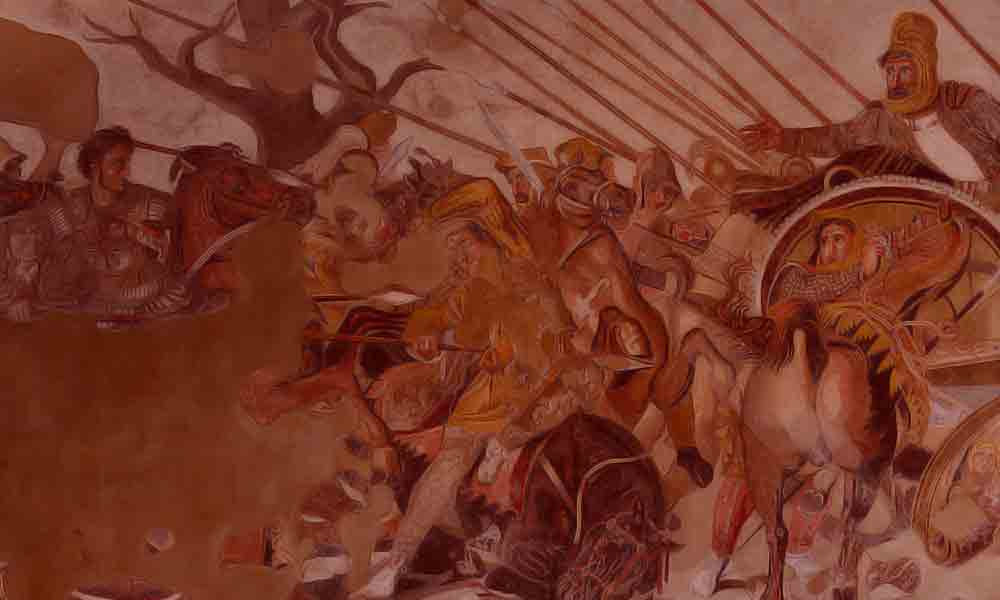
Alexander in a Battlefield
Introduction
The rewriting of Indian history by Indians has been faced with opposition from many sides and they are of all categories based on varieties of interests involved at national and international levels and strategies. When the Aryan Invasion hypotheses and theories are questioned and demolished and even historians have started considering them, new hypotheses and theories are floated under the guise of genetic studies bringing out new evidences to show that the Dravidians had different genes and Aryans different genes.
As the question of Alexander's invasion and his alleged contemporaneity with Chandragupta of Maurya dynasty has also been questioned, now the western scholars have started floating or reviving the old discarded myths again. The alleged intrusion of Alexander myth in the Hindu pantheon is one of such suggestions. Indian scholars immediately pointed out the fallacies involved in such hypotheses put forward4. However, as some scholars5 have tried to resurrect such myth recently, the background is critically analyzed in the context. As it delves around the Greek source materials and accounts, they are examined minutely to expose the myth behind it. In fact, the author refuted it effectively inviting the wrath of one of such scholars.
The British historians, who collaborated with the East Indian Company Rulers, have decided to fix the invasion of Alexander as a sheet anchor of Indian history1. They decided that before 327 BCE, no incident of India could be considered historical2. They wrote that the advancements of Indian arts and sciences were also only outcome of Alexander's invasion and adapted and adopted from the Greeks3. The British historians first and later, western historians have consistently fixed that the Alexander's invasion of India has to be taken as sheet anchor of India history. Thus, the history of India, in proper has been made to start with 327-326 BCE.
Not satisfying with that history, now, they try to interpret and restrict the history of Indian thought, philosophy, ethics and other subjects also after that date. Independent fixing of dates of personalities and events had not, has not and is not made in Indian historical methodology. Many times, attempts have been and are made to link the date of one personality with that of the other and one event with other, and if one does not suit the other, either way it is adjusted to come close together according to their predetermined hypotheses and theories. The proceedings of a conference1 held in Germany stress that the date of Buddha is 240 BCE only and therefore, Indians could think philosophically only with the Greek philosophy after the invasion of Alexander! Therefore, it is imperative that not only the historicity of invasion but also that of Alexander and connected factors have to be scrutinized by Indians carefully to find out the truth.
Conception, Development and Establishment of Myths
In every tradition, culture, religion, or civilization, heroes are made Gods in the long run. If the chosen heroes do not belong to them, they are divinized and converted to suit the local traditions superimposing with local similar myths. Not only Gods, even heroes are created from the prototypes and archetypes of other cultures, traditions and civilizations. With the political domination, the ruling masters try to interpret such myths as originals to that of the dominated. Thus, histories are written and rewritten with the engaged-scholarship.
No doubt, archaeological evidences support for the existence of one particular personality, but it might not be historical. Scholars, as they proceed in one particular orientation, knowingly or unknowingly, they could create such historical personalities with the archaeological evidences out of myths and fables for the purpose or otherwise, as they have to follow others or accepted and established hypotheses and theories. If the accepted and established hypotheses and theories are subjected to analytical and critical study, they turn out to be fables and myths only, as they are too based on the available evidences. Many times, they accept the agreeable evidences to suit their hypotheses and theories and reject, ignore or even destroy the non-agreeable, unfavorable and troublesome evidences, which are inconvenient to them questioning their hypotheses or theories or in short, their credibility.
The Greek Accounts and Histories
As popularly believed the source materials for Alexander (c.October 356 BCE to June 13, 323 ) is scanty and much of his history has been written based on fables and secondary sources of later period. Scholars have pointed out this fact. While discussing about the Records of Alexander, Greene2 notes that, : ..the really authentic records are so scanty. There are no contemporary authorities for the history of Alexander. All written so-called histories are based on secondary or even third sources of much later period.
The western historians have depended upon –
- Arrian (c.90-170 or 96-160 CE)'s Anabasis onf Alexander,
- Quintus Curtius (date uncertain, though western scholars assign 1st to 5th centuries of CE),
- Plutarch (c.46-100 CE),
- Justin (c.2nd century of CE) and
- 5. Diodorus (c.first century of CE).
All these five have made use of earlier writers whose works are reportedly lost or not available, i.e, the sources are unauthentic and unverifiable. They were writing after 300 to 800 years after Alexander. And the writings of them do not agree with any matter, as published and pointed out by the westerners themselves. There have been hundreds of legends and fables about Alexander. After loosing all secondary-secondary sources, how the sketchy details transformed into history is seen from the books published by the western scholars:
No Historical Records Exist For Alexander
No historical records exist for Alexander and even contemporary evidences of any category are found as all were lost long back, as has been accepted by the historians themselves. Robin Lane Fox, gives the following details:
1. More than twenty contemporaries wrote books on Alexander and not one of whom survives.
2. They are known by quotations from later authors, not one of whom preserved the original wording.
3. These later authors are themselves only known from the manuscripts of even later copyists and in the four main sources these manuscripts are not complete.
4. The most detailed history goes back to only one manuscript, whose text cannot be checked.
5. Another much used has often been copied illegibly.
6. Alexander left no informal letter, which is genuine beyond dispute, and the two known extracts from his formal documents both concern points of politics.
7. The written evidence for Alexander is scarce and often peculiar.
Thus, for the existence of Alexander –
1. No contemporary evidence is available.
2. All the so-called contemporary writings about him were reportedly lost irrecoverably.
3. Even the available secondary sources compiled from the fragmentary sources belong to later period.
4. There is nothing mentioned in the Indian sources of any period. In fact, the ancient texts have not even whispered about his name. But, he is made the Great only on his alleged invasion and conquest of India.
Alexander, the name
The writers of Alexander have been silent about the origin of it. Though dictionaries mention different forms of Alexander they do not explain how they originate.
In fact, such forms are reportedly found in the books written about the Romance of Alexander. After that the word Alexander is derived from Alexandrine or Alexandrin means of doubtful origin. Alexander was in fact not the First one, but the Third ruler of Macedonia. Alexander I (c.507-463 BCE) and Alexander II (c.369-367 BCE) were there earlier ruling Macedonia. In fact, Alexander had a son called Alexander. Even the historians and epigraphists have not been specific about the meaning. In the Indian context, they have made many guess work without any evidences, as the Greek writers mention words Alexandrum, Androcottus, Androcottos, Xandrames, Angrammes, Ganderatai and so on similar to each other.
1. The myth of Chandragupta meerting Alexader started with Plutarch, who refers to a meeting between Alexandrum and Androcottos.
2. Justin reads Nandrum in the place of Alexandrum.
3. Androcottos can be anybody, as andro = male, prefix is common in Greek, e.g, Andromeda etc.
4. Curtius refers to one Agrammes as the present King ruling at Palibothra / Pataliputra etc., which scholars identify as Nanda or Chandragupta.
5. Diodorus refers to one Xandrames as the present King ruling at Palibothra / Pataliputra etc., which scholars identify as Nanda or Chandragupta.
6. Plutrach refers to another King Gandaritai ruling India.
7. Chandragupta is also identified or equated with different expressions
Therefore, which name denotes whom or of whom who is Chandragupta etc., would be only wild goose chase and not of any historical pursuit.
Again about the word Alikasundara as found in the Asokan Rock Edict No.XIII, the western scholars are not anonymous:
1. Fleet4 and others identify him as Alexander of Corinth (c.252-244 BCE).
2. Buhler5 identifies with Alexander of Epirus, who died between 262 and 258 BCE relying upon Lassen.
3. AP.Dascalakis6, a professor of University of Athens opines that –
the names like Alexandros…………….are purely Greek, and at the same time points out that certain names including Alexandros are obviously borrowed from pre-Greek mythology.
Therefore, whom exactly, the words Alexander and its forms referred to are still in doubt and not final. All these go to prove that the Greek classical accounts complied from different secondary sources and available today not at all reliable. Incidentally, an important point arises here is the famous of Chandragupta among the Greek writers. It is not known as to why so much of importance is given to him, that too, when he was a child or boy, when Alexander was reportedly on the banks of Hydaspes or Acesines very far away from Magadha!.
The Birth and Death of Alexander
The birth of Alexander is shrouded with mystery and legends. He was born in a night to Olympias, the daughter of Neoptolemus, prince of the Molossi, when the great temple of the Asian Goddess at Ephesus was supposed to have been burned down. She was fierce and beautiful7! His father, Philip divorced Olympias and married Cleopatra, thus Alexander was estranged from him and his legitimacy was suspected. Later Olympias murdered Philip elevating Alexander to an advantageous position. Other versions accuse Alexander of patricide.
How Alexander died is mystery, though, historians asserted that he was died of a mysterious disease, after the conquest of India! When he was dying, Peucestas and some others of the Companions passed the night in the temple of Serapis and asked the god whether they should convey the sick man into the temple, if haply the might be cured there by divine help, but a voice warned them not to bring him, but to let him remain where he lay! Bury8 characteristically notes that, such is the punctilous and authentic account of in the Court diary; but it is not sufficient to enable us to discover the precise nature of the fatal disease. These details are discussed to show that they have no similarity with that of Skanda archetype or Skanda form of worship.
Then, how to Interpret Alexander historically on Others? The western scholars have been compromised miserably and proceeded further just to historicize Alexander for their historical purposes. Many times, they have to depend upon the forged, concocted and fabricated literature, collectively known as The Alexander Romance. Therefore, historians have to be careful in taking such mythical legends for historical interpretations. They cannot try to make mole out of a mountain.
The Alexander Romance
Like the Alexander's invasion on India, the Alexander Romance has also been exploited by the westerners to belittle India. Some have tried to interpret that the Skanda / Kanda worship has been developed only from the Alexander myth. Therefore, such Romances turned myths have to be analyzed critically. The Alexander Romance is nothing but superstitious, legendary and mythical narrations developed based on earlier myths and circulated in the name of Alexander.
This legendary narrative took shape in Egypt, mostly some five centuries after Alexander's death. Earlier elements and a few facts survive among its wild fiction. Because of the spread of the Romance of Alexander, there are Afghan chieftains who still claim to be descended from his blood. Seventy years ago they would go to war with the red flag they believed to be his banner, while on stormy nights in the Aegean, the island fishermen of Lesbos still shout down the sea with their question, Where is Alexander the Great?, and on giving their calming answer, Alexander the Great lives and is King, they rest assured that the waves still subside (RLF, p.26).
His only measurement is given in the fictitious Romance of Alexander , where he is said to have been three cubits, or four feet six inches high…….Only in German myth was Alexander was remembered as king of the dwarfs, and it would perhaps be rash to explain his ambition on the assumption that he was unusually small (RLF, p.41).
Philips orders Aristotle to teach Homer to Alexander (RLF, p.59).
……..Alexander is said to have been crowned as Pharaoh of Upper and Lower Egypt, an honour only mentioned in the fictitious Romance of Alexander; this crowning cannot be dated to any one month, but is supported by the Pharonic titles which were applied to him in the inscriptions of the country's temples. As Pharaoh, he was the recognized representative of god on earth, worshipped as a living and accessible god by his Egyptian subjects; he was hailed as Horus, divine son of the sun god Ra whose worship had prevailed in Lower Egypt, and as beloved son of Amun, the creator of the universe, whose worship had flourished in the temples of Upper Egypt and grown to incorporate the worship of the more southerly Ra. This divine sonship fitted him to the dynastic past of the native Pharaohs, for he could be said to share their common father Amun-Ra, who visited the Pharaoh's mother to father each future king; (RLF, p.196-197).
Romance of Alexander gives the details of death of Alexander as to how he was poisoned to death (RLF, p.462).
The author discusses about his deification in pages 436-460 Chapter 31. He was worshipped as god in Egypt and Greece.
This romance / the German myth also gives a hint that the myth might have been adapted and adopted from the Vamana avatara, where, the Dwarf Vishnu conquers the entire world, which is well known in India. The main feature of the dwarf incarnation is to conquer the world. As usual, to reverse the facts, the historians must have resorted to this reverse method of writing history as has been done in other cases.
The Alexander's Invasion of India
Encyclopedias14 have been cautious in narrating about the Alexander's invasion of India, because, he never reached India proper. They never record that he conquered India, though they mention about his invasion of India. In fact, there has been a tradition that the Indian forces defeated him and he was forced to retreat.
In the battle of Jhelum a large majority of Alexander's cavalry was killed. Alexander realized that if he were to continue fighting he would be completely ruined. He, therefore, requested Porus to stop fighting. Treye to Indian tradition Porus did not kill the surrendered enemy. After this both signed a treaty. Alexander then helped him in annexing othere territories to his kingdom15.
Recently, a project on Alexander after working extensively, created a website, which points out the following facts:
1. Alexander's ideas concerning India were …still sketchy in the extreme.
2. To the Greeks, the land across the Indus was a shallow peninsula, bounded on the north by the Hindu Kush (it was known as such only in the medieval period) and on the east by the great world-stream of ocean, which ran at no great distance beyond the Sind desert, implying that there were no countries.
3. On the main Indian sub-continent, let alone the vast Far Eastern land-mass from China to Malaysia, they knew nothing.
4. In general Alexander's ignorance of Indian geography remained profound.
5. His whole eastern strategy rested on a false assumption.
6. When enlightenment came, it was too late.
7. The great Ganges Plain, by its mere existence, shattered his dream more effectively than the army could have done.
Therefore, the historians have made a frivolous attempt during 19th century to make Alexander invade India obviously to strengthen their invasion theory of colonized nations.
The Nile and Nila Explode the Myth of Alexander's Invasion on India: Alexander and Virgil considered and named Indus as Nile.
According to the geographical theories of the earliest Greeks, the Prometheus Bound is described as follows: This condition was fulfilled by the river Indus. Arrian (vi, I) mentions that Alexander the Great, when preparing to sail down the Indus 9having seen the crocodiles in the river Indus, and in no other river except the Nile…..), seemed to himself to have discovered the sources of the Nile; as though the Nile, rising from some place in India, and flowing through much desert land, and thereby losing its name Indus, next…….flowed through inhabited land, being now called Nile by the Ethiopians of those parts and afterwards by the Egyptians. Virgil in the Ivth George echoes the obsolete error,
Blavatsky16, after giving these details notes that –
Alexander, who was better acquainted with Attock than with India – for he never entered India proper – could not have failed to hear the Indus near its sources, called Nil and Nila. The mistake – if mistake it is – is thus easily accounted for
The Greek cartographers have cleared showed that the world ends with Arabia during the material period. No two maps tally with each other in any detail. In fact, they later start to identify India as Indian extra-Gangem and India intra-Gangem. Whereas, there were Greek scholars who considered India as a land of knowledge, wealth and so on, and thus, later even mentioned as paradise on the earth. But, because of the complexity, they started misrepresented the facts of India.
The Difference Between Greek and Indian Geographers
Greek geographers and other experts made Alexander to believe that he had reached the end of the world, after he crossed Persia. But, Indian geographers, astronomers and cosmologists had clear idea about the world, existing countries and even Universe.
The Creation of Alexander Romance
The Alexander Romance has been the creation of medieval writers and later glorified by the Christian and Islamic apologists. They contain fairy tales making different countries inheriting Alexander to be their king, son and so on. He takes different forms visiting many countries performing miraculous acts. Particularly, the stories connecting him with India brings out the following details17:
1. India was the paradise of the earth. It contained enormous
wealth.
2. India had many spiritual men, who were not afraid
of him.
3. Alexander reached earthly paradise, but he was turned
back at the gate, because only the just can enter there! But he
was given a mysterious ball, which turned into a eyeball warning
him that he would go to earth as dust (According Babylonian Talmud
story datable to 500 CE).
4. Alexander came to a great city
on the banks of Ganges or Euphrates, which had a wall with one window.
When he went there, an old man appeared. He asked for the tribute
and the old man gave a stone of mystic meaning advising him that
the city was the earthly paradise and home of the blessed (According
to a 12th cent. German story).
5. Alexander took revenge against
the Brahmins, as they critically injured him and killed his horse.
6. He was born of a snake in Egypt and flew to India to attack
Brahmins.
The above stories have certain truth, as vouchsafed by the Greeek accounts:
1. Certain Indians were beating their feet on the ground and they explained the significance as follows: O king Alexander, each man possesses just so much of the earth as this on which we stand; and you being a man like other men, save that you are full of activity and relentless, are roaming over all this earth far from your home troubled yourself, and troubling others. But not so long hence you will die, and will posses just so much of the earth as suffices for your burial (According to Arrian).
2. He hanged many Indian philosophers, as they reviled him and encouraged the free states to revolt against him.
3. He also captured ten Indian sadhus or gymnophists and executed them, as they spoke against him. Before dying one of them replied for the query of Alexander as to why they induced other to revolt against him, as follows: Because I wished him to live with honor or die with honor.
4.This is similar to the request of Porus.
Alexander in his life had seen only killings, horrors of war and terror of death. But, here, he found people, who were not afraid of death. Who showed the way that swords could not do anything before them or conquer the hearts of people. However, he persecuted them, because of his frenzied zeal. He could not understand the meaning and power of non-violence and hence died on June 13, 323 within three years from the date of killing Indian spiritualists and philosophers.
Alexander destroyed the works of the Zoroaster, the founder of the Fire-temple of Azareksh18. He routed the Persian empire and destroyed the places of worship and thus, certain Muslim rulers regarded him as a model in carrying out their jihad against kafirs. Thus, Sikandar Lodhi (1488-1517), Sultan Sikandar, the Idol Breaker of Kashmir (1386-1410), Sikandar Shah of Bengal and others assumed the titles of Alexander to imitate him! But, this archetype or myth started with 14th century in India.
About his conquer of India: Much of his history has been glorified with his invasion of India. Therefore, it is analyzed next.
Chivalry suited the politics of balancing one Punjab rajah against another, but Indian historians have been unable to believe this intelligent generosity and still argue that if Porus received such honours, India's alleged defeat at the Jhelum can only be a western falsehood (RLF, p.361).
The retreat he inspired has always seemed sympathetic. Alexander's eastern plans have not been well received by historians: many have argued that they never existed and some have maintained that all mentions of the Ganges, are best discarded as legend (RLF, p.371).
It is to be noted that for the Alexander invasion of India, there are no historical evidences, but there are only secondary-secondary evidences written much later. Therefore, really, it is a wonder that such unhistorical narrative has been thrusted and imposed on Indians as historical fact and it has been in the academic curriculum for the last 60 years.
But, in the case of Alexander, the source materials are scanty, even at secondary-secondary stages, the available materials have to be treated and handled with caution. Here, no bias, prejudice and pre-conceived notions can be given place in research. As Fox has accepted that more than twenty contemporaries wrote books on Alexander and not one of whom survives; they are known by quotations from later authors, not one of whom preserved the original wording; these later authors are themselves only known from the manuscripts of even later copyists and in the four main sources these manuscripts are not complete; the most detailed history goes back to only one manuscript, whose text cannot be checked. Another much used has often been copied illegibly- the other way is also possible- i.e, Alexander would not have come to Indus, met Porus, retreated etc.
Then, how the narrative given can be accepted? Let us now deal with the details of them:
- Chivalry suited the politics of balancing one Punjab rajah against another, but Indian historians have been unable to believe this intelligent generosity and still argue that if Porus received such honours, India's alleged defeat at the Jhelum can only be a western falsehood: The cruel nature of Alexander has well been brought out by the western historians and therefore under the circumstances, the treatment of Porus by the victor Alexander makes one to suspect the Victor's victory. In fact, the psychology of the poets / writers in eulogizing the Defeated was to make him a Victor always.
- The retreat he inspired has always seemed sympathetic: Because, already many soldiers were killed. His pet horse was killed or died. The rest of the army had already started revolting and urging him to return.
- Alexander's eastern plans have not been well received by historians: The historians know very well that the Greek scholars had no knowledge of India's geography and real capabilities, as they were imagining it as a dreamland.
- Many historians have argued that they never existed and some have maintained that all mentions of the Ganges, are best discarded as legend: As he had to retreat from the Jhelum, probably after his defeat from Porus, there was no question of his reaching going beyond and reaching India.
The more, we go into the details of Alexander's invasion and conquest of India, the more we get details about such fabrication. It is evident that the Greek writers have exaggerated his campaign and the western historians blew into extraordinary proportion to appear as if he conquered the entire world to become the Great! However, they have been careful enough to deal with the subject. But, as some of them want to rack up the issue, we have to check them for authenticity. From the above, it is evident that the Greek writers have manipulated / forged even the much later documents to fabricate the Alexander's invasion on India. Therefore, as there are no historical evidences, it is better to discard them as narrative as has been maintained by the historians themselves, just like the Romance of Alexander. Therefore, if Indian historians consider the defeat of Porus is western falsehood, definitely, there is a strong case. Therefore, the Indian historiography has to be changed accordingly.
What was the Direct and Indirect Effect of Alexander's Invasion of India? Vincent Arthur Smith19 gives answer to this crucial question, which is reproduced as follows:
1. Whatever Hellenistic elements in Indian civilization can be detected were all indirect consequences of Alexander's invasion. The Greece influence never penetrated deeply. Indian polity and structure of society resting on the caste basis remained substantially, unchanged, and even in military science Indians showed no disposition to learn the lessons taught by the sharp sword of Alexander (emphasis added).
2. Alexander's fierce campaign produced no direct effects upon either the ideas or the institutions of India. During his brief stay in the basin of the Indus, he was occupied almost solely with fighting. Presumably, he was remembered by the ordinary natives of the regions which he harried merely as a demon-like outer barbarian who hanged Brahmins without scruple and won battles by impious methods in defiance of scriptures, Indians felt no desire to learn from such a person (emphasis added).
Smith has only corroborated the killings and violent inhumane crimes meted against Indian spiritualists and philosophers as pointed out. Thus, the guilty consciousness is revealed in the Alexander romance in later days.
The Methodology Adapted by the Greeks in Alexander's Romance and as well as in Greek Histories:
The Greek writers were having less information about India and they were writing imaginary descriptions about India. However, there were genuine visitors to India From Greece. They included Pythogorus (c.550 BCE), Plato (427-347 BCE), Appolonius and others. Scholars like Socrates were influenced by the Indian thought20. As they were reflecting Indian thought, they were persecuted, poisoned and killed. Others adapted and adopted to eulogize Greeks against Indians, thus, the Classical accounts, in spite of glorification of Alexander's exploits, contain some facts, because, Alexander killed innocent Indians and philosophers and sages against all moral principles. The guilty consciousness worked through the minds of the Greek writers and as well as the modern and western histroriographers.
Jacob Burchhardt21 succinctly assessed the mindset of them as follows:
Followers of Alexander pretended find these myths native to the orient in order to flatter him. They transformed the Caucasus from the north to the Eastern (Indian) ocean by the simple expedient of naming certain mountains in India Caucasus and showed him in the Paropamisus, a ridge of mountains to the north of India, a cave serving as a prison from which Herakles freed Prometheus. They flatteringly compared Akexander himself with Herakles by demonstrating that he had reached as far in his campaigns as Herakles had travelled.
The Greeks reveal a falsifying trait by their forgeries and interpolations. It is highly characteristic that the very first epistle in the later Trojan legend is a forgery. Genealogies and documents were often unreliable: the works of Acusilaus, the ancient Ionic historian, were in their later form a notorious forgery. He supposedly derived them from bronze tablets his father had dug up. Laws and enactments of popular assemblies were casually forged; the latter are betrayed by the garullous motivations adduced like those of the Athenian resolution to honour Hippocrates.
I we also consider the opposite of forgery, namely, the suppression of authentic dates and documents, we shall get an idea of the difficulties besetting the critical researcher everywhere. However, like Thucydides, sought what is true, first had to discriminate truth from poesy, second truth from falsification, at every step of the way. And finally, Greek historiography was weak in dealing with events long past but acquired fame in presenting contemporary or recent events.
Therefore, Indian researchers have to be careful in dealing with non-Indian source materials in dealing with Indian subjects. It is better to exhaust indigenous source materials and then cross check with non-Indian sources.
Does the World conqueror Myth Developed out of Vamana Avatara? That the Alexander romance has been connected with the German myth has been mentioned above. They give a hint that the myth might have been adapted and adopted from the Vamana avatara, where, the Dwarf Vishnu conquers the entire world, which is well known in India. The main feature of the dwarf incarnation is to conquer the world. As usual, to reverse the facts, the historians must have resorted to this reverse method of writing history as has been done in other cases.
Donald A. Mackanzie has pointed out that the Varaha paintings and sculpture are there in the Great Britain. Thus, the Varaha myth associated with the world conquest must have been prevalent in different parts of world with their traditions.
Suggestions for Further Reading
- The Myth, Romance and Historicity of Alexander and His Influence on India
- The History of Bharata or India According to Indian Astronomy
- Distortions in Indian History, Dealing With Core Issues
- A Comparative and Critical Study of Shankaradeva, Vallabha and Chaitanya
- Was Bhakti Movement Anti Women?
- The history of Afghanistan
- Akbar, Emperor of India
- Alexander's Invasion of India. Fact and Fiction
- Descriptions Of Ancient India During Mauryan Period
- The Pros and Cons of the Theory of Aryan Invasion into India
- History of Atheism in Ancient India
- Caste system the Bane of Hinduism
- The Bravery of Ancient Indians
- Herodotus Account of India
- History of Hinduism - the Ancient Period
- Hinduwebsite - the History Section
- The Biggest Holocaust in World History
- The Religion of the Indus Valley Civilization
- The Arthashastra of Kautilya
- The Historical Origin of Lord Krishna, the Incarnation of Vishnu
- Traces of the Mahabharat in Sangam Literature
- Science and Religion in Ancient India
- Religious Tolerance in Ancient India
- Essays On Dharma
- Esoteric Mystic Hinduism
- Introduction to Hinduism
- Hindu Way of Life
- Essays On Karma
- Hindu Rites and Rituals
- The Origin of The Sanskrit Language
- Symbolism in Hinduism
- Essays on The Upanishads
- Concepts of Hinduism
- Essays on Atman
- Hindu Festivals
- Spiritual Practice
- Right Living
- Yoga of Sorrow
- Happiness
- Mental Health
- Concepts of Buddhism
- General Essays
Notes and References
1. 2. Elphinstone, History of India, 5th edition, p.11. Fleet, Imperial Gazeteer of India, Vol.II, Epigrapgy in Indian Empire, p.3,5,6. Vincent A. Smith, Oxford History of India, Clarendon Press, 1923. Max Mueller, What India Can Teach Us?, pp.3-8.
3. Vincent Arthur Smith, opt.cit., Max Mueller, opt.cit.
3. John Bentley, Hindu Astronomy, Calcutta. James Ferguson, On the Study of Indian Architecture, London, 1867, Parta Mitter, Much Maligned Monsters, Clarendon Press, Oxford, 1977, London.
4. Heinze Bechert (Ed.), When Did Buddha Live? The Controversy on the Dating of the Historical Buddha, Sri Satguru Publications, New Delhi, 1995.
The editor accepts the lacunae in the problem, but tries to fix the date around 480BCE. He even suggests that if the Japanese dates of 290 BCE etc., could be accepted, the influence of Greek philosophy on India after the invasion of Alexander could be noted.
4. K. V. Ramakrishna Rao, The Myth of Deification of Alexander and its Alleged Influence on Kanda-Muruga-Karttikeya Worship, a paper presented during the Second International Conference on Skanda-Muruka held at Mauritius from May 2000. See the website http://murugan.org/events/2001_synopses/rao-1.htm
5. Robin Lane Fox, Alexander the Great, Penguin, 1986, U.K.
6. Greene, History of Greece, U.K, 1943, p.473.
4. Fleet, Epigraphica Indica, Vol.II, Motilal Banarasidas, 1970, p.471.
5. G. Buhler, Asoka's Rock Edicts, in Epigraphica Indica, Vol.II, Motilal Banarasidas, 1970, p.471.
6. Ap. Dascalakis, The Hellenism of the Ancient Macedonians, Institute for Balkan Studies, 1965, Greece, p.65, 66.
7. Greene, opt.cit, p.404.
8. J. B. Bury, History of Greece, Macmillan & Co., U.K, p.821.
9. Encyclopedia Americana, The International Edition, Vol.I, 1998, p.540; The New Encyclopedia Brittanica, Vol.13, p.226, Crolier Encyclopedia, Crompton's Encyclopedia etc.
10. E.A.W.Badge (Editor), Ethiopic Texts, .
11.Blavatsky, The Secret Doctrine, Madras, 1975, Vol.III, p.416.
12. Richard Cavensidh, Man, Myth and Magic, New York, 1983, pp.1090-103.
13. Blavatsky, opt.cit., Vol.III, p.19.
14. Vincent A. Smith, The Oxford History of India, Clarendon Press, UK, 1923, p.87 and 139, quoted verbatim with emphasis added.
15. E. Migot, Memoris Sur les anciens philosophers de l' Inde, andMemories de l' Academie Eroyal des Inscriptions et Belles, Letters, XXXI, 1761,-63, pp.90-92.
Richard Garbe, India and Christendom, The Open Court Publishing Co., La Sale, Illiones, 1959.
E. Pocoke, India in Greece, Orient Publishers, New Delhi, 1976.
21. Jacob Burchhardt,History of Greek Culture, Constable Publishers, London.
16. P. K. Agrawala, Skanda-Karttikeya, Banaras Hindu University, Varanasi, 1967, p.xiv.
He pointed out that - At some early stages in the study of Indian thought, a view was hazarded that Skanda was nothing but a Sanskritization of the name Alexander. But how fantastic is this frivolous statement we need not comment upon it. That Skanda is not an intruded deification of Alexander is again clear from the Chandayoga Upanishad where he is identified with Sanatkumara. The date of the Upanishad is unanimously regarded earlier than the Greek invader by several centuries
17. Patrichk Harrigan, Skanda-Iskandar and the Alexander Romance : History and Diffusion of Mythic Archetypes, Souvenir of the First International Conference Seminar on Skanda-Murukan, 1998, p.187.
N. Gopala Pillai, Skanda: The Alexander Romance in India, All India Oriental Conference, 1937.
18. Mahaffy discusses in his Problems of Greek History, 165, sqq. And Wilamowitz-Mollendorff in Aristoteles and Athen, 808, 1.40 (quoted by J.B. Bury, p.883).
19. J. B. Bury, opt.cit., p.828.
© KV Ramakrishna Rao, M.A., A.M.I.E., C.Eng(I)., B.L. All rights reserved. No part of this article should be reproduced in any form without prior permission of the author.