
A Comparative and Critical Study of Shankaradeva, Vallabha and Chaitanya
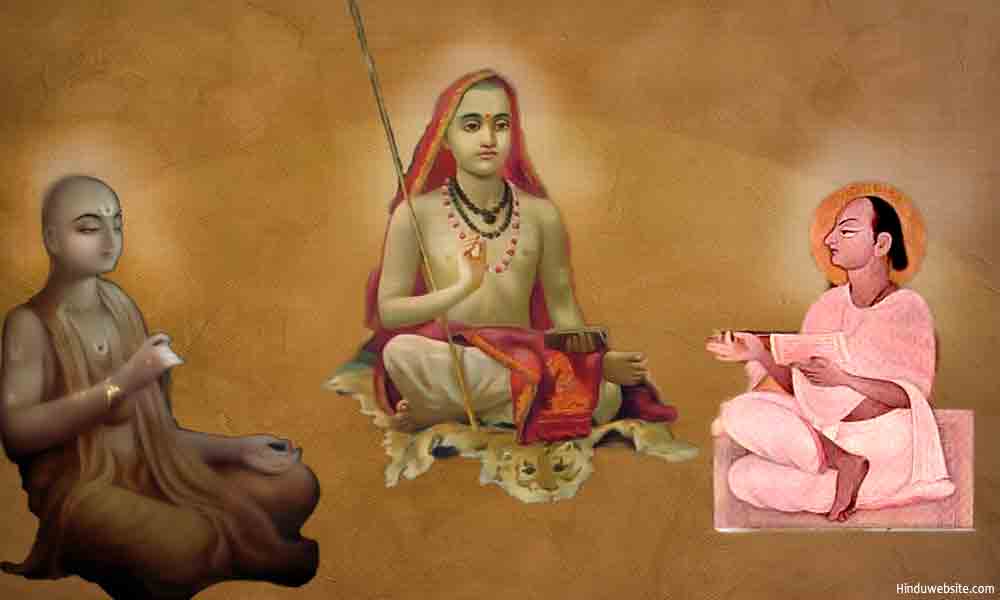
Sri Chaitanya Mahaprabhu, Adi Shankara and Sri Vallabhacharya (From Let)
Introduction
The existence of the three important saints Shankaradeva, Vallabha and Chaitanya during 15th and 16th centuries, particularly, when Muslim rulers tried to establish their hold over India is not a mere coincidence or past parallelism or ordinary happening, but a historical fact coupled with socio-economic-religious significance. While Ala-ud-Din Alam Shah (1443-1451 CE), Bahlol Lodhi (1451-1488), Sikandar Lodhi (1488-1517), Ibrahim Lodhi (1517-1526), Babur (1526-1530), Humayun (1530-1556), Sher Shah Suri and his successors (1540-1556 were ruling parts of north India, the Bahmani Sultans Mohammed Shah II (1463-1482), Mahmud (1482-1518), and later rulers (1518-1526), were ruling south India.
The representatives of Delhi Sultanates were ruling from Bengal. Malikkaffur (1305-1311) had already made his inroads up to Rameswaram sending shock waves in the minds of people. Thus, the people, particularly, of rural and village areas, were exposed to a new religious creed entirely different from them, affecting their physical and psychological factors of all walks of life considerably.
Incidentally, the period (where the three saints lived and laboured) was dominated by many saints of Bhakti movement like Vidyapati (1400-1477), Narsi Mehta (1414-1481), Chandidas (1417-1477), Guru Nanak (1469-1538), Surdas (1479-1584), Tulasidas (1511-1637), Kabirdas (1398-1527), and others carrying out their work at different parts of India. Such crowding of saints committed with the principles of social reformation during the period is not a mere coincidence, but a well planned attempt of them to save the Indian society from the atrocities of the alien rulers and raids inflicted on the religious, social and political institutions.
The saints, religious heads and reformers had therefore chosen ahimsa as a method to counter the trauma inflicted on the Indians. The adaption and adoption of Bhakti movement as the most non-violent method against all negative factors have been something unique in their technique. That Gandhiji followed such non-violent methodology later is not surprising, as both Gandhiji and his disciples like Vinobha bhave were greatly influenced by the teachings of these three saints. Getting beatings without preventing or rising arms against, bearing all atrocities without rising arms (weapons), taking poundings on their chests with upright bodies, giving up lives before the blood curdling sword carrying fanatics etc are not cowardice acts, but the most strongest acts on the earth, as the earth bears every exploitation of men but keeps quite. Non-violence against violence might be a unique phenomenon as observed by others, but it is practiced in India since time immemorial. Thus, the Bhakti movement became the most non-violent movement on the earth.
Though scholars interpret that the saints followed advaita philosophy, it appears that they actually followed dvaita philosophy, though differed in some aspects according to the exigencies. Their concepts of Brahman, Jiva, Jagat, Mukti, Vidhya, Bhakti and other factors had deviated considerably from the advaitic ideas. Because of the similarity of such philosophical concepts and the following of Vaishnava sampradaya, it is possible that they might have been influenced by the Madhwa philosophy (1238-1317). They transformed the high philosophy of the learned and elite to simple devotion to God, continuous repetition of God’s name, singing and dancing, so that even common men can get the benefits. They travelled extensively, particularly rural areas meeting common people understanding the reality of the then prevailing social and political conditions. The simple but attractive Krishna and devotion to Him were propagated at length and breadth of the country. They travelled without carriages and horses; without protection and food; without any fear or favour; But, they gave and preached love, devotion, sympathy, brotherhood and such other qualities and characters to all men without any discrimination.
Shankaradeva, Vallabha and Chaitanya
The contemproneity of Shankaradeva (1449-1568), Vallabha (1479-1532) and Chaitanya (1486-1533) is an important factor to study their unique service rendered to the humanity. Particularly, the longevity of life1 of Shankaradeva for 119 / 120 years is interesting to note, as he would be 30 (1479-1449=30), when Vallabha was born and 37 (1486-1449=37) when Chaitanya born and he continued to live 36 years (1568-1532=36) and 35 years (1568-1533=35) after them. Therefore, there is a reason to believe that he must have known not only Vallbha and Chaitanya, but also others.
He set out on a pilgrimage2 to different Vaishnava cultural centres of northern India in 1483 Viz., Gaya, Puri, Brindavan, Mathura, Dwaraka, Kasi, Sitakunda, Brahmakunda, Ayodhya, Badrikasrama etc and returned to his place in 1495. This is his first pilgrimage and about seventeen followers accompanied him. Thus, in his sojourn of thirteen years, he had met other saints of the day at those places. He would have been a witness to the political incidents, sociological problems and the acts of many reformers of the period.
In 1533, he went out on a second pilgrimage with a large number of his followers. He visited the tomb of Kabirdas (1398-1527), where he reportedly claimed that Kabir was not a Jaban (non-Hindu), but a Param Vaishnav. Therefore, he must have visited the areas of the Gangetic plain after 1527, after the first Panipet battle (1526). He must have also heard about the death of Guru Nanak (1469-1538) in 1538. Thus, Shankaradeva must have known the contemporary events and understood the prevailing social, political and economic conditions.
Unlike, Vallabha and Chaitanya, Shankaradeva is not popular outside Assam. Even the books and works, dealing with Bhakti movement, mention hardly anything about Shankaradeva. Thus, it is difficult to note as to whether Shankaradeva influenced other two or the other two influenced him, because of the popularity of the latter. However, as the movements of them were mass based, definitely their interactions, contacts and connections are important to be studied considering the underlying commonality of them.
Moreover, it is evident that each had restricted or chosen their area of operation, as Shankaradeva concentrated in Assam, Vallabha in Gujarat and Rajasthan and Chaitanya in Bengal and Orissa. Shankaradeva’s compositions of borgeets (hymns), anklanaat (dance-drama), sankirtans (recitals), setting up of sattras (monasteries) and namghars (prayer halls) have certain things common comparing to methods of Vallabha and Chaitanya. Considering the climatic conditions of Assam, opposition to his new doctrine and persecution by the sakta priests and rulers, he might have chosen people to assemble inside naamghar and perform borgeets instead of doing on the roads and public places.
Shankaradeva and Vallabha
There is no evidence that Shankaradeva had ever met Vallabha, even though both were contemporaries, but, he must have heard about him, because of his longevity of life (119 years) and active role played in the spread of Krishna consciousness. His second pilgrimage was in 1533 and Vallabha was reported to leave his mortal coil in 1532. Therefore, if at all they could meet, they would have met only in 1532-33, which might be highly improbable. In last years, Vallabha spent most of the time in writing commentaries on the scriptures of Vaishnava sampradhaya, even being a grahasta. Shankaradeva too by being a grahasta did an excellent job. He reduced such high philosophical ideas to ordinary songs and plays understandable to ordinary men including illiterate. In Vallabha’s marga, the new followers were initiated with the mantra “Sri Krishna Saranam Nama” meaning “Sri Krishna is my refuge” or “I surrender to the Supreme God”. A similar expression was used to initiate the new bhaktas of Shankaradeva also. It consisted of four words Rama, Narayana, Krishna and Hari.
Shankaradeva and Chaitanya
In his second pilgrimage in the year 1533, had Sankaradeva been at Puri, he might have met Chaitanya and it could have been taken place before June 14, 1533, i.e, before Chaitanya’s demise. Chaitanya specifically ordered Nityananda to go to Bengal to spread his ideals. Therefore, he must have heard about Chaitanya’s movement earlier and the historic meeting of Vallabha and Chaitanya. His disciples might have had contacts with the Chaitanya’s disciples, because of the popularity of latter’s movement.
Here it is pointed out that there have been differences of opinion about the meeting of Shankaradeva and Chaitanya. Some scholars have gone to extent of asserting that Chaitanya went to Kamarupa and preached, though there are no evidences to that effect. It is evident that the difference arises only in the context of influence of Chaitanya on Shankaradeva, as otherwise, they could have very well met. Moreover, Chaitanya need not have influenced Shankaradeva in the context of Nama-sankritana, as such practice had been in Assam since early centuries onwards. An eighth century inscription clearly proves it3.
About the possibility of the meeting of the saints, the biographers4 opine as follows:
1. Some biographers claim that Shankaradeva had seen Chaitanya.
2. Later writers hold the view that they had conversation.
3. Daityari and Ramaraya , the principal biographers are unanimous that –
1. Shankaradeva met Chaitanya.
2. No conversation took between them.
3. Shankaradeva did not receive any direct teaching from Chaitanya.
Here, it may be noted that the dispute is mainly about the influence of Chaitanya on Shankaradeva and not about their meeting. During their pilgrimage, as they conducted for years together, it is a fact that they met many saints, religious leaders and others at different places. But, that does not mean that each other influenced them and vice versa. Even, if there were similarities, there is nothing wrong in such methodology, as it was meant for specific purpose, directed against a target and ultimately to achieve the target. The unanimous working, consensus application and determined methodology are to be appreciated.
His disappearance on June 14, 1533 at Puri from the temple of Gundicavadi must have also provoked him, as it was big news at that time. As Chaitanya had to face the wrath of the priests, he also had to confront them, as he shunned them in all religious rites, rituals and ceremonies. In fact, the dominant Sakta priests urged the Ahom King Chuhumung or Swarga Narayana (1497-1593) to proscribe his activities. Therefore, he had to flee to Paat Baauxl in western Assam, but continued his activities. At any case, Chaitanya’s influence on Shankaradeva is evident from the mode of worship prescribed. His construction of satras and naamghars must have been due to the geographical – climatic conditions of Assam, as the devotees might not roam through the streets, gardens and forests singing and dancing like that of Chaitanya. Thus, the worship was done inside the naamghars. Like Chaitanya, he accommodated all people without any discrimination of caste, creed, denomination or religion.
Shankaradeva’s encounters with other Believers
Shankaradeva first had encounters with Sakta worshippers. There is an apocryphal story that when he was born, the deity of the house fell down. This is interpreted by his followers that he had come to replace shakti with bhakti. As he was believer in one Godhead and against idol worship, the activities of Saktas appeared to him as inconsistent. However, the hold of Saktas on the mass was significant, as Assam happened to be one of the important sakta and tantric worship places. Therefore, he had difficulties in winning over the hearts of sakta believers. Even the people were ready to accept his newly preached doctrine, the sakta priests stoutly opposed. Realizing the growing influence of Shankaradeva, they colluded with the Ahom ruler to ban his Krishna movement.
His movement attracted Muslims also, who settled there since 13th century. One of his beloved Muslim followers is Chandkha. At that time, Muslims were following Hindu customs, rites and practices and therefore, the one God concept preached by Shankaradeva must have been acceptable to them without any theological conflict. Thus, it might not be a surprise, exactly 200 later, when Ajan Fakri had chosen to adapt and adopt the same methods (Jikirs, Jaris etc.,) to convert Hindus to Islam.
With the followers of animal sacrificing cults, he had tough time. Therefore, he preached ahimsa and explained that animals were also like men and men should be kind to them shunning killing.
Thus, his disciples and followers included Bhutanese, Brahmins, Muslims, Ahoms, Garos, Nagas, Mikirs, Bhutias, Kaivartas, Mishing, Karbi, Rabha and others. Particularly, women too became his followers participating in all activities. As all were treated equal and as devotees made to feel so in their day to day activities, egalitarianism prevailed.
Finding the similarities between the teachings of Shankaradeva and Buddha, some scholars maintain that he preached only Buddhism in different form. But, the works Rajavamsavali and Gurucharitra show that he had debates with Buddhists in the Court of King Naranarayana and won, leading the Buddhists to leave5. The movement is considered to have been borrowed at least partially, its seminal ideas from Christianity, and one God concept (monotheism) from Islam by some modern scholars6. But, neither Eka-sarana-namadharma (a faith allegiance to one God) is new in the Hindu religion nor the idol worship is not prevalent in other non-Hindu religions. At higher level, the religious heads and refined believers may claim purity of religious concepts philosophically, metaphysically, theologically, or catechetically, but lower level, they have to compromise with popular beliefs, practices, systems and symbols. Therefore, their interpretation that the methods resemble Christianity, Islam and so on is not sustainable.
Vallabha and Chaitanya
The meetings of Vallabha and Chaitanya have been well recorded. First they met at Gangasagar. The next meetings were held at Brindavan and Gokula. Though, Vallabha was reported to have been defeated by Chaitanya in debates, Vallabha’s stature was never diminished. The fundamental link between them was the acceptance of the Bhagavat Purana as the most important sacred text and Krishna as the Purnavatara (the complete descended Godhead). Chaitanya preached Madhurabhava or Srungara Bhakti based on the divine relation between Radha and Krishna to all of his followers, but Vallabha recommended this only to a select few and advocated the loving-adoration of boy Krishna (Bala Krishna) to all others. Chaitanya gave up intellectual pursuit and took devotional life, but Vallabha concentrated in such faculty till his death. Chaitanya abandoned family and became a sanyasin, but Vallabha, even after becoming a sanyasin, cointinued to live with family.
How Shankaradeva differed from Vallabha and Chaitanya
It could easily be noted that Vallabha and Chaitanya moved at higher philosophical level. Though, Chaitanya moved with ordinary people by visiting their places, Vallabha had chosen to work from his place writing commentaries and other works. But, Shankaradeva had been totally different, as his job was to unite different people of his area. As Sakta and Buddhist ways of worship degraded, they could not satisfy the needs of common people. Thus, he acted as a poet, singer, dramatist, painter and so on mingling with all strata of people of society. His ekasarana dharma (devotion to one God) had been so simple to be followed by anybody without any difficulty. His must have chosen his method of reformation with the following experience:
- His extensive traveling provided first had information about the socio-political-religious condition of people and places of worship at different parts of India.
- His profound knowledge of Sanskrit and Indian philosophical literature made him to put it down in simpler form through songs understandable to common people.
- His application of the spirit of Bhakti constituted psychology of the times satisfying the psychosomatic needs of the people.
- His egalitarian preaching of Oneness of God brought many people of different sects, denominations, and even religions together.
His method contained mainly the following incorporating his above experience7:
1. Sravana kirtana dharma (singing the glory of God): Traditionally, namsankritana was adopted by every saint not only to attract common people to engage in God thinking, but also psychologically relieve them from worries and tension. Bargeetas had a distinct musical scheme and Ankargeetas were placid and graceful apart from the deep philosophical thought inspiring the singers. It was required, as they had already been exposed many atrocities.
2. Dasyabhava (serving God as a servant): saints like Kabirdas, Tulasidas and others also adopted this. By using this bhava, he tactfully avoided rasrasa as adopted by Mirabai or Surdas. As most of the new devotees were from the lower strata of society, psychologically, they got full satisfaction in treating God as their master and sing His glory.
3. No discrimination among the devotees: When all devotees sang together, prayed together and moved together, they developed confidence that in front of God all were equal. Moreover, the approach to God was very simple without any rites, rituals or ceremonies and particularly, intermediaries like priests.
4. Literature – easily understandable and accessible to all including illiterates: The songs composed by him were in simple colloquial language understandable to everybody. They could sing the songs with others and feel oneness among them.
Why Vaishnava Tradition Followed?
Man would not accept anything given to him free or otherwise, voluntarily or by force. No doubt, for material benefits and comforts or due to prevailing social, economic and political compulsion, necessity or obsession, he would have changed his way of life. But, he always knows what is reality and suitable to him. Unless his physical and psychological needs are satisfied and fulfilled, he cannot be kept a prisoner of compulsion. Therefore, the saints adopted and adapted the age-old Bhakti movement suitable to the prevailing condition during 15th and 16th centuries. God is personalized, but movement is socialized and even nationalized to have mass base. This could not have been achieved unless all the involved planned together in a systematic manner. Therefore, the selection of Vaishnava tradition at that juncture is collectively decided one workable among all sections of society.
Vaishnava tradition delves on the Godhead of Vishnu. Moreover, the Bhagavata tradition has been traditionally traced back to Vedic period and so popular among the people of India. It was also popular among the Greeks. Thus, even a Greek King became a Bhaghavata. The stories of Krishna have been so attractive meeting all the exigencies of human life satisfying all psychosomatic urges, ambitions and drives. Like an ordinary human being he lived, worked, suffered and died for others. He was always helping, protecting, and safeguarding others irrespective of their status, rank or position. He has been depicted in black, blue or white colour according to the taste of the artist or concept of the philosopher, but suitable to people. Thus, Krishna has been treated by his ardent devotees as their King, Master, Mother, Father, Brother, Son, Daughter, Baby, Lover, Friend, Servant, Cowherd, Messenger and so on. By doing so they could feel the presence of God with them always nurturing confidence, reducing tensions and relaxing their stresses. His archetype model has been consonance with every man engaged in any work belonging to any part of India. The concept of Krishna has been so flexible for any devotee, as he himself declared in His Bhagavat Gita that he can be approached in any way, treating Him any manner. The orthodoxy too liked such objective and enjoyed it. The egalitarian approach attracted everybody.
Reformation
The movement of these saints had been to reform the then existed practices of believers. But, whether such reformation resulted in regeneration or degeneration has to be critically analyzed. Western scholars to the large extent and Indian scholars too, who depend upon the evolutionary principles of religion, opine that Krishna worship or Bhakti led to degradation of Vaishnavism, because of the emphasis given to the association of male and female concepts of Krishna and Radha8. But, this has been in accordance with the Indian tradition. It is also common in Siva-sakti mode of worship. However, it has to be noted that the very movement was started or the saints participated in the movement to achieve certain goals. Whenever, there is aggressiveness, aggression, violence, inflicted on the believers by the aliens or the dominating groups, reformers take recourse to correct. Shankaradeva adapted and adopted only to counter the degradation of Sakta worship and the infiltration of Muslims. Vallabha and Chaitanya too pursued it to counter Islam in the subtlest manner in the form of non-violent methods.
The Attitude towards Women and their Participation in the Movement
All the three Saints had great respect towards women and womanhood. With much concern, they wanted to protect the honour of the Indian womanhood. Contrary to the interpretation of the modern scholars, it is noted that the saints encouraged women in the participation of their movement. All the three saints were married. In fact, Shankaradeva and Chaitanya married twice. Shankaradeva married second time after marrying off his daughter9. Chaitanya married second time, when his first wife Lakshmi was died of a snake-bite10.
Shankaradeva went on pilgrimage only after the demise of his wife. As he lost his parents in his childhood, his grandmother, Kherushuti, brought him up. He was so grieved, when he lost his grand mother and decided to take sanyasa. Some scholars write to point out that he never allowed women in religious gatherings and to become sanyasins. He did not give mantra to women11. But, the fact is many women participated in the naamghars. As he preached that there was no difference between men, it is congruent that he would have differentiated between man and woman.
Vallabha undertook pilgrimage for three times for a period of twenty years. At that time, he took his mother and other family members many times. He married and led his married life till death, even though later, he became a sanyasin. He was with family writing commentaries. In his mode of worship, he never allowed the concept of Radha, but only Supreme God Krishna.
Chaitanya was also married, but abandoned married life and became a Sanyasin. However, through his Radhakrishna concept, he respected womanhood to a great extent. The universal prescription of conjugal attitude is the special feature of Chaitanya’s teachings. But, he eschewed every form of comfort and contacts with opposite sex. He never even allowed women devotees to come neat but see from a distance12. This is not antinomism as has been interpreted by some scholars, but practical syncretism.
Therefore, the restrictive method adopted by Shankaradeva and Chaitanya was only due to their nature of vulnerability and exposed position under the prevailing condition and other safety and security reasons and not with an intention to oppress and suppress women. Here it may be mentioned that during the material period only there had been many women saints, poets and scholars. They were none other than Sachidevi - the mother of Chaitanya, Vishnupriya – the second wife of Chaitanya, Jahnava (an assoiciate of Nityananda), the wives of Nityananda and Aswaita, Sita, Ichadevi and Hemalata were Vaishava devotees. Meera (Rajasthan), Laleswari (Kashmir), Sahajobai (Maharastra), Bhinabai (Maharastra) were saints. Chandravati, Anandamayi, Gangamayi, Gangamani, Hdati Vidyalankara were literary women. Viswasadevi (Tirhut), Chauching (Assam), Chandraprabha were good rulers and administraters. Samyagita (Rajasthan), Kumara Devi (Rajasthan), Padmini (Rajasthan), Tata Bai, Rani Durgavati, Dhatri Panna were all heroic women who fought with Muslims. Similarly, Gangadevi (Tamilnadu), Molla (), Andhrapradesh), Oduva Tirumalamba (of royal court of Achutaraya), Honamma (Karnataka), Cheluvamba (Karnataka) and other were poetesses.
Citing the poems of Guru Nanak, Kabirdas, Dady Dayal and others, some scholars argue that hgakti movement ignored the rights of women13. But as different saints adopted different modes of expression and philosophy of Bhakti depending upon the exigencies, the limitations of women in such conditions cannot be ignored. Chaitanya mode of expressing Bhakti by singing, dancing and jumping with or without musical instruments might or might not be possible for women. That too such activities would become controversial and unacceptable, during the discourses of rasabhava form Bhakti. Moreover, all these activities were going on when the Muslims were abducting, exploiting , marrying Hindu women by force and abandoning. Therefore, any isolate and exclusive interpretation would not do any justification of the subject or exposition of the facts in the right overall perspective.
Interactions and Encounters with Muslims
All the three saints introduced their methodology only to counter the effects of Muslims. However, as they adopted and adapted ahimsa, they had been humane in their approach towards Muslims. Some scholars claim that Islam neither created any impact on Assam nor gave any impetus to the Bhakti movement14. But, other scholars maintain the contrary15. Ilyas Sha (1342-57) is reported to have defeated Hindu kings of Champaran, Tirher, Kathmanddu, Jainagar and Kamrup (corresponding to modern Bihar, Nepal, Orissa and Assam). Then, Sultan Ala-al-Din Husain Shah (1493-1519), in the second year of his reign also reported to have extended the kingdom’s northern frontiers by invading and conquering both Kuch Bihar ("Kameta") and western Assam (“Kamrup”). Therefore, the Islamic onslaught in these areas is not ruled out. Definitely, the staunch belief and stern action of Muslims must have made Hindus to realize their vulnerable condition and position.
Shankaradeva had Muslim followers. Chandikha was one of his beloved Muslim followers. His one God concept preached coupled with the Hindu customs and manners practiced by the local Muslims made no difference to them to accept Krishna.
Vallabha’s birth took place in midst of threat of Muslim invasion. In all his three pilgrimages, he could witness the havoc played by the Muslim invaders at length and breadth of the country. He was pained to note as to how many times devotees had to remove the idols from the temples to save from the Muslim invasion. Vallabha installed Krishna idol and appointed two priests in charge of the temple. But, the same idol had to be removed, because of Muslim invasion later.
Chaitanya had interesting encounters with Muslims. Once, his activities were informed to a Kazi urging him to take action against him. At another time, the Pathans who came to arrest him changed their minds on seeing him and became his followers. One of them became Ramdas, the Pir and others Vairagis or pathan Vaishnavas. The episode of Haridas, the Muslim devotee is too well known to be repeated here.
The Significance of Meeting of Saints
As pointed out elsewhere, the appearance of many saints and their concerted efforts directed towards a common cause during the 14th-15th century period at different parts of India was not a mere coincidence or historical interpretation to be dubbed as Bhakti movement. The movement is an all India phenomena started to with a specific purpose to counter Mohammedan onslaught, protect Indian religious institutions, temples and other establishments and assert the civil and political rights of Indians. It was not an ideology, counter-operation or reaction as has been cheaply described and interpreted by modern scholars.
The meeting of leaders of bhakti movement and saints at different places prove the systematic and organized efforts in that direction but practicing ahimsa with patience, endurance and fortitude. In ahimsa, one could notice as to how all the ancient tradition traditions of Sanatana, Jaina and Buddhist ideas were blended catering to the needs of people. Such systematic and organized efforts are not so easy in carrying out against totally different alien people practicing exactly opposite dogmas, principles and convictions of violence, massacre, destruction, inequality and injustice, all in the name of religion. That is why the most non-violent method of Bhakti was selected after careful thought and consideration for immediate implementation.
It was out and out a movement of people involving them to –
- Assert their rights to move freely from one part of India to the other;
- Protest against the human rights violations;
- Demonstrate against the restrictions imposed on religious activities;
- Remonstrate the atrocities heaped on women and innocents;
- Register their ownership over their places of worship;
- Claim their properties situated in different parts of India;
- Prove that their religion was no inferior to the alien ones;
- Establish and convince the believers that violence had no place in religion;
- Confirm that violence could not win over non-violence;
- Demonstrate their rights through ahimsa methods
With this, more and more pilgrimages and tirth yatras were conducted. Saints started visiting traditional religious places with their disciples and supporters. For safety and protection, the pilgrims always travelled together. Without using horses and vehicles, they travelled on foot visiting hundreds of villages and meeting thousands of people. Besides Kings, merchants and others involved in the renovation of temples, rest houses and ghats. Thus, the Bhakti movement was converted into mass movement and national activity. His one can easily notice as to how they intelligently and judiciously selected the method to counter the political restrictions imposed by the alien rulers through Jizya and other measures.
These methods elaborately, but definitely used psychological methods. Therefore, the psychology of Bhakti movement is analyzed.
Psychology of Bhakti Movement16:
As pointed out elsewhere, the psychology of Bhakti movement is an important factor adapted and adopted by the saints. The traditional methodology of Bhakti was simplified, using external and internal symbolism, accompanied rituals and rites, superimposed by newly invented paraphernalia. The defense mechanism of Indians worked effectively through the bhakti movement achieving immediate expected results through their gurus.
All the principles of Bhakti (sravanam, kirtanam, smaranam, padasevanam, archanam, vandanam, dashyam, sakhyam and atmanivedhanam) satisfy the needs of the devotees fulfilling their requirements at different exigencies. The defense mechanism is nothing but the instinct or protecting oneself from the inflicting danger or threat posed by anything affecting his life and day to day activities.
Here, anyone can notice as to how the affected, injured, hurt, wrecked, impaired and concerned men, women and children were psychologically treated with the processes of Bhakti. Had they not been dealt with so or otherwise, the defense mechanism would have made them to react and oppose leading to counter-violence. Therefore, the leaders of bhakti movement had handled the situation and connected people so consciously for the welfare of the nation. Thus, more and more temples were built, renovated and consecrated; pilgrimages and tirtha yatras increased with the list of 12 Jyotislingas, 51 Saktipitas, 108 Vaishnavite holy places, and so on; festivals hitherto celebrated in the past or restricted to one particular area was made to be celebrated at all places. Thus, the national consciousness was roused with ordinary people and their movement from one part to another increased considerably. In spite of the restrictions imposed by the Mohammedan rulers. Thus, the bhakti movement has been an all India phenomenon and not restricted to any particular area, language speaking people or followers of religion of India.
Conclusion
The work of the three saints during the material period had been very unique and crucial in the Indian socio-religious context. Their reformatory acts had been so systematic and conducive to India soil, that their impact has been marvellous and tremendous. Their established institutions still spread the message and working effectively serving the common people. That Muslim and Christian Missionaries too have later copied their methodology shows the effective application to humanity universally. For brevity, they are explained in the historical context and as discussed below.
Some important conclusions drawn from their work rendered as follows:
1. The work of the saints or the Bhakti movement is not a reactionary, ideological or supporting feudatory forces as being interpreted by some scholars17 but a natural, ingenuous, traditional method to withstand the onslaught of alien forces acted in social, religious and political context.
2. Contrary to the claims of modern writers, caste system became more rigid, because of the carrying away of Hindu women during their military and other operations and conversion activities of Muslims. The Hindus who returned to their original fold had to be accommodated suitably. Therefore, they worked hard to bring all sections of Hindu society together.
3. Restrictions were imposed in taking back such women and men into Hindu fold again. However, equality of caste, their participation in religious activities etc were stressed. Males were encouraged to marry such women, who returned back.
4. As there was difference among the Muslims themselves on the base of denomination (Sunni, Shia etc), race (Arab, non-Arab etc with tribal consciousness), theology (belief in rebirth, invisible Imams, Prophet-hood etc), the converted Hindus were placed only at the lowest pedestal of the Muslim society, according to their earlier caste affiliations. Thus, the converted Muslims again returned to their parent religion.
5. In fact, the women were subjected to all kinds of crimes during the Muslim rule. Purdah system was introduced into the Hindu society as the Muslims carried away Hindu women and girls by force and forced them to the lecherous, licentious and lewd activities, ultimately dumping in harems and selling as slaves. Therefore, the saints preached glory of the Indian womanhood and stressed for the honour for it. Through Radhakrishnabhava, they emphasised this.
6. Child marriage and sati were other social aberrations crept into Indian society, as the Hindus did not want their young girls to be carried away by force and the wives of killed kings and soldiers did not want to loose their honour by the lecherous Muslim armies and rulers. On the other hand, the free movement of Muslim women was restricted. Feroz Thuglak (1351-88) prohibited women even from visiting the tombs of holy men outside cities. This also made the saints to realize the participation of women in the Bhakti movement.
7. The movement had not been anti-Brahmianic or anti-Vedic, as suggested by some scholars, as the songs / bhajans appear to criticize Vedas, rituals, rites and ceremonies. As ultimately, the concepts of Vedas only adapted and adopted in them. The works of the three saints amply prove the fact.
8. The usage of Sufi movement to counter Hindus was also effectively checked, restricted and even contained.
9. Awareness among the Hindus about their rights was created. Hitherto, they were very indifferent to the politics. But, then, they started asserting their rights.
10. Working of saints of different parts of India mainly promoted oneness feeling among Indians.
Suggestions for Further Reading
- The Myth, Romance and Historicity of Alexander and His Influence on India
- The History of Bharata or India According to Indian Astronomy
- Distortions in Indian History, Dealing With Core Issues
- A Comparative and Critical Study of Shankaradeva, Vallabha and Chaitanya
- Was Bhakti Movement Anti Women?
- The history of Afghanistan
- Akbar, Emperor of India
- Alexander's Invasion of India. Fact and Fiction
- Descriptions Of Ancient India During Mauryan Period
- The Pros and Cons of the Theory of Aryan Invasion into India
- History of Atheism in Ancient India
- Caste system the Bane of Hinduism
- The Bravery of Ancient Indians
- Herodotus Account of India
- History of Hinduism - the Ancient Period
- Hinduwebsite - the History Section
- The Biggest Holocaust in World History
- The Religion of the Indus Valley Civilization
- The Arthashastra of Kautilya
- The Historical Origin of Lord Krishna, the Incarnation of Vishnu
- Traces of the Mahabharat in Sangam Literature
- Science and Religion in Ancient India
- Religious Tolerance in Ancient India
- Essays On Dharma
- Esoteric Mystic Hinduism
- Introduction to Hinduism
- Hindu Way of Life
- Essays On Karma
- Hindu Rites and Rituals
- The Origin of The Sanskrit Language
- Symbolism in Hinduism
- Essays on The Upanishads
- Concepts of Hinduism
- Essays on Atman
- Hindu Festivals
- Spiritual Practice
- Right Living
- Yoga of Sorrow
- Happiness
- Mental Health
- Concepts of Buddhism
- General Essays
Notes and References
1. According to Ata-Bhkta-sabada, Shankaradeva died at the age of 105. Ramacharana Thakura opines that he lived upto 107 years. According to others he lived for 118 years and six months. They were not unanimous about his date of birth. However, from the available sources, it can be fixed as the year of 1371 of the Saka era i.e, 1371 + 78 = 1449 CE (Current era).
2. The work Ata-Bhkta-sabada gives the years of sojourn as follows:
| Place | Period of stay | Dates |
| Alipukhri | 13 years | 1449-1462 |
| Baradoa | 21 years | 1462-1483 |
| Pilgrimages to various places | 12 years | 1483-1495 |
| Baradoa | 21 years | 1495-1516 |
| Komaracheda | 6 months | 1516-1517 |
| Gangamau | 5 years | 1517-1522 |
| Belaguri or Bhianhata | 15 years | 1522-1537 |
| Kapala | 6 months | 1537-1537 |
| Palandi | 6 months | 1537-1538 |
| Kumarakuchi | 1 year | 1538-1539 |
| Patabansi | 16 years | 1539-1555 |
Note: From the known dates, the unknown dates have been worked out and given for comparative study.
- The word adau appearing in the Sankara-Narayana stone
image inscription of 8th century gives the impression
that some chanting of prayers to God before the consecration of
the idol in the temple. Shankaradeva got such inspiration from the
Sahasra-nama-khanda of the Pasdmapurana. The inscription, therefore,
proves the existence of such cult in Assam as early as in the 8th
century.
- P.C. Choudhry, Journal of Indian History, XLVIII, Part.1, p.9.
- Mukunda Madhava Sharma, Inscriptions of Ancient Assam, Dept.of Publications, Gauhati University, Assam, 1978, pp.310-311.
- Nagendra Nath Vasu, The Social History of Kamarupa, North Book Centre, New Delhi, 1983, Vol.II, p.100, 115.
3. Ibid, p.114.
4. This movement is considered by some modern scholars to have borrowed, at least partially, its seminal ideas from the Thomasine Christians of Southern India. But, it is historically incorrect. In fact, the allusion St. Thomas is another myth.
5. Hem Barua, Assamese Literature, National Book Trust, New Delhi, 1965, p.40.
6. R.G.Bhandarkar, Vaisnavism, Saivism and Minor Religious Systems, 1913, p.101.
7. Nagendra Nath Vasu, opt.cit, p.86, 89.
8. Swami Madhavananda and R.C. Majumdar, Great Women of India, advaita Ashrama, Calcutta, 1997, P.373.
9. Swami Bhumananda, Bhakta Sankara Deva of Assam, Vivekananda Kendra Patrika, August, 1977, Madras, p.205;
Kalyana Kalpataru, January, 1941.
10. Swami Tapasyananda, Bhakti Schools of Vedanta, Sri Ramakrishna Math, Madras, 1994, p.303-304.
11. Rekha Pande, The Bhakti Movement – An Interpretation, Proceedings of Indian History Congress, Goa (48h session), 1988, pp.214-221.
12. S.L. Baruah, A Comprehensive History of Assam, Munshiram Manoharlal, New Delhi, New Delhi, 1985, p.447.
13. Simon Digby, The Fate of Daniyal, Prince of Bengal, in the Light of an Unpublished Inscription, Bulletin of the School of Oriental and African Studies 36, No.3 (1973), pp.593-601.
14. Richard M. Eaton, The Rise of Islam and the Bengal Frontier, 1204-1760, Oxford University Press, New Delhi, 1997, p.64.
15. K. V. Ramakrishna Rao, Psychology of Bhakti Movement, Anusandhan Patrika, Vol.XIX, Maharatra, pp.34-51.
16. Critical Analysis of the Influence of Sufism on the Bhakti Movement, 5th National Conference on Bhakti Movement (Synopsis), 1999, Bangalore, p.11-12.
17. R. Champakalakshmi, Text and Context: Colonial traditions and Religious Communities in Pre-Modern South India, Tamilnadu History Congress Endowment Lecture delivered on Oct.24, 1999 at Vaniyambadi.
R. Champakalakshmi and S. Gopal (Eds), From Devotion and Dissent to Dominance: The Bhakti of Alwars and Nayanmars, in Tradition Dissent and Ideology, Essays in Honour of Romila Thapar, Oxford University Press, New Delhi, 1996.