
The Secrets of Hindu Worship
The Role of Mantra, Tantra
and Yantra In Hinduism
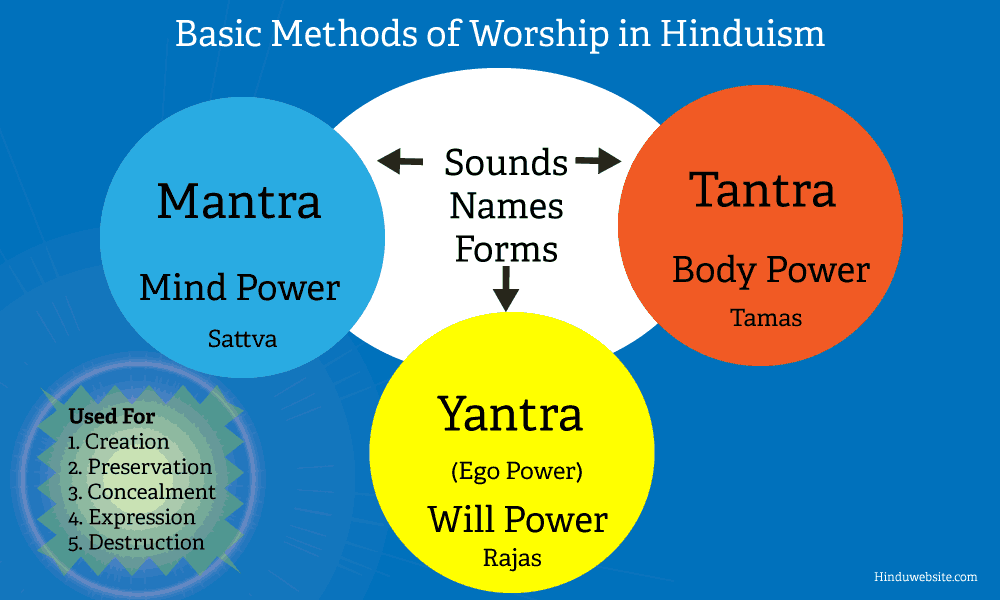
Be it a complicated form of Vedic sacrificial ritual such a yajna or a homa or a simple form of domestic worship (puja), which is performed in millions of Hindu households by common people every day, the worship of divinities in Hinduism invariably involves the use of three basic techniques, namely the Mantra, the Tantra and the Yantra. They also represent three basic types of knowledge (vidyas) in Hinduism.
Tantra, Mantra and Yantra
Fundamentally, the three represent the three basic approaches available to human beings to harness the power of God and use it to perform their duties upon earth as part of their obligatory duties. They are employed in the three important paths, which are mentioned in the Bhagavadgita namely the path of action (karma marg), the path of knowledge (jnana marg) and the path of renunciation (sanyasa marg). They can be used for constructive purposes to achieve peace and prosperity and liberation or for destructive ends to create chaos, cast evil spells or inflict pain and suffering upon others.
The method of Mantra is used to invoke divine power for positive and negative purposes through the use of mind or thought power (man+tra). In Yantras the restraining power (yan + tra) of the will is used for the same purpose. The Tantras are meant for the transformation and transmission of the physical (sexual) power of the body (tan) from the lower planes to higher planes through the use of tantu (nerve fibers or nadis). Thus, Tantra means the use of the body power (tan + tra) or the use of the nerves in the body (tant + tra) or both. Tantu is also a symbolic reference to God or Self (Tantunama or Tantu Nadha), who is the lord of the body. In that sense, Tantra means the use of the power (Shakti) of God for self-transformation and liberation.
In the practice of Mantras, the mind and intelligence are active. In the practice of Tantra, the organs of actions and the organs of perception are active, whereas in the practice of Yantra, the ego is active. From the perspective of the triple Gunas, the Mantra method is predominantly sattvic, the Yantra is rajasic, and the Tantra tamasic. In Hinduism the three constitute the three fundamental methods of divine worship and devotional service by which one may perform obligatory duties, practice self-purification or achieve liberation. They are also the basic and universal approaches which worshippers use in Hinduism to uphold Dharma, fulfill desires and achieve the four aims of human life (purusharthas).
However, as with many other aspects of Hinduism, their distinction is rather amorphous since Mantras may be used in the practice of Yantra and Tantra and vice versa. Hence, in most Hindu forms of worship you see that the elements of all the three are present or deeply intermingled. They are also present in the Vedic sacrificial ceremonies. Mantras are used to invoke gods, Yantras to construct the sacrificial pit (yajna stala) in specific geometric formations to impart to them certain purifying and magical powers, and Tantra to discipline the body before or during the ceremony, and to sacrifice (offer) the body and or its elements during the sacrifice.
The Use of Mantra
Each Mantra is a set of sacred syllables or sounds, which is used in a Vedic ritual as an invocation to a deity or a number of deities. They form part of the Vedic hymns, which are found in the Samhita section of the Vedas. Most of them are set to a particular meter, although some may be in prose form. In the Vedic mantras, the emphasis is more on the sounds rather than their wording.
When a Mantra is correctly uttered with devotion and a right intention according to the scriptures such as the Vedangas, which lay down the rules for correct pronunciation and methods of worship, it is believed that it will awaken the power of the mantra, which carry the prayer to intended deity and make it heard.
It is said that the efficacy of a mantra depends upon the place and method of worship, the person who chants it and its pronunciation. If it is correctly pronounced, the deity will be pleased and the prayer will be answered. Otherwise, it may invoke the wrath of the gods, which in turn require expiation, penance or penitence. Some people believe that a Vedic mantra is a divinity in itself and has a power of its own. If it is correctly pronounced in the right manner as instructed in the scriptures, the deity who is invoked by it promptly responds as if he is compelled by the force of the Mantra and has no will of his own.
In other words, they consider the mantras superior to gods. However, it appears that truth lies somewhere in between. While each mantra has a hidden power, a number of factors seem to determine whether a mantra bears fruit or not, including the karma of the worshippers and the will of the deity. The Upanishads exhort people to perform sacrifices as an obligatory duty, without desires and expectations and leave the results to God.
The Vedas personify the power of Brahman in sound form. The mantras represent aspects or aural manifestations of him. When they are chanted loudly, it is Brahman who carries them through space to the designated deity and facilitates the communication between the worshipper and the worshipped. Hence, it is rightly stated that Brahman is the cause as well as the effect of the Vedic hymns. He is also the ultimate recipient of all sacrificial offerings.
When a complicated yajna such as a soma sacrifice, horse sacrifice, or some other yajna is performed, not one but many deities are invoked simultaneously by groups of priests who chant or sing hymns from one or more Vedas. The chanting is usually loud. Each mantra begins or ends with specific set of sacred syllables such as Aum, Hime, Hrim, Swaha, etc. Depending upon their specialization, the priests go by different names. Each sacrifice has a beginning, a middle and an end, during which the priests chant selected hymns from the Vedas to make the sacrifice effective and beneficial. Their chanting creates powerful vibrations, which travel through the mid-region (the space between the earth and the heaven) to the heaven, where they awaken the deities and facilitate their descent to the place of worship.
The chanting and the sounds constitute but one part of the sacrificial rituals. There are other components of Tantra and Yantra, which are vital to their success. They augment the manifesting power and make the rituals successful. We will later discuss their importance in Hindu ritual worship. The mechanics of the Vedic rituals and sacrifices are discussed in the Brahmana and the Aranyaka parts of the Vedas in considerable detail. Much of this knowledge is lost or has become obsolete as we have lost their ritual, spiritual, and symbolic significance.
As stated before, the Mantras represent gods in sound or speech form. Hidden in each of them is the energy of a particular deity, which remains latent until the Mantra is pronounced accurately with right intention, intonation and aspiration as prescribed in the scriptures. The deity of the Mantra awakens only if the sounds create right frequencies, and if the rest of the sacrifice is performed correctly with right attitude, right offerings and in the prescribed manner. Fate and karma also play an important role in the efficacy of the mantras. Some mantras do good, some cause harm, and depending upon their use and intention they produce positive and negative consequences. The mechanical and procedural aspects of the rituals are therefore important. Indeed, the Purva Mimansa school of Hinduism holds the Vedic rituals, rather than God, as the source of all existence and the highest manifesting power in itself.
The Use of Tantra
Tantra is the systematic use of the body (including the perceptual mind) and its parts (tattvas) for self-transformation and self-realization. The body and the perceptual mind constitute the lower self. They are considered an obstacle to liberation since they induce the beings to indulge in desire-ridden actions and worldly pleasures under the influence of the triple gunas, namely, sattva, rajas and tamas, and bind them to the cycle of births and deaths. As the instruments of Nature, they are responsible for the modifications of the mind and body, which the beings experience variously as suffering, attractions and aversion, attachment, delusion, ignorance, birth and death, egoism, etc. As beings act and react under their influence, they remain bound to the mortal world and the law of karma.
In Tantra, the practitioners use the very obstacles and impurities that are usually shunned in other methods to achieve control over them and transcend them. Desires are not resisted but used to overcome the gunas that induce them. Controlled sexual intercourse is allowed to transform impure sexual energy (retas) into pure spiritual energy (ojas) and body vigor (tejas). Through such revolutionary and transformative practices, Tantra aims to liberate and transform the mind and body from their natural impulses and binding impurities, and make them fit for self-absorption and self-realization. Different postures, breathing and meditation techniques, and self-purification practices are used for this purpose.
Some schools of Tantra employ extreme methods of self-torture, graveyard rituals, and chemical substances to achieve quick results. Because of their extreme nature, the Tantra methods and practices are not liked by many. Hence, many of its practices are kept secret and revealed only to qualified members, which has made Tantra even more controversial in the eyes of the people. Currently, a lot of myth and misinformation have become associated with the left-hand methods (vamachara) of Tantra. However, Tantra is a spiritual discipline, which aims to set the mind free from habitual thoughts, judgments, and conditioning to which is it is subject. It aims to achieve righteous ends through a set of conventional and unconventional methods as a departure from the rigid norms of society. Hence, since ancient times Tantra has been an important and integral part of Hindu spiritualism, and it has successfully retained its place and importance in the ritual and spiritual practices of Hindu ascetic and renunciant traditions.
Tantra is not for Tantrics only
There is a misconception among many that Tantra is used by Tantrics only through the medium of sex and other objectionable means. This is not true. Tantra has a darker side, but it is only one side of it. Tantra revolutionized Hinduism and made it down-to-earth. Elements of Tantra are now an integral part of Hindu ritual worship. Atharvaveda seems to have been greatly influenced by the beliefs and practices of Tantra. What we see in traditional Tantrism is an extreme form of Tantra where the body and the mind are allowed to express themselves freely under the supervision of an enlightened master to come to terms with them and achieve complete mastery over them. Nevertheless, Tantra in its milder and normal forms can be seen in action in everyday life. For example, the Yoga of Patanjali, is a kind of Tantra only, where yogis aim to achieve bodily control through certain physical postures, purification practices, and mind control techniques.
The traditional domestic worship (puja) incorporated many elements of tantric worship, such as purification of the ritual place, the use of mystic syllables, symbols and objects such the sacred pot (kalas), vermillion, mystic diagrams, and swastika, installation and consecration of the idols, prostrating before the deity, joining the hands in front of the deity, applying sacred marks on the body to awaken the energy centers, wearing rudraksha beads, purification of the body through fasting and bathing, worshipping the physical body of the deity from head to toe, use of sacred gestures (mudras) and postures (nyasa), controlling the mind and body through yoga practices such as withdrawal of the senses, breath control, meditation and devotional singing. In pure devotional forms of worship, the body and the mind are offered to God as an act of supreme self-sacrifice and inner detachment, thereby allowing the divine power (Shakti) to descend into the body and do the purification and transformation.
In a complicated Vedic ritual also we can see the influence of Tantra. A Vedic ritual bears no fruit if the body and mind of the performer are not adequately trained and prepared to participate in the ritual with the required degree of purity and sincerity. All the chanting of the Mantras is futile and the sacrifice will be ineffective if these two are not in harmony with the goals of the ritual. The host of the sacrifice (yajmana) and the priests have to maintain utmost purity and observe strict discipline before performing the rituals. Besides, as in Tantra, the Vedas also recognize sexual intercourse as a form of Vedic ritual only.
The Use of Yantra
Yantra means that which controls, dominates, regulates, restrains, protects or prevents. In common parlances, Yantras refer to names, forms, diagrams, patterns and sound forms that have the five powers of God, namely the power to create, uphold, conceal, manifest and destroy. In Hindu ritual practices, which date back to the Vedic times, Yantras are created using certain objects, symbols, sounds, names and forms, and specific divisions of time to invoke the power of a deity for any of the five purposes which are mentioned before. Yantras act like temporary energy centers. They radiate spiritual energy, or the power of the deity who presides over it. They are used to enhance one's own will power or weaken that of others, ward off evil, seek protection from the enemies or destroy them. The more benign forms of Yantras can be seen even in the right hand methods of Vedic worship.
For example, the act of folding of hands in front of a deity is but a kind of Yantra only. It is meant to restrain the mind and the body and facilitate concentration so that the mind can communicate with the deity through the force of will. The manner in which a fireplace is built for the performance of a Vedic sacrifice, the method in which the place is prepared and the materials (sambhra) are assembled, the manner in which the oblations are poured into the fire, the way the priests sit around the altar, and in fact the very act of chanting of the Mantras with mechanical precision serve the same purpose as the Yantras. They are meant to enhance the magical and manifesting powers of the rituals and to control and regulate the lives of the worshippers who participate in them, ensuring their welfare, peace and prosperity, or to protect them from possible harm. Yantras are also used in Tantric rituals to invoke mystic powers, and to design good luck charms, amulets, spells, etc. Because a lot of secrecy and superstition are associated with them, some charlatans use them to exploit people, and make money.
The very design of the temple as a physical symbol of existence and creation in the material plane, the act of visiting a temple, circling around it to earn the grace of the deity, entering the temple, and the lighting of the lamps in front of the divine follow the pattern of Yantras. The decorations and the ornamentation that are so characteristic of Hindu temples and places of worship, the manner in which the images are built and installed, the lighting of the lamps, the offerings, the method of worship, the partaking of prasad, and in short any practice that is mechanical, symbolic and ritualistic to a degree also form part of the same Yantric approach. They are meant to invoke the power of God and use it for material or spiritual purposes.
The Practical Significance of Mantra, Tantra and Yantra in human life
Small minds always look at things negatively or suspiciously and ignore the larger picture which is hidden in them. There is a lot you can learn by introspection, without jumping to conclusions using a few surface impressions. People are easily influenced by negative criticism directed against ancient ritual practices of Hinduism. This is because of the assumption that only spirituality is good, and the rest of the religious practices are mere acts of superstition. However, are all spiritual practices equally effective? A lot of superstition is associated even with prayers and yoga practices. When someone says that yoga can cure cancer, it may be a belief or a mere superstition. No one can say when a belief becomes superstition, because belief itself has no rational basis. The difference between belief (faith) and blind belief (superstition) is notional. Logically speaking, belief itself is blind. It has no rational validity. You either accept it or reject it. Otherwise, it cannot be considered belief. Therefore, anyone who argues that some aspects of the religion are true and acceptable and others are superstition is merely echoing the logical fallacy to which the human mind is subject.
In this regard, let us examine whether Mantra, Tantra and Yantra have any significance to human life, beyond their outward ritual importance. Every religion has outward observances. You can look at them without much thinking and consider them mere acts of superstition, which many people do, or you can examine them closely to see whether they have any hidden significance. Anyone who is familiar with Hinduism knows that any religious discipline or knowledge cannot always be taken on its face value because it may have a lot of symbolism and hidden significance, which becomes self-evident only when you are in a certain state of mind or when your mind and body are sufficiently purified. You can take its knowledge literally and base your faith on it until your mind opens, or you can go deeper into its scriptures and look for the higher and symbolic knowledge, which is hidden in them.
The same holds true for Mantra, Tantra and Yantra methods of religious worship. They are not mere acts of superstition, as some people would like to argue. It is true that they are often misused by frauds and charlatans to exploit innocent people and create a wrong impression about them. Their essential purpose is purification of the mind and body and make them fit instruments for self-realization.
The Mantra, Tantra and Yantra methods contain an important, hidden lesson about life. They teach you that you are an aspect of God, and you can awaken the power of God which is latent in you through the triple means of your mind, body and will. Many people might have read the book the Secret or watched the video. It may be surprising to know that the book contains many elements of Tantra which are vital to invoke the hidden powers of your mind and body to manifest your thoughts and desires.
Mantra, Tantra and Yantra are the three fundamental means by which you can manifest your intentions or your destiny. In Hinduism they are called the chief aims of human life, namely duty, wealth, pleasure, and liberation or ultimate freedom. To reach any goal in your life, you have to use the three powers which are naturally gifted to you namely the mind power, the body power and the power of your intention. You have to rely upon your mind and speech (the Mantra method) to become self-aware or let others know what you need, desire or wish to manifest. Then, you have to use your will power and determination to train your skills, gather necessary resources and create right conditions and circumstances (Yantra) to manifest them. Finally, you have to make adequate physical effort (Tantra) to give shape to your dreams and desires, and make them happen. Thus, you can see that whether you are an atheist or a theist you have to invariably rely upon the three approaches to attain your goals. They are not mere mumbo-jumbo, as some would like to argue, but valuable tools to bring out the best in you and manifest your dreams and desires according to your vision, strength and intelligence.
Hindu Worship, a Means to Evolution
Mantra, Tantra and Yantra are three supreme means on the path of liberation in the spiritual advancement of the soul. They purify the mind and body and strengthen the souls. They awaken the hidden supernatural powers and energy centers, burn their impurities and past life impressions. The Hindu way of worship which incorporates these three disciplines is not a superstitious ritual, but a complicated form of divine worship. In that sacred effort the higher universal forces are invoked in the energy field of the mind and body to facilitate inner awakening and deeper awareness. They help the worshippers to achieve not only specific worldly ends but also spiritually evolve into higher beings, radiating the power and intelligence of God.
Suggestions for Further Reading
- Reasons For Idol Worship in Hinduism,
- The Practice of Tantra and Tantric Ritual in Hinduism and Buddhism
- Vehicles of Hindu Gods and Goddesses - Symbolism
- The Secret Code Of The Bhagavadgita - A New Approach
- Symbolism of Puja, the Ritual Worship of
- The symbolic significance of the Vedic gods
- Pythagorean Mathematics
- The Symbols of Pythagoras
- The Seven Principles of Man by Dr.Annie Besant
- Thought Forms By Dr.Annie Besant
- The Samkhya Philosophy and 24 Principles of Creation
- The Bhagavadgita On The Problem Of Sorrow
- The Concept of Atman or Eternal Soul in Hinduism
- The Practice of Atma Yoga Or The Yoga Of Self
- The Problem of Maya Or Illusion and How To Deal With It
- Belief In Atman, The Eternal Soul Or The Inner Self
- Brahman, The Highest God Of Hinduism
- The Bhagavad Gita Original Translations
- The Bhagavadgita, Philosophy and Concepts
- Bhakti yoga or the Yoga of Devotion
- Hinduism And The Evolution of Life And Consciousness
- Why to Study the Bhagavadgita Parts 1 to 4
- The Triple Gunas, Sattva, Rajas and Tamas
- The Practice of Tantra and Tantric Ritual in Hinduism and Buddhism
- The Tradition Of Gurus and Gurukulas in Hinduism
- Origin, Definition and Introduction to Hinduism
- Hinduism, Way of Life, Beliefs and Practices
- A Summary of the Bhagavadgita
- Avatar, the Reincarnation of God Upon Earth
- The Bhagavadgita on Karma, the Law of Actions
- The Mandukya Upanishad
- The Bhagavadgita On The Mind And Its Control
- Symbolic Significance of Numbers in Hinduism
- The Belief of Reincarnation of Soul in Hinduism
- The True Meaning Of Renunciation According To Hinduism
- The Symbolic Significance of Puja Or Worship In Hinduism
- Introduction to the Upanishads of Hinduism
- Origin, Principles, Practice and Types of Yoga
- Hinduism and the Belief in one God
- Essays On Dharma
- Esoteric Mystic Hinduism
- Introduction to Hinduism
- Hindu Way of Life
- Essays On Karma
- Hindu Rites and Rituals
- The Origin of The Sanskrit Language
- Symbolism in Hinduism
- Essays on The Upanishads
- Concepts of Hinduism
- Essays on Atman
- Hindu Festivals
- Spiritual Practice
- Right Living
- Yoga of Sorrow
- Happiness
- Mental Health
- Concepts of Buddhism
- General Essays