
History Of The Four Buddhist Councils
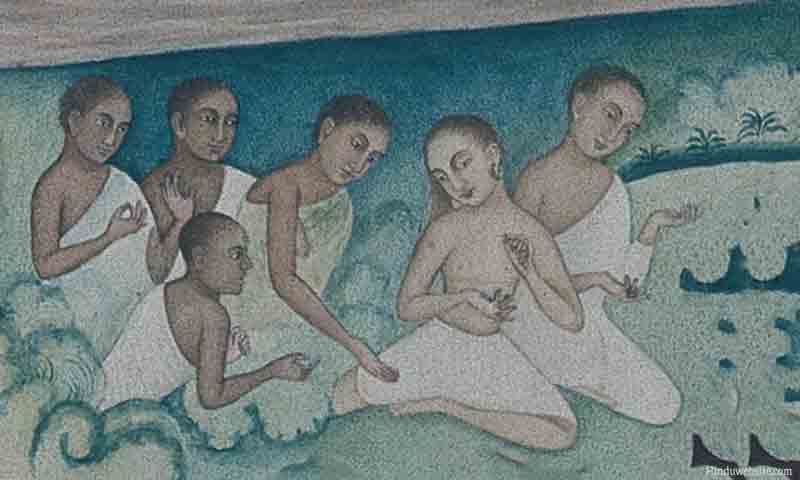
A Group of Buddhist Monks from an Indian Cave Painting
According to tradition, immediately after the Buddha's death, a gathering of 500 monks took place at Rajagriha in about 487 B.C. representing various sanghas under the leadership of Mahakassapa. The assembled monks discussed, collated and classifieds the discourses of the Buddha into authoritative canonical texts. Upali and Ananda, two of the Buddha's chief disciples, said to have recited the Vinaya Pithaka and Sutta Pitaka infront of the gathering. Historians doubt the authenticity of this account.
About a hundred years after the Buddha's death the second Buddhist council was said to have been convened at Vaisali, around 387 B.C. The council was called mainly to discuss certain serious differences that arose within the Buddhist Order over the true interpretation of the Buddha's teachings and certain practices followed by some monks, especially the monks of Vaisali. The orthodox followers of the Buddha believed that the monks of Vaisali were taking liberties with the rules prescribed in the Vinaya Pitaka.
The council discussed the matter at length, but could not reach an agreement. This resulted in the great schism within the Order and led to the formation of the two divergent schools of thought. The first school advocated strict adherence to the age old traditions of Buddhism and compliance with the original teachings of the Buddha. They were called The Sthaviravadins. The second group did not find a problem in having a liberal attitude towards the rules prescribed in the Pitakas and the deviations followed by the monks of Vaisali. They became known as the Mahasamghikas. The schism subsequently led to the formal division of Buddhism into irreconcilable Hinayana and the Mahayana sects. Some historians, however, doubt the authenticity of the second council also.
The Third Buddhist Council was held at Pataliputra, about 236 years after the death of the Buddha, during the reign of Asoka. It was presided over by Moggaliputta Tissa and said to have also been attended by king Asoka himself in the capacity of a monk. Many heretics were expelled during this meeting. The Sthaviravadins established themselves as the orthodox school of Buddhism, firmly adhering to the original teachings of the Buddha and unwilling to make any compromises. The Council also made some additions and alterations to the existing Buddhist Pali Canon by brining together the Vinaya Pitaka and Dhamma Pitaka with the Kathavaththu of Abhidammam Pitaka.
The Fourth Buddhist Council was held in Kashmir or at Jullundhar under during the reign of Kanishka, the famous Kushana King of great valor and personal charm, who in the early Christian era ruled large parts of central Asia and the north western India. He was a patron of Buddhism and was instrumental in spreading the religion in the northwestern borders of India. He played a key role in organizing the fourth Buddhist Concil. The Council was presided over by Vasumitra and Asvaghosha and had to deal with a seriious conflict between the Sarvasthivada teachers of Kashmir and Gandhara. During this meeting the Sarvasthavadin doctrines were organized into a Mahavibhasa containing three large commentaries on the Pitakas. The reign of Kanishka witnessed the ascendence of the Mahayana sect.
The followers of the Hinayana sect adhered strictly to the early teachings of the Buddha and were uncompromising on the fundamental teachings of the Buddha such as the existence of soul and God. They did not introduce new gods or heavens, nor encouraged any speculation about such matters as Nirvana and the after life of an of Arhat.
The followers of the Mahayana sect, on the other hand, tried to elaborate upon the earlier doctrines and remove the ambiguities and contradictions inherent in early Buddhism by providing new explanations and clarifications. They expanded the scope of Buddhism by introducing new theories and practices so as to make it more familiar and meaningful to the lay Buddhists. They also elevated the status of the Buddha to that of God to rest all questions and doubts regarding the existence of the Buddha after his parinirvana.
The four Buddhist councils can be considered as the four mile stones in the history of Buddhism. If the Four Noble Truths formed the core of the Buddha's teachings, these four Buddhist meetings formed the core of its early history. They helped the followers of the Buddhist Order to sort out the differences amongst them in a democratic and collective manner. Where rapprochement was not possible the Councils defined the boundaries by organizing the Canonical texts and fomralizing their interpretation.
Initially the divisions with in the Buddhist Order did not weaken Buddhism, though they caused a lot of confusion and commotion and gave scope for the entry of certain corrupt and unethical practices. But in the long run they also provided the much needed diversity and flexibility to Buddhism, by offering a wide range of alternatives to the would be followers.
Since the followers of Buddhism came from different social, geographical and cultural backgrounds, this diversity suited them. They were able to chose the best path according to their inclinations and inner aspirations and the peculiarities of their own environment.
Suggestions for Further Reading
- Buddhism - The Concept of Anatta or No Self
- Anatta or Anatma in Buddhism
- Anicca or Anitya in Buddhism
- The Buddha on God
- The Buddha on Avijja or Ignorance and on the Origin of Life
- The Buddha On the Self And Anatta, the Not-Self
- History Of The Four Buddhist Councils
- Chinese Buddhism
- The Eightfold Path Of Buddhism
- The Four Noble Truths of Buddhism
- Four Stages of Progress on the Middle Way in Buddhism
- The Practice of Friendliness, Kalyanamittata, in Buddhism
- Karma or Kamma In Buddhism
- Mahayana Buddhism
- Buddha's Last Days and Final Words
- Buddhism - The Middle Way
- The Buddha's Teaching on Right Mindfulness
- The Meaning and Practice of Mindfulness
- Buddhism - Vinaya or Monastic Discipline
- Right Conduct For Lay Buddhists
- Nirvana or Nibbana in Buddhism
- Buddhism - Objects of Meditation and Subjects for Meditation
- Buddhism - Right Speech and Mind Training
- Buddhism - Right Living On The Eightfold Path
- Handbook for the Relief of Suffering by Ajaan Lee
- Theravada Buddhism
- Meat Eating or Vegetarianism in Buddhism
- Essays On Dharma
- Esoteric Mystic Hinduism
- Introduction to Hinduism
- Hindu Way of Life
- Essays On Karma
- Hindu Rites and Rituals
- The Origin of The Sanskrit Language
- Symbolism in Hinduism
- Essays on The Upanishads
- Concepts of Hinduism
- Essays on Atman
- Hindu Festivals
- Spiritual Practice
- Right Living
- Yoga of Sorrow
- Happiness
- Mental Health
- Concepts of Buddhism
- General Essays
Image Attribution: The image of the Buddha used in this article is either in public domain or licensed under the Creative Commons Attribution-Share Alike 3.0 Unported license.