
Four Stages of Progress Towards Liberation
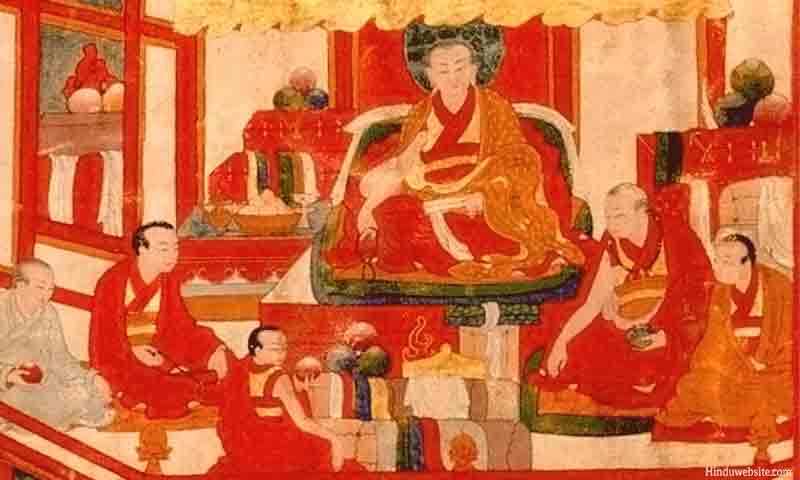
Buddhist monks in a Tibetan Monastery
In Buddhism we can identify four main stages in the spiritual progress of a monk, who takes refuge in the Buddha, Dhamma and Sangha and resolves to overcome his or her suffering through the eightfold practice namely right view, right resolve, right speech, right action, right livelihood, right effort, right mindfulness and right concentration. Perfecting his practice on the Eightfold Path and opening his mind to the higher wisdom (prajna), the monk gradually progress from one stage to another until he reaches, Nirvana, the ultimate goal.
The foundation of this effort is self-purification through righteous living. The monk has to cultivate morality (sila) by overcoming the ten great evils namely delusion of soul, doubt about the Buddha or his teachings, adherence to rituals, sensual desires, attraction and aversion (dvesha), desire for material things, desire for spiritual things, pride, self-righteousness, and ignorance.
Success in each stage depends upon the effort in this life as well as in previous lives. A monk may successfully complete all four stages in one lifetime or over several lifetimes, according to his or her deeds and state of progress. Those who made progress in their previous lives, start from where the left in this life. If they persist, they have better chances of attaining perfection in this very life.
The Four stages
The Four stages are easily recognizable due to their distinct characteristics, which are described below.
First stage
The First stage begins when a person is introduced to the teachings of the Buddha, and becomes aware of the causes of suffering, whereby he resolves to end it by following the Eightfold Path. His decision to follow the Buddha may happen due to fortuitous circumstances or due to his good deeds, good thoughts and practice of virtues or due to the compassion and blessings shown to him by an adept monk who takes pity on him and decides to help him.
In this stage the monk succeeds in attaining the basic knowledge of the Buddhist Dhamma, consisting of the Four Noble Truths and the Eightfold Path. His awareness of them grows as he takes refuge in the Buddha, the Dharma and the Sangha and spends time in self-purification, contemplation and mindfulness to cultivate higher knowledge or wisdom.
As he progresses on the Path, he gains clarity and right perspective. His doubts and fears begin to fade, while his resolve to end suffering and attain Nirvana grows stronger. After the successful completion of this stage, a monk attains freedom from delusion and from any doubts or reservations he may have about the life and teachings of the Buddha. He also succeeds in overcoming his attachment and preference for rituals and ceremonies.
Second stage
In the Second stage, the monk's awareness and discernment grows, as he develops a deeper understanding of the Four Noble Truths and the Eightfold Practice. With his mind freed from doubt and delusion and having cultivated distaste for rites and rituals, he spends more time in contemplation and concentration and cultivating right views, right intentions, right effort, right resolve and so on. By that, he gains control over his thoughts and desires and afflictions of his mind.
He becomes free from ignorance and delusion and from attraction and aversion to material things. His knowledge and commitment to the Four Noble Truths and the Eightfold Path become firm and unquestionable. At this stage, he is is advanced well enough to enter the third stage. If he passes away for any reason, he would require only one more birth to complete the remaining stages to attain Nirvana, unless something happens and he succumbs to evil deeds and distractions.
Third stage
In the Third stage the monk advances towards final perfection. He becomes purer, more insightful, more knowledgeable, more virtuous and more detached. Through constant practice of morality, mental absorption and higher wisdom, he becomes completely free from whatever little defilements, attraction and aversion or obstructions which are still present in him and preventing him from become perfect. He grows immune to the disturbances and impurities of the world.
By attaining skillfulness in all the eightfold practice and by discerning and removing all the causes of karma, he also succeeds in arresting the formation and continuation of karma. Thereby, he also resolves the problem of rebirth, putting an end to the cycle of births and deaths. He is now ready to attain final freedom from mortality and impermanence. At this stage, he may decide to enter Nirvana or become a Bodhisattva to help others on the Path.
Fourth stage
The Fourth stage is the state of an Arhat. It is the highest state of wisdom and intelligence (prajna) to which a Buddhist monk can aspire. He contains no traces of impurity in his consciousness. He is free from all the fetters that defile the mind. Hence, his mind is strong as a diamond and his discernment sharp as a warriors knife. An Arhat is an adept, who has been completely freed from all attachments and desire for rebirth, both in the worlds of form (rupa lokas ) worlds that are without forms (arupa lokas).
He attains this stage having transcended all the states of awareness (jhanas). No trace of pride, self-righteousness and ignorance exist in his consciousness. The only feeling which remains in him is a constant and boundless wave of good will for all beings. He remains in this state of mind when asleep or awake, when sitting or standing, walking or lying down. He has become holy.
Four types of monks
Reference to the four stages of progress is found in the Anapanasati Sutta from Majjima Nikaya,1 which refers to four types of noble disciples. The first one is Arahant, who has progressed through all the four stages. Having overcome the five fetters and reborn in the higher worlds, he never returns to the mortal world. In the second class are monks who have overcome first three fetters and never subject to suffering and ignorance. They have only one rebirth left and return to earth to complete the last stage of purification.
The third type of monks remain devoted to the practice of right living on the Eightfold Path. They engage in steadfast practice to advance to the next stage. The fourth type refers to those novices who begin their journey on the Eightfold Path. They awaken to the knowledge of Dharma and cultivate right view to focus upon physical and mental imperfections with an intention to overcome them.
The original text on the Four Types of Monks can be found here
Suggestions for Further Reading
- Buddhism - The Concept of Anatta or No Self
- Anatta or Anatma in Buddhism
- Anicca or Anitya in Buddhism
- The Buddha on God
- The Buddha on Avijja or Ignorance and on the Origin of Life
- The Buddha On the Self And Anatta, the Not-Self
- History Of The Four Buddhist Councils
- Chinese Buddhism
- The Eightfold Path Of Buddhism
- The Four Noble Truths of Buddhism
- Four Stages of Progress on the Middle Way in Buddhism
- The Practice of Friendliness, Kalyanamittata, in Buddhism
- Karma or Kamma In Buddhism
- Mahayana Buddhism
- Buddha's Last Days and Final Words
- Buddhism - The Middle Way
- The Buddha's Teaching on Right Mindfulness
- The Meaning and Practice of Mindfulness
- Buddhism - Vinaya or Monastic Discipline
- Right Conduct For Lay Buddhists
- Nirvana or Nibbana in Buddhism
- Buddhism - Objects of Meditation and Subjects for Meditation
- Buddhism - Right Speech and Mind Training
- Buddhism - Right Living On The Eightfold Path
- Handbook for the Relief of Suffering by Ajaan Lee
- Theravada Buddhism
- Meat Eating or Vegetarianism in Buddhism
- Essays On Dharma
- Esoteric Mystic Hinduism
- Introduction to Hinduism
- Hindu Way of Life
- Essays On Karma
- Hindu Rites and Rituals
- The Origin of The Sanskrit Language
- Symbolism in Hinduism
- Essays on The Upanishads
- Concepts of Hinduism
- Essays on Atman
- Hindu Festivals
- Spiritual Practice
- Right Living
- Yoga of Sorrow
- Happiness
- Mental Health
- Concepts of Buddhism
- General Essays