Manusmriti: The Laws of Manu - Introduction to Hindu Dharmashastra
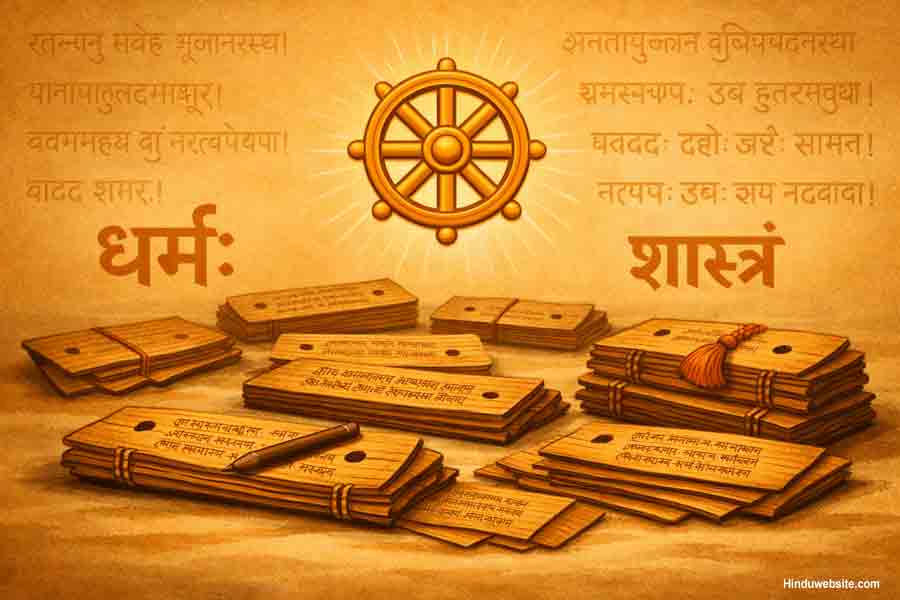
Summary: Manusmriti, translated as 'The Laws of Manu' or 'The Institutions of Manu,' represents the most important and authoritative Hindu law book (Dharmashastra) in the Hindu tradition. Serving as a foundational work on Hindu law and jurisprudence for over 1500 years in ancient India, Manusmriti functioned as the standard reference for adjudicating both civil and criminal cases. This introduction explores the text's significance, authority, and enduring influence on Hindu legal philosophy and practice.
Since Manusmriti is the most important Hindu Law Book and its study is necessary to understand the historical progress of Hinduism and Hindu society, we have brought to you the entire translation of the scripture which you can access from the following links.
Manusmriti, translated as "The Laws of Manu" or "The Institutions of Manu," is the most important and authoritative Hindu law book (Dharmashastra). For at least 1,500 years, it served as a foundational text on Hindu law and jurisprudence in ancient India. Until modern times, it was the standard reference for adjudicating civil and criminal cases, both for rulers who patronized the Vedic faith and for people who practiced Hinduism. Hinduism has many law books, but among them, Manusmriti is certainly the most popular and authoritative.
In Hindu tradition, Manu is considered the first of Brahma's sons and a progenitor of the human race. Therefore, it is difficult to determine the age of Manusmriti. The laws of Manu may have been known to the Vedic people for a long time before they were codified into their present form sometime during the post-Vedic period. The work we know today as Manusmriti may have reached its final form through the contributions of many authors by around 200 CE.
The people of ancient India believed in the order and regularity of the world as manifestations of God's will and intent, and in the clear victory of divine forces over demonic ones. Accordingly, many scholars and sages in ancient India formulated laws to govern individual conduct and uphold the order and regularity of Hindu society from the earliest times. Their works are available to us today as the 18 Dharmashastras, among which the work of Manu (Manusmriti) is considered the most important and widely used. Unlike the Vedas, the Hindu law books fall into the category of intellectual or scholarly works (smritis). They were distilled and codified through observation, experience, analysis, and the study of the Vedas, with the best interests of humanity and society in mind. Therefore, they are not entirely free from human flaws. Nor are they free from caste or racial bias. As a result, they are vulnerable to criticism from a modern standpoint.
Manusmriti presents an ideal society and ideal human conduct as the foundation for establishing an orderly society and a divinely centered life. To promote these ideals and enforce divine will, it proposes numerous laws to govern human life and conduct in minute detail, applying them to each individual according to his or her social class, duties, and responsibilities. Their purpose is to inculcate discipline, provide rulers with a basis for enforcing lawful conduct, and ensure the orderly progression of the world through righteous behavior and the observance of obligatory duties by individuals who choose either the life of a householder or that of a renunciant. The power to enforce these laws is carefully distributed among rulers and the guardians of society who assist them in decision-making. Manusmriti also recognizes the corrupting and deluding influence of power on the mind and cautions kings to exercise their judgment with great care in order to avoid sinful karma and harmful consequences for themselves and for the world.
The laws proposed by Manu to govern human conduct and society reflect the conditions, needs, and values of the times in which they were formulated. Most of them do not align with present-day values. They accept prevailing social and gender inequalities as natural conditions of human existence and propose laws to regulate individual behavior without allowing for the changes that time may bring to society or to people's lives. As a result, many of Manu's laws may now appear archaic, outdated, or even primitive. These laws favor a paternalistic social and family system, placing authority in the hands of men and assigning women a subordinate and subservient role. They also reveal a clear lack of trust in the integrity and sexual choices of women, suggesting that women should always be guarded by men and never left alone in the presence of men outside their families. At the same time, they do not ignore or diminish the role of women in family and domestic matters, and they urge men to treat women with honor and respect and not allow them to suffer.
The British who ruled India used Manusmriti as the standard for settling disputes among Hindus in matters such as inheritance, family disputes, marriage, and royal succession. Some Hindu scholars believe that the British found in Manusmriti a useful tool for promoting their interests or perpetuating social divisions among Hindus in order to consolidate their power. There is also criticism that, for a long time, Manusmriti served the interests of privileged classes and justified the oppression of women and the lower castes, since it prescribed unequal laws for different castes based on their status in society.
Manusmriti acknowledges and justifies the caste system as the basis of social order and regularity. It clearly recognizes four classes of people (Brahmanas, Kshatriyas, Vaisyas, and Sudras) and their respective roles in the preservation of dharma. Brahmanas and Kshatriyas are granted many privileges and greater leniency in matters of punishment for misconduct, whereas Sudras are given the fewest privileges and the harshest punishments, even for minor misdemeanors. Therefore, it is important to study Manusmriti with an open mind in order to understand its historical and religious significance in the evolution of Hinduism from its early days to its present form.
It is difficult to apply the laws of Manu in today’s world because present conditions are very different from those that existed when they were formally codified. For example, contemporary laws do not permit gender bias or the imposition of restrictive rules on women or their freedom to choose their marriage partners, professions, or ways of life. Similarly, laws governing people's conduct according to caste or occupation are considered discriminatory by today’s standards and cannot be enforced. Despite these problems and limitations, Manusmriti retains historical value. Students of Hinduism still need to study it in order to understand the way of life in ancient India and how people governed their lives according to its principles.