Ancient Vimanas: Air Travel and Flying Machines in Hindu Scripture
Summary: This scholarly article examines the concept of Vimanas, the flying machines described in ancient Hindu literature and sacred texts. Drawing on detailed literary evidence from Vedic and classical Indian sources, the article explores how ancient Indian civilization understood air travel, aerospace technology, and interplanetary flight long before the modern era. Readers will discover how these ancient texts describe mechanical, spiritual, and tantric mechanisms that powered these legendary aircraft for warfare, religious ceremonies, and cosmic exploration.
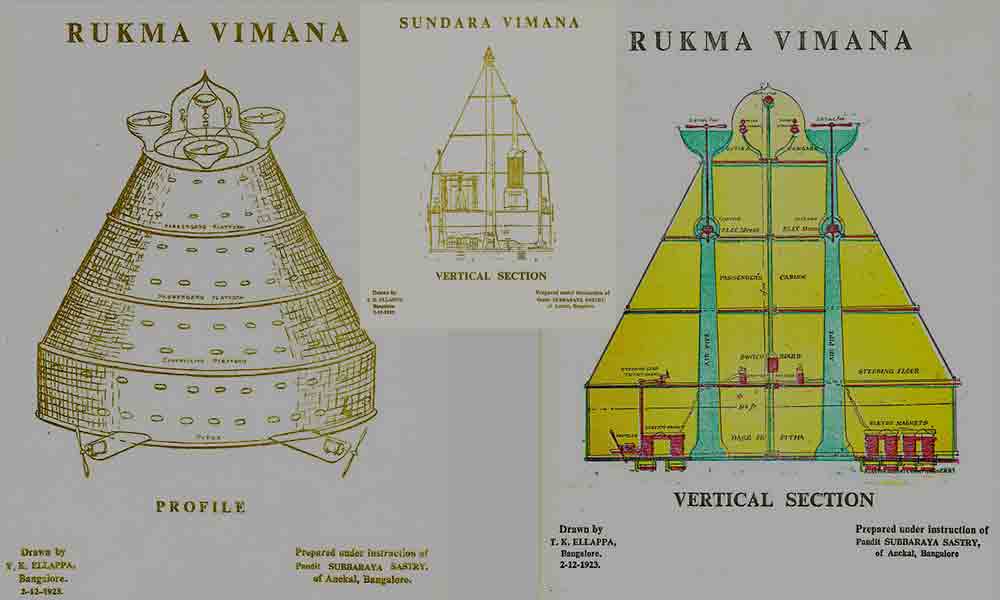
The Vymaanika Shastra - Index Page
"Our vision of "prehistory" is terribly inadequate. We have not yet rid our minds from the hold of a one-and-only God or one-and-only Book, and now a one-and-only Science."
The idea of aerial travel by means of flying machines has occupied a prominent place in the literary imagination of India since antiquity and continued to do so through the medieval and modern periods, long before the invention of the modern airplane by the Wright brothers. A substantial body of literary material suggests that ancient Indian thinkers were familiar with the possibility of human flight, whether for long-distance travel or for journeys across cosmic realms. These flying machines are described as operating through mechanical, spiritual, and tantric forms of power. Hindu sacred and epic literature contains numerous accounts of such vehicles transporting individuals from one place to another, or even from one world to another, in order to wage war, participate in religious rites, rescue those in distress, or undertake extraordinary missions.
The Meaning and Symbolism of Vimana
In Sanskrit, the language of communication during the Vedic period, the word "vimana" denotes an airplane or flying machine. It is therefore noteworthy that the soaring towers adorning many Hindu temples are also called vimanas. In this architectural and symbolic context, however, the term carries a deeper spiritual significance. A vimana may be understood as that which transcends, or turns away from, ordinary mental consciousness. It signifies a higher mode of awareness oriented toward the heavens and associated with divine realms, where elevated energies are subordinated to higher purpose and will. By contrast, ordinary consciousness draws human beings into samsara and binds them to sensory existence. Deluded by worldly illusion, people remain confined to the earthly realm (bhur), unable to ascend freely into the intermediate (bhuva) and higher (suva) worlds. As an elongated tower rising from the temple roof toward the sky, the vimana serves an important symbolic function in Hindu religious thought. It evokes the idea of lost worlds and forgotten states of consciousness. Elevated above the routines of earthly life and adorned with vivid representations of gods and goddesses, the temple vimana communicates that entry into the divine realm requires a turning inward, away from mental distraction and toward God.
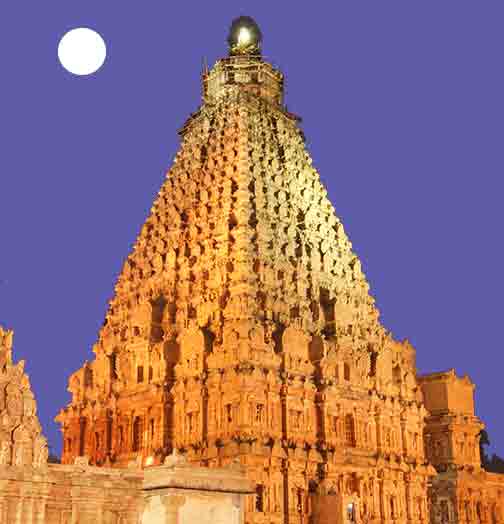
A temple tower called Vimana
The term vimana may also refer to a space vehicle or aerial object capable of overcoming ordinary limitations of time and space and reaching the furthest extents of creation. In this sense, it functions as a conceptual bridge between the human world, the domains of gods and goddesses, and other realms beyond ordinary knowledge. Such a vehicle is portrayed not as earthly but as celestial in origin. Human beings, constrained by mental and physical energies conditioned by worldly existence, are generally depicted as incapable of using it. Yet these traditions also imply that higher states of being may be regained by transcending the mind. Through the vimana, understood here as a metaphor for purified consciousness, one may approach God and the divine worlds by turning away from bodily temptation and cultivating single-minded devotion.
Vimana in Epic and Mythological Literature
Indian mythological and epic traditions contain numerous references to remarkable spacecraft and flying machines employed by gods, demons, and humans alike. The two great Sanskrit epics, the Ramayana and the Mahabharata, both mention vimanas or related aerial devices in ancient times. In several respects, these descriptions invite comparison with the spacecraft imagined in modern science-fiction narratives.
In the Ramayana, one of the most prominent examples is the Pushpaka Vimana. This aircraft originally belonged to Kubera, king of the Yakshas and one of the wealthiest beings in the cosmic order. Kubera was also the half-brother of Ravana, the demon king who serves as the principal antagonist of the epic. According to the narrative, the Pushpaka Vimana was constructed by Vishwakarma at the command of Brahma, who, moved by compassion for the disabled Kubera, commissioned it for his use. The vehicle is described as immense, comparable in size to a large city, and capable of accommodating an unlimited number of passengers. It was said to move by means of its own tantric power. After receiving this gift, Kubera traveled in it from place to place, distributing wealth and assisting those in need.
According to the epic narrative, Ravana later seized this vehicle and used it for destructive purposes, including the abduction of Sita to Lanka. It was also employed in his conflict with Rama. After Ravana's death, his brother Vibhishana, who succeeded him as king, proposed that Rama use the aircraft to return promptly to Ayodhya. Rama accepted, and the narrative states that the vehicle was able to carry not only his companions but also the entire army. Its extraordinary scale and capacity are emphasized throughout the account. The epic also offers a vivid description of the aerial view of the subcontinent as the aircraft traveled toward Ayodhya. Some later interpreters have argued that this depiction resembles the view of the Indian subcontinent from great height or even from outer space. Given the presumed antiquity of the text, such claims have often prompted speculation about how such imagery was conceived.
The Mahabharata likewise refers to flying chariots powered by lightning and capable of traversing vast distances, extending even into the solar system and beyond. One episode describes the demon king Salva using a flying machine to attack Dwaraka, and narrates how Krishna engaged him in battle and destroyed the craft. The Srimad Bhagavatam contains a related reference:
"One time while King Chitaketu was traveling in outer space on a brilliantly effulgent airplane given to him by Lord Vishnu, he saw Lord Shiva...
"The arrows released by Lord Siva appeared like fiery beams emanating from the sun globe and covered the three residential airplanes, which could then no longer be seen."
Modern Interpretations and Commentary
Many modern writers and scholars have expressed fascination at the references to airplanes and spacecraft in ancient Hindu literature. Commenting on the idea of flying machines in ancient India, Col. Henry S. Olcott (1832–1907) wrote the following.
"The ancient Hindus could navigate the air, and not only navigate it, but fight battles in it like so many war-eagles contending for dominion over the clouds. To have become so proficient in aeronautics, they must have known the arts and sciences related to that field, including the strata and currents of the atmosphere, and the relative temperature, humidity, density, and specific gravity of various gases..."
Prof. D. K. Kanjilal offered a similar observation in reference to descriptions of flying machines in the Matsya Purana 1*:
"Behind the veil of legend, a scientific truth seems to emerge: three flying cities were made for, and used by, the demons. Of these three, one remained in a stationary orbit in the sky, another moved through the heavens, and one was permanently stationed on the ground. These were docked, like modern spaceships, in the sky at a particular time and at fixed latitudes and longitudes. Siva's arrow was thus interpreted as a blazing missile fired from a specially constructed flying satellite, while the wreckage of the spaceship is said to have fallen into the Indian Ocean. Vestiges of a once-prosperous civilization destroyed in battle survive only faintly in these legends."
The Vedas also refer to flying chariots of varied forms and configurations. Among these are references to a fire chariot with two engines, an “elephant-chariot” with multiple engines, and other vehicles named after animals. Surya, the sun god, is described as traversing the sky each day from east to west in his radiant chariot, illuminating the world. Likewise, when invoked, gods are said to descend from heaven in celestial vehicles to bless worshippers. In his Anti-Gravity Handbook, discussing “Ancient Indian Aircraft Technology,” D. Hatcher Childress makes the following observation:
"According to ancient Indian texts, people possessed flying machines called vimanas. The ancient Indian epics describe a vimana as a double-decked, circular aircraft with portholes and a dome, much as one might imagine a flying saucer. It moved with the ‘speed of the wind’ and emitted a melodious sound. There were at least four different types of vimanas, some saucer-shaped and others long and cylindrical, resembling cigar-shaped airships."
In addition to descriptions of mechanical devices, these traditions also contain references to gods and sages appearing instantaneously wherever they wished through the exercise of willpower, and even existing in multiple places simultaneously. According to some religious accounts, humanity in the primordial age possessed similar capacities, which were gradually lost as human beings became increasingly materialistic and impure. The sage Narada, for example, is portrayed as traversing the three worlds instantaneously while chanting the name of Vishnu. The Yoga Shastra of Patanjali likewise discusses the attainment of siddhis, or extraordinary powers, through yogic practice, including levitation and long-distance astral travel.
Historical Evaluation and Conclusion
At the same time, these descriptions should be approached with caution. From a historical and archaeological standpoint, there is no direct material evidence, beyond literary references, demonstrating that people in ancient India flew by means of mechanical or aerial devices. The vimanas described in Hindu literature are generally portrayed as operating through mantric and tantric power rather than the yantric, or mechanical, principles associated with modern aircraft. It is therefore possible to interpret these accounts as symbolic, mythological, or theological rather than historical in the modern empirical sense.
From the standpoint of mainstream academic history, ancient India possessed neither airplanes nor rockets, nor any mechanically powered flying machines comparable to modern aviation. Travel was ordinarily undertaken on foot or with the aid of animals such as horses, elephants, camels, and donkeys. Chariots, bullock carts, boats, and ships were used for regional and long-distance movement, as well as for the transport of goods. Such travel could be hazardous because of wild animals, banditry, and the social risks associated with being perceived as a stranger, foreigner, or spy.
Some of the descriptions found in ancient Indian literature may be understood as imaginative constructions, much like the extraordinary spacecraft of modern science fiction. Others may be interpreted as expressions of cultural memory, symbolic theology, or metaphysical speculation concerning latent human capacities associated with mantric and tantric power. If there once existed any concrete knowledge of the kinds of spacecraft mentioned in these traditions, including those described in The Vymaanika Shastra attributed to Maharshi Bharadwaaja, that knowledge has not survived in verifiable form. As a result, the subject remains best approached as a rich and revealing body of mythic, religious, and speculative literature rather than as established technological history.