The Brihadaranyaka Upanishad - Summary and Essential Philosophy
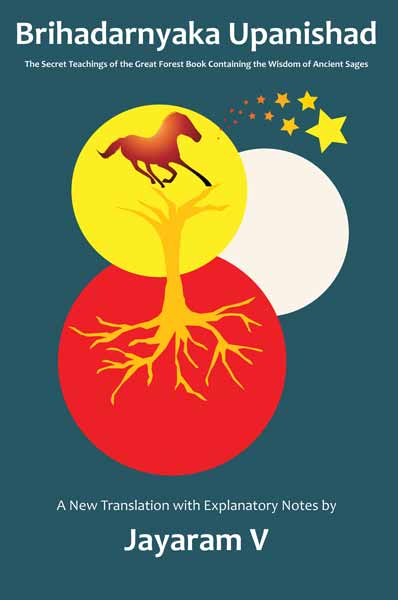
Brihadaranyaka Upanishad With Devanagari Script, Translation and Notes
Sample Translations: Ch:1.1.1 | Ch:1.1.2
Summary: This page presents a comprehensive introduction to the Brihadaranyaka Upanishad, offering English verse translations, meaning glosses, and detailed commentary that illuminate its symbolism and philosophical depth. It explores the Upanishad’s movement from ritual imagery to inward realization, emphasizing themes such as non‑duality, the supremacy of the Self, the role of desire in bondage, the nature of consciousness, and the “seer of seeing” doctrine. Key dialogues—including Yajnavalkya’s teachings and the Maitreyi conversation—highlight the text’s inquiry into what is ultimately real. Together, the materials guide readers toward understanding the Upanishad as a foundational source of Vedantic wisdom.
About this book
This volume is not simply a translation of the Brihadaranyaka Upanishad but a guided reading of it: English verse renderings are paired with short “Meaning” glosses and longer “Notes/Commentary” sections that explain symbolism, connect recurring themes, and nudge the reader from ritual imagery toward inward realization. The author treats the Upanishad as a hinge-text: it still speaks the language of Vedic sacrifice and social duty, yet it repeatedly redirects attention to what is prior to ritual, Brahman/Atman as the hidden ground of experience. The framing claim, echoed across the introduction and the notes, is that the human being is a microcosm: the body mirrors the universe, and the same ultimate reality present in cosmic processes (sun, breath, seasons, directions) is to be discovered “within,” not as an object, but as the witness and support of all objects.
Across the English portions, two movements run together. One is explanatory and historical: why these rituals mattered, what “horse sacrifice” signified, how Vedic cosmology imagined worlds and deities, and why lineages of teachers are repeatedly listed. The other is philosophical and practical: the text’s repeated diagnosis that bondage is rooted in desire and duality, and its repeated prescription that liberation comes through discernment of the Self, often via negation (“not this, not this”), and via seeing that all loves and all meanings terminate in the Self alone.
Madhu Khanda (Chapters 1- 2)
Chapter 1 begins with the Ashvamedha (horse sacrifice) imagery. The English commentary insists that the horse is a deliberate macrocosmic map: dawn as head, sun as eyes, wind as breath, year as body, directions as sides, stars as bones, rivers as veins. The purpose of this mapping, as the notes keep stressing, is not antiquarian description but a contemplative reorientation, what looks like a political royal rite is also a meditation on totality. The king’s claim to sovereignty is relativized: true “lordship” belongs to Brahman, and the rite symbolically dissolves ego by making sacrificer, sacrifice, and cosmos interpenetrate. Immediately after, the narrative of creation is presented through stark, almost unsettling symbols: “Death” or hunger/desire as the enveloping primal condition; mind arising first; water produced through a kind of worship/austerity; earth condensing from froth; fire emerging from heat; further differentiation into sun, air, and breath. The commentary repeatedly interprets “hunger” as desire, the engine of manifestation and the root of bondage. This is a key interpretive lens of the book: cosmology is read psychologically. Creation is not merely “how the world began,” but how multiplicity and craving arise in consciousness and then harden into “my” world. A long, central portion of Chapter 1 elaborates the contest between gods and demons inside the body, used to explain why breath (prana) is treated as uniquely “invincible.” Speech, smell, sight, hearing, and mind can be “polluted” because they are easily co-opted by selfish enjoyment; breath, by contrast, is described as autonomous and necessary, not driven by the same motives. The author’s commentary repeatedly moralizes this point in a way meant to be immediately applicable: selfishness is framed as a demonic quality; selfless functioning is framed as divine. Breath becomes a model for right action, doing its work without clinging to outcomes, so the Upanishadic physiology becomes an ethic and even a proto-yogic instruction (pranayama is briefly invoked as a practical corollary).
Chapter 1 also contains one of the book’s major philosophical pivots: duality is said to produce fear and sorrow, while realization of the Self dissolves fear. The famous development, “I am” leading to individuation, then the longing for a “second,” then male–female polarity, then the proliferation of paired beings, gets treated in the notes not as a biological myth but as a symbolic account of how separation and attraction structure lived experience. Alongside that, the Upanishad’s “name, form, and action” triad is presented as the mechanism by which the undifferentiated becomes the social and perceptual world. In the author’s gloss, these three stabilize ordinary reality while simultaneously veiling the immortal element within it. Chapter 2 intensifies the inward turn through the exchange between Balaki and King Ajatasatru. Balaki proposes a series of “Brahmans” identified with impressive cosmic supports (sun, moon, lightning, space, and so on). Ajatasatru’s responses, as presented in the English notes, are not pure rejection but a diagnosis of incompleteness: these are symbols of Brahman, not Brahman itself. The teaching then shifts decisively into consciousness analysis: waking, dream, and deep sleep. In deep sleep, the senses are “restrained,” the person rests in the “space within the heart,” and the Self is presented as the source from which senses, worlds, and beings arise like sparks from fire or threads from a spider. The “truth of truth” theme appears here: what we call “truth” at the level of experience is still dependent; the Self is the ground of even that truth. A major highlight of the English material is the Yajnavalkya–Maitreyi dialogue (appearing in Chapter 2 and again later with variation). The book’s commentary treats it as a deliberate challenge to ordinary value-systems: wealth cannot grant immortality; even love for spouse, children, status, or gods is ultimately love for the Self. The culminating teaching, when duality is present, knowing operates through subject-object division, but when all becomes the Self there is no “other” to know, becomes the book’s philosophical spine. The commentary repeatedly underlines the point: liberation is not acquiring a new object called Brahman; it is the collapse of separative knowing. The “madhu” (honey) doctrine then universalizes the insight. Earth, water, fire, air, sun, directions, mind, lightning, and more are described as mutually “honey” to one another because the same shining, immortal presence is said to be within them and within the body. The author’s notes explain “honey” as nourishment, sweetness, and sustaining essence, often tied back to prana. The net effect is a vision of radical interdependence: cosmology, physiology, ritual exchange, and inner realization are made to mirror one another.
Muni & Khila Khanda (Chapters 3 - 6)
Chapters 3 and 4 are presented as Yajnavalkya’s public examinations in Janaka’s court, where ritual expertise is gradually pushed beyond itself. Many questions begin in sacrificial vocabulary, how to “overcome death,” how many chants/offerings, what worlds are won, but the deeper arc (emphasized in the notes) is interiorization: the rites and their “gains” are repeatedly shown to be limited or temporary compared with knowledge of the imperishable. Several teachings stand out in the English commentary. One is the “seer of seeing” argument: the Self cannot be objectified. You cannot see the seer, hear the hearer, think the thinker, or know the knower. This is used to block the instinct to locate Brahman as one more thing among things, even a cosmic thing. Another is renunciation as a rational consequence of insight: when hunger, thirst, grief, delusion, old age, and death are treated as conditions of embodied identification, the response is not merely ritual protection but a loosening of desire for sons, wealth, and worlds, because these desires are portrayed as one continuum of craving. A second major strand is the “inner controller” teaching: the Self is said to reside within earth, water, fire, air, organs, mind, intelligence, controlling from within while remaining unseen. The commentary treats this as both metaphysical and devotional in a non-sectarian way: the divine is not merely “out there” as a distant deity but is the inward governor of every function, including the very capacity to know. Closely linked is the “imperishable” teaching to Gargi, expressed via a long chain of negations (not gross, not subtle, not short, not long, without eyes, without breath, etc.). The book repeatedly interprets this not as nihilism but as a disciplined refusal to reduce Brahman to any measurable attribute. Yet the imperishable is also presented as the law that holds cosmos and time in place, sun and moon, days and nights, seasons, rivers, so the negative language is paired with a strong assertion of sovereignty. Chapter 4 continues the method of “partial definitions”: speech, breath, sight, hearing, mind, heart are treated as “Brahman” only in a limited sense, “one-footed,” not the whole. The point is pedagogical: these are gateways for contemplation, but mistaking any instrument for the ground is an error. The “light within” teaching then asks what truly illumines a person when external lights fail; the trajectory moves from sun and moon to subtler supports and finally to the Self as self-luminous. In the later chapters (5–6), the text (and the author’s notes) mix compressed doctrine with practical rites, ethics, and after-death accounts. The well-known “Da” instruction from Prajapati is highlighted as a minimal moral core heard differently by gods, humans, and demons (self-restraint, generosity, compassion), and the commentary presents it as psychologically universal, each tendency exists in people and must be disciplined. The discussions of breath’s supremacy recur, along with “paths” after death (gods vs ancestors), reinforcing the book’s repeated distinction: ritual and duty can lead to higher worlds, but only knowledge cuts the root of rebirth. Throughout, the commentary keeps returning to the same culmination: when the Self is realized as non-dual, fear ends, the compulsions of desire loosen, and the person is no longer merely a participant in cosmic exchange but the ground in which all exchange appears.
The Upanishad’s central philosophical vision
The Brihadaranyaka Upanishad presents a sustained inquiry into what is ultimately real and what, in a human being, survives change, loss, and death. While it still speaks through Vedic images, sacrifice, cosmic deities, ritual correspondences, its philosophical direction is clear: the deepest truth is the Self (Atman), and that Self is not other than Brahman, the ground of the whole cosmos. Much of the text is structured as a movement away from external supports (rites, gods as separate powers, cosmic phenomena as ultimate) toward a recognition that the real “support” of everything is interior and non-objectifiable. The Upanishad’s knowledge is therefore not primarily about describing a supreme object, but about removing mistaken identifications, body, senses, mind, name, and social role, until what remains is the witnessing reality that cannot be seen as an object: the seer of seeing, the hearer of hearing, the knower of knowing. A recurring claim is that bondage is sustained by duality and desire. The text narrates creation itself as the unfolding of duality: the One appears as many; names and forms arise; beings enter relationships of attraction and aversion; fear emerges wherever there is a “second.” Liberation (freedom from “further death”) is therefore tied to non-dual vision, where the Self is recognized as the one reality present in all beings and all experiences. The Upanishad repeatedly insists that the divine cannot be captured through finite predicates. Its most famous method, “not this, not this” (neti neti), functions as a philosophical discipline: any describable thing is excluded, not because Brahman is nothing, but because Brahman is not a thing among things.
From ritual cosmos to inner reality (Chapters 1–2)
The opening material uses large ritual-cosmic symbolism (especially the horse sacrifice) to map the universe onto a single body. Philosophically, the point is that the apparent multiplicity of the world is not independent; it is a structured manifestation that can be contemplated as a unity. Creation passages then describe reality emerging from “hunger/death,” which the text treats as a primal force. Read philosophically, hunger stands for desire: the impulse that produces differentiation and keeps beings moving within the cycle of birth and death. Even cosmology is pressed into existential diagnosis: what looks like an account of origins also explains why embodied life is inherently restless and vulnerable. One of the most important early teachings is the superiority of breath (prana). Breath is portrayed as what cannot be “corrupted” in the way senses and mind can, because it functions without the same self-serving selectivity. Philosophically, breath becomes the symbol of a deeper principle: a life-supporting power that precedes personal preference, and a hint of what is most inwardly constant. The Upanishad uses this to shift attention from the senses (which divide experience into subject and object) toward what silently sustains them. Chapter 2 makes the critique of superficial “Brahman-knowledge” explicit through the Balaki–Ajatasatru dialogue. Balaki offers a series of impressive identifications of Brahman with cosmic supports (sun, moon, lightning, space, and so on). The teaching rejects these as incomplete, not because they are meaningless, but because they mistake symbols for the ultimate. The discussion turns to the states of consciousness: waking, dream, and deep sleep. Deep sleep is especially important philosophically because it shows experience can cease without the Self ceasing. When the senses and mind are withdrawn, the person rests in an inner “space of the heart,” and from that Self the functions of life and knowledge arise again. Hence the famous claim: the Self is the “truth of truth”, the ground even of what we call truth in ordinary experience. The chapter also offers the “two forms of Brahman” teaching (formed/formless; mortal/immortal; fixed/moving). The philosophical purpose is to distinguish the realm of manifestation, where things have attributes and perish, from the underlying reality that is not limited by form. The method of neti neti appears here as well: Brahman cannot be captured in sensory or conceptual categories. This culminates in the “honey” doctrine (madhu), which asserts a deep reciprocity: every level of the cosmos is “honey” (nourishing essence) to every other because the same shining, immortal Self is present in earth, water, fire, air, sun, directions, and in the body’s corresponding faculties. It is a metaphysics of pervasion: one reality appearing as many functions.
Knowledge, non-duality, and liberation (Chapters 3–4)
Chapters 3–4 stage Yajnavalkya’s debates and instructions, and they sharpen the Upanishad’s epistemology: the Self is not known the way objects are known. The text repeatedly blocks objectification with formulations like: you cannot see the seer, hear the hearer, think the thinker, or know the knower. This is a decisive philosophical move. It implies that ultimate reality is not reached by accumulating descriptions, but by recognizing the ever-present subjectivity that makes description possible. A second major teaching is the “inner controller” (antaryamin). The Self is said to dwell within earth, water, fire, air, the organs, the mind, and even darkness, controlling them from within while remaining unseen. Philosophically, this asserts both immanence and transcendence: the ultimate is interior to all phenomena as their governing reality, yet it cannot be reduced to any phenomenon. The paired teaching is the “imperishable” (akshara) described to Gargi through a chain of negations: not gross or subtle, not short or long, without eyes or breath, without interior or exterior. Yet the text also says sun and moon, time and seasons, and the flow of rivers stand “by its command.” So Brahman is beyond attributes and still the lawful ground of order. The Upanishad’s renunciation teaching is likewise philosophical, not merely ascetic: desire for sons, wealth, and worlds is treated as one continuum of craving, and craving is the mechanism by which the self remains bound. Hence the ideal of the knower: one who has gone beyond hunger, thirst, grief, delusion, old age, and death, not by changing external circumstances, but by realizing the Self that is untouched by them. The most concentrated non-dual teaching appears in the Yajnavalkya–Maitreyi dialogue. Its core thesis is that nothing is loved for its own sake; everything is loved “for the sake of the Self.” This is not sentimental but metaphysical: it means the Self is the hidden value and reality in every object of attachment. The dialogue culminates in the famous paradox: as long as there is duality, knowing operates (one knows another); when everything is the Self, there is no “other” left to know. Liberation is thus described as the dissolution of separative cognition, not as the acquisition of an extraordinary object called Brahman.