
The Life Of The Buddha After Enlightenment
Next >> Page 1 | Page 2 |
Here is a brief sketch of the life of the Buddha also known as Siddhartha, Gautama and Sakyamuni, the founder of Buddhism, after he received enlightenment. We have presented the life of the Buddha in two parts. This is part 2.
After attaining the stage of Nirvana under the bodhi tree, the Buddha remained in the same place for a few more weeks contemplating upon the Truths he just realized and then left for the world he renounced a few years ago to preach the Truths he just realized. It is difficult for a liberated being who is free from desires and motivation to return to the world and become involved with people and their ways. Buddha was guided in this decision by his compassion for the suffering of the world. It may be remembered that he began his quest to find an aswer to the problem of suffering and having found it, it became imperative for him to teach it to othrs and rescue them from the cycle of births and deaths.
His early sermons
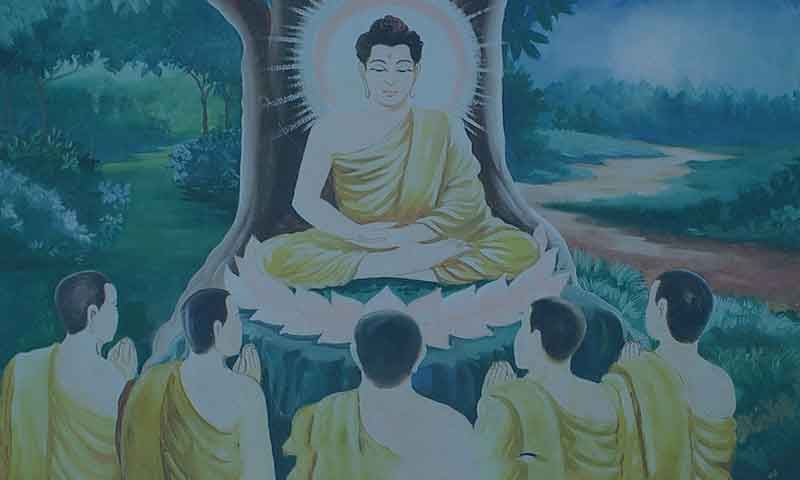
Leaving the bodhi tree, the Buddha went to Ispitana near Benares to see the five monks who deserted him few months ago. When the monks saw him approaching them they decided not to accord him any special welcome and pay him any respects. But when the Buddha came nearer them, they failed to keep up their resolve. They all stood up and bowed to him reverently. They were not aware that the Buddha had attained enlightenment. So they addressed him as 'Brother'. The Buddha requested them gently not to address him so since he had become a Buddha of clear vision. He made them sit in front of him and delivered his first sermon known as "Setting in Motion the Wheel of Law".
He taught them the middle path, the Four Noble Truths concerning the origin of suffering, the cause of suffering , the ending of suffering and the Eightfold path that would lead to the ending of suffering. After listening to the discourse, the five monks joined the Buddhist order and became his disciples. A few days later he gave them his second sermon on anatta (anatma) or the non-existence of soul.
A day after the second sermon a young man named yasa and fifty four of his companions joined the order and received initiation from the Buddha. The Buddha sent them in different directions to preach and reveal the new doctrine to other people.
Conversions and expansion of the Order
He then proceeded to Uravela, where he converted some more people including a few Brahmins. Uravela Kassapa, who later became one of his prominent disciples was among them. He taught them his third sermon on the truth concerning fire of lust, the fire of resentment and the fire of enchantment.
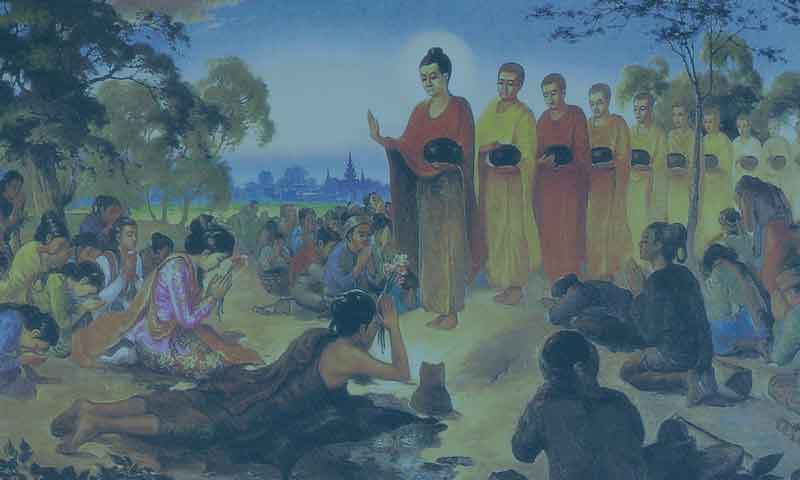 Buddha preaching
From Uravela, he went to Rajagriha to keep his earlier promise. There king Bimbisara met him and paid him great respects. He and members of his court were converted to the new faith. He also built a monastery for the Buddha and his followers in a near by bamboo grove and requested the latter to stay there for sometime. During this period he converted two more Brahmin ascetics, Sariputta and Mogallana. Both became arhats in short time.
Journey to Kapilavasthu
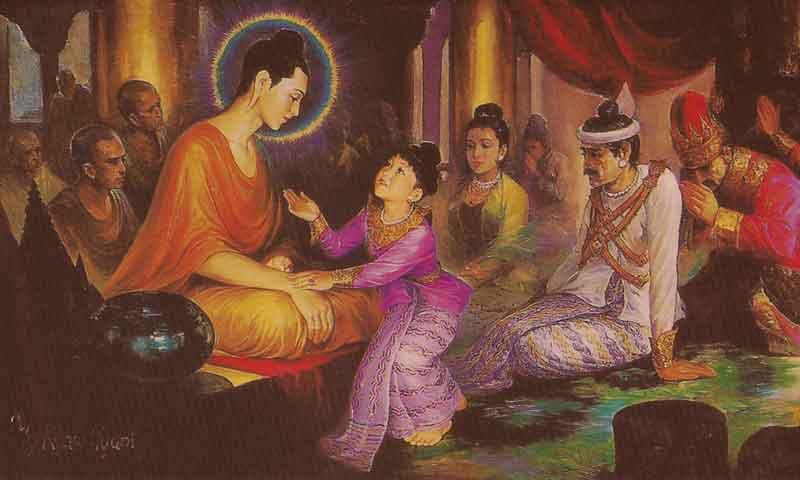 Buddha in Kapilavastu with Rahula
A few months later, the Buddha went to Kapilavasthu at the request of his father Suddhodana. He stayed in Nirgodha grove near the city and received his father and other members of the royal family.
We are told that the Buddha performed a miracle infront of them to show them that he had become the Buddha and to prevent them from treating him like one of their family members.
According to tradition, when he was at Kapilavasthu, he converted his father to Buddhism. He also saw his wife and son, Rahula, who were also converted to the new faith.
On his way back to Rajagriha he also converted several Sakya princes to his teachings and admitted them into his Order.
Chief among them were his cousins Ananda who later became his chief attendant and Devadatta who for some strange reasons turned later into his arch enemy.
Donations from the wealthy
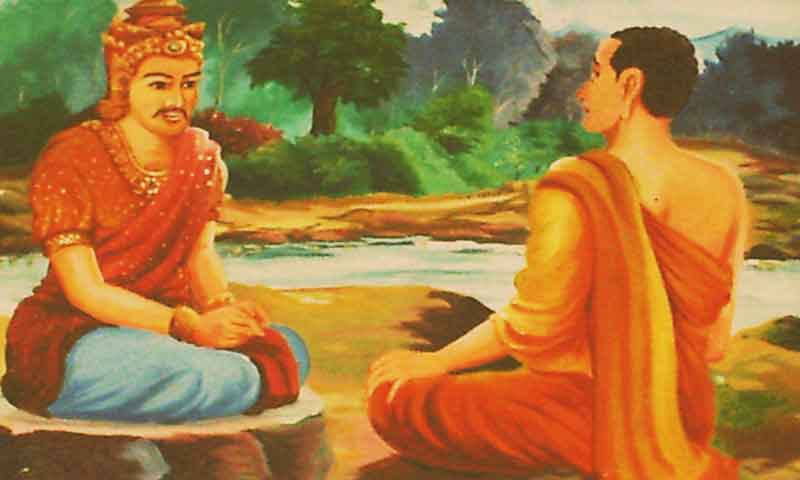
By this time the Buddha's name and fame spread to various parts of the Gangetic plain. Many people began joining his Order and following him wherever he went. Many wealthy merchants impressed by his radical teaching supported his Order with their generous donations and gifts of monasteries. Prominent among them were Ananthapindika who donated the famous Jetavana grove with a monastery built in between and Vishaka, the wife of a wealthy merchant from Sravasthi, who donated a monastery to the Order at Pubbarama.
Increasing influence
The buddha is credited with the act of settling a dispute between two warring groups, the Sakyas and the Koliyas by meeting them personally and convincing them of the utter futility of waging a war and causing enormous bloodshed simply for the sake of some trivial gains. He also met the famous bandit Angulimala alone and converted him and his followers to Dhamma.
Admission of women
The Buddha was initially reluctant to admit women into the Order as he felt that their admission would greatly reduce the influence of His creed over a period of time. Thrice he refused to admit his step mother Gautami into the order, even against the personal requests and recommendations of his personal attendant Ananda.
But Ananda said to have prevailed upon his master to rescind his decision as he felt that women also qualified to attain Nirvana. The Buddha finally agreed to admit women into the Order, but he was said to be not well disposed towards this development. It is also recorded that he said to have told Ananda that because of this decision the Doctrine and Discipline would not long endure. He however subjected the women who joined the Order to the 'Eight Duties of Subordination to the Brethren.
The Buddha's Daily life
After the enlightenment, the Buddha spent most part of his life wandering from place to place along with his monks and preaching Dhamma. During the rainy season, when the monsoon clouds gathered over the Indian subcontinent and rain poured down in great torrents, the Buddha and his followers spent time in monasteries, engaging in discussions, discourses and contemplation of the Noble Truths. During this period, the Order was well looked after by dedicated kings, wealthy merchants with generous donations and supply of food. When the rains ended and the monsoon clouds dispersed, the Buddha and hundreds of his followers went from village to village and town to town seeking alms and spreading the new creed.
Increasing popularity of the Dhamma
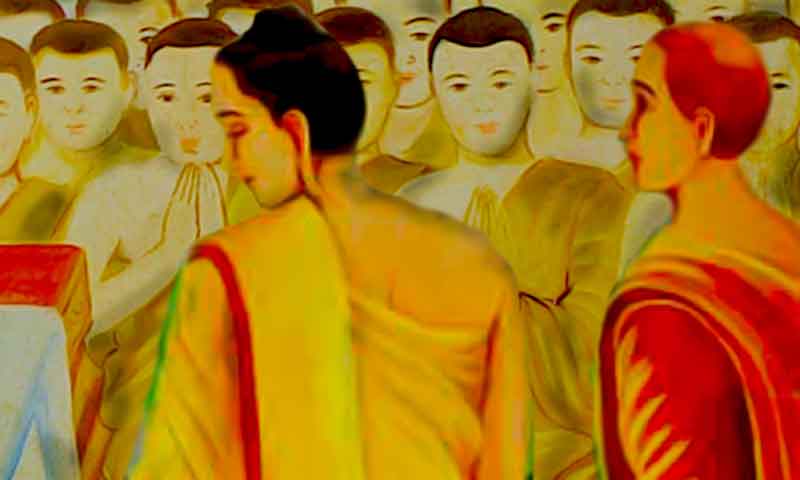 Buddha with his followers
Wherever they went the people of the place received the master with great reverence, considering it to be a rare chance to see him, if possible to speak to him and find answers to their questions. During this period he met several merchants who were eager to join the path and the famous courtesan, Amrapali.
It is said that even the king Ajathasatru could not suppress his curiosity to see the Buddha personally when he heard about him from his physician Jivaka.
Accompanied by his queen and a large retinue of his ministers and followers, he went to see Buddha who was staying in a mango grove near Rajagriha at that time. The Buddha said to have delivered a discourse 'on the fruits of asceticism' to him and converted him as a lay follower.
It is however difficult to believe that he was ever really converted to the new faith, for the king continued to engage in destructive wars and large scale bloodshed. He even engaged the Sakyas in a war and greatly destroyed the might of the Sakyas completely.
Opposition to the Buddha
The life of the Buddha was not entirely without opposition and controversy. His cousin Devadatta was one of his arch critics who was jealous of him and who tried his best to put the Buddha in difficulties. He developed enmity with the Exalted One because the latter refused to acknowledge him as his successor and true heir. It is said that he even contrived to kill the Buddha through a stratagem by engaging a mad elephant . But did not succeed as the Buddha confronted the elephant with his compassion and pacified it.
Legend states that the Buddha often engaged himself in religious debates with some heretical teachers to convince them of the efficacy of the Dhamma. Some among them, dissatisfied with his growing popularity and the strength of his arguments, said to have engaged one women named Cinca to make baseless allegations of an illicit relationship with him. The Buddha, when he heard this, maintained his demeanor and showed the strength of his character through silence and compassion. In the end the women was exposed and his opponents beat a retreat.
In the thirteenth year following his enlightenment the Buddha had to face insults from his own father-in-law, Suprabuddha. The reason for this enmity is not clearly known. But it appears that perhaps Suprabuddha never forgave his son-in-law for deserting his daughter and becoming a wandering monk.
Final years
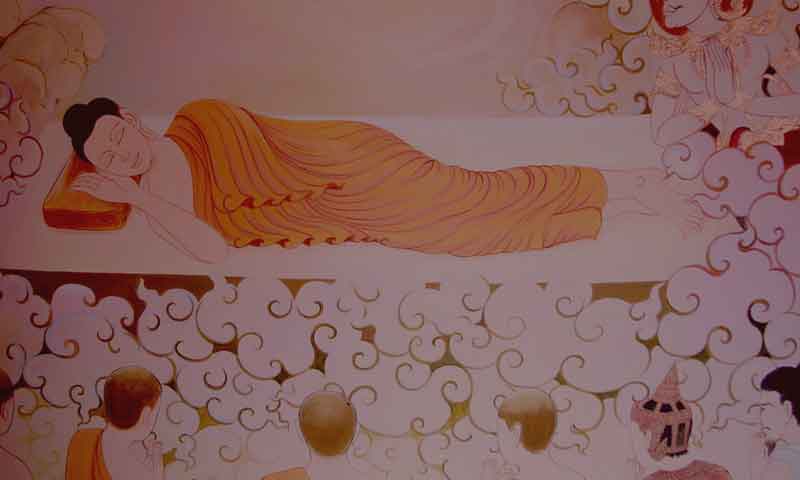
Buddha's Parinirvana
When the Master reached the age of seventy nine years, he said to have declared forty one conditions for the welfare of the Order, most of which dealt with the manner in which the monks were expected to conduct themselves and pursue their paths. he delivered the same message at Rajagriha and Nalanda. Then he proceeded to Vesali and stayed in a mango grove belonging to the beautiful, wealthy and legendary courtesan Amrapali. When she heard that the famous Buddha was staying in the mango grove, she met the great teacher and received religious instruction from him. He also accepted an invitation from her to visit her house and receive her hospitality. Amrapali later donated her mansion to the Order and was blessed by the Buddha.
From Vesali, the Buddha went to Beluva a small village where he spent his last Retreat. He fell sick there, but recovered soon as he realized that his time of departure was not yet come. But he was aware that final moments were approaching. At a place called Capala shrine he said to have informed Ananda of his approaching death and prepared him mentally for it. After some time he assembled the Brethren and made a public announcement of his fast approaching death saying," Behold now, O Brethren, I exhort you. All component things are subject to decay. Work our your salvation with diligence. The final passage of the Tathagatha will take place soon. At the end of three months hence the Tathagatha will die."
Thereafter he went to Pava where he stayed in a mango grove owned by a lay disciple, Cunda and accepted his invitation to visit his house and receive his hospitality. He became extremely sick after eating a meal in his house realized that his final hours had come. He requested Ananda to accompany him to Kusinara. That night on the outskirts of the town, in a Sala-grove of the Mallas, he left his earthly existence and passed into Nirvana.
Next >> Page 1 | Page 2 |
Suggestions for Further Reading
- Buddhism - The Concept of Anatta or No Self
- Anatta or Anatma in Buddhism
- Anicca or Anitya in Buddhism
- The Buddha on God
- The Buddha on Avijja or Ignorance and on the Origin of Life
- The Buddha On the Self And Anatta, the Not-Self
- History Of The Four Buddhist Councils
- Chinese Buddhism
- The Eightfold Path Of Buddhism
- The Four Noble Truths of Buddhism
- Four Stages of Progress on the Middle Way in Buddhism
- The Practice of Friendliness, Kalyanamittata, in Buddhism
- Karma or Kamma In Buddhism
- Mahayana Buddhism
- Buddha's Last Days and Final Words
- Buddhism - The Middle Way
- The Buddha's Teaching on Right Mindfulness
- The Meaning and Practice of Mindfulness
- Buddhism - Vinaya or Monastic Discipline
- Right Conduct For Lay Buddhists
- Nirvana or Nibbana in Buddhism
- Buddhism - Objects of Meditation and Subjects for Meditation
- Buddhism - Right Speech and Mind Training
- Buddhism - Right Living On The Eightfold Path
- Handbook for the Relief of Suffering by Ajaan Lee
- Theravada Buddhism
- Meat Eating or Vegetarianism in Buddhism
- Essays On Dharma
- Esoteric Mystic Hinduism
- Introduction to Hinduism
- Hindu Way of Life
- Essays On Karma
- Hindu Rites and Rituals
- The Origin of The Sanskrit Language
- Symbolism in Hinduism
- Essays on The Upanishads
- Concepts of Hinduism
- Essays on Atman
- Hindu Festivals
- Spiritual Practice
- Right Living
- Yoga of Sorrow
- Happiness
- Mental Health
- Concepts of Buddhism
- General Essays
Image Attribution: The images of the Buddha used in this article are either in public domain or licensed under the Creative Commons Attribution-Share Alike 3.0 Unported license.