
The Staus of Buddhist Women in Buddha's Time
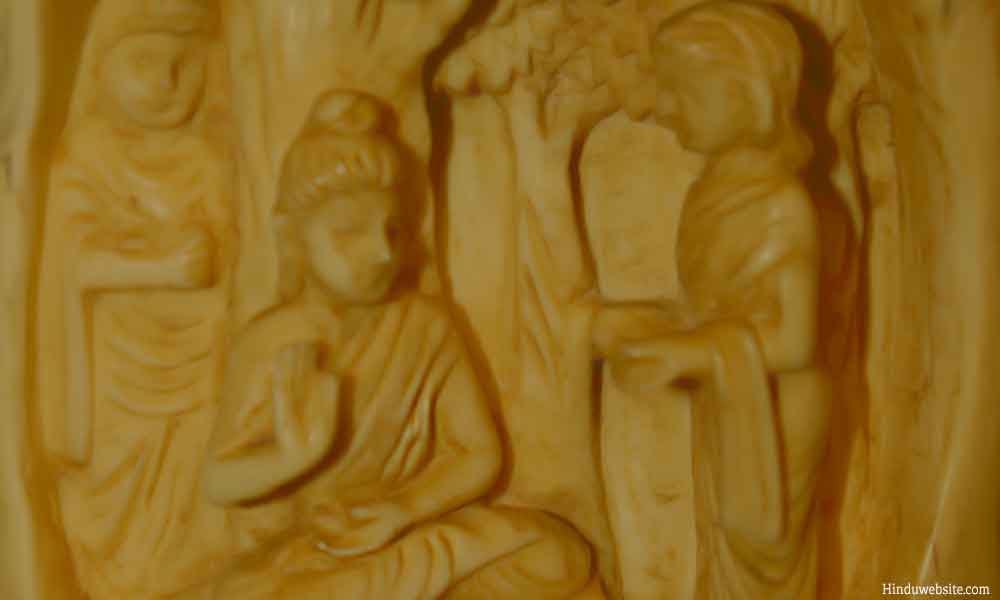
Notes from Jayaram V
We know that the Buddha initially had reservations against admitting women into the Sangha. It was not necessarily because he was prejudiced against them but because of the problems that were inherent in keeping men and women together under strict monastic discipline. He was also probably influenced by the vulnerability of both men and women towards each other and the consequences to his fledgling movement because of it. This was true especially in the ancient world, where women were looked upon as objects of beauty or lust or some form of property. These and for various other reasons, the Buddha was initially reluctant to admit women into the community of monks and accommodate them in the monasteries.
Further, monastic life in the ancient days was full of hardships. Monkhood demanded austere life. It was not a case of people going to a retreat and spending a few days in a comfortable and secluded environment. It was a complete and unconditional retreat into forests from the comforts of home life, a retreat from civilized world into a life which was unpredictable and without any comforts, and which was hard upon anyone, especially women. The monks were expected to live on alms and forego food for days if necessary. According to the Sramanic tradition of ancient India, they had to be homeless wanderers, walking long distances each day, often through inhospitable terrains, to spread the Dhamma or to avoid attachment to a particular place or its people.
Under these circumstances, it was indeed difficult for anyone to admit women into monastic life. This following work by Helmuth Hecker is one of the most comprehensive workw on the status of women in ancient India during the Buddha's time. From this work you may understand the influences at work and how the women monks or nuns led their lives. The Buddha was not a misogynist. He interacted with many women in his lifetime, even after he attained enlightenment. He was extremely compassionate towards them and treated them with great respect. His very presence motivated many of them to convert to Buddhism and follow his teachings.
Contents
- Foreword
- Abbreviations
- The Verses of Final Knowledge of Bhikkhuni Sujata
- Queen Mallika
- What Cannot Be Got: The Buddha's Words to King Pasenadi on Queen Mallika's Death
- Khema of Great Wisdom
- Bhadda Kundalakesa, the Former Jain Ascetic
- Kisagotami, the Mother with the Dead Child
- Sona, With Many Children
- Nanda, the Half-sister of the Awakened One
- Queen Samavati
- Patacara, Preserver of the Vinaya
Foreword
The following stories, written by Hellmuth Hecker, have been translated from the German Buddhist magazine, "Wissen and Wandel," XVIII 3 (1972), XXLI 1/2 (1976). They are published here with their kind permission.
While every effort has been made by the translator to conform to the original writing, some changes had to be made for the sake of clarity.
The stories of Bhadda Kundalakesa and Patacara have been enlarged and filled in.
Grateful acknowledgment is made to Ven. Khantipalo for his assistance in improving the style and content of this narrative. His new translations of verses of the Therigatha and the Dhammapada from the original Pali have helped to make these stories come alive.
It is hoped that this booklet will serve as an inspiration to all those who are endeavoring to tread in the Buddha's footsteps.
Sister Khema
Wat Buddha Dhamma
Wisemans Ferry, N.S.W.2255
Australia
January 1982
Abbreviations of Source References
![[go to top]](../../images/scrollup.gif)
A .... Anguttara Nikaya
D .... Digha Nikaya
Dhp .... Dhammapada
M .... Majjhima Nikaya
S .... Samyutta Nikaya
Sn .... Sutta
Nipata
Thag .... Theragatha
Thig .... Therigatha
Pac. ....
Pacittiya (Vinaya)
J. .... Jataka
Ud. .... Udana
Mil. ....
Milindapañha
Jtm. .... Jatakamala
Bu. .... Buddhavamsa
Divy..... Divyavadana
Ap. .... Apadana
The Verses of Final Knowledge
of Bhikkhuni Sujata
With subtle veils adorned,
Garlands and sandal-wood bedecked,
Covered all over with ornaments,
Surrounded by my servants,
Taking with us food and drink,
Eatables of many kinds,
Setting
off from the house,
To the forest grove we took it all.
Having enjoyed and sported there,
We turned our feet to home
But on the way I saw and entered
Near Saketa, a monastery.
Seeing the Light of the World
I drew near, bowed down to Him;
Out of compassion the Seeing One
Then taught me Dhamma there.
Hearing the words of the Great Sage,
I penetrated Truth:
The Dhamma passionless,
I touched the Dhamma of Deathlessness.
When the True Dhamma had been known,
I went forth to the homeless
life;
The three True Knowledges are attained,
Not empty the
Buddha's Teaching!
Queen Mallika
At the time of the Buddha, a daughter was born to the foreman of the guild of garland-makers in Savatthi. She was beautiful, clever and well behaved and a source of joy to her father.
One day, when she had just turned sixteen, she went to the public flower gardens with her girl-friends and took three portions of fermented rice along in her basket as the day's sustenance.
When she was just leaving by the city gate, a group of monks came along, who had come down from the monastery on the hill to obtain almsfood in town. The leader among them stood out; one whose grandeur and sublime beauty impressed her so much, that she impulsively offered him all the food in her basket.
He was the Awakened One. He let her put her offering into his alms bowl. After Mallika — without knowing to whom she had given the food — had prostrated at his feet, she walked on full of joy. The Buddha smiled. Ananda, his attendant, who knew that the fully Enlightened One does not smile without a reason, asked therefore why he was smiling. The Buddha replied that this girl would reap the benefits of her gift this very same day by becoming the Queen of Kosala.
This sounded unbelievable, because how could the Maharaja of Benares and Kosala elevate a woman of low caste to the rank of Queen? Especially in the India of those days with its very strict caste system, this seemed quite improbable.
The ruler over the United Kingdoms of Benares and Kosala in the Ganges Valley was King Pasenadi, the mightiest Maharaja of his day. At that time he was at war with his neighbor, the King of Magadha.
The latter had won a battle and King Pasenadi had been forced to retreat. He was returning to his capital on the horse that had been his battle companion. Before entering the city, he heard a girl sing in the flower gardens. It was Mallika, who was singing melodiously because of her joy in meeting the Illustrious Sage. The King was attracted by the song and rode into the gardens; Mallika did not run away from the strange warrior, but came nearer, took the horse by its reins and looked straight into the King's eyes. He asked her whether she was already married and she replied in the negative. Thereupon he dismounted, lay down with his head in her lap and let her console him about his ill-luck in battle.
After he had recovered, he let her mount his horse behind him and took her back to the house of her parents. In the evening he sent an entourage with much pomp to fetch her and made her his principal wife and Queen.
From then on she was dearly beloved by the King. She was given many loyal servants and in her beauty she resembled a goddess. It became known throughout the whole kingdom that because of her simple gift she had been elevated to the highest position in the State and this induced her subjects to be kind and generous towards their fellow men. Wherever she went, people would joyously proclaim: "That is Queen Mallika, who gave alms to the Buddha." (J 415E)
After she had become Queen, she soon went to visit the Enlightened One to ask him something which was puzzling her. Namely, how it came about that one woman could be beautiful, wealthy and of great ability, another be beautiful but poor and not very able, yet another although ugly, be rich and very able, and finally another be ugly, poor and possess no skills at all.
These differences can constantly be observed in daily life. But while the ordinary person is satisfied with such common place terms as fate, heredity, coincidence and so on, Queen Mallika wanted to probe deeper as she was convinced that nothing happens without a cause.
The Buddha explained to her in great detail that all attributes and living conditions of people everywhere were solely dependent on the extent of their moral purity. Beauty was caused by forgiveness and gentleness, prosperity due to generous giving, and skillfulness was caused by never envying others, but rather being joyful and supporting their abilities.
Whichever of these three virtues a person had cultivated, that would show up as their "destiny," usually in some mixture of all of them. The coming together of all three attributes would be a rarity. After Mallika had listened to this discourse of the Buddha, she resolved in her heart to be always gentle towards her subjects and never to scold them, to give alms to all monks, brahmans and the poor, and never to envy anyone who was happy.
At the end of the Enlightened One's discourse she took refuge in the Buddha, Dhamma and Sangha and remained a faithful disciple for the rest of her life. (A IV, 197)
She showed her great generosity not only giving regular alms, but also by building a large, ebony-lined hall for the Sangha, which was used for religious discussions. (M 78, D 9)
She exhibited her gentleness by serving her husband with the five qualities of a perfect wife, namely: always rising before him, and going to bed after him, by always obeying his commands, always being polite, and using only kind words. Even the monks praised her gentleness in their discussions about virtue.
Soon she was to prove that she was also free of jealousy. The King had made up his mind to marry a second chief wife and brought a cousin of the Buddha home as his betrothed. Although it is said that it is in the nature of women not to allow a rival into her home, Mallika related to the other wife without the slightest malice. (A VI, 52) Both women lived in peace and harmony at the Court.
Even when the second wife gave birth to a son, the crown prince, and Mallika had only a daughter, she was not envious. When the King voiced disappointment about the birth of a daughter, the Buddha said to him that a woman was superior to a man if she was clever, virtuous, well-behaved and faithful. Then she could become the wife of a great King and give birth to an almighty Ruler. (S 3,16) When the daughter, Princess Vajira, had grown up, she became Queen of Magadha and thereby the ancestress of the greatest Indian Emperor, Asoka, who ruled Magadha 250 years later.
After Mallika had become a faithful lay devotee of the Buddha, she also won her husband over to the teaching. And that happened in this way: One night the King had a succession of sixteen perturbing dreams during which he heard gruesome, unfathomable sounds from four voices, which uttered: "Du, Sa, Na, So." When the King woke up from these dreams, great fear seized him, and sitting upright and trembling, he awaited the sunrise.
When his Brahman priests asked him whether he had slept well, he related the terror of the night and asked them what one could do to counteract such a menace. The Brahmans declared that one would have to offer great sacrifices and thereby pacify the evil spirits. In his fear the King agreed to that. The Brahmans rejoiced because of the gifts they would surely reap and busily began to make preparations for the great sacrifice. They scurried about, building a sacrificial altar and tied many animals to posts, so they could be killed.
For greater efficacy, they demanded the sacrifice of four human beings and these also awaited their death, tied to posts. When Mallika became aware of all this activity, she went to the King and asked him why the Brahmans were so busily running about full of joyous expectation. The King replied that she did not pay enough attention to him and did not know his sorrows.
Thereupon he told her of his dreams. Mallika asked the King whether he had also consulted the first and foremost of Brahmans about the meaning and interpretation. He replied that she first had to tell him who was the first and foremost of Brahmans. She explained that the Awakened One was foremost in the world of Gods and men, the first of all Brahmans. King Pasenadi decided to ask the Awakened One's advice and went to Prince Jeta's Grove, Anathapindika's Monastery.
He related to the Buddha what had taken place in his dreams and asked him what would happen to him. "Nothing," the Awakened One replied and explained the meaning to him. The sixteen dreams which he had were prophecies, showing that the living conditions on earth would deteriorate steadily, due to the increasing moral laxity of the kings. In a meditative moment, King Pasenadi had been able to see future occurrences within his sphere of interest because he was a monarch concerned with the well-being of his subjects.
The four voices which he had heard belonged to four men who had lived in Savatthi and had been seducers of married women. Because of that they were reborn in hell and for 30,000 years they drowned in red-hot cauldrons, coming nearer and nearer to the fire, which intensified their unbearable suffering. During another 30,000 years they slowly rose up in those iron cauldrons and had now come to the rim, where they could once again at least breathe the air of the human realm.
Each one wanted the speak a verse, but because of the gravity of the deed, could not get past the first syllable. Not even in sights could they voice their suffering, because they had long lost the gift of speech. The four verses, which start in Pali with "du," "sa," "na," "so," were recognized by the Awakened One as follows:
Du: Dung-like life we lived,
No willingness to give,
Although we could have given much,
We did not make our refuge
thus.
Sa: Say, the end is near?
Already 60,000 years have
gone
Without respite the torture is
In this hell realm.
Na: Naught, no end near, Oh, would it end!
No end in
sight for us.
Who once did misdeeds here
For me, for you,
for both of us.
So: So, could I only leave this place
And raise myself
to human realm,
I would be kind and moral too,
And do good
deeds abundantly.
After the King had heard these explanations, he became responsive to the request of the compassionate Queen and granted freedom to the imprisoned men and animals. He ordered the sacrificial altar to be destroyed. (J 77 & 314)
The King, who had become a devoted lay disciple of the Buddha, visited him one day again and met a wise and well-learned layman there. The King asked him whether he could give some daily Dhamma teaching to his two Queens. The layman replied that the teaching came from the Enlightened One and only one of his immediate disciples could pass it on to the Queens. The King understood this and requested the Buddha to give permission to one of his monks to teach. The Buddha appointed Ananda for this task. Queen Mallika learned easily in spite of her uneducated background, but Queen Vasabhakhattiya, cousin of the Buddha and mother of the crown-prince, was unconcentrated and learned with difficulty. (Pac 3)
One day the royal couple looked down upon the river from the palace and saw a group of the Buddha's monks playing about in the water. The king said to Queen Mallika reproachfully: "Those playing about in the water are supposed to be Saints?" Such was namely the reputation of this group of the so-called seventeen monks, who were quite young and of good moral conduct. Mallika replied that she could only explain it thus, that either the Buddha had not made any rules with regard to bathing or that the monks were not acquainted with them, because they were not amongst the rules which were recited regularly.
Both agreed that it would not make a good impression on lay people and on those monks not yet secure, if those in higher training played about in the water and enjoyed themselves in the way of untrained worldly people. But King Pasenadi wanted to avoid blackening those monks' characters and just wanted to give the Buddha a hint, so that he could lay down a firm rule. He conceived the idea to send a special gift to the Buddha to be taken by those monks. They brought the gift and the Buddha asked them on what occasion they had met the King. Then they told him what they had done and the Buddha laid down a corresponding rule. (Pac. 53)
One day when the King was standing on the parapet of the palace with the Queen and was looking down upon the land, he asked her whether there was anyone in the world she loved more than herself. He expected her to name him, since he flattered himself to have been the one who had raised her to fame and fortune. But although she loved him, she remained truthful and replied that she know of no one dearer to herself than herself. Then she wanted to know how it was with him: Did he love anyone — possibly her — more than himself? Thereupon the King also had to admit that self-love was always predominant. But he went to the Buddha and recounted the conversation to find out how a Saint would consider this.
The Buddha confirmed his and Mallika's statements:
I visited all quarters with my mind
Nor found I any dearer
than myself;
Self is likewise to every other dear;
Who loves
himself may never harm another.
One day the Buddha said to a man whose child had died: "Dear ones, those who are dear, bring sorrow, lamentation, pain, grief and despair" — the suffering that results from a clinging love. In spite of the clearly visible proof, the man could not understand this. The conversation was reported to the King and he asked his wife whether it was really true that sorrow would result from love. "If the Awakened One has said so, O King, then it is so," she replied devotedly.
The King demurred that she accepted every word of the Buddha like a disciple from a guru. Thereupon she sent a messenger to the Buddha to ask for more details and then passed the explicit answer on to her husband.
She asked him whether he loved his daughter, his second wife, the crown-prince, herself and his kingdom? Naturally he confirmed this, these five things were dear to him. But if something happened to these five, Mallika responded, would he not feel sorrow, lamentation, pain, grief or despair, which comes from loving? Then the King understood and realized how wisely the Buddha could penetrate all existence: "Very well, then Mallika, continue to venerate him." And the King rose, uncovered his shoulder, prostrated deferentially in the direction where the Blessed One was wont to stay and greeted him three times with: "Homage to the Blessed One, the Holy One, the fully Awakened One."
But their lives also did not remain quite without conflict. One day an argument arose between the couple about the duties of the Queen. For some reason the King was angry at her and treated her from then on as if she had disappeared into thin air. When the Buddha arrived at the palace the next day for his meal, he asked about the Queen, who had always been present at other times. Pasenadi scowled and said: "What about her? She has gone mad because of her fame." The Buddha replied that he, himself, had raised her up to that position quite unexpectedly and should become reconciled with her. Somewhat reluctantly the King had her called. Thereupon the Buddha praised the blessing of amity and the anger was forgotten, as if it had never happened. (J 306)
But later on a new tension arose between the couple. Again the King would not look at the Queen and pretended she did not exist. When the Buddha became aware of this, he asked about her. Pasenadi said that her good fortune had gone to her head. Immediately the Awakened One told an incident from a former life:
Both were then heavenly beings, a deva couple, who loved each other dearly. One night they were separated from each other because of the flooding of a stream. They both regretted this irretrievable night, which could never be replaced during their life-span of a thousand years. And during the rest of their lives they never let go of each other's company and always remembered to use this separation as a warning so that their happiness would endure during that whole existence. The King was moved by this story, and became reconciled to the Queen. Mallika then spoke this verse to the Buddha:
With joy I heard your varied words,
Which spoken were for
my well-being;
With your talk you took away my sorrow
Verily,
you are the joy-bringer amongst the ascetics
May you live long!
A third time the Buddha told of an occurrence during one of the former lives of the royal couple. At that time Pasenadi was a crown-prince and Mallika his wife. When the crown-prince became afflicted with leprosy and could not become King because of that, he resolved to withdraw into the forest by himself, so as not to become a burden to anyone. But his wife did not desert him, and looked after him with touching attention. She resisted the temptation to lead a care-free life in pomp and splendor and remained faithful to her ugly and ill-smelling husband. Through the power of her virtue she was able to effect his recovery. When he ascended to the throne and she became his Queen, he promptly forgot her and enjoyed himself with various dancing girls. It is almost as difficult to find a grateful person, the Buddha said, as it is difficult to find a Holy One. (A III, 122)
Only when the King was reminded of the good deeds of his Queen, did he change his ways, asked her forgiveness and lived together with her in harmony and virtue. (J 519)
Queen Mallika committed only one deed in this life which had evil results and which led her to the worst rebirth. Immediately after her death, she was reborn in hell, though this lasted only a few days.
When she died, the King was just listening to a Dhamma exhortation by the Buddha. When the news reached him there, he was deeply shaken and even the Buddha's reminder that there was nothing in the world that could escape old age, disease, death, decay and destruction could not immediately assuage his grief. (A V,49)
His attachment — "from love comes sorrow" — was so strong, that he went to the Buddha every day to find out about the future destiny of his wife. If he had to get along without her on earth, at least he wanted to know about her rebirth. But for seven days the Buddha distracted him from his question through fascinating and moving Dhamma discourses, so that he only remembered his question when he arrived home again. Only on the seventh day would the Buddha answer his question and said that Mallika had been reborn in the "Heaven of the Blissful Devas." He did not mention the seven days she had spent in hell, so as not to add to the King's sorrow. Even though it was a very short-termed sojourn in the lower realms, one can see that Mallika had not yet attained stream-entry [*] during her life on earth, since it is one of the signs of a stream-enterer that there is no rebirth below the human state. However, this experience of hellish suffering together with her knowledge of Dhamma, could have quickened Mallika's last ripening for the attainment of stream-entry.
* [Stream-entry: the first stage of Enlightenment, where the first glimpse of Nibbana is gained and the first three fetters abandoned.]
Sources: M 87; A V,49, IV, 197, VIII, 91; S 3,8 = Ud V,I; S 3, 16; J 77, 306, 314, 415, 504, 519; Pac. 53,83; Mil. 115, 291; Jtm. 3; Divy, p.88What Cannot Be Got:
The
Buddha's Words to King Pasenadi on Queen Mallika's Death
At one time the Lord was staying near Savatthi at Jeta Grove, Anathapindika's Monastery. Then King Pasenadi of Kosala approached the Lord and having done so, paid his respects and sat down nearby. Now at that time Queen Mallika died. A certain man then approached the King and whispered in his ear: "Your Majesty, Queen Mallika has died." At those words king Pasenadi was filled with grief and depression, and with shoulders drooping, head down, he sat glum, and with nothing to say. The Lord saw the king sitting there like that and spoke to him in this way:
"Great king, there are these five circumstances not-to-be-got by monk, brahman, deva, Mara, Brahma, or by anyone in the world. What are the five?
"That what is of the nature to decay may not decay, is a circumstance not-to-be-got by a monk... or by anyone in the world. That what is of the nature to be diseased may not be diseased, is a circumstance not-to-be-got by a monk... or by anyone in the world.
"That what is of the nature to die may not die, is a circumstance not-to-be-got by a monk... or by anyone in the world.
"That what is of the nature to be exhausted may not be exhausted, is a circumstance not-to-be-got by a monk... or by anyone in the world.
"That what is of the nature to be destroyed may not be destroyed, is a circumstance, not-to-be-got by a monk... or by anyone in the world.
"Great king, for an uninstructed ordinary person what is of the nature to decay does decay, what is of the nature to be diseased does become diseased, what is of the nature to die does die, what is of the nature to be exhausted is exhausted and what is of the nature to be destroyed is destroyed — and when these things happen to him he does not reflect, "It's not only for me that what is of the nature to decay decays... that what is of the nature to be destroyed is destroyed, but wherever there are beings, coming and going, dying and being born, for all those beings what is of the nature to decay decays... what is of the nature to be destroyed is destroyed, and if I, when there is decay in what is of the nature to decay... when there is destruction in what is of the nature to be destroyed, should grieve, pine, and lament, and crying beat the breast and so fall into delusion, food would not be enjoyed, my body would become haggard, work would not be done and enemies would be pleased, while friends would be depressed. Then, when there is decay in what is of the nature to decay, disease in what is of the nature to be diseased, death in what is of the nature to die, exhaustion in what is of the nature to be exhausted, destruction in what is of the nature to be destroyed, he grieves, pines and laments, and crying beats his breast and so falls into delusion.
"This is called an uninstructed ordinary person; pierced by the poisoned dart of grief, he just torments himself. Great king, for the instructed Noble Disciple what is of the nature to decay does decay... and what is of the nature to be destroyed is destroyed... and when these things happen to him he does reflect, "It's not only for me that what is of the nature to decay decays... that what is of the nature to be destroyed, is destroyed, but wherever there are beings, coming and going, dying and being born, for all those beings what is of the nature to decay decays... what is of the nature to be destroyed is destroyed, and if I, when there is decay in what is of the nature to decay... when there is destruction in what is of the nature to be destroyed, should grieve, pine and lament, and crying beat the breast and so fall into delusion, food would not be enjoyed, my body would become haggard, work would not be done and enemies would be pleased while friends would be depressed. Then when there is decay in what is of the nature to decay, disease in what is of the nature to be diseased, death in what is of the nature to die, exhaustion in what is of the nature to be exhausted, destruction in what is of the nature to be destroyed, he does not grieve or pine or lament, he does not beat his breast and fall into delusion.
"This is called an instructed Noble Disciple. Drawn out is the poisoned dart of grief with which the uninstructed ordinary person torments himself. Free of grief, free from the dart, the Noble Disciple has quenched [*] himself completely."
* [Or "become cool" literally "nibban-ered."]"Great king, these are the five circumstances not-to-be-got by monk, brahman, deva, Mara, Brahma, or by anyone in the world.
Do not grieve, nor should you lament.
Here, what good is gained?
— none at all indeed,
and enemies rejoice to see that grief and
pain.
But when misfortunes do not shake the wise —
that one
who knows well how to seek the good,
then enemies because of
that are pained
seeing his face as formerly, not strained.
Where and whatever good may gotten, be
there and just there he
should try for that
by study, wisdom and well-spoken words,
unpracticed so far, and tradition, too.
But if he knows: "This
good can be got
Neither by me nor any other too"
then ungrieving
he should bear it all (and think),
"Now how to use my strength
for present work?"
Khema of Great Wisdom
Just as there were two foremost disciples in the order of monks, namely Sariputta and Moggallana, likewise the Buddha named two women as foremost amongst nuns, namely Uppalavanna and Khema.
The name Khema means well-settled or composed or security and is a synonym for Nibbana. The nun Khema belonged to a royal family from the land of Magadha. When she was of marriageable age, she became one of the chief consorts of King Bimbisara. As beautiful as her appearance was, equally beautiful was her life as the wife of an Indian Maharaja.
When she heard about the Buddha from her husband, she became interested, but she had a certain reluctance to become involved with his teaching. She felt that the teaching would run counter to her life of sense-pleasures and indulgences. The king, however, knew how he could influence her to listen to the teaching. He described at length the harmony, the peace and beauty of the monastery in the Bamboo Grove, where the Buddha stayed frequently. Because she loved beauty, harmony and peace, she was persuaded to visit there.
Decked out in royal splendor with silk and sandalwood, she went to the monastery. The Exalted One spoke to her and explained the law of impermanence of all conditioned beauty to her. She penetrated this sermon fully and still dressed in royal garments, she attained to enlightenment. Just like the monk, Mahakappina — a former king — she likewise became liberated through the power of the Buddha's words while still dressed in the garments of the laity. With her husband's permission she joined the Order of Nuns. Such an attainment, almost like lightning, is only possible however where the seed of wisdom has long been ripening and virtue is fully matured.
An ordinary person, hearing Khema's story, only sees the wonder of the present happening. A Buddha can see beyond this and knows that this woman did not come to full liberation accidentally. It came about like this: In former times when a Buddha appeared in the world, then Khema in those past lives also appeared near him, or so it has been recounted. Due to her inner attraction towards the highest Truth, she always came to birth wherever the bearer and proclaimer of such Truth lived. It is said that already innumerable ages ago she had sold her beautiful hair to give alms to the Buddha Padumuttara. During the time of the Buddha Vipassi, ninety-one eons ago, she had been a teacher of Dhamma. Further it is told, that during the three Buddhas of our happy eon, which were previous to our Buddha Gautama, she was a lay disciple and gained happiness through building monasteries for the Sangha.
While most beings mill around heaven or hell realms during the life-time of a Buddha, Khema always tried to be near the source of wisdom. When there was no Buddha appearing in the world, she would be reborn at the time of Pacceka-Buddhas or Bodhisattas. In one birth she was the wife of the Bodhisatta, who always exhorted his peaceful family like this:
According to what you have got, give alms;
Observe the Uposatha
days, keep the precepts pure;
Dwell upon the thought of death
and be mindful of your mortal state.
For in the case of beings
like ourselves, death is certain, life is uncertain;
All existing
things are transitory and subject to decay.
Therefore be heedful
of your ways day and night.
One day Khema's only son in this life was suddenly killed by the bite of a poisonous snake, yet she was able to keep total equanimity:
Uncalled he hither came, without leave departed, too;
Even
as he came, he went. What cause is here for woe?
No friend's
lament can touch the ashes of the dead:
Why should I grieve?
He fares the way he had to tread.
Though I should fast and weep,
how would it profit me?
My kith and kin, alas! would more unhappy
be.
No friend's lament can touch the ashes of the dead:
Why
should I grieve? He fares the way he had to tread.
Another time — so it is told — she was she daughter-in-law of the Bodhisatta (J 397), many times a great Empress who dreamt about receiving teaching from the Bodhisatta and then actually was taught by him (J 501,502,534). It is further recounted that as a Queen she was always the wife of he who was later Sariputta, who said about her:
Of equal status is the wife,
Obedient, speaking only loving
words,
With children, beauty, fame, garlanded,
She always
listens to my words.
This husband in former lives was a righteous king, who upheld the ten royal virtues: Generosity, morality, renunciation, truthfulness, gentleness, patience, amity, harmlessness, humility, justice. Because of these virtues the king lived in happiness and bliss. Khema, too, lived in accordance with these precepts. (J 534)
Only because Khema had already purified her heart and perfected it in these virtues, in many past lives she was now mature enough and had such pure and tranquil emotions, that she could accept the ultimate Truth in the twinkling of an eye.
The Buddha praised her as the nun foremost in wisdom. A story goes with that: King Pasenadi was traveling through his country, and one evening he arrived at a small township. He felt like having a conversation about Dhamma and ordered a servant to find out whether there was a wise ascetic or priest in the town. The servant sounded everyone out, but could not find anyone whom his master could converse with. He reported this to the King and added that a nun of the Buddha lived in the town.
It was the saintly Khema, who was famed everywhere for her wisdom and known to be clever, possessing deep insight, had heard much Dhamma, and was a speaker of renown, knowing always the right retort. Thereupon the king went to the former Queen, greeted her with respect and had the following conversation with her:
P.: Does an Awakened One exist after death?
K.: The Exalted
One has not declared that an Awakened One exists after death.
P.: Then an Awakened One does not exist after death?
K.: That
too, the Exalted One has not declared.
P.: Then the Awakened
One exists after death and does not exist?
K.: Even that, the
Exalted One has not declared.
P.: Then one must say, the Awakened
One neither exists nor not exists after death?
K.: That too,
the Exalted One has not declared.
Thereupon the King wanted to know why the Buddha had rejected these four questions. First we must try to understand what these questions imply. The first question corresponds with the view of all those beings whose highest goal is to continue on after death, spurred on by craving for existence. The answer that an Awakened One continues to exist after death, is the one given by all other religions, including later interpretations of Buddhism.
The second answer that the Enlightened One does not exist after death would be in keeping with craving for non-existence, i.e., annihilation.
Because of an urge for definite knowledge and certainly, a definition is sought which could claim that the five aggregates (khandha) of form, feeling, perception, mental formations and consciousness — which make up the sum total of all existence — are completely dissolved and disappear upon the shedding of an Awakened One's body; and that deliverance consisted in that mere fact of dissolution.
The third answer seeks a compromise: everything impermanent in an Awakened One would be annihilated, but the permanent aspect, the essence, his actual person, would remain.
The fourth answer tries to get out of the predicament by formulating a "neither-nor" situation, which is meant to be satisfying. [*] All four formulas have been rejected by the Buddha as wrong view. They all presuppose that there is an "I" distinct from the world, while in reality "I" and "world" are part of the experience which arises because of consciousness.
* [This "solution" is formulated with the idea that it is something that words/concepts cannot describe, but it still uses "exist" "not exist" and so was not accepted by the Buddha.]
Only the Enlightened Ones can actually see this or those who have been their disciples, and unless this understanding is awakened, the assumption is made that an "I," and essentially permanent "self," is wandering through samsara, [*] gradually ascending higher and higher until it is dissolved, which is liberation; this is a belief held by some. Others conclude from this, that the Buddha teaches the destruction of the "self." But the Buddha teaches that there is no "I" or "self," which can be destroyed, that it has never existed and has never wandered through samsara.
* [Samsara: The rounds of birth and death, continually recurring.]
What we call "I" and what we call "world" are in reality a constantly changing process, always in flux, which always throws up the illusion of "I" and "world" born in the present and speculated upon in the past and future. The way to liberation is to stop speculating about the "I," to become free from habitual views and formulas, and come to the end of the mind's illusory conjuring.
Not through increasing the thought processes about phenomena, but through mindfulness of the arising of phenomena, which leads to reducing the chatter in the mind, can liberation be attained. Everything we see, hear, smell, taste, touch and think, anything that can be contained in consciousness, no matter how wide-ranging and pure it is, has arisen due to causes; therefore it is impermanent and subject to decay and dissolution.
Everything which is subject to decay and change is not-self. Because the five clung-to aggregates are subject to destruction, they are not "my" self, are not "mine." "I" cannot prevent their decay, their becoming sick, damaged, faulty and their passing away. The conclusion that the self must then be outside of the five aggregates does not follow either, because it, too, is a thought and therefore belongs to one of the five clung-to aggregates (i.e., mental formations).
Any designation of the Enlightened One after death is therefore an illusion, born out of compulsion for naming, and cannot be appropriate. Whoever has followed the teaching of the Awakened One, as Khema did, is greatly relieved to see that the Buddha did not teach the destruction of an existing entity, nor the annihilation of a self. But, on the contrary, those not instructed by the Exalted One live without exception in a world of perpetual destruction, of uncontrollable transiency in the realm of death. Whatever they look upon as "I" and "mine" is constantly vanishing and only upon renouncing these things which are unsatisfactory because of their impermanence, can they reach a refuge of peace and security. Just as the lion's roar of the Exalted One proclaimed: "Open are the doors to the deathless, who has ears to hear, come and listen."
Khema tried to explain this to the King with a simile. She asked him whether he had a clever mathematician or statistician, who could calculate for him how many hundred, thousand or hundred-thousand grains of sand are contained in the river Ganges. The King replied that that is not possible. The nun then asked him whether he knew of anyone who could figure out how many gallons of water are contained in the great ocean. That, too, the King considered impossible. Khema asked him why it is not possible. The King replied that the ocean is mighty, deep, unfathomable.
Just so, said Khema, is the Exalted One. Whoever wished to define the Awakened One, could only do so through the five clung-to aggregates and the Buddha no longer clung-to them. "Released from clinging to form, feeling, perception, mental formations and consciousness is the Enlightened One, mighty, deep unfathomable as the great ocean."
Therefore it was not appropriate to say he existed or did not exist, or existed and did not exist, nor did he neither exist nor not exist. All these designations could not define what was undefinable. Just that was liberation: liberation from the compulsion to stabilize as "self" the constant flux of the five aggregates, which are never the same in any given moment, but only appear as a discharge of tensions arising from mental formations.
The King rejoiced in the penetrating explanation of the nun Khema. Later on he met the Enlightened One and asked him the same four questions. The Buddha explained it exactly as Khema had done, even using the same words. The King was amazed and recounted his conversation with the wise nun Khema, the arahant. (S 44,1)
Sources: S 17,23; S 44,1; A I,24; II,62; IV,176; VIII,91. Thag. 139-144; J 354;397;501;502;534;539; Ap II No.18 (verse 96); Bu 26,19.Bhadda Kundalakesa
The Former
Jain Ascetic
In Rajagaha, the capital of the kingdom of Magadha, lived a girl of good family named Bhadda. Her parents protected her very carefully, because she had a passionate nature and they were afraid that she would be hurt due to her attraction to men. One day from her window Bhadda saw how a thief was being led to the place of execution. He was the son of a Brahman (priest-caste) but had a strong tendency towards stealing.
She fell in love with him at first sight. She convinced her father that she could not live without him, and so he bribed the guards who let the condemned man escape.
Soon after the wedding the bridegroom became obsessed with the desire to get his wife's jewelry. He told her he had made a vow that he would make an offering to a certain mountain deity if he could escape execution. Through this ruse he managed to get Bhadda away from his home. He wanted to throw her down from a high cliff to gain possession of her valuable ornaments. When they came to the cliff, he brusquely told her about his intention. Bhadda, in her distress, likewise resolved to a ruse that enabled her to give him a push so that it was he who fell to his death.
Burdened by the enormity of her deed, she did not want to return to lay life. Sensual pleasures and possessions were no longer tempting for her. She became a wandering ascetic. First she entered the order of Jains and as a special penance, her hair was torn out by the roots, when she ordained. But it grew again and was very curly. Therefore she was called "Curly-hair" (Kundalakesa).
The teaching of the Jain sect did not satisfy her, so she became a solitary wanderer. For fifty years she traveled through India and visited many spiritual teachers, thereby obtaining an excellent knowledge of religious scriptures and philosophies. She became one of the most famous debaters. When she entered a town, she would make a sand-pile and stick a rose-apple branch into it and would announce that whoever would engage in discussion with her should trample upon the sand-pile.
One day she came to Savatthi and again erected her little monument. At that time, Sariputta — the disciple of the Buddha with the greatest power of analysis — was staying at the Jeta Grove. He heard of the arrival of Bhadda and as a sign of his willingness for debate, he had several children go and trample on the sand-pile. Thereupon Bhadda went to the Jeta Grove, to Anathapindika's Monastery, accompanied by a large number of people. She was certain of victory, since she had become used to being the winner in all debates.
She put a number of questions to Sariputta. He answered all of them until she found nothing more to ask. Then Sariputta questioned her. Already the first question affected Bhadda profoundly, namely, "What is the One?" She remained silent, unable to discern what the Elder could have been inquiring about. Surely he did not mean "God," or "Brahman" or "the Infinite," she pondered. But what was it then? The answer should have been "nutriment" because all beings are sustained by food.
Although she was unable to find an answer and thereby lost the debate, she knew that here was someone who had found what she had been looking; for during her pilgrimage of half a century. She chose Sariputta as her teacher, but he referred her to the Buddha. The Awakened One preached Dhamma to her at Mount Vulture Peak and concluded with the following verses:
Though a thousand verses
are made of meaningless lines,
better the single meaningful line
by hearing which one is at
peace.
Just as the wanderer Bahiya was foremost amongst monks who attained arahantship faster than anyone else, she was foremost amongst nuns with the same quality. Both grasped the highest Truth so quickly and so deeply that admittance to the Order followed after attainment of arahantship. Mind and emotions of both of them had long been trained and prepared, so that they could reach the highest attainment very quickly.
Bhadda's verses have been handed down to us in the collection of the "Verses of the Elder Nuns," as she summarizes her life:
I traveled before in a single cloth,
With shaven head, covered
in dust,
Thinking of faults in the faultless,
While in the
faulty seeing no faults. [*]
When done was the day's abiding,
[**]
I went to Mount Vulture Peak
And saw the stainless Buddha
By the Order of Bhikkhus revered.
Then before Him my hands in
anjali [***]
Humbly, I bowed down on my knees.
"Come, Bhadda,"
He said to me:
And thus was I ordained.
Debt-free, I traveled
for fifty years
In Anga, Magadha and Vajji,
In Kasi and Kosala,
too,
Living on the alms of the land.
That lay-supporter —
wise man indeed —
May many merits accrue to him!
Who gave
a robe to Bhadda for
Free of all ties is she.
** [The daytime spent in seclusion for meditation.]
*** [anjali: hands placed palms to palm respectfully.]
Sources: A I,24; Thig 107-111; J 509; Ap 11 No.21 (p.560).Kisagotami:
The Mother With
The Dead Child
There lived in Savatthi a girl called Gotami, in poor circumstances, belonging to the lowest caste. Because she was very thin and haggard, a real bean-pole, everyone called her the haggard (kisa) Gotami. When one saw her walking around, tall and thin, one could not fathom her inner riches. One could truly say about her:
Her beauty was an inner one
One could not see its spark outside.
She was despondent because due to her poverty and lack of attractiveness, she was unable to find a husband. But one day it suddenly happened that a rich merchant who appreciated her inner wealth and considered that more important than her outer appearance, married her. However, the husband's family despised her because of her caste, her poverty and her looks. This animosity caused her great unhappiness, especially because of her beloved husband, who found himself in conflict between love for his parents and love for his wife.
But when Kisagotami gave birth to a baby boy, the husband's whole clan finally accepted her as the mother of the son and heir. Her relief about this changed attitude was immense and a great burden was taken from her. Now she was totally happy and contented. The boy grew up and soon started playing outside, full of energy and joy. However, one day her happiness showed itself to be based on an illusion. Her little son died suddenly. She did not know how to bear this tragedy. Beyond the usual love of a mother for her child, she had been especially attached to this child, because he was the guarantee for her marital bliss and her peace of mind.
His death made her fear that her husband's family would despise her again and that they would blame her, saying she was karmically unable to have a son. "Kisagotami must have done some very despicable deeds, to have this happen to her," people would say. And even her husband might reject her now. All such ideas and imaginings revolved in her mind and a dark cloud descended upon her. She simply refused to accept the fact that the child was dead, and became obsessed with the fantasy that her child was only sick and that she had to get medicine for him.
With the dead child in her arms, she ran away from her home and went from house to house asking for medicine for her little son. At every door she begged: "Please give me some medicine for my child," but the people replied that medicine would not help any more, the child was dead. But she did not understand what they were saying to her, because in her mind she had resolved that the child was not dead. Others laughed at her without compassion. But amongst the many selfish and unsympathetic people, she also met a wise and kind person who recognized that her mind was deranged because of grief. He advised her to visit the best physician, namely the Buddha of the ten powers, who would know the right remedy.
She immediately followed this advice and ran to Prince Jeta's Grove, Anathapindika's Monastery, where the Buddha was staying. She arrived in the middle of a discourse being given by the Buddha to a large congregation. Totally despairing and in tears, with the corpse of the child in her arms, she begged the Buddha, "Master, give me medicine for my son." The Awakened One interrupted his teaching and replied kindly that he knew of a medicine. Hopefully she inquired what that could be.
"Mustard seeds," the Enlightened One replied, astounding everyone present.
Joyfully, Kisagotami inquired where she should go to obtain them and what kind to get. The Buddha replied that she need only bring a very small quantity from any house where no one had died. She trusted the Blessed One's words and went to the town. At the first house, she asked whether any mustard seeds were available. "Certainly," was the reply. "Could I have a few seeds?" she inquired. "Of course," she was told, and some seeds were brought to her. But then she asked the second question, which she had not deemed quite as important: whether anyone had died in this house. "But of course," the people told her. And so it went everywhere. In one house someone; had died recently, in another house some time ago. She could not find any house where no one had died. The dead ones are more numerous than the living ones, she was told.
Towards evening she finally realized that not only she was stricken by the death of a loved one, but this was the common human fate. What no words had been able to convey to her, her own experience — going from door to door — made clear to her. She understood the law of existence, the being fettered to the always re-occurring deaths. In this way, the Buddha was able to heal her obsession and bring her to an acceptance of reality. Kisagotami no longer refused to believe that her child was dead, but understood that death is the destiny of all beings.
Such were the means by which the Buddha could heal grief-stricken people and bring them out of their overpowering delusion, in which the whole world was perceived only in the perspective of their loss. Once, when someone was lamenting the death of his father, the Buddha asked him which father he meant: the father of this life, or the last life, or the one before that. Because if one wanted to grieve, then it would be just as well not only to feel sorrow for the one father. (Pv 8, J 352).
Another time a grief-stricken person was able to see reality when the Buddha pointed out to him that his son would be reborn and that he was only lamenting for an empty shell. (Pv 12, J 354).
After Kisagotami had come to her senses, she took the child's lifeless body to the cemetery and returned to the Enlightened One. He asked her whether she had brought any mustard seed. She gratefully explained how she had been cured by the Blessed One. Thereupon the Master spoke the following verse to her:
In flocks and children finding delight,
with a mind clinging
— just such a man
death seizes and carries away,
as a great
flood, a sleeping village.
Because her mind had matured and she had won insight into reality, it was possible for her to become a stream-winner after hearing the Buddha proclaim just that one verse. She asked for admittance into the Order of Nuns.
After having spent some time as a nun, practicing and studying Dhamma, she watched her lamp one evening and compared the restlessly hissing flames with the ups and downs of life and death. Thereupon the Blessed One came to her and again spoke a short verse:
Though one should live a hundred years
not seeing the Deathless
State,
yet better is life for a single day,
seeing the Deathless
State.
When she heard these lines, she was able to shed all fetters and became one of the arahants, the fully Enlightened Ones.
Ninety-two eons ago, in one of her former lives, she had been the wife of a Buddha-to-be, at the time of the Buddha Phussa. During the time of the last Buddha before the Sage of the Sakyas, namely Buddha Kassapa, she had been a King's daughter who became a nun. (J 409)
In the collection of "Verses of the Elder Nuns" her stanzas can be found, in which she describes the great joy the Buddha imparted to her. Therefore she praises friendship with the Noble and Holy Ones:
The Sage has emphasized and praised
Noble friendship for the
world.
If one stays with a Noble Friend,
even a fool will
become a wise person.
Stay with them of good heart
for the
wisdom of those who stay with them grows.
And while one is staying
with them,
from every kind of dukkha one is freed.
Dukkha one should know well,
and how dukkha arises
and ceases,
and the Eightfold Path,
and the Four Noble Truths.
The compassion of the Buddha, the most noble friend of all, had saved her from all suffering experienced in this and former lives. She used as her model, the heartrending example of the nun Patacara who had also been afflicted with temporary insanity after the death of not only husband and two sons, but also parents and brothers. Because women's longing for men is so deeply ingrained, the Buddha said, "For a man does the woman strive." (A VI.52) From this attachment is born the torture of jealousy, the lack of self-reliance, and the despair of loneliness.
Only when one penetrates a woman's suffering in this way can one realize the full impact of Kisagotami's gratitude towards the Buddha who showed her the way. So she says:
"Woman's state is painful,"
declares the Trainer of tamable
men.
"A wife with others is painful
and once having borne
a child,
some even cut their throats;
others of delicate constitution
poison take, then pain again;
and then there's the baby obstructing
the birth,
killing the mother too."
After she attained to arahantship, she was able to see her past lives and could now say:
Miserable woman, your kin all dead
and limitless dukkha
you've known.
So many tears have you shed
in these many thousands
of births.
The third part of her verses finalizes her joy in finding liberation and release from all suffering:
Wholly developed by me is
the Eightfold Noble Path going to
Deathlessness,
Nibbana realized,
I looked into the Mirror
of the Dhamma.
With dart removed am I,
the burden laid down,
done what was to be done,
The elder nun Kisagotami,
freed
in mind and heart, has chanted this.
When Mara,[*] as he had done so often before with other nuns, came to tempt her, to distract her from meditation and asked her whether she was lusting for man now that her child was dead, she immediately replied, discerning the ruse:
* [Mara is traditionally depicted as the "tempter" or "temptation." While here it is made to appear as if "he" were an outer force, the Buddha taught that temptation arises in one's own heart and mind because of one's own defilements.]
Passed is the time of my child's death
and I have fully done
with men;
I do not grieve, nor do I weep,
and I'm not afraid
of you, friend.
Sensual delight in every way is dead,
for
the mass of darkness is destroyed.
Defeating the soldiery of
death,
I live free from every taint.
Addressing Mara as "friend," she shows her lack of fear and her equanimity. Grumbling sullenly, Mara disappeared just as before when he had tried in vain to fetter other nuns to the realm of birth and death.
The nun Kisagotami, rising to holiness from lowliest birth, was praised by the Buddha as amongst the seventy-five greatest nuns.[*]
* [She was pre-eminent in ascetic habits and was wont to wear garments of rough fibers. (A I, 24).] Sources: A I,24; S 5,3; Thig 213-223, J 438; Ap 11 No.22Sona
With Many Children
There was a housewife in Savatthi who had ten children. She was always occupied with giving birth, nursing, upbringing, educating and arranging marriages for her children. Her children were her whole life. She was therefore known as "Sona with many children."
She was rather like Migara's mother of the same city, though the latter had twenty children. We may find such an abundance of offspring in one family somewhat strange today. However, this was not uncommon in Asia and even in some parts of the West.
Sona's husband was a lay follower of the Buddha. After having practiced moral conduct according to the precepts for several years while living the household life, he decided that the time had come to enter into the holy life, and so he became a monk. It was not easy for Sona to accept this decision, yet she did not waste her time with regrets and sorrow, but decided to live a more religiously dedicated life. She called her ten children and their husbands and wives together, turned her considerable wealth over to them, and asked them only for support for her necessities. For a while all went well. She had sufficient support and could spend her time in religious activities.
But soon it happened that the old woman became a burden to her children and children-in-law. They had not been in agreement with their father's decision, and even less did they agree with their mother's devout attitude and religious speech. Indeed, they thought of their parents as foolish because they would not indulge in the pleasures their wealth could purchase. They considered their parents mentally unstable, religious fanatics; this attitude made them despise their mother.
They quickly forgot that they owed all their riches to their mother, that she had lavished many years of care and attention on them. Looking only at the present moment, they considered the old woman a nuisance. The words of the Buddha, that a grateful person is as rare in the world as one who becomes a Noble One, proved true again in this case. (A III, 122; V, 143; V, 195).
The increasing disdain by her children was an even greater pain for Sona than the separation from her husband. She became aware that waves of bitterness arose in her, that reproaches and accusations intermingled. She realized that what she had taken to be selfless love, pure mother's love, was in reality self love, coupled with expectations. She had been relying on her children completely and had been convinced that she would be supported by them in her old age as a tribute to her long years of solicitude for them, that gratitude, appreciation and participation in their affairs would be her reward. Had she not looked at her children as an investment then, as an insurance against the fear and loneliness of old age? In this manner, she investigated her motives and found the truth of the Enlightened One's words in herself. Namely, that it was a woman's way not to rely on possessions, power and abilities, but solely on her children, while it was the way of the ascetic to rely on virtue alone. (A VI, 53).
Her reflections brought her to the decision to enter the Order of Nuns so that she could develop the qualities of selfless love and virtue. Why should she remain in her home where she was only reluctantly accepted? She looked upon the household life as a gray existence and pictured that of a nun as brilliant, and so was ready to follow here husband's path. She became a nun, a Bhikkhuni in the order of the Buddha's followers.
But after a while she realized that she had taken her self-love along. The other nuns criticized her behavior in many small matters. She had entered the Sangha as an old woman and had dozens of habits and peculiarities which were obstacles in this new environment. She was used to doing things in a certain way, and the other nuns did them differently.
Sona soon realized that it was not easy to reach noble attainments, and that the Order of Nuns was not the paradise she had envisioned — just as she had not found security with her children. She also understood that she was still held fast by her womanly limitations. It was not enough that her weaknesses were abhorrent to her, and that she was longing for more masculine traits. She also had to know what to do to effect the change. She accepted the fact that she had to make tremendous efforts, not only because she was already advanced in years, but also because until now she had only cultivated female virtues. The masculine characteristics which she was lacking were energy and circumspection. Sona did not become discouraged, nor thought of the Path as too difficult. She had the same sincerity and steadfastness as her sister-nun-Soma, who said:
What's it to do with a woman's state
When the mind, well-composed
with knowledge after knowledge born,
sees into Perfect Dhamma
clear?
For who, indeed, conceives it thus:
A woman am I, a
man am I,
or what, then indeed, am I?
Such a one can Mara
still address.
It became clear to Sona that she had to develop courage and strength to win victory over her willfulness and her credulity. She realized that it was necessary to practice mindfulness and self-observation, and to implant into her memory those teachings which could be at her disposal when needed to counteract her emotions.
What use would be all knowledge and vows if she were carried away by her emotions, and her memory fail her when it was most needed? These were the reasons which strengthened Sona's determination and will-power to learn the Buddha's discourses. Through many a night thereby she attained the ability to memorize them. Furthermore, she took pains to serve her sister-nuns in a loving way and to apply the teachings constantly. After having practiced in this way for some time, she attained not only the assurance of nonreturner, but became an arahant, fully-enlightened, a state she had hardly dared to hope for in this lifetime.
It happened without any special circumstances to herald it. After she had made a whole-hearted commitment to perfect those abilities which she lacked, no matter what the cost, she drew nearer to her goal day by day. One day she was liberated from the very last fetter. The Buddha said about her that she was foremost of the nuns who had energetic courage. (A I, 24)
In the "Verses of the Elder Nuns" she describes her life in five verses:
Ten children having borne
from this bodily congeries,
so
I, now weak and old,
approached a Bhikkhuni.
The Dhamma she taught me —
groups, sense-spheres and elements,
[*]
I heard the Dhamma,
and having shaved my hair, went forth.
While still a probationer
I purified the eye divine;
Former
lives I knew,
and where I lived before.
One-pointed, well-composed,
the Signless [**] I developed,
immediately released,
unclinging now and quenched!
Knowing
the five groups well,
they still exist; but with their roots
removed.
Unmovable am I,
on a stable basis sure,
now rebirth
is no more.
* [The five groups (or aggregates), the twelve sense spheres and the eighteen elements — see Buddhist Dictionary, B.P.S. Kandy, for definition.]
** [One of the three gates to freedom the other two being the Desireless and Emptiness.]
Sona's sister-nuns, who had formerly been her severe critics, and who had thought that because of her age she would not be able to change, now apologized to her sincerely and endeavored to follow her good example.
Sources: A I, 24; Thig 102-106; AP. 11, No.26Nanda:
The Half-Sister Of
the Awakened One
When she was born, Nanda was lovingly welcomed by her parents — the father of the Buddha and his second wife. Her name means joy, contentment, pleasure, and was given when parents were especially joyful about the arrival of a baby.
Nanda was extremely well-bred, graceful and beautiful. To distinguish her from others by the same name, she was later called "Rupa-Nanda," "one of delightful form," or sometimes "Sundari-Nanda," "beautiful Nanda."
In due course many members of her family — the royal house of the Sakyans — left the household for the homeless life, influenced by the amazing fact that one of their clan had become the fully-enlightened Buddha. Amongst them was her brother Nanda, her cousins, and finally her mother, together with many other Sakyan ladies. Thereupon Nanda also took this step, but it is recorded that she did not do it out of confidence in the teacher and the teachings, but out of love for her relatives and a feeling of belonging with them.
One can easily imagine the love and respect accorded the graceful half-sister of the Buddha and how touched the people were by the sight of the lovely royal daughter, so near in family ties to the Blessed One, wandering amongst them in the garb of a nun.
But it soon became obvious that this was not a good basis for a nun's life. Nanda's thoughts were mainly directed towards her own beauty and her popularity with the people, traits which were resultants of former good actions. These resultants now became dangers to her, since she forgot to reinforce them with new actions. She felt that she was not living up to the high ideals the people envisioned for her, and that she was far from the goal for which so many noble-born clansmen had gone into the homeless life. She was sure that the Blessed One would censure her on account of this. Therefore she managed to evade him for a long time.
One day the Buddha requested all the nuns to come to him, one by one, to receive his teaching, but Nanda did not comply. The Master let her be called specially, and then she appeared before him, ashamed and anxious by her demeanor. The Buddha addressed her and appealed to all her positive qualities so that she listened to him willingly and delighted in his words. When the Blessed One knew that the talk had uplifted her, had made her joyful and ready to accept his teaching, he did not immediately explain absolute reality to her, as is often mentioned in other accounts, frequently resulting in noble attainment to his listener.
Because Nanda was so taken up with her physical beauty, the Buddha used his psychic powers to conjure up the vision of an even more beautiful woman, who then aged visibly and relentlessly before her very eyes. Thereby Nanda could see, compressed within a few moments, what otherwise one can only notice in people through decades — and often because of proximity and habit one does not even fully comprehend: the fading away of youth and beauty, the decay, the appearance of wrinkles and gray hair. The vision affected Nanda deeply; she was shaken to the center of her being.
After having shown her this graphic picture, the Buddha could explain the law of impermanence to her in such a way that she penetrated the truth of its completely, and thereby attained the knowledge of future liberation — stream-entry. As a meditation subject the Buddha gave her the contemplation of the impermanence and foulness of the body. She persevered for a long time with this practice "faithful and courageous day and night"; (Thig 84) as she described in her verses:
Sick, impure and foul as well,
Nanda, see this congeries
With the unlovely, [*] develop mind
Well-composed to singleness.
As is that, thus will this likewise be.
Exhaling foulness,
evil smells,
A thing it is enjoyed [**] by fools.
Diligently considering it,
By day and night thus seeing it,
With my own wisdom having seen,
I turned away, dispassionate.
With my diligence, carefully
I examined the body
And saw
this as it really is —
Both within and without.
Unlusting and dispassionate
Within this body then was I:
By diligence from fetters freed,
Peaceful was I and quite cool.
(Thig 82-86)
* [The meditations on seeing the body as unattractive, either as parts, or in death. See "Bag of Bones," Wheel 271/272.]
** [Play on her own name, Nanda or Joy and "abhinanditam."]
Because Nanda had been so infatuated with her physical appearance, it had been necessary for her to apply the extreme of meditations on bodily unattractiveness as a counter-measure to find equanimity as balance between the two opposites. For beauty and ugliness are just two kinds of impermanence. Nothing can disturb the cool, peaceful heart ever again.
Later the Buddha raised his half-sister as being the foremost amongst nuns who practiced Jhana.[*] This meant that she not only followed the analytical way of insight, but put emphasis on the experience of tranquillity. Enjoying this pure well-being, she no longer needed any lower enjoyments and soon found indestructible peace. Although she had gone into homelessness because of attachment to her relatives, she became totally free and equal to the One she venerated.
* [Jhana: Total meditative absorption.]
Sources: A I, 24; Thig 82-86; AP II, No.25 (54 verses).
Queen Samavati
In the days when India was the fortunate home of an Awakened One, a husband and wife lived within its borders with an only daughter, who was exceedingly beautiful. Their family life was a happy and harmonious one. Then one day pestilence broke out in their hometown. Amongst those fleeing from the disaster area was also this family with their grown-up daughter.
They went to Kosambi, the capital of the kingdom of Vamsa in the valley of the Ganges. The municipality had erected a public eating-hall for the refugees. There the daughter, Samavati, went to obtain food. The first day she took three portions, the second day two portions and on the third day only one portion.
Mitta, the man who was distributing the food, could not resist from asking her somewhat ironically, whether she had finally realized the capacity of her stomach. Samavati replied quite calmly: On the first day her father had died and so she only needed food for two people; on the second day her mother had succumbed to the dreaded disease, and so she only needed food for herself. The official felt ashamed about his sarcastic remark and wholeheartedly begged her forgiveness. A long conversation ensued. When he found out that she was all alone in the world, he proposed to adopt her as his foster-child. She was happy to accept and was now relieved of all worries about her livelihood.
Samavati immediately began helping her foster father with the distribution of the food and the care of the refugees.
Thanks to her efficiency and circumspection, the former chaos became channeled into orderly activity. Nobody tried to get ahead of others any more, nobody quarreled, and everyone was content.
Soon the Finance Minister of the king, Ghosaka, became aware that the public food distribution was taking place without noise and tumult. When he expressed his praise and appreciation to the food-distributor, the official replied modestly that his foster-daughter was mainly responsible for this. In this way Ghosaka met Samavati and was so impressed with her noble bearing, that he decided to adopt her as his own daughter. His manager consented, even if somewhat woefully, because he did not want to be in the way of Samavati's fortune. So Ghosaka took her into his house and thereby she became heiress of a vast fortune and became part of the most exalted circles of the land.
The king, who was living in Kosambi at that time, was Udena. He had two chief consorts. One was Vasuladatta, whom he had married both for political reasons and because she was very beautiful, but these were her only assets. The second one, Magandiya, was not only very beautiful, but also very clever though without heart. So the King was not emotionally contented with his two wives.
One day king Udena met the charming, adopted daughter of his Finance Minister and fell in love with her at first sight. He felt magically attracted by her loving and generous nature. Samavati had exactly what was missing in both his other wives. King Udena sent a messenger to Ghosaka and asked him to give Samavati to him in marriage. Ghosaka was thrown into an emotional upheaval. He loved Samavati above all else, and she had become indispensable to him. She was the delight of his life. On the other hand, he knew his king's temperament and was afraid to deny him his request. But in the end his attachment to Samavati won and he thought: "Better to die than to live without her."
As usual, King Udena lost his temper. In his fury he dismissed Ghosaka from his post as Finance Minister and banned him from his kingdom and did not allow Samavati to accompany him. He took over his minister's property and locked up his magnificent mansion. Samavati was desolate that Ghosaka had to suffer so much on her account and had lost not only her, but also his home and belongings. Out of compassion for her adopted father, to whom she was devoted with great gratitude, she decided to make an end to this dispute by voluntarily becoming the king's wife. She went to the Palace and informed the King of her decision. The king was immediately appeased and restored Ghosaka to his former position, as well as rescinding all other measures against him.
Because Samavati had great love for everyone, she had so much inner strength that this decision was not a difficult one for her. It was not important to her where she lived: whether in the house of the Finance Minister as his favorite daughter, or in the palace as the favorite wife of the king, or in obscurity as when she was in the house of her parents, or as a poor refugee — she always found peace in her own heart and was happy regardless of outer circumstances.
Samavati's life at the court of one of the Maharajas of that time fell into a harmonious pattern. Amongst her servants, there was one, named Khujjuttara the "hunch-backed." Outwardly she was ill-formed, but otherwise very capable. Everyday the Queen gave her eight gold coins to buy flowers for the women's quarters of the palace. But Khujjuttara always bought only four coins worth and used the rest for herself. One day when she was buying flowers again for her mistress from the gardener, a monk was taking his meal there. He was of majestic appearance. When he gave a discourse to the gardener after the meal, Khujjuttara listened. The monk was the Buddha. He directed his discourse in such a way that he spoke directly to Khujjuttara's heart. And his teaching penetrated into her inner being. Just from hearing this one discourse, so well expounded, she attained stream-entry. Without quite knowing what had happened to her, she was a totally changed person. The whole world, which had seemed so obvious and real to her until now, appeared as a dream, apart from reality. The first thing she did that day was to buy flowers for all of the eight coins. She regretted her former dishonesty deeply.
When the Queen asked her why there were suddenly so many flowers Khujjuttara fell at the Queen's feet and confessed her theft. When Samavati forgave her magnanimously, Khujjuttara told her what was closest to her heart, namely, that she had heard a discourse by the Buddha, which had changed her life. She could not be specific about the contents of the teaching, but Samavati could see for herself what a wholesome and healing influence the teaching had had on her servant. She made Khujjuttara her personal attendant and told her to visit the Monastery every day to listen to the Dhamma and then repeat it to her.
Khujjuttara had an outstanding memory and what she had heard once, she could repeat verbatim. Later on she made a collection of discourses she had heard from the Buddha or one of his enlightened disciples during these days at Kosambi, and from it developed the book now called Itivuttaka ("It-was-said-thus"), composed of 112 small discourses.
When king Udena once again told his beloved Samavati that she could wish for anything and he would fulfill it, she wished that the Buddha would come to the palace daily to have his food there and propound his teaching. The king's courier took the message of this perpetual invitation to the Buddha, but he declined and instead sent his cousin Ananda.
From then on Ananda went to the palace daily for his meal and afterward gave a Dhamma discourse. The Queen had already been well prepared by Khujjuttara's reports, and within a short time she understood the meaning and attained to stream-entry, just as her maid-servant had done.
Now, through their common understanding of the Dhamma, the Queen and the maid became equal. Within a short time, the teaching spread through the whole of the women's quarters and there was hardly anyone who did not become a disciple of the Awakened One. Even Samavati's step-father, the Finance Minister Ghosaka, was deeply touched by the teaching. Similarly to Anathapindika, he donated a large monastery in Kosambi to the Sangha, so that the monks would have a secure and satisfying shelter. Every time the Buddha visited Kosambi he stayed in this Monastery named Ghositarama, and other monks and holy people also would find shelter there.
Through the influence of the Dhamma, Samavati became determined to develop her abilities more intensively. Her most important asset was the way she could feel sympathy for all beings and could penetrate everyone with loving-kindness and compassion. She was able to develop this faculty so strongly that the Buddha called her the woman lay-disciple most skilled in metta ("loving-kindness"). (A I.19)
This all-pervading love was soon to be tested severely. It happened like this: The second main consort of the king, Magandiya, was imbued with virulent hatred against everything "Buddhist." Once her father had heard the Buddha preach about unconditional love to all beings, and it had seemed to him that the Buddha was the most worthy one to marry his daughter. In his naive ignorance of the rules of the monks, he offered his daughter to the Buddha as his wife. Magandiya was very beautiful and had been desired by many suitors already.
The Buddha declined the offer but by speaking a single verse about the unattractiveness of the body caused her father and mother to attain the fruit of nonreturning. This was the Buddha's verse, as recorded in the Sutta Nipata (v.835):
Having seen craving with Discontent and Lust,[*]
There was
not in me any wish for sex;
How then for this, dung-and-urine
filled, that
I should not be willing to touch with my foot.
* [The three beautiful daughters of Mara (the tempter).]
But Magandiya thought that the Buddha's rejection of her was an insult and therefore hatred against him and his disciples arose in her. She became the wife of King Udena and when he took a third wife, she could willingly accept that, as it was the custom in her day. But that Samavati had become a disciple of the Buddha and had converted the other women in the palace to his teaching, she could not tolerate. Her hatred against everything connected with the Buddha now turned against Samavati as his representative. She thought up one meanness after another, and her sharp intelligence served only to conjure up new misdeeds.
First she told the King that Samavati was trying to take his life. But the King was well aware of Samavati's great love for all beings, so that he did not even take this accusation seriously, barely listened to it, and forgot it almost immediately.
Secondly, Magandiya ordered one of her maid-servants to spread rumors about the Buddha and his monks in Kosambi, so that Samavati would also be maligned. With this she was more successful. A wave of aversion struck the whole order to such an extent that Ananda suggested to the Buddha that they leave town. The Buddha smiled and said that the purity of the monks would silence all rumors within a week. Hardly had King Udena heard the gossip leveled against the Order, than it had already subsided. Magandiya's second attempt against Samavati had failed.
Some time later Magandiya had eight specially selected chickens sent to the King and suggested that Samavati should kill them and prepare them for a meal. Samavati refused to do this, as she would not kill any living beings. Since the King knew of her all-embracing love, he did not lose his temper, but accepted her decision.
Magandiya then tried for a fourth time to harm Samavati. Just prior to the week which King Udena was to spend with Samavati, Magandiya hid a poisonous snake in Samavati's chambers, but the poison sacs had been removed. When King Udena discovered the snake, all evidence pointed towards Samavati. His passionate fury made him lose all control. He reached for his bow and arrow and aimed at Samavati. But the arrow rebounded from her without doing any harm. His hatred could not influence her loving concern for him, which continued to emanate from her.
When King Udena regained his equilibrium and saw the miracle — that his arrow could not harm Samavati, he was deeply moved. He asked her forgiveness and was even more convinced of her nobility and faithfulness. He became interested in the teaching which had given such strength to his wife.
When a famous monk, named Pindola Bharadvaja stayed at the Ghosita Monastery, the King visited him and discussed the teaching with him. He learned that the young monks, according to the Buddha's advice, instead of having contact with women tried to attain the feelings as towards a mother, sister, or daughter thereby they overcame their dependence on the opposite sex and could live joyously as celibates in spite of their youth. At the end of the discourse, the King was so impressed that he took refuge in the Buddha and became a lay disciple. (S 35,127)
Samavati had been thinking about the wonders of the Dhamma and the intricacies of karmic influences. One thing had led to another: she had come to Kosambi as a poor refugee; then the food-distributor had given her shelter; the Finance Minister had taken her on as his daughter; then she became the King's wife; her maid-servant had brought the teaching to her; and she became a disciple and stream-winner. Subsequently she spread the teaching to all the women in the palace, then to Ghosaka and now lastly also to the King. How convincing Truth was! She often thought in this way and then permeated all beings with loving-kindness, wishing them happiness.
The King now tried more determinedly to control his passionate nature and to subdue greed and hate. His talks with Samavati were very helpful to him in this respect. Slowly this development culminated in his losing all sexual craving when he was in Samavati's company as he was trying to attain the feelings towards women of mother, sister and daughter in himself. While he was not free of sexual desire towards his other wives, he was willing to let Samavati continue on her Path to emancipation unhindered. Soon she attained to the state of once-returner and drew nearer and nearer to nonreturner, an attainment which many men and women could achieve in lay-life in those days.
Magandiya had suspended her attacks for some time, but continued to ponder how to harm the Buddha through Samavati. After much brooding, she initiated a plan. She brought some of her relatives to her point of view and uttered slander against Samavati to them. Then she proposed to kill her. So that it would not attract attention, but would appear to be an accident, the whole women's palace was to be set on fire. The plan was worked out in all details. Magandiya left town some time beforehand, so that no suspicion could fall on her.
This deed of arson resulted in sky-high flames which demolished the wooden palace totally and the 500 women [*] residing in it were all killed, including Samavati. The news of this disaster spread around town very quickly. No other topic of conversation could be heard there. Several monks, who had not been ordained very long, were also affected by the agitation and after their almsround they went to the Buddha and inquired what would be the future rebirth of these women lay disciples with Samavati as their leader.
* [Five hundred just means 'a great many' in Pali.]
The Awakened One calmed their excited hearts and diverted their curiosity about this most interesting question of rebirth, by answering very briefly: "Amongst these women, O monks, there are some disciples who are stream-enterers, some who are once-returners and some who are nonreturners. None of these lay disciples failed to receive the fruits of their past deeds." (Ud VII, 10)
The Buddha mentioned here the first three fruits of the Dhamma: stream-entry, once-returner and nonreturner. All these disciples were safe from rebirth below the human realm, and each one was securely going towards the final goal of total liberation. This was the most important aspect of their lives and deaths and the Buddha would not elucidate any further details. Once he mentioned to Ananda that it was a vexation for the Enlightened One to explain the future births of all disciples who died. (D 16 11)
The Buddha later explained to some monks who were discussing how "unjust" it was that these faithful disciples should die such a terrible death, that the women experienced this because of a joint deed they had committed many life-times ago. Once Samavati had been Queen of Benares. She had gone with her ladies-in-waiting to bathe and feeling cold, she asked that a bush be burned to give some warmth. She saw only too late that a monk — a Pacceka Buddha — was sitting immobile within the bush; he was not harmed, however, because one cannot kill Awakened Ones. The women did not know this and feared that they would be blamed for having made a fire without due caution. Thereupon Samavati had the deluded idea to pour oil over this monk who was sitting in total absorption, so that burning him would obliterate their mistake. This plan could not succeed however, but the bad intention and attempt had to carry karmic resultants. In this lifetime the ripening of the result had taken place.
The Buddha has declared that one of the favorable results of the practice of Metta (loving-kindness) is the fact that fire, poison and weapons do no harm to the practitioner. This has to be understood in such a way: during the actual emanation of loving-kindness the one who manifests this radiance cannot be hurt, just as Samavati proved when the king's arrow did not penetrate her.
But at other times fire could incinerate her body. Samavati had become a nonreturner, and was therefore free of all sensual desire and hate and no longer identified with her body. Her radiant, soft heart was imbued with the four divine abidings [*] and was unassailable and untouched by the fire. Her inner being could not be burned and that which was burned was the body only. It is a rare happening that one of the Holy Ones is murdered (see Mahamoggallana, Kaludayi) or that one of the Buddhas is threatened with murder (see Devadatta's attempt on the Buddha Gautama) and equally rare is it to find that one perfected in metta and attained to nonreturner should die a violent death. All three types of persons, however, have in common that their hearts can no longer be swayed by this violence.
* [Four divine abidings: Loving-kindness, Compassion, Sympathetic Joy, Equanimity.]
Samavati's last words were: "It would not be an easy matter, even with the knowledge of a Buddha, to determine exactly the number of times our bodies have thus been burned with fire as we have passed from birth to birth in the round of existences which has no conceivable beginning. Therefore, be heedful!" Those ladies meditated on painful feeling and so gained the Noble Paths and Fruits.
Two thousand years after the Parinibbana of the Buddha, in 1582, soldiers burned a Buddhist Monastery in Japan and all the monks inside were burned to death. The last thing the soldiers beard before everything burned down were the words of the Abbot:
Who has liberated heart and mind,
For him fire is only a cool
wind.
Referring to the tragedy of the fire at Kosambi, the Buddha spoke the following verse to the monks:
The world is in delusion's grip,
Its form is seen as real;
The fool is in the "assets" [*] grip,
Wrapped about with gloom,
Both seem to last forever
But nothing is there for one who Sees.
* [Assets: Upadhi. The basis for life and continued birth and death.]
King Udena was overwhelmed with grief at Samavati's death and kept brooding about who could be the perpetrator of this ghastly deed. He came to the conclusion that it must have been Magandiya. He did not want to question her directly because she would deny it. So he thought of a ruse. He said to his Ministers: "Until now I have always been apprehensive, because Samavati was forever seeking an occasion to slay me. But now I shall be able to sleep in peace." The Ministers asked the king who it could have been that had done this deed, "Only someone who really loves me," the king replied. Magandiya had been standing near and when she heard that, she came forward and proudly admitted that she alone was responsible for the fire and the death of the women and Samavati. The King said that he would grant her and all her relatives a boon for this.
When all the relatives were assembled, the King had them burned publicly and then had the earth plowed under so that all traces of the ashes were destroyed. He had Magandiya executed as a mass-murderess, which was his duty and responsibility, but his fury knew no bounds and he still looked for revenge. He had her killed with utmost cruelty. She died an excruciating death, which was only a fore-taste of the tortures awaiting her in the nether world, after which she would have to roam in samsara [*] for a long, long time to come.
* [Samsara: rounds of existence.]
Soon King Udena regretted his revengeful and cruel deed. Again and again he saw Samavati's face in front of him, full of love for all beings, even for her enemies. He felt he had removed himself from her even further than her death had done, because of his violent fury. He began to control his temper more and more and to follow the Buddha's teachings ardently.
Two women, who had been friends of Samavati, were so moved by this tragedy and saw the impermanence of all earthly things so clearly, that they entered the Order of Nuns. One of them soon became an arahant, fully enlightened, and the other one after twenty-five years of practice. (Thig 37 and 39).
Samavati, however, was reborn in the realm of the Pure Abodes, where she would be able to reach Nibbana. The different results of love and hate could be seen with exemplary clarity in the lives and deaths of these two Queens. When one day the monks were discussing who was alive and who dead, the Buddha said that Magandiya while living, was dead already; while Samavati, though dead, was truly alive, and he spoke these verses:
Heedfulness — the path to the Deathless,
heedlessness — the
path to death,
the heedful ones do not die;
the heedless are
likened to the dead.
The wise then, recognizing this
as the distinction of heedfulness,
in heedfulness rejoice, delighting
in the realm of Noble Ones.
They meditate persistently,
constantly; they firmly strive
the steadfast to reach Nibbana,
the Unexcelled Secure from bonds.
(Dhp 21-23)
The Buddha declared Samavati to be foremost among those female lay disciples who dwell in loving-kindness (metta).
Sources: Dhammapada Commentary to vv. 21-23; Commentary to Anguttara Nikaya Vol. I (on those Foremost); "Path of Purification" p. 417.
Patacara:
Preserver
of the Vinaya
Patacara was the beautiful daughter of a very wealthy merchant of Savatthi. When she was sixteen years old, her parents put her in a seven-story high tower on the top floor surrounded by guards to prevent her from keeping company with any young man. In spite of this precaution, she became involved in a love affair with a servant in her parents' house.
When her parents arranged a marriage for her with a young man of equal social standing, she decided to elope with her lover. She escaped from the tower by disguising herself, and the young couple went to live in a village far away from Savatthi. The husband farmed, and the young wife had to do all the menial chores which formerly had been performed by her parents' servants. Thus she reaped the results of her deed.
When she became pregnant, she begged her husband to take her to her parents' house to give birth there, saying to him that father and mother always have a soft spot in their hearts for their child, no matter what has happened. However, her husband refused on the grounds that her parents would surely subject him to torture or imprisonment. When she realized that he would not give in to her pleas, she decided to make her way to her parents by herself. When the husband found her gone and was told by the neighbors of her decision, he followed her and tried to persuade her to return. However she would not listen to him.
Before they could reach Savatthi, the birth-pains started, and soon a baby son was born. As there was no more reason to go to her parents' house, they turned back and resumed their family life in the village.
Sometime later she became pregnant again. And again she requested her husband to take her home to her parents. Again he refused and she took matters in her own hands and started off, carrying the older child. When her husband followed her and pleaded with her to return with him, she would not listen, but continued on her way. A fearful storm arose, quite out of season, with thunder and lightning and incessant rain. Just then her birth-pains started, and she asked her husband to find her some shelter.
The husband went searching for material for a shelter and set about to chop down some saplings. A poisonous snake bit him at that moment and he fell dead instantly. Patacara waited for him in vain and after having suffered birth pains, a second son was born to her. Both children screamed at the top of their lungs because of the buffeting of the storm, so the mother protected them with her own body all night long. In the morning she placed the new-born baby on her hip, gave a finger to the older child and set out upon the path her husband had taken with the words: "Come, dear child, your father has left us." After a few steps she found her husband lying dead, his body rigid. She wailed and lamented and blamed herself for his death.
She continued on her journey to her parents' house but when she came to the river Aciravati, it was swollen waist-deep on account of the rain. She was too weak to wade across with both children, so she left the older child on the near bank and carried the baby across to the other side. Then she returned to take the first-born across. When she was mid-stream, an eagle saw the new born baby and mistook it for a piece of meat. It came swooping down and in spite of Patacara's cries and screams, flew off with the baby in its talons.
The older boy saw his mother stop in the middle of the river and heard her loud yells. He thought she was calling him and started out after her. Immediately, he was swept off by the strong current.
Wailing and lamenting Patacara went on her way, half-crazed by the triple tragedy that had befallen her, losing husband and both sons within one day. As she came nearer to Savatthi, she met a traveler who was just coming from the city. She inquired about her family from him but at first he refused to answer her. When she insisted, he finally bad to tell her that her parents, house had collapsed in the storm, killing both of them as well as her brother, and that the cremation was just taking place.
When she heard that, her reason left her, because her grief was too much to bear. She tore off her clothes, wandered around weeping and wailing, not knowing what she was doing or where she was going. People pelted her with stones and rubbish and chased her out of the way.
At that time the Buddha was staying at the Jeta Grove, Anathapindika's Monastery. He saw Patacara approaching from afar and recognized that in a past life she had made an earnest resolve to become a nun well versed in the Law. Therefore, he instructed his disciples not to obstruct her, but to let her enter and come near him. As soon as she was close to the Buddha, through his supernatural powers, she regained her right mind. Then she also became aware of being naked and in her shame she crouched upon the ground.
One of the lay-followers threw her a cloak and after she had wrapped herself in it, she prostrated at the feet of the Buddha. Then she recounted to him the tragedy that had befallen her.
The Teacher listened to her with compassion and then made it clear to her that these painful experiences she had gone through were only tiny drops in the ocean of impermanence in which all beings drown if they are attached to that which rises and ceases. He told her that all through many existences, she had wept more tears over the loss of dear ones than could be contained in the waters of the four oceans. He said:
But little water do the oceans four contain,
Compared with
all the tears that man hath shed,
By sorrow smitten and by suffering
distraught.
Woman, why heedless dost thou still remain?
This exposition of the Awakened One penetrated her mind so deeply that at that moment she could completely grasp the impermanence of all conditioned things.
When the Enlightened One had finished his teaching she had attained the certainty of future liberation by becoming a stream-winner. She practiced diligently and soon realized final deliverance. She said:
With plows the fields are plowed;
With seed the earth is sown;
Thus wives and children feed;
So young men win their wealth.
Then why do I, of virtue pure,
Doing the Master's Teaching,
Not lazy nor proud,
Nibbana not attain?
Having washed my feet,
Then I watched that water,
Noticing
the foot-water
Flowing from high to low.
With that the mind
was calmed
Just as a noble, thoroughbred horse.
Having taken my lamp,
I went into my hut,
Inspected the
sleeping-place,
Then sat upon the couch.
Having taken a pin,
I pushed the wick right down, and
Just
as the lamp went out,
So all delusion of the heart went too.
(Thig 112-116)
It had been enough for her to see the water trickle down the slope, to recognize the whole of existence, each life a longer or shorter trickle in the flood of craving. There were those that lived a short time like her children, those — like her husband — who lived a little longer, or her parents who lived longer yet. But all passed by a constant change, in a never-ending rising and ceasing. This thought-process gave her so much detachment, that she attained to total emancipation the following night.
The Buddha said about Patacara, that she was the foremost "Keeper of the Vinaya" amongst the Nuns. Patacara was thereby the female counterpart of the monk Upali. That she had chosen the "Rules of Conduct" as her central discipline is easy to understand, because the results of her former indulgences had become bitterly obvious to her.
She learned in the Sangha, that an intensive study of the rules was necessary and purifying, and brought with it the security and safety of self-discipline; she learned not to become complacent through well-being or anxious and confused through suffering. Because of her own experiences she had gained a deep understanding for the human predicament and could be of great assistance to her fellow nuns.
She was a great comfort to those who came to her in difficulties. The nun Canda said that Patacara showed her the right path out of compassion and helped her to achieve emancipation. (Thag. 125)
Another nun, Uttara II, reported how Patacara spoke to the group of nuns about conduct and discipline:
Having established mind,
One-pointed, well-developed,
Investigate
formations
As other, not as self.
Uttara took Patacara's words to heart and said:
When I heard these words, —
Patacara's advice,
After washing
my feet —
I sat down alone.
Thereby this nun, too, was able to attain to the three "True Knowledges" (vijja) and final liberation. In the "Verses of the Elder Nuns" we have a record of Patacara's instructions to the nuns and their resultant gains:
Having taken flails,
Young men thresh the corn.
Thus wives
and children feed;
So young men win their wealth.
So likewise
as to Buddha's Teachings,
From doing which there's no remorse.
Quickly cleanse your feet
And sit you down alone.
Devote yourselves
to calm of mind,
And thus do Buddha's Teachings.
When they
heard these words —
Patacara's instructions,
Having washed
their feet,
They sat down, each one alone,
Devoted themselves
to calm of mind.
And thus followed the Buddha's Teachings.
In the night's first watch [*]
Past births were remembered;
In the middle watch of the night
The eye divine was purified;
In the night's last watch
They rent asunder the mass of gloom.
Having risen, they bowed at her feet,
Her instructions having
done;
We shall live revering you
Like the thirty gods to Indra,
Undefeated in war.
We are with triple knowledge true
And gone
are all the taints.
(Thig 117-121)
* [First watch of the night: 6-10 p.m; Middle watch: 10 p.m.-2 a.m.; Last watch: 2-6 a.m.]
Patacara was able to effect the change from a frivolous young girl to a Sangha Elder so quickly, because from previous births she had already possessed this faculty. During the previous Buddha's existence, it is said that she had been a nun and had lived the holy life for many, many years. The insights gained thereby had been hidden through her actions in subsequent lives. But when the next Buddha appeared in the world, she quickly found her way to him, the reason unbeknown to herself, spurred on by her suffering. Relentlessly attracted to the Awakened One and his doctrine, she entered into the homeless life and soon attained to eternal freedom.
Suggestions for Further Reading
- Discourses of the Ancient Nuns, Bhikkhuni-Samyutta
- The Staus of Buddhist Women in Buddha's Time
- A History of Chinese Buddhism
- The Rock Edicts of King Asoka
- A Record of Fa-hien's Travels to India and Ceylon - Part 1
- A Record of Fa-hien's Travels to India and Ceylon - Part 2
- Chinese Buddhism
- The Jataka Tales
- Maha kassapa, Father of the Buddhist Sangha
- Life and History of Maha Moggallana
- The Mahayana Buddhism - History and Metaphysics
- Readings from the edicts of king Asoka
- Theravada Buddhism Chronology
- The Early Life Of The Buddha
- History Of The Four Buddhist Councils
- History Of Buddhism, Early Period
- History of Buddhism: The Mauryan Period
- History Of Buddhism, The Post Mauryan Period, Reasons For Decline
- Chinese Buddhism
- Mahayana Buddhism
- Schools of Buddhism
- Theravada Buddhism
- Hinduwebsite - the History Section
- The History of Jainism
- Maha-satipatthana Sutta - A Sutra on Buddhist Mindfulness Meditation
- A Short History of Buddhism In Myanmar or Burma
- Life of Sariputta, A Disciple of The Buddha
- The Gospel of the Buddha
- Buddha, Truth and Brotherhood; An Epitome of Many Buddhist Scriptures
- Essays On Dharma
- Esoteric Mystic Hinduism
- Introduction to Hinduism
- Hindu Way of Life
- Essays On Karma
- Hindu Rites and Rituals
- The Origin of The Sanskrit Language
- Symbolism in Hinduism
- Essays on The Upanishads
- Concepts of Hinduism
- Essays on Atman
- Hindu Festivals
- Spiritual Practice
- Right Living
- Yoga of Sorrow
- Happiness
- Mental Health
- Concepts of Buddhism
- General Essays
Sources: A1,24; Thig 112-121,125,175,178; Ap. 11 No.20; J 547
Source: The Wheel Publication No. 292/293 (Kandy: Buddhist Publication Society, 1982). Transcribed from the print edition in 1994 by Raj Mendis under the auspices of the DharmaNet Dharma Book Transcription Project, with the kind permission of the Buddhist Publication Society. Copyright © 1982 Buddhist Publication Society. Reproduced and reformatted from Access to Insight edition © 1994 For free distribution. This work may be republished, reformatted, reprinted, and redistributed in any medium. It is the author's wish, however, that any such republication and redistribution be made available to the public on a free and unrestricted basis and that translations and other derivative works be clearly marked as such.