
Jataka Tales of the Buddha
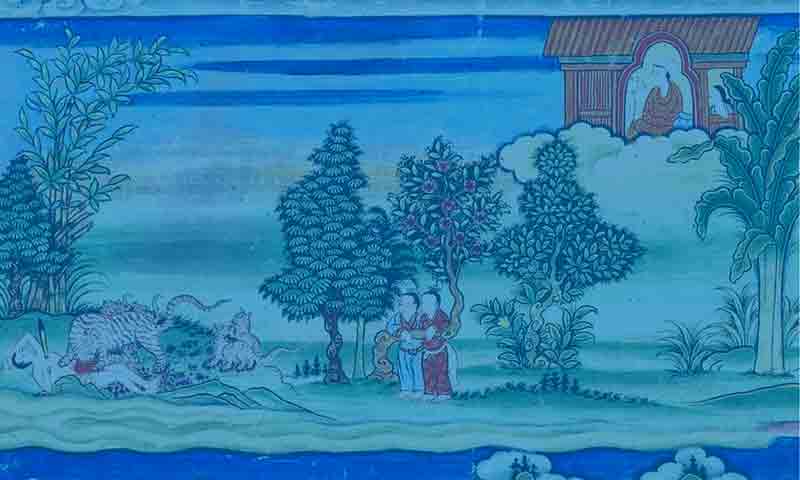
A Partial reproducction of Bhutanese painted thanka of the Jataka Tales, 18th-19th century, Phajoding Gonpa, Thimphu, Bhutan
Contents
![[go to top]](../../images/scrollup.gif)
- Apannaka Jataka — Crossing the Wilderness (Jat 1)
- Serivavanija Jataka — The Traders of Seriva (Jat 3)
- Matakabhatta Jataka — The Goat That Laughed and Wept (Jat 18)
- Kuhaka Jataka — The Straw Worth More Than Gold (Jat 89)
- Illisa Jataka — The Miserly Treasurer (Jat 78)
- Kalakanni Jataka — What's in a Name? (Jat 83)
- Mahasara Jataka — The Queen's Necklace (Jat 92)
- Kumbha Jataka — The Fifth Precept (Jat 512)
- Silanisamsa Jataka — A Good Friend (Jat 190)
- Duddubha Jataka — The Sound the Hare Heard (Jat 322)
- Mahakapi Jataka — The Great Monkey King (Jat 407)
- Mahasupina Jataka — The Sixteen Dreams (Jat 77)
- Manicora Jataka — The Virtuous Wife (Jat 194)
- Dabbhapuppha Jataka — The Jackal's Judgment (Jat 400)
- Nalapana Jataka — The Case of the Hollow Canes (Jat 20)
- Vattaka Jataka — The Baby Quail (Jat 35)
- Pañcavudha Jataka — Prince Five-weapons (Jat 55)
- Alinacitta Jataka — The Elephant Who Saved a Kingdom (Jat 156)
Namo tassa Bhagavato Arahato Sammasambuddhassa
Apannaka Jataka
Crossing the Wilderness - Jat 1
While the Buddha was staying at Jetavana Monastery near Savatthi, the wealthy banker, Anathapindika, went one day to pay his respects. His servants carried masses of flowers, perfume, butter, oil, honey, molasses, cloths, and robes. Anathapindika paid obeisance to the Buddha, presented the offerings he had brought, and sat down respectfully. At that time, Anathapindika was accompanied by five hundred friends who were followers of heretical teachers. His friends also paid their respects to the Buddha and sat close to the banker. The Buddha's face appeared like a full moon, and his body was surrounded by a radiant aura. Seated on the red stone seat, he was like a young lion roaring with a clear, noble voice as he taught them a discourse full of sweetness and beautiful to the ear.
After hearing the Buddha's teaching, the five hundred gave up their heretical practices and took refuge in the Triple Gem: the Buddha, the Dhamma, and the Sangha. After that, they went regularly with Anathapindika to offer flowers and incense and to hear the teaching. They gave liberally, kept the precepts, and faithfully observed the Uposatha Day.1 Soon after the Buddha left Savatthi to return to Rajagaha, however, these men abandoned their new faith and reverted to their previous beliefs.
Seven or eight months later, the Buddha returned to Jetavana. Again, Anathapindika brought these friends to visit the Buddha. They paid their respects, but Anathapindika explained that they had forsaken their refuge and had resumed their original practices.
The Buddha asked, "Is it true that you have abandoned refuge in the Triple Gem for refuge in other doctrines?" The Buddha's voice was incredibly clear because throughout myriad aeons He had always spoken truthfully.
When these men heard it, they were unable to conceal the truth. "Yes, Blessed One," they confessed. "It is true."
"Disciples," the Buddha said "nowhere between the lowest of hells below and the highest heaven above, nowhere in all the infinite worlds that stretch right and left, is there the equal, much less the superior, of a Buddha. Incalculable is the excellence which springs from obeying the Precepts and from other virtuous conduct."
Then he declared the virtues of the Triple Gem. "By taking refuge in the Triple Gem," He told them, "one escapes from rebirth in states of suffering." He further explained that meditation on the Triple Gem leads through the four stages to Enlightenment.
"In forsaking such a refuge as this," he admonished them, "you have certainly erred. In the past, too, men who foolishly mistook what was no refuge for a real refuge, met disaster. Actually, they fell prey to yakkhas — evil spirits — in the wilderness and were utterly destroyed. In contrast, men who clung to the truth not only survived, but actually prospered in that same wilderness."
Anathapindika raised his clasped hands to his forehead, praised the Buddha, and asked him to tell that story of the past.
"In order to dispel the world's ignorance and to conquer suffering," the Buddha proclaimed, "I practiced the Ten Perfections for countless aeons. Listen carefully, and I will speak."
Having their full attention, the Buddha made clear, as though he were releasing the full moon from behind clouds, what rebirth had concealed from them.
Long, long ago, when Brahmadatta was reigning in Baranasi, the Bodhisatta was born into a merchant's family and grew up to be a wise trader. At the same time, in the same city, there was another merchant, a very stupid fellow, with no common sense whatsoever.
One day it so happened that the two merchants each loaded five hundred carts with costly wares of Baranasi and prepared to leave in the same direction at exactly the same time. The wise merchant thought, "If this silly young fool travels with me and if our thousand carts stay together, it will be too much for the road. Finding wood and water for the men will be difficult, and there won't be enough grass for the oxen. Either he or I must go first."
"Look," he said to the other merchant, "the two of us can't travel together. Would you rather go first or follow after me?"
The foolish trader thought, "There will be many advantages if I take the lead. I'll get a road which is not yet cut up. My oxen will have the pick of the grass. My men will get the choicest wild herbs for curry. The water will be undisturbed. Best of all, I'll be able to fix my own price for bartering my goods." Considering all these advantages, he said, "I will go ahead of you, my friend."
The Bodhisatta was pleased to hear this because he saw many advantages in following after. He reasoned, "Those carts going first will level the road where it is rough, and I'll be able to travel along the road they have already smoothed. Their oxen will graze off the coarse old grass, and mine will pasture on the sweet young growth which will spring up in its place. My men will find fresh sweet herbs for curry where the old ones have been picked. Where there is no water, the first caravan will have to dig to supply themselves, and we'll be able to drink at the wells they have dug. Haggling over prices is tiring work; he'll do the work, and I will be able to barter my wares at prices he has already fixed."
"Very well, my friend," he said, "please go first."
"I will," said the foolish merchant, and he yoked his carts and set out. After a while he came to the outskirts of a wilderness. He filled all of his huge water jars with water before setting out to cross the sixty yojanas2 of desert which lay before him.
The yakkha who haunted that wilderness had been watching the caravan. When it had reached the middle, he used his magic power to conjure up a lovely carriage drawn by pure white young bulls. With a retinue of a dozen disguised yakkhas carrying swords and shields, he rode along in his carriage like a mighty lord. His hair and clothes were wet, and he had a wreath of blue lotuses and white water lilies around his head. His attendants also were dripping wet and draped in garlands. Even the bulls' hooves and carriage wheels were muddy.
As the wind was blowing from the front, the merchant was riding at the head of his caravan to escape the dust. The yakkha drew his carriage beside the merchant's and greeted him kindly. The merchant returned the greeting and moved his own carriage to one side to allow the carts to pass while he and the yakkha chatted.
"We are on our way from Baranasi, sir," explained the merchant. "I see that your men are all wet and muddy and that you have lotuses and water lilies. Did it rain while you were on the road? Did you come across pools with lotuses and water lilies?"
"What do you mean?" the yakkha exclaimed. "Over there is the dark-green streak of a jungle. Beyond that there is plenty of water. It is always raining there, and there are many lakes with lotuses and water lilies." Then, pretending to be interested in the merchant's business, he asked, "What do you have in these carts?"
"Expensive merchandise," answered the merchant.
"What is in this cart which seems so heavily laden?" the yakkha asked as the last cart rolled by.
"That's full of water."
"You were wise to carry water with you this far, but there is no need for it now, since water is so abundant ahead. You could travel much faster and lighter without those heavy jars. You'd be better off breaking them and throwing the water away. Well, good day," he said suddenly, as he turned his carriage. "We must be on our way. We have stopped too long already." He rode away quickly with his men. As soon as they were out of sight, he turned and made his way back to his own city.
The merchant was so foolish that he followed the yakkha's advice. He broke all the jars, without saving even a single cupful of water, and ordered the men to drive on quickly. Of course, they did not find any water, and they were soon exhausted from thirst. At sunset they drew their carts into a circle and tethered the oxen to the wheels, but there was no water for the weary animals. Without water, the men could not cook any rice either. They sank to the ground and fell asleep. As soon as night came, the yakkhas attacked, killing every single man and beast. The fiends devoured the flesh, leaving only the bones, and departed. Skeletons were strewn in every direction, but the five hundred carts stood with their loads untouched. Thus the heedless young merchant was the sole cause of the destruction of the entire caravan.
Allowing six weeks to pass after the foolish trader had left, the Bodhisatta set out with his five hundred carts. When he reached the edge of the wilderness, he filled his water jars. Then he assembled his men and announced, "Let not so much as a handful of water be used without my permission. Furthermore, there are poisonous plants in this wilderness. Do not eat any leaf, flower, or fruit which you have never eaten before, without showing it to me first." Having thus carefully warned his men, he led the caravan into the wilderness.
When they had reached the middle of the wilderness, the yakkha appeared on the path just as before. The merchant noticed his red eyes and fearless manner and suspected something strange. "I know there is no water in this desert," he said to himself. "Furthermore, this stranger casts no shadow. He must be a yakkha. He probably tricked the foolish merchant, but he doesn't realize how clever I am."
"Get out of here!" he shouted at the yakkha. "We are men of business. We do not throw away our water before we see where more is to come from!"
Without saying any more, the yakkha rode away.
As soon as the yakkhas had left, the merchant's men approached their leader and said, "Sir, those men were wearing lotuses and water lilies on their heads. Their clothes and hair were wringing wet. They told us that up ahead there is a thick forest where it is always raining. Let us throw away our water so that we can proceed quicker with lightened carts."
The merchant ordered a halt and summoned all his men. "Has any man among you ever heard before today," he asked, "that there was a lake or a pool in this wilderness?"
"No, sir," they answered. "It's known as the 'Waterless Desert.' "
"We have just been told by some strangers that it is raining in the forest just ahead. How far does a rain-wind carry?"
"A yojana, sir."
"Has any man here seen the top of even a single storm-cloud?"
"No, sir."
"How far off can you see a flash of lightning?"
"Four or five yojanas, sir."
"Has any man here seen a flash of lightning?"
"No, sir."
"How far off can a man hear a peal of thunder?"
"Two or three yojanas, sir."
"Has any man here heard a peal of thunder?"
"No, sir."
"Those were not men, but yakkhas," the wise merchant told his men. "They are hoping that we will throw away our water. Then, when we are weak and faint, they will return to devour us. Since the young merchant who went before us was not a man of good sense, most likely he was fooled by them. We may expect to find his carts standing just as they were first loaded. We will probably see them today. Press on with all possible speed, without throwing away a drop of water!"
Just as the merchant had predicted, his caravan soon came upon the five hundred carts with the skeletons of men and oxen strewn in every direction. He ordered his men to arrange his carts in a fortified circle, to take care of the oxen, and to prepare an early supper for themselves. After the animals and men had all safely bedded down, the merchant and his foremen, swords in hand, stood guard all through the night.
At daybreak the merchant replaced his own weak carts for stronger ones and exchanged his own common goods for the most costly of the abandoned merchandise. When he arrived at his destination, he was able to barter his stock of wares at two or three times their value. He returned to his own city without losing a single man out of all his company.
This story ended, the Buddha said, "Thus it was, laymen, that in times past, the foolish came to utter destruction, while those who clung to the truth escaped from the yakkhas' hands, reached their goal in safety, and returned to their homes again.
"This clinging to the truth not only endows happiness even up to rebirth in the Realm of Brahma,3 but also leads ultimately to Arahantship. Following untruth entails rebirth either in the four states of punishment or in the lowest conditions of mankind." After the Buddha had expounded the Four Truths, those five hundred disciples were established in the Fruit of the First Path.
The Buddha concluded his lesson by identifying the Birth as follows: "The foolish young merchant was Devadatta,4 and his men were Devadatta's followers. The wise merchant's men were the followers of the Buddha, and I myself was that wise merchant."
Serivavanija Jataka
The Traders of Seriva - Jat 3
So that a disheartened bhikkhu would have no regrets in the future, the Buddha told him this story at Savatthi to encourage him to persevere. "If you give up your practice in this sublime teaching which leads to Nibbana," the Buddha told him, "you will suffer long, like the trader of Seriva who lost a golden bowl worth a hundred thousand pieces."
When asked to explain, the Buddha told this story of the distant past.
Five long aeons ago, the Bodhisatta was an honest trader selling fancy goods in the kingdom of Seriva. Sometimes he traveled with another trader from the same kingdom, a greedy fellow, who handled the same wares.
One day the two of them crossed the Telavaha river to do business in the bustling city of Andhapura. As usual, to avoid competing with each other, they divided the city between them and began selling their goods from door to door.
In that city there was a ramshackle mansion. Years before the family had been rich merchants, but by the time of this story their fortunes had dwindled to nothing, and all the men of the family had died. The sole survivors were a girl and her grandmother, and these two earned their living by working for hire.
That afternoon, while the greedy peddler was on his rounds, he came to the door of that very house, crying, "Beads for sale! Beads for sale!"
When the young girl heard his cry, she begged, "Please buy me a trinket, Grandmother."
"We're very poor, dear. There's not a cent in the house and I can't think of anything to offer in exchange."
The girl suddenly remembered an old bowl. "Look!" she cried. "Here's an old bowl. It's of no use to us. Let's try to trade it for something nice."
What the little girl showed her grandmother was an old bowl which had been used by the great merchant, the late head of the family. He had always eaten his curries served from this beautiful, expensive bowl. After his death it had been thrown among the pots and pans and forgotten. Since it hadn't been used for a very long time, it was completely covered with grime. The two women had no idea it was gold.
The old woman asked the trader to come in and sit down. She showed him the bowl and said, "Sir, my granddaughter would like a trinket. Would you be so kind as to take this bowl and give her something or other in exchange?"
The peddler took the bowl in his hand and turned it over. Suspecting its value, he scratched the back of it with a needle. After just one covert look, he knew for certain the bowl was real gold.
He sat there frowning and thinking until his greed got the better of him. At last he decided to try to get the bowl without giving the woman anything whatever for it. Pretending to be angry, he growled, "Why did you bring me this stupid bowl? It isn't worth half a cent!" He threw the bowl to the floor, got up, and stalked out of the house in apparent disgust.
Since it had been agreed between the two traders that the one might try the streets which the other had already covered, the honest peddler came later into that same street and appeared at the door of the house, crying, "Beads for sale!"
Once again the young girl made the same request of her grandmother, and the old woman replied, "My dear, the first peddler threw our bowl on the ground and stormed out of the house. What have we got left to offer?"
"Oh, but that trader was nasty, Grandmother. This one looks and sounds very kind. I think he will take it."
"All right, then. Call him in."
When the peddler came into the house, the two women gave him a seat and shyly put the bowl into his hands. Immediately recognizing that the bowl was gold, he said, "Mother, this bowl is worth a hundred thousand pieces of silver. I'm sorry but I don't have that much money."
Astonished at his words, the old woman said, "Sir, another peddler who came here a little while ago said that it was not worth half a cent. He got angry, threw it on the floor, and went away. If it wasn't valuable then, it must be because of your own goodness that the bowl has turned into gold. Please take it, and just give us something or other for it. We will be more than satisfied."
At that time the peddler had only five hundred pieces of silver and goods worth another five hundred. He gave everything to the women, asking only to keep his scales, his bag, and eight coins for his return fare. Of course, they were happy to agree. After profuse thanks on both sides, the trader hurried to the river with the golden bowl. He gave his eight coins to the boatman and got into the boat.
Not long after he had left, the greedy peddler returned to the house, giving the impression of having reluctantly reconsidered their offer. He asked them to bring out their bowl, saying he would give them something or other for it after all.
The old woman flew at him. "You scoundrel!" she cried. "You told us that our golden bowl was not worth even half a cent. Lucky for us, an honest trader came after you left and told us it was really worth a hundred thousand pieces of silver. He gave us a thousand for it and took it away, so you are too late!"
When the peddler heard this, an intense pain swept over him. "He robbed me! He robbed me!" he cried. "He got my golden bowl worth a hundred thousand!" He became hysterical and lost all control. Throwing down his money and merchandise, he tore off his shirt, grabbed the beam of his scales for a club, and ran to the riverside to catch the other trader.
By the time he got to the river, the boat was already in midstream. He shouted for the boat to return to shore, but the honest peddler, who had already paid, calmly told the ferryman to continue on.
The frustrated trader could only stand there on the river-bank and watch his rival escape with the bowl. The sight so infuriated him that a fierce hate swelled up inside him. His heart grew hot, and blood gushed from his mouth. Finally, his heart cracked like the mud at the bottom of a pond dried up by the sun. So intense was the unreasoning hatred which he developed against the other trader because of the golden bowl, that he perished then and there.
The honest trader returned to Seriva, where he lived a full life spent in charity and other good works, and passed away to fare according to his deserts.
When the Buddha finished this story, he identified himself as the honest trader, and Devadatta as the greedy trader. This was the beginning of the implacable grudge which Devadatta held against the Bodhisatta through innumerable lives.
Matakabhatta Jataka
The Goat That Laughed and Wept - Jat 18
One day, while the Buddha was staying in Jetavana, some bhikkhus asked him if there was any benefit in sacrificing goats, sheep, and other animals as offerings for departed relatives.
"No, bhikkhus," replied the Buddha. "No good ever comes from taking life, not even when it is for the purpose of providing a Feast for the Dead." Then he told this story of the past.
Long, long ago, when Brahmadatta was reigning in Baranasi, a brahman decided to offer a Feast for the Dead and bought a goat to sacrifice. "My boys," he said to his students, "take this goat down to the river, bathe it, brush it, hang a garland around its neck, give it some grain to eat, and bring it back."
"Yes, sir," they replied and led the goat to the river.
While they were grooming it, the goat started to laugh with a sound like a pot smashing. Then, just as strangely, it started to weep loudly.
The young students were amazed at this behavior. "Why did you suddenly laugh," they asked the goat, "and why do you now cry so loudly?"
"Repeat your question when we get back to your teacher," the goat answered.
The students hurriedly took the goat back to their master and told him what had happened at the river. Hearing the story, the master himself asked the goat why it had laughed and why it had wept.
"In times past, brahman," the goat began, "I was a brahman who taught the Vedas like you. I, too, sacrificed a goat as an offering for a Feast for the Dead. Because of killing that single goat, I have had my head cut off 499 times. I laughed aloud when I realized that this is my last birth as an animal to be sacrificed. Today I will be freed from my misery. On the other hand, I cried when I realized that, because of killing me, you, too, may be doomed to lose your head five hundred times. It was out of pity for you that I cried."
"Well, goat," said the brahman, "in that case, I am not going to kill you."
"Brahman!" exclaimed the goat. "Whether or not you kill me, I cannot escape death today."
"Don't worry," the brahman assured the goat. "I will guard you."
"You don't understand," the goat told him. "Your protection is weak. The force of my evil deed is very strong."
The brahman untied the goat and said to his students, "Don't allow anyone to harm this goat." They obediently followed the animal to protect it.
After the goat was freed, it began to graze. It stretched out its neck to reach the leaves on a bush growing near the top of a large rock. At that very instant a lightning bolt hit the rock, breaking off a sharp piece of stone which flew through the air and neatly cut off the goat's head. A crowd of people gathered around the dead goat and began to talk excitedly about the amazing accident.
A tree deva5 had observed everything from the goat's purchase to its dramatic death, and drawing a lesson from the incident, admonished the crowd: "If people only knew that the penalty would be rebirth into sorrow, they would cease from taking life. A horrible doom awaits one who slays." With this explanation of the law of kamma the deva instilled in his listeners the fear of hell. The people were so frightened that they completely gave up the practice of animal sacrifices. The deva further instructed the people in the Precepts and urged them to do good.
Eventually, that deva passed away to fare according to his deserts. For several generations after that, people remained faithful to the Precepts and spent their lives in charity and meritorious works, so that many were reborn in the heavens.
The Buddha ended his lesson and identified the Birth by saying, "In those days I was that deva."
Kuhaka Jataka
The Straw Worth More Than Gold - Jat 89
The Buddha told this story at Jetavana about a conniving bhikkhu, who was the source of much trouble to other bhikkhus.
Long, long ago, when Brahmadatta was reigning in Baranasi, a shifty ascetic with long, matted hair, lived near a certain little village. The landowner had built a modest hermitage in the forest for him, and daily provided him with excellent food in his own house.
The landowner had a great fear of robbers and decided that the safest course to protect his money was to hide it in an unlikely place. Believing the matted-haired ascetic to be a model of sainthood, he brought a hundred pieces of gold to the hermitage, buried them there, and asked the ascetic to keep watch over the treasure.
"There's no need to say more, sir, to a man like me who has renounced the world. We hermits never covet what belongs to others."
"That's wonderful," said the landowner, who went off with complete confidence in the hermit's protestations.
As soon as the landowner was out of sight, the ascetic chuckled to himself, "Why, there's enough here to last a man his whole life!"
Allowing a few days to elapse, the hermit dug up the gold and reburied it conveniently by the road. The following morning, after a meal of rice and succulent curries at the landowner's house, the ascetic said, "My good sir, I've been staying here, supported by you, for a long time. Frankly, living so long in one place is like living in the world, which is forbidden to ascetics like me. I really cannot remain here any longer; the time has come for me to leave."
The landowner urged him to stay, but nothing could overcome the hermit's determination.
"Well, then," said the landowner, "if you must go, good luck to you." Reluctantly, he escorted the ascetic to the outskirts of the village and returned home.
After walking a short way by himself, the ascetic thought it would be a good thing to cajole the landowner. Sticking a straw in his matted hair, he hurried back to the village.
"What brings you back again?" asked the surprised landowner.
"I just noticed that a straw from your roof got stuck in my hair. We hermits must not take anything which has not been given to us, so I have brought it back to you."
"Throw it down, sir, and go your way," said the landowner. "Imagine!" he said to himself. "This ascetic is so honest he won't even take a straw which does not belong to him. What a rare person!" Thus, greatly impressed by the ascetic's honesty, the landowner bid him farewell again.
At that time the Bodhisatta, reborn as a merchant, was traveling to the border on business and happened to stop at that same little village, where he witnessed the ascetic's return with the piece of straw. Suspicion grew in his mind that the hermit must have robbed the landowner of something. He asked the rich man whether he had deposited anything in the ascetic's care.
"Yes," the landowner answered rather hesitantly, "a hundred pieces of gold."
"Well, why don't you just go and see if it's still safe?" the merchant suggested.
The landowner went to the deserted hermitage, dug where he had left his money, and found it gone. Rushing back to the merchant, he cried, "It's not there!"
"The thief is certainly that long-haired rascal of an ascetic," said the merchant. "Let's catch him."
The two men ran after the rogue and quickly caught him. They kicked him and beat him until he showed them where he had hidden the gold. After they had gotten back the money, the merchant looked at the coins and scornfully asked the ascetic, "Why didn't this hundred pieces of gold trouble your conscience as much as that straw? Take care, you hypocrite, never to play such a trick again!"
When his life ended, the merchant passed away to fare according to his deserts.
When he had ended his lesson, the Buddha said, "Thus you see, monks, that this monk was as conniving in the past as he is today." Then he identified the Birth by saying, "This monk was the scheming ascetic of those days, and I was the wise and good merchant."
Notes
1. The Uposatha is the full, new, and half-moon days, when many Buddhists observe the Eight Precepts.
2. Yojana: a unit of distance, about seven miles.
3. The Realm of Brahma refers to the highest heavens, where beings enjoy radiant bliss.
4. Devadatta was a cousin of the Buddha. He tried to kill the Master several times, but always failed. See Jataka No.3, immediately below.
5. Devas are celestial beings, ranging from the highest gods to simple tree spirits.
Illisa Jataka
The Miserly Treasurer - Jat 78
This story was told by the Buddha while at Jetavana Monastery, about a tremendously rich royal treasurer, who lived in a town called Sakkara near the city of Rajagaha. He had been so tightfisted that he never gave away even the tiniest drop of oil you could pick up with a blade of grass. Worse than that, he wouldn't even use that minuscule amount for his own satisfaction. His vast wealth was actually of no use to him, to his family, or to the deserving people of the land.
Moggallana, however, led this miser and his wife to Jetavana, where they served a great meal of cakes to the Buddha and five hundred bhikkhus. After hearing words of thanks from the Buddha, the royal treasurer and his wife attained stream-entry.
That evening the bhikkhus gathered together in the Hall of Truth. "How great is the power of the Venerable Moggallana!" they said. "In a moment he converted the miser to charity, brought him to Jetavana, and made possible his attainment. How remarkable is the elder!" While they were talking, the Buddha entered and asked the subject of their discussion.
When they told him, the Buddha replied, "This is not the first time, bhikkhus, that Moggallana has converted this miserly treasurer. In previous days too the elder taught him how deeds and their effects are linked together." Then the Buddha told this story of the past.
Long, long ago, when Brahmadatta was reigning in Baranasi, there was a treasurer named Illisa who was worth eighty crores of wealth. This man had all the defects possible in a person. He was lame and hunchbacked, and he had a squint. He was a confirmed miser, never giving away any of his fortune to others, yet never enjoying it himself.
Interestingly enough, however, for seven generations back his ancestors had been bountiful, giving freely of their best. When this treasurer inherited the family riches, he broke that tradition and began hoarding his wealth.
One day, as he was returning from an audience with the king, he saw a weary peasant sitting on a bench and drinking a mug of cheap liquor with great gusto. The sight made the treasurer thirsty for a drink of liquor himself, but he thought, "If I drink, others will want to drink with me. That would mean a ruinous expense!" The more he tried to suppress his thirst, the stronger the craving grew.
The effort to overcome his thirst made him as yellow as old cotton. He became thinner and thinner until the veins stood out on his emaciated frame. After a few days, still unable to forget about the liquor, he went into his room and lay down, hugging his bed. His wife came in, rubbed his back, and asked, "Husband, what is wrong?"
"Nothing," he said.
"Perhaps the king is angry with you," she suggested.
"No, he is not."
"Have your children or servants done anything to annoy you?" she queried.
"Not at all."
"Well, then, do you have a craving for something?"
Because of his preposterous fear that he might waste his fortune, he still would not say a word.
"Speak, husband," she pleaded. "Tell me what you have a craving for."
"Well," he said slowly, "I do have a craving for one thing."
"What is that, my husband?"
"I want a drink of liquor," he whispered.
"Why didn't you say so before?" she exclaimed with relief. "I'll brew enough liquor to serve the whole town."
"No!" he cried. "Don't bother about other people. Let them earn their own drink!"
"Well then, I'll make just enough for our street."
"How rich you are!"
"Then, just for our household."
"How extravagant!"
"All right, only us and our children."
"Why fuss about them?"
"Very well, let it be just enough for the two of us.
"Do you need any?"
"Of course not. I'll brew a little liquor only for you."
"Wait! If you brew any liquor in the house, many people will see you. In fact, it's out of the question to drink any here at all." Producing one single penny, he sent a slave to buy a jar of liquor from the tavern.
When the slave returned, Illisa ordered him to carry the liquor out of town to a remote thicket near the river. "Now leave me alone!" Illisa commanded. After the slave had walked some distance away, the treasurer crawled into the thicket, filled his cup, and began drinking.
At that moment, the treasurer's own father, who had been reborn as Sakka, king of the devas, happened to be wondering whether the tradition of generosity was still kept up in his house and became aware of his son's outrageous behavior. He realized that his son had not only broken with the customary magnanimity of his family, but that he had also burned down the alms houses and beaten the poor to drive them away from his gate. Sakka saw that his son, unwilling to share even a drop of cheap liquor with anyone else, was sitting in a thicket drinking by himself.
When he saw this, Sakka cried, "I must make my son see that deeds always have their consequences. I will make him charitable and worthy of rebirth in the realm of the devas."
Instantly, Sakka disguised himself as his son, complete with his limp, hunchback, and squint, and entered the city of Baranasi. He went directly to the palace gate and asked to be announced to the king.
"Let him approach," said the king.
Sakka entered the king's chamber and paid his respects.
"What brings you here at this unusual hour, my lord high treasurer?" asked the king.
"I have come, sire, because I would like to add my eighty crores of wealth to your royal treasury."
"No, my lord high treasurer," answered the king. "I have ample treasure. I have no need of yours."
"Sire, if you will not take it, I will give it all away to others."
"By all means, treasurer, do as you wish."
"So be it, sire," Sakka said. Then, bowing again to the king, he went to the treasurer's house. None of the servants could tell that he was not their real master. He sent for the porter and ordered, "If anybody resembling me should appear and claim to be master of this house, that person should be severely beaten and thrown out." Then he went upstairs, sat down on a brocaded couch, and sent for Illisa's wife. When she arrived, he smiled and said, "My dear, let us be bountiful."
When his wife, his children, and all the servants heard this, they thought, "We have never seen the treasurer in this frame of mind! He must have drunk a lot to have become so good-natured and generous."
His wife answered, "Be as charitable as you please, my husband."
"Send for the town crier," Sakka ordered. "I want him to announce to all the citizens of the city that anybody who wants gold, silver, diamonds, pearls, or other gems should come to the house of Illisa the treasurer."
His wife obeyed him, and a large crowd of people carrying baskets and sacks soon gathered. Sakka instructed the servants to open the doors to the store rooms and announced to the people, "These are my gifts to you! Take what you like! Good luck to you!"
Townspeople filled their bags and carried away all the treasure they could manage. One farmer yoked two of Illisa's oxen to a beautiful cart, filled it with valuable things, and drove out of the city. As he rode along, humming a tune in praise of the treasurer, he happened to pass near the thicket where Illisa was hiding. "May you live to be a hundred, my good lord Illisa!" sang the farmer. "What you have done for me this day will enable me to live without ever toiling again. Who owned these oxen? You did! Who gave me this cart? You did! Who gave me the wealth in the cart? Again it was you! Neither my father nor my mother gave me any of this. No, it came solely from you, my lord."
These words chilled the treasurer to the bone. "Why is this fellow mentioning my name?" he wondered to himself. "Has the king been giving away my wealth?" He peeped out of the thicket and immediately recognized his own cart and oxen.
Scrambling out of the bushes as fast as he could, he grabbed the oxen by their nose rings and cried, "Stop! These oxen belong to me!"
The farmer leaped from the cart and began beating the intruder. "You rascal!" he shouted. "This is none of your business. Illisa the treasurer is giving his wealth away to all the city." He knocked the treasurer down, climbed back on the cart, and started to drive away.
Shaking with anger, Illisa picked himself up, hurried after the cart, and seized hold of the oxen again. Once more the farmer jumped down, grabbed Illisa by the hair, and beat him severely. Then he got back on the cart and rumbled off.
Thoroughly sobered up by this rough handling, Illisa hurried home. When he arrived, he saw the people carrying away his treasure. "What are you doing? he shouted. "How dare you do this?" He seized first one man then another, but every man he grabbed knocked him down.
Bruised and bleeding, he tried to go into his own house, claiming that he was Illisa, but the porters stopped him. "You villain!" they cried. "Where do you think you are going?" Following orders, they beat him with bamboo staves, took him by the neck, and threw him down the steps.
"Only the king can help me now," groaned Illisa, and he dragged himself to the palace.
"Sire!" he cried. "Why, oh why, have you plundered me like this?"
"I haven't plundered you, my lord high treasurer," said the king. "You yourself first offered me your wealth. Then you yourself offered your property to the citizens of the town."
"Sire, I never did such a thing! Your majesty knows how careful I am about money. You know I would never give away so much as the tiniest drop of oil. May it please your majesty to send for the person who has squandered my riches. Please interrogate him about this matter."
The king ordered his guards to bring Illisa, and they returned with Sakka. The two treasurers were so exactly alike that neither the king nor anyone else in the court could tell which was the real treasurer. "Sire!" pleaded Illisa. "I am the treasurer! This is an imposter!"
"My dear sir," replied the king. "I really can't say which of you is the real Illisa. Is there anybody who can distinguish for certain between the two of you?"
"Yes, sire," answered Illisa, "my wife can."
The king sent for Illisa's wife and asked her which of the two was her husband. She smiled at Sakka and went to stand beside him. When Illisa's children and servants were brought and asked the same question, they all answered that Sakka was the real treasurer.
Suddenly, Illisa remembered that he had a wart on the top of his head, hidden under his hair, known only to his barber. As a last resort, he asked that his barber be called. The barber came and was asked if he could distinguish the real Illisa from the false.
"Of course, I can tell, sire," he said, "if I may examine their heads."
"By all means, look at both their heads," ordered the king.
The barber examined Illisa's head and found the wart. As he started to examine Sakka's head, the king of the devas quickly caused a wart to appear on his own head, so that the barber exclaimed, "Your Majesty, both squint, both limp, and both are hunchbacks, too! Both have warts in exactly the same place on their heads! Even I cannot tell which is the real Illisa!"
When Illisa heard this, he realized that his last hope was gone, and he began to quake at the loss of his beloved riches. Overpowered by his emotions, he collapsed senseless on the floor. At this, Sakka resumed his divine form and rose into the air. "O king, I am not Illisa," he announced. "I am Sakka!"
The king's courtiers quickly splashed water on Illisa's face to revive him. As soon as he had recovered his wits, the treasurer staggered to his feet and bowed before Sakka.
"Illisa!" Sakka shouted. "That wealth was mine, not yours. I was your father. In my lifetime I was bountiful towards the poor and rejoiced in doing good. Because of my charity, I was reborn in this great grandeur. But you, foolish man, are not walking in my footsteps. You have become a terrible miser. In order to hoard my riches, you burned my alms houses to the ground and drove away the poor. You are getting no enjoyment from your wealth; nor is it benefiting any other human being. Your treasury is like a pool haunted by demons, from which no one may satisfy his thirst.
"If you rebuild my alms houses, however, and show charity to the poor, you will gain great merit. If you do not, I will take away everything you have, and I will split your head with my thunderbolt."
When Illisa heard this threat, he shook with fear and cried out, "From now on I will be bountiful! I swear it!"
Accepting this promise, Sakka established his son in the precepts, preached the Dhamma to him, and returned to the realm of the devas.
True to his word, Illisa became diligent in charity and performed many good works. He even attained rebirth in heaven.
"You see, bhikkhus," the Buddha said, "this is not the first time that Moggallana has converted this miserly treasurer. At that time, the treasurer was Illisa; Moggallana was Sakka, king of the devas; Ananda was the king; and I myself was the barber."
Kalakanni Jataka
What's in a Name? - Jat 83
The Buddha told this story while at Jetavana, about one of Anathapindika's friends, a man named "Curse." The two had played together as children and had gone to the same school. As the years passed, however, the friend became extremely poor and could not make a living for himself no matter what he did. In desperation, he approached Anathapindika, who welcomed him kindly and employed him to look after his property and to manage all of his business for him. From that time on, it was a common thing to hear someone shouting, "Curse!" each time a member of the household spoke to him.
One day some of Anathapindika's friends and acquaintances came and said, "Treasurer, don't let this sort of thing go on in your house! It's enough to scare an ogre to hear such inauspicious speech as 'Come here, Curse,' 'Sit down, Curse,' or 'Have your dinner, Curse.' The man is a miserable wretch, dogged by misfortune. He's not your social equal. Why do you have anything to do with him?"
"Nonsense," replied Anathapindika, firmly rejecting their advice. "A name only denotes a man. The wise do not measure a man by his name. It is useless to be superstitious about mere sounds. I will never abandon the friend with whom I made mud-pies as a child, simply because of his name."
Not long after that, Anathapindika went with many of his servants to visit a village of which he was headman. He left his old friend in charge. Hearing of his departure, a band of robbers decided to break into the house. That night, they armed themselves to the teeth and surrounded it.
Curse had suspected that burglars might try something so he stayed awake. As soon as he knew that the robbers were outside, he ran about noisily as though he were rousing the entire household. He shouted for one person to sound the conch and for another to beat the drum. Soon it seemed that the house contained a whole army of servants.
When the robbers heard the din, they said to one another, "The house is not as empty as we thought it would be. The master must still be at home after all." They threw down their clubs and other weapons and fled.
In the morning, the discarded weapons were found lying scattered outside the house. When the townspeople realized what had happened, they lauded Curse to the skies. "If such a wise man hadn't been guarding the house," they said, "those robbers would have walked in and plundered as they pleased. Anathapindika owes this good luck to his staunch friend, Curse." As soon as Anathapindika returned from his trip, they told him the whole story.
"My friends," Anathapindika answered, "this is the trusty guardian I was urged to get rid of. If I had taken your advice and sent him away, I would be a poorer man today. It's not the name but the heart within that makes the man!" In appreciation of his friend's services, he even raised his wages. Thinking that this was a good story to tell the Buddha, Anathapindika went to the Master and gave him a complete account.
"This is not the first time, sir," the Buddha said, "that a man named Curse has saved his friend's wealth from robbers. The same thing happened in bygone days as well." Then, at Anathapindika's request, the Buddha told this story of the past.
Long, long ago, when Brahmadatta was reigning in Baranasi, the Bodhisatta was the treasurer. He was very famous and had a friend named Curse. At that time everything was the same as in the story of Anathapindika. When the treasurer returned from the village and heard the news, he said to his friends, "If I had taken your advice and had gotten rid of my trusty friend, I would have been a beggar today. A friend is one who goes seven steps to help. He who goes twelve can be called a comrade. Loyalty for a fortnight or a month makes one a relative; long and steady dependability, a second self. How could I forsake my friend Curse who has always been so true?"
His lesson ended, the Buddha identified the Birth by saying, "At that time Ananda was Curse, and I myself was the treasurer of Baranasi."
Mahasara Jataka
The Queen's Necklace - Jat 92
The Buddha told this story at Jetavana Monastery about the Venerable Ananda.
One day the wives of the King of Kosala were talking together, saying, "It is very rare for a Buddha to appear in the world," they said. "It is also rare to be born a human being. We have been born humans during a Buddha's lifetime, but we are not free to go to the monastery to pay our respects, to hear his teaching, and to make offerings to him. We might as well be living in a cage as in this palace. Let's ask the king to allow someone to come here to teach us the Dhamma. We should learn what we can, be charitable, and do good works. In that way we will truly benefit from living at this happy time!" They went to the king and made their request. The king listened and gave his consent.
That same morning, the king decided to enjoy himself in the royal gardens, so he gave orders that the grounds should be prepared. As the gardener was finishing, he saw the Buddha seated at the foot of a tree. He immediately went to the king and reported that everything was ready, but that the Buddha was there sitting under a tree.
"Very good," said the king, "we will go and hear the Master." Then he went to the garden by royal chariot.
When he got there, he found a lay disciple, Chattapani, sitting at the Buddha's feet, listening to his words. When the king saw this lay disciple, he hesitated. Realizing, however, that this must be a virtuous man, or he would not be sitting by the Buddha for instruction, the king approached, bowed, and seated himself on one side.
Out of his profound respect for the Buddha, Chattapani neither rose to honor the king nor saluted him. This made the king very angry.
Aware of the king's displeasure, the Buddha praised the merits of the layman, who had, in fact, entered the path of nonreturning. "Sire," the Buddha said, "this lay disciple knows by heart the scriptures that have been handed down, and he has set himself free from the bondage of passion."
"Surely," the king thought, "this can be no ordinary person who is being so praised by the Buddha." He turned to Chattapani and said, "Let me know if you are in need of anything."
"Thank you," Chattapani replied.
The king listened to the Master's teaching. When it was time, he rose and left ceremoniously.
A few days later, the king met Chattapani again as he was on his way to Jetavana and had him summoned. "I hear, sir, that you are a man of great learning. My wives are eager to hear the truth. I would be very glad to have you teach them."
"It would not be proper, sire, for a layman to expound the truth in the king's harem. That is the prerogative of the bhikkhus."
The king immediately realized that this was correct, so he called his wives together and announced that he would ask the Buddha to appoint one of the elders to become their instructor in the Doctrine. He asked them which of the eighty chief disciples they would prefer. The women unanimously chose Ananda, the Treasurer of the Doctrine.
The king went to the Buddha, greeted him courteously, sat down, and stated his wives' wish that Ananda might be their teacher. The Buddha assented, and the Venerable Ananda began teaching the king's wives regularly.
One day, when Ananda arrived at the palace as usual, he found that the women, who had always before been so attentive, were all troubled and agitated. "What's wrong?" he asked. "Why do you seem anxious today?"
"Oh, venerable sir," they replied, "the jewel from the king's turban is missing. He has called his ministers and ordered them to apprehend the thief and to find the jewel without fail. They are interrogating and searching everybody, even all of us women. The entire court is in an uproar, and we have no idea what might happen next to any of us. That is why we are so unhappy."
"Don't worry," said Ananda cheerfully, as he went to find the king.
Taking the seat which the king prepared for him, Ananda asked if it was true that his majesty had lost his jewel.
"Quite true, venerable sir," said the king. "I have had everyone in the palace searched and questioned, but I can find no trace of the gem."
"There is a way to find it, sire," Ananda said, "without upsetting people unnecessarily."
"What way is that, venerable sir?"
"By wisp-giving, sire."
"Wisp-giving?" asked the king. "What do you mean?"
"Call everyone you suspect," Ananda instructed, "and give him or her a wisp of straw. Say to each of them, 'Take this and put it in a certain place before daybreak tomorrow.' The person who took the jewel will be afraid of getting caught and will give the gem back with the straw. If it is not returned on the first day, the same thing must be done for one or two more days. You will undoubtedly get your jewel back." With these words, the elder departed.
Following Ananda's advice, the king distributed straw and designated the place where it was to be returned. Even though he did this for three days, the jewel was not recovered. On the third day the elder came again and asked whether the jewel had been returned.
"No, venerable sir," replied the king, "it has not."
"In that case, sire," Ananda said, "have a large waterpot filled with water and placed in a secluded corner of your courtyard. Put a screen around it, and give orders that all who frequent the palace, both men and women, are to take off their outer garments and, one by one, to step behind the screen and wash their hands." Again the king did exactly as Ananda had suggested.
"Ananda has seriously taken charge of the matter," thought the thief. "He is not going to stop until the jewel is found. The time has come to give it up." He concealed the jewel in his underclothes, went behind the screen, and dropped it in the water. After everyone had finished, the pot was emptied, and the jewel was found.
"Because of the Elder Ananda," exclaimed the king joyfully, "I have gotten my jewel back!"
"Because of the Elder Ananda," exclaimed all the residents of the palace, "we have been saved from a lot of trouble!"
The story of how his wisdom had returned the jewel spread throughout the city and reached Jetavana Monastery.
A few days later, while the bhikkhus were talking together in the Hall of Truth, one of them said, "The great wisdom of the Elder Ananda led to recovering the lost jewel and restoring calm to the palace." While all of them were singing the praises of Ananda, the Buddha entered and asked the subject of their conversation.
"Monks," he said after they had told him, "this is not the first time that stolen gems have been found, nor is Ananda the only one who has brought about such a discovery. In bygone days, too, the wise and good discovered stolen valuables and saved a lot of people from trouble." Then he proceeded to tell this story of the past.
Long, long ago, when Brahmadatta was reigning in Baranasi, the Bodhisatta completed his education and became one of the king's ministers. One day the king went with a large retinue to his pleasure garden. After walking about the woods for a while, he decided to enjoy himself in the water and sent for his harem. The women removed their jewels and outer garments, laid them in boxes for their attendants to look after, and joined the king in the royal tank.
As the queen was taking off her jewels and ornaments, a female monkey that was hiding in the branches of a nearby tree watched her intently. The monkey conceived a longing to wear the queen's pearl necklace and waited for a chance to snatch it. At first the queen's attendant stayed alert, looking all around to protect the jewels, but after a while she began to nod. As soon as the monkey saw this, she jumped down as swift as the wind. Then just as swiftly she leaped up into the tree with the pearls around her neck. Fearing that other monkeys would see her treasure, she hid the string of pearls in a hole in the tree and sat demurely keeping guard as though nothing had happened.
By and by the girl awoke and saw that the jewels were gone. Terrified at her own negligence, she shouted, "A man has run off with the queen's pearl necklace!"
Sentries ran up from every side and questioned her. The king ordered his guards to catch the thief, and they rushed around the pleasure garden, searching high and low. A poor timid peasant who happened to be nearby became frightened when he heard the uproar and started to run away.
"There he goes!" cried the guards. They chased the poor man, caught him, began beating him, and asked why he stole such precious jewels.
The peasant thought, "If I deny the charge, these brutes will beat me to death. I'd better say I took them." He immediately confessed to the theft and was hauled off in chains to the king.
"Did you take those precious jewels?" asked the king.
"Yes, your majesty."
"Where are they now?"
"Your majesty, I'm a poor man," he explained. "I've never owned anything of any value, not even a bed or a chair, much less a jewel. It was the treasurer who made me take that expensive necklace. I took it and gave it to him. He knows all about it."
The king sent for the treasurer, and asked whether the peasant had passed the necklace on to him.
Also afraid to deny the charge, the treasurer answered, "Yes, sire."
"Where is it then?"
"I gave it to your majesty's high priest."
The high priest was sent for, and interrogated in the same way. He said he had given it to the chief musician, who in his turn said he had given it as a present to a courtesan. The courtesan, however, utterly denied having received it and the questioning continued until sunset.
"It's too late now," said the king, "we will look into this tomorrow." He handed the suspects over to his officers and went back into the city.
The Bodhisatta began thinking, "These jewels were lost inside the grounds, but the peasant was outside. There was a strong guard at the gate. It would have been impossible for anyone inside to have gotten away with the necklace. I don't see how a person, inside or out, could have stolen it. I don't believe that any of these five had anything to do with it, but I understand why they falsely confessed and implicated the others. As for the necklace, these grounds are swarming with monkeys. It must have been one of the female monkeys that took it."
Having arrived at this conclusion, the minister went to the king and requested that the suspects be handed over to him so that he could look into the matter personally.
"By all means, my wise friend," said the king, "go ahead."
The minister ordered his servants to take charge of the five prisoners. "Keep strict watch over them," he said. "I want you to listen to everything they say and report it all to me."
As the prisoners sat together, the treasurer said to the peasant, "Tell me, you wretch, where you and I have ever met before today. How could you have given me that necklace?"
"Honorable sir," said the peasant, "I have never owned anything valuable. Even the stool and the cot I have are rickety. I said what I did because I thought that with your help I would get out of this trouble. Please don't be angry with me, sir."
"Well then," the high priest indignantly asked the treasurer, "how did you pass on to me what this fellow never gave to you?"
"I said that," explained the treasurer, "because I thought that you and I, both being high ranking officials, would be able to get out of trouble together."
"Brahman," the chief musician asked the high priest, "when do you think you gave the jewel to me?"
"I only said I did," answered the chaplain, "because I thought you would help to make the time in prison pass more agreeably."
Finally the courtesan complained, "You wretch of a musician, you have never visited me, and I have never visited you. When could you have given me the necklace?"
"Don't be angry, my dear." said the musician. "I just wanted you to be here to keep us company. Cheer up! Let's all be lighthearted together for a while."
As soon as his servants had reported this conversation to the Bodhisatta, he saw that all his suspicions were correct. He was convinced that a female monkey had taken the necklace.
"Now I must find a way to make her drop it," he said to himself. He ordered his servants to catch some monkeys, to deck them out with strings of beads, and then to release them again in the pleasure garden. The men were to carefully watch every monkey in the grounds. As soon as they saw one wearing the missing pearl necklace, they were to frighten her into dropping it.
The monkeys strutted about with their beads strung around their necks, their wrists, and their ankles. They flaunted their splendor in front of the guilty monkey, who sat quietly guarding her treasure. At last, jealousy overcame her prudence. "Those are only beads!" she screeched, and foolishly put on her own necklace of real pearls. As soon as the servants saw this, they began making loud noises and throwing things at her. The monkey became so frightened that she dropped the necklace and scampered away. The men took it to their master.
The minister immediately took it to the king. "Here, sire," he said, "is the queen's necklace. The five prisoners are innocent. It was a female monkey in the pleasure garden that took it."
"Wonderful!" exclaimed the king. "But, tell me, how did you find that out? And how did you manage to get it back?"
When he had heard the whole story, the king praised his minister. "You certainly are the right man in the right place!" he proclaimed. In appreciation, the king showered the minister with immeasurable treasure.
The king continued to follow the Bodhisatta's advice and counsel. After a long life of generosity and meritorious acts, he passed away to fare according to his deserts.
His lesson ended, the Buddha again praised Venerable Ananda's merits, and identified the birth. "Ananda was the king of those days," he said, "and I was his wise counselor."
Kumbha Jataka
The Fifth Precept - Jat 512
Once, while the Buddha was staying at Jetavana Monastery in Savatthi, Visakha, the wealthy and devout lay Buddhist, was invited by five hundred women she knew to join in celebrating a festival in the city.
"This is a drinking festival," Visakha replied. "I do not drink."
"All right," the women said, "go ahead and make an offering to the Buddha. We will enjoy the festival."
The next morning, Visakha served the Buddha and the Order of bhikkhus at her house and made great offerings of the four requisites.1
That afternoon she proceeded to Jetavana to offer incense and beautiful flowers to the Buddha and to hear the teaching. Although the other women were already quite drunk, they accompanied her. Even at the gate of the monastery itself, they continued drinking. When Visakha entered the hall, she bowed reverently to the Buddha and sat respectfully on one side. Her five hundred companions, however, were oblivious to propriety. They seemed, in fact, not to notice where they were. Even in front of the Buddha some of them danced, some sang, some stumbled around drunkenly, and some bickered.
In order to inspire a sense of urgency in them, the Buddha emitted a dark blue radiance from his eyebrows, and everything suddenly became dark. The women were terrified with the fear of death and instantly became sober. The Buddha then disappeared from his seat and stood on top of Mount Meru. From the curl of white hair between his eyebrows he emitted a ray of light as bright as if one thousand moons and suns were rising. "Why are you laughing and enjoying yourselves," he demanded, "you who are always burning and surrounded by darkness? Why don't you seek light?"
The Buddha's words touched their now-receptive minds, and all five hundred women became stream-enterers.
The Buddha then returned and sat down in his chamber. Visakha bowed to him once more and asked, "Venerable sir, what is the origin of this custom of drinking alcohol, which destroys a person's modesty and sense of shame?"
In answer to Visakha's question, the Buddha revealed this story of the distant past.
Long, long ago, when Brahmadatta was reigning in Baranasi, a hunter named Sura went to the Himalayas from his hometown in Kasi to look for game. In that remote jungle there was a unique tree whose trunk grew to the height of a man with his arms held up over his head. At that point three branches spread out, forming a hollow about the size of a big water barrel. Whenever it rained, the hollow filled up with water. Around the tree grew a bitter plum tree, a sour plum tree, and a pepper vine. The ripe fruit from the plum trees and the pepper vine fell directly into that hollow. Nearby there was a patch of wild rice. Parrots plucked the heads of the rice and sat on the tree to eat. Some of the seeds fell into the water. Under the heat of the sun, the liquid in the hollow fermented and became blood red.
In the hot season, flocks of thirsty birds went there to drink. Swiftly becoming intoxicated, they wildly spiraled upwards, only to fall drunkenly at the foot of the tree. After sleeping for a short time, they woke up and flew away, chirping merrily. A similar thing happened to monkeys and other tree-climbing animals.
The hunter observed all this and wondered, "What is in the hollow of that tree? It can't be poison, for if it were, the birds and animals would die." He drank some of the liquid and became intoxicated the same as they. As he drank, he felt a strong desire to eat meat. He kindled a small fire, wrung the necks of some of the partridges, fowls, and other creatures lying unconscious at the foot of the tree, and roasted them over the coals. He gesticulated drunkenly with one hand as he stuffed his mouth with the other.
While he was drinking and eating, he remembered a hermit named Varuna who lived near there. Wishing to share his discovery with the hermit, Sura filled a bamboo tube with the liquor, wrapped up some of the roast meat, and set out for the hermit's leaf hut. As soon as he arrived, he offered the hermit some of the beverage, and both of them ate and drank with gusto.
The hunter and the hermit realized this drink could be the way to make their fortune. They poured it into large bamboo tubes which they balanced on poles slung across their shoulders and carried to Kasi. From the first border outpost they sent a message to the king that drink-makers had arrived. When they were summoned, they took the alcohol and offered it to the king. The king took two or three drinks and became intoxicated. After a few days, he had consumed all that the two men had carried and asked if there was any more.
"Yes, sire," they answered.
"Where?" asked the king.
"In the Himalayas."
"Go and fetch it," ordered the king.
Sura and Varuna went back to the forest, but they soon realized how much trouble it was to return to the mountains every time they ran out. They took note of all the ingredients and gathered everything needed, so that they were able to brew the alcohol in the city. The citizens began drinking the liquor, forgot about their work, and became poor. The city soon looked like a ghost town.
At that point the two drink-makers left and took their business to Baranasi, where they sent a message to the king. There, too, the king summoned them and offered them support. As the habit of drinking spread, ordinary business deteriorated, and Baranasi declined in the same way as Kasi had. Sura and Varuna next went to Saketa, and, after abandoning Saketa, proceeded to Savatthi.
At that time the king of Savatthi was named Sabbamitta. He welcomed the two merchants and asked them what they wanted. They asked for large quantities of the main ingredients and five hundred huge jars. After everything had been combined, they put the mixture in the jars and tied a cat to each jar to guard against rats.
As the brew fermented, it began to overflow. The cats happily lapped up the potent drink that ran down the sides, became thoroughly intoxicated, and lay down to sleep. Rats came and nibbled on their ears, noses, and tails.
The king's men were shocked and reported to the king that the cats tied to the jars had died from drinking the escaping liquor.
"Surely these men must be making poison!" the king concluded, and he immediately ordered them both beheaded. As Sura and Varuna were being executed, their last words were, "Sire, this is liquor! It is delicious!"
After putting the drink merchants to death, the king ordered that the jars be broken. By then, however, the effects of the alcohol had worn off, and the cats were playing merrily. The guards reported this to the king.
"If it had been poison," the king said, "the cats would have died. It may be delicious after all. Let us drink it."
He ordered that the city be decorated and that a pavilion be set up in the courtyard. He took his seat on a royal throne under a white umbrella and, surrounded by his ministers, prepared to drink.
At that moment, Sakka, the king of the gods, was surveying the world and wondering, "Who is dutifully taking care of his parents? Who is conducting himself well in thought, word, and deed?"
When he saw the king seated in his royal pavilion, ready to drink the brew, he thought, "If King Sabbamitta drinks that, the whole world will perish. I will make sure that he does not drink it."
Sakka instantly disguised himself as a brahman and, carrying a jar full of liquor in the palm of his hand, appeared standing in the air in front of the king. "Buy this jar! Buy this jar!" he cried.
King Sabbamitta saw him and asked, "Where do you come from, brahman? Who are you? What jar is that you have?"
"Listen!" Sakka replied. "This jar does not contain butter, oil, molasses, or honey. Listen to the innumerable vices that this jar holds.
"Whoever drinks this, poor silly fool, will lose control of himself until he stumbles on smooth ground and falls into a ditch or cesspool. Under its influence, he will eat things he'd never touch in his right mind. Please buy it. It is for sale, this worst of jars!
"The contents of this jar will distract a man's wits until he behaves like a brute, giving his enemy the fun of laughing at him. It will enable him to sing and dance stupidly in front of an assembly. Please buy this wonderful liquor for the obscene gaiety it brings.
"Even the most bashful will lose all modesty by drinking from this jar. The shyest man can forget the trouble of being dressed and can shamelessly run nude around the town. When he's tired, he'll happily rest anywhere, oblivious to danger or decency. Such is the nature of this drink. Please buy it. It is for sale, this worst of jars!
"When one drinks from this, one loses control of one's body, tottering as if one cannot stand, trembling, jerking, and shaking like a wooden puppet worked by another's hand. Buy my jar. It's full of wine.
"The man who drinks from this is prey to every danger because he loses his senses. One might burn to death in one's bed, stumble into a pack of jackals, drown in a puddle, become reduced to bondage or penury — there is no misfortune that drinking this may not lead to.
"Having imbibed this, men may lie senseless on the road, soiled with their own vomit and licked by dogs. A woman may become so intoxicated she will tie her beloved parents to a tree, revile her husband, and in her blindness even abuse or abandon her only child. Such is the merchandise contained in this jar.
"When a man drinks from this jar, he can believe that all the world is his and that he owes respect to no one. Buy this jar. It is filled to the brim with the strongest drink.
"Addicted to this drink, whole families of the highest class will squander their wealth and ruin their name. Buy this jar, sire. It is for sale.
"In this jar is a liquid which makes tongue and feet lose control. It creates irrational laughter and weeping. It dulls the eye and impairs the mind. It makes a man contemptible.
"Drinking this will create strife. Friends will quarrel and come to blows. Even the old gods were susceptible and lost their heaven because of drink.2 Buy this jar and taste the wine.
"Because of this beverage, falsehoods are spoken with pleasure, and forbidden actions are performed with joy. False courage will lead to danger, and friends will be betrayed. The man who drinks this will dare any deed, unaware that he is dooming himself to hell. Try this drink, sire. Buy my jar.
"The one who drinks this brew will sin in thought, word, and deed. He will see good as evil and evil as good. Even the most modest person will act indecently when drunk. The wisest man will babble foolishly. Buy this lovely liquid and become addicted. You will grow accustomed to evil behavior, to lies, to abuse, to filth, and to disgrace.
"When thoroughly drunk, men are like oxen struck to the ground, collapsing and lying in a heap. No human power can compete with the poisonous power of liquor. Buy my jar.
"In short, drinking this will destroy every virtue. It will banish shame, erode good conduct, and kill good reputation. It will defile and cloud the mind. If you can allow yourself to drink this intoxicating liquor, sire, buy my jar."
When the king heard this, he realized the misery that would be caused by drinking alcohol. Overjoyed at being spared the danger, he wished to express his gratitude. "Brahman," he cried, "you have outdone even my mother and father in caring for me! In gratitude for your excellent words, let me give you five choice villages, a hundred serving women, seven hundred cows, and ten chariots with pure-bred horses. You have been a great teacher."
"As chief of the thirty-three gods," Sakka replied, revealing his identity, "I have no need of anything. You may keep your villages, servants, and cattle. Enjoy your delicious food and be content with sweet cakes. Take delight in the truths I've preached to you. In this way you will be blameless in this world and will attain a glorious heavenly rebirth in the next."
With these words, Sakka returned to his own abode.
King Sabbamitta vowed to abstain from alcohol and ordered that the jars be smashed. From that day on, he kept the precepts and generously dispensed alms. He lived a good life and was indeed reborn in heaven.
Later, however, the habit of drinking alcohol spread across India, and many people were affected.
The Buddha here ended his lesson and identified the Birth: "At that time Ananda was the king, and I myself was Sakka."
Silanisamsa Jataka
A Good Friend - Jat 190
The Buddha told this story at Jetavana Monastery about a pious lay follower. One evening, when this faithful disciple came to the bank of the Aciravati River on his way to Jetavana to hear the Buddha, there was no boat at the landing stage. The ferrymen had pulled their boats onto the far shore and had gone themselves to hear the Buddha. The disciple's mind was so full of delightful thoughts of the Buddha, however, that even though he walked into the river, his feet did not sink below the surface and he walked across the water as if he were on dry land. When, however, he noticed the waves on reaching the middle of the river, his ecstasy subsided and his feet began to sink. But as soon as he again focused his mind on the qualities of the Buddha, his feet rose and he was able to continue walking joyously over the water. When he arrived at Jetavana, he paid his respects to the Master and took a seat on one side.
"Good layman," the Buddha said, addressing the disciple, "I hope you had no mishap on your way."
"Venerable sir," the disciple replied, "while coming here, I was so absorbed in thoughts of the Buddha that, when I came to the river, I was able to walk across it as though it were solid."
"My friend," the Blessed One said, "you're not the only one who has been protected in this way. In olden days pious laymen were shipwrecked in mid-ocean and saved themselves by remembering the virtues of the Buddha." At the man's request, the Buddha told this story of the past.
Long, long ago, at the time of the Buddha Kassapa,3 a lay disciple who had already entered the path booked passage on a ship along with one of his friends, a rich barber. The barber's wife asked this disciple to look after her husband.
A week after the ship left the port, it sank in mid-ocean. The two friends saved themselves by clinging to a plank and were at last cast up on a deserted island. Famished, the barber killed some birds, cooked them, and offered a share of his meal to the follower of the Buddha.
"No, thank you," he answered, "I am fine." Then he thought to himself, "In this isolated place, there is no help for us except the Triple Gem." As he sat meditating on the Triple Gem, a naga king who had been born on that island transformed himself into a beautiful ship filled with the seven precious things.4 The three masts were made of sapphire, the planks and anchor of gold, and the ropes of silver.
The helmsman, who was a spirit of the sea, stood on the deck and cried, "Any passengers for India?"
"Yes," the lay disciple answered, "that's where we are bound."
"Then come on board," the sea spirit said.
The layman climbed aboard the beautiful ship and turned to call his friend the barber.
"You may come," the sea spirit said, "but he may not."
"Why not?" the disciple asked.
"He is not a follower of the holy life," answered the sea spirit. "I brought this ship for you, but not for him."
"In that case," the layman announced, "all the gifts I have given, all the virtues I have practiced, all the powers I have developed — I give the fruit of all of them to him!"
"Thank you, Master!" cried the barber.
"Very well," said the sea spirit, "now I can take you both aboard."
The ship carried the two men over the sea and up the Ganges River. After depositing them safely at their home in Baranasi, the sea spirit used his magic power to create enormous wealth for both of them. Then, poising himself in mid-air, he instructed the men and their friends, "Keep company with the wise and good," he said. "If this barber had not been in company with this pious layman, he would have perished in the middle of the ocean." Finally, the sea spirit returned to his own abode, taking the naga king with him.
Having finished this discourse, the Buddha identified the Birth and taught the Dhamma, after which the pious layman entered on the fruit of the second path. "On that occasion," the Buddha said, "the disciple attained arahantship. Sariputta was the naga king, and I myself was the spirit of the sea."
Duddubha Jataka
The Sound the Hare Heard - Jat 322
One morning while some bhikkhus were on their alms round in Savatthi, they passed some ascetics of different sects practicing austerities. Some of them were naked and lying on thorns. Others sat around a blazing fire under the burning sun.
Later, while the monks were discussing the ascetics, they asked the Buddha, "Lord, is there any virtue in those harsh ascetic practices?"
The Buddha answered, "No, monks, there is neither virtue nor any special merit in them. When they are examined and tested, they are like a path over a dunghill, or like the noise the hare heard."
Puzzled, the monks said, "Lord, we do not know about that noise. Please tell us what it was."
At their request the Buddha told them this story of the distant past.
Long, long ago, when Brahmadatta was reigning in Baranasi, the Bodhisatta was born as a lion in a forest near the Western Ocean. In one part of that forest there was a grove of palms mixed with belli trees.5 A hare lived in that grove beneath a palm sapling at the foot of a belli tree.
One day the hare lay under the young palm tree, idly thinking, "If this earth were destroyed, what would become of me?" At that very instant a ripe belli fruit happened to fall and hit a palm leaf making a loud "THUD!"
Startled by this sound, the hare leapt to his feet and cried, "The earth is collapsing!" He immediately fled, without even glancing back.
Another hare, seeing him race past as if for his very life, asked, "What's wrong?" and started running, too.
"Don't ask!" panted the first. This frightened the second hare even more, and he sprinted to keep up.
"What's wrong?" he shouted again.
Pausing for just a moment, the first hare cried, "The earth is breaking up!" At this, the two of them bolted off together.
Their fear was infectious, and other hares joined them until all the hares in that forest were fleeing together. When other animals saw the commotion and asked what was wrong, they were breathlessly told, "The earth is breaking up!" and they too began running for their lives. In this way, the hares were soon joined by herds of deer, boars, elk, buffaloes, wild oxen, and rhinoceroses, a family of tigers, and some elephants.
When the lion saw this headlong stampede of animals and heard the cause of their flight, he thought, "The earth is certainly not coming to an end. There must have been some sound which they misunderstood. If I don't act quickly they will be killed. I must save them!"
Then, as fast as only he could run, he got in front of them, and roared three times. At the sound of his mighty voice, all the animals stopped in their tracks. Panting, they huddled together in fear. The lion approached and asked why they were running away.
"The earth is collapsing," they all answered.
"Who saw it collapsing?" he asked.
"The elephants know all about it," some animals replied.
When he asked the elephants, they said, "We don't know. The tigers know."
The tigers said, "The rhinoceroses know." The rhinoceroses said, "The wild oxen know." The wild oxen said, "The buffaloes know." The buffaloes said, "The elk know." The elk said, "The boars know." The boars said, "The deer know." The deer said, "We don't know. The hares know."
When he asked the hares, they pointed to one particular hare and said, "This one told us."
The lion asked him, "Is it true, sir, that the earth is breaking up?"
"Yes, sir, I saw it," said the hare.
"Where were you when you saw it?"
"In the forest in a palm grove mixed with belli trees. I was lying there under a palm at the foot of a belli tree, thinking, 'If this earth were destroyed, what would become of me?' At that very moment I heard the sound of the earth breaking up and I fled."
From this explanation, the lion realized exactly what had really happened, but he wanted to verify his conclusions and demonstrate the truth to the other animals. He gently calmed the animals and said, "I will take the hare and go to find out whether or not the earth is coming to an end where he says it is. Until we return, stay here."
Placing the hare on his tawny back, he raced with great speed back to that grove. Then he put the hare down and said, "Come, show me the place you meant."
"I don't dare, my lord," said the hare.
"Don't be afraid," said the lion.
The hare, shivering in fear, would not risk going near the belli tree. He could only point and say, "Over there, sir, is the place of dreadful sound."
The lion went to the place the hare indicated. He could make out where the hare had been lying in the grass, and he saw the ripe belli fruit that had fallen on the palm leaf. Having carefully ascertained that the earth was not breaking up, he placed the hare on his back again and returned to the waiting animals.
He told them what he had found and said, "Don't be afraid." Reassured, all the animals returned to their usual places and resumed their routines.
Those animals had placed themselves in great danger because they listened to rumours and unfounded fears rather than trying to find out the truth themselves. Truly, if it had not been for the lion, those beasts would have rushed into the sea and perished. It was only because of the Bodhisatta's wisdom and compassion that they escaped death.
At the conclusion of the story, the Buddha identified the Birth: "At that time, I myself was the lion."
Mahakapi Jataka
The Great Monkey King - Jat 407
One day in Jetavana Monastery bhikkhus began talking about the good that the Buddha did for his relatives. When the Buddha asked them about their subject, and they told him, he said, "Bhikkhus, this is not the first time the Tathagata has done good works to benefit his relatives." Then he told this story of the past.
Long, long ago, when Brahmadatta was reigning in Baranasi, the Bodhisatta was born as a monkey in the Himalayas. When he was fully grown, he was extremely strong and vigorous and became the leader of a troop of eighty thousand monkeys.
On the bank of the Ganges there was an enormous mango tree, with two massive branches so thick with leaves it looked like a mountain. Its sweet fruit was of exquisite fragrance and flavor. One branch spread over the bank of the river, but the other extended over the water. One day, while the monkey king was eating the succulent fruit, he thought, "If any of this fruit ever fell into the river, great danger could come to us." To prevent this, he ordered the monkeys to pick all the mango flowers or tiny fruit from that branch. One fruit, however, was hidden by an ant's nest and escaped the monkeys' attention. When it ripened, it fell into the river.
At that time, the King of Baranasi was bathing and amusing himself in the river. Whenever the king bathed in the river, he had nets stretched both upstream and downstream from where he was. The mango floated down the river and stuck in the net upstream from the king. That evening, as the king was leaving, the fishermen pulled in the net and found the fruit. As they had never seen a fruit like this before, they showed it to the king.
"What is this fruit?" the king asked.
"We do not know, sire," they answered.
"Who will know?"
"The foresters, sire."
The king summoned the foresters, who told him that the fruit was a mango. The king cut it with a knife and, after having the foresters eat some, tasted it himself. He also gave some of the fruit to the ministers and to his wives.
The king could not forget the magnificent flavor of the ripe mango. Obsessed with desire for the new fruit, he called the foresters again and asked where the tree stood. When he learned that it was on the bank of the river, he had many rafts joined together and sailed upstream to find it. In due course, the king and his retinue arrived at the site of the huge tree.
The king went ashore and set up a camp. After having eaten some of the delectable mangoes, he retired for the night on a bed prepared at the foot of the tree. Fires were lit and guards set on each side.
At midnight, after the men had fallen asleep and all was quiet, the monkey king came with his troop. The eighty thousand monkeys moved from branch to branch eating mangoes. The noise woke the king, who roused his archers.
"Surround those monkeys eating mangoes and shoot them," he ordered. "Tomorrow we will dine on mango fruit and monkey's flesh."
The archers readied their bows to obey the king. The monkeys saw the archers and realized that all means of escape had been cut off. Shivering in fear of death, they ran to their leader and cried, "Sire, there are men with bows all around the tree preparing to shoot us. What can we do?"
"Do not fear," he comforted them. "I will save your lives." Then he climbed onto the branch stretching over the river. Springing from the end of it, he jumped a hundred bow-lengths and landed on the opposite bank of the Ganges. Judging the distance he had jumped, he thought, "That is how far I came." Then he found a long vine and cut it, thinking, "This much will be fastened to a tree, and this much will go across the river." He secured one end of the vine to a sturdy tree and the other around his own waist. Then he again leapt across the river with the speed of a cloud blown by the wind. In his calculation, however, he had forgotten to include the length to be tied around his own waist, so he could not reach the trunk of the mango tree. He reached out and grabbed the end of a branch firmly with both hands. He signaled to the troop of monkeys and cried, "Quick! Step on my back and run along this vine to safety. Good luck to you all!"
The eighty thousand monkeys, each in turn, respectfully saluted the monkey king, asked his pardon, and escaped in this way. The last monkey in the troop, however, had long resented the leader and wished to overthrow him. When he saw the monkey king hanging there, he exulted, "This is my chance to see the last of my enemy!" Climbing onto a high branch, he flung himself down on the monkey king's back with a dreadful blow that broke his heart. Having caused his rival excruciating pain, the wicked monkey triumphantly escaped and left the monkey king to suffer alone.
Having seen all that had happened as he lay on his bed, the king thought, "This noble monkey king, not caring for his own life, has ensured the safety of his troop. It would be wrong to destroy such an animal. I will have him brought down and taken care of." He ordered his men to lower the monkey gently down to a raft on the Ganges. After the monkey had been brought ashore and washed, the king anointed him with the purest oil. Spreading an oiled skin on his own bed and laying the monkey king on it, the king covered him with a yellow robe. After the noble animal had been given sugared water to drink, the king himself took a low seat and addressed him, "Noble monkey, you made yourself a bridge for all the other monkeys to pass over to safety. What are you to them, and what are they to you?" he asked.
The monkey explained, "Great king, I guard the herd. I am their lord and chief. When they were filled with fear of your archers, I leapt a great distance to save them. After I had tied a vine around my waist, I returned to this mango tree. My strength was almost gone, but I managed to hold the branch so that my monkeys could pass over my back and reach safety. Because I could save them, I have no fear of death. Like a righteous king, I could guarantee the happiness of those over whom I used to reign. Sire, understand this truth! If you wish to be a righteous ruler, the happiness of your kingdom, your cities, and your people must be dear to you. It must be dearer than life itself."
After teaching the king in this way, the monkey king died. The king gave orders that the monkey king should be given a royal funeral. He ordered his wives to carry torches to the cemetery with their hair disheveled. The ministers sent a hundred wagon loads of wood for the funeral pyre. When the regal ceremony was over, the ministers took the skull to the king. The king built a shrine at the monkey's burial place, and made offerings of incense and flowers. He had the skull inlaid with gold, raised on a spear, and carried in front of the procession returning to Baranasi. There he put it at the royal gate and paid homage to it with incense and flowers. The whole city was decorated, and the skull was honored for seven days. For the rest of his life the king revered the skull as a relic, offering incense and garlands. Established in the wonderful teaching of the monkey king, he gave alms and performed other good deeds. He ruled his kingdom righteously and became destined for heaven.
After the lesson, the Buddha declared the Truths and identified the Birth: "At that time the king was Ananda, the monkey retinue was this assembly, the wicked monkey was Devadatta, and I myself was the monkey king."
Notes
1. Robes, food, lodgings, and medicines.
2. The asuras, the predecessors of the devas, lost their heaven because Sakka was able to expel them when they were too drunk to fight him.
3. The Buddha Kassapa was the Buddha immediately preceding Gotama in the lineage of the Buddhas.
4. Gold, silver, pearls, gems, cat's eyes, diamonds and coral.
5. The belli (beluva or vilva) is the Bengal quince.
Mahasupina Jataka
The Sixteen Dreams - Jat 77
One morning, when the ministers and brahmans went to the palace to pay their respects to King Pasenadi, the King of Kosala, and to inquire whether His Majesty had slept well, they found him lying in terror, unable to move from his bed.
"How could I sleep well?" exclaimed the king. "Just before daybreak I dreamed sixteen incredible dreams, and I have been lying here terrified ever since! Since you are my advisors, tell me what these dreams mean."
"What were your dreams, sire?" the brahmans asked. "Surely we will be able to judge their importance."
As the king was telling them his dreams, the brahmans looked very worried and began wringing their hands.
"Why are you wringing your hands, brahmans?" asked the king. "Is it because of my dreams?"
"Yes, sire. These are evil dreams. They are full of peril."
"What will come of them?" asked the king.
"They portend one of three calamities, sire — great harm to your kingdom, to your wealth, or to your life."
"Is there any remedy?"
"These dreams are powerful and extremely threatening. Still, we will find a remedy, otherwise what is the use of our vast study and learning?"
"How do you propose to avert the evil?" asked the king.
"Wherever four roads meet, we will offer appropriate sacrifices, sire."
"My advisors," cried the king. "My life is in your hands! Hurry and do your best to save me!"
Each of the exultant brahmans had the same thought: "We are going to make a fortune from these dreams. Soon we will feast on the choicest foods."
As soon as they had left the king's presence, they began scurrying about, happily giving orders in every direction. They ordered laborers to dig huge sacrificial pits. They demanded herds of various four-footed creatures, all without blemish. They called for baskets of pure white birds of many kinds. Again and again, they discovered something or other lacking. Messengers raced back and forth to inform the king of each new request.
Noticing all the commotion, Queen Mallika went to the king and asked why the brahmans and their servants kept coming to him.
"I envy you," said the king sarcastically. "A snake in your ear, and you don't even know it!"
"What does your majesty mean?" asked the queen.
"I have dreamed such unlucky dreams! The brahmans tell me they point to disaster. They keep coming here because they are anxious to protect me from the evil by offering sacrifices."
"Has your majesty consulted the Chief Brahman of all the worlds about this?" asked the queen.
"Who do you mean, my dear?" asked the king.
"Of course, I mean Lord Buddha. He will surely understand your dreams. Go to Jetavana and ask him."
"A good idea, my queen," answered the king. "I will go at once."
When the king reached the monastery, he paid his respects to the Buddha and sat down.
"What brings your majesty here so early in the morning?" asked the Buddha.
"Just before daybreak, venerable sir, I dreamed sixteen terrifying dreams. My brahmans have warned me that my dreams foretell calamity. To avert the evil, they are preparing to sacrifice many animals wherever four roads meet. Queen Mallika suggested that I ask you to tell me what these dreams really mean and what will come of them."
"It is true, sire, that I alone can explain the significance of your dreams and tell you what will come of them. Tell me your dreams as they appeared to you."
"I will, Blessed One," answered the king, and he began relating his dreams.
"In the first dream, I saw four jet-black bulls," the king began. "They came together from the four cardinal directions to the royal courtyard with every intention to fight. A great crowd of people gathered to see the bullfight. The bulls, however, only made a show of fighting, pawing and bellowing. Finally, they went off without fighting at all. This was my first dream. What will come of it?"
"Sire, that dream will have no result in your lifetime or mine. But in the distant future, when kings are stingy, when citizens are unrighteous, when the world is perverted, and when good is waning and evil waxing, in those days of the world's decline, no rain will fall from the heavens, the monsoons will forget their season, the crops will wither, and famine will stalk the land. At that time immense clouds will gather from the four quarters of the heavens as if for rain. Farmers will rush to bring in the rice they had spread to dry in the sun. Men will take their spades and hurry to repair the dikes. The thunder will roar, and the lightning will flash from the clouds. However, just as the bulls in your dream didn't fight, these clouds will retreat without giving any rain. This is what shall come of this dream. But no harm shall come to you from this dream because it applies only to the remote future. The brahmans only said what they said to get some profit for themselves. Now tell me your second dream, sire."
"My second dream was about tiny trees and shrubs which burst through the soil. When they were scarcely more than a few inches high, they flowered and bore fruit. This was my second dream. What will come of it?"
"Sire," said the Buddha, "this dream will be realized in future days when the world has fallen into decay and when human lives are short. Passions then will be so strong that even very young girls will cohabitate with men. Despite their immaturity, they will get pregnant and have children. The flowers and fruit symbolize their babies. However, you have nothing to fear from this. Tell me your third dream."
"I saw cows sucking milk from their very own newborn calves. This was my third dream. What can it possibly mean?"
"This dream will come about only when age is no longer respected. In that future time young people will have no regard for their parents or parents-in-law. Children will handle the family estate themselves. If it pleases them, they will give food and clothing to the old folks, but, if it doesn't suit them, they will withhold their gifts. Thus the old people, destitute and dependent, will survive only by the favor and whim of their own children, like big cows suckled by day-old calves. However, you have nothing to fear from this. Tell me your fourth dream."
"Men unyoked a team of strong, sturdy oxen, and replaced them with young steers, too weak to draw the load. Those young steers refused to pull. They stood stock-still, so that the wagons didn't move at all. This was my fourth dream. What will come of it?"
"Here again the dream will not come to pass until the future, in the days of wicked kings. In days to come, unjust and parsimonious kings will show no honor to wise leaders, skilled in diplomacy. They will not appoint experienced, learned judges to the courts. On the contrary, they will honor the very young and foolish, and will appoint the most inexperienced and unprincipled to the courts. Naturally, these appointees, because of their ignorance of statecraft and the law, will not be able to bear the burden of their responsibilities. Because of their incompetence they will have to throw off the yoke of public office. When that happens, the aged and wise lords will remember being passed over, and, even though they are able to cope with all difficulties, they will refuse to help, saying: 'It is no business of ours since we have become outsiders.' They will remain aloof, and the government will fall to ruins. It is just like when the young steers, not strong enough for the burden, were yoked instead of the team of sturdy oxen. However, you have nothing to fear from this. Tell me your fifth dream."
"I saw an incredible horse with a mouth on each side of its head being fed fodder on both sides. That dreadful horse ate voraciously with both its mouths. This was my fifth dream. What will come of it?"
"This dream will also come true only in the future, in the days of unrighteous and irresponsible kings, who will appoint covetous men to be judges. These despicable magistrates, blind to virtue and honesty, will take bribes from both sides as they sit in the seat of judgment. They will be doubly corrupt, just like the horse that ate fodder with two mouths at once. However, you have nothing to fear from this. Tell me your sixth dream."
"I saw people holding out a brightly burnished golden bowl which must have been worth a fortune. They were actually begging an old jackal to urinate in it. Then I saw the repulsive beast do just that. This was my sixth dream. What can it mean?"
"This dream too will come to be only in the remote future, when immoral kings, although from a royal line themselves, will mistrust the sons of their old nobility, preferring instead the lowest-born of the country. Because of the kings' blindness, nobles will decline, and the low-born will rise in rank. Naturally, the great families will give their daughters to them in marriage. The union of the noble maidens with the ignoble, nouveau-riche will be like the pissing of the old jackal into the golden bowl. However, you have nothing to fear from this. Tell me your seventh dream."
"I saw a man braiding rope. As he worked, he dropped the finished rope at his feet. Under his bench, unknown to him, lay a hungry jackal bitch, which kept eating the rope as fast as he braided it. This was my seventh dream. What shall come of it?"
"This dream also will happen only in far off days. At that time women will crave men, strong drink, extravagant clothes, jewelry, and entertainment. In their profligacy these women will get drunk with their lovers and carry on shamelessly. They will neglect their homes and families. They will pawn household valuables, selling everything for drink and amusements, even the seed needed for the next crop. Just as the hungry jackal under the bench ate the rope of the rope-maker, so these women will squander the savings earned by their husbands' labor. However, you have nothing to fear from this. Tell me your eighth dream."
"At a palace gate there stood a big pitcher full to the brim. Around it stood many empty pitchers. From all directions there came a steady stream of people carrying pots of water which they poured into the already full pitcher. The water from that full pitcher kept overflowing and wastefully soaking into the sand. Still the people came and poured more and more water into the overflowing vessel. Not a single person even glanced at the empty pitchers. This was my eighth dream. What shall come of it?"
"This dream too will not come to pass until the future when the world is in decline. The kingdom will grow weak, and its kings will be poorer and more demanding. These kings in their poverty and selfishness will make the whole country work exclusively for them. They will force citizens to neglect their own work and to labor only for the throne. For the kings' sake they will plant sugar cane, make sugar-mills, and boil down molasses. For the kings' sake they will plant flower gardens and orchards and gather fruits. They will harvest all the crops and fill the royal storerooms and warehouses to overflowing, but they will be unable even to glance at their own empty barns at home. It will be like filling and overfilling the full pitcher, heedless of the needy, empty ones. However, you have nothing to fear from this. Tell me your ninth dream."
"I saw a deep pool with sloping banks overgrown with lotuses. From all directions, a wide variety of animals came to drink water from that pool. Strangely, the deep water in the middle was terribly muddy, but the water at the edges, where all those thirsty creatures had descended into the pool, was unaccountably clear and sparkling. This was my ninth dream. What does it mean?"
"This dream too will not come to pass until the future, when kings grow increasingly corrupt. Ruling according to their own whim and pleasure, they will never make judgments according to what is right. Being greedy, they will grow fat on lucrative bribes. Never showing mercy or compassion to their subjects, they will be fierce and cruel. These kings will amass wealth by crushing their subjects like stalks of sugar cane in a mill and by taxing them to the last penny. Unable to pay the oppressive taxes, the citizens will abandon their villages, towns, and cities, and will flee like refugees to the borders. The heart of the country will be a wilderness, while the remote areas along the borders will teem with people. The country will be just like the pool, muddy in the middle and clear at the edges. However, you have nothing to fear from this. Tell me your tenth dream."
"I saw rice boiling in a pot without getting done. By 'not getting done' I mean that it looked as though the cooking was going on in three distinct stages which were sharply delineated and separate from each other. One part of the rice was sodden, another part was hard and raw, and the third part looked like it was perfectly cooked. This was my tenth dream. What will come of it?"
"This dream too will not be fulfilled until the future. In days to come kings will become unrighteous; the nobles will follow the king's example, and so will the brahmans. The townsmen, the merchants, and at last even the farmers will be corrupted. Eventually, everyone in the country, the sages and even the gods of the land, will become immoral. Even the winds that blow over the realm of such an unrighteous king will grow cruel and lawless. Because even the skies and the spirits of the skies over that land will be disturbed, they will cause a drought. Rain will never fall on the whole kingdom at once. It may rain in the upper districts, but in the lower it will not. In one place a heavy downpour will damage the crops, while in another area the crops will wither from drought. The crops sown within a single kingdom — like the rice in the one pot — shall have no uniform character. However, you have nothing to fear from this. Tell me your eleventh dream."
"I saw rancid buttermilk being bartered for precious sandalwood worth a fortune in gold. This was my eleventh dream. What shall come of it?"
"This will happen only in the distant future, when my teaching is waning. In those days, there will be many greedy, shameless bhikkhus, who for the sake of their bellies dare to preach the very words in which I have warned against greed! Because they desert the Truth to gratify their stomachs, and because they sided with sectarians, their preaching will not lead to Nibbana. Their only thought as they preach will be to use fine words and sweet voices to induce lay believers to give them costly robes, delicate food, and every comfort. Others will seat themselves beside the highways, at busy street corners, or at the doors of kings' palaces where they will stoop to preach for money, even for a pittance! Thus these monks will barter away for food, for robes, or for coins, my teaching which leads to liberation from suffering! They will be like those who exchanged precious sandalwood worth a fortune in pure gold for rancid buttermilk. However, you have nothing to fear from this. Tell me your twelfth dream."
"I saw dried gourds sinking in the water. What shall come of it?"
"This dream also will not have its fulfillment until the future, in the days of unjust kings, when the world is perverted. In those days kings will favor the low-born, not the sons of nobility. The low-born will become great lords, while the nobles will sink into poverty. In the king's court and in the courts of justice, the words of the low-born alone will be recognized, so that they, like the dried gourds, will be firmly established. In the assemblies of monks it will be the same. Whenever there are enquiries about proper behavior, rules of conduct, or discipline, only the counsel of wicked, corrupt monks will be considered. The advice of modest monks will be ignored. It will be as when the empty pumpkins sank. However, you have nothing to fear from this. Tell me your thirteenth dream."
Then the king said, "I saw huge blocks of solid rock, as big as houses, floating like dried gourds upon the waters. What shall come of it?"
"This dream also will not come to pass until those times of which I have spoken. At that time unrighteous kings will show honor to the low-born, who will become great lords, while the true nobles will fade into obscurity. The nobles will receive no respect, while the ignorant upstarts will be granted all honors. In the king's court and in the law courts, the words of the nobles, learned in the law, will drift idly by like those solid rocks. They will not penetrate deep into the hearts of men. When the wise speak, the ignorant will merely laugh them to scorn, saying 'What is it these fellows are saying?' In the assemblies of monks as well, people will not respect the excellent monks. Their words will not sink deep, but will drift idly by, the same as the rocks floating on the water. However, you have nothing to fear from this. Tell me your fourteenth dream."
"I saw tiny frogs, no bigger than miniature flowerets, swiftly pursuing huge black snakes and devouring them. What can this mean?"
"This dream too will not have its fulfillment until those future days of which I have already spoken, when the world is declining. At that time men's passions will be so strong that husbands will be thoroughly infatuated with their childish wives. Men will lose all judgment and self-respect. Being completely smitten, they will place their infantile wives in charge of everything — servants, livestock, granaries, gold and silver, everything in the house. Should the over-fond husband presume to ask for some money, or for a favorite robe, he will be told to mind his own business, and not to be so inquisitive about property in her house. These abusive young wives will exercise their power over their husbands as if the men were slaves. It will be like the tiny frogs which gobbled up the big black snakes. However, you have nothing to fear from this. Tell me your fifteenth dream."
"I saw a village crow, a vile creature with all the ten vices,1 attended by an entourage of Mandarin ducks, beautiful birds with feathers of golden sheen. What shall come of it?"
"This dream too will not come to pass until the far distant future, in the reign of weakling kings. Then there will be kings who know nothing about ruling. They will be cowards and fools. Fearing revolt and revolution, they will elevate their footmen, bath-attendants, and barbers to nobility. These kings will ignore the real nobility. Cut off from royal favor and unable to support themselves, bona fide nobles will be reduced to dancing attendance on the upstarts, as when the crow had regal Mandarin ducks for his retinue. However, you have nothing to fear from this. Tell me your sixteenth dream."
"I saw goats chasing wolves and eating them. At the sight of goats in the distance, the wolves fled terror-stricken, quaking with fear to hide in thickets. Such was my dream. What will come of it?"
"This dream too will not have its fulfillment until the reign of immoral kings. The low-born will be raised to important posts and will become royal favorites. True nobles will sink into obscurity and distress. Gaining power in the law courts because of the king's favors, the parvenu will claim the ancestral estates of the impoverished old nobility, demanding their titles and all their property. When the real nobles plead their rights in court, the king's minions will have them beaten and tortured, then taken by the throat and thrown out with words of scorn. 'That will teach you to know your place, fools!' they will shout. 'How dare you dispute with us? The king shall hear of your insolence, and we will have your hands and feet chopped off!' At this, the terrified nobles will agree that black is white and that their own estates belong to the lowly upstarts. They will then hurry home and cower in an agony of fear. Likewise, at that time, evil monks will harass good, worthy monks until the worthy ones flee from the monasteries to the jungle. This oppression of true nobles by the low-born and of good monks by the evil monks will be like the intimidation of wolves by goats. However, you have nothing to fear from this. This dream refers to the future only."
When he had thus reassured the king, the Buddha added: "It was neither truth nor love for you that prompted the brahmans to prophesy as they did. It was pure greed and selfishness that led them to prescribe sacrifices."
Thus the Buddha explained the meaning of the sixteen dreams. Then he said, "Nor are you the first to have had these dreams. They were dreamed by kings of bygone days as well. Then, as now, brahmans found in them a pretext for sacrifices."
At the king's request, the Buddha told this story of the past.
Long, long ago, when Brahmadatta was reigning in Baranasi, the Bodhisatta was born into a brahman family in the North country. When he grew up, he renounced the world and became a hermit. Having attained a high level of meditation, he acquired supernatural powers.
One day, King Brahmadatta dreamed sixteen mysterious dreams and asked his advisors about them. The brahmans explained that the dreams foretold evil and began preparing great sacrifices. Seeing this, one of the pupils of the chief brahman, a young man of considerable learning and wisdom, approached his teacher, and said, "Master, you have taught me the Three Vedas. Don't the texts say that it is never a good thing to take life?"
"My dear boy," answered the teacher, "this means money to us — a great deal of money. Why are you anxious to spare the king's treasury?"
"Do as you will, Master," replied the young man. "I will no longer stay here with you." With those words he left the palace and went to the royal gardens.
That same morning the Bodhisatta had thought to himself, "If I visit the king's garden today, I will save a great number of creatures from death."
The young brahman found the ascetic radiant as a golden image sitting on the king's ceremonial stone seat in the garden. He sat down in an appropriate place, paid respect to the hermit, and entered into pleasant conversation with him. The hermit asked the young man if he thought the king ruled righteously.
"Sir," he answered, "the king himself is righteous, but the brahmans are leading him astray. The king consulted with them about sixteen dreams he had, and the brahmans jumped at the opportunity for sacrifices. Venerable sir, how good it would be for you to explain to the king the real meaning of his dreams! Your explanation will save many animals from cruel death!"
"I do not know the king, nor does he know me. If he comes here and asks me, however, I will tell him."
"Please wait here, sir. I will bring the king," said the young brahman. He hurried to the king and told him there was a wondrous ascetic who would interpret the dreams. He asked the king to visit the ascetic and talk with him.
The king immediately agreed and went to the garden with his retinue. Paying his respects to the ascetic, he sat down and asked if the ascetic could tell him what would come of his dreams.
"Certainly, sire," he answered. "Let me hear the dreams as you dreamed them."
The king proceeded to tell the dreams exactly as King Pasenadi told them to the Buddha.
"Enough!" said the Bodhisatta. "You have nothing to fear from any of these dreams."
Having reassured the king and having freed a great number of creatures from death, the hermit, poised in midair, taught the king how to observe the Five Precepts and concluded by saying, "From this time on, sire, do not join the brahmans in slaughtering animals for sacrifice!"
Remaining firm in the teaching he had heard and spending the rest of his days in alms-giving and other good works, the king passed away to fare according to his deserts.
His lesson ended, the Buddha said, "Sire, you too have nothing to fear from these dreams. Stop the sacrifice!" Then the Buddha identified the Birth by saying, "Ananda was the king of those days, Sariputta was the young brahman, and I was the ascetic."
Manicora Jataka
The Virtuous Wife - Jat 194
During a stay in Veluvana, the Buddha heard that Devadatta intended to kill him. "Monks, this is not the first time that Devadatta has tried to kill me; he tried before and failed." Then he told them this story of the past.
Long, long ago, when Brahmadatta was reigning in Baranasi, in a village not far from the capital the Bodhisatta was born as the son of a householder. When he became a young man, he married a well-bred young lady from Baranasi. She was a fair and graceful maiden named Sujata. She became a virtuous wife, faithfully serving her husband and his parents. The young man loved his wife very much, and the two of them lived together in joy, harmony, and oneness of mind.
One day Sujata said to her husband, "I would like to see my mother and father again after such a long time."
"Very well, my dear," he replied "Please prepare food for us for the journey."
They loaded a cart with provisions and gifts. He sat in front to drive, and she sat behind. As soon as they reached the outskirts of Baranasi, they stopped to rest, and he unyoked the oxen. After they had washed and eaten their meal, Sujata changed her clothes and adorned herself. Quite refreshed, her husband yoked the oxen again and climbed up into the driver's seat. Sujata sat down again in the back, and they resumed their journey.
As they entered the city, Sujata stepped down from the cart and walked behind it. The king of Baranasi happened to be passing in procession on the back of his splendid royal elephant and saw her. He was so attracted by her beauty that he ordered one of his men to go and find out whether or not she had a husband.
"I am told she has a husband, sire," the servant reported. "Do you see that man driving the cart? That is her husband."
The king could not control his passion. "I will get rid of that fellow," he thought, "and take the wife for myself." A vicious plan began forming in his mind, and he called his servant again. "Take this ornament," he said to the servant, handing him a beautiful jeweled crest, "and walk past that man's wagon. As you pass by, casually drop the jewel into the wagon without letting anyone see what you are doing. As soon as you have done it, report back to me." The servant did exactly as he was told.
"I have lost a jeweled crest!" cried the king. "Shut all the gates! Catch the thief!" The news spread rapidly, and the city was soon in an uproar.
The servant immediately set out with soldiers and accosted Sujata's husband. "Hey, you!" he shouted. "Stop that cart! The king has lost a jewel, and we must search your wagon." Of course, he quickly found the jeweled crest which he himself had put there a few minutes before. "Thief!" he cried, grabbing hold of the young man. The soldiers immediately seized him and beat him. They tied his arms behind his back and dragged him before the king.
"Here's the thief who stole your jewel!" they cried.
"Off with his head!" the king commanded excitedly.
The soldiers led the young man away, striking him with whips at every corner until they reached the south gate. Sujata ran after him, stretching out her arms and wailing, "Dearest husband, it is I who got you into this wretched predicament!"
Just outside the city, the king's servants threw him down and prepared to cut off his head. When she saw her beloved husband about to be executed, Sujata reflected on her own virtue and cried, "No gods are here! They must be far away. There can be no gods here or they would stop these cruel men from slaying my innocent husband!"
While the virtuous Sujata reproached the heavens in this way, Sakka, king of the gods, noticed that his throne was growing hot. "Who is trying to make me fall from my position?" he wondered. He immediately became aware of what was happening. "Ah!" he thought, "The king of Baranasi is doing a very evil deed. He is making the worthy Sujata suffer. I must go there at once!"
Swiftly descending from his heaven, Sakka plucked the wicked king from the royal elephant and laid him down on the execution ground. In the same instant he snatched Sujata's husband from the execution place, dressed him in the king's robes, and set him on the back of the king's elephant.
The executioner lifted his axe and cut off a head — but it was the king's head, and as soon as the blow was struck everyone realized it was the king's.
Then Sakka appeared to the crowd, stood in front of the young man, and consecrated him as king with Sujata his queen. All the courtiers, brahmans, householders, and other citizens rejoiced. "The unjust king is dead!" they cried. "Sakka himself has given us a righteous king!"
Sakka stood poised in the air and declared, "This upright king shall rule you virtuously. Because he was unrighteous, the evil king was slain. If a king is immoral, the gods send rain out of season, and in season there is no rain. If the king is evil, three great fears torment men — fear of famine, fear of pestilence, and fear of the sword. This righteous king has been sent to you from heaven." Having thus admonished the people, Sakka returned to his divine abode.
The just king reigned wisely, and in due time went to swell the hosts of heaven.
At the end of this discourse, the Buddha identified the Birth: "At that time Devadatta was the wicked king; Anuruddha was Sakka; Rahula's mother2 was Sujata; and I myself was the king proclaimed by Sakka."
Dabbhapuppha Jataka
The Jackal's Judgment - Jat 400
While staying in Jetavana the Buddha told this story about the bhikkhu Upananda the Sakyan. Upananda had forsaken the virtues of contentment and had become extremely greedy. At the beginning of the rains retreat he tried two or three monasteries, leaving an umbrella or a shoe at one and a water pot or a walking stick at another, but actually staying at yet another.
As he began the retreat in a rural monastery, he exhorted his fellow bhikkhus, as if he were making the moon rise in the sky, saying, "Bhikkhus must live contentedly!" He praised contentment with bare necessities and expounded on the nobility of having few wants. Swayed by his eloquence, the other bhikkhus threw away their fine robes and vessels and began wearing robes of rags and using rough clay pots.
Upananda collected all the choice items and kept them in his own lodging. When the rains retreat was over, he filled a cart and set out for Jetavana. On the way he came to a forest monastery. He stopped behind the monastery and wrapped his feet with creepers. Saying to himself, "Surely there's something to be gotten here," he entered the monastery. He found two old bhikkhus who had spent the retreat there and had received two coarse cloaks and one fine blanket. The two were pleased to see Upananda.
"Sir," they said, "we cannot divide these things. We are having an argument about them and would be very grateful if you would divide them between us."
Upananda quickly agreed. He gave a coarse robe to each of them and took the blanket for himself. "This falls to me for knowing the rules of discipline," he said, and went away.
Those elders, who loved the blanket, went with him to Jetavana and explained the matter to the senior monks who knew the rules. "Is it right," they asked, "for those who know the rules to take so much away from us in this way?"
When the bhikkhus saw the pile of robes and bowls which Upananda had brought, they said, "Sir, you must have great merit to have gained so much food and so many robes."
"Sirs," he protested, "where is my merit?" Then he proceeded to tell them exactly how he had gained everything.
In the Hall of Truth the bhikkhus said to each other, "Upananda the Sakyan is very covetous and greedy."
When the Buddha heard about it, he said, "Bhikkhus, Upananda's deeds are not suited for progress. A bhikkhu should act suitably himself before he preaches to others about progress. As for Upananda," he added, "this is not the first time that he has been covetous. In the past, too, he plundered others' property in the same way." Then he told this story.
Long, long ago, when Brahmadatta was reigning in Baranasi, there was a jackal named Mayavi who had taken a mate and lived near a riverbank. One day his wife said to him, "Husband, I suddenly feel a very strong craving for fresh redfish."
"All right, my dear," he said. "Just wait, and I'll bring you some." Then he went to the river, wrapped his feet in creepers, and crept along the bank.
Not far from that place, two otters, named Gambhiracari and Anutiracari, were standing on the bank looking for fish. At that moment, Gambhiracari saw a great redfish. He jumped into the water and grabbed it by the tail. The fish was strong and swam away, dragging the otter with him. Gambhiracari called to his friend, "Quick! Come and help me, Anutiracari! This enormous fish will be enough for both of us."
Rushing to help him, Anutiracari shouted, "How lucky you are, Gambhiracari! And strong, too! Hold the fish as tight as you can, and like a garuda3 lifting a snake, I'll snatch him from the water."
Then the two together hauled and pushed the redfish onto the riverbank, laid him down, and killed him.
"You have caught a great fish," Anutiracari said. "Please divide it."
"No," protested Gambhiracari. "I could not have caught it without your help. You must divide it."
In this way the two of them quarreled, both refusing to divide the fish. At last they sat down with the fish lying in front of them. As soon as they had sat down, the jackal emerged from his hiding place and approached them. The otters saluted him and said, "Welcome, friend! Please help us. Together we have caught this redfish, but we cannot decide how to divide it between us. Please cut it fairly and give us each an equal part."
"Certainly," the jackal answered. "I have settled many cases such as this, and I have always acted fairly, maintaining peace and friendship between the parties."
Then, as cleanly as if he had a butcher's knife, he bit the fish into three pieces. "Anutiracari, take the tail," he said. "And you, Gambhiracari, keep the head! Eat your shares without quarreling. The middle part will be my payment for settling your dispute." In a flash he grabbed the plump middle portion of the fish and ran off.
The two otters sat stunned as though they had lost a purse of a thousand pieces of silver.
"What fools we are!" they cried. "If we had not argued over this fish, it would have been enough for a delicious feast for us both. But now the jackal has taken the fish and left us with no more than the bony head and tail!"
The jackal was very proud of himself as he carried the redfish to his wife. When she saw him coming, she saluted him, and cried, "My lord, how happy I am to see you with such a prize! You are like a king who has just conquered a neighboring kingdom. How did you manage to catch this fish? You can't swim."
Mayavi placed the fish before his wife and explained: "Strife causes weakness and decay. Because of strife, the otters lost their prize, and I, Mayavi, brought it home to you."
A tree-spirit dwelling nearby who had observed all this added, "So it is among men as well. When strife arises and men seek an arbiter, the arbiter gains the upper hand. They lose their wealth, but the king grows richer still."
After the lesson, the Buddha explained: "At that time the jackal was Upananda, the otters were the two old monks, and I myself was the tree-spirit who witnessed the scene."
Notes
1. The crow is: destructive, reckless, greedy, gluttonous, rough, merciless, weak, noisy, forgetful, and wasteful.
2. A name for Yasodhara, the Buddha's wife and mother of his son Rahula, who was born before he renounced the world.
3. A gigantic bird, a perennial enemy of the serpents.
Nalapana Jataka
The Case of the Hollow Canes - Jat 20
Buddha told this story while journeying through Kosala. When he came to the village of Nalakapana (Cane-drink Village), he stayed near the Nalakapana Lake. One day, after bathing in the pool, the monks asked the novices to fetch them some canes for needle-cases. After getting the canes, however, the monks discovered that, rather than having joints like common canes, the canes were completely hollow.
Surprised, they went to Buddha and said, "Venerable Sir, we wanted to make needle-cases out of these canes, but from top to bottom they are quite hollow. How can that be?"
"Monks," said Buddha, "this was my doing in days gone by." Then he told this story of the past.
Long, long ago, on this spot there was a lake, surrounded by a thick forest. In those days the Bodhisatta was born as the king of the monkeys. As large as the fawn of a red deer, he was the wise leader of eighty thousand monkeys that lived in that forest.
He carefully counseled his followers: "My friends, in this forest there are trees that are poisonous and lakes that are haunted by ogres. Remember always to ask me first before eating any fruit you have not eaten before or drinking any water from a source you have not drunk from before."
"Certainly," the monkeys agreed.
One day while roaming the jungle, the monkey troop came to an area they had never before visited. Thirsty after their day's wanderings, they searched for water and found this beautiful lake. Remembering their master's warning, the monkeys refrained from drinking. They sat and waited for their leader. When he joined them he asked, " Well, my friends, why don't you drink?"
"We waited for you to come."
"Well done!" said the monkey king. Then he walked a full circuit around the lake. He noticed that all the footprints led down into the water, but none came back.
"My friends," he announced, "you were right not to drink from this lake. It is undoubtedly haunted by a demon."
Suddenly, the ogre, in a hideous guise, rose up out of the lake and appeared before them. He had a blue belly, a white face, and bright-red hands and feet. "Why are you sitting here?" he asked the monkeys. "Go down to the lake and drink."
The monkey king asked him, "Aren't you the ogre of this lake?"
"Yes, I am. How did you know I was here?"
"I saw the footprints leading down to the water but none returning. Do you prey on all those who go down to the water?"
"Yes, I do. From small birds to the largest animals, I catch everything which has come into my water. I will eat all of you too!"
"Oh, no, ogre," said the monkey king, "we are not going to let you eat us."
"You must be parched. Just drink the water," taunted the monster.
"All right, ogre, we will drink some water, but we are not going to fall into your power."
"How can you drink water without entering the lake?"
"Ogre!" the monkey king cried. "We need not enter your lake at all. All eighty thousand of us can drink through these canes as easily as through a hollow lotus stalk. We will drink and you will not be able to harm us."
The monkey king requested that a cane be brought to him. Then, recollecting the Ten Paramitas he was perfecting, he recited them in a solemn asseveration of truth, and blew into the cane.
Instantly, the joints disappeared, and the whole length of the cane became hollow. After hollowing several more in the same way, the monkey king toured the lake. "Let all canes growing here become perfectly hollow throughout," he commanded. Because of the great virtues of Bodhisattas, their commands are always fulfilled. Therefore, every single cane that grew around that lake instantly became hollow and has always remained so.
(There are four miraculous phenomena which will endure throughout the whole kappa [eon]. What are the four? First, the figure of the hare can be seen in the moon [Jat 316]; second, fire will not touch the spot of the baby quail's nest [Jat 35]; third, no rain shall fall on the site of Ghatikara's house [Ghatikara Sutta, MN 81]; and fourth, the canes that grow round this lake will remain perfectly hollow.)
At last, the monkey king seated himself with a cane in his hands. The other eighty thousand monkeys likewise arranged themselves around the lake, each with a cane. They all dipped their canes into the water and drank. They satisfied their thirst, but the ogre could not touch a single one of them. Frustrated and furious, he returned to his home in defeat.
When all had finished, the monkey king led his followers back into the forest.
When Buddha had ended his lesson, he showed the connection, and identified the Birth by saying, "Devadatta was the water-ogre of those days; my disciples were the eighty thousand monkeys; and I was the monkey-king, so fertile in resourcefulness."
Vattaka Jataka
The Baby Quail
- Jat 35
While he was on tour through Magadha, Buddha told this story about the extinguishing of a forest fire.
One day, Buddha went on his morning round for alms through a hamlet in Magadha. After finishing his meal, he went out again accompanied by a large group of bhikkhus. Some monks walked ahead of Buddha, and some walked behind him. While they were on their way, a great forest fire broke out, raging fiercely and spreading rapidly, until the jungle was a roaring wall of flames and smoke.
Those monks who had not yet made attainments were terrified with the fear of death. "Let us set a counter fire so the jungle fire cannot reach us over the ground we have burned," they cried, and immediately started to kindle a fire.
"What are you doing?" asked the other monks. "You are blind to the sun rising in front of your eyes. Here you are, journeying along with Buddha who is without equal, but still you cry, 'Let us make a counter fire!' You do not know the might of a Buddha! Come with us to the Teacher."
All the monks gathered around Buddha who had halted as soon as he had seen the flames. The blaze whirled and roared as if to devour them. Suddenly, however, when the fire was exactly sixteen lengths from the spot where Buddha stood, the flames went out like a torch plunged into water, extinguished and completely harmless.
The monks burst into praises of Buddha, "Oh, how great are the virtues of the Teacher! Even fire can not singe the spot where Buddha stands!"
"It is no present power of mine," Buddha told them, "that makes the fire go out as soon as it reaches this spot. It is the power of a former Act of Truth of mine. No fire will ever burn this spot during the whole of this world age. This is one of the miracles which will last until the end of this era."
The Elder Ananda then folded a robe in fourths and laid it down for Buddha to sit on. After he had taken his seat, the monks bowed to him and seated themselves respectfully around him. "Only the present is known to us, Sir. The past is hidden," they said. "Please make it clear to us." At their request, the Buddha told this story of the past.
Long, long ago in this very spot the Bodhisatta was reborn as a quail. Every day, his parents fed him with food which they brought in their beaks, since he was still was confined to the nest and unable to forage on his own. The baby quail did not even have the strength yet to stand on his feet to walk about, much less to spread his wings and fly.
One day, a great jungle fire broke out. (At that time also, this area of Magadha was ravaged by fire every year in the dry season.) As the flames swept through the grass and the forest, birds and animals fled for their lives. The air was filled with the shrieking of adult birds flying away from their nests. The parents of this young bird were as frightened as the others and abandoned their helpless offspring to his fate. Lying there in the nest, the little quail stretched his neck to see what was happening. When he saw the flames coming toward him, he thought to himself, "My parents, fearing death, have fled to save themselves, leaving me here completely alone. I am without protector or helper. Had I the power to take to my wings, I too would fly to safety. If I could use my legs, I would run away. What can I do?"
"In this world," he thought further, "there exists the Power of Goodness and the Power of Truth. There are beings who, having realized all the Perfections in previous lives, have attained enlightenment beneath the Bodhi tree. They have become Buddhas, filled with truth, compassion, mercy, and patience. There is power in the attributes they have won. Although I am very young and very weak, I can grasp one truth that is the single principle in Nature. As I call to mind the Buddhas of the past and the power of their attributes, let me perform an Act of Truth."
The little quail concentrated his mind by recalling the power of the Buddhas long since passed away and declared, "With wings that cannot fly and legs that cannot yet walk, forsaken by my parents, here I lie. By this truth and by the faith that is in me, I call on you, O dreadful Fire, to turn back, harming neither me nor any of the other birds!"
At that instant, the fire retreated sixteen lengths and went out like a torch plunged in water, leaving a circle thirty-two lengths in diameter around the baby quail perfectly unscathed.
From that time on, that very spot has escaped being touched by fire, and so it will continue to be throughout this entire era. When his life ended, the quail who had performed this Act of Truth, passed away to fare according to his deserts.
"Thus monks," said the Master, "it is not my present power but the efficacy of that Act of Truth performed by me as a young quail, that has made the flames spare this spot in the jungle."
At the end of his lesson Buddha preached the Truths. Some of the monks who heard attained the First path, some the Second, some the Third, and some became Arahats. Then Buddha showed the connection and identified the Birth by saying, "My present parents were the parents of those days, and I myself the little quail who became king of the quails."
Pañcavudha Jataka
Prince Five-weapons - Jat 55
Buddha told this story while at Jetavana monastery, about a monk who had stopped making effort.
Asked if it was true that he was a backslider, the monk immediately admitted it was so.
"In bygone days, bhikkhu," Buddha told him, "the wise and good won a throne by sheer perseverance in the hour of need."
Then he told this story of the past.
Long, long ago when Brahmadatta was reigning in Baranasi, the Bodhisatta was reborn to his queen. On the day he was to be named, his royal parents gave a feast for eight hundred brahmans. After the meal, they asked the brahmans what their son's destiny would be. Noting that the child showed promise of a glorious destiny, the soothsayers predicted that the child would become a mighty king endowed with every virtue. Winning fame through exploits with his five weapons, he would be without equal in all Jambudipa (India). Because of the brahmans' prophecy, the king and queen named their son Prince Five-Weapons.
When the prince was sixteen years old, the king gave him a thousand pieces of silver and sent him to study with a famous teacher in Takkasila, a city in Gandhara. The prince studied there for several years. When he had mastered all his subjects, the teacher presented him with a set of five weapons. The prince paid his respects to his master and left Takkasila to return to Baranasi.
On his way the prince came to a dense jungle. Some men who were camped at the edge of the jungle tried to stop him from going on. "Young man," they warned, "do not try to go through that forest. It is the haunt of a formidable ogre named Shaggy-grip who kills everyone who enters his territory."
Confident of his own strength, the prince was undaunted, but, sure enough, in the middle of the jungle, the hairy ogre confronted him. The monster made himself as tall as a palm-tree, with a head as big as a gazebo, eyes like mixing bowls, two sharp tusks, and a hawk-like beak. His distended belly was purple, and the palms of his hands were blue-black.
"Where do you think you're going?" cried the monster. "Stop! You are mine!"
"Ogre," answered the prince calmly, "You do not scare me. Do not come near me, or I will kill you with a poisoned arrow!"
Bravely, the prince fitted an arrow dipped in deadly poison to his bow. He shot it at the monster, but it only stuck to the creature's scruffy coat. The youth shot all fifty of his arrows, one after another, but they all stuck to the ogre's unkempt fur.
Shaking himself, so that the arrows fell harmlessly at his feet, the ogre gave a roar and charged the prince. The young prince shouted defiance, drew his sword, and struck at the ogre, but, like the arrows, the sword merely got caught in the demon's shaggy hair. Next the prince hurled his spear, but that, too, lodged in the demon's thick pelt. He struck the ogre with his club, but the club joined the other weapons in sticking to the creature's fur.
The prince maintained his stance, "Ogre, you have never before heard of me. I am Prince Five-Weapons. When I entered this forest, however, I put my trust not in these weapons — bow arrows, sword, spear, and club — but in myself! Now will I give you a blow which will crush you to smithereens." The prince hit the demon with his right fist, but his hand stuck fast to the hair. Next he aimed a blow with his left hand. He kicked the ogre with his right foot, and with his left. All he accomplished, however, was to get himself stuck to the monster with both hands and both feet.
"I will crush you to atoms!" he shouted, as he butted the ogre with his head, but that too stuck fast.
Though completely ensnared by all four limbs and his head, hanging helplessly like a doll from the ogre's coat, the prince remained fearless and undaunted.
The monster reflected, "This is a hero without equal, a lion among men. He cannot be an ordinary human being! Although he has been captured by an ogre like me, he shows no sign of fear. In all the time I've been killing travelers in this jungle, I have never seen anyone like him. Why isn't he afraid of me?"
Reluctant to devour the prince, the ogre asked, "How can it be, young prince, that you have no fear of death?"
"Why should I be afraid? Each life must surely end in death. I know that inside my body there is a diamond sword which not even you can digest. If you eat me, this sword will chop your innards into mincemeat. My death will bring about yours." Of course, the prince was referring to the adamantine Sword of Knowledge.
The ogre pondered on this. "This young prince speaks only the truth. Surely I would not be able digest a morsel of such a hero. I had better release him." Fearful for his own life, the demon let the prince go free, saying, "Brave youth, I will not eat you. Go free to gladden the hearts of your kinsfolk, your friends, and your country."
"I am free to go, and I will go, ogre," answered the prince, "but the sins you committed in a past life have caused you to be reborn as a murderous fiend. If you continue your evil ways, you will go from darkness to darkness. Having met me, however, you have the chance to stop killing. To destroy life is to ensure rebirth in hell, as a brute, or as a hungry spirit. Even if a killer's rebirth is as a human, it will be miserable and short."
The prince taught the ogre the evil consequences of violating the moral precepts and explained the blessings that follow from observing them. Having converted the monster, the prince imbued him with self-discipline and established him in the Five Precepts.
Before continuing on his way, the prince made the ogre the guardian of that forest, with a right to levy dues, and charged him to remain steadfast. As he passed through the villages at the forest's edge, he announced to everyone that the ogre was completely reformed.
Finally, armed with his five weapons, the prince returned to the city of Baranasi and was reunited with his parents.
When he at last became king, he was a righteous ruler. After a life spent in charity and other good works, he passed away to fare according to his deserts.
His lesson ended, Buddha said, "Without attachments to hamper one's heart, victory will be achieved by walking righteously."
Buddha taught the Dhamma progressively, until that monk won Arahatship. Then he showed the connection, and identified the Birth by saying, "Angulimala was the ogre of those days, and I myself was Prince Five-Weapons."
Alinacitta Jataka
The Elephant Who Saved a Kingdom - Jat 156
One day, while Buddha was staying at Jetavana, a bhikkhu came to him and confessed that he was weak-hearted. Buddha encouraged him, saying, "Monk, in bygone days you won the entire kingdom of Baranasi and presented it to a tiny baby boy. You did it by sheer determination. Now that you have embraced this great discipline leading to liberation, how could you possibly lose heart?" Then he told this story of the past.
Long, long ago, when Brahmadatta was king of Baranasi there was a village of carpenters who earned their livelihood by building houses. Every day they took a boat upriver and went into the forest. There they cut trees and shaped beams and timbers for houses. Then they numbered all the pieces to be put together into a frame. Taking all the lumber back to the river, they loaded it on the boat and returned to town. They were very skillful at their work and earned substantial wages.
One day, near their jungle workplace, an elephant stepped on a splinter of acacia wood. The splinter pierced the elephant's foot, which began to swell and fester, causing him terrible agony. When the elephant heard the carpenters cutting wood, he thought, "Perhaps those carpenters can cure my foot." Limping with pain, he approached them and lay down. At first, the carpenters were very surprised at this, but, noticing his swollen foot, they looked closely and discovered the splinter. With a sharp tool they made an incision around the splinter, fastened a string to it, and pulled it out. Then they lanced the wound, cleaned it thoroughly with warm water, and wrapped it in clean bandages. In a short time the elephant's foot had healed completely.
Grateful to the carpenters for having saved his life, the elephant decided to repay them by helping them with their work. From that time on, he pulled up trees and rolled logs for them. Whenever the carpenters needed tools, he picked them up with his trunk and took them to where they were working. At lunchtime, the carpenters brought food to the elephant, so that he didn't have to forage.
After some time, the elephant realized that he was getting old and would not be able to continue serving the carpenters much longer. One day he brought his son, a magnificent, well-bred white elephant. He said to the carpenters, "This young elephant is my son. Since you saved my life, I give him to you. From now on, he will work for you." After he had explained all his duties to his son, the old elephant returned alone to the forest.
The young elephant worked faithfully and obediently, the same as his father had done. The carpenters fed him as they had fed his father, and he thrived.
At the end of each work day, the elephant bathed in the river before returning to the forest. The carpenters' children enjoyed pulling him by the trunk and playing all sorts of games with him both in the water and on the riverbank.
Of course, noble creatures, be they elephants, horses, or men, never urinate or defecate in water. This elephant, being noble and pure white, was always careful never to do anything of the kind while he was in the river. He always waited until he came out.
One day, when it rained very heavily, flood waters caught a half-dry cake of the white elephant's dung and carried it down river. This piece of dung floated to Baranasi where it lodged in a bush, right at the spot where the king's elephant keepers brought the king's five hundred elephants to bathe. When these beasts caught the scent of the dung of the noble young elephant, they refused to enter the water. Instead, they extended their tails, fanned their ears, and ran from the river.
When the keepers explained what had happened to the elephant trainers, the trainers realized that there was something in the water. Orders were given to search the river, and the lump of dung was found in the bush. The trainers powdered the dung and mixed it with a little water. Then they sprinkled it over the backs of the other elephants. This caused the animals to smell very sweet, and they immediately went into the water to bathe. The trainers were sure the dung had come from a very noble elephant. They reported all this to the king and advised him to capture the elephant for himself.
The king ordered a raft prepared and set off upstream. When he reached the place where the carpenters had settled, he found the young elephant playing in the water. As soon as the elephant heard the sound of the king's drums, he came out of the water and drew near to the carpenters. They all went together to pay their respects to the king.
"Sire," the carpenters said, "if you wish us to do any work for you, you didn't need to come yourself. You could have sent for it, and we would have brought it to you."
"No, my friends," the king answered. "I've come not for wood, but for this elephant."
"He is yours, Sire!" they replied immediately, but the elephant refused to budge.
Addressing the elephant directly, the king asked, "What do you want me to do?"
"Order the carpenters paid for what they have spent on me, Sire," the elephant answered.
"Willingly, friend." The king ordered a hundred thousand coins to be piled by the elephant's trunk, by his tail, and beside each foot, but this was not enough for the elephant; he still refused to go. Each of the carpenters was given clothes for himself and his wife. Then the king provided money for all the children.
Satisfied that his friends would be able to manage without his help, the elephant bade farewell to the carpenters, their wives, and the children, and departed with the king.
The king took the elephant to his capital, which was beautifully decorated to mark the occasion. He led the elephant around the city in a solemn procession and gave him a beautifully furnished stable.
The elephant served as the king's comrade, and no one else was ever permitted to ride him. With the help of this elephant, the king won supremacy over all India.
After some time, the Queen Consort became pregnant. When it was almost time for her to give birth, the king died.
Everyone realized that if the elephant were to learn of the death of the king, his heart would break, so he was cared for as usual, but not a word was said.
As soon the king of Kosala heard rumors of the king's death, however, he thought, "Surely Baranasi is at my mercy!" and he decided to attack the kingdom.
Marching at the head of a great army, he laid siege to the capital. The people of Baranasi closed the city gates and sent a message to the king of Kosala: "The Queen of Baranasi is near the time of her delivery, and the astrologers have predicted that she will bear a son in seven days. If, indeed, she bears a son, we will fight to protect the kingdom. Please grant us seven days." The king of Kosala agreed to their terms.
Just as predicted, on the seventh day, the baby boy was born. Since he was born to win the hearts of his people, the Queen named him Alinacitta, which means "Inspirer."
On that day, the army emerged to begin fighting the king of Kosala. Without a leader, however, the soldiers were driven back and began to waver.
Shortly after the battle began, messengers went to see the queen. "Our army is losing ground," they reported, "and we are afraid of defeat. The state elephant, our late king's loyal friend, has not been told that the king is dead, that a prince has just been born, and that we are besieged by the king of Kosala. Shall we tell him?"
"Yes, the time has come," answered the Queen. She quickly dressed her baby boy and wrapped him in a fine cloth. Then she went with all the court to the elephant's stable. There she laid the infant at the elephant's feet, saying, "Master, your comrade, the king, is dead, but we were afraid to tell it to you for fear your heart would break. This is your king's son. Now the king of Kosala is besieging our city, and is making war upon us. Our army is losing ground. Either kill your son yourself or win back his kingdom for him!"
The elephant stroked the child with his trunk and gently lifted him up to his own head. Then with lamentation for his dead master, he took the baby and laid him in his mother's arms.
The elephant told the officers to dress him in his armor and to prepare for battle. They unlocked the city gate, and escorted him out. The great beast emerged trumpeting. His awe-inspiring demeanor so surprised and frightened the invaders that they panicked and fled in retreat.
During the rout, the elephant managed to seize the king of Kosala by his topknot. He carried his prisoner to the young prince and dropped him at the baby's feet. Soldiers sprang to kill the invader, but the elephant stopped them. "Be careful in the future," the noble elephant advised the captive king. "Never presume to take advantage of us because our Prince is young." Then he allowed the king to go.
Alinacitta was consecrated King at the age of seven. Like his father, he ruled all of India, and no foe dared rise up against him again. His reign was just, and, when he came to the end of his life, he went to swell the hosts of heaven.
To conclude his discourse, Buddha observed that any monk, strong in will and seeking a refuge in the Triple Gem, would prevail as did the determined elephant of yore. After Buddha had declared the Truths, the weak-hearted monk was established in Arahatship.
Identifying the birth, Buddha said, "Queen Mahamaya was then the mother; this monk was the elephant who won the kingdom and handed it over to the child; Sariputta was the father elephant; and I myself was the young prince."
Suggestions for Further Reading
- Discourses of the Ancient Nuns, Bhikkhuni-Samyutta
- The Staus of Buddhist Women in Buddha's Time
- A History of Chinese Buddhism
- The Rock Edicts of King Asoka
- A Record of Fa-hien's Travels to India and Ceylon - Part 1
- A Record of Fa-hien's Travels to India and Ceylon - Part 2
- Chinese Buddhism
- The Jataka Tales
- Maha kassapa, Father of the Buddhist Sangha
- Life and History of Maha Moggallana
- The Mahayana Buddhism - History and Metaphysics
- Readings from the edicts of king Asoka
- Theravada Buddhism Chronology
- The Early Life Of The Buddha
- History Of The Four Buddhist Councils
- History Of Buddhism, Early Period
- History of Buddhism: The Mauryan Period
- History Of Buddhism, The Post Mauryan Period, Reasons For Decline
- Chinese Buddhism
- Mahayana Buddhism
- Schools of Buddhism
- Theravada Buddhism
- Hinduwebsite - the History Section
- The History of Jainism
- Maha-satipatthana Sutta - A Sutra on Buddhist Mindfulness Meditation
- A Short History of Buddhism In Myanmar or Burma
- Life of Sariputta, A Disciple of The Buddha
- The Gospel of the Buddha
- Buddha, Truth and Brotherhood; An Epitome of Many Buddhist Scriptures
- Essays On Dharma
- Esoteric Mystic Hinduism
- Introduction to Hinduism
- Hindu Way of Life
- Essays On Karma
- Hindu Rites and Rituals
- The Origin of The Sanskrit Language
- Symbolism in Hinduism
- Essays on The Upanishads
- Concepts of Hinduism
- Essays on Atman
- Hindu Festivals
- Spiritual Practice
- Right Living
- Yoga of Sorrow
- Happiness
- Mental Health
- Concepts of Buddhism
- General Essays
Source: Bodhi Leaves No. 135 (Kandy: Buddhist Publication Society, 1995). Transcribed from a file provided by the BPS. - Copyright © 1995 Buddhist Publication Society. Reproduced and reformatted from Access to Insight edition © 1995 For free distribution. This work may be republished, reformatted, reprinted, and redistributed in any medium. It is the author's wish, however, that any such republication and redistribution be made available to the public on a free and unrestricted basis and that translations and other derivative works be clearly marked as such.